Robert Jones died yesterday (January 29) and officers said there are no suspicious circumstances surrounding his death.
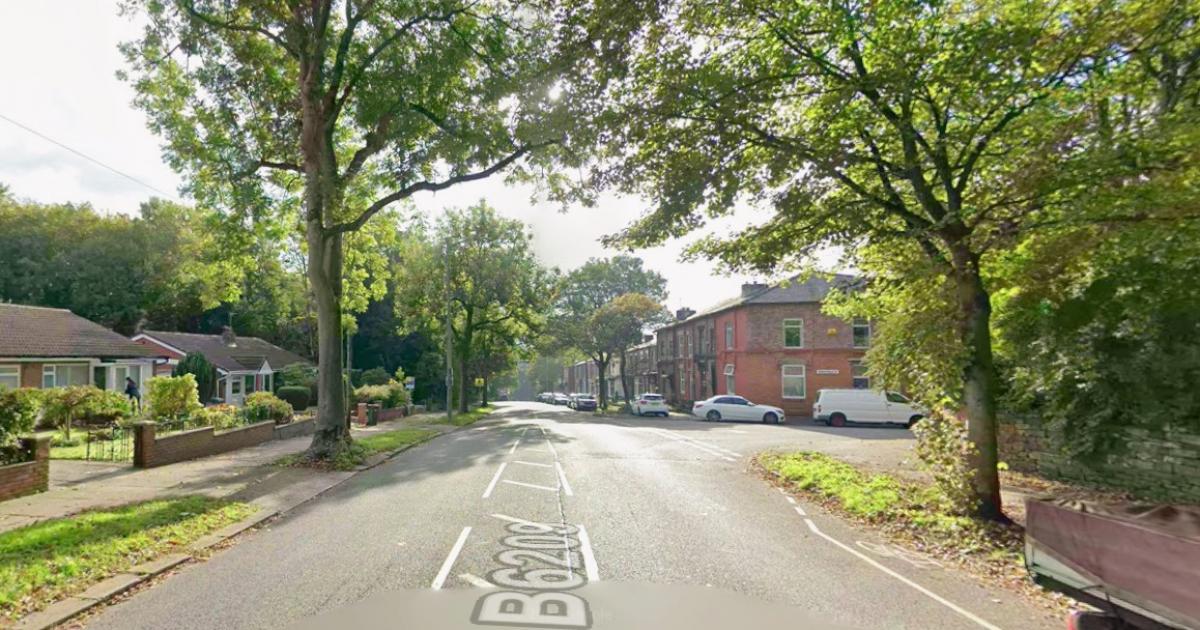
The 73-year-old was at his home address on Radcliffe Road and police are asking for help tracking down his family.
GMP posted the appeal on social media, which they often do to help trace the relatives of people who have died before establishing a cause of death.
Advertisement
In UK law, there is no legal definition of “next of kin”, but it is usually understood to be the closest relative, whether a partner, parent, child or sibling.
Once the police have the details that they need, they will be passed along to the Coroner’s Office to let full cause of death be established.
They’ve asked anyone who might have information to contact the Police Coroner’s Office on 0161 856 4687.
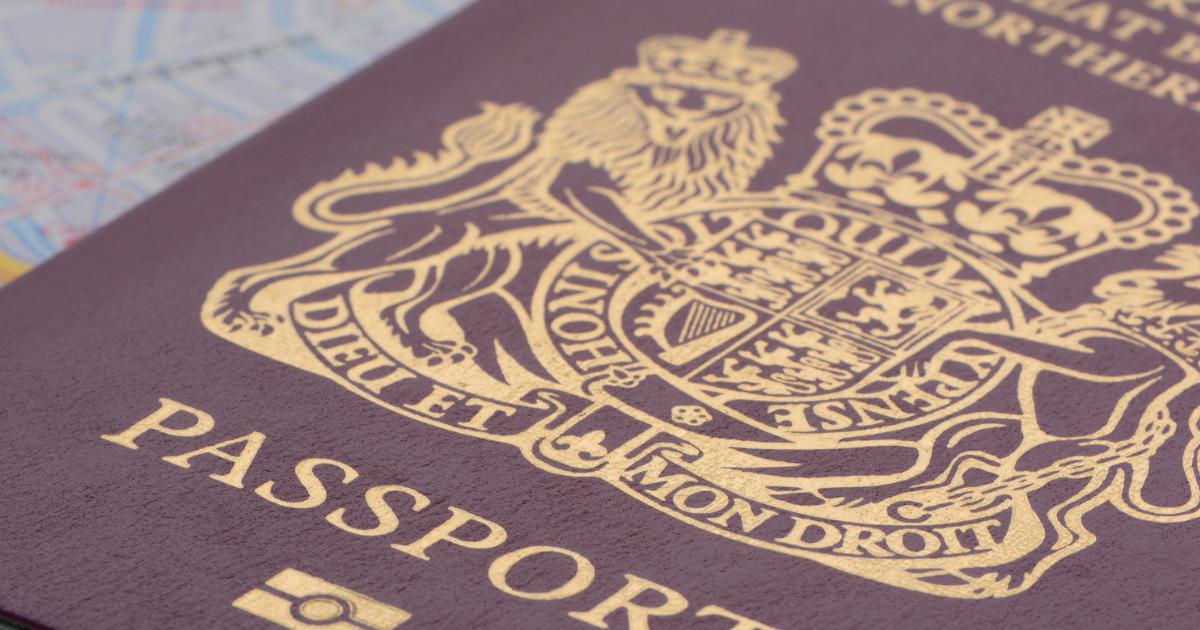
This is because the government has announced an increase to passport fees which, if approved, will come into effect from Wednesday, April 8.
Here’s what we know about the price increase, including how much adult and child passports will cost under the new plans.
Passport fees to increase for Brits from April
Currently, the new fees are waiting for approval from Parliament but the government has shared a first look at what the prices could increase to.
Advertisement
Here are what are thought to be the new prices:
Standard online application:
For adults – £102 (up from £94.50)
For children – £66.50 (up from £61.50)
Standard postal application:
For adults – £115.50 (up from £107)
For children – £80 (up from £74)
A Premium Service (one day) application made from the UK could cost £239.50, up from £222.
A standard online application that’s applied for from overseas could cost £116.50 for adults (increased from £108) and £75.50 for children (up from £70).
— His Majesty’s Passport Office (@HM_Passport) March 13, 2026
Advertisement
If you apply from overseas for a new standard passport by post, you can expect the price to jump from £120.50 to £130 for adults and from £82.50 to £89 for children.
Why are passport fees going up?
The government said: “The new fees will help the Home Office to continue to move towards a system that meets its costs through those who use it, reducing reliance on funding from general taxation.
“The government does not make any profit from the cost of passport applications.
“The fees contribute to the cost of processing passport applications, consular support overseas, including for lost or stolen passports, and the cost of processing British citizens at UK borders.”
Advertisement
Recommended reading:
How long does it take to get a new passport?
The government asks Brits to apply for a passport “in good time before travelling”.
It added: “In 2025, where no further information was required, 99.7% of standard applications from the UK were processed within three weeks.”
What do you think of the proposed new passport fees? Let us know in our poll above or in the comments below.
Joe Sugg and Dianne Buswell have shared a little explanation of their son’s name after they revealed they had become first-time parents.
The Strictly Come Dancing stars have delighted their friends and fans by announcing the birth of their first child. It was in September last year that Joe and Dianne revealed they were expecting a baby boy.
The couple, who met and fell in love while taking part in the BBC One dance contest in 2018, shared an adorable announcement video on Instagram, which was set to the iconic Elton John track, Tiny Dancer, and told their loyal following: “Our little baby boy [heart emoji]. We cannot wait to meet you.”
It was then on Wednesday (March 18) after keeping their fans and followers updated throughout their journey to becoming mum and dad that Dianne and Joe confirmed the arrival of their baby boy.
Advertisement
Taking to Instagram, Joe led the announcement by sharing the first pictures of their son, one of him swaddled in a cot and wearing a knitted blue hat, alongside another of him bonding with his mum and a third in which Joe could be seen carrying him out of the hospital in his car seat.
Joe captioned the post, which was also reshared by Dianne: “Never felt a love like it,” before adding: “Baby Bowden Mark Richard Sugg,” with the date 16/03/26, confirming he was born on Tuesday.
The congratulatory messages soon came flooded in from Dianne’s Strictly co-stars, their famous pals and their fans. But Joe and Dianne were quick to address one detail about their new bundle of joy.
Taking to their Instagram Stories, the pair shared another photo of baby Bowden, in which they could be seen taking his tiny hand into theirs. It was alongside the snap that Joe wrote an explanation about their son’s name, as he shared: “Bowden Sugg (pronounced Bow like How not Bow like Row… Hopefully that makes sense [crying laughing emoji]).”
And fans have been sharing their reaction to Dianne and Joe’s chosen name, and spotted the significance of both his middle names and his birth dates. @scdjoanne said: “I am just now learning that joe grew up in a cottage at 1 bowden hill lacock and i have a little tear actually because that’s really beautiful to name their child after his childhood.” @ultimatesugg replied: “Also Richard after grandad chippy and of course Mark.”
@strictlylmx commented: “What is life joe and Dianne have a baby that was born on the 16th,” to which @Edensmith1122 replied: “I also don’t know what the 16th means,” and the original poster said: “Joe and Dianne announced they were together on the 16th and it kinda became a big deal.”
Advertisement
As mentioned, the congratulatory messages to come flooding in, especially from Dianne’s Strictly co-stars. Gorka Marquez replied: “OMG!! Congrats to you both !!!” Vito Coppola gushed: “Oh Finally. Bello di zio.I am so so happy. Crying for joy and happiness. Uncle Vito cannot wait to meet you. Love love love. Bellissimo a zio.”
Katya Jones replied: “He’s just perfect!!!! Congratulations to the pair of you.” Alexis Warr shared: “So precious! Congratulations!!” Anton Du Beke posted: “Congratulations my loves.” Neil Jones penned: “Honestly congratulations. He’s so cute and I can’t wait to meet little baby Bowden.” Nikita Kuzmin wrote: “Congratulations that’s so so amazing. That’s the best and most special thing in the world. Love love love to you!!! Karen Hauer added: “Congratulations !! So beautiful.”
Meanwhile, some also shared the special news with their own followers. Resharing Dianne and Joe’s post to her Instagram Story, Amy Dowden said: “So happy for you both! Isn’t baby Bowden perfect! Can’t wait for cwtches @diannebuswell @joe_sugg.” Alexis also shared: “So very precious! Congratulations @diannebuswell @joe_sugg.” Carlo Gu posted: “My heart is melting!!!” while Strictly 2025 contestant George Clarke also shared the post with a string of heart emojis.
With the Senedd (Welsh parliament) election due in May, Wales faces a test of whether long-term thinking can survive short-term political pressure.
In 2015, Wales made a bold move. Through the Well-being of Future Generations Act prevention was written into Welsh law, requiring public bodies to consider how today’s decisions shape the wellbeing of future generations.
It requires them to set wellbeing objectives, work across organisational boundaries and prioritise prevention over short-term reaction. Success is measured not only through economic growth but through health, equality, environmental resilience and strong communities.
Take Sian, aged 41, who lives in Swansea and was one of the participants in our recent study. She works full time, has two children, doesn’t sleep enough and had stopped exercising. After rising blood pressure and a health scare, she was introduced to a local community coordinator.
Advertisement
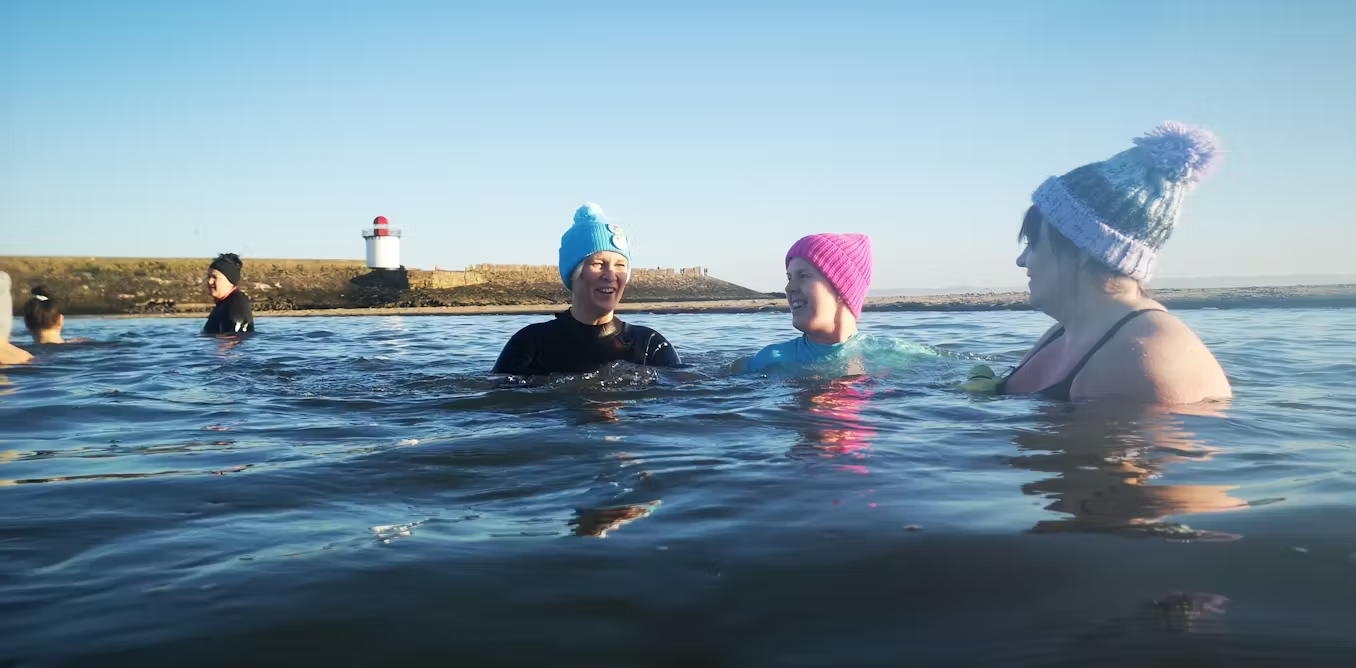
They met for coffee, then walked to a small Sunday sea swim. The first time, the coordinator went into the water with her. Sian was hooked. Through the group she met other women. She now helps organise the swims, and her children go to the beach in all weathers. What began as a referral became part of her life and community.
What shifted was not just her blood pressure, but her connection to movement, people and place. Our research on local area coordination suggests this relationship-centred support can strengthen wellbeing, confidence and social ties before problems escalate into crises.
If this type of preventive work is scaled back, crises may become more frequent and costs may rise, leading to further pressure on hospitals and social care. Health and social care already consume more than half of the Welsh government’s budget. With services stretched and more people living longer with complex needs, that path is not sustainable.
Politically fragile
Passing a law is one thing. Changing how an entire system behaves is another. Politics naturally pulls towards the immediate. Election cycles are short and budgets are set year by year. Members of the Senedd must respond to urgent concerns from voters. Visible problems demand visible progress.
Advertisement
Prevention, by contrast, produces quieter results that often emerge slowly and may not appear within a single parliamentary term. Implementation is also hard. Frontline services and staff are stretched. Legislation can set direction, but embedding change in strained organisations requires sustained backing, culture change and investment.
Public attention follows the same pattern. When uncertainty rises, attention narrows. Waiting lists, rising living costs and visible migration are immediate and emotionally charged. Policies designed to reduce future risk can feel abstract by comparison.
Psychological research helps explain this. Studies suggest that when people feel under threat, they look for stories that explain what is happening and who is responsible. These narratives can restore a sense of control, but they may also simplify complex problems into clear lines of blame.
For a policy built around prevention, this creates a difficult political environment. Polarised debate tends to reward immediate fixes and simple villains rather than the slower work of building the conditions that allow people to stay well.
The wellbeing approach takes a broader view of health. Rather than seeing health solely as an individual responsibility, it recognises that wellbeing is shaped by social and environmental conditions. In other words, safe neighbourhoods, strong communities and access to nature.
International evidence suggests that investing earlier in community support can reduce pressure on crisis services. Wales is now exploring a similar redesign, but it will require leadership support and investment.
Research published in 2023 that had followed Welsh communities over a decade found better mental health in greener neighbourhoods, particularly in more deprived areas. Access to nature improves wellbeing directly and can also strengthen people’s sense of connection to the environment, which in turn encourages more sustainable behaviour.
These insights are already influencing local initiatives. Our work has embedded neurorehabilitation – support for people recovering from brain injury or neurological illness – into everyday community life through partnerships between health services and local organisations.
Advertisement
Ecotherapy programmes have been developed through relationships with locally valued initiatives, including community farms and a surfing charity that works with the coastline as part of recovery.
The aim is a shift from simply fixing what is “wrong” to rebuilding agency, purpose and connection. These are all factors linked to resilience and reduced demand on services over time.
Our work also incorporates “biophilic” design – architecture that integrates greenery, natural light and outdoor spaces into buildings – into social housing developments. This work is re-imagining preventive health by bringing nature into our cities, offering residents an opportunity to reconnect to nature, tend to community gardens and grow their own food.
Advertisement
The goal is what we refer to as “sustainable wellbeing”, which means improving health while also nurturing the skills and mindsets needed for a more sustainable future.
Wales is making decisions amid overlapping crises, including widening inequality, rising chronic illness and the accelerating effects of climate change. In this context, the Well-being of Future Generations Act is either a framework for building more resilient systems, or a piece of legislation that is often praised but rarely followed.
Governments ultimately decide whether prevention is protected when finances tighten. But voters shape those choices too. A question facing this Senedd election is whether the Act continues to guide party manifestos, budgets and service design, or slips behind the pressure for immediate solutions.
On May 7, Wales will not only choose its representatives. It will also decide whether the wellbeing of people – and the planet they depend on – remains at the heart of public decision-making.
More than a million people in Lebanon have been displaced and over 900 killed as Israel intensifies its offensive against the militant group Hezbollah.
Israel says those displaced from southern Lebanon will not be allowed back to their homes until the IDF has dismantled Hezbollah’s infrastructure in the region.
The latest round of violence erupted on 2 March when the group launched missiles into northern Israel in support of its ally, Iran, which had come under US-Israeli attack four days earlier.
Israel responded with full force, launching hundreds of strikes across Lebanon, mostly concentrated in southern Lebanon.
Advertisement
But there have also been many strikes on the Lebanese capital, Beirut, including the southern suburb of Dahiya – a Hezbollah stronghold, but also densely packed with civilian residents.
These strikes have coincided with a sweeping evacuation order covering almost half of the capital.
Datawrapper
This content is provided by Datawrapper, which may be using cookies and other technologies.
To show you this content, we need your permission to use cookies.
You can use the buttons below to amend your preferences to enable Datawrapper cookies or to allow those cookies just once.
You can change your settings at any time via the Privacy Options.
Unfortunately we have been unable to verify if you have consented to Datawrapper cookies.
To view this content you can use the button below to allow Datawrapper cookies for this session only.
And in southern Lebanon, the IDF has ordered the evacuation of everyone living south of the Zahrani river – the largest evacuation order issued by the Israeli military in recent history.
Datawrapper
This content is provided by Datawrapper, which may be using cookies and other technologies.
To show you this content, we need your permission to use cookies.
You can use the buttons below to amend your preferences to enable Datawrapper cookies or to allow those cookies just once.
You can change your settings at any time via the Privacy Options.
Unfortunately we have been unable to verify if you have consented to Datawrapper cookies.
To view this content you can use the button below to allow Datawrapper cookies for this session only.
Sky News estimates that the area covered by the evacuation orders was previously home to two million people – or a third of Lebanon’s population.
Advertisement
At least two bridges across the Litani river have been destroyed in recent weeks, despite the need for civilians to cross it to comply with the IDF’s evacuation orders.
On 18 March, the IDF announced that it would begin striking the remaining bridges, which it alleged were being used by Hezbollah to transport soldiers and combat equipment.
“The orders have come with terrifying force, and there is panic,” says international human rights lawyer Geoffrey Nice KC.
“The panic is your responsibility if you’re the one that’s ordering them to leave.”
Advertisement
“It seems to me there’s quite a lot of evidence to say this is unlawful,” he adds.
“We are following international law and doing everything we can to avoid harm to civilians,” an IDF official told Sky News.
Israel may be planning to stay
Israeli defence secretary Israel Katz said on 18 March that those fleeing southern Lebanon will not be allowed to return to the area south of the Litani river “until the safety of the residents of the north [of Israel] is guaranteed”.
Advertisement
Under a 2006 UN resolution, the only armed groups allowed to operate south of the Litani river are the Lebanese armed forces and UN peacekeepers.
Datawrapper
This content is provided by Datawrapper, which may be using cookies and other technologies.
To show you this content, we need your permission to use cookies.
You can use the buttons below to amend your preferences to enable Datawrapper cookies or to allow those cookies just once.
You can change your settings at any time via the Privacy Options.
Unfortunately we have been unable to verify if you have consented to Datawrapper cookies.
To view this content you can use the button below to allow Datawrapper cookies for this session only.
Israel says that by removing Hezbollah from this region, it is seeking to enforce the UN resolution.
Advertisement
Last year, Mr Katz said Israel would also maintain a “security zone” inside Lebanon for the foreseeable future.
Since 2024, the IDF has maintained at least five bases on the Lebanese territory.
Candice Ardiel, spokesperson for the UN’s peacekeeping mission in Lebanon (UNIFIL), told Sky News that the existence of these bases is a “clear violation” of the 2006 resolution.
An IDF official told Sky News that “Israel kept to that agreement until Hezbollah started attacking our civilians”.
Advertisement
Satellite imagery shared with Sky News by the London-based Centre for Information Resilience suggests three additional bases may have been constructed in recent months.
Datawrapper
This content is provided by Datawrapper, which may be using cookies and other technologies.
To show you this content, we need your permission to use cookies.
You can use the buttons below to amend your preferences to enable Datawrapper cookies or to allow those cookies just once.
You can change your settings at any time via the Privacy Options.
Unfortunately we have been unable to verify if you have consented to Datawrapper cookies.
To view this content you can use the button below to allow Datawrapper cookies for this session only.
Mr Katz has said that the IDF’s goal in the current war is to “take control of additional strategic positions in Lebanon”.
Advertisement
In early March, the country’s opposition leader, Yair Lapid, called for this expanded security zone to be “an area with no Lebanese villages in it”.
“It might be unaesthetic perhaps, or unpleasant, to scrape away two or three Lebanese villages, but they brought it upon themselves,” he told i24 News.
Many are experiencing displacement for the second time
When Sky News visited Beirut on 12 March, our team found people sleeping in tents and cars near the port.
Advertisement
Advertisement
Beachfront hit as Israel bombards Beirut
“People are leaving very fast when evacuation orders are announced,” says Carolina Lindholm Billing, Lebanon representative for the UN’s refugee agency (UNHCR).
“They just get in their car without even collecting some extra clothes or belongings, out of fear of being there when aerial strikes begin. And one reason, many say, is that they experienced the same in 2024.”
Before the latest round of hostilities, more than 64,000 people were still displaced from the last major escalation in 2024, according to the International Migration Observatory.
Advertisement
Despite a ceasefire signed in November 2024, many have been unable to return to their homes due to frequent Israeli strikes.
Others have had no homes to return to, with some border towns like Aita Al Chaab almost destroyed.
The video below, shared on 17 March, shows the IDF demolishing several houses in the town, much of which is already in ruins.
Satellite imagery taken in November shows that 91% of buildings in the town centre had already been destroyed by that point.
An Israeli military official acknowledged to Sky News that the IDF was responsible for widespread destruction in the area, but insisted it only targeted buildings used by Hezbollah.
When Sky visited Aita Al Chaab in December, the few remaining residents told us they wanted to rebuild – but IDF strikes on construction equipment made it impossible.
Human Rights Watch, a US-based international rights group, described the strikes on reconstruction equipment as “systematic”.
Advertisement
“They don’t allow anyone who’s building or wants to settle back in Aita Al Chaab,” said cafe owner Nehmeh Mahmoud Al Zein.
“If you have a problem with Hezbollah, go sort it with Hezbollah. It’s not our problem – we’re civilians here and we’ve got nothing to hide.”
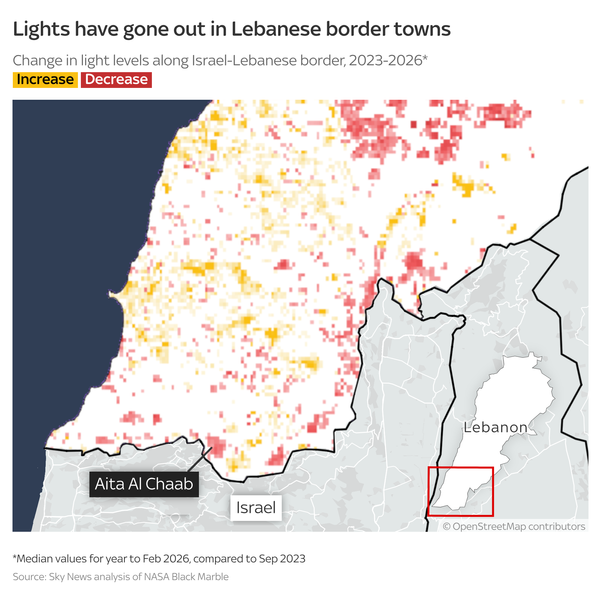
The scale of the depopulation along the border can be seen from space, with a marked decrease in light levels visible in night-time satellite imagery.
The map below shows the change, with decreases highlighted in red. Right along the border with Israel, the lights in Lebanese towns have dimmed.
Advertisement
Concerns about the use of white phosphorus
Since October 2023, Sky News has interviewed dozens of residents of southern Lebanon who say they have seen white phosphorus being sprayed on their crops, farmland and houses.
The video below, first shared on 15 March and verified by Sky News, shows an IDF operation in southern Lebanon.
Amael Kotlarsk, a weapons expert at defence intelligence company Janes, told Sky News that the substance is white phosphorus.
The chemical is used by militaries to create smokescreens or for illumination, as above, but can also start fires, damage crops and cause severe burns.
Its indiscriminate use in populated areas is illegal under international law.
Advertisement
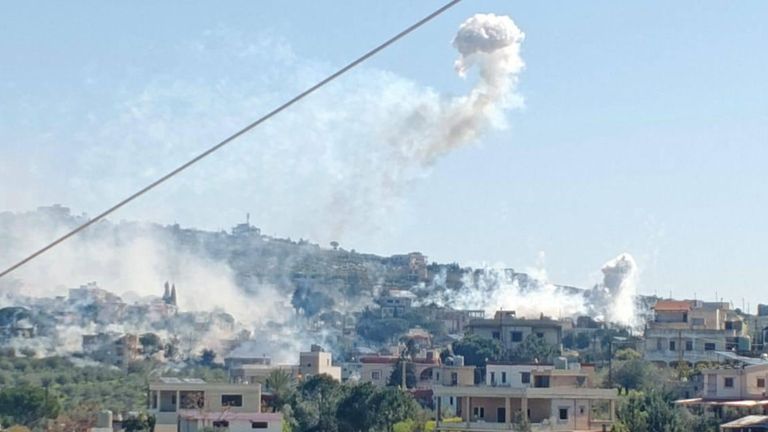
The photograph below, verified by Sky News, shows a white cloud enveloping buildings in the town of Yohmor on 3 March. Human Rights Watch says it has confirmed that the substance is white phosphorus.
Image: A white cloud rising over the town of Yohmor, Lebanon on 3 March, 2026. Human Rights Watch says the substance is white phosphorus. Pic: Islamic Health Committee
Human Rights Watch previously documented widespread use of white phosphorus by the IDF in Lebanese border towns in late 2023 and early 2024.
When asked by Sky News, the IDF did not deny using white phosphorus during recent operations in Lebanon but said it always does so in a way that “complies with and exceeds the requirements of international law”.
Ramzi Kaiss, Lebanon researcher at Human Rights Watch, tells Sky News the use of white phosphorus in populated areas risks damage to homes and agricultural lands.
“I think the use of white phosphorus now is another tactic that is pushing people out of those towns or making it much harder for them to return,” he says.
Advertisement
The Data and Forensics team is a multi-skilled unit dedicated to providing transparent journalism from Sky News. We gather, analyse and visualise data to tell data-driven stories. We combine traditional reporting skills with advanced analysis of satellite images, social media and other open source information. Through multimedia storytelling we aim to better explain the world while also showing how our journalism is done.
These agents, Microsoft’s national security officer Jo Miller tells Metro, are common on personal and work phones and laptops alike.
‘We might choose to download some tools beyond Copilot, for example,’ she says of Microsoft’s AI model.
Advertisement
‘Some might be developed by Western companies, others elsewhere that have a different lens on how AI should be used and data protected.
‘If I choose to download three more, maybe an image generator or a research agent, I can’t have the same confidence in where these tools come from – they could be harvesting my data, selling it, misusing it and playing it back as misinformation or disinformation.’
What can shadow AI agents do?
The computer giant found that many bosses are confident in tackling shadow AI threats (Picture: Cheng Xin/Getty Images)
Microsoft’s survey of 1,000 major public and private sector bosses, conducted in January, shows that bosses are quickly trying to get their heads around new-fangled tech like AI agents.
At least 62% of organisations are already deploying autonomous AI agents, almost tripling from 22% last year.
As much as shadowy AI agents are in the back of their minds, 68% expect agents to be fully integrated across their organisation within a year.
Advertisement
Microsoft says that as employees rush to embrace AI agents, they are creating security blind spots that bosses are addressing.
Most mainstream AI agents, Miller explains, have a level of autonomy held back by corporate guardrails – they won’t go off the rails, in other words.
But these agentic tools can be exploited by cyber criminals or ‘hostile nation states’ to conduct cyber attacks, ransomware attacks, data theft and IP theft, actions typically described as ‘adversarial’.
What do companies itching to use AI agents need to do to keep us safe?
Microsoft found that 86% of leaders are employing AI agents for security challenges, though 80% worry about managing agents at a large scale.
Advertisement
As the race is on to embrace these futuristic-sounding machines, 85% believe deployment is progressing faster than oversight approaches were built to support.
Nevertheless, 87% told Microsoft they’re confident they can prevent shift AI tools from being created or used.
Security experts told Microsoft that they should have three priorities:
Maintain visibility over where AI agents are operating (50%)
Integrate agents safely into existing systems and processes (50%)
Meet compliance, risk and audit requirements as autonomous activity expands (49%).
By ‘hostile nation states’, also called nation-state threats, Miller means groups tied to countries with not the best intentions.
Advertisement
Think pro-Russia groups amid Moscow’s war against Ukraine, with Miller saying there has been a rise in cyber attacks over the last four years.
AI agents used at work can sometimes be fully integrated – embedded in email services, slideshow software and other apps.
‘If I bring in another tool that will sit just outside our platform, I don’t know what back doors there might be to exfiltrate data,’ Miller says.
She adds: ‘We really need to be really deliberate and clear about what tools we’re downloading and using.
Advertisement
‘We don’t truly know where data might be going if we don’t understand the security parameters around a particular tool.’
AI-powered cyber threats have risen during the Russia-Ukraine war (Picture: REUTERS)
What should you do about shadow AI?
The main thing, according to Miller, is to only use AI tools you can trust.
‘Like by a known vendor or supplier,’ she adds, ‘that’s well-established and has published information around how secure they are.’
‘There’s an element of faith or trust we place in AI, but we need to remember these tools are designed around the human brain.
‘So, in the same way a human brain misremembers, the same way the brain is not always factually correct, these models will not always be correct.
Advertisement
‘Humans in the loop adds a level of accountability and an assurance of output.’
Muslims across Wales are expected to celebrate Eid ul-fitr marking the end of Ramadan
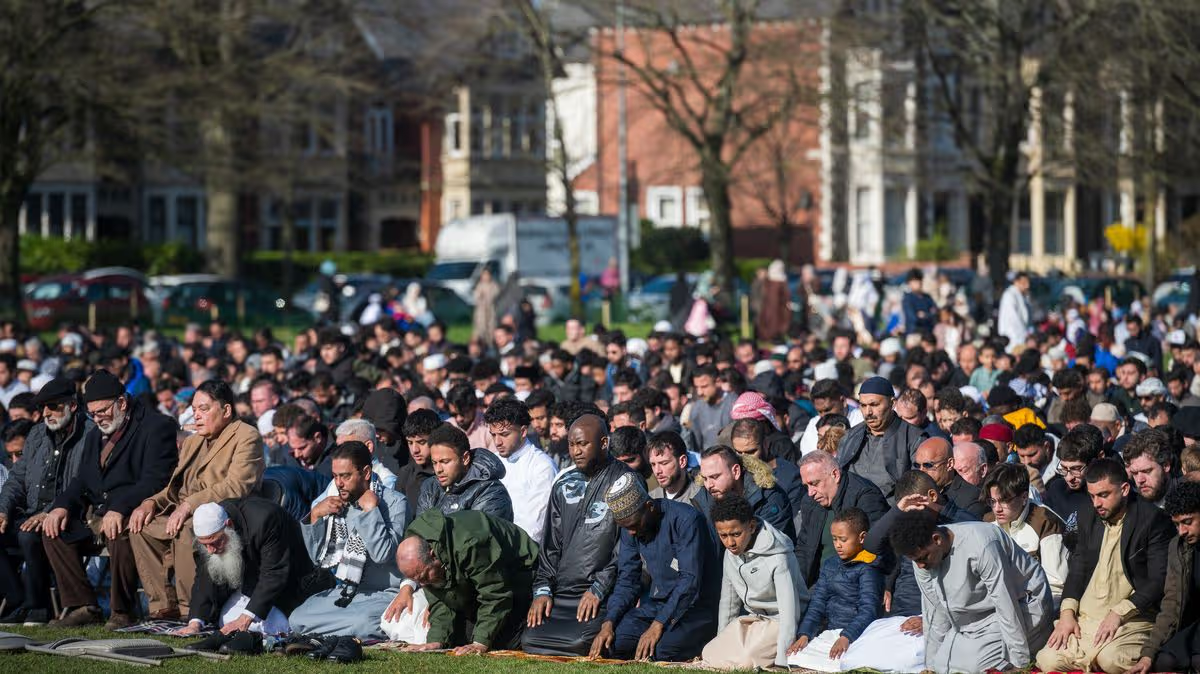
Hundreds of people across Cardiff are coming together this week to celebrate Eid with a large open-air prayer in the city. The moon sighting took place on Wednesday, March 18, and with Saudi Arabia confirming that the crescent was not visible, Muslims following the ruling of Saudi Arabia, will complete a 30-day Ramadan and are expected to celebrate Eid on Friday.
Advertisement
Two Cardiff mosques, Dar Ul Isra Mosque and Al-Manar Centre, are hosting an Eid prayer at Blackweir Fields on the morning of Friday, March 20, at 9.30 am.
Both Dar Ul Isra Mosque and Al-Manar Centre are well-established parts of Cardiff’s Muslim community, based in the Cathays area. Stay in the know by making sure you’re receiving our daily newsletter
They serve a large and diverse population and play a key role throughout the year, hosting daily prayers and community events, as well as providing educational and charitable initiatives.
The event follows a similar gathering last year at Roath Recreation Ground, which drew hundreds of people from across Wales to mark the end of Ramadan together.
Advertisement
Eid is one of the most important dates in the Islamic calendar and marks the end of Ramadan. It is typically celebrated with a special morning prayer, followed by time spent with family and friends, as well as acts of charity.
The exact date of Eid is determined by the sighting of the new moon, meaning it can vary depending on where in the world it is observed.
Because of this, some communities in the UK follow announcements made in Saudi Arabia, where the holy cities of Mecca and Medina are located, while others rely on local sightings.
Advertisement
Despite potential differences in timing, the celebrations bring communities together, with a strong turnout expected in Cardiff as people gather once again to mark the occasion.
Eid ul-Fitr marks the end of Ramadan, the Islamic holy month of fasting. This year, Ramadan began on the evening of Tuesday, February 17, with Muslims around the world fasting from dawn until sunset throughout the month.
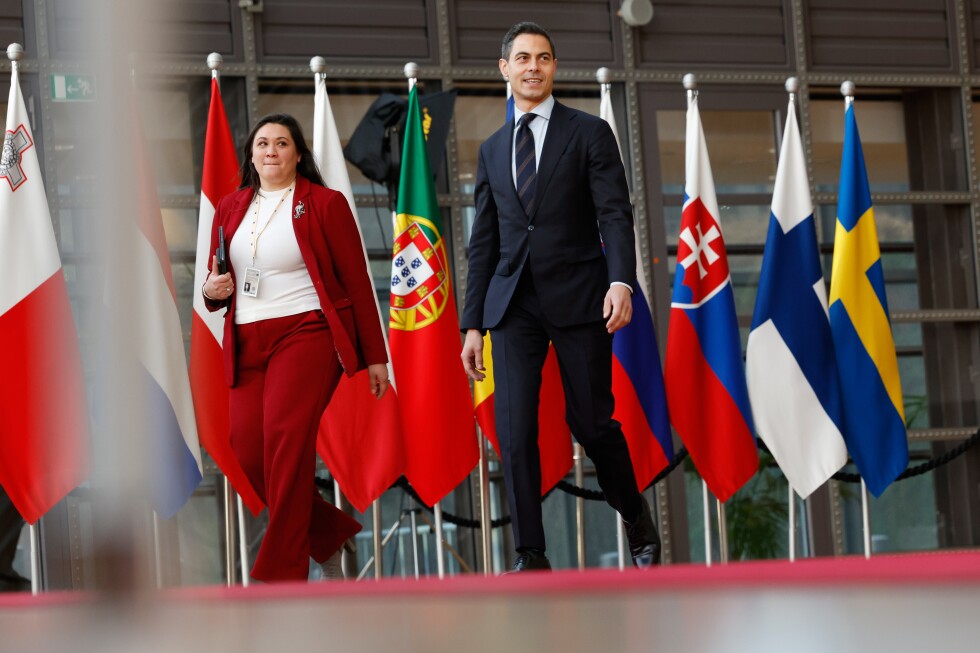
BRUSSELS (AP) — Leaders from across the European Union are meeting Thursday to grapple with rising oil and gas prices caused by the war raging across key energy producers and shipping lanes in the Middle East.
Many of those leaders have deflected entreaties by U.S. President Donald Trump to send military assets to secure the Strait of Hormuz, a key waterway for the global flow of oil, gas and fertilizer. Rising energy prices because of the war and fears in Europe of a new refugee crisis have pushed leaders to make the Middle East a priority at the summit.
“We are very worried about the energy crisis,” said Belgian Prime Minister Bart De Wever ahead of the European Council summit of 27 leaders of European Union nations. He said that energy prices were too high before the war, but that the conflict “created another spike.”
“If that becomes structural, we’re in deep trouble,” he said. “At a European level, some measures can be taken to address the problem of the high energy prices.”
Advertisement
The European Commission has told leaders it has a mix of financial instruments that member nations could deploy to lower energy prices, which will be up for discussion. No single policy will likely work to blunt the economic shocks from the war across the bloc’s myriad markets from Romania to Ireland.
European leaders have struggled to take a firm stance on the fighting in Iran and Lebanon. While they have been critical of the Iranian government, they have not provided military support.
“This is a war that was started by the United States and Israel against Iran on reasons that I can understand because the Iranian regime is brutal not only for its own people, but also for the broader region and a security threat for Europe,” said Dutch Prime Minister Rob Jetten.
“But it’s not a war that we are part of,” he said, calling for more sanctions on Iran and support for opposition groups.
Video has emerged of the Ireland centre watching the end of the France v England game on a phone in Dublin
Footage has emerged of Ireland star Bundee Aki’s reaction to losing the Six Nations on the final kick on Saturday night.
Advertisement
Having beaten Scotland in Dublin to seal the Triple Crown earlier on Super Saturday, Andy Farrell’s side were relying on England to beat France in Paris to hand them the title as well. Remarkably, Steve Borthwick’s side found themselves leading 46-45 in the dying seconds after a dramatic 80 minutes.
However, Thomas Ramos’ last-gasp penalty snatched victory for the hosts with the final kick of the tournament – denying Ireland any title celebrations as well.
It capped the end of a lengthy wait for the Irish in Dublin.
Many Irish journalists had stayed in the Avivia Stadium to watch the end of France’s match – which ended just over six hours after Ireland’s match had finished.
Advertisement
However, that seemingly wasn’t the case for the Irish players.
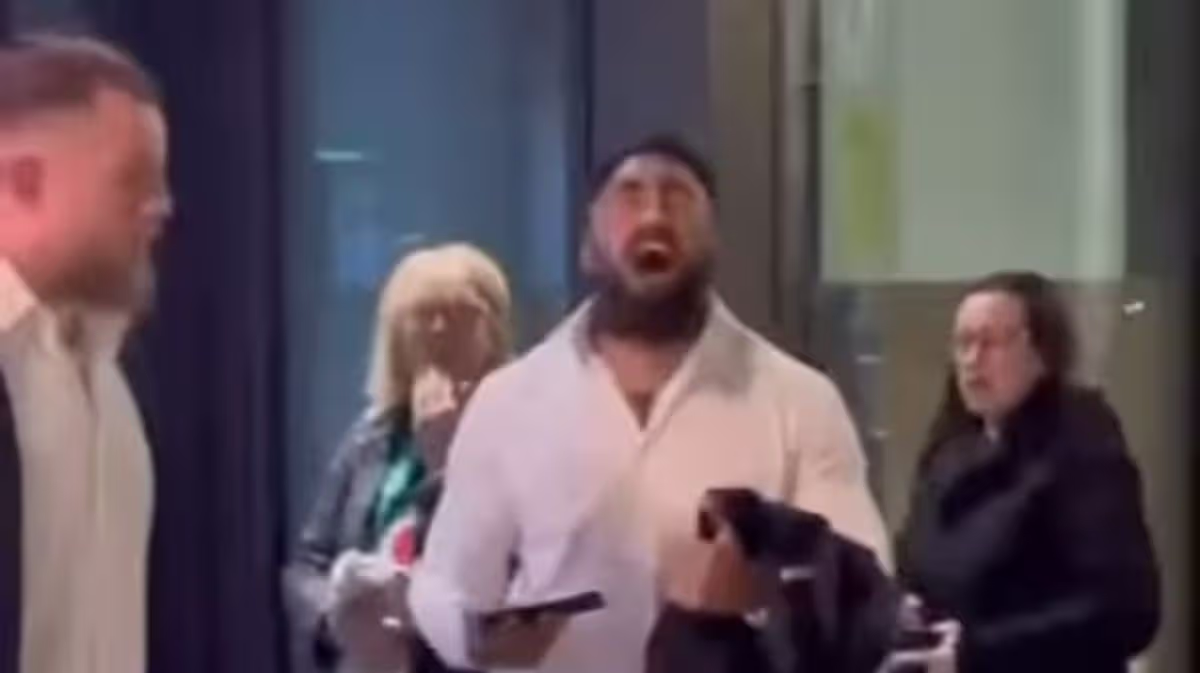
A video has been posted on Instagram of Irish duo Aki and Finlay Bealham watching the game on a phone outside of Pitch on Dawson Street in the Irish capital.
As one group of fans watch Ramos’ kick sail through the posts on one phone, the camera pans to Aki and Bealham seeing their title hopes ended.
The British and Irish Lions centre simply reacts by shouting “F**k”, before the two go on with the rest of their night.
Advertisement
Warning: Strong language in the video
Content cannot be displayed without consent
Many supporters revealed they were left feeling the exact same way late on Saturday night following the dramatic end to the Six Nations.
“We couldn’t say it better ourselves Bundee!” replied one comment on Instagram.
“Aki speaking on behalf of the nation,” said another.
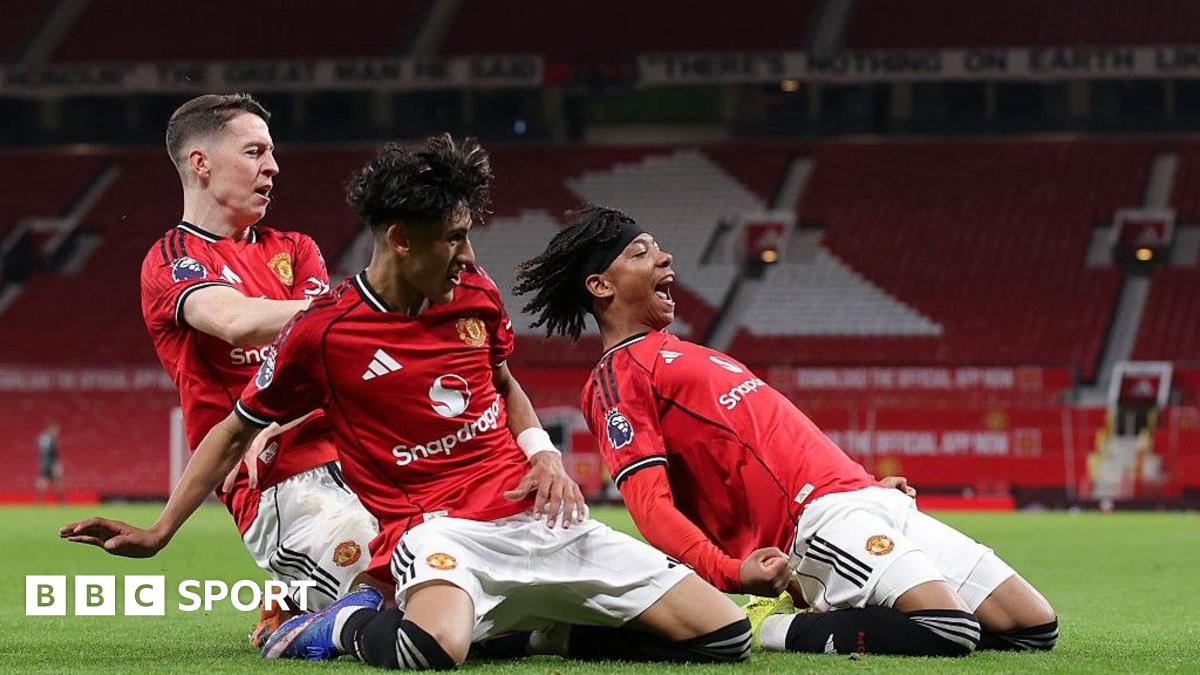
Manchester United’s fans won’t have a chance to see JJ Gabriel in Premier League action at Old Trafford this season, so a good proportion of the 2,516 who saw him feature in the 3-2 FA Youth Cup win over Sunderland made sure they got their selfies.
As he only celebrated his 15th birthday in October, Gabriel currently falls foul of the Premier League regulation that players must be 15 by 31 August of the season in question to be allowed to play. In other words, they have to be in Year 11 at school.
That is what makes Gabriel such a special talent.
Despite being a Year 10 in school terms and, physically, much smaller than the vast majority of the players he is playing with and against, he still tends to stand out.
Advertisement
The victory against Sunderland that earned United an Old Trafford semi-final with Crystal Palace, who they also meet in the Premier League Under-18 Cup final at Selhurst Park next month, wasn’t his best performance.
But he still produced a couple of magical moments. There was the first-time lay-off to Chido Obi in the first half that really should have led to United going in front. There was the perfectly weighted pass to Junior Brown that was smashed home superbly for the winner.
More thrillingly, there was the dazzling two-footed manoeuvre that took him into a shooting position at the end of the game.
That’s why those fans were after their selfies at the end. It is why Gabriel’s name was cheered the loudest when it was read out just before kick-off.
Advertisement
Youth coaches are notoriously reluctant to single out individual players for assessment. They know only too well the pressure they can place on youngsters who have so much growing up and so much development ahead of them.
But, just as with Arsenal’s Max Dowman – the 16-year-old who last weekend became the Premier League’s youngest ever scorer – for Gabriel there is no escaping attention.
In August, he was in the directors’ box with his family for the league opener against Arsenal. In December, he was pictured with Sir Alex Ferguson at the 1-1 draw with West Ham.
These events do not happen by accident. United know they must prove to Gabriel that he should commit his future to them.
Advertisement
They rolled out the red carpet last summer, when technical director Jason Wilcox was part of the delegation that spoke to Gabriel with a sales pitch that kept the Londoner in the north-west.
Nothing that has happened since will dissuade Europe’s leading clubs from thinking Gabriel has talent they would quite like.
He is top of the Premier League Under-18 scoring charts. He has scored 10 goals in his past nine games. In a United side challenging on multiple fronts under coach Darren Fletcher, Gabriel is a stand-out performer.
Ruben Amorim was the first to call him into the senior training squad, even if his response to Gabriel’s presence was lukewarm.
Advertisement
Michael Carrick was also asked about the youngster this week.
Fletcher is probably the best judge though given he has worked with him all season, deciding initially to pick him in a false nine position to give him more space.
He is more natural out wide but Fletcher and others are of the view he is better suited currently to a central position, so his physicality does not become a disadvantage.
“I couldn’t speak highly enough of JJ,” said Fletcher, when asked for his verdict in January.
Advertisement
“He’s got an amazing family and amazing support around him.
“He’s somebody we’re delighted to have at the club.
“There’s a lot of noise around him and deservedly so because he’s a real talented kid.
“He works hard. He loves football. He loves training and playing and he loves expressing himself.
Advertisement
“He has a bright future ahead of him and I’m super excited by his talent. But the most important thing is that he keeps developing because he still has lots to learn.”
This is true, as it is of any player.
But there are also milestones.
Wayne Rooney was at Old Trafford, along with Carrick, as his son Kai was an unused substitute in the game.
Advertisement
Rooney made his senior debut for Everton at 16. He became England’s youngest player when he made his debut against Australia in 2003, aged 17 years and 111 days.
When the 2026-27 season begins on 22 August, Gabriel will be 15 years and 320 days. Although the specific dates are yet to be confirmed, when United enter next season’s EFL Cup, it will be before his 16th birthday, even if, as seems certain, they do not enter until the third round stage as a European qualifier.
Currently, United’s youngest ever player is David Gaskell, a goalkeeper who made his debut when he was 16 years and 19 days. Legendary England international Duncan Edwards (16 years, six months, four days) is third on the list. Angel Gomes is the youngest to play for United in the Premier League era (16 years, eight months, 20 days).
Norman Whiteside (17 years 08 days) is United’s youngest scorer. Federico Macheda was 17 years, seven months, and 14 days when he scored his memorable winner against Aston Villa. He is still United’s youngest Premier League scorer.
Advertisement
Some of those names are proof that being the youngest to achieve something offers no guarantees. Equally, there are others for whom it was genuine confirmation of a rare talent.
For now, Gabriel will carry on doing his thing at the Under-18s. There is plenty for him – and his team-mates – to achieve.
But it won’t be long before his chance at senior level comes. And that is something many are looking forward to.
As Iran’s government buried its fallen heroes, its supporters came out in strength.
Senior security official Ali Larijani was killed in an airstrike two days ago, honoured today along with the crew of the Iranian navy ship sunk by the US at the start of the war.
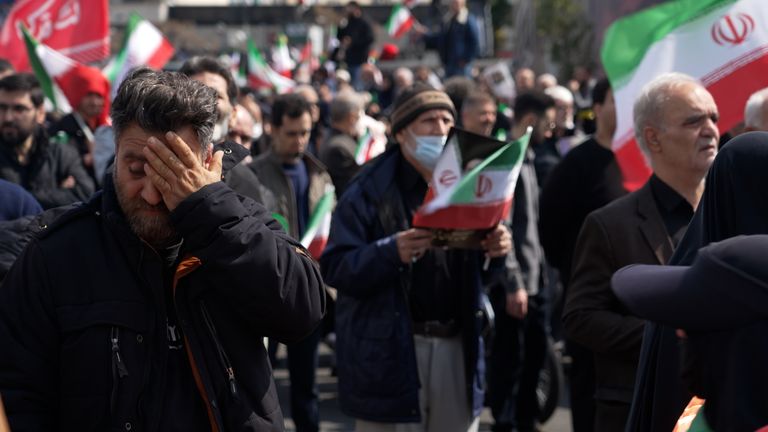
Thousands of mourners gathered for the combined funeral. If you assassinate people whose religion embraces martyrdom, this can be expected.
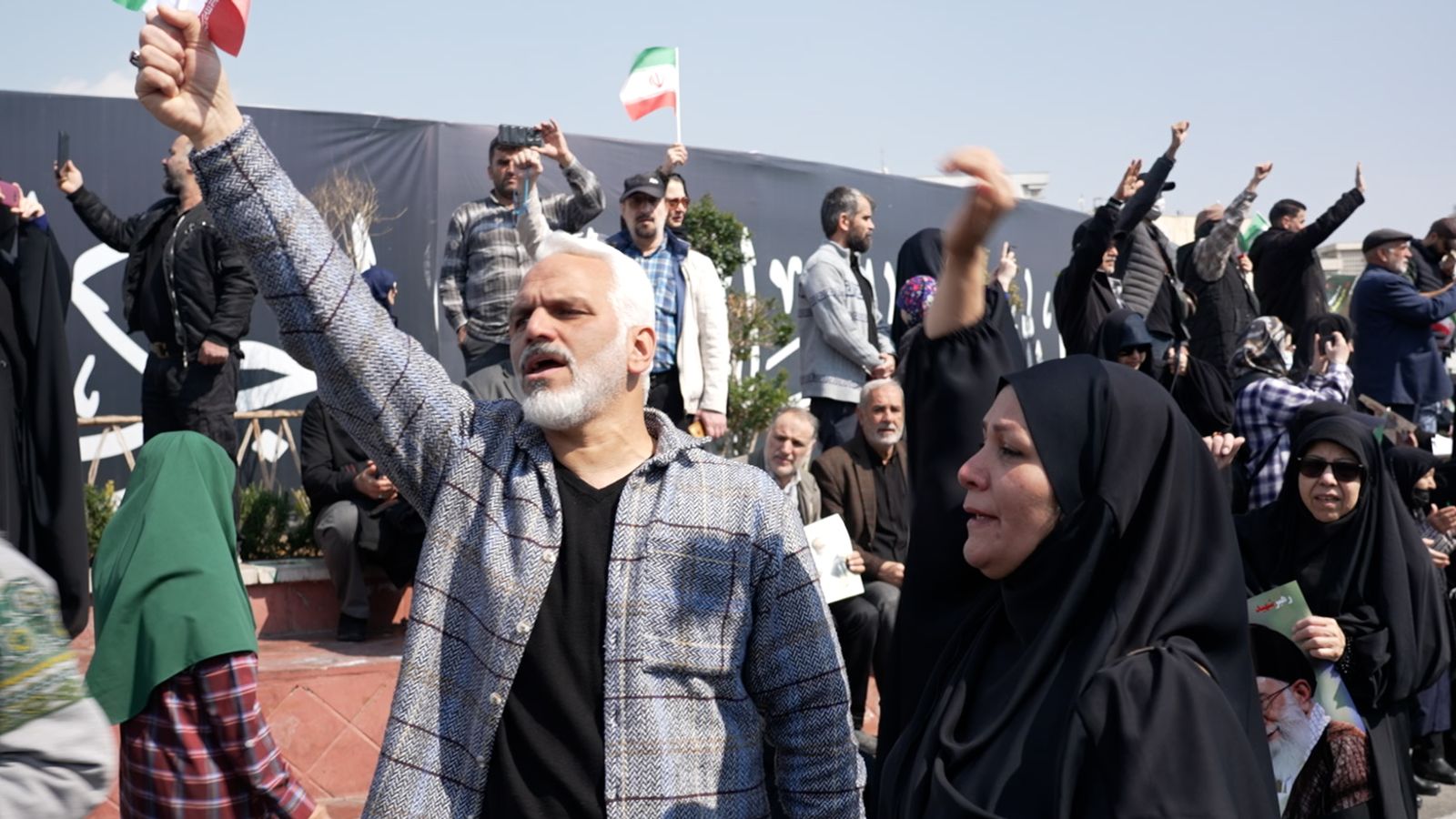
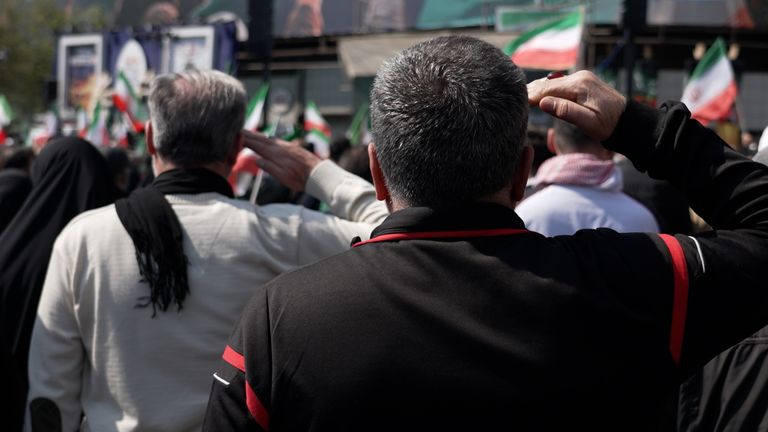
The funeral saw some of the biggest crowds since the war began.
Floats carrying coffins of the slain officials were driven down Revolution Square in Tehran, surrounded by grieving mourners. Women wept holding posters of the former and new supreme leaders.
As it loses leader after leader, Iran’s government still wants to maintain a sense that it can survive and outlast the enemy.
Holding a poster saying “Trump is humiliated”, one man had this message for the US president:
Advertisement
“Trump, soon we will kill you; Netanyahu is not our target anymore, our target is you. You killed our children to mock us and we will kill you to teach you a lesson in history.”
While Israel and America seek regime change in Iran, the scenes today suggest there is still considerable support for its government.
Mohammed and his wife, Hamideh, came with their children to show support. They told me people were united against the US and Israel’s actions.
“The method of our weak enemy martyring him [Ali Larijani] shows its weakness and impotence.
“The way he was killed was very unfair and is unacceptable anywhere in the world.” Mohammed told me.
Advertisement
Iran saw huge protests against the government before the war. Thousands of civilians were killed as well as hundreds of security forces, say authorities.
Opposition groups blamed the authorities for the crackdown, while the government insists the protests were stoked by foreign forces.
What is clear from today’s scenes in Tehran is many support the leadership still, not least because they depend on it for a livelihood.
Israeli airstrike destroys apartment building in Beirut
Sepora, a protester holding a placard with a old Persian poem written on it, explained to me its meaning: “It says, ‘if we are killed, all of us one by one, it’s better than giving our country to the enemy’.
Advertisement
“It is our country, we will not surrender.”
The culture of resistance and no surrender on show in today’s events also highlights the limitations of a strategy aimed at bombing Iran into submission from the air.














































You must be logged in to post a comment Login