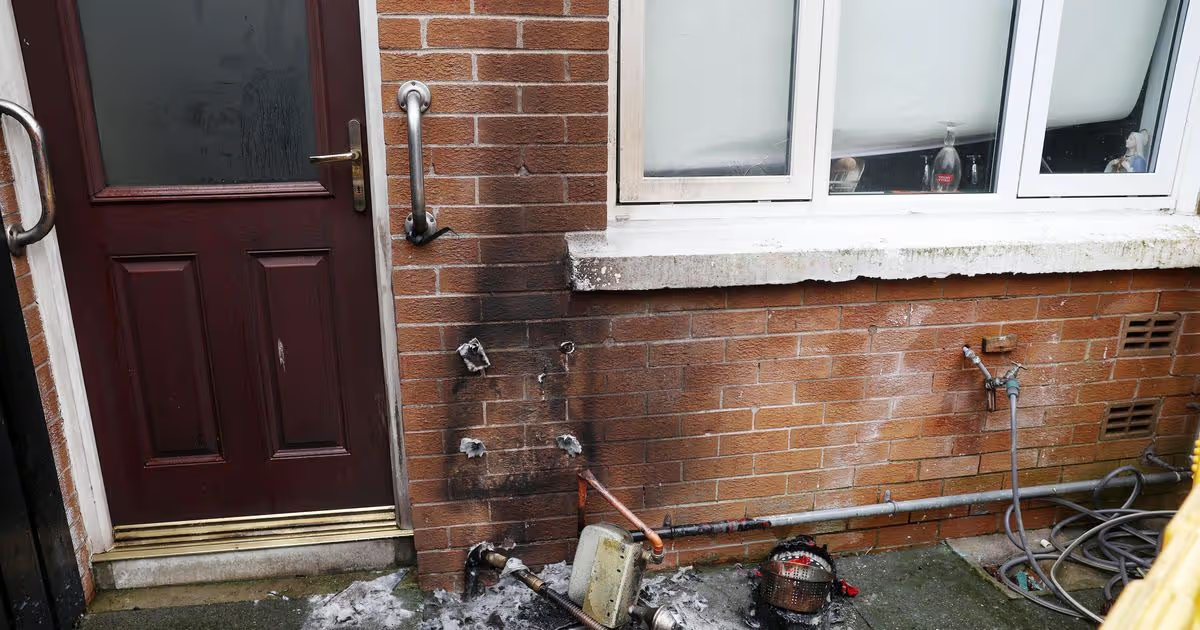
Police say they are treating an incident in Belfast as deliberate ignition and arson with intent to endanger life.
Officers in the south of the city say they received a report at around 4.55am on Tuesday that a gas box had been set alight by two males in the Eliza Street Close area. The males are believed to have made off in the direction of Friendly Street.
Detective Sergeant Long said: “Officers attended the scene, along with colleagues from the Northern Ireland Fire and Rescue Service, who extinguished the fire. Thankfully, no injuries were reported. However, the fire is being treated as deliberate ignition and as arson with intent to endanger life.
“Our enquiries are ongoing, and we would appeal to anyone who saw what happened, or who might have any information, including CCTV, dash-cam or other footage, to contact police on the 101 number, quoting reference 136 of 10/02/26.”
Detective Long added: “Alternatively, you can submit a report online using the non-emergency reporting form or contact Crimestoppers anonymously on 0800 555 111 or online.”
In 18th- and 19th-century Ireland, it was common for courting couples to exchange gifts to mark their developing relationships. Many of these items are familiar gifts today: books, cards, items of clothing, jewellery and sweet treats. Others, however, are less familiar. In fact, some of the gifts exchanged by couples in the past might give many today the dreaded ick – especially those items of the hairier variety.
While you might be familiar with the tradition of mourning hairwork jewellery that was made and worn to remember deceased loved ones in the Victorian era, hairy tokens were traditionally a gift exchanged between couples in love. In my new book, Pious and Promiscuous: Life, Love and Family in Presbyterian Ulster, I explore the tradition of gift-giving among courting couples in Ulster – from hairy tokens to food and clothing. The book reveals for the first time the personal stories that shaped the rituals of Presbyterian family life in 18th- and 19th-century Ulster.
Batchelor’s Fare, Bread, Cheese, and Kisses, by Thomas Rowlandson (1813). Met Museum
Gift-givers thought deeply about what to gift that special someone. Items exchanged in courtship were carefully chosen because different gifts had different meanings. Whereas shirts were understood to symbolise friendship, items like gloves – which covered the hands and fingers – were associated with marriage.
Those on the receiving end also had to consider whether or not to accept these tokens. Accepting a gift from a would-be suitor indicated that the receiver shared their romantic interest. Refusing a gift communicated the opposite. The tradition of gift-giving could also be used to break off relationships. When a relationship failed, people were expected to return any gifts that they had received.
Advertisement
The most special token that a person could gift was their hair. As a physical piece of a person that would outlast their human life, a lock of hair symbolised immortal love. Locks of hair were generally gifted by women to men and sometimes at the request of their male suitors.
Men might write to their beloveds and request that they enclose a lock of hair in their next letter as a token with which to remember them. Locks of hair could be tied into neat plaits and fashioned with a ribbon, enabling the lock to keep its shape. Hair could also be pressed into jewellery or placed in the back of miniatures.
Lock of hair belonging to Miss Hannah McGee, May 1818. Reproduced thanks to the Deputy Keeper of the Records, Public Record Office of Northern Ireland (PRONI) and National Museums Northern Ireland, Ulster Museum, PRONI, D1748/G/802/6.
The recipients of these hairy tokens would engage with them both physically and sensorially. Locks of hair could be rubbed, stroked, sniffed and gazed upon as the recipient thought about the person who had sent it. Given their size, these little hairy tokens could also be secreted inside of clothes and worn next to the heart, or placed under a pillow and slept upon, enabling the recipient to dream of its hairy bestower.
A hairy fetish
Some people appear to have had a real appetite, perhaps even a fetish, for hairy gifts and tokens. Robert James Tennent (1803–80), a middle-class man who came of age in 19th-century Belfast, is one such example. Catalogued among his papers at the Public Record Office of Northern Ireland, Belfast, is an extraordinary archive of hairy treasures, each seemingly representing a woman with whom he had some sort of romantic connection.
What makes Tennent’s collection so intriguing is its size. It contains 14 locks of hair, each wrapped individually in a small handmade envelope. At one time the collection may have been even larger. Among the items is an envelope, now empty, bearing the label “Hair”, which possibly held a lock of hair that has since been lost.
Advertisement
The hair itself varies dramatically in colour, condition and care: wisps of fine blonde hair; neatly tied plaits of brown hair, fashioned with pink string; and unshapen masses of dark hair streaked with grey. The collection also contains a broken ring.
In 2022, I published a paper on Tennent’s hairy treasures in which I theorised that he kept and curated the collection as a trophy cabinet of his past romantic (and sexual) adventures. I argued that the collection served the purpose of a handmade and homemade pornographic archive that Tennent could revisit to transport himself back to pleasured memories and experiences.
Evidence for this view is inscribed in the collection itself. Twelve of the locks are labelled, telling us the name of the woman to whom the hair belonged. We can identify ten women in total. Eleven of the locks are also dated, recording the day, month and year that they were received by Tennent. The collection was assembled between 1818 and 1827, when Tennent was between 15 and 24 years of age.
Tennent’s archiving efforts betray his philandering lifestyle when a younger, unmarried man. There is a considerable overlap in the dates that the different locks of hair were collected. In fact, at least two locks of hair were received into his collection at the same time that Tennent was courting his future wife, Eliza McCracken. The pair were involved in a rather bumpy courtship from 1826, eventually marrying in 1830.
Advertisement
Lock of hair belonging to Miss Hannah McGee, September 1820. Reproduced thanks to the Deputy Keeper of the Records, Public Record Office of Northern Ireland (PRONI) and National Museums Northern Ireland, Ulster Museum, PRONI,D1748/G/802/11.
Whereas item nine in the collection labelled “Hair of Lucretia Belfast” is dated December 13 1826, item 15, belonging to Ellen Lepper, is dated June 26 1827. A lock of McCracken’s hair is also included in Tennent’s collection; a partly unrolled plait of brown hair bears the label: “Eliza, Where is the Bosom friend dearer than all.”
That Tennent returned to these tokens to revisit his bachelorhood is suggested by the physical state of some of the items too. A lock of hair attributed to Miss Catharine Louise Lawless (dated November 10/11 1820), may have once been tied into a neat little plait. It is likely that the plait has come undone overtime due to excessive touch.
So, if you find yourself stumped, browsing the shelves this Valentine’s Day for the perfect gift for your other half, perhaps the answer lies atop of your head. Hairy tokens might not suit everyone’s taste today, but they remind us that love and how we express it has always been intensely personal.
From locks of hair twisted into plaits and encased in jewellery to chocolate hearts and handwritten love notes, the tokens we give carry meaning and memory. Love and affection, then as now, is an expression of our intimate sides and can occasionally be a little hairy.
Advertisement
Looking for something good? Cut through the noise with a carefully curated selection of the latest releases, live events and exhibitions, straight to your inbox every fortnight, on Fridays. Sign up here.
The chain announced on Friday, January 30 it would be closing, after staff were told earlier in the week.
Darlington Borough Council previously said the announcement was “disappointing” for town centre shoppers.
Advertisement
It is the second time the retailer has announced the closure of the town centre store, after previously publicising its intention to close in 2024, before the building was purchased by a new owner.
The store will close in April 2026 (Image: THE NORTHERN ECHO)
Store bosses later signed a deal in March 2025 to extend House of Fraser’s stay in the town centre by a further 12 months.
Miller Homes will build their new Maplebrook development at a site on Meikle Earnock Road
A 7.5-acre site in Hamilton is to be developed for housing, with 64 new properties to be constructed and the first residents set to move in at the end of the year.
Advertisement
Miller Homes has announced its acquisition of the site at Meikle Earnock Road for its new Maplebrook development, which will consist of three- to five-bedroomed properties and is due to be launched this summer with a showhome then opening in autumn.
The company says it marks 25 years of building in the town, following previous developments including Highstonehall Park and nearby Highstonehall which were both completed in 2025, and described the latest project as a “significant milestone”.
Maplebrook is described as providing energy-efficient homes, with five house types including terraced, semi-detached and detached.
The company says the new Hamilton site “reflects Miller Homes’ long-standing presence and commitment to the area”, adding: “Over the past quarter-century, Miller Homes has helped create thriving communities across the region, and the team is excited to bring forward a new neighbourhood as part of its continued investment in South Lanarkshire.”
Advertisement
Regional operations director Andrew McArthur visited the site, in a growing residential part of the town, to mark the acquisition announcement; with the company saying the first properties are scheduled for completion in November.
He said: “As we mark 25 years of building in the area, we are delighted to be bringing forward our next development in Hamilton.
“With demand for energy-efficient family housing remaining strong, we will maintain our focus on identifying and investing in land opportunities that support the area’s expansion and align with our regional growth strategy.
Advertisement
“The acquisition of Maplebrook further strengthens our land position in the west of Scotland, and this latest purchase will enable us to continue delivering the new communities that South Lanarkshire requires.”
*Don’t miss the latest headlines from around Lanarkshire. Sign up to our newsletters here.
And did you know Lanarkshire Live had its own app? Download yours for free here.
The Prince of Wales has been asked to raise the case of a Manchester man detained in Saudi Arabia during his first official trip to the country.
In a letter, exclusively shared with Sky News, Amnesty International has written to Prince William sharing the plight of Ahmed al-Doush.
The father of four, and senior banking analyst for Bank of America, was returning from a holiday in Saudi with his wife and children in 2024 when he was arrested for past social media posts and his alleged association with a Saudi critic in exile, which he denies.
He was initially sentenced to ten years in prison now reduced to eight.
Advertisement
Sky News approached the Saudi embassy for comment but received no response.
Felix Jakens, head of campaigns for Amnesty, told us: “It was unsurprising the UK government and our economy and society are moving much closer to Saudi Arabia, so we would expect to see a royal visit at some point.
“Obviously, what we as a human rights organisation want to do is make sure that human rights are part of that conversation…
“Obviously, we wouldn’t be expecting him (Prince William) to make big public statements about human rights in Saudi Arabia, but we know that some of these issues are close to his and his wife’s heart, so we’d just be asking him whether, in private, he’d be willing to raise the case of Ahmed.”
Advertisement
Advertisement
Prince William’s trip overshadowed by Epstein?
Talking about the impact on the al-Doush family, Haydee Dijkstal, Mr al-Doush’s legal representative, said: “His wife has spoken about the core role that Ahmed had in their family, not only as a provider, as the main provider for the family, but as a loving father.
“And his absence has been very much missed by his wife and children, and has had a serious impact on them.
“And this in addition to the most recent concerns about the fact that Ahmed’s health and well-being, and the recent fear about his mental health, his mental well-being as well, have led his wife to appeal directly to the Crown Prince of Saudi Arabia.”
Advertisement
We understand his case has been raised by the UK with Saudi authorities.
The Foreign Office told Sky News: “We are supporting a British man who is detained in Saudia Arabia and are in contact with his family and the local authorities.”
This visit was always going to have its political sensitivities.
Kensington Palace wouldn’t comment on the letter from Amnesty, but talking more widely about Prince William’s three-day visit, a royal source said: “Prince William didn’t blink [when asked to go].
Advertisement
“He knows this is an important part of his global role for UK PLC.”
Prince William spent his first night in Saudi with his royal counterpart Mohammed bin Salman Al Saud, the Crown Prince of Saudi Arabia; the man credited with having a more open and more modern vision for Saudi, albeit one that some would suggest hasn’t been wide-reaching enough in the political arena.
Advertisement
But the first full day of engagements for William will be a display of how the country has liberalised and changed its focus, from meeting women’s football teams, talking about their energy transition away from a dependence on oil and taking part in an e-gaming competition, another part of how Saudi’s economy is diversifying, and trying to draw in a global tourism audience.
William is also tasked with trying to maintain the attention on the significance of the trip after statements were released yesterday both on his behalf and from Buckingham Palace about the Epstein files and Andrew Mountbatten-Windsor’s association with the convicted paedophile.
Andrew denies any wrongdoing in relation to Epstein.
Swedish is a vibrant language spoken by about 10 million people, mostly in Sweden and Finland. But Swedish young people are often proficient in English, too.
Although English has no official status in Sweden, proficiency in English is a formal requirement to progress in education, and often for employment and social activity as well. The Swedish national curriculum points out that “the English language surrounds us in our daily lives and is used in areas as diverse as politics, education and economics”.
Like many national languages in Europe, Swedish is increasingly sharing its space with English. Public spaces have long been papered with signs and advertising in English, or both Swedish and English.
Advertisement
There is a lack of interest in learning other foreign languages among Swedish young people: English is thought to be enough.
English is the default language (lingua franca) for Swedish speakers in any situation where someone is thought not to be fully proficient in Swedish, both in international travel and at home in Sweden when talking to visitors or migrants. In fact, migrants report finding it hard to get Swedes to speak Swedish with them.
In Swedish secondary schools, English language teaching aspires to help students speak English with confidence. English communication skills – listening, speaking, reading and writing – are taught and assessed, with national testing beginning in year six (age 12). The emphasis is on implicit language knowledge (being able to use the language) rather than explicit language knowledge (knowing about the language).
Advertisement
Accurate language production is not an explicit aim in the curriculum. Consequently, young people, though often orally proficient due to widespread exposure to English, may lack knowledge of grammar and conventions, allowing them to communicate effectively but not always with full accuracy.
This potential lack of accuracy does not stop young Swedes from gravitating towards English. Outside of the classroom, Swedish students engage with English more extensively than many of their peers abroad. English retains significant appeal due to its prominence in media and advertising, the popularity of British and American culture, and the prevalence of Swedish music artists using English in songwriting.
What’s more, many young people are inclined to use English on social media platforms, for swearing, and in slang expressions. Much of the language young people in Sweden encounter online is English. Youth media consumption in Sweden, from Netflix to YouTube, from TikTok to Snapchat, is primarily in English.
Much of the social media content Swedish teens interact with is in English. Ground Picture/Shutterstock
Many Swedish influencers generate content in English. Gaming in Sweden has always been overwhelmingly in English.
Advertisement
Although schools provide exposure to formal language aspects and a chance to receive some corrective feedback, students will usually simultaneously be acquiring English informally outside the classroom.
This English language use is based on students’ personal interests, such as gaming, sports, pop music and reading. The students are not actively aiming to develop their English, but pick up vocabulary, pronunciation and structure while doing something that interests them.
Willingness to use English is not the same thing as a solid knowledge of the language. Most students benefit from combining classroom learning with out-of-school exposure to fully develop their English proficiency. Ideally, teachers should acknowledge and integrate this language use into their instruction.
The new upper secondary English syllabus reflects this by emphasising the value of raising students’ awareness of how language can be learned beyond school.
Advertisement
What goes on in schools is only a small part of how young people learn English in Sweden. Formal instruction and informal language use offer much more together than separately.
Sometimes, a piece of jewellery just feels right. At present, that piece is a choker necklace, whether it’s an Art Deco style torque or a string of dainty strands.
Call it the “Wuthering Heights” effect. Margot Robbie’s press tour wardrobe for Emerald Fennell’s hotly anticipated adaptation has featured winning look after winning look, from archival Galliano to custom Chanel couture by Matthieu Blazy. Alongside sculptural corsetry, intricate lace and elaborate feathering, chokers have been a hallmark of the romantic soft goth aesthetic Robbie has embraced during the tour.
And they haven’t been any old chokers. At the world premiere of the film, Robbie made headlines for wearing the famous $8 million heart-shaped Cartier necklace given to Elizabeth Taylor by Richard Burton. For the Paris premiere, she opted for a 100-carat diamond Lorraine Schwartz whopper.
Justin Bieber, left, and Hailey Bieber arrive at the 68th annual Grammy Awards (Jordan Strauss/Invision/AP)
But Robbie is not the only A-lister opting for this classic kind of neck adornment. At the Grammys, Hailey Bieber, Chappell Roan and Tate McRae all went for bold choker styles. Taylor Swift is another fan who has been spotted wearing one of late, as she has done for years (remember that custom Schiaparelli look from her 2024 Grammys win).
Advertisement
The look works off the red carpet too, as evidenced by spikes in sales recorded by jewellery designers including Laura Vann. “Despite launching them last summer, our torque chokers were one of our best-performing styles over Christmas and have continued to stay strong into 2026,” she says.
“There’s something about chokers that feels both cool and nostalgic. They nod to the ’90s and early 2000s but have come back in a more refined, sculptural way. They strike that perfect balance between elevated and causal.”
FilmMagic
As for how to wear one without feeling like you’re on a press tour of your own, the key is to make sure the choker is the statement piece — don’t bother with any other jewellery pieces if you’re wearing one. They’re great for elevating everyday looks, too.
“Keep it casual and layer a sleek choker over a simple knit or tee, or pair it with an open shirt and jeans,” says Vann. “It adds a touch of polish without feeling too dressed up.”
Rowallane DUP councillor Callum Bowsie said: “In relation to senior officers’ register of interests, I think the council is making this more difficult than it needs to be.”
14:22, 10 Feb 2026Updated 14:34, 10 Feb 2026
A DUP councillor has raised transparency concerns over council officers’ conflict of interests in decision making.
In a report to the chamber, the Information Commissioner’s Office is said to advise that senior officers’ disclosure was a matter for consideration on the UK’s GDPR.
Rowallane DUP councillor Callum Bowsie said: “In relation to senior officers’ register of interests, I think the council is making this more difficult than it needs to be.
“The issue with the report is that it is stated that senior officers’ register of interests is not put on the council website based on ICO guidance. Having asked for sight of that guidance we now know that the guidance didn’t exist as I suspected.
Advertisement
“The advice now states that senior officers’ interest should be published in line with data protection. But, senior management is saying that the entirety of that register cannot be published because of data protection.
“Once again that is not what is in the guidance.”
During council committees senior management provide reports to the councillors in order to make decisions including on policy and funding.
However, at times senior officers are given ‘delegated authority’, which means they have the power to make decisions without the need for elected members.
Advertisement
Councillor Bowsie added: “I have been in touch with the ICO office and they have confirmed to me that they expect information in relation to senior officers’ declaration of interests to be published.
“It also states you should publicise which public registers you hold and how the information in them is made known to the public.
“I have requested sight of the register for senior officers and to date my right to view that has even under a freedom of information request, been rejected, because the register is ‘commercially sensitive’.
Advertisement
“The public is entitled to know at the very least if the commercial interests of those within our council who have delegated authority to make decisions without council approval. It is the antithesis of transparency that senior officers’ declaration of interest cannot be published.
“The fact they are not is concealment of interests. What use is a register of interest if nobody can check it for any potential conflict of interest. Surely deciding not to share interests is a conflict of interest in itself.”
Want to see more of the stories you love from Belfast Live? Making us your preferred source on Google means you’ll get more of our exclusives, top stories and must-read content straight away. To add Belfast Live as a preferred source, simply click here
Currently all councillors in Northern Ireland must declare their interests on a register including employment and membership of any organisations, which is then published on local authority websites.
Advertisement
Senior management made up of the CEO and four directors do not have their interest published.
A council legal adviser responded: “The clarification you sought related to declaration of interests for senior officers. It is important to remember they are not elected members and the requirement for elected members is different to employees who have protection of GDPR.
“Officers make declarations of interest and are properly recorded, but there is no lawful requirement to say they must be published on a website
“If we are aware of any disclosure that has not been made it should be properly investigated.”
Advertisement
Councillor Bowsie said: “GDPR means you remove things like personal addresses, trade unions and health status; it doesn’t mean you block an entire register.
“The council’s own policy we agreed at the last audit committee states, the council publishes declarations of interest from councillors and senior officers, but not for remaining staff.
“This is in compliance to ICO guidance. So, you do or you don’t publish declaration of interests for senior officers on the website.
“The policy says you do, but I’m now being told you don’t. What is being said is completely inconsistent.
Advertisement
“I wonder do any of the other parties have concerns about declarations of interest being made public?”
No other members of the committee raised any concerns.
Independent chair Brona Slevin advised Councillor Bowsie to take the matter up with senior management outside of the audit chamber.
TUCSON, Ariz. (AP) — “Today” show host Savannah Guthrie pleaded for the public’s help at “an hour of desperation” in the search for her missing mother as the family’s latest attempts to reach the abductors failed to yield any proof she is alive or communication with the culprits.
Guthrie and her family have posted several videos to Instagram in recent days in which they pleaded for the return of 84-year-old Nancy Guthrie and offered to pay a ransom for her safe return. Her latest message Monday evening struck a different tone as she talked about entering “another week of this nightmare” and was more focused on helping investigators gather clues into the disappearance than earlier posts.
The FBI said Monday that it isn’t aware of ongoing communication between Guthrie’s family and any suspected kidnappers more than a week after Nancy Guthrie went missing. The FBI has also not identified any suspects or persons of interest in Nancy Guthrie’s disappearance, Connor Hagan, a spokesperson for the FBI, said in a statement. The agency is operating a 24-hour command post equipped with investigative teams and crisis management experts while asking for help from the public.
The family continues to believe Nancy Guthrie is out there and hearing everyone’s prayers, Savannah Guthrie said in the video released Monday.
Advertisement
“She was taken and we don’t know where, and we need your help,” Guthrie said in the video posted on Instagram, urging people nationwide to be on the lookout “no matter where you are, even if you’re far from Tucson, if you see anything, if you hear anything.”
The mysterious disappearance and search has riveted the country — from President Donald Trump, who spoke with Savannah Guthrie last week, to the online sleuths who’ve flooded social media with tips, theories and rumors.
The FBI is asking for the public’s help on digital billboards up in several major cities in Texas, California, Arizona and New Mexico. The FBI has offered a $50,000 reward for information.
Multiple news outlets received alleged ransom letters during the past week. At least one letter made monetary demands and set deadlines for receiving the money. The first passed last Thursday and a second one passed Monday evening.
Advertisement
Law enforcement officials declined to affirm that the letters were credible but said all tips were being investigated seriously. The Pima County Sheriff’s Department said Monday that law enforcement tip lines have received thousands of calls.
Authorities say they have growing concerns about Nancy Guthrie’s health because she needs daily medication. She is said to have a pacemaker and has dealt with high blood pressure and heart issues, according to sheriff’s dispatcher audio on broadcastify.com.
In a video Saturday, Savannah Guthrie said the family was prepared to pay for her mother’s return. “This is the only way we will have peace. This is very valuable to us, and we will pay.”
Authorities believe Nancy Guthrie was taken against her will from her home just outside Tucson. She was last seen there Jan. 31 and reported missing the next day after not attending church. DNA tests showed blood on Nancy Guthrie’s front porch was a match to her, and her doorbell camera was disconnected in the early hours of Sunday morning, Pima County Sheriff Chris Nanos has said.
Advertisement
Outside the home Monday, neighbors strolled by on their morning jogs and walks, while a county sheriff’s deputy remained stationed out front.
Law enforcement’s work at Guthrie homes will continue Tuesday “as part of the ongoing investigative process, including the expansion of the search and follow-up on new leads,” the Pima County Sheriff’s Department said in a statement Monday.
Detectives and agents carried out follow-up work in the neighborhood and other locations over the weekend as part of the investigation, the Pima County Sheriff’s Department said Sunday.
Investigators on Saturday were inside daughter Annie Guthrie’s home, about 4 miles (6 kilometers) from Nancy Guthrie’s house. On Sunday, an investigator was seen using a pole to search an underground tank behind Nancy Guthrie’s home.
A drug dealer who booby-trapped his house after being inspired by the classic Christmas comedy Home Alone has been jailed for seven years.
Ian Claughton, 60, rigged his home with tripwires and homemade pipe bombs to protect his illicit drugs business from intruders.
As police searched nearby homes connected to Claughton and his ex-wife in May 2024, more than 100 homes were evacuated in Grimethorpe, near Barnsley, South Yorkshire.
They found a series of traps as well as a home-made flamethrower, large quantities of cannabis, amphetamines and cash.
Advertisement
Sign up for all of the latest stories
Start your day informed with Metro’s News Updates newsletter or get Breaking Newsalerts the moment it happens.
Today, Claughton was jailed for seven years at Sheffield Crown Court by Judge Graham Reeds. His ex-wife, Lesley Claughton, was sentenced to 21 months in prison, suspended for two years.
Advertisement
Opening the trial to jurors last October, prosecutor Helen Chapman said: ‘If you are sitting there thinking that this sounds a little like the film Home Alone, then you would be correct.
‘In fact, that is precisely what Ian Claughton said he was aiming for when he told the police about these devices.’
He filmed himself using a flame thrower (Picture: PA)
Police found large amounts of amphetamines (Picture: PA)
When police entered one of the ‘heavily protected’ houses, they found a fishing wire running across the length of one of the rooms at knee height, attached to an electrical connector and a battery pack.
Claughton told police the explosives were crow-scarers, used by farmers, which he had inserted into plastic piping and, in one instance, into a bag of paint.
Other devices found in the property consisted of banger fireworks inside piping, sealed with foam, and with wires and a coiled spring.
Advertisement
A stun gun was found behind a fridge-freezer, and a homemade flame-thrower was discovered in a workshop.
Other weapons found at the properties included two high-powered air guns and a crossbow, along with £27,000 sewn into a sofa.
Cannabis plants were found growing in two of the houses, including some in tents in hidden rooms.
Claughton kept weapons and money stashed in his house (Picture: PA)
Police found a note warning that ‘everything was booby trapped’ (Picture: PA)
Claughton was caught when detectives found a package of imitation firearms ordered from China, set to be delivered to his ex-wife.
The package was opened at Heathrow Airport, and five small silver-and-black folding five-shot revolvers were found.
Advertisement
The court heard this was ordered by Claughton using Lesley’s eBay account.
Claughton pleaded guilty to bringing a realistic imitation firearm into the country, being concerned in the production of cannabis and two counts of possession with intent to supply class B drugs.
He was convicted of three counts of possessing prohibited firearms, possession of criminal property and possession of explosive substances after a trial at Doncaster Crown Court.
Lesley Claughton, 59, was found guilty of bringing a realistic imitation firearm into the country, possessing class B drugs with intent to supply, possession of criminal property and being concerned in the production of cannabis.
Mario Tennis Fever – Mario is only using a normal racket here (Nintendo)
Nintendo’s long-running sports series gets its best new entry since the 90s but there’s still some aspects that fans may take issue with.
The Nintendo Switch 2 will be a year old in less than four months and it is very strange that we still haven’t had even a hint about a new Super Mario game, either 2D or 3D. Very strange is, of course, Nintendo’s stock in trade but with a new animated movie coming out in April they seem content merely to push remasters of Super Mario Galaxy 1 and 2, with not a hint of what their modern day successor might look like.
That’s not to say that there are no Mario-themed games out in the next few months but it’s all things like the Switch 2 version of Super Mario Bros. Wonder and a standalone Yoshi title. The most significant of these spin-offs is this, the ninth entry in a sports series that stretches back to Mario’s Tennis on the Virtual Boy – which will become available on Nintendo Switch Online later this month.
Very few people ever played that though, so for most the series began, and peaked, with Mario Tennis on the N64. One of the most entertaining multiplayer games on the system, the main mode was a semi-realistic tennis sim with all the Mario Kart-inspired gimmicks cordoned off to the ancillary modes. However, that hasn’t been the case for any of the subsequent titles.
Advertisement
Apart from the Virtual Boy game, every single one of the Mario Tennis titles (and sister series Mario Golf) have been developed by third party studio Camelot Software Planning. The quality has remained consistent but the problem with each new game is that instead of the power-ups and wacky abilities being an optional novelty they quickly overtook the whole game, removing any real sense of skill from it.
You can see why – a Mario Kart style take on popular sports seems a fun idea in theory, and either way you’ve got to come up with a new selling point for each sequel – but all it’s done is frustrate fans of the original and bamboozle those who just wanted to play an arcade style tennis game. 2018’s Mario Tennis Aces did pare things back a bit, and was the best of the modern games, but it was still not a must-have title.
Expert, exclusive gaming analysis
Sign up to the GameCentral newsletter for a unique take on the week in gaming, alongside the latest reviews and more. Delivered to your inbox every Saturday morning.
Advertisement
It’s arguable as to whether Mario Tennis Fever is, but it’s certainly the best entry since the N64 era and for a number of good reasons: it’s stacked full of content, with a ton of unlockables and multiple single-player modes, including a story campaign; it has a robust online mode; and, most importantly, it’s relatively easy to set-up a game that is just normal tennis, without any of the gimmicks.
In terms of the basic gameplay, the controls are identical to the original N64 game, allowing for a fair amount of shot choice, as well as lobs and charged smashes. Even stripped down, it’s not exactly a simulation, but although the amount of swerve you can put on a ball, and how far you can be from it and still hit it, are greatly exaggerated it’s a lot closer to real tennis than Mario Kart is to real motorsports.
Advertisement
The central gimmick for the game is fever rackets which have a special ability you can power up and unleash over the course of a match. Activating one lets you automatically return a ball, no matter where you are on the court, and initiates a power-up, ranging from pools of mud, sheets of ice, and lightning bolts to spinning fire bars, a volcano, and a shadowy doubles partner.
There are lots to unlock and some, like the ink one that obscures your view, are more disruptive than others but all are easier to cope with than it first seems. Although you do have to bear in mind that your character has a HP bar and can be injured, including by being hit by an ordinary ball.
Spawning Pokeys is just one of the fever racket powers (Nintendo)
It’s a simple matter to turn off the fever rackets but if you want a plain vanilla match you also have to consider that some of the characters, particularly the unlockable ones, have their own passive traits, such as Kamek’s physics-defying curve balls. To avoid that requires a gentleman’s agreement before you start a match, which you’re not going to get online unless you know who you’re playing against.
Tiptoeing around the options like this can be annoying but at least the game recognises that not everyone is going to want to use fever rackets, with even ranked matches offering an option to leave them out. In fact, the game is admirably customisable, including the ability to turn off the Talking Flower commentator (we liked him) and an optional motion control method with the Joy-Cons, if you’re missing Wii Sports.
The story campaign is surprisingly long and leans into the role-playing elements that the series emphasised in its early years, making it far superior to the one in Mario Tennis Aces. There’s also separate single-player tournaments and one or two-player Trial Towers, which work like Mortal Kombat tower challenges but with specific stipulations about what rackets and limitations you and your opponent have.
Advertisement
Mario Tennis Fever is certainly the most comprehensive entry in the series, in terms of the range of modes and options, and whether you like them or not the fever rackets are a good gimmick. However, that’s predicated on you knowing how they work and how you can combat them when they’re used against you, which means the game isn’t as pick up and play casual friendly as Mario Kart.
Once you get all the settings where you want them, though, it is a very enjoyable multiplayer game. Although it’s also a very expensive one, even if you get the cheaper digital download. Whether you feel it’s worth it depends on your circumstances and preferences, although if you’ve played any previous Mario Tennis titles you’ll know exactly what you’re getting yourself into. It’s definitely our second favourite of the series and over time may even take centre court.
Mario Tennis Fever review summary
In Short: The best Mario Tennis game since the N64 era and a hugely enjoyable multiplayer game with a ton of single-player content, although there’ll still be too many gimmicks for some people.
Pros: The core tennis action is fun and relatively accessible, while the fever rackets are amusing if you’re in the mood for them. Robust online play, plenty of game modes, and lots of unlockables and customisation options.
Advertisement
Cons: Very expensive and the fever rackets are an acquired taste. Playing against characters with weird abilities can only be avoided with a verbal agreement.
Score: 8/10
Advertisement
Formats: Nintendo Switch 2 Price: £58.99 (£66.99 physical) Publisher: Nintendo Developer: Camelot Software Planning Release Date: 12th February 2026 Age Rating: 7
Playing on ice isn’t quite as hard as it sounds (Nintendo)