

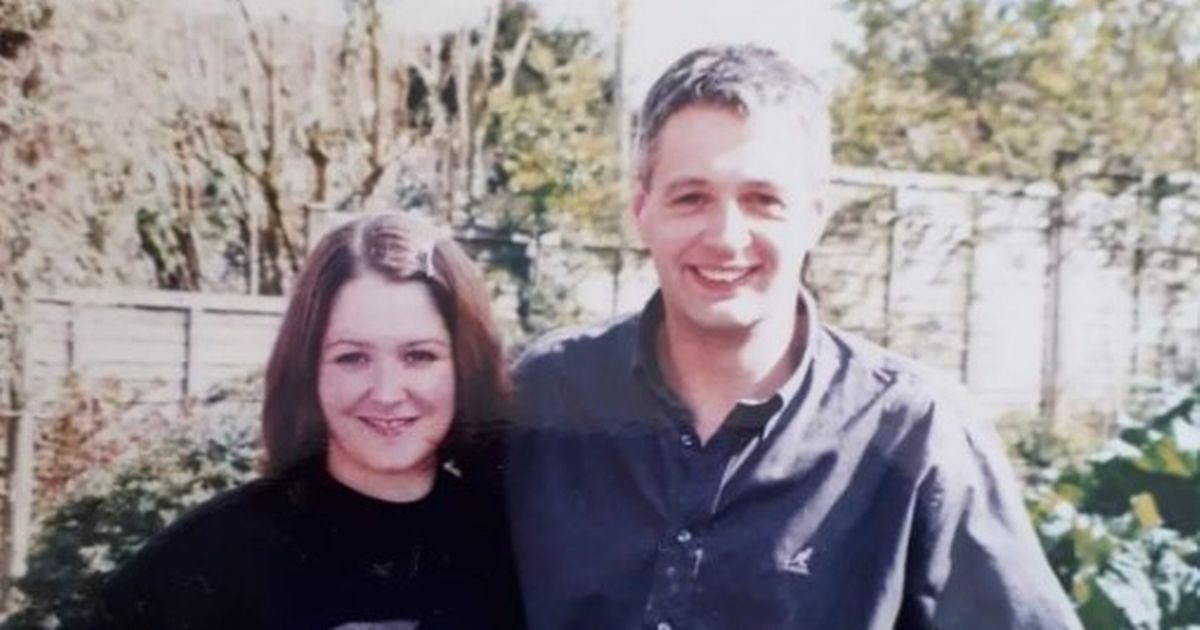
Robin Garbutt, 60, has served 15 years for the murder of his wife Diana but he maintains she was killed by a robber at their post office.
An ex-postmaster who was found guilty of bludgeoning his wife to death with a metal bar has said he would rather have a retrial to prove his innocence than walk free from jail.
Robin Garbutt, 60, is serving life for murdering his wife but has spent almost 15 years going through legal papers in his prison cell as he “seeks justice” for his wife, Diana. He remains convinced that she was killed by a robber at their post office in the village of Melsonby, North Yorkshire, on March 23, 2010.
A campaign has been launched to clear his name, with friends, neighbours, a private investigator, and a legal expert all involved in the effort to free him.
An in-depth investigation of the case, told in a three-part Sky documentary ‘Murder at the Post Office’, raises serious questions about the safety of his conviction.
The series features Garbutt’s personal diary entries and testimony from independent experts. Garbutt is currently in the midst of a fourth application to the Criminal Cases Review Commission to take his case to the Court of Appeal. But he wants a retrial to clear his name once and for all, reports the Mirror.
After a failed appeal bid in 2015, he wrote: “I feel like I have let Di down again. The killers are still out there.” The jury at his trial heard that he was in financial difficulties as he paid for extravagant holidays to keep his wife happy.
In April 2011, in evidence at Teesside crown court, he admitted that they “did not have enough sex”. The jury also heard that Diana had signed up to an online dating site and admitted to a fling with another man at a party.
Men on the site had been messaging her on the night she died. Garbutt’s insisted there was “no evidence” of an affair and she had not responded to any admirers on the site.
The Horizon scandal cast fresh doubt on financial records used to suggest Garbutt dipped into the post office till. His financial situation was key in the prosecution case as he was found guilty of beating his wife to death with a bar.
A judge said that he called police, having faked the armed robbery. But Garbutt’s DNA was not found on the murder weapon, located on a wall by a garage two days after Diana died.
Her blood was on one end of the metal bar, while the DNA of a police officer who found it was on the other. A clump of hair seen in a North Yorkshire Police scene of crime photo was also “lost” during the probe.
Robin’s supporters believe it could mean that Diana put up a fight and the hair, which did not match Robin’s, may have been pulled from the head of her killer during a struggle in the bedroom. Forensic analysis suggested that she was struck on the head by a blunt instrument from behind while she was asleep.
Dr Mike Naughton, an academic and legal campaigner, said the Garbutt case ‘may be the most egregious miscarriage of justice stemming from the post office scandal’. He stressed that there was ‘no forensic evidence whatsoever’ linking Garbutt to the murder scene. He added: “There is just circumstantial evidence.
“There is no evidence of any fraud with money going to him. The evidence that led to the conviction has been discredited. I have never known another case where there is DNA on the murder weapon and that is not from the person sitting in prison.”
Key evidence against Garbutt that his wife died between 2.30am and 4.30am – not later as he claimed – is also being speculated upon. It was based on evidence given regarding her stomach contents and when she stopped digesting a fish and chip supper.
Dr Jennifer Miller, a botanist and specialist in digestion, told the jury at his trial that it was likely to be sometime from 2.30 am to 4.30 am. That did not correspond with Garbutt’s account of a robber coming into the post office at 8.30 am. Garbutt said the robber told him: “Don’t do anything stupid. We have got your wife.”
Dr David Rouse, a forensic pathologist, said that the time of death ‘should not have been that specific’. He says in the documentary that Diana’s time of death could have been later. Her mother Agnes Gaylor, 75, who made a public appeal for information three days after her daughter’s murder, has warned that Garbutt is ‘jumping on the bandwagon’ of the Horizon scandal in a bid to be freed.
But his supporters say that he is instead determined to find the real killers of his wife. His sister Sallie Wood recounts how he has spent years in his cell going through legal papers on the case.
“He has never given up,” she said. “He is going to prove that there is someone out there who has done this.” Christine Elliott, one of Diana’s best friends, is also convinced of his innocence. She admits that she knew nothing of Diana being on a dating site, but wonders if it was to give her ego a boost, rather than to have an affair.
“The dating site was just people messaging her or liking her photo,” she said. “All I can think of is that she kind of needed a bit of an ego boost. Maybe her self esteem was struggling a little bit. I don’t know if Di did all the things that came out, but even if she did, he (Robin) would have forgiven her.”
His harrowing 999 call to police to report the robbery was played at his trial at Teesside crown court. Garbutt is heard saying to a paramedic that his wife is still ‘warm’, only to be told that rigor mortis has set in and that she has been dead for some time.
The prosecution argued that he was aware that the time of death would not fit in with his version of events; his friends and supporters are sure that it shows his shock at finding his wife dead.
Series director Louise Malkinson said that the documentary aimed to explore in detail the prosecution and defence cases in the trial of Robin Garbutt.
It features the account of Diana’s cousin Trevor Roberts, who admits that he was not sure of Garbutt’s guilt after listening to the evidence at the trial; he also gives his account of going to see Garbutt in prison.
“This is about Diana Garbutt,” said Louise. “If mistakes are made in an investigation then that is really devastating for her family. There are members of her family who sat through the trial and still did not think that Robin Garbutt was guilty.”
Another key witness, a post office customer, told of hearing a woman’s voice upstairs when he went into the shop at 6.45 am on the day she died, and Robin replying to her ‘Yes Di’ or ‘Yes darling’.
If that was Diana, then the evidence of transactions in the shop between then and 8.30 am confirm that he would not have had time to carry out the murder.
North Yorkshire Police have said they had nothing to add to the facts which had been set out during court proceedings, which ‘resulted in Robin Garbutt being sentenced to life’.
The CCRC confirmed that an application has been received in relation to this case and a review was underway.



