





Connect with us

NewsBeat

Relationship with United States is ‘rock solid’, Taiwan president insists – despite Donald Trump’s call with Xi Jinping | World News

Published

on

Taiwan President Lai Ching-te has played down fears that the security assurances offered by the U.S. may be evaporating. Pic: Reuters

Taiwan shares a “rock solid” relationship with the United States, its president has insisted – despite talks between US President Donald Trump and Chinese leader Xi Jinping over the self-governed island’s future.

During a phone call on Wednesday, Mr Xi warned his American counterpart to be “prudent” about giving arms to Taiwan, the Chinese Foreign Ministry claimed.

Last December, the US announced it would ship more than $11.1bn of weapons to the island – its largest package ever.

“The Taiwan-US relationship is rock solid, and all cooperation projects will continue uninterrupted,” Taiwan President Lai Ching-te told reporters during a visit to textile merchants in western Taiwan.

Advertisement
Image:
Presidents Donald Trump and Xi Jinping at a meeting in South Korea last year. Pic: Associated Press

Taiwan is a self-governing island that China claims as its own and is willing to use force to reclaim, prompting fears of a future invasion.

Beijing even prohibits all countries with which it has diplomatic relations, including the US, from having formal ties with Taipei.

Advertisement

It means the US does not recognise Taiwan as a nation state – but still remains its biggest backer.

After Mr Trump and Mr Xi’s phone call, the Chinese foreign ministry shared a readout of the conversation.

It said: “President Xi emphasised that the Taiwan question is the most important issue in China – US relations. Taiwan is China’s territory.

“China must safeguard its own sovereignty and territorial integrity, and will never allow Taiwan to be separated.

Advertisement

“The US must handle the issue of arms sales to Taiwan with prudence.”

Read more from Sky News:
Family of woman killed on holiday issue warning
Sky News go undercover in scam centre

For his own part, Mr Trump took to Truth Social to celebrate the successful call – but made no mention of China’s firm words on Taiwan.

He said: “The relationship with China, and my personal relationship with President Xi, is an extremely good one, and we both realise how important it is to keep it that way.”

Advertisement

The $11.1bn arms shipment announced in December is not over the line yet, having still not been approved by Congress.

There has also been significant pushback to the deal from within China, which conducted military drills around Taiwan in response.

Source link

Advertisement
Continue Reading
Click to comment

Leave a Reply

Your email address will not be published. Required fields are marked *

NewsBeat

the iron overload condition that too often goes undiagnosed

Published

on

the iron overload condition that too often goes undiagnosed

When we think about iron imbalance, most people are familiar with iron deficiency and the health problems it can cause. What many may not realise is that the opposite problem, iron overload, can be just as serious – yet many aren’t even aware of the condition.

Haemochromatosis is an inherited genetic condition that affects the amount of iron the body absorbs. The condition disproportionately affects people of Irish, Scottish and Welsh descent, which is why it’s been nicknamed the “Celtic curse”. Yet this label can be misleading as it is also prevalent in other northern European countries – and this may contribute to why so many cases still continue to go undiagnosed today.

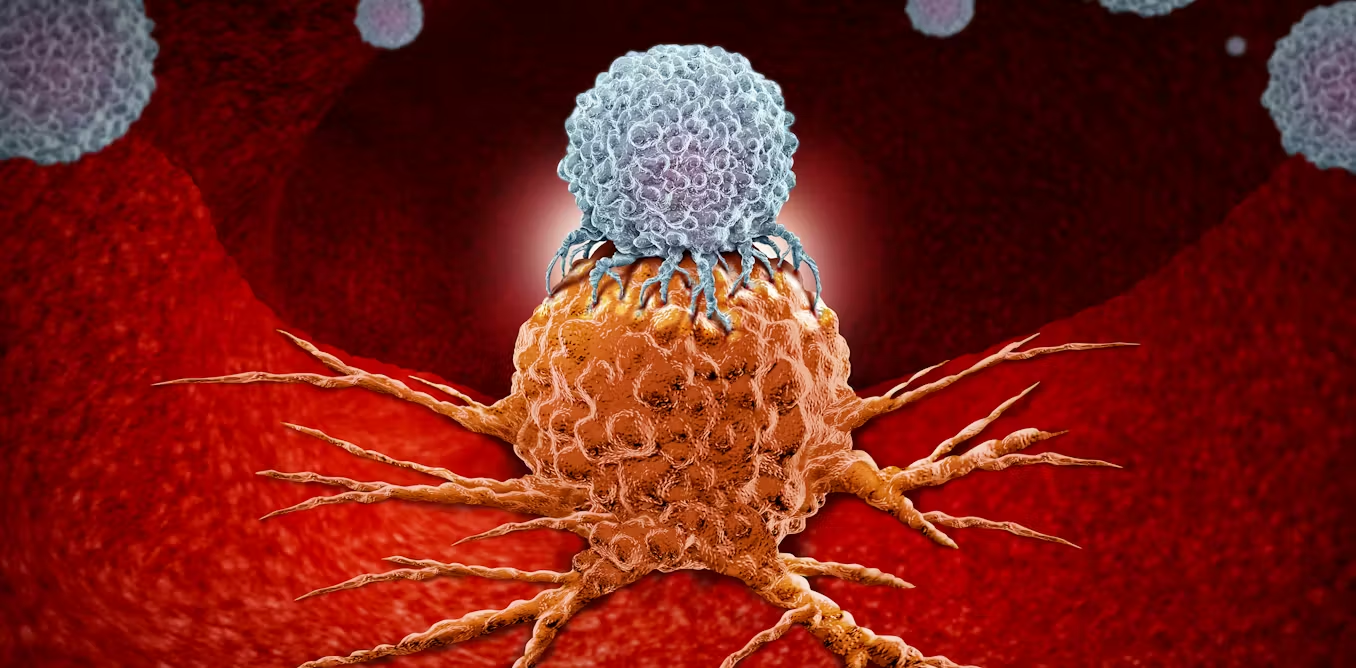
Haemochromatosis causes the body to absorb too much iron from food. Iron is essential for health, particularly for the oxygen-carrying capacity of red blood cells.

In healthy people, this iron is safely stored in the bone marrow and liver in the form of a protein called ferritin. But in people with haemochromatosis, iron stores gradually exceed safe limits. As the body has no effective way to excrete this excess iron, this means the mineral accumulates in their tissues and organs, resulting in damage to these tissues and organs.

Advertisement

Most cases of haemochromatosis are caused by mutations in a gene called HFE, which regulates hepcidin – a hormone made by the liver that helps regulate iron absorption. When this system is disrupted, iron absorption continues unchecked. In people with haemochromatosis, this mutation is usually inherited from both parents.

Iron overload can also occur in people who need repeated blood transfusions – such as those with sick cell disease.

The liver is particularly vulnerable, and excess iron can cause inflammation, irreversible scarring and damage and, in advanced cases, liver cancer. Once liver storage capacity is exceeded, iron begins to accumulate in other organs – including the pancreas, heart, joints and brain, impairing their function.

Diagnosing iron overload

Genetic haemochromatosis has been identified from human remains as far back as bronze age and neolithic Irish populations. It’s thought that humans with the HFE mutation were resistant to iron deficiency caused by iron-poor diets, offering a survival advantage.

Advertisement

But while haemochromatosis is more common people of Celtic ancestry, the condition can affect anyone. The “Celtic curse” label may even have unintentionally contributed to the misconception that the condition is rare.

In reality, around one in 200 people of northern European ancestry carry the mutations that can cause the condition. However, in Ireland, around one in 83 people carry this mutation.

Before the genetic basis of haemochromatosis was discovered, patients were often diagnosed incidentally or after developing cirrhosis or diabetes.

Today, it’s widely understood that symptoms can be wide ranging and of varying severity. The most common complaint is joint pain, particularly affecting the knuckles and hands. Other symptoms include chronic fatigue, bronzing of the skin, reduced libido, heart rhythm problems and difficulties with memory or concentration.

Advertisement
Regular blood removal can help to deplete iron stores.
24K-Production/ Shutterstock

Many people have no obvious symptoms for decades – and when symptoms do occur, they’re often attributed to age-related conditions, such as arthritis. This makes haemochromatosis easy to miss.

Large UK population studies suggest that up to 40% of patients with genetic haemochromatosis will develop at least one symptom related to iron overload in their lifetime. Men with the condition are at the highest risk of developing liver cancer.

Despite this, many people remain undiagnosed – even when serious organ damage has already occurred. According to the charity Haemochromatosis UK , undiagnosed haemochromatosis costs the NHS an estimated £300 million per year, due to to avoidable illness and complications associated with the condition.

Diagnosing haemochromatosis is actually quite straightforward. Blood tests are performed to measure iron and liver function. If results suggest iron overload, genetic testing can confirm the diagnosis.

Advertisement

But the challenge is knowing who to test. Because symptoms are often vague and the condition is still perceived as rare, haemochromatosis is often overlooked.

Many people are diagnosed incidentally during routine blood tests for unrelated reasons. When a diagnosis is made, close relatives are usually offered testing because of the inherited nature of the condition.

When diagnosed, treatment is simple and highly effective. The standard approach is regular blood removal, known as venesection or phlebotomy. Removing blood removes mobilises stored iron to make new blood cells, helping to deplete these stores. Initially this may be weekly or fortnightly until iron levels normalise – followed by lifelong monitoring and occasional maintenance venesections.

Dietary changes, such as avoiding iron and vitamin C supplements, limiting alcohol and reducing red meat consumption, may help slow iron accumulation, but these cannot replace or be as effective as venesection.

Advertisement

Not all patients tolerate regular blood removal – particularly older people or those whose veins may not be as visible or easy to access. In these cases, iron-chelating drugs (which make it possible for iron to be passed in urine) can be used. However, their side-effects – such as diarrhoea, pain and tiredness – limit their use.

Encouragingly, new treatments are emerging. Drugs that mimic hepcidin, restoring the body’s natural iron regulation, are currently being trialled. Other approaches aim to block ferroportin (which transports iron), using a synthetic inhibitor that competes against the natural protein and is known to reduce iron levels in mice.

Haemochromatosis is common, treatable, and when caught early, the health effects are largely preventable. The greatest challenge is increasing awareness among both doctors and the public, so the condition can be caught before it causes serious harm.

Advertisement

Source link

Continue Reading

NewsBeat

Cereulide poisoning in babies who drank recalled formula – everything we know so far

Published

on

Daily Record
Cereulide poisoning in babies who drank recalled formula – everything we know so far – Daily Record

reach logo

At Reach and across our entities we and our partners use information collected through cookies and other identifiers from your device to improve experience on our site, analyse how it is used and to show personalised advertising. You can opt out of the sale or sharing of your data, at any time clicking the “Do Not Sell or Share my Data” button at the bottom of the webpage. Please note that your preferences are browser specific. Use of our website and any of our services represents your acceptance of the use of cookies and consent to the practices described in our Privacy Notice and Terms and Conditions.

Source link

Continue Reading

NewsBeat

People only just realising secret meaning behind their surname

Published

on

Wales Online

A history and folklore enthusiast has shared the five types of English surnames and what they mean about your family history

People are only just discovering the origins of their surnames and the meanings behind them. Whilst surnames such as Smith, Johnson and Hill might appear commonplace, many individuals don’t give them a second thought.

However, people are now realising that their surnames could reveal more about their family heritage than delving back through multiple generations of research.

Advertisement

A surname is generally handed down from one generation to another, offering insight into a person’s cultural and geographical roots, profession or physical traits.

A history and folklore enthusiast, posting on TikTok as @the_past_and_curious, has explained that there are five categories of surname and their various origins.

He explained: “In England, there are five types of surnames introduced by the Normans with the Doomsday Book.

“They needed to differentiate between all the people with the same first name so that they could keep track of everyone and tax them accordingly.

Advertisement

“The types of surnames are patronymic, which means from the father. For example, John’s son becomes Johnson or Peter’s son becomes Peterson.

Content cannot be displayed without consent

“The next type is vocational, so that’s the type of job somebody had. For example, Smith or Thatcher. Now these often end in ‘er’, like Thatcher or Cooper, which means someone who makes barrels.”

The history enthusiast continued by explaining that certain names are geographical, meaning that somebody residing in Derby would adopt that as their surname. Others derive from geographical features and draw inspiration from the terrain where individuals resided, such as Hill, Bridge and Wood.

He explained: “So someone who lives by a hill would take the surname Hill. The last and the least common type is a descriptive name.

Advertisement

“So a name like Armstrong would be a strong person, or Grey would be a person who had grey hair or possibly a grey beard.”

Across English-speaking nations, some of the most prevalent surnames include Smith, Johnson, Williams, Brown, Jones, Garcia, Miller, Davis, Rodriguez, and Martinez.

Smith frequently ranks as the most widespread surname in numerous English-speaking countries, originally stemming from the craft of metalworking.

Source link

Advertisement
Continue Reading

NewsBeat

England vs Wales, Six Nations 2026: Kick-off time, TV channel, live stream, team news, lineups, h2h results, odds

Published

on

England vs Wales, Six Nations 2026: Kick-off time, TV channel, live stream, team news, lineups, h2h results, odds

Twickenham plays host to a battle between two sides in very different form, with Steve Borthwick’s hosts riding an 11-game winning streak as they bid to go one better than last year’s runner-up finish – a result confirmed by a blowout victory against Wales.

The Welsh squad, meanwhile, will be hoping to leave their recent two winless Six Nations campaigns in the past as new head coach Steve Tandy takes charge for the first time at this level, with a pair of nervy victories over Japan last year ending their abysmal losing streak.

Wales are desperate to avoid a third successive wooden spoon during a campaign that takes place against the backdrop of ongoing turmoil in their club game, particularly the future of Ospreys.

Here’s everything you need to know about England vs Wales on the opening weekend of the 2026 Six Nations.

Advertisement

England vs Wales date, kick-off time and venue

England vs Wales takes place on Saturday February 7, 2026 at the Allianz Stadium, Twickenham in south-west London.

Kick-off is scheduled for 4:40pm GMT.

How to watch England vs Wales

Advertisement

TV channel: In the UK, England vs Wales is being shown live and free to air on ITV1 and STV, with coverage beginning at 3:45pm GMT.

Live stream: Live coverage of the game will also be available for online streaming via the ITVX website and app, which is free with a registration.

Live blog: Meanwhile, you can follow the action as it happens at Twickenham on Saturday right here with us, in Standard Sport’s dedicated live blog.

England vs Wales team news

Advertisement

Source link

Advertisement
Continue Reading

NewsBeat

HMRC warns ‘now is the time to act’ as 864,000 taxpayers face new rules

Published

on

Manchester Evening News

The new rules will come into force from April 6

HMRC has issued a call to action as over 860,000 taxpayers are set to face new rules within two months. From April 6, many sole traders and landlords will need to start using digital tax reporting, and experts are urging those affected to be prepared.

Advertisement

Any sole traders and landlords earning more than £50,000 from self-employment and property will be required to use use digital tax reporting from April 6. This will see affected taxpayers no longer filling out their tax return all at once, and instead the admin will be split and spread throughout the year.

From April 6, those affected will need to begin using a HMRC recognised software to keep their digital records, before sending light-touch quarterly updates of their income and expenses. Free software options are available and once income and expenses are recorded, the software generates a simple summary to be sent to HMRC.

Try MEN Premium NOW for just £1

With two months to go until the change comes into force, HMRC is now urging those affected to prepare for Making Tax Digital (MTD) for Income Tax. To support those affected, a range of free resources including online guidance, webinars and videos are also being provided by HMRC.

Advertisement

Craig Ogilvie, HMRC’s Director of Making Tax Digital, said: “With two months to go until MTD for Income Tax launches, now is the time to act. A range of software is available and the system is straightforward and helps reduce errors. Thousands of volunteers have already used it successfully.

“This will make it easier for sole traders and landlords to stay on top of their tax affairs and help ensure everyone pays the right amount of tax. Spreading your tax admin throughout the year means avoiding that last minute scramble to complete a tax return every January. Go to GOV.UK and start preparing today.”

Those joining MTD in April 2026 will still file their tax return for the 2025 to 2026 tax year in the usual way by 31 January 2027, as this covers the period before MTD begins. The first MTD tax return, covering the 2026 to 2027 tax year, will be due by 31 January 2028.

To support the transition, the government has also announced customers joining MTD for Income Tax in April 2026 won’t receive penalty points for late quarterly updates, for the first 12 months following the change. Under the new system, penalty points will also be given for each late submission, with a £200 penalty only applied once four points are reached, helping to allow for occasional slip-ups.

Advertisement

The new rollout forms part of the Government’s plan to transform the UK’s tax system in a bid to support economic growth. Thousands of sole traders and landlords have also signed up already for MTD for Income Tax, and more than 20,000 quarterly updates successfully submitted through a voluntary testing programme.

Source link

Continue Reading

NewsBeat

Captain jailed over North Sea tanker crash death

Published

on

Captain guilty of North Sea tanker crash death

Speaking earlier following the sentencing, senior investigating officer Det Ch Supt Craig Nicholson, of Humberside Police, said: “Motin completely failed in this duty as a captain, causing the death of one of his own crew and endangering the remaining lives of the crews of both vessels.

Source link

Continue Reading

NewsBeat

Team GB at 2026 Winter Olympics: Full schedule, dates and best medal hopes

Published

on

Team GB at 2026 Winter Olympics: Full schedule, dates and best medal hopes

With 53 British stars heading to Milan-Cortina, UK Sport has targeted eight medals to smash the previous record haul of five which was set in Sochi 2014 and matched in Pyeongchang 2018.

UK Sport have set a medal range of four to eight, which they believe reflects Team GB “being more competitive in more sports at a winter games than ever before”.

Team GB’s best medal hopes

Two-time world skeleton racer champion Matt Weston is among Team GB’s best hopes for a gold medal, while Tabby Stoecker, in the same discipline, will hope to follow up her World Cup medal with a podium place in Italy.

Advertisement

Matt Weston

Robert Michael via DPA./PA Wire

Curling is always among the more promising podium chances for Team GB, with Bruce Mouat competing in both the men’s team and mixed doubles events.

Lilah Fear and Lewis Gibson missed out on an European title last month, but will hope to be in contention for figure skating gold in Italy.

Advertisement

Freestyle skiing star Zoe Atkin heads to Italy having won gold in SuperPipe at the X Games, months after winning a halfpipe gold at the 2025 World Championships. She is never far away from a podium.

Here’s who to look out for on a podium, and when…

Team GB schedule and medal hopes

Curling, mixed doubles: Bruce Mouat and Jennifer Dodds

Advertisement

Curling, mixed doubles: Bruce Mouat and Jennifer Dodds

  • 9.05am: Team GB vs Estonia
  • 6.05pm: Czechia vs Team GB

Curling, mixed doubles: Bruce Mouat and Jennifer Dodds

  • 9.05am: Sweden vs Team GB
  • 1.35pm: South Korea vs Team GB
  • 8.55am: Ice Dance, rhythm dance (RD): Lilah Fear and Lewis Gibson, Phebe Bekker and James Hernandez
  • 10.35am: Pair Skating: Anastasia Vaipan-Law and Luke Digby
  • 12.35pm: Women’s Single Skating: Kristen Spours

Bruce Mouat and Jennifer Dodds

Andrew Milligan/PA Wire

Curling, mixed doubles: Bruce Mouat and Jennifer Dodds

  • 9.05am: Team GB vs Canada
  • 1.35am: Team GB vs United States

Freestyle skiing: Kirsty Muir

  • 10.30am: Women’s Freeski qualifying, run 1
  • 11.35am: Women’s Freeski qualifying, run 2

Freestyle skiing: Chris McCormick

  • 2pm: Men’s Freeski qualifying, run 1
  • 3.05pm: Men’s Freeski qualifying, run 2

Cross-country skiing: Anna Pryce (GOLD MEDAL)

  • 1pm: Women’s 10km and 10km Skiathlon
  • 6.45pm: Men’s Single Skating: Edward Appleby
  • 9.05pm: Ice Dance, free dance (FD): Lilah Fear and Lewis Gibson, Phebe Bekker and James Hernandez

Men’s 10km and 10km Skiathlon: James Clugnet, Joe Davies, Andrew Musgrave

Curling, Mixed doubles: Bruce Mouat and Jennifer Dodds

Advertisement
  • 1.35pm: Team GB vs Switzerland
  • 6.05pm: Italy vs Team GB
  • 6.30pm: Pair Skating: Anastasia Vaipan-Law and Luke Digby
  • 7.45pm: Women’s Single Skating: Kristen Spours
  • 8.55pm: Men’s Single Skating: Edward Appleby (GOLD MEDAL)

Freestyle skiing: Kirsty Muir

  • 12.30pm: Women’s Freeski Final run 1
  • 12.59pm: Women’s Freeski Final run 2
  • 1.28pm: Women’s Freeski Final run 3 (GOLD MEDAL)

Speed skating: Ellia Smeding

  • 4.30pm: Women’s 1000m (GOLD MEDAL)

Curling, mixed doubles: Bruce Mouat and Jennifer Dodds

Figure skating: Lilah Fear and Lewis Gibson, Phebe Bekker and James Hernandez

Cross-country skiing: Anna Pryce; James Clugnet, Joe Davies, Andrew Musgrave

  • 09.15am: Women’s Sprint Classic qualifying
  • 09.55am: Men’s Spring Classic qualifying
  • 11.45am: Women’s Sprint Classic quarter-finals
  • 12.15pm: Men’s Sprint Classic quarter-finals
  • 12.45pm: Women’s Sprint Classic semi-finals
  • 12.57pm: Men’s Sprint Classic semi-finals
  • 1.13pm: Women’s Sprint Classic final (GOLD MEDAL)
  • 1.25pm: Men’s Sprint Classic final (GOLD MEDAL)

Short track speed skating: Niall Treacy

  • 10.08am: Men’s 1000m heats

Freestyle skiing: Mateo Jeannesson; Chris McCormick; Makayla Gerken Schofield

  • 11.15am: Men’s Moguls qualifying 1
  • 12.30pm: Men’s Freeski Final run 1
  • 12.59pm: Men’s Freeski Final run 2
  • 1.28pm: Men’s Freeski Final run 3 (GOLD MEDAL)
  • 2.15pm: Women’s Moguls qualifying 1

Curling, mixed doubles: Bruce Mouat and Jennifer Dodds

  • 1.05pm: Bronze medal match
  • 5.05pm: Gold medal match

Lilah Fear and Lewis Gibson

Getty Images

Freestyle skiing: Makayla Gerken Schofield

Advertisement
  • 11.00am: Women’s Moguls qualifying 2
  • 2.15pm: Women’s Moguls Final 1
  • 2.55pm: Women’s Moguls Final 2 (GOLD MEDAL)

Curling, men: Bruce Mouat, Grant Hardie, Hammy McMillan Jr, Bobby Lammie, Kyle Waddell

Figure skating: Lilah Fear and Lewis Gibson, Phebe Bekker and James Hernandez

  • 6.30pm: Ice Dance (FB) (GOLD MEDAL)

Skeleton: Matt Weston, Marcus Wyatt

  • 9.30am: Men Heat 1
  • 11.08am: Men Heat 2

Freestyle skiing: Mateo Jeannesson

  • 10am: Men’s Moguls qualifying 2
  • 12.15pm: Men’s Moguls Final 1
  • 12.55pm: Men’s Moguls Final 2 (GOLD MEDAL)

Cross-country skiing: Anna Pryce

  • 1pm: Women’s 10km Interval Start Free (GOLD MEDAL)

Curling, men’s: Bruce Mouat, Grant Hardie, Hammy McMillan Jr, Bobby Lammie, Kyle Waddell

Curling, women’s: Rebecca Morrison, Sophie Jackson, Sophie Sinclair, Jennifer Dodds, Fay Henderson

Snowboard: Huw Nightingale

  • 1.45pm: Men’s Snowboard Cross 1/8 finals
  • 2.18pm: Men’s Snowboard Cross quarter-finals
  • 2.39pm: Men’s Snowboard Cross semi-finals
  • 2.56pm: Men’s Snowboard Cross small final
  • 3.01pm: Men’s Snowboard Cross big final (GOLD MEDAL)

Short track speed skating: Niall Treacy

  • 7.29pm: Men’s 1000m – quarter-finals
  • 8.05pm: Men’s 1000m – semi-finals
  • 8.37pm: Men’s 1000m – Final B
  • 8.43pm: Men’s 1000m – Final A (GOLD MEDAL)

Curling, men’s: Bruce Mouat, Grant Hardie, Hammy McMillan Jr, Bobby Lammie, Kyle Waddell

Curling, women’s: Rebecca Morrison, Sophie Jackson, Sophie Sinclair, Jennifer Dodds, Fay Henderson

Advertisement

Cross-country skiing: James Clugnet, Joe Davies, Andrew Musgrave

  • 11.45am: Men’s 10km Interval Start Free

Snowboard: Charlotte Bankes

  • 1.30pm: Women’s Snowboard Cross 1/8 finals
  • 2.03pm: Women’s Snowboard Cross quarter-finals
  • 2.24pm: Women’s Snowboard Cross semi-finals
  • 2.41pm: Women’s Snowboard Cross small final
  • 2.46pm: Women’s Snowboard Cross big final (GOLD MEDAL)

Skeleton: Amelia Coltman, Freya Tarbit, Tabby Stoecker

  • 4pm: Women Heat 1
  • 5.48pm: Women Heat 2

Skeleton: Matt Weston, Marcus Wyatt

  • 7.30pm: Men Heat 3
  • 9.05pm: Men Heat 4 (GOLD MEDAL)

Tabby Stoecker

David Davies/PA Wire

Curling, women’s: Rebecca Morrison, Sophie Jackson, Sophie Sinclair, Jennifer Dodds, Fay Henderson

Curling, men’s: Bruce Mouat, Grant Hardie, Hammy McMillan Jr, Bobby Lammie, Kyle Waddell

Advertisement

Skeleton: Amelia Coltman, Freya Tarbit, Tabby Stoecker

  • 6pm: Women Heat 3
  • 7.44pm: Women Heat 4 (GOLD MEDAL)

Short track speed skating: Niall Treacy

  • 7.15pm: Men’s 1500m – quarter-finals
  • 8.44pm: Men’s 1500m – semi-finals
  • 9.27pm: Men’s 1500m – Final B
  • 9.34pm: Men’s 1500m – Final A (GOLD MEDAL)

Curling, men’s: Bruce Mouat, Grant Hardie, Hammy McMillan Jr, Bobby Lammie, Kyle Waddell

  • 8.05am: Germany vs Team GB
  • 6.05pm: Team GB vs Switzerland

Curling, women’s: Rebecca Morrison, Sophie Jackson, Sophie Sinclair, Jennifer Dodds, Fay Henderson

  • 9am: Women’s Monobob Heat 1
  • 10.50am: Women’s Monobob Heat 2

Snowboard: Charlotte Bankes, Huw Nightingale

  • 1.45pm: Mixed Team Snowboard Cross quarterfinals
  • 2.15pm: Mixed Team Snowboard Cross semifinals
  • 2.35pm: Mixed Team Snowboard Cross small final
  • 2.40pm: Mixed Team Snowboard Cross big final (GOLD MEDAL)

Figure skating: Anastasia Vaipan-Law and Luke Digby

  • 6.45pm: Pair Skating – Short Program

Adele Nicoll and Kya Placide

REUTERS

Curling, women’s: Rebecca Morrison, Sophie Jackson, Sophie Sinclair, Jennifer Dodds, Fay Henderson

  • 8.05am: Denmark vs Team GB
  • 6.05pm: Switzerland vs Team GB

Curling, men’s: Bruce Mouat, Grant Hardie, Hammy McMillan Jr, Bobby Lammie, Kyle Waddell

Bobsleigh: Brad Hall, Taylor Lawrence

Advertisement
  • 9am: 2-man Heat 1
  • 10.57am: 2-man Heat 2
  • 6pm: Women’s Monobob Heat 3
  • 8.06pm: Women’s Monobob Heat 4 (GOLD MEDAL)

Alpine Skiing: Billy Major, Dave Ryding, Laurie Taylor

  • 10am: Men’s slalom Run 1
  • 1.30pm: Men’s slalom Run 2 (GOLD MEDAL)

Short track speed skating: Niall Treacy

  • 10.18am: Men’s 500m – Heats

Snowboard: Mia Brookes, Maisie Hill; Tzema Mazet-Brown

  • 10.30am: Women’s Slopestyle qualifying Run 1
  • 11.35am: Women’s Slopestyle qualifying Run 2
  • 2pm: Men’s Slopestyle qualifying Run 1
  • 3.05pm: Men’s Slopestyle qualifying Run 2

Figure skating: Anastasia Vaipan-Law and Luke Digby

  • 7.00pm: Pair Skating – Free Skating (GOLD MEDAL)

Snowboard: Mia Brookes, Maisie Hill

  • 1pm: Women’s Slopestyle Final Run 1
  • 1.27pm: Women’s Slopestyle Final Run 2
  • 1.54pm: Women’s Slopestyle Final Run 3 (GOLD MEDAL)

Curling, men’s: Bruce Mouat, Grant Hardie, Hammy McMillan Jr, Bobby Lammie, Kyle Waddell

Figure skating: Kristen Spours

  • 5.45pm: Women’s Single Skating – Short Program

Bobsleigh: Brad Hall, Taylor Lawrence

  • 6pm: 2-man Heat 3
  • 8.05pm: 2-man Heat 4 (GOLD MEDAL)

Curling, women’s: Rebecca Morrison, Sophie Jackson, Sophie Sinclair, Jennifer Dodds, Fay Henderson

  • 8.05am: United States vs Team GB
  • 6.05pm: Team GB vs Japan

Men’s team: Bruce Mouat, Grant Hardie, Hammy McMillan Jr, Bobby Lammie, Kyle Waddell)

Snowboard: Tzema Mazet-Brown

  • 12.30pm: Men’s Slopestyle Final Run 1
  • 12.59pm: Men’s Slopestyle Final Run 2
  • 1.28pm: Men’s Slopestyle Final Run 3 (GOLD MEDAL)

Figure skating: Kristen Spours

  • 6.00pm: Women’s Single Skating – Free Skating (GOLD MEDAL)

Short track speed skating: Niall Treacy

  • 7.15pm: Men’s 500m – quarter-finals
  • 7.42pm: Men’s 500m – semi-finals
  • 8.24pm: Men’s 500m – Final B
  • 8.29pm: Men’s 500m – Final A (GOLD MEDAL)

Zoe Atkin

Getty Images

Freestyle skiing: Gus Kenworthy, Liam Richards; Zoe Atkin

Advertisement
  • 10.30am: Men’s Freeski Halfpipe qualifying Run 1
  • 11.27am: Men’s Freeski Halfpipe qualifying Run 2
  • 7.30pm: Women’s Freeski Halfpipe qualifying Run 1
  • 8.27pm: Women’s Freeski Halfpipe qualifying Run 2

Curling, women’s: Rebecca Morrison, Sophie Jackson, Sophie Sinclair, Jennifer Dodds, Fay Henderson)

Curling, men’s: Bruce Mouat, Grant Hardie, Hammy McMillan Jr, Bobby Lammie, Kyle Waddell

Curling, women’s: Rebecca Morrison, Sophie Jackson, Sophie Sinclair, Jennifer Dodds, Fay Henderson

Curling, men’s: Bruce Mouat, Grant Hardie, Hammy McMillan Jr, Bobby Lammie, Kyle Waddell

  • 6.05pm: Bronze medal match

Speed skating: Ellia Smeding

  • 3.30pm: Women’s 1500m (GOLD MEDAL)

Bobsleigh: Adele Nicoll, Ashleigh Nelson

  • 5pm: 2-woman Heat 1
  • 6.50pm: 2-woman Heat 2

Freestyle skiing: Gus Kenworthy, Liam Richards

  • 7.30pm: Men’s Freeski Halfpipe Final Run 1
  • 7.59pm: Men’s Freeski Halfpipe Final Run 2
  • 8.28pm: Men’s Freeski Halfpipe Final Run 3 (GOLD MEDAL)

Rebecca Morrison

Andrew Milligan/PA Wire

Advertisement

Bobsleigh: Brad Hall, Leon Greenwood, Taylor Lawrence, Greg Cackett

  • 9am: 4-man Heat 1
  • 10.57am: 4-man Heat 2

Bobsleigh: Adele Nicoll, Ashleigh Nelson

  • 6pm: 2-woman Heat 3
  • 8.05pm: 2-woman Heat 4 (GOLD MEDAL)

Freestyle skiing: Ollie Davies

  • 12.00pm: Men’s Ski Cross 1/8 finals
  • 12.35pm: Men’s Ski Cross quarter-finals
  • 12.54pm: Men’s Ski Cross semi-finals
  • 1.10pm: Men’s Ski Cross small final
  • 1.15pm: Men’s Ski Cross big final

Curling, women’s: Rebecca Morrison, Sophie Jackson, Sophie Sinclair, Jennifer Dodds, Fay Henderson

  • 1.05pm: Bronze medal match

Curling, men’s: Bruce Mouat, Grant Hardie, Hammy McMillan Jr, Bobby Lammie, Kyle Waddell

Freestyle skiing: Zoe Atkin

  • 7.30pm: Women’s Freeski Halfpipe Final Run 1
  • 7.59pm: Women’s Freeski Halfpipe Final Run 2
  • 8.28pm: Women’s Freeski Halfpipe Final Run 3 (GOLD MEDAL)

Bobsleigh: Brad Hall, Leon Greenwood, Taylor Lawrence, Greg Cackett

  • 9am: 4-man Heat 3
  • 11.15am: 4-man Heat 4 (GOLD MEDAL)

Curling, women’s: Rebecca Morrison, Sophie Jackson, Sophie Sinclair, Jennifer Dodds, Fay Henderson

  • 10.05am: Gold medal match

Source link

Continue Reading

NewsBeat

Italy vs Scotland, Six Nations 2026: Kick-off time, TV channel, live stream, team news, lineups, h2h results, odds

Published

on

Italy vs Scotland, Six Nations 2026: Kick-off time, TV channel, live stream, team news, lineups, h2h results, odds

The Scots head to Rome looking to make an early statement that they are finally capable of competing for a first title in the competition after years of frustration.

Though the familiar questions remain over their wider player pool, Gregor Townsend has a star-studded starting team mostly devoid of the sort of key injuries that are currently affecting the likes of Ireland and brilliantly led by Finn Russell and Sione Tuipulotu.

Their campaign won’t be helped by speculation over the future of head coach Townsend, a consultant for Red Bull who has denied reports that he will take over at Red Bull-owned Newcastle when his Scotland contract expires after the 2027 World Cup in Australia.

Italy will also view this game as a chance to set out their stall for an impressive campaign where they can demonstrate further progress, having won three games over the last two editions and finished above Wales both times to avoid the wooden spoon.

Advertisement

However, Gonzalo Quesada’s Azzurri are missing plenty of high-profile players due to injury and the loss of one fallow week in the schedule is likely to cause them additional problems when it comes to their own squad depth.

Here’s everything you need to know about Italy vs Scotland on the opening weekend of the 2026 Six Nations.

Italy vs Scotland date, kick-off time and venue

Italy vs Scotland takes place on Saturday February 7, 2026 at the Stadio Olimpico in Rome, Italy.

Advertisement

Kick-off is scheduled for 2:10pm GMT, which is 3:10pm local time.

How to watch Italy vs Scotland

TV channel: In the UK, Italy vs Scotland is being shown live and free to air on BBC One, with coverage beginning at 1pm GMT.

The game is also being broadcast on Premier Sports 1.

Advertisement

Live stream: Free live coverage will be available online via the BBC iPlayer as well as the BBC Sport website and app. Premier Sports subscribers can watch the match through the Premier Sports website and app.

Italy vs Scotland team news

There is no Duhan van der Merwe at all for Scotland, who has endured an injury-hit club spell with Edinburgh and was dropped from the national team – for whom he is the all-time top try scorer – for the first time last autumn for big matches against New Zealand and Argentina.

Source link

Advertisement
Continue Reading

NewsBeat

Captain jailed for six years for fatal crash off Yorkshire

Published

on

Captain jailed for six years for fatal crash off Yorkshire

Russian Vladimir Motin had been on sole watch duty when the Solong collided with the Stena Immaculate anchored near the Humber Estuary at 9.47am on March 10 last year.

Mark Angelo Pernia, 38, who was working on the Solong’s bow, died instantly in the fire, although his body was never recovered.

Mark Angelo Pernia (Image: Crown Prosecution Service/PA Wire)

The Filipino man had a five-year-old child at the time of the collision but he never met his second child, who was born two months after his death.

At his trial, Motin claimed he knew the Stena Immaculate was up ahead but pressed the wrong button to take the Solong out of autopilot and steer safely away.

Advertisement

Motin denied he had been asleep or had left his post on the bridge.

The prosecution asserted that Motin failed to keep a proper watch for a lengthy period of time and then failed to sound the alarm, summon help or warn either crew of the impending disaster.

Captain Vladimir Motin, 59, who has been jailed (Image: Crown Prosecution Service)

A jury deliberated for eight hours to find Motin, 59, from St Petersburg, guilty of manslaughter by gross negligence.

Jailing Motin for six years, Mr Justice Andrew Baker told him: “You were a serious accident waiting to happen.”

Advertisement

Motin had shown a “blatant disregard for the very high risk of death” and fallen prey to his own complacency and arrogance, the judge said.

Death was ‘wholly avoidable’, says judge

Mr Pernia was described by colleagues as a friend and had appeared “quietly confident, at ease, a man upon whom one might depend”, the court heard.

His death was “wholly avoidable” and the blame lay squarely on the defendant, the judge said.

Other members of the Solong and Stena Immaculate crew could have died and the crash caused “huge” destruction of the cargo, he added.

Advertisement

The senior judge said Motin’s account was “highly implausible”, adding his explanation he did not initiate a crash stop for fear of hitting the accommodation block of the Stena Immaculate was “desperate stuff”.

Tug boats shadow the Solong container ship as it drifts in the Humber Estuary, off the coast of East Yorkshire following a collision with the MV Stena Immaculate oil tanker, operating as part of the US government’s Tanker Security Programme (Image: Danny Lawson/PA Wire)

In a victim impact statement read to the court, Mr Pernia’s widow Leacel said no amount of compensation made up for the “pain” of her loss and the impact on her young family.

In mitigation, James Leonard KC conveyed the defendant’s “shame” at what happened, his condolence to Mr Pernia’s family and his vow never go to sea again.

The defence barrister highlighted the experienced mariner’s “blameless” previous record, saying: “This was truly an aberration of his conduct.”

Advertisement

Previously, the court heard the Solong, which was 130 metres long and weighed 7,852 gross tonnes, had left Grangemouth in Scotland at 9.05pm on March 9 bound for the port of Rotterdam in Holland.

With a 14-strong crew, it was carrying mainly alcoholic spirits and some hazardous substances, including empty but unclean sodium cyanide containers.

The Stena Immaculate, with a crew of 23, was 183.2 metres long and was transporting more than 220,000 barrels of JetA1 high-grade aviation fuel from Greece to the UK.

With both ships laden with flammable cargo, the danger in the event of a collision was obvious, jurors were told.

Advertisement

Motin was responsible for multiple failures in the lead-up to the tragedy and then lied about what took place on the bridge, the prosecution said.

The Stena Immaculate was visible on the Solong’s radar display for 36 minutes before impact, yet Motin did nothing to steer away from the collision course.

He failed to summon help, slow down, sound the alarm to alert crews of both ships or instigate a crash stop as a last resort, the prosecution said.

Dramatic CCTV footage captured the moment both ships were consumed in a massive blaze ignited by leaking fuel from the Stena Immaculate.

Advertisement

The shocked crew aboard the US tanker reacted instantly, saying: “Holy s*** … what just hit us … a container ship … this is no drill, this is no drill, fire fire fire, we have had a collision.”

Jurors heard a lengthy silence from the bridge of the Solong before it crashed into the oil tanker at a speed of 15.2 knots. A full minute elapsed before Motin was heard to react.

Motin and the remaining Solong crew abandoned ship and were taken ashore in Grimsby, where the defendant messaged his wife, saying he would be “guilty”.

Jurors heard Motin had switched off the Solong’s bridge navigation watch alert system (BNWAS), which was designed to ensure there is someone physically on the bridge and awake.

Advertisement

Source link

Continue Reading

NewsBeat

Diabetes patients urged to prevent blood sugar spikes with 3 changes to rice

Published

on

Daily Mirror

A man with type-1 diabetes has shared three expert-backed methods to reduce blood sugar spikes from rice – and they’re all so easy to follow and try for easier life

If you’re diabetic and looking to prevent blood sugar spikes, one bloke, who lives with type-1 diabetes himself, has offered some expert guidance on the variety of rice you consume and how you prepare it. Justin provides tips for maintaining health as a diabetic and demonstrates how to minimise unnecessary blood sugar surges from your rice intake.

Advertisement

Be Well SHBP revealed: “Recent studies have shown that eating white rice can raise blood glucose significantly, especially if eaten often or in large quantities. One study showed an 11% increase in diabetes risk with each daily serving of white rice. If you love rice with your stir-fries, switch to brown rice.”

In his YouTube Shorts clip, Justin stated: “Did you know that the type of rice and the way you cook it can impact your glucose levels differently?”

He mentioned he would be speaking to “three friends from South Asia” who revealed what steps you can take to reduce the blood sugar spike from rice.

1. Soak your rice

Deeksha, from India, explained: “Soaking rice for at least one or two hours prior to you cooking it, and then straining it, really well, washing it at least five times actually combats that big spike that you get later on with the rice.”

Advertisement

Soaking rice helps lower its glycemic index (GI), which measures how rapidly a food elevates blood sugar levels after eating. When rice is soaked, some of the surface starches dissolve into the water.

Throwing away the soaking water eliminates a portion of these quickly digestible carbohydrates. Soaking rice also benefits digestion.

The process partially breaks down complex carbohydrates, making them simpler to digest and potentially slowing glucose absorption into the bloodstream.

Following this gradual absorption can help avoid sudden blood sugar spikes, which is beneficial for those managing diabetes. Research published in the International Journal of Food Sciences and Nutrition (2011) revealed that soaking and cooking techniques affect starch digestibility and rice’s glycemic index.

Advertisement

This reinforces the notion that soaking can enhance rice as a choice for blood sugar management.

2. Boil your rice

Anum, from Pakistan, explained: “If you have boiled rice, you will get very controlled levels after eating lots, because when you drain the water, all the starch has been drained.”

When rice is boiled in abundant water and subsequently drained, a considerable amount of surface starches and certain soluble carbohydrates leach into the cooking liquid. Disposing of this water eliminates these quickly digestible carbohydrates, which can help reduce the glycemic index (GI) of the rice.

The Harvard T. H. Chan School of Public Health notes that cooking rice using methods such as boiling and draining can decrease its GI, thereby minimising the likelihood of sharp blood sugar increases after meals.

Advertisement

3. Opt for brown rice

Hubban, also from Pakistan, explained: “Brown rice is just white rice but with an extra layer, and this layer is insoluble fibre. It takes the spike lower, and it doesn’t give you an instant spike.”

However, he cautioned if you have a “sensitive gut,” insoluble fibre “might cause you some issues,” so you need to be “wary” of this. Nevertheless, he suggested it’s worth trying to prevent the sugar spike.

Brown rice is typically regarded as a superior option compared to white rice for individuals with diabetes, thanks to its elevated fibre content, reduced glycemic index, and enhanced nutritional profile, all of which help with better blood sugar control and overall wellbeing.

Furthermore, brown rice is a whole grain, which means it preserves the bran and germ layers that are stripped away during white rice production. These layers are packed with essential nutrients, including fibre, vitamins, minerals, and beneficial plant compounds.

Advertisement

Source link

Continue Reading

Trending

Copyright © 2025