
News Beat
School pool barricaded as repairs contract ends with work unfinished


Branwen Jeffreys,education editorand
Hope Rhodes,education producer

 Ann Gannon / BBC
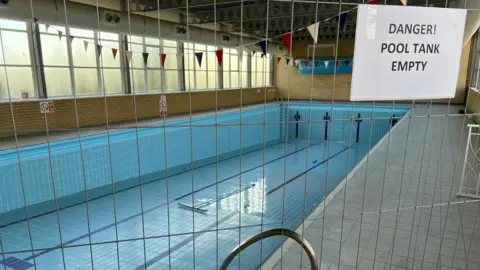
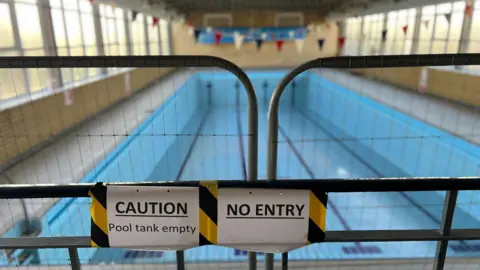
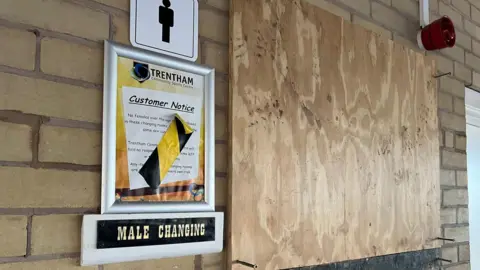
At Trentham Academy, a large secondary school in Stoke-on-Trent, the swimming pool is barricaded with danger signs, while the heating system has remained broken during recent mock exams.
“It was hard to concentrate,” student Esme says. “I couldn’t stop myself from shivering while I was trying to breathe and to calm myself down while I was trying to do the exam.”
This is one of 88 schools in the area that were maintained as part of a Private Finance Initiative (PFI) contract, signed by the city council 25 years ago.
These contracts pay private companies to maintain buildings in return for being allowed to generate profits.
The contract in Stoke-on-Trent is one of the largest of around 660 similar contracts across the UK, most of which were signed under a previous Labour government, and is among the first to come to an end.
 Ann Gannon / BBC
But a BBC investigation in February last year revealed concerns the Stoke-on-Trent contract would run out before vital school repairs were completed.
The end of these contracts is crucial, because if buildings are not handed back in good condition, public money has to pick up the bill. In the years before the contract finished, the BBC understands work costing between £24m and £30m was identified, not all of which was done in time.
Shortly after the contract ended in October, Transform Schools (Stoke) Ltd (TSSL) – the PFI company – went into liquidation, leaving building repairs unfinished, contractors unpaid, and the city council left picking up the pieces. Just months earlier, TSSL had agreed to “extend its obligations”, but that became irrelevant because of the insolvency.
Earlier in the year, as concern grew, Stoke-on-Trent City Council said it would set aside £3.5m to ensure schools were left “safe, warm and dry”.
But the BBC has also heard allegations that work slowed down markedly in the final year of the contract, with repair jobs marked as closed without problems being fixed.
The BBC spent a day seeing some of the problems first-hand at Trentham and other academies in the same trust.
‘Hands shaking’
On the day the BBC visited Trentham, teenagers preparing for their science GCSEs were bundled up in layers of clothes, some wearing coats.
The school has reported problems with the heating system repeatedly, but some classrooms still rely on small electric heaters for warmth.
“You can’t write,” pupil Sam said. “You can’t hold the pencil properly.”
“It’s simply so cold and no one wants to work,” classmate Kai added.
If classrooms become too cold, the school has to send pupils home to learn remotely.
 Ann Gannon / BBC
The school pool was previously used by local primaries for swimming lessons, but remains closed after first shutting in 2022 due to leaks and structural issues.
When Trentham bid for government funding for building work, it was turned down on the grounds the PFI contract was meant to put everything right by October 2025.
But Sharon Bates, from the school trust, says jobs were “stacking up” in the final year of the contract, despite repeated requests for repairs.
The schools involved had been paying a regular fee to TSSL as part of the contract to manage any issues with their buildings and facilities.
Equans, a large sub-contractor working for TSSL, ran the contract helpdesk, and told us TSSL insisted on signing off work costing more than £250, meaning schools had to repeatedly chase jobs that had been marked as completed.
Even small repairs were caught up in the process, including a water issue with a sink at Smallthorne Primary School, which was first reported in May 2025 but remained unfixed by the end of the contract in October.
The BBC has seen evidence the issue was logged under multiple job numbers, and understands a repair was not signed off by TSSL.
Down the road, Mill Hill Primary School had roof repairs completed in May by a different company for TSSL and by October was still reporting leaks, with little information about what work had been done.
 Ann Gannon / BBC
Information released to the BBC a year ago by the government revealed surveys of the 88 schools in 2021 and 2024 warned their condition was graded “amber/red”, meaning major work was needed.
Despite Stoke-on-Trent City Council promising “safe, warm and dry” schools and saying an agreement was being reached, on 20 November the council wrote to the schools in the contract warning that TSSL was going into Creditors Voluntary Liquidation, meaning the agreement no longer applied.
The council said it had worked hard to manage the end of the PFI contract over several years and had withheld a further £8m from TSSL to ensure work would be completed, on top of the £3.5m from unspent capital funds.
It is not clear how much of the money set aside by the council has already been spent, or how great the remaining bill will be to repair Stoke-on-Trent’s schools.
In a statement, the council said it was working to reach agreement with schools on what needed to be done.
“We want to reassure schools and parents that we absolutely intend to complete the remaining works,” a spokesperson said.
 Ann Gannon / BBC
Council chief executive Jon Rouse robustly defended the management of the contract, which he described as a “difficult hand” weighted towards the private sector.
He said there was a “moral and ethical” obligation to sort it out, adding that “we know what remains undone and needs to be put right”.
Rouse told the BBC he “would have preferred if those profits had been spent on Stoke-on-Trent’s schools”, but conceded that making money was part of the contract.
Subcontractor Equans told the BBC it had successfully completed £6.2m worth of handback repairs, and was still owed £5m by TSSL, which it was pursuing through the liquidation process.
The saga has left many wanting answers. Carl Ward, chief executive of City Learning Trust – which includes Trentham and four other academies left with multiple building issues – said it was “hugely frustrating” that work wasn’t completed before the contract ended.
Half of the schools in the contract, all academies, had been withholding payments as concerns about unfinished work escalated.
Privately, three other academy chief executives have shared concerns and evidence with the BBC about unfinished work and the legacy for schools in Stoke-on-Trent.
 Ann Gannon / BBC
Questions remain about why work seemingly slowed down towards the end of the contract, and how much profit was made over the 25 years.
That question is harder to answer than it may seem because of complex company structures.
TSSL was in a group of companies that ultimately belongs to Innisfree, one of the largest infrastructure investment companies in the UK with a big share of PFI projects, which has included 260 schools.
The founder and chief executive of Innisfree, David Metter, has been a staunch advocate of the value for public money in PFI contracts, telling MPs in 2011 that, overall, “UK plc is getting an excellent deal”.
BBC analysis of public accounts suggests Metter, or companies owned and controlled by him or his family, appear to have made at least £130m in dividends from PFI investments in schools, hospitals and other infrastructure projects. It’s not possible to say how much came from the Stoke-on-Trent contract.
The BBC first wrote to Metter and his company Innisfree Ltd in December, and made a number of attempts to contact him.
The BBC understands Innisfree was asked if it would put money back into the Stoke-on-Trent PFI company, TSSL, having drawn significant dividends out over the years, and the company declined.
A spokesperson for Innisfree said: “We have no comment other than to say that on Stoke schools these matters are subject to commercial contract.”
The directors of the now liquidated TSSL, based at Innisfree, have not replied to the concerns raised by our investigation.
When approached by the BBC in February 2025, TSSL said it was “unaware of widespread issues with quality” and considered that schools had been “maintained in accordance with the contract”.
Subcontractor Equans said it had “focused on fulfilling our role with a consistently high standard of service” throughout the contract, adding that it “conducted a responsible and well-managed close of our contracted works”.
Concerns about the end of these PFI contacts have been longstanding.
In 2021, the public accounts committee of MPs said academy schools, responsible for their own buildings, might be left having to fund outstanding repairs.
PFI investors, they added, could pay higher dividends and “walk away with limited threat of recourse”.
Additional reporting by Ben King



