

Cosmic dust may be necessary to spark life in space
Space dust may be vital in the process that sparks life, scientists leading the first study of its kind have said.
A team of researchers are investigating mineral dust in space and its role in increasing the building blocks required for life.
The team, from Heriot-Watt University in Edinburgh, Friedrich Schiller University Jena in Germany and the University of Virginia in the US, are investigating how simple molecules turn into more complex, potentially life-forming molecules in the vacuum and extreme cold of space.
Their latest study found that surface reactions between carbon dioxide and ammonia – both common in space – only occur efficiently when dust is present.
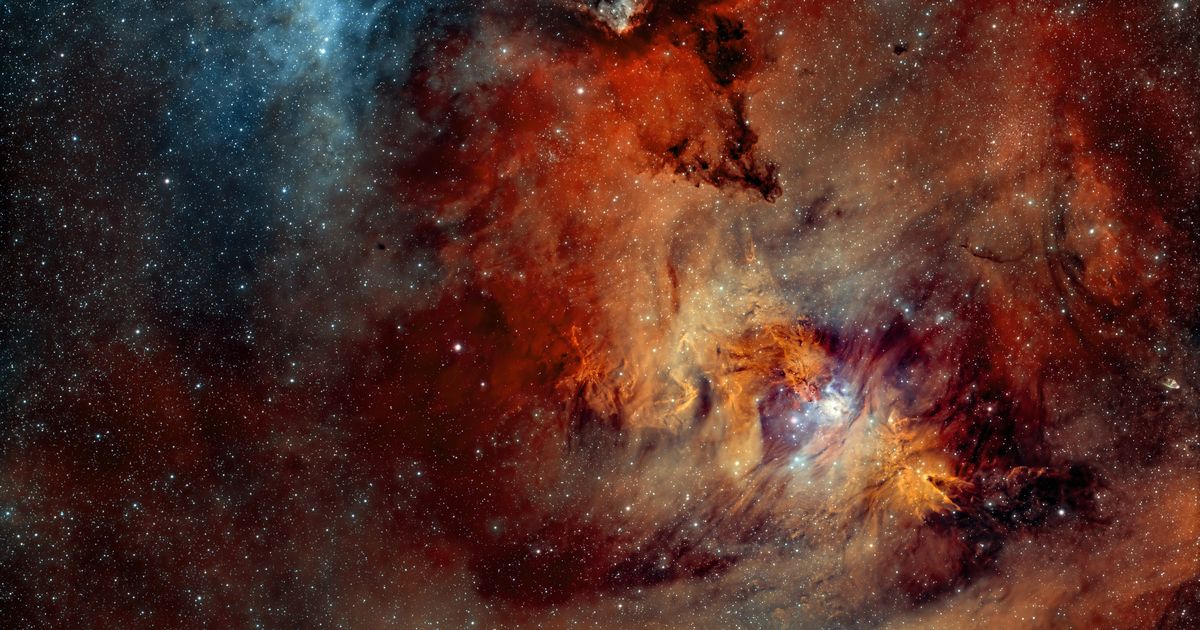
Space dust, or cosmic dust, is made of tiny solid particles of rock, ice, and organic compounds found in space, created when stars die, from the debris of asteroid collisions, or from dust shed by comets.
The study found these reactions form ammonium carbamate, a compound thought to be a chemical precursor to urea and other molecules essential to life.
Professor Martin McCoustra, an astrochemist from Heriot-Watt University, said: “Dust isn’t just a passive background ingredient in space. It provides surfaces where molecules can meet, react and form more complex species.
“In some regions of space, this dust chemistry is a prerequisite for making life’s molecular building blocks. We now know that surface reactions occur efficiently – more quickly – with the dust than without.”
In Dr Alexey Potapov’s laboratory in Jena, Germany, researchers recreated a tiny piece of outer space by using dusty “sandwiches” made from carbon dioxide and ammonia. Between the layers they added a thin layer of porous silicate grains – a stand-in for cosmic dust.
The samples were frozen at -260C – a temperature similar to interstellar clouds – and then warmed to about -190C, similar to the conditions found as these clouds evolve into protoplanetary disks.
They found that the molecules spread through the dust layer and reacted to form ammonium carbamate. Without the dust layer, the researchers found the icy molecules did not react as well.
Dr Alexey Potapov said: “The findings suggest that dust grains play a far more active role in astrochemistry than previously thought.
“Floating through interstellar clouds and protoplanetary disks, these particles may provide the micro-environments where molecules meet and evolve into more complex forms.
Prof McCoustra added: “We’ve shown that dust can promote the chemistry needed to build more complex organics, even at extremely low temperatures.
“This could be how nature overcomes the harshness of space to kickstart chemistry that ultimately leads to life.”
The researchers plan to explore whether other molecules can form in the same way, and whether this dust-driven chemistry is taking place today in protoplanetary disks, where new planets are being born.
The study was published in The Astrophysical Journal.



