

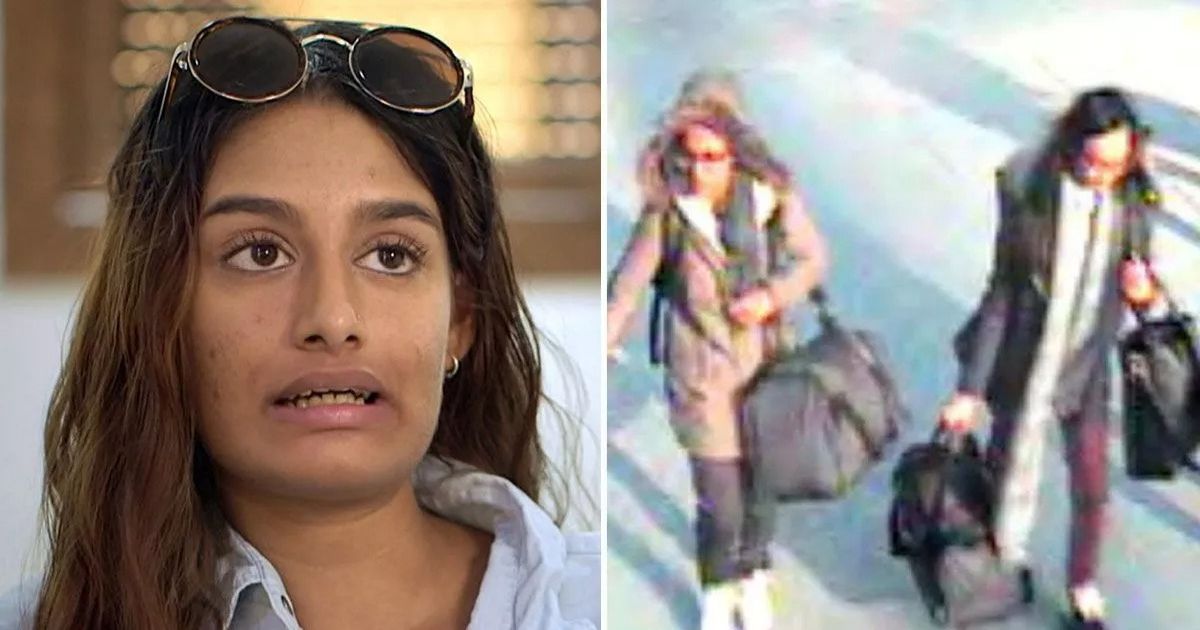
ISIS bride Shamima Begum who fled the UK to join the Islamic State could soon be free from the Syrian detention camp where she is being held amid violent clashes.
Shamima Begum, the schoolgirl who became one of Britain’s most notorious jihadi brides, could soon be free from the detention camp she has been held in after losing her British citizenship. Aged just 15, Begum abandoned her family to join Islamic State (ISIS).
The choice resulted in her citizenship being revoked and her detention in a Syrian camp described as “dangerous”. Now 26 and still yearning to return home, Begum had a brief exchange with the Daily Express from the “filthy” camp, with journalists observing that “her eyes were somewhat sunken, and she seemed pale, as well as very thin”.
She is currently in the al-Roj camp in the region, but could soon be free. The Syrian government has announced a ceasefire with the Syrian Democratic Forces (SDF), taking almost full control of the country and dismantling the Kurdish-led forces which controlled the north east for more than a decade, reports the Mirror.
Lawyers for Begum have appealed to the European Court of Human Rights, which has demanded answers from Britain over the move.
Far less is known about Begum’s two schoolmates, Kadiza Sultana and Amira Abase, who were merely 16 and 15 respectively when they undertook the dangerous trek from London to Syria in February 2015. The threesome, all top-grade pupils at Bethnal Green Academy, witnessed their lives change dramatically.
With Begum’s case back in the spotlight, we examine what became of her classmates and fellow ISIS brides, Sultana and Abase.
The three teenagers made international headlines when CCTV images of them passing through security scanners at a London airport emerged during a desperate bid to stop them reaching their destination. Travelling unaccompanied, Begum wore a leopard print scarf, Abase sported a bright yellow hoodie, and Sultana was dressed in a grey checked scarf and jumper.
The trio were captured once more on CCTV footage at an Istanbul bus station in Turkey, dragging their weighty luggage through the snow whilst queuing for public transport. However, by the time authorities issued their public appeal, it was far too late – the teenagers had already slipped across the Syrian border and become brides to ISIS militants.
What exactly they did within the so-called caliphate remains uncertain. Begum maintains she simply kept house, whilst intelligence officials claim she helped stitch explosives into suicide vests.
Sultana, the oldest of the three teenagers, had married an American ISIS combatant. Yet in telephone conversations with her UK-based sister, recorded by ITV News, she voiced her wish to come home to Britain but confessed she was “scared”.
Her sister Halima, reacting straight after the conversation, revealed: “She sounds very terrified. She did get very emotional there as well. I feel really helpless. What can I do? It’s really hard. I don’t think she’s ever made a choice by herself. That was the first one and a very big one. I just look forward to the next call and that’s what keeps me going.”
Sultana is thought to have perished in a Russian air strike several weeks afterwards in May 2016, though this has never been confirmed independently. The family’s legal representative, Tasnime Akunjee, informed BBC Newsnight they’d been notified of her death in Raqqa.
Mr Akunjee added: “I think she found out pretty quickly that the propaganda doesn’t match up with the reality.”
He went on to say: “The problem with that was the risk factors around leaving are quite terminal also, in that if ISIS were able to detect and capture you, then their punishment is quite brutal for trying to leave. In the week where she was thinking of these issues, a young Austrian girl had been caught trying to leave ISIS territory and was, by all reports, beaten to death publicly, so given that that was circulated in the region as well as outside – I think Kadiza took that as a bad omen and decided not to take the risk.”
Years on, Begum spoke about losing her friend, saying: “Her house was bombed. Underground, there was secret stuff going on, and a spy had figured out that something was going on, and other people got killed as well. At first, I was in denial. I thought if we died, we’d die together.”
Abase married ISIS fighter Abdullah Elmir, an 18 year old Australian who became known as the Ginger Jihadi because of his red hair. He was killed in a drone strike in December 2015.
Abase had been messaging her mum, Fetia Hussen, back in Britain through social media, but the contact suddenly stopped, leaving her mum fearing her daughter had died too. Yet Begum has previously insisted Abase is still alive.
Begum married ISIS fighter and Dutch national Yago Riedijk, 27, when she was only 15 and had three children with him, all of whom later died. In 2019, Begum was deprived of her British citizenship and in 2023, she lost her appeal to regain it.
In 2025, it was reported that Begum had been selling food parcels given to her by aid agencies in a detention camp to raise enough money for Western clothes and hair dye. Begum has tried to reverse the government’s 2019 decision to revoke her citizenship on national security grounds.
However, in August 2024, judges decided that she would not be allowed to challenge the removal at the Supreme Court as the grounds of her case “do not raise an arguable point of law.”
At the time, her solicitor, Daniel Furner, said: “We are not going to stop fighting until she does get justice and until she is safely back home”.
The issue of whether Begum will be allowed back to London was discussed again following the fall of the Assad regime in December 2024.
However, during these discussions, the now Deputy Prime Minister David Lammy promised that Begum would never be permitted to return to the UK after President Donald Trump’s counter-terrorism chief declared that British members of ISIS currently living in Syrian prison camps should be repatriated.
Sebastian Gorka, a prominent figure in the Trump administration, stated that any country wishing to be seen as a “serious ally” of the US should commit to repatriating citizens in northeastern Syria.
However, Mr Lammy, then Foreign Secretary, made it abundantly clear that the Government would “always put British security interests first and the safeguarding of our population.”
During an appearance on ITV’s Good Morning Britain at the time, Mr Lammy stated: ” Shamima Begum will not be coming back to the UK. It’s gone right through the courts. She’s not a UK national. We will not be bringing her back to the UK. We’re really clear about that. We will act in our security interests. And many of those in those camps are dangerous, are radicals.”
Mr Lammy went on to say that should these individuals return to the UK, some of them “would have to be, frankly, jailed as soon as they arrived”.
Despite exhausting all legal options when the Supreme Court rejected a final appeal bid in August 2024, Begum continues to harbour hopes of returning to the UK, with her legal team now attempting to present a case to the European Court of Human Rights.
In their ruling, justices determined the decision would rest with the court, noting it would need to establish whether the procedure to strip her of her British citizenship ought to have taken into account that she might have been a victim of trafficking. Her legal representatives argued the UK had failed to step in and secure the return “of their citizens and their children” who have been “arbitrarily imprisoned”.
They declared: “It is a matter of the gravest concern that British women and children have been arbitrarily imprisoned in a Syrian camp for five years, all detained indefinitely without any prospect of a trial. All other countries in the UK’s position have intervened and achieved the return of their citizens and their children.”



