News Beat
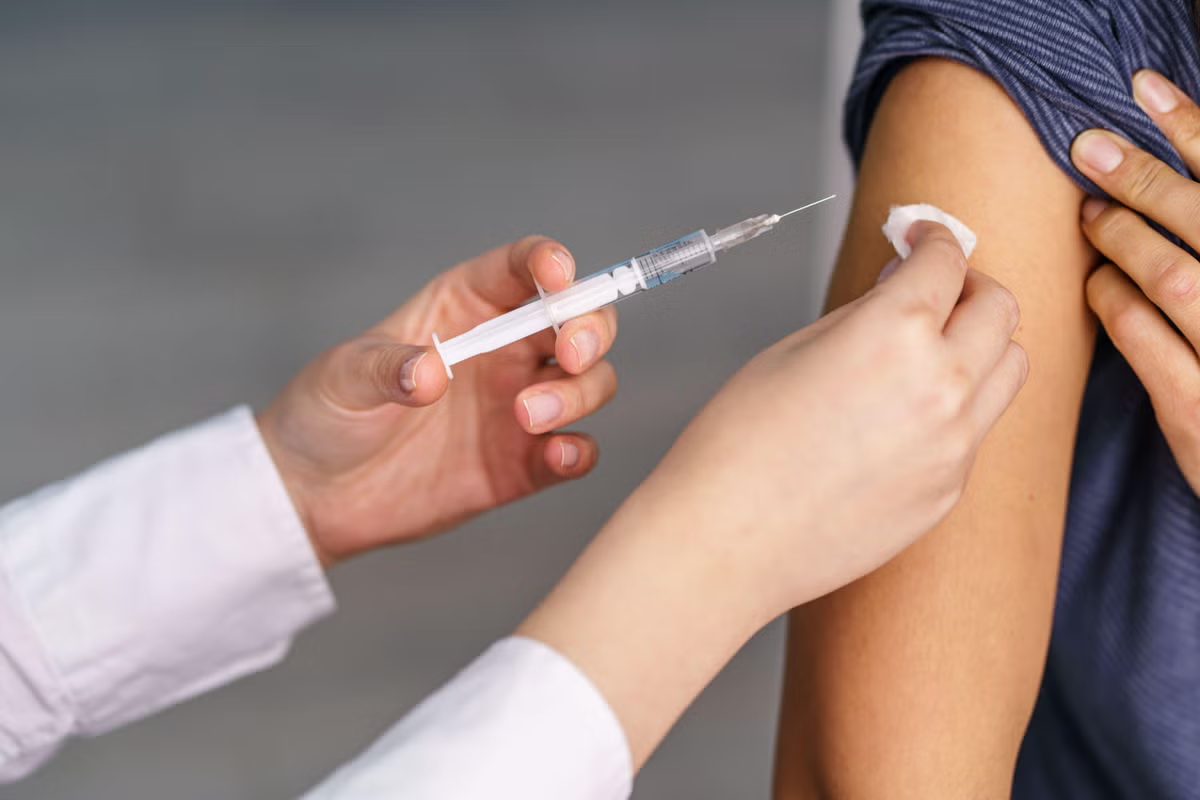
Should a young healthy person like me get a flu jab?

Ginger shots, clementines, 10-hour sleeps, soup, spice, surplus hydration, supplements – for the past three weeks, I’ve tried just about everything and anything to stop myself getting sick. Still, as hard as I fight, I can feel something brewing in the background; achy limbs, heavy head, elevated body temperature. While it’s not yet the horrendous H3N2 flu strain out in full force, something is decidedly not right.
It’s hardly surprising. Cold and flu levels in the UK are absurd right now. An average of 2,660 patients per day were in a hospital bed with flu last week, with the sick being urged to wear masks if they have to go outside to tackle the wave. Inevitably, this has also seen a surge in Covid lockdown flashbacks, and turned my mind more specifically to December 2020, when we were advised to see our loved ones in a “limited and cautious” way, while the Alpha B117 variant was spreading rapidly across the country.
Flu for Christmas wouldn’t be fun for me – but it almost certainly wouldn’t be fatal. The same can’t be said for my 87-year-old nana, who’s firmly in the high-risk realm. Although she’s protected by the flu vaccine, that doesn’t make her invincible to the hopped-up H3N2 strain, and I worry about contaminating her. For the price of £21.95 at Boots, could it be worth getting jabbed even if the NHS doesn’t dictate to?
“If you’re a young person who doesn’t have an underlying condition that makes you eligible, you should still consider having the flu jab,” says Dr Nisa Aslam, a NHS GP, who points to the local pharmacy, Boots or Superdrug as one of the many high street locations you can book a vaccine appointment with ease or difficulty – depending on whereabouts in the UK you live. Currently, in south London, it’s a struggle.
This is frustrating, as Dr Aslam says it’s essential to get booked in ASAP if you want protection for Christmas – but that’s, of course, easier said than done. “For most people, it takes around 10 days to two weeks for the protection to kick in,” she explains.“It could be a bit longer. Or, it could be a bit less. So, the most practical thing to do is get your flu jab as soon as you can.”
And it’s not just your loved ones you could be protecting, either. “The other group you’re protecting are individuals in the community who are unable to have the flu vaccines, so this could be transplant, organ transplant recipients,” Dr Aslam says. “It might be people who’re allergic to ingredients in the flu vaccine. So, there are lots of good reasons to go and have the flu vaccine, essentially.”
Superflu has also pushed the NHS to the brink, with leading medics warning of severe hospital overcrowding, countless staff members struck down with illness and a worrying number of cases among children. “We’ve had more hospitalisations at this time of the year compared to previous years,” says Dr Aslam.

And it’s important to remember that just because you don’t feel sick, it doesn’t mean you’re not carrying the virus. “You can basically be infectious for 24 hours before you first develop symptoms,” Dr Aslam warns. “Then, you can continue to be infectious for up to a week afterwards.”
“Maybe, if someone is very frail, undergoing chemotherapy or a very young baby, for example, then try to keep your distance,” the GP suggests. “Don’t get too close, and remember things like hand hygiene, disposing of any used tissues, and ventilating the room that you’re going to spend time in, because all of those things mean that you can still see your loved ones but you’re taking measures to protect them.”
It’s important to note that even if you and your loved ones have had the flu vaccine, it can still be worth following these measures to avoid infecting somebody vulnerable.
“It’s hard to know,” acknowledges Dr Aslam of the gamble many of us will take this festive season. “You can’t make hard and fast rules, because we have to balance protecting loved ones from mental health [issues] with things like loneliness.” Notably, a recent Age UK study found that more than a million older people could be spending Christmas alone, while five per cent won’t see or speak to anyone during the entire day.
So, at the risk of sounding like we’ve stepped back into a time machine, there appears to be an obvious answer here: “The one thing that the pandemic taught us is that if you can comfortably tolerate a mask, then it’s going to help,” says Dr Aslam. “These viruses are spread through respiratory droplets, and masks absolutely do provide a layer of protection.”
Ho, ho, oh no, here we go again.