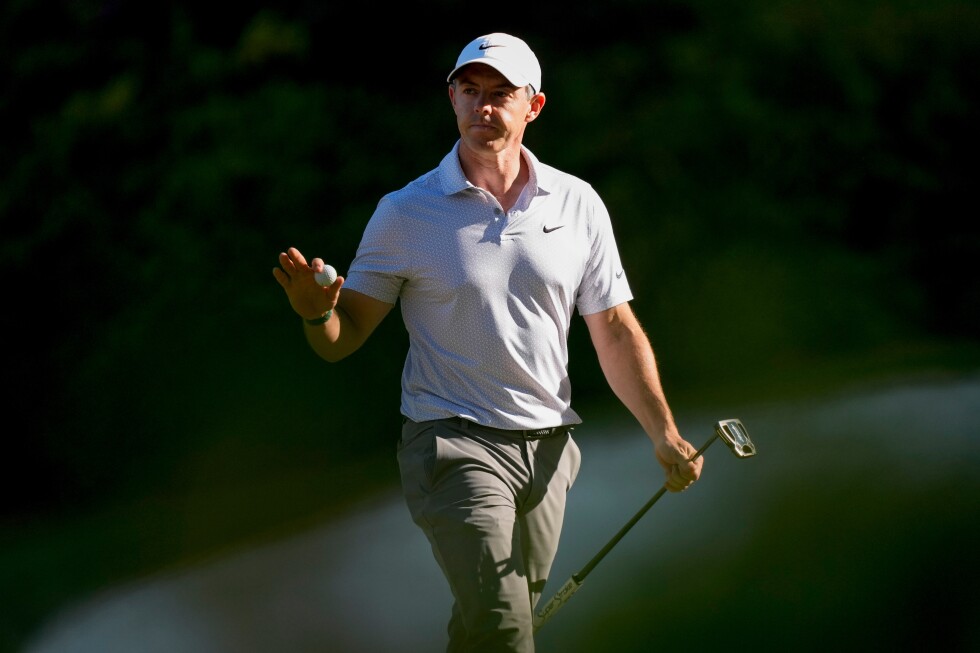
AUGUSTA, Ga. (AP) — Rory McIlroy planned to keep his mind off golf as much as possible while awaiting the third round of the Masters.
“There’s actually two really good semifinals at Monte Carlo in the tennis. So I’ll watch that,” he said. “We’ve been watching the tennis early in the mornings.”
The tennis matches might be more competitive than what’s taken place so far at Augusta National, where McIlroy led by a record six strokes after 36 holes. He birdied six of the last seven in a second-round 65 on Friday that left him at 12 under par for the tournament.
Now this could go a few different ways. McIlroy could cruise to victory and become the fourth player to win back-to-back Masters. He could maintain this level of domination and challenge Tiger Woods’ record for margin of victory (12) or Dustin Johnson’s for lowest score (20 under).
Advertisement
Or he could blow the lead and make history that way — 36 holes is a lot of golf still to play.
“Look, I’ve built up a nice cushion at this point,” McIlroy said. “I guess my mindset is just trying to keep playing well and keeping my foot on the gas.”
McIlroy nearly was paired in Saturday’s final group with Patrick Reed, his foil during a memorable Ryder Cup match in 2016 and in the final group of the 2018 Masters, won by Reed. But a bogey on the 18th hole Friday left Reed tied for second with Sam Burns, who will play with McIlroy on Saturday.
“Just have to wait and see what the weekend entails,” Reed said. “Hopefully I can go out and have a good day tomorrow and have a good shot going into Sunday.”
Advertisement
Justin Rose, Shane Lowry and Tommy Fleetwood were another stroke back at 5 under.
Bryson DeChambeau won’t be playing this weekend after finishing at 6 over and missing the cut. He owed his exit to a pair of triple bogeys in which he needed multiple shots to get out of bunkers. The first was on No. 11 on Thursday. The second was on the 18th hole Friday, when he only needed a bogey to play on.
Before McIlroy finished his run of six birdies in the last seven holes Friday, the best round of the tournament was Tyrrell Hatton’s second-round 66. He was at 4 under along with Wyndham Clark, Haotong Li, Jason Day, Cameron Young and unheralded Norwegian Kristoffer Reitan.
The rest of the field shouldn’t give up. McIlroy, after all, shot 80 in the final round in 2011 after leading the Masters following the first three rounds.
Advertisement
He’s a different player now, though.
“Becoming a wily old veteran,” McIlroy said. “Even go back to the final round in 2011, hitting it in that bunker off the tee at the second hole and, like, not panicking, but thinking, ‘oh, this isn’t good.’ I can’t go for this in two. How am I — and I walk up there today, and it’s like, no, I lay it up to a good number, and I’ll have a good chance to make a birdie.”
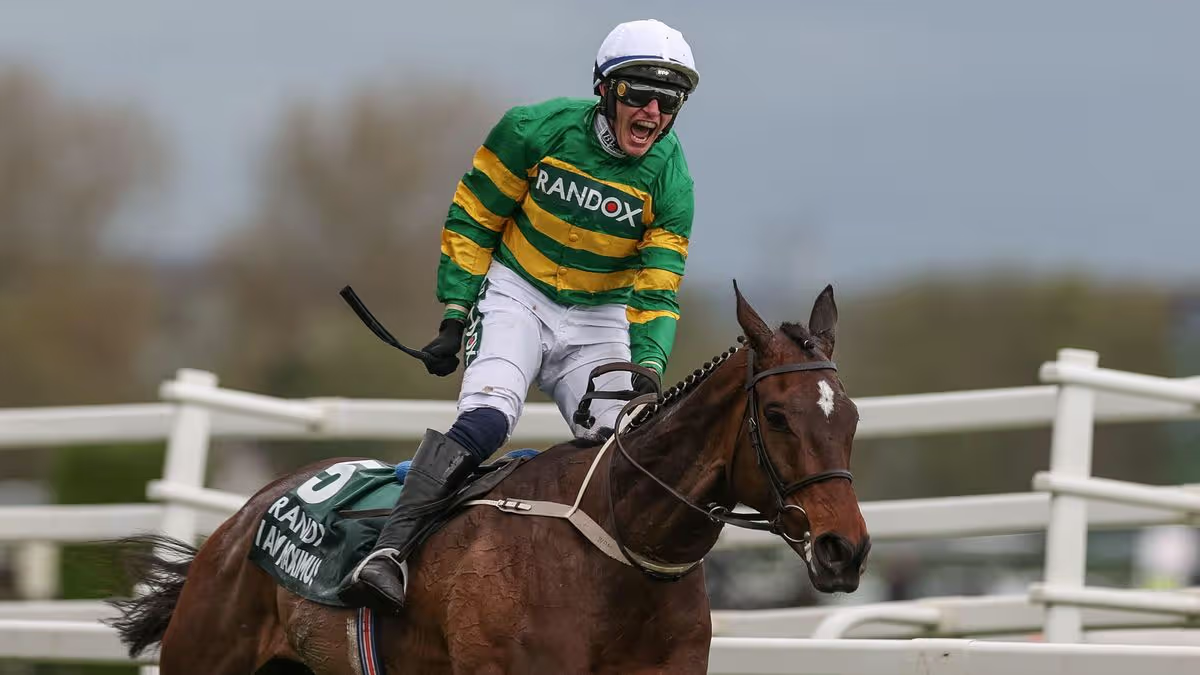
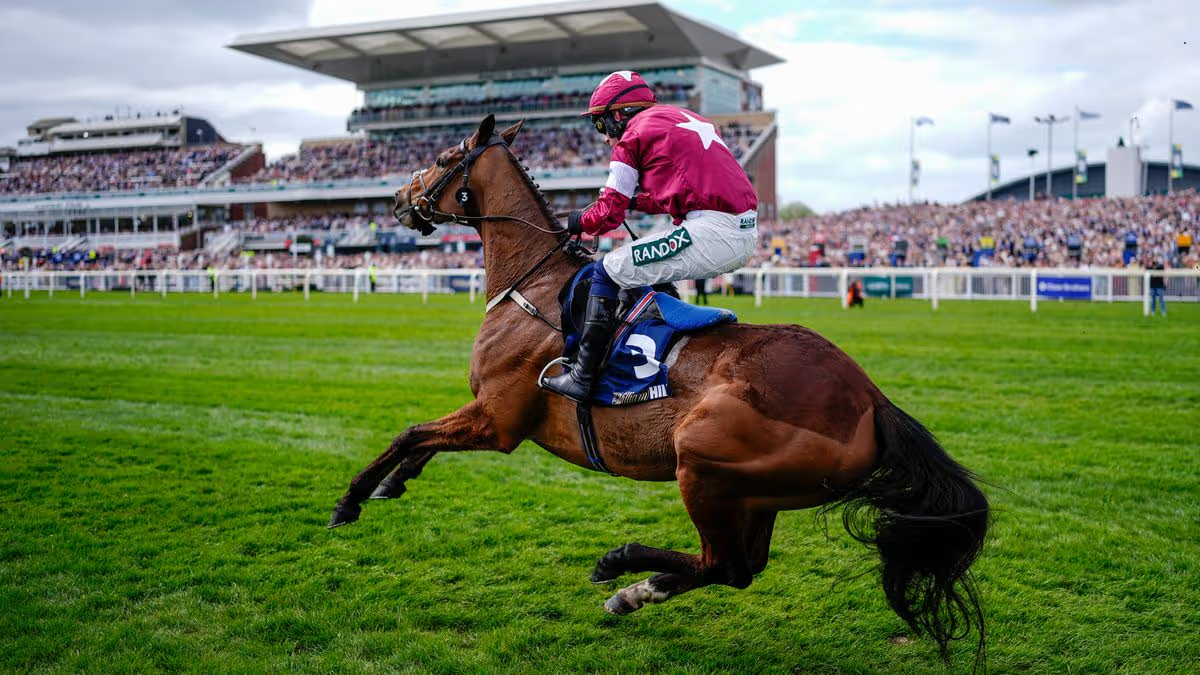
The Grand National took place at Aintree at 4pm on Saturday, April 11 – with Paul Townend riding I Am Maximus to a second title at the biggest horse racing event of the seasonal calendar
16:13, 11 Apr 2026Updated 16:20, 11 Apr 2026
I Am Maximus has won the 2026 Grand National. It marks the second title that the JP McManus-owned horse has won, joining Tiger Roll in becoming a two-time champion at one of racing’s most prestigious events.
It also sees McManus become the most highly-decorated owner in the event’s history, with four wins at the National.
Here are how the other horses placed at the Grand National…
There will be more to follow on this breaking news storyand Mirror Sport will bring you the very latest updates, pictures and video as soon as possible.
DEIR EL-ZOUR, Syria (AP) — A Syrian man on Saturday buried his wife and four of his five children, killed in the massive wave of Israeli strikes that pounded Beirut earlier this week, laying them to rest in Deir el-Zour province in northeastern Syria.
It was not the homecoming they had anticipated when they fled to Lebanon six years ago.
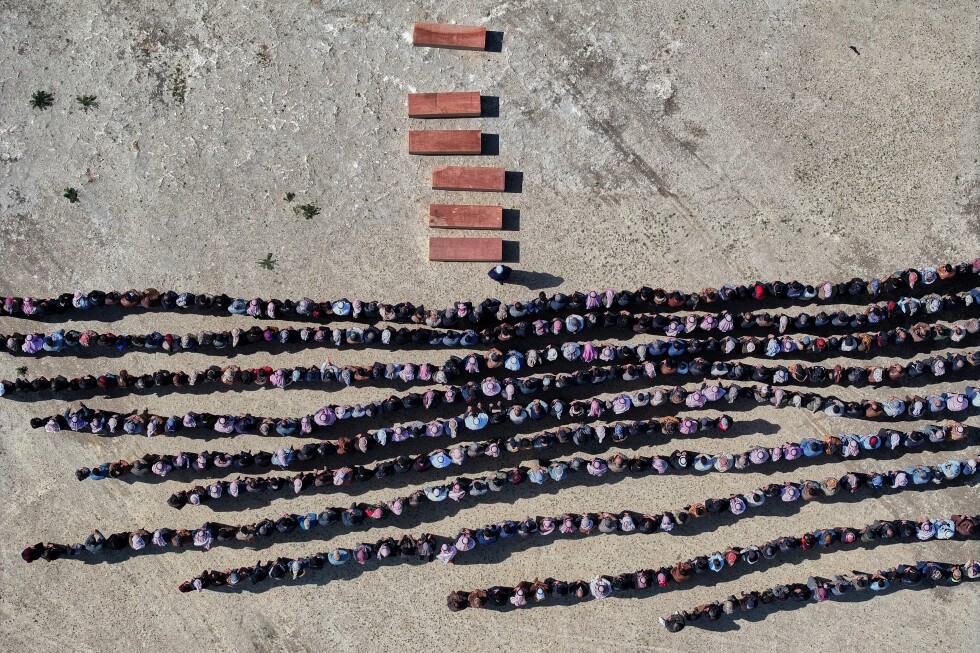
The bodies, along with that of his six-month pregnant daughter-in-law, arrived in wooden coffins on a bus from Lebanon, their names scribbled on the sides. Men stood beside the bus crying before the burial procession in al-Sour town, as mourners gathered to offer condolences.
The remains of one of his two daughters were still missing, believed to be trapped under rubble, as search operations concluded Saturday, three days after the attacks.
Advertisement
The strike was one of roughly 100 carried out by Israel on Wednesday without warning, targeting what the Israeli military said were Hezbollah-linked sites across Beirut and other parts of Lebanon. More than 350 people were killed that day, a third being women and children, making it the deadliest day in nearly six weeks of war.
Many of the strikes hit commercial streets and densely populated neighborhoods in central Beirut, far from conflict zones, where repeated Israeli evacuation warnings have been issued since March 2, when the Iran-backed militant group Hezbollah fired missiles into Israel in retaliation for the U.S.-Israeli attacks on Iran.
A father’s grief
The father, Hamad al-Jalib, survived because he was away fetching a gas canister while working as the building’s concierge. When he heard that a strike had hit the Ain Mreisseh neighborhood, where he lives, he rushed back, only to see a plume of smoke rising from a building behind a mosque across from Beirut’s famous seaside promenade — usually crowded with people walking and exercising.
“The Israeli attack killed my girls, they are innocent, just sitting at home,” al-Jalib said. “They were having lunch.”
Advertisement
He said it took rescue teams three days to extract the bodies of his family from under the rubble. “And I still have a daughter missing, her name is Fatima Hamad al-Jalib.” She is 10 years old. His other daughter was 12 while his sons were 17, 14 and 13 years old.
Three other Syrian relatives were also killed in the Ain Mreisseh strike and were buried on Saturday in the town of al-Shuhail in Deir el-Zour, after the family split upon returning to Syria.
Al-Jalib said his family had been displaced from their area and moved to Lebanon in 2020, as local tensions grew involving tribal groups and the Kurdish-led Syrian Democratic Forces.
Syrian refugees among the dead and wounded
The casualties from Wednesday’s strikes and others across the country have pushed the death toll in more than a month of Israel’s war with Hezbollah to over 1,950 killed and more than 6,300 wounded, according to Lebanon’s Health Ministry. The toll includes at least 315 Syrians killed and wounded.
Advertisement
It remains unclear how many of those killed on Wednesday were non-Lebanese, as the Health Ministry did not provide a breakdown by nationality. Officials have reported that at least 39 Syrians were among the dead.
Dalal Harb, a spokesperson for the U.N. refugee agency, said the family killed in Ain Mreisseh was not registered with the UNHCR. There are about 530,000 Syrians refugees registered with UNHCR in Lebanon, with hundreds of thousands more believed to be unregistered.
Advertisement
Sign up for Morning Wire:
Our flagship newsletter breaks down the biggest headlines of the day.
Advertisement
While hundreds of thousands of Syrians have returned from Lebanon since the ouster of former Syrian President Bashar Assad in December 2024, many others remain reluctant to go back because of the lack of jobs and ongoing violence.
Al-Jalib’s brother, Jomaa, who also lived in Lebanon, said he was about 150 meters (500 feet) away at work when the first blast hit. “We ran and we ran, then the second strike happened.” He said he was arriving at the building as it began to collapse. “It was too late to get anyone out. We yelled for them, but no one answered.”
He said ambulances later recovered the bodies, which he identified at a hospital.
Following the burial on Saturday, men stood shoulder to shoulder in prayer over the fresh graves.
Advertisement
——-
Associated Press writer Abby Sewell in Beirut contributed to this report.
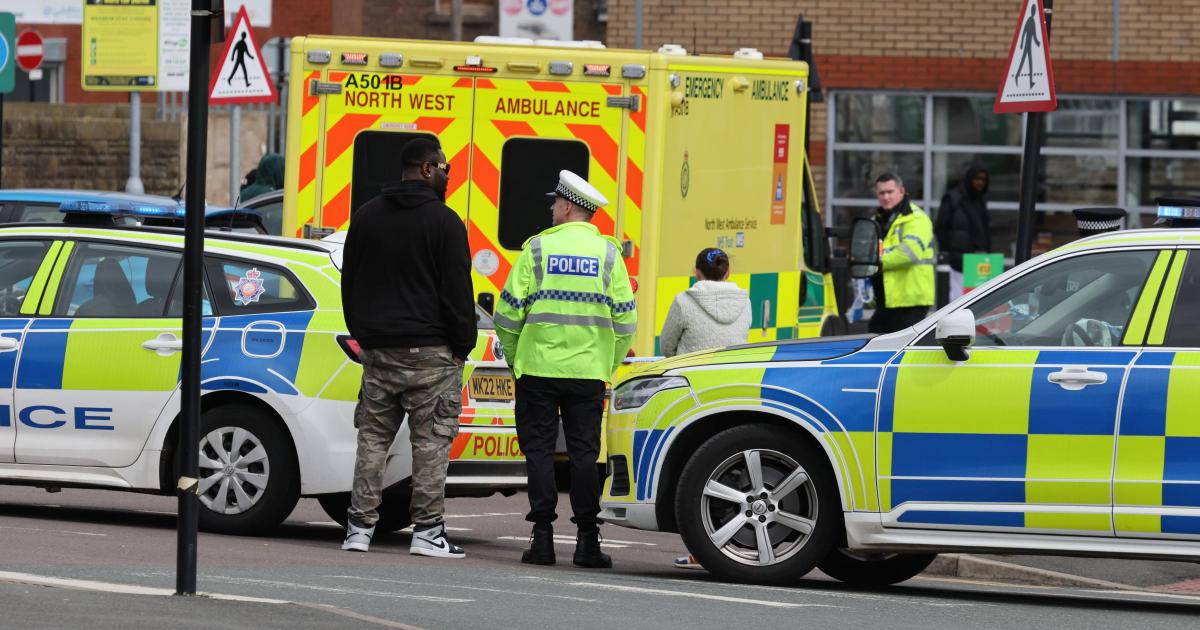
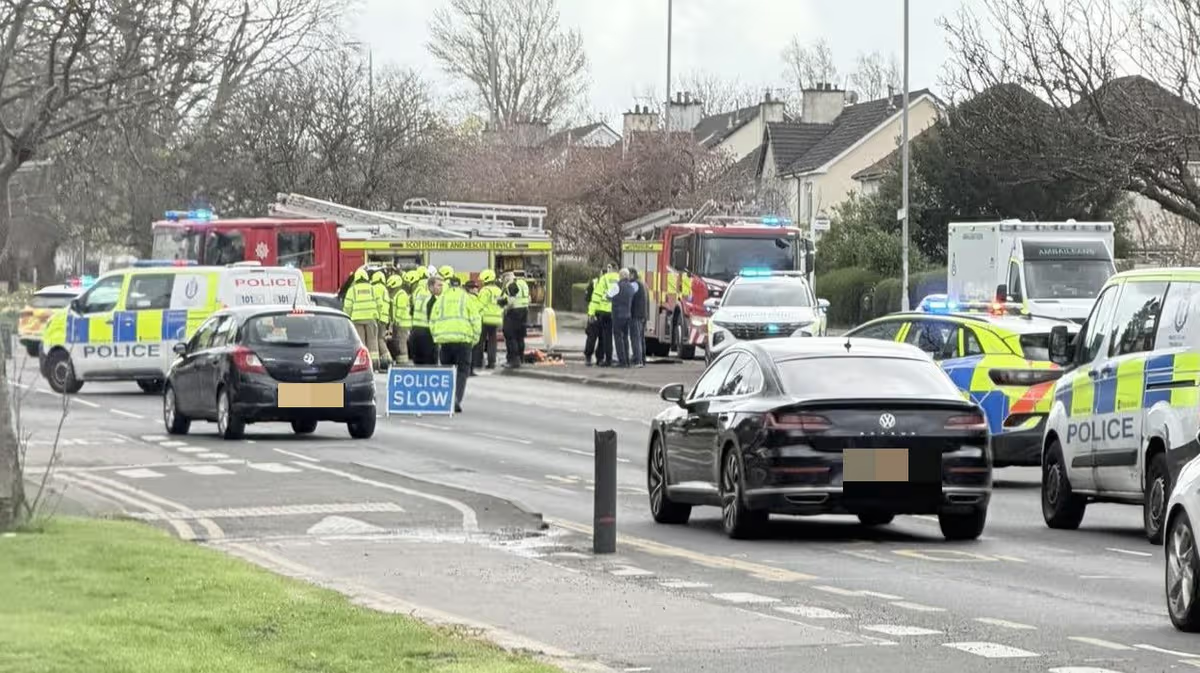
Emergency services were called to Great Western Road, at the junction with Lincoln Avenue, after the alarm was raised at around 2pm on Saturday, April 11.
A major road in Glasgow has been blocked off following a crash this afternoon.
Advertisement
Emergency services were called to Great Western Road, at the junction with Lincoln Avenue, after the alarm was raised at around 2pm on Saturday, April 11.
An image shared with the Record shows a significant number of police officers and fire crews at the scene. Ambulance crews are also in attendance.
Unconfirmed reports suggest emergency crews are working to cut a passenger out of the back seat of a taxi following the collision.
The number of vehicles involved and the nature of any injuries is not yet known.
Advertisement
An eyewitness said: “Avoid Great Western Road at the Lincoln Avenue junction. Horrendous smash affecting both sides of the road. They’re trying to cut a passenger out the back seat of a taxi by the looks of it. Hope everyone involved is okay.”
A spokesperson for the Scottish Fire and Rescue Service confirmed that two engines are currently on the scene to assist.
The Record has contacted Police Scotland for comment.
Get more Daily Record exclusives by signing up for free to Google’s preferred sources. Click HERE.
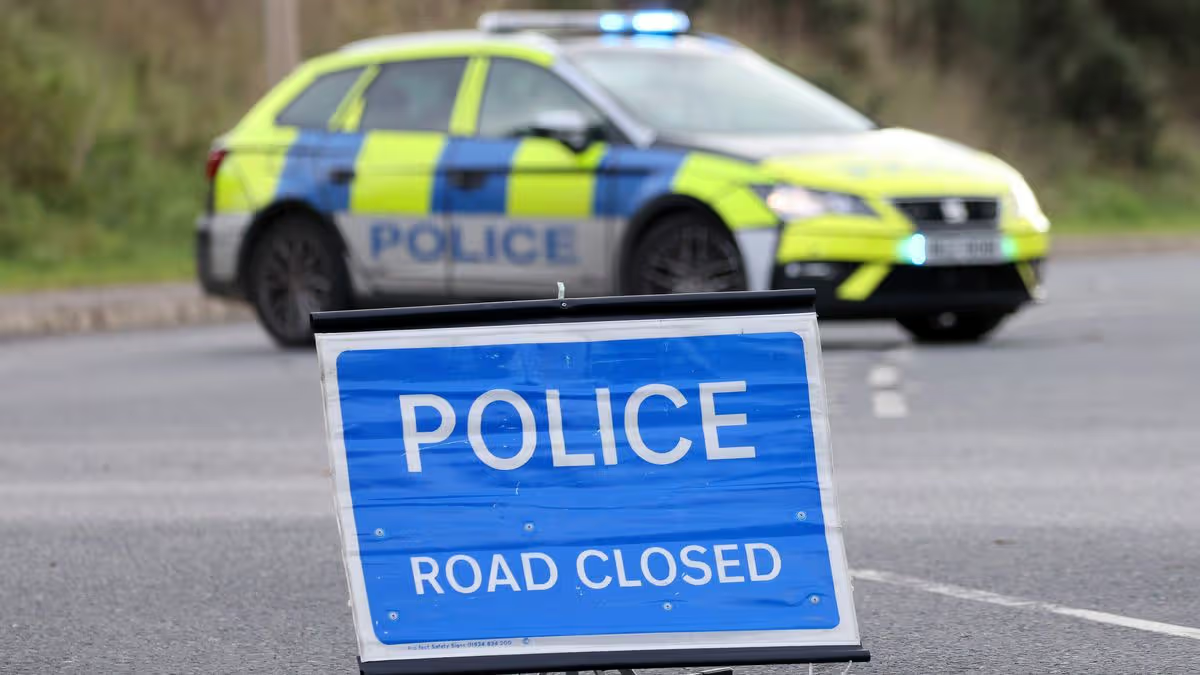
The full closure of the M1 westbound between junction 7 and junction 8 at Sprucefield, Lisburn has taken place following an incident. PSNI officers have been confirmed as attending the scene.
TrafficWatch NI reported that the incident happened shortly after 3pm on Saturday afternoon.
A PSNI spokesperson said: “Road users are advised of the full closure of the M1 westbound between junction 7 and junction 8, Sprucefield.
Advertisement
“All westbound traffic can exit at junction 7 and return at junction 8. Eastbound traffic can exit at junction 8 and return at 7.
Add this to your 2026 to-do list boys (Picture: Getty Images)
Hold for 1…2…3… and release.
Women have long been doing their Kegel exercises, squeezing their pelvic floor muscles while sitting on the sofa or on their office chairs, unbeknownst to those around them.
They’re recommended by the NHS to combat a variety of health concerns, mostly commonly urinary incontinence, associated with pregnancy and childbirth.
But let’s be real, it’s not just the girlies who need to look after their pelvic floor.
Advertisement
‘Penis Kegels’ are a thing too — also recommended by the NHS — and those who choose to incorporate the simple exercises into their daily routine could see an improvement in bladder control, prostate health — and even sexual performance.
That’s right, stronger erections could be on the horizon.
Here’s everything the guys out there need to know about squeezing those pelvic floor muscles. We’re doing ours right now…
Why are ‘penis Kegels’ beneficial?
Next time you see a colleague looking extra concentrated at his desk, leave him to it okay! (Picture: Getty Images)
Sign up to The Hook-Up, Metro’s sex and dating newsletter
Love reading juicy stories like this? Need some tips for how to spice things up in the bedroom?
Sign up to The Hook-Up and we’ll slide into your inbox every week with all the latest sex and dating stories from Metro. We can’t wait for you to join us!
Advertisement
Urologist Dr Ashwin Sridhar tells Metro: ‘The pelvic floor muscles act like a hammock supporting your internal organs. So, when these muscles are strong, they provide several health benefits.’
Bladder Control. According to Dr Ashwin, Kegels prevent ‘post-urination dribble’ (leaking a few drops after leaving the toilet) and help manage urinary incontinence, especially after prostate surgery.
Bowel Control. Kegels can help prevent fecal incontinence.
Prostate Health. They can help manage pain and swelling associated with prostatitis (inflammation of the prostate) and BPH (enlarged prostate).
Core Stability. As part of the ‘deep core,’ Kegels contribute to overall pelvic stability and lower back support.
Can penis Kegels improve sexual performance?
It’s not just your bladder that Kegels have a positive impact on.
Dr Ashwin shares that one of the ‘most significant motivators for men to perform Kegels’ is, in fact, to do with sexual function.
Advertisement
‘Strong pelvic floor muscles directly influence the mechanics of erection and ejaculation,’ he explains.
Kegels can help with erectile dysfunction, for example: ‘The pelvic floor muscles help trap blood in the penis to maintain an erection. Strengthening them can lead to harder, longer-lasting erections.’
The more you know… (Picture: Getty Images)
Penis kegels can also help with premature ejaculation (PE). Dr Ashwin notes how ‘Kegels give you better control over the ejaculatory reflex. Men with strong pelvic floors can often voluntarily “squeeze” to delay orgasm.’
Interestingly, by doing regular penis Kegels, men can also develop a ‘stronger contraction during ejaculation’ which Dr Ashwin explains can lead to ‘more intense and pleasurable orgasms.’
How do Kegels for men work?
There are a couple of ways men can practice their Kegels. But Dr Ashwin specifically recommends starting with the standard Kegel to ease yourself in.
Advertisement
Step 1: Find the muscle
Dr Ashwin reminds men, ‘you cannot strengthen a muscle you cannot feel.’ So, first things first, is to locate it. There are two main ways you can do this.
There’s the delicately named Stop Gas Method. This involves imagining you’re in a crowded elevator and need to stop yourself from passing gas. The muscle you squeeze to pull your anus inward is the pelvic floor.
Next time you’re in a lift, why not try the ‘Stop Gas’ method out! (Picture: Getty Images)
Next, you can try the Stop Pee Method.
Next time you urinate, try to stop the flow mid-stream. If you succeed, you’ve found the muscle.
Step 2: The technique, aka ‘the squeeze and lift’
Once you know where the muscle is, the next step is the actual Kegel itself – you can do this sitting, standing, or lying down.
Advertisement
You’re going to isolate (aka squeeze) the muscle you identified in step one. Then, imagine you’re trying to lift your scrotum upwards into your body.
A thing to remember, Dr Ashwin notes, is that you should not hold your breath, clench your buttocks, or tighten your thighs.
‘Your body should look completely relaxed from the outside; the work is all internal.’
Step 3: The routine
It’s recommended that you perform 10 repetitions in a row, aiming for three sets per day – in the morning, afternoon, and evening.
Advertisement
‘While squats and glute bridges help the general area, the standard Kegel is the most effective isolation exercise for these specific muscles,’ the expert adds.
He continues: ‘Also, the “relax” phase is just as important as the squeeze. If you don’t fully relax between reps, you risk over-tightening the muscle (hypertonicity), which can cause pelvic pain.’
Is it too late to start penis Kegels?
While there isn’t a specific ‘start date’, the sooner you start these kegels, the better.
‘Muscles naturally weaken with age,’ Dr Ashwin explains.
Advertisement
‘Starting in your 20s or 30s establishes a strong baseline that can prevent incontinence and ED later in life.’
Moreover, the goal is to make Kegels a lifelong habit: ‘Like brushing your teeth, this is something you should try to do your whole life.
‘It is widely recommended for older men, particularly those preparing for or recovering from prostate treatment.’
If you are just starting out, it’s crucial to build endurance gradually so the muscles don’t cramp.
Advertisement
Dr Ashwin recommends the following guide:
Beginner: Hold for 3 seconds, then relax for 3 seconds.
Intermediate: Hold for 5 seconds, then relax for 5 seconds.
Goal: Work your way up to holding for 10 seconds, with 10 seconds of rest between reps.
As a result, a return to winning ways after three league games without one is imperative for Arne Slot’s side, especially with Chelsea facing Manchester City and Brentford facing Everton across the weekend.
Fulham, meanwhile, are very much in contention to qualify for Europe – whether that be the Europa League or the Conference League – and head to Merseyside in decent form having won three of their last five league matches.
Date, kick-off time and venue
Liverpool vs Fulham is scheduled for a 5.30pm BST kick-off today, Saturday, April 11, 2026.
Advertisement
The match will take place at Anfield, in Liverpool.
Where to watch Liverpool vs Fulham
TV channel: In the UK, the game will be televised live on Sky Sports. Coverage starts at 5pm BST on Sky Sports Main Event and Sky Sports Premier League.
Live stream: Sky Sports subscribers can also catch the contest live online via the Sky Go app.
Advertisement
Live blog: You can follow all the action on matchday via Standard Sport’s live blog.
Liverpool vs Fulham team news
Liverpool will be without Alisson Becker once again through injury, while Conor Bradley, Giovanni Leoni and Wataru Endo are long-term absentees.
Slot also said he was “worried” about Joe Gomez and Jeremie Frimpong.
Advertisement
Kenny Tete and Harrison Reed have been ruled out, as has Fulham’s club-record signing Kevin after undergoing successful surgery on an injury to his fifth metatarsal last month.
Calvin Bassey, however, is fit having recovered from a back problem that forced him to pull out of the Nigeria squad during the international break.
Mohamed Salah could return for Liverpool against Fulham
Liverpool FC via Getty Images
Advertisement
Liverpool vs Fulham prediction
Liverpool will need to regain a spark in the Premier League having gone three games without a win. Facing a Fulham side more than capable of getting a result makes this a tricky test for the hosts.
Though, confirmation that a top-five finish will earn Champions League qualification should ease the pressure on Slot who continues to face speculation regarding his future.
We expect Liverpool to have too much quality for Fulham and secure a much-needed win to boost confidence going into a season-defining week.
Advertisement
Head to head (h2h) history and results
Arne Slot, as Liverpool head coach, is yet to record a win over Marco Silva and Fulham in three attempts, drawing two and losing one.
Simon Minty posted an Instagram update confirming his future on Gogglebox after not feeling well, with fans rushing to support the Channel 4 star
Joe Crutchley Screen Time reporter
15:22, 11 Apr 2026Updated 15:26, 11 Apr 2026
A much-loved Gogglebox star has shared an update on their future on the programme after “not feeling so well”.
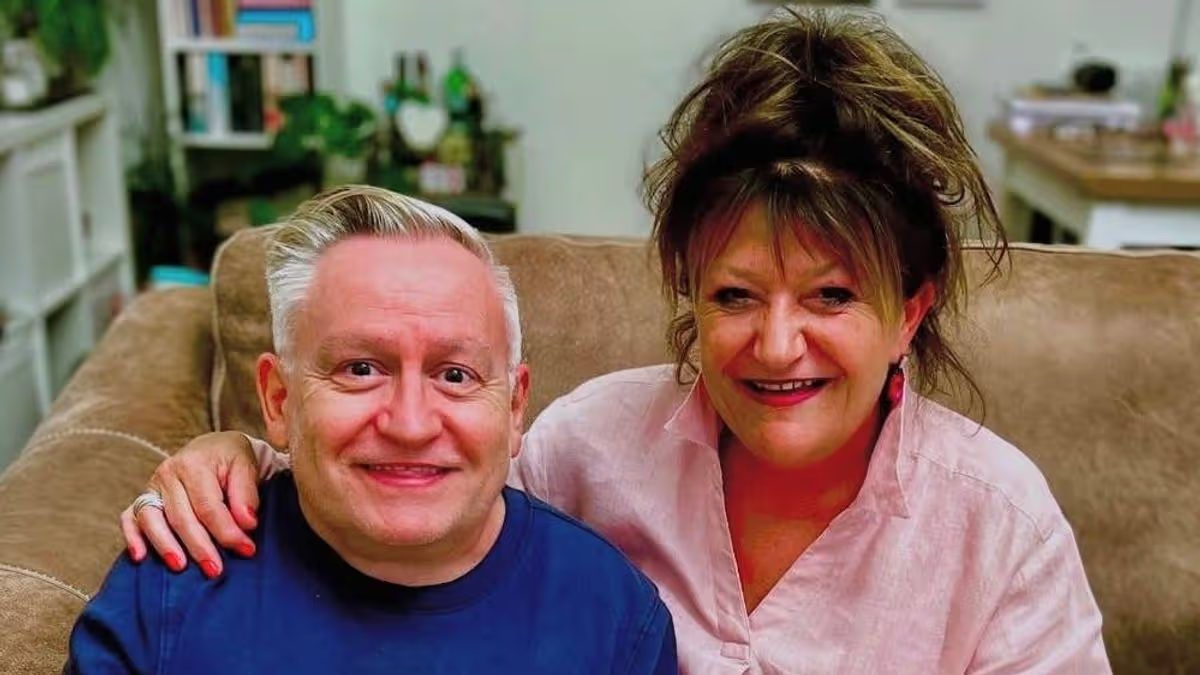
Simon Minty first appeared on the long-running Channel 4 show back in 2021, alongside sister Jane – and it didn’t take long for the pair to become firm favourites amongst viewers.
Advertisement
Over the years, Simon and Jane – who are based in Surrey – have had fans in stitches with their witty one-liners and amusing reactions to the week’s television highlights.
Away from the Gogglebox sofa, Jane works as a chef, while Simon, who was born with restricted growth, is a committed disability rights advocate.
The duo have also made their return for the new series of Gogglebox that launched last month, and during Friday’s (April 10) episode the siblings made their comeback following Simon’s bout of illness, reports the Mirror.
Advertisement
On Instagram, the pair shared a photograph of themselves on the sofa. In the caption, Simon wrote: “Gogglebox should be a lot of fun tonight.
“Happy to be back too after not feeling so well. Hope you enjoy it and you have a lovely weekend ahead.”
Content cannot be displayed without consent
As anticipated, his followers swiftly flooded the comments section with messages of support. One person said: “Sorry to hear you haven’t been well. Hope you’re feeling much better now.”
Another added: “Pleased to hear you are feeling better x See you both later.” Echoing the sentiment, a third wrote: “Lovely to see my two favourite people back on Gogglebox Hope you’re feeling much better Simon Sending you both much love as always.”
Advertisement
To the delight of fans, Simon and Minty have continued to appear on Gogglebox for a number of years. However, last year, ahead of the 2025 series, it was confirmed that popular favourites Roisin Kelly and Joe Kyle would not be making a return.
Following Roisin and Joe’s exit, Gogglebox introduced a fresh set of faces to its lineup. Among them are Jake and Calum from Glasgow, the Gordon family from Surrey, and married couple Andrew and Alfie from the Cotswolds.
Mother-and-daughter-in-law duo Sara and Lara from Yorkshire also made their first appearance on the show.
The Grand National is the most famous and popular horse race in the calendar, watched by millions and seen as one of the biggest sporting events in the UK. While it is regarded as something of a national institution, it has not been without controversy over the years, with many horse deaths sparking criticism from animal welfare groups.
Changes have been made in recent years to make the race safer, not least a cut in the number of runners from 40 to 34 and an earlier start time of 4pm. The first fence was also moved 60 yards closer to the start, while there is no longer a parade of the field in an effort to keep the horses calmer and the height of the 11th fence has been lowered by two inches to 4ft 10ins. However, the changes have not been enough to prevent more deaths and injuries.
In total, 89 horses have died after being entered in the race. Last year saw Celebre d’Allen die a few days after the main Aintree race after collapsing on the track.
Advertisement
After modifications to the course were introduced in 2012, six horse deaths have occurred, but a total of 65 have died since 2000 across all races at the three-day festival. There were two at this year’s Grand National festival prior to the start of the main race at 4pm on Saturday.
On Friday, Gold Dancer died after picking up a fatal injury on the way to victory in the William Hill Mildmay Novices’ Chase. It was later revealed the horse broke its back.
An RSPCA spokesperson said: “We are devastated by Gold Dancer’s death.
Advertisement
Aintree Racecourse issued a statement confirming the news, saying: “The winner of our second race of the day, Gold Dancer, was pulled up after the line and dismounted.
“He was immediately attended to by our expert veterinary team but sadly he could not be saved.
“Our heartfelt condolences are with his connections.”
“This is the 42nd fatality linked to competitive horse-racing in the UK this year alone – and it is only April.
Advertisement
“Lessons must be learned from any tragedy like this – around the contributing factors, pre- and mid-race decision-making, and means of prevention.
“We will be speaking with the British Horseracing Authority later today (10 April) to discuss the incident, understand their assessment of what happened, and how it could have been prevented – including an update on the welfare of other horses who are reported to have fallen today.
“The RSPCA continues to engage with the industry in the hope of seeing greater safety measures introduced to the sport, and improvements for equine welfare both on and off the track.”
The number of Grand National race horse deaths since 2000
















































You must be logged in to post a comment Login