Each year as Spotify Wrapped drops, social media timelines fill with neon slides declaring who we “really” are. We trade our top artists and most-played songs like postcards from a year already fading.
It feels communal, a party game to end the year of listening. But this cheerful ritual shows how deeply surveillance has woven itself into our leisure – and, how readily we accept it. It’s what the social psychologist and philosopher Shoshana Zuboff describes in her book The Age of Surveillance Capitalism the “claiming of human experience as free raw material” for predictive data.
Wrapped does more than reflect our taste. It turns private listening into public connection, and connection into content. What looks like play can instead be seen as work. And what feels like recognition of our uniqueness is a reflection of how well we have conformed to the algorithm.
No one’s 20s and 30s look the same. You might be saving for a mortgage or just struggling to pay rent. You could be swiping dating apps, or trying to understand childcare. No matter your current challenges, our Quarter Life series has articles to share in the group chat, or just to remind you that you’re not alone.
Read more from Quarter Life:
At first glance, it’s simple. You listen, Spotify counts. Then it wraps those counts in bright colours and confident language, diagnosing who you are, or who the platform imagines you to be.
Wrapped acts as an identity machine: statistics made into self-portrait. You appear as the “indie purist” or “pop maximalist”. But behind the graphics lies the attention economy, turning every pause into data. What looks like a mirror is really a map drawn to lead you back to using Spotify. That map is built from collecting data on your skipping habits, workout playlists and time-of-day listening.
Leisure once stood apart from labour. Datafication – turning everyday behaviour into trackable, monetisable data – is an answer to an old problem: how to profit from free time. Through this perspective, nearly every facet of life now includes some form of labour.
With apps like Spotify, every engagement creates the highly valuable byproduct of data. Every skip or replay generates data that can be traded and sold. Every share is free advertising. Even when we think we’re unwinding, we’re producing value for someone else.
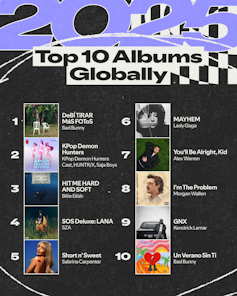
Spotify
The sociologist David Beer, who researches the role of data in social and cultural life, wrote that his Wrapped “in some ways … feels like a performance review of [his] leisure time”.
Being told you’re in the top 1% of listeners of a certain artist feels like recognition, but that pleasure masks a loss of agency. Beer felt his Wrapped was humouring him and rewarding him for being a “good listener”, which seems like a byword for “worker”.
By telling him how long and “well” he had listened, by informing him he had “found ways to grow”, he felt like it was boosting his sense of self in order to keep him coming back.
It is an effective platform strategy. Wrapped spikes app downloads and engagement each December, with Spotify crediting it as a major driver of growth.
Narrowing your tastes
Another thing to be wary of is how Wrapped and Spotify’s algorithm could be shaping your taste. Research suggests recommendation loops tend to reinforce existing habits rather than expand them, producing what scholars call “taste tautology”.
À lire aussi :
Four ways to cultivate a unique taste in music in the age of streaming algorithms
These recommendations – new albums like the ones you love, artists spotlighted who are like your favourites – are presented on the interface so readily or built into the design. For instance, the feature where tracks chosen by the algorithm start playing immediately when the song or album you put on ends. Or “curated” playlists like Discover Weekly – described as “your shortcut to hidden gems, deep cuts, and future faves”.
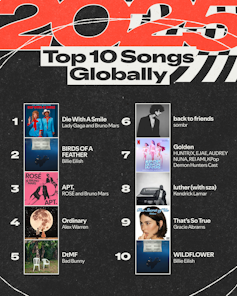
Spotify
But the more we click on these curated options and the more data we feed the app about our listening habits the more we teach the algorithm to serve more of the same rather than surprise us.
Engagement becomes affirmation of who we seemingly are as predictions reshape preferences, and the preferences it serves us harden into identity. Research suggests that rather than expanding your taste by introducing you to new tracks and artists, this type of algorithmic recommendation can actually narrow your taste.
What kind of individuality can exist in a system that decides what we see and rewards compliance? This subtle erosion of choice isn’t accidental. Wrapped struggles to capture eclectic or erratic listening, flattening diversity into generic categories that distort more than they reveal.
Posting your Wrapped is a small cultural performance, part taste, part humour, part self-awareness. Friends reply with theirs; brands join in. The ritual doubles as free global marketing. Each share delivers a flicker of pleasure that keeps the attention economy turning, our emotions becoming raw material.
A better use of Wrapped is to treat it as a prompt, not a verdict or refelection. Close the app, follow a friend’s suggestion, watch a band live. Keep some of your taste uncounted. Not because numbers are evil, but because taste is more than what can be measured and you deserve to find something you love off the beaten track.