

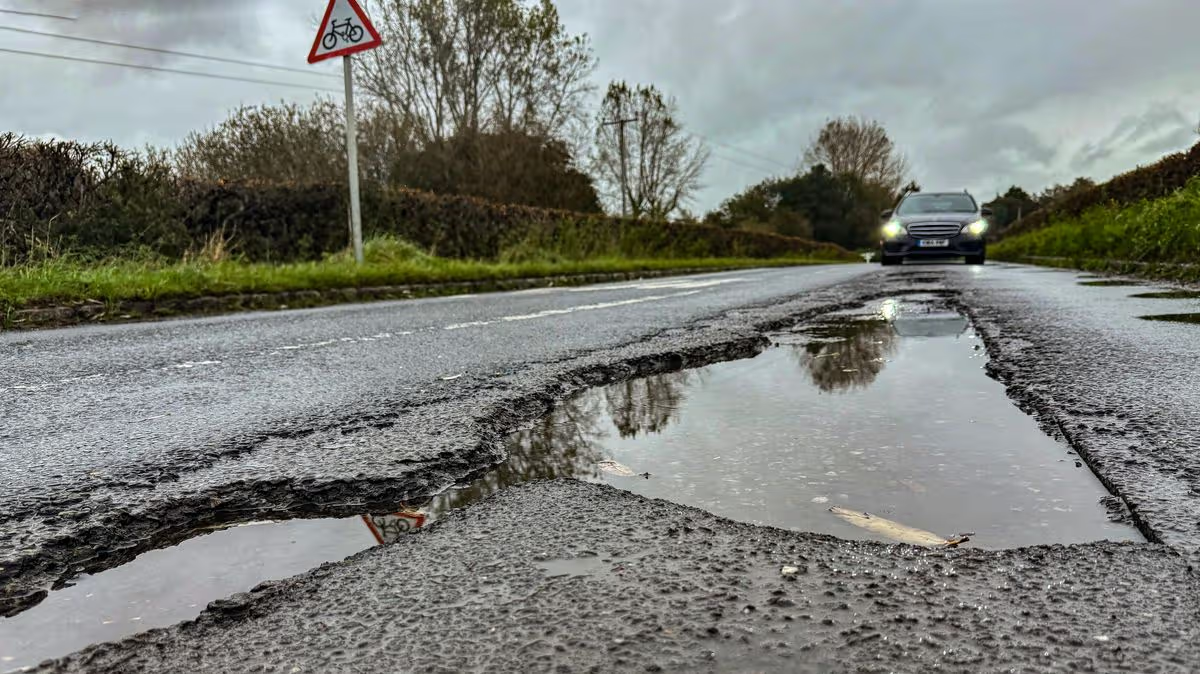
“If the Executive continues to prioritise rigid carbon accounting over road safety, economic connectivity, and the financial stability of households, they won’t just miss their climate targets, they’ll miss the point of government entirely.”
There is a fine line between visionary leadership and blind dogma. If you want to see what happens when a government tumbles headfirst over that line, look no further than the current state of Northern Ireland’s infrastructure.
On Tuesday, the DUP will bring a motion to the Assembly floor that sets out how our region’s legally binding climate targets have become an impenetrable barrier to basic regional prosperity.
For years, we were told the Climate Change Act (Northern Ireland) 2022 was a “landmark” victory for the environment. But in 2026, the reality on the ground, or more accurately, the potholes in the ground, tells a different story. What was billed as a green revolution has instead become, as Doug Beattie has aptly described, a “contagion of caution” that has paralysed our road network and created a zero-sum war for every penny in the public purse.
The most glaring casualty is the A5 Western Transport Corridor. A £1.7 billion project designed to save lives and connect the west has been quashed by the High Court because the Department for Infrastructure couldn’t reconcile a massive road scheme with a yet-to-be-finalised Climate Action Plan.
This isn’t just about one road. The A5 ruling has set a far-reaching precedent. Any project that generates emissions is now a sitting duck for judicial review. We’ve seen the £36 million A4 Enniskillen Southern Bypass, a vital project for Fermanagh, stalled indefinitely because the Minister is “mindful” of the legal risks. This hesitation cost the taxpayer £6.6 million in surrendered funding this year alone. While the lawyers argue, the costs of civil engineering continue to skyrocket, leaving the ratepayer to pick up an even bigger bill whenever, if ever, the diggers return.
Perhaps the most perverse outcome of the 2022 Act is the 10 per cent mandatory spend on “active travel”. On paper, spending £85 million a year on walking and cycling sounds lovely. In reality, it has forced the DfI into what can only be described as creative accounting, raising concerns from the Audit Office.
The Department has been caught reclassifying £37 million of general repairs as “active travel” just to hit a statutory quota. Meanwhile, the actual structural maintenance budget is a heavily depressed £68 million, which is well short of what is needed to keep the lights on and the tarmac smooth. We are being forced into a binary choice between asking if we want aspirational cycle lanes or roads that don’t destroy our suspension.
Then there is the draft Climate Action Plan 2023-2027. It is a document built on “speculative accounting” and “unquantified” proposals. It asks our farmers to adopt targets that are, frankly, unworkable, based on what critics have described as failed models from the Republic of Ireland.
For those in social housing, the “Just Transition” plan pushes for heat pumps that, without a complete retrofit, are more expensive to run than gas or oil. Because there is no grant support for these retrofits, housing associations are forced to take out commercial loans, the interest on which could be paid for by the region’s most vulnerable tenants through higher rents.
The DUP motion calls for a rigorous cost-benefit analysis, and frankly, we cannot continue to govern by aspiration while ignoring the macroeconomic reality of a cost-of-living crisis.
Northern Ireland needs to decarbonise, but it shouldn’t have to go bankrupt to do it. If the Executive continues to prioritise rigid carbon accounting over road safety, economic connectivity, and the financial stability of households, they won’t just miss their climate targets, they’ll miss the point of government entirely.
For all the latest news, visit the Belfast Live homepage here and sign up to our daily newsletter here.















































You must be logged in to post a comment Login