

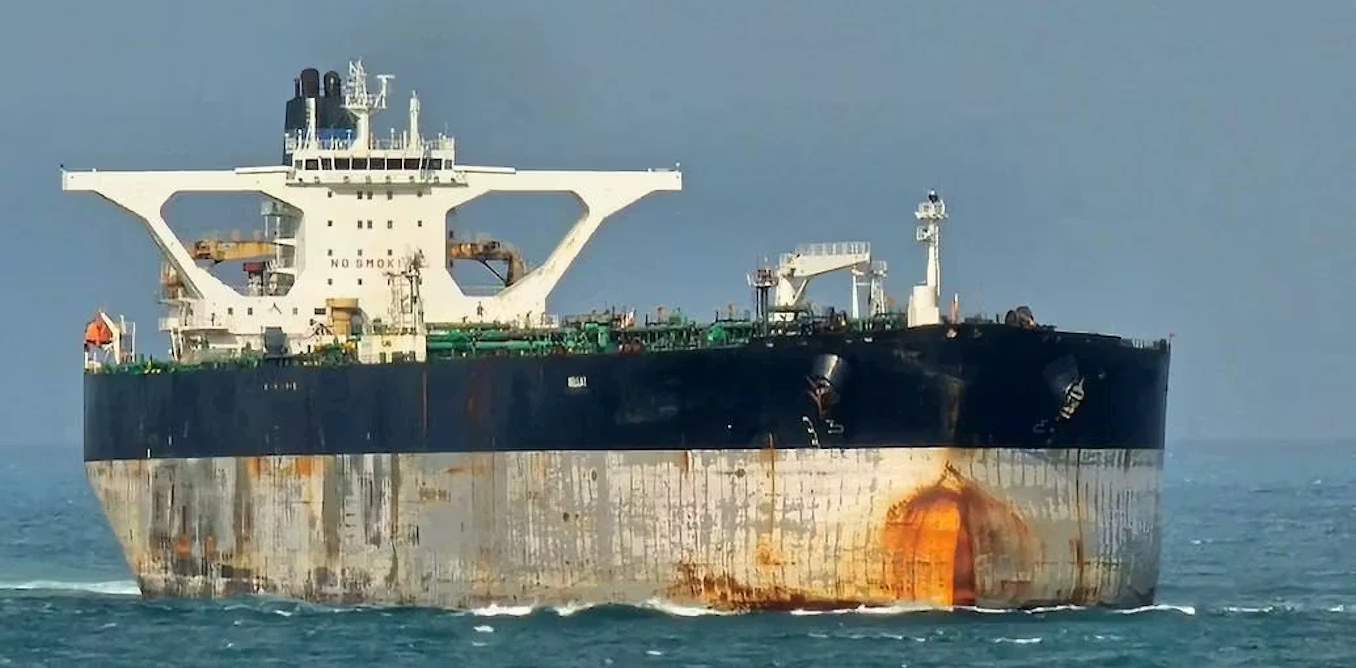
The dramatic seizure of the Russian-flagged tanker Marinera/Bella 1 in the north Atlantic, carried out by the US coastguard with British support, underscores the collision between maritime law and power politics.
Under the United Nations Convention on the Law of the Sea (Unclos), ships on the high seas enjoy freedom of navigation and fall under the exclusive jurisdiction of their flag state. (However, boarding a vessel without consent is lawful in exceptional cases such as piracy, statelessness, hot pursuit or under a UN mandate.)
The US has justified the operation through domestic sanctions law and a federal warrant. These sanctions were part of a broader US oil-export blockade targeting shipments of Venezuelan crude, specifically sanctioning tankers involved in transporting oil for the Venezuelan government and affiliated entities. They were not directed at Russia generally.
The US and the UK emphasised the vessel’s “statelessness”. Indeed, the tanker’s mid-voyage switch to a Russian flag raises questions about the regularity of its re-registration.
Under maritime law, fraudulent reflagging is a violation that can render a vessel stateless and open the door to enforcement. In this case, this position is obviously contested by Russia, which claims that a proper re-registration happened.
Moscow’s protest and reported naval shadowing – Russia reportedly dispatched a submarine and at least one surface vessel in proximity but did not engage – highlight the geopolitical stakes. When legal ambiguity meets strategic rivalry, the high seas become a stage for confrontation.
But the Marinera affair is more than a clash over a sanctioned vessel. It exposes the fragility of maritime law. Unclos was designed for a world of consensus, not for shadow fleets and geopolitical rivalries. Yet, from the Middle East to Venezuela to Ukraine, enforcement is moving from courtrooms to contested waters – and the risk of miscalculation and escalation is growing.
What is striking is how quickly “shadow fleets” – that is, clandestine vessels operating outside normal maritime governance to move sanctioned or high-risk commodities while concealing their true origin, ownership, or destination – have become central to global geopolitical tensions.
Their operations raise serious safety, insurance and accountability concerns. But for countries facing western sanctions, they are vital. Russia, for instance, is using its shadow fleet to generate revenue for its war effort by selling oil in defiance of international sanctions.
Russia and its war against Ukraine is one of two major flashpoints, the other being the various measures being taken by the US against Venezuela and Iran. In both cases, one side (Venezuela, Iran and Russia) uses shadow fleets to bypass American or western sanctions.
The other (US and Ukraine) meanwhile – each for their own reasons – aims to disrupt these operations. And they do so increasingly through the use of force.
For Ukraine, this is happening in the context of an open armed conflict (outside the remit of Unclos, a peacetime instrument). This arguably makes its attacks on commercial assets that aid Russia’s war machine legitimate under the logic of war.
For the US, enforcement stems from the sanctions regime and domestic law. So, the boarding of the Marinera signals Washington’s willingness to enforce sanctions outside its own territory, even at the risk of provoking Moscow. Although the re-registration might arguably be non-compliant with Unclos, the vessel was de facto sailing under the Russian flag.
Kremlin humiliated
In less than a week, the US has arrested Venezuelan president Nicolás Maduro
(a Kremlin ally), announced its withdrawal from numerous international organisations, boarded a vessel displaying the Russian flag, and issued bold statements of aggressive intent about other sovereign nations.
This suggests the Trump administration has entered a new phase of implementing the 2025 national security strategy. The strategy is to challenge the status quo through a calculated shift in risk management. It is clearly willing to accept short-term geopolitical uncertainty in exchange for what the administration frames as long-term national resilience.
The US decision to board a vessel sailing under a Russian flag is deeply embarrassing for the Kremlin. This humiliation comes just days after successful US strikes on Venezuela, an ally of Russia, underscoring Moscow’s inability to shield its partners. The episode follows similar failures with Assad in Syria and with Iran – the latter also exposing the ineffectiveness of Russian-supplied air defence systems.
The repercussions are global. Russia’s war in Ukraine now reaches beyond the Black Sea, extending into the Mediterranean – even possibly as far as west Africa – with strikes on suspected Russian sanctions‑evading vessels. The attack in the Mediterranean has been officially claimed by Ukraine, while the one off Senegal remains unacknowledged, though it appears to follow similar patterns.
The US–Venezuela crisis combines regime politics, narcotics and shadow fleet dynamics. And two of the world’s biggest economies, India and China, which are major consumers of Russian oil, are deeply entangled, giving these maritime developments a truly international scope.
The question remains as to whether the use of force will deter shadow fleet operations. These operate within a now well-established business model, with unscrupulous owners and captains willing to make easy money out of illegal and dodgy operations.
These are backed by Russia, Iran and, until now, Venezuela and enabled by willing buyers and open registries (national ship registries that allow foreign-owned vessels to register under their flag with minimal requirements, often for lower costs and fewer regulations).
That makes prospects for deterrence bleak. Yet the use of force against civilian shipping in neutral or international waters, almost unprecedented outside major wars, could mark a turning point.
On one hand, it demonstrates that Unclos cannot serve as a shield for sanctions evasion. On the other, it reinforces power politics at sea, opening the door to more hybrid warfare in the maritime domain. This dynamic could ultimately play into Moscow’s hands, given Russia’s proven expertise in hybrid and grey zone warfare.



