
Another is to always know what you want to order before you approach the bar, making sure not to hold everyone else up while you umm and ah.
‘It’s a small thing, but when the queue is three people deep, extra seconds or minutes add up,’ says Todd N, North London Account Manager at Beavertown.
This may seem obvious, but staff see this unspoken rule broken time and time again, so some people clearly need a refresher on proper boozer etiquette.
Advertisement
Lisa Williams, landlady of The Cricketers Pub in Farncombe, Surrey, tells Metro: ‘You can always spot the customers who haven’t thought about what they order until they get to me. They stare at me then start thinking, it drives me crazy!’
According to Phil McAree, general manager of the Hoop and Grapes in Clerkenwell, ‘novice drinkers’ and the ‘part-time’ crowd who only come in at Christmas are typically guilty of this.
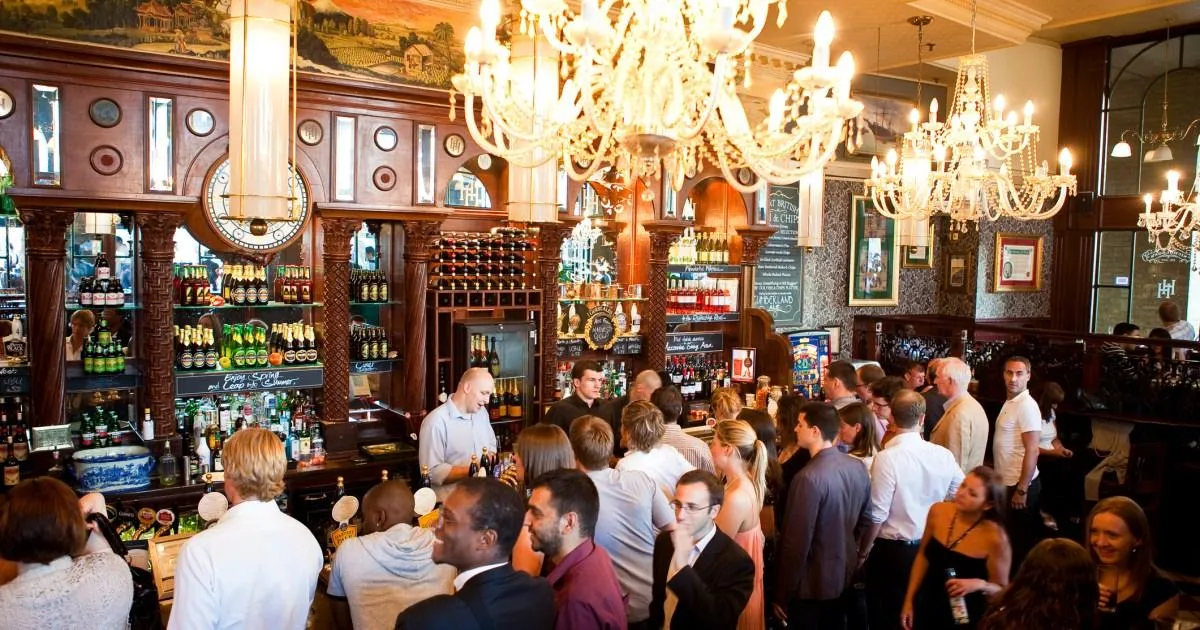
The easier you make things for the bar staff, the more they’ll warm to you (Picture: Getty Images)
‘It’s a bit frustrating because our team are drilled to cope with big orders, but they need the order so they can figure out what the best way to go about it,’ he tells Metro.
‘So if you’ve got someone who’s like “I’ll have this, and then have a little think about it, and then, oh yeah, so and so wanted this”, it makes it a lot slower.
‘All bar staff are aiming to do is just deliver that round of drinks as quickly as possible, and move on to the next punter.’
Advertisement
Having come from a family of publicans and with over 20 years of experience in the industry, Phil is well used to indecisive customers, to the point he no longer gets annoyed.
What do you think is the most important bar etiquette?
Always know your order before approaching the bar
Return your glass to the bar after finishing
Be polite and patient with the staff
Advertisement
Order complex drinks like Guinness first
Sign up to Metro’s The Slice newsletter for your guide to what’s on in London, with trusted reviews, offers and giveaways.
Advertisement
He notes that the clientele at the Hoop and Grapes, a Grade II listed spot which he reopened this month after it closed in 2019, largely ‘tend to know what they want’ — but even if they don’t, ‘at the end of the day, they’re paying our wages’.
Still, Phil says that in the hospitality world, certain things ‘endear you to people a lot more’, and politeness is key. To become a bartender’s absolute favourite though, bring your glass back once you’re done.
‘There’s something magical about it,’ he explains. ‘We’re like, “wow, what an amazing person”, falling over ourselves. It’s our job to go and get the empty glasses, but it’s sort of like a little token of thanks.’
Hey, foodies! Add us as a Preferred Source
At Metro Food, we’re here to bring you all the latest foodie news, delicious recipes, restaurant reviews, and cooking tips. As a loyal reader and a part of our vibrant community, we want to make sure you never miss our articles when searching for stories
Advertisement
Click here and tick Metro.co.uk to ensure you see stories from us first in Google Search.
From the latest Walkers flavours to the secret McDonald’s menu, Metro Food has it all
The perfect pub punter
According to Phil, the best customers in a pub have a few traits in common:
They’re polite and empathetic.
They know what they want when they approach the bar.
They bring their empty glasses back.
They’re up for a chat when it’s quieter, but understanding if staff are stretched.
They know how to drink (aka, ‘someone who can put a few away and not turn into some sort of drooling monster’).
They support and enjoy the place — because ‘the more people you can garner like that, the better the pub is going to be for it’.
Order Guinness first
Alongside having your order ready when you reach the bar, the order you ask for the drinks is also important; specifically, stout (such as Guinness) should always come first.
Advertisement
Dougal Sharp, founder and master brewer at Innis and Gunn, tells Metro: ‘They’re never a quick hand-over like a lager or a spirit and mixer, so ordering the stout first means the bartender can pour it, let it settle, and get on with the rest of the order at the same time.
‘You’re back at the table quicker, and it helps bar staff keep things moving when it’s busy.’
Stout, such as Guinness, needs time to settle (Picture: Getty Images)
As Becky McCabe, co-founder at drinks brand training app, Brandee, notes, it takes 119.5 seconds to pour the perfect pint of Guinness — and that two minutes makes all the difference in a busy pub.
By giving them that bit of extra notice, she says ‘the team will quietly love you,’ telling Metro: ‘It makes service smoother, eases the pressure behind the bar, and marks you down as a top customer.’
And in contrast to a recent YouGov poll which found that 45% of Brits reckon they could get it right on their first try, Lisa says: ‘The ones who order Guinness last have obviously never poured a pint of it in their life.’
Advertisement
‘I could serve twice as fast if everyone knew what they wanted and ordered the tricky ones first,’ she adds. ‘Luckily I’ve managed to train my regulars well.’
Police searches at Andrew Mountbatten-Windsor’s former home of Royal Lodge, in Windsor, are continuing, after he was released by police under investigation on Thursday evening.
Mountbatten-Windsor has consistently and strenuously denied any wrongdoing.
The BBC’s Helena Wilkinson has been reporting on the arrest from outside the former prince’s home, asking the question of what’s next for the King’s brother?
According to Dr Himender Makker, a consultant physician in respiratory, chest and sleep medicine at Circle Health Group: “A pillow needs to support the head, which weighs approximately 3kg. It must be firm to stop the head from sinking in too far and affecting neck curvature.”

“We all have different heads, necks and shoulders, so there cannot be one perfect pillow to meet the demands of diverse human bodies,” Dr Makker continues. “What we do know is that there is an approximate distance of six inches between the side of the neck and the tip of the shoulder. This is what should determine the height of your pillow.”
One of the most important factors when choosing a pillow is sleep position. Dr Makker says: “Most people sleep on their side (left or right), some on their back and few on their front. Any sleep position can work so long as you wake up feeling refreshed. The right pillow should help you to sleep comfortably with your neck and spine straight or slightly bent backwards (extended).”

The singer, whose real name is Charlotte Aitchison, has had now eight top 40 albums in total, with 2015’s Sucker (15), 2017’s Number 1 Angel (37), 2019’s Charli (14), 2020’s How I’m Feeling Now (33), and 2025 remix record Brat And It’s Completely Different But Also Still Brat (40).
A judge described the injury Said Sadat inflicted as ‘graphic and horrendous’
18:13, 20 Feb 2026
Advertisement
This is the mug shot of a thug who stabbed a stranger in the neck with a broken bottle in Piccadilly Gardens. Said Sadat was jailed for more than three years this week following the violent attack on July 27 last year.
The 19-year-old was approached by his would-be victim over payment of a debt. He told Sadat he was settling on his cousin’s behalf and handed him a £20 note.
Sadat ripped the note up and hissed: “I don’t need your money, I will sort you out.”
Manchester Crown Court heard he left, but returned armed with a broken bottle. He slashed at the man, leaving him with a large wound to his neck.
Sadat was arrested as the victim was rushed to hospital, where he received emergency surgery for a 12cm wound to his neck. He was also treated for lacerations to his upper left arm and right hand.
Sadat pleaded guilty to section 20 wounding on a basis that he did not have a knife and instead used a broken bottle, prosecutor Hayley Parkes said.
The court heard Sadat was on bail at the time having been arrested for another attack in the city centre, along with two others who had chased down two pals on a night out in Manchester city centre on June 15, 2024.
Advertisement
Huw Edwards, defending, said he Sadat a difficult upbringing in Afghanistan before moving to the UK when he was 17. He said he was a ‘young man’ and had limited previous convictions.
Jailing him, Recorder Ciaran Rankin said: “I have seen the graphic and horrendous neck injury. It’s only by good luck, not good fortune, you are not facing a more serious offence. You could have killed that man.”
Sadat, of Block Lane, Chadderton, Oldham, was jailed for three years and nine months for theft; assault occasioning actual bodily harm and section 20 wounding. The charges covered both incidents.
Detective Constable Peter Viney of GMP’s City of Manchester CID, who led the investigation, said: “This was a violent and unprovoked attack in one of the busiest areas of the city centre. I would like to commend the quick actions of officers and the bravery of members of the public at the scene who helped the victim who had been severely injured.
Advertisement
“Sadat’s sentencing today reflects the gravity of his actions and our ongoing commitment to tackling knife crime and violence in Manchester.”
A developer has been told they can’t build 27 new affordable homes on the edge of Little Thetford.
Plans to build 27 new homes on the edge of a small village have been blocked after being branded “repetitive and bland”. East Cambridgeshire District Council criticised the design of the proposed development in Little Thetford and the impact it could have on the countryside.
Advertisement
The new homes had been proposed for a field off The Wytches, next to the A10 junction. The developer, Cambridge Housing Society, had proposed to make all of the new homes available as affordable housing, with 23 offered at affordable rent, and four as shared ownership.
The homes were proposed to be a mix of flats, bungalows and houses, ranging in size from one-bedroom flats and bungalows, up to four-bedroom houses. The developer said the plans offered the opportunity to create “high-quality” affordable homes for the area.
They said: “The site represents a sustainable, logical extension to the settlement, providing a sensitive interface between village and countryside while contributing to local housing need.”
The plans faced backlash from people living in the village, with 48 formal objections lodged with the district council against the plans. Several raised concerns about the impact the development could have on congestion and road safety, particularly due to how close the development’s access road would be to the A10 junction.
Advertisement
One objector said: “As a one-way in and one-way out village, adding more housing right next to the village entrance, a known busy area for traffic, is asking for fatal accidents to happen. I’ve lived in the village all my life and I would like to continue to do so, without this increased risk.
“Not only would there be a high chance of collisions, the road is the main pedestrian route that leads to the village bus stop, frequently used by visitors, residents and school children. The additional traffic will result in increased queuing at peak times, backing into the village. Not only increasing the level of fumes for school children, but increasing the risk of queuing motorists taking risks to exit the village.”
Another objector highlighted that Little Thetford had “limited amenities and an intermittent bus service”, which they said would make people more reliant on cars and “placing further pressure on an already unsafe junction”.
Concerns were also raised about the size of the proposed development, with one person arguing that it would be “disproportionate to a village of approximately 320 dwellings”.
Advertisement
Questions were also raised about whether this amount of affordable housing is needed in the village, with one objector highlighting that a separate development of affordable homes was already underway.
Council argues development will ‘harm the countryside’
The district council refused to grant planning permission for the development, citing as one of its reasons that the affordable housing need in the village had already been assessed and met through a separate development.
The authority also highlighted the lack of services and facilities in Little Thetford, which it said would lead to people having to leave the village for the majority of their daily needs.
The district council added that the proposed development would cause “harm to the character and setting of the settlement and surrounding countryside”.
Advertisement
The decision notice said: “The proposal results introduce a large quantum of development projecting beyond the existing build line of the settlement in a very prominent location that would be highly visible on approach from both directions. The proposed layout results in the apartment block introducing an urban feature into the rural edge of the development.
“The design of the dwellings is repetitive and bland, projecting poor quality design into the countryside in a visually prominent location and the apartment blocks would be out of keeping with the existing houses.”
As soon as you start to wake up with discomfort, it’s time to consider whether you need a new mattress. Even the best mattress needs to be replaced around the seven-year mark, so that’s why we’ve tested 45 – from major brands, including Simba, Emma and Dreams – to help you choose the right one.
“People often believe their mattress is adequate since they spent a lot of money on it,” says Dr. Lindsay Browning, founder of Trouble Sleeping . “But often it transpires that it’s at least 15 to 20 years old. In these cases, it’s unlikely that the mattress is providing the same level of support.”
According to Dr. Browning: “An ideal mattress should support your back and spine, allowing the spine to remain in a neutral position during the night”. Our guide to choosing a mattress runs through this in detail, but here’s what to consider:
Advertisement
Side sleepers need pressure relief to cushion their shoulders and hips. A hybrid mattress, with its combination of memory foam and springs, should offer the right balance.
Back sleepers need to prevent their torso from sinking too far into the mattress. Medium-to-firm pocket sprung mattresses are best, because each spring works individually, tailoring its cushioning to different body parts.
Front sleepers (or stomach sleepers) should opt for medium-firm or firm mattresses – whether that’s memory foam, pocket sprung or hybrid – to ensure even distribution of weight.
Below, you’ll find a comprehensive guide to mattresses, plus FAQs with advice from our sleep experts.
Advertisement
Telegraph readers have given us their verdict too, helping us to whittle down the 45 tested to our 10 best mattress recommendations.
The best mattress: At a glance
In a hurry? These are our top recommendations for each category:
It’s a Thursday night in November. A pub in Glasgow’s Merchant City. Four men, all about the age of 30, are squeezed around a small table, eating and talking about what the next few months might bring. Nobody recognises them.
That same pub three months later. Screens showing a Celtic game are changed so the patrons can watch the curling. Almost everyone is anxiously staring at the TVs, willing those same four men to reach a Winter Olympic final.
Chances are they will be doing the same on Saturday (18:05 GMT), when Team GB’s Bruce Mouat, Grant Hardie, Hammy McMillan and Bobby Lammie take on Canada with a gold medal at stake.
“Our gold medal,” as Mouat referred to it after the epic semi-final win over Switzerland in northern Italy on Thursday – a contest which drew 3.4million viewers to the BBC at its peak.
Advertisement
And fulfilling what they believe to be their destiny – by upgrading their silver medal from Beijing four years ago – is what these four Scots have travelled to Cortina to do.
Since that 2022 near miss, Team Mouat have come to dominate men’s curling, winning two World Championships and adding another couple of European crowns, as well as a record 12 Grand Slam titles.
At times, they have been unbeatable.
That cloak of invincibility slipped during the round-robin stages here – leaving qualification out of their hands – but that fright has now been forgotten, replaced with the return of a clear-eyed focus on the task in hand.
Advertisement
But who are these four young men who have now caught the country’s attention? And what makes them more than the sum of their parts?
Seven UK police forces are investigating the files following allegations that victims were flown into Stansted Airport on Epstein’s plane
Caroline Barry and Sam Elliott-Gibbs
17:54, 20 Feb 2026
The Met Police have issued a plea for ex-bodyguards of former Prince Andrew to come forward with any information they may have relating to the Epstein files.
It follows the release of millions of court documents by the United States Department of Justice from Epstein. The files are being assessed to see if there are any further details from law enforcement partners including authorities in America, reported the Mirror.
Advertisement
Seven UK police forces are now investigating the files following allegations that victims were flown into Stansted Airport on Epstein’s plane which was nicknamed the Lolita Express. It is estimated that as many as 90 flights arrived into the airport’s private terminal with 15 of these happening after Epstein was jailed over child sex offences in 2008.
The force said: “Following the further release of millions of court documents relating to Jeffrey Epstein by the United States Department of Justice, we are aware of the suggestion that London airports may have been used to facilitate human trafficking and sexual exploitation.
“We are assessing this information and are actively seeking further detail from law enforcement partners, including those in the United States. Separately, the Met is identifying and contacting former and serving officers who may have worked closely, in a protection capacity, with Andrew Mountbatten‑Windsor.
Advertisement
“They have been asked to consider carefully whether anything they saw or heard during that period of service may be relevant to our ongoing reviews and to share any information that could assist us.
“While we are aware of the extensive media reporting and commentary about this matter, as of today, no new criminal allegations have been made to the Met regarding sexual offences said to have occurred within our jurisdiction.
“We continue to urge anyone with new or relevant information to come forward. All allegations will be taken seriously and, as with any matter, any information received will be assessed and investigated where appropriate.
“The action outlined above is independent of investigations or assessment work being carried out by other forces. We are working with the national coordination group which has been set up to bring together affected forces to ensure consistency of approach, including access to appropriate expertise and guidance.”
Advertisement
Gordon Brown, the former Prime Minister, said messages in the Epstein files linked Andrew, 65, to at least one victim flown into the airport on the “Lolita Express” before being sneaked into Buckingham Palace.
The investigation happened after at least six other forces began assessing evidence within the Epstein files. Forces include the Metropolitan Police, Essex, Thames Valley, Surrey, Norfolk and Bedfordshire.
The National Police Chiefs’ Council (NPCC) said: “We continue to work collaboratively to assess the details being made public to allow us to understand any potential impact arising from the millions of documents that have been published. We continue to support our partners and contribute in any way we can to help secure justice for victims and survivors.”
Oaveed Rahman, 26, took almost £5,000 from his victims before leaving dozens of dogs and a cat with no food or water before they were found among carcasses of other animals
17:40, 20 Feb 2026Updated 17:40, 20 Feb 2026
Dogs and cats were left to starve to death, with bodies ‘piled up like rubbish’, at a fake rehoming centre.
Oaveed Rahman, 26, claimed to be looking after the animals at a centre called Save A Paw in Crays Hill, Billericay, Essex, but actually left them to suffer. A vet who was called to the scene with police last May 13 said that as soon as she left her vehicle, which was parked about 40 metres away from Rahman’s property, she could smell rotting flesh.
Remains of dogs were found in bins and throughout the site, with some piled up “like rubbish”, the sentencing judge said. Basildon Crown Court heard that veterinary surgeon Amy Cooper saw masses of bodies riddled with maggots with rats around the kennels.
Advertisement
Some 21 dogs which were alive were kept in pens or confined to small spaces. Tom Godfrey, prosecuting, told the court that Ms Cooper said in a statement: “I can honestly say what I smelt and saw was the most horrific thing I have ever seen. It was clear just from a general initial inspection that these animals were all suffering.”
Ensure our latest headlines always appear at the top of your Google Search by making us a Preferred Source.Click here to activateor add us as your Preferred Source in your Google search settings.
Sentencing him to five years in prison, Judge Richard Conley said Rahman’s fraud was “an act of betrayal of epic proportions that has devastated many lives”. He said Rahman had convinced decent and well-meaning pet owners to entrust their beloved animals into his care.
Advertisement
“In fact many animals taken in by you… were subjected to prolonged barbaric mistreatment, cruelty and neglect,” Judge Conley said. “Some of them died directly as a result.”
Faeces was found inside the pens and cages, and many of the dogs were severely underweight but did not have access to food, the court heard. Ms Cooper said the dogs kept in pens would have faced “mental turmoil” as there were open bags of food in the property which they could not access.
Victims whose dogs were “rehomed” by Rahman and their supporters in the packed public gallery sobbed as Mr Godfrey told of the condition the animals were found in. Later, after Rahman was sentenced, a victim in the court shouted at him through the video link: “F****** b*****d, I hope you rot in there you dirty b*****d.”
Three of the 21 dogs were so unwell they had to be put down, and one poodle later went blind, the court heard. Rahman previously pleaded guilty to cruelty against 21 dogs and a cat, and 11 counts of fraud by false representation. Police found 37 dead dogs when they first searched the rehoming centre, where dogs were left to roam among the carcasses.
Advertisement
Four more dead dogs were found when a shed was demolished during a later visit. Emma Thompson said she feels “extremely traumatised” by what happened to her dog. She planned to rehome him after the dalmatian pointer cross had shown signs of aggression, and she was pregnant.
“I often think about how confused, scared and sad Lennon must’ve felt being taken from the family he loved, transported to Essex and taken to a stranger,” she said in a victim impact statement read to the court by Mr Godfrey. “He would’ve smelt the death of other dogs at the property.”
Ms Thompson paid Rahman a £300 “surrender fee” and a further £200 as a charitable donation. Lennon was one of the dogs found dead during the first raid. Tina Davis, another of Rahman’s victims, took her dog Chad, a pocket bully, to Save A Paw to be rehomed after he had a fight with her other dog.
Advertisement
In her victim impact statement, read to the court, she said: “I was devastated at the prospect of giving up my dog but knew it was required for Chad to have the best possible life. I torture myself, wondering how much he suffered. He must’ve thought I didn’t love him to leave him at that wretched place… I question if I will ever forgive myself.”
Chad is still missing, the court heard. Some of Rahman’s victims contacted him on his Facebook page for Save A Paw, which had good reviews, the court heard. He was sometimes paid a “surrender fee” and also accepted “donations” to his organisation, which he told victims was a charity – but in fact an application for charitable status had been refused.
Rahman took around £4,800 from his 11 victims, telling them it would be used to rehome dogs, provide a new kennel block or train dogs to behave around children and other animals.
He promised to keep in touch with people about how their dogs were doing, the court heard, but often became difficult to contact and in some cases blocked the people who had taken their dogs to him.
Advertisement
“We’ll never truly know the extent of how far maybe offending or this behaviour has gone,” said Superintendent Leigh Norris of Essex Police.
He sentenced Rahman to five years’ imprisonment, with 38 months of that for animal cruelty. The animal cruelty sentence will run consecutively to the fraud counts, for which he was sentenced to 22 months for each count, to all run concurrently.
He was also sentenced to three months’ imprisonment, to run concurrently, for owning the banned XL bully, and was banned from owning dogs and cats for life.
Rahman can apply for the ban to be lifted after 15 years. He was also sentenced to a deprivation order, meaning the dogs found at his property can be taken. Costs will be dealt with at a later date.