

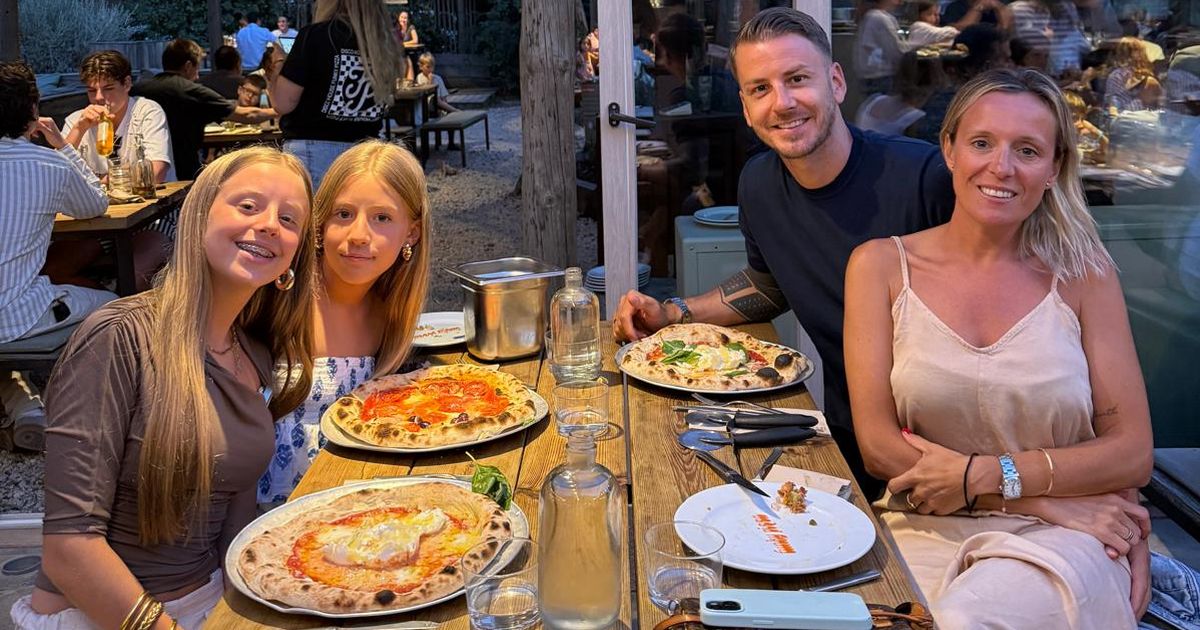
WalesOnline caught up with former Swansea player Andrea Orlandi and his life since leaving south Wales has been eventful to say the least
“I was playing at the tennis club and I woke up four days later.”
Andrea Orlandi remembers very few little, but the events of March 23, 2024, would be no less life-changing.
On a cloudy day in Barcelona, he stepped out at the Club de Tenis Laietà to take part in a friendly amateur tournament.
After rubbing shoulders with some of the best names in world football at Barcelona, and going from the bruising world of League One all the way to the Premier League with Swansea City, Andrea might well have expected this to be a comparatively gentle assignment.
JOIN US ON FACEBOOK! Follow Wales Online’s Swansea City FB page for more news and analysis
Little did he know, he would end up fighting for his life.
“I was in a coma for four days and I was in intensive care for two weeks,” he tells WalesOnline.
“The doctors they told me I was very lucky, but I don’t remember anything of how it happened.”
Andrea had suffered a cardiac arrest and, he would later be informed, was technically dead for 16 minutes before waking up in the ICU at the Hospital Clinic de Barcelona.
He credits the quick thinking of those around him, including a fellow tennis player named Malik, who administered CPR, as one of the main reasons he’s still alive.
“I just call them my guardian angels as they kept me alive,” he added. “And obviously thanks to that, I still got some oxygen to the brain and they didn’t have any consequences after, because even if you survive you can often not go back to how you were brain-wise as you’re basically dead for a few minutes.”
Even so, Andrea’s recovery was an arduous one.
“I had pneumonia, and I had a liver problem because basically your system stops working,” he says.
“My lungs filled with water and it took me a long while to get back to normal.
“So for the first few months, I couldn’t get out of my house and it felt really busy because I was taking medication to keep my heart rate down and my tension down.
“I couldn’t really go out without my wife, I’d manage five minutes and then have to go back in.
“But you just get used to it. And now I live a completely normal life. I don’t do much in terms of sport because I can’t do it. But I just work and travel without any problems. So I’m feeling OK enough.”
Andrea insists the whole episode came as a shock, but his heart had already forced him to call time on his career at the age of 34.
Having spent six months out in India, Andrea signed for Virtus Entilla in January 2019, who at the time were going for promotion in Serie C. He would never end up making a single appearance for them.
“I couldn’t,” he explains. “I didn’t even try because in the first medical check-up, they said, ‘no, you can’t play’. I wanted a second opinion because I’ve been playing for years and I’ve never had a problem.
“And they said, ‘OK, we’re going to send you to the best one. It’s the doctor of the Italian Federation, but he’s in Rome, so you’ll have to wait for two weeks’.
“I said, ‘OK, I’ll wait’. So basically, I was training on my own in the gym, just keeping myself fit, waiting to see this doctor.
“And then I went around and did all the tests again. And the doctor told me I had to stop. It was finished for me. It was over.
“It was hard. When I got out of the dressing room and closed the door, knowing I wasn’t going to open it again, I felt empty and scared.”
Andrea’s 16-year career, took him across five countries, and provided its fair share of highs and lows.
It began at his beloved Barcelona, where he would end up rubbing shoulders with the likes of Ronaldinho, Samuel Eto’o, Xavi, Andres Iniesta, and even a young Lionel Messi.
“I was obviously initially playing for the second team, but when I got the chance to train with them in the first team, I was star-struck a little bit,” he admits.
“There’s a moment where you get used to it, and that shouldn’t happen. You train with them regularly, you play with them and you think that this is the normality.
“The next thing you know, you’re out of the club and you are struggling to play in League One in England.”
How does a promising young footballer go from Barcelona to the third tier of English football?
As it turns out, it was the son of a Dutch legend who made it happen.
“I was friends with Jordi Cruyff and he was very close to Roberto Martinez,” Andrea explains. “I remember playing with the first team [at Barca], it was a cup game, and Roberto was there.
“He invited me to Swansea. I was there with my father for a couple of days, with him, and I just loved him. I thought that he was going to take me to the next level.
“At Barcelona breaking into the first team felt impossible, and I wanted to get out. I wanted something different, something fresh, new. The UK, British football, had always been my target.
“I thought, ‘OK, League One, it doesn’t matter. I like Roberto. I believe in what he says’.
“And this is how it happened.”
So taken in by Martinez, Orlandi claims he signed “a very bad contract”‘ when he joined on free transfer in the summer of 2007, but the move was also a massive culture shock.
“We didn’t have a training ground,” he says. “We used to wash our own clothes. We didn’t have food after training. We’d have like a cold wrap and a cold tomato soup or a cold sandwich.
“We were getting changed in the local gym with fans, with customers of the gym. And I couldn’t believe it really.
“But at the end of the day, you just get used to it and you kind of even like it at time. You get to see familiar faces, you’re friends with them as well.
“So it was peculiar, but it was the type of club we were. A family club, humble, low budget, but we did something different.
“That’s why we were successful because we were not there for money. We were there because of the way we played and this is how we attracted better and better players over the years and we got to where we where we got to.
“So I just went on with it and enjoyed it.”
Andrea still vividly remembers his debut against Leeds United at a typically raucous Elland Road, around three weeks after he signed.
“I couldn’t believe it,” he says. “I couldn’t even hear Guillem Bauza on the bench, it was that loud. And I think there were like over 2,000 Swansea fans traveling to Elland Road.
“It was great.”
Bauza and Angel Rangel were part of what would prove an important core of Spanish players that would ultimately help Swansea win promotion to the Championship that season.
They would also help the 23-year-old Andrea settle in after a somewhat chaotic welcome to the club.
“Thank God they were there for me because I couldn’t speak the language,” he remembers.
“We had characters in the team, Thomas Butler, for one. The first thing he did was he shot me with an air rifle twice in the leg.
“It was my third day at the club, and I was signing a shirt and then I felt like a sharp pain in my leg twice, and I just turned to my right, and I saw him with the air rifle, and he just left.
“He just put the air rifle in the body of his car and drove away.
“I just thought ‘what just happened? Honestly, what the f***?’
“I was in shock because I couldn’t speak any English. I just let it go.
“A year later, I finally asked him about it, because we actually got on really well.
“He said, ‘Listen, amigo, I had to do something. You came, you played in my position. You were better looking than me and a better player. So I had to do something’.”
As well as some anarchic shenanigans behind the scenes, Andrea’s first season would also see him wrestle with what proved a strained relationship with Martinez.
In his opening campaign he’d make just one league start.
“I fell in love with him and I signed for Swansea because of him,” he said.
“And then I felt lonely. When I got there, I didn’t feel that he helped me really.
“For a player that was leaving Barcelona for the first time and had taken a gamble really to go there, and being Spanish as well, I thought he was going to give me more opportunities and maybe a different treatment.
“Those two years with Roberto were difficult. I had to suffer in silence.”
Swansea would go on to win promotion to the Championship that season, and while all was not entirely well behind the scenes, Andrea admits he still enjoyed the new and exciting possession-based style City were starting to implement. A style that would later become known as ‘the Swansea Way’.
“I loved it,” he says. “I mean, it’s what I learned since I was a kid in Spain. Obviously, at Barcelona, I kind of mastered it. At Barcelona, every training session is detailed to play like this.
“Then when Roberto left, everybody thought, maybe we’re getting lost here.
“Paulo Sousa came and I think we finished seventh. And then Brendan (Rodgers) came and we got promoted.
“So it was our evolution every season and I could see that we were destined to do something special.
“Roberto told me when I signed that in four years we would reach the Premier League, and I thought maybe it was a bit too ambitious.
“But in four years we got to the Premier League.”
That win over Reading in the play-off final at Wembley in 2011 would understandably go down in Swans folklore, but for Andrea, the experience was bittersweet.
“That season I was playing up until January, but I got injured, and then I came back, got injured again, and then Joe Allen was playing and there was no space for me,” he remembers.
“But with two or three games to go, I was back in the team, and I was always involved.
“I was on the bench for the semi-finals, and before the final, Brendan called me into his room.
“He was crying and he said, ‘listen, I can’t have you on the bench because Garry Monk is struggling, so I need another defender’.
“I was that type of player that I said, ‘no worries, gaffer’. I’ll be a fan and I’ll do what I can to support my team-mates.
“But inside I was dead.”
However, despite his disappointment, the euphoria of watching his team-mates seal a return to the top flight after a 28-year exile was enough to put those feelings to one side.
“The atmosphere at Wembley was crazy,” he says “I just forgot about myself. I was just a Swansea fan, and at the end of the game, I hugged Brendan and he said, ‘well, you’re a Premier League player now’.
“And still it’s one of my best moments during my five years. So this is how football works.”
Andrea would end up playing just three games in the Premier League, and after briefly being linked with Dutch side Den Haag, which he insists to this day he knew nothing about, he eventually left for Brighton & Hove Albion in the summer of 2012.
Looking back, he insists he deserved more of a chance, but is quick to dismiss any suggestion of any ill-feeling towards Rodgers.
“I loved him as a manager. And as a guy,” he says.
“When he left, he called me and he thanked me for my behaviour and attitude during those two years where he felt that I deserved more than what I got.
“So no, there was no tension with Brendan.”
Amidst the joyous scenes, that famous day at Wembley would also see Swansea’s players pay tribute to Besian Idrizaj, who, like Andrea, suffered a cardiac arrest.
Tragically, he passed away on May 15, 2010.
“I remember Garry Monk calling me,” he says. “I was driving back from Italy to Spain during the holidays and he gave me the news. I had to stop.
“I was in shock. We just couldn’t believe it.
“I remember not being able to sleep.
“I’m not ashamed of saying that one day I had to share a bed with my mother – and I was 25.
“I was anxious and I tested myself. I had lots of cardiac tests because you start doubting and thinking it could happen to you as well.”
Despite those tests, Andrea’s own heart problems wouldn’t be discovered for another nine years.
“I thought about Besian when I had to retire,” he says.
“But then I was thinking of my family, my daughters, my wife, and to make sure that I have to be there for them.
“I managed to survive and I’m still here and I’m OK now. I’m taking medication. I’ve got a defibrillator inside and hopefully I’ve got a lot of life to live.”
Incredibly, nine years before that fateful day on the tennis court, he had already survived a brush with death.
Andrea was playing for Blackpool at the time, and was travelling back to the north-west following some time off during an international break. After a timetabling mix-up he ended up missing his flight back to the UK.
“I called Lee Clark and said, ‘listen, gaffer, sorry, I made this mistake [about the time]. There are no flights tonight so I have to fly tomorrow’,” he said.
“He went, ‘OK, don’t worry, you’re missing training tomorrow. Just try to be there in the afternoon and go to the gym’.
“So I was checking some flights and there were no direct flights to Manchester the following morning from Barcelona.
“There was a flight to London early and then my sister-in-law sent me a flight to Dusseldorf from Barcelona and then Dusseldorf to Manchester.
“My car was in Manchester airport. And then I was there deciding, London or Manchester through Dusseldorf?
“And I thought I’d take the one to London, rent a car and drive up.
“My wife was telling me, ‘But why? It’s better if you go to Manchester’. I said no.”
Incredibly, it was a decision that would save his life.
“The flight that was going to Manchester crashed. It took off from Barcelona and crashed in the Alps,” he says.
“So if I’d taken the decision to go to Manchester, I would have died that day.
“My sister-in-law, right now, she doesn’t take any flights because she was the one sending this flight. So she hasn’t taken any flights since then.”
One has to wonder if someone up there must like Andrea, who after his heart-attack has understandably had to change his lifestyle somewhat, but has managed to stay in football.
He’s also kept in touch with many of his former colleagues at Swansea and even dropped in for the League Cup clash with Manchester City earlier this season.
After previously working as a pundit, he has since become an agent, which perhaps helps to fill the void left by his early retirement.
“I get excited when they have good moments,” he says. “I get frustrated when they are frustrated. I feel part of them and of the journey.
“It’s good. I’m super busy, but I’m very happy.”
As for what comes next, well there’s one obvious answer.
“I’m hoping to bring a star player to Swansea and to celebrate with him in Swansea’s promotion to the Premier League,” he says with a smile.
“This would be like the icing on the cake of my agent career.
“But the most important is that me and my family are healthy and we’re all together and happy.
“Work-wise, I’m OK with what I’m doing. I’m not over ambitious. I know how hard it is, this agency world.
“It’s crazy. But, you know, I’m just being honest to myself and just keep being myself.
“I’ve not changed.”



