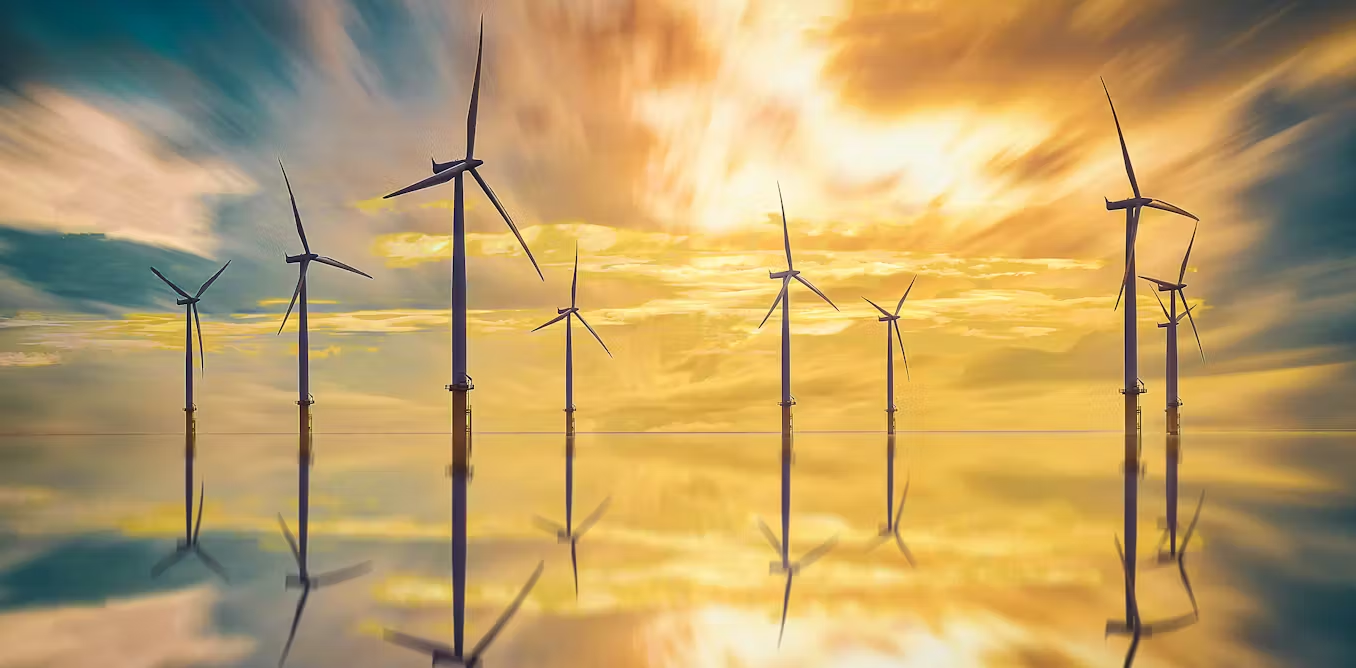
The UK government has just announced the results of its biggest-ever auction for new offshore wind projects. By doubling the budget at the eleventh hour, it managed to award contracts for a massive 8.4 gigawatts of new capacity. Energy secretary Ed Miliband described it as “a monumental step towards clean power by 2030”.
But despite the headline success, this outcome actually makes the government’s own clean power targets harder – not easier – to meet. While the auction successfully awarded contracts, it does nothing to address the bottlenecks that mean these projects won’t start producing electricity for many years.
German company RWE dominated the auction. It has been awarded contracts for 6.9GW of capacity, securing revenue for its Dogger Bank South, Norfolk Vanguard and Awel y Môr projects. The only other big winner was SSE, for the next phase of its Berwick Bank project in the North Sea, currently the largest planned offshore wind farm in the world.
The government’s “contracts for difference” scheme guarantees developers a fixed price for electricity to protect them from market volatility. This auction result should help stabilise an industry that was running into problems.
After the disastrous collapse of projects like the proposed Hornsea 4 wind farm last year, the government tweaked the rules for this round of auctions to prioritise deliverability over costs. It also extend guaranteed revenue contracts from 15 to 20 years, giving investors long-term certainty.
It’s a pragmatic move. By relying on established giants like RWE and prioritising projects that are actually likely to get built, the UK hopes to leave the era of high-profile collapses in the past.

Obatala-photography / shutterstock
Floating wind risks sinking
But this safety-first approach has left the more innovative end of the sector out in the cold.
Floating turbines are the next big thing in the wind industry. They enable electricity generation further offshore, where winds are even stronger and more consistent.
However, their low level of funding was already a talking point in the industry, and in these new auctions the budget for floating wind projects remained stagnant. Only two floating offshore wind farms have been awarded contracts, each a modest 100 megawatts (these days, a single big fixed-bottom turbine can generate about 15 megawatts).
The UK government has doubled down on established technology, but has missed a crucial chance to drive the standardisation floating wind will need before it can be deployed on a much larger scale.
Behind the bottleneck
But the ultimate problem is time.
The government’s clean power 2030 action plan sets the ambitious target of taking fixed-bottom offshore wind capacity from around 16GW today to nearly 50GW by 2030. The new 8.4GW may sound like a huge step towards that total, but signed contracts aren’t the same as actual turbines.
In the short-term, there are still serious bottlenecks. There aren’t enough of the huge and specialised ships needed to transport and deploy offshore wind farms. Grid connections are backlogged, and essential port upgrades can take a decade to complete.

Baxter Media / shutterstock
Despite the government prioritising the most mature projects, doubling the budget at the last minute just adds even more capacity lined up behind these backlogs. In fact, the UK already has a significant pipeline of 96.4GW of offshore wind in various stages of development.
The newly-awarded projects will almost certainly not be generating power by 2030. Even with more investment in ports and supply chains, the timing is simply too tight.
The new auction demonstrates the balancing act between the need to grow confidence among investors and progress towards renewable energy generation targets.
Tweaks made to the auction design should result in fewer incidents like Hornsea 4 and will help revive a struggling industry, but political uncertainty is growing. In the UK, Reform is leading the polls and has promised to roll back net zero initiatives while, in the US, Donald Trump’s vendetta against offshore wind has resulted in legal battles that have global ramifications for the industry.
The industry needed a win and it got one. The new auction should ultimately deliver more wind farms. However, it won’t accelerate the transition to net zero. If the goal really is clean power by 2030, the government will need to do much more.