
News Beat
The UK’s weak spot in World War 3? The NHS and loo roll | News UK

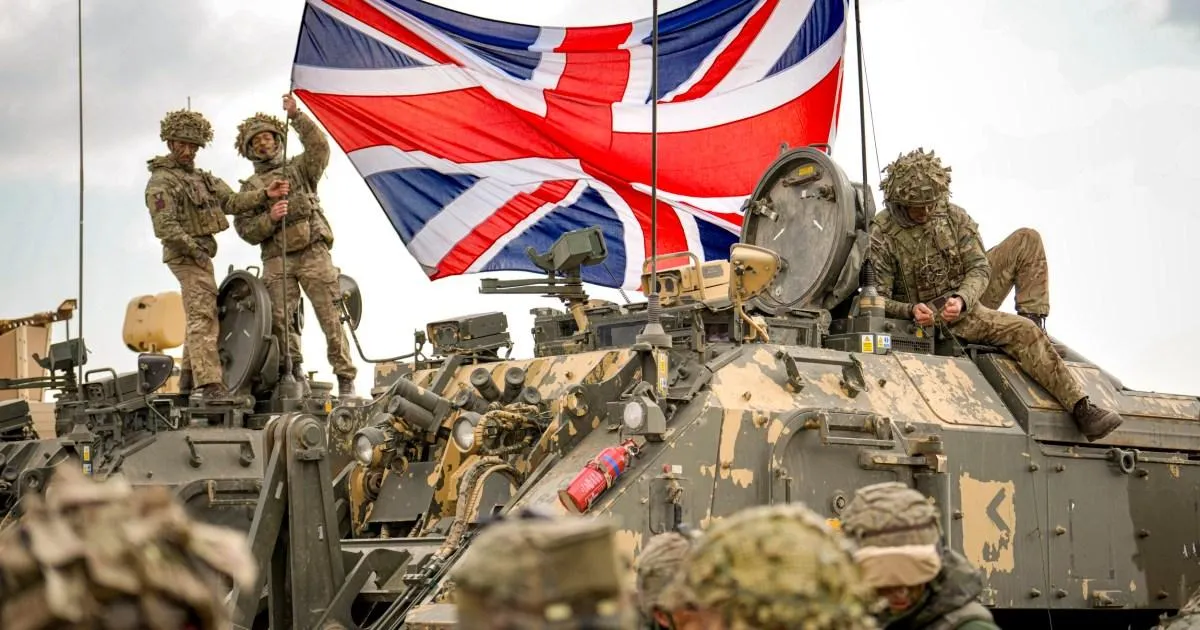

World War Three is unlikely to start with a ‘cyber Pearl Harbor’, a catastrophic cyberattack on critical infrastructure.
But if conflict comes to Britain – as suggested by armed forces minister, Al Carns – experts say it may be felt closer to home than on the frontline.
While the government is preparing for the possible outbreak of war, cyber warfare experts argue that the real danger is not a total digital collapse, but disruption to the NHS and supply chains, both in public and private sectors.
Dr Pia Hüsch, research fellow in cyber, technology and national security at RUSI, said Russia’s invasion of Ukraine has taught us an important lesson about the future of warfare.
She told Metro: ‘If you think about a scenario that is a sort of a World War Three full-on war, cyber operations are not going to have that sort of “Pearl Harbor! effect. That doesn’t really exist.
Sign up for all of the latest stories
Start your day informed with Metro’s News Updates newsletter or get Breaking News alerts the moment it happens.
‘Cyber operations will still be an essential part of any modern warfare as they will support any kinetic actions [traditional attacks, using missiles and bullets, for example] – as we have seen in Ukraine, where civilians are targeted, and warfare is brought closer to home, not just on the frontline.
‘These large-scale effect operations are highly sophisticated and extremely difficult to achieve.
‘If we are already in a kinetic [physical] war, then it might be far easier to drop a bomb somewhere than to plan a highly sophisticated cyber operation, that may or may not have the same effect.’
Earlier this week, Foreign Secretary Yvette Cooper warned that hybrid threats – from drone incursions to cyber attacks – are escalating across Europe.
In a speech at the Foreign Office, she said these attacks are designed to ‘weaken critical national infrastructure, undermine British interests and interfere in our democracies all for the advantage of malign foreign states.’
From January to September, GCHQ’s National Cyber Security Centre had already dealt with a record 204 ‘nationally significant’ cyber attacks.
This was more than double the 89 in the previous 12 months.

Of a total of 429 incidents, 18 were seen as ‘highly significant’, meaning that they had the potential to have a serious impact on essential services.
Dr Hüsch admitted that there are many Russian and Chinese actors targeting both public and private UK infrastructure.
Pointing to the cyber attacks on M&S and Jaguar Land Rover this year, she said: ‘This illustrates how vulnerable the UK private sector still is, and the private sector runs a lot of the UK critical national infrastructure.’
She warned that the most vulnerable sectors are hospitals and clinics, schools and also supermarkets.
Dr Hüsch added: ‘Another interesting part is about resilience… to make a comparison to some of the public responses we saw to the Covid-19 pandemic.
‘No one expected the UK to panic over loo roll… If you think about what supply chain shortages do to human nature and how people panic at the supermarket queue, and how we have really seen some unsocial behaviour come out during those pressure moments in Covid….
‘This is also where some of our worries should lie. I mean, cyber security, yes, it is a technical but also a social problem.’
Dr Hüsch’s response to future cyber warfare comes as the Armed Forces minister said the country is close to a conflict and that the ‘shadow of war was at Europe’s door.’
Hours before, Nato general secretary, Mark Rutte, urged all allied nations, including Britain, to boost their defence efforts against Russia.
In a speech in Berlin, he said that too many allies do not feel the urgency of the threat in Europe, and that they must rapidly increase defence spending and production to prevent a war on the scale of that seen by past generations.
‘We are Russia’s next target. I fear that too many are quietly complacent,’ he warned.
Too many don’t feel the urgency. And too many believe that time is on our side. It is not. The time for action is now.’
How much does the UK spend on defence?
The UK defence spending has been steadily growing in recent years.
In the year to March 2025, Britain spent £60.2 billion on defence.
This is expected to rise to around £62.2 billion this year, and up to an estimated £73.5 billion in 2028/29.
The government has pledged to grow defence spending to the Nato requirement of 2.5% of GDP by 2027, and up it to 3.5% by 2035.
Britain is 12th on the list of what chunk of their GDP Nato countries spend on defence.
Poland, Lithuania, Latvia and Estonia – all neighbouring Russia – lead the list for 2025 expenditure.
Get in touch with our news team by emailing us at webnews@metro.co.uk.
For more stories like this, check our news page.
MORE: Could the UK revive conscription after Army minister’s ‘war footing’ warning?
MORE: UK’s military power explained after warning ‘war knocking at Europe’s door’
MORE: ‘I deliver aid to the brave people of Ukraine – they will fight on despite Trump’s surrender plan’



