The human body is a machine whose many parts – from the microscopic details of our cells to our limbs, eyes, liver and brain – have been assembled in fits and starts over the four billion years of our history.
But scientists are still puzzling over why we evolved into this particular form. Why do humans uniquely have a chin, for example? And why, relative to body weight, is a human testicle triple the size of a gorilla’s but a fifth of that of a chimpanzee? As I show in my new book, The Tree of Life, we are still searching for the answers to many of these “why” questions. But we are starting to find answers to some of them.
The story of evolution tells us how, starting from simple beginnings, each species was built, when each of the components that make a living creature was added to its blueprint. If we climb the evolutionary tree of life, we can follow a twisting path that visits the increasingly specialised branches that a species belongs to. We humans, for example, were animals before we became vertebrates; mammals before evolving into primates and so on.
The groups of species we share each of these branches with reveal the order our body parts appeared.
Advertisement
A body and a gut (inventions of the animal branch) must have come before backbone and limbs (vertebrate branch); milk and hair (mammals) came before fingernails (primates).
The story of evolution tells us how, starting from simple beginnings, each species was built (Getty/iStock)
There is a way we can study the separate problem of just why we evolved each of these body parts, but it only works if the feature in question has evolved more than once on separate branches of the tree of life. This repeated evolution is called convergence. It can be a source of frustration for biologists because it confuses us as to how species are related. Swallows and swifts, for example, were once classified as sister species. We now know from both DNA and comparisons of their skeletons that swallows are really closer relatives of owls than swifts.
Size matters when it comes to evolution
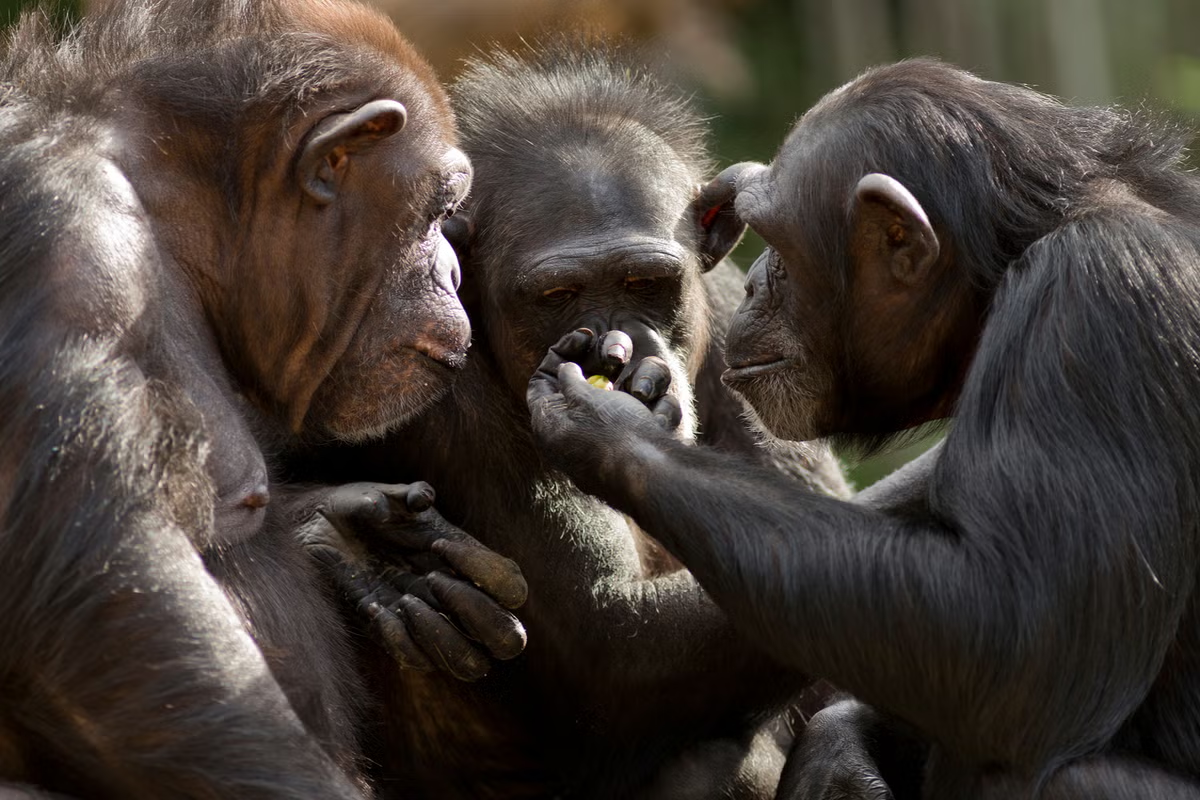
But convergent evolution becomes something useful when we think of it as a kind of natural experiment. The size of primate testicles gives us a classic example. Abyssinian black and white colobus monkey and bonnet macaque adult males are roughly the same size. But, like chimps, humans and gorillas, these similar monkeys have vastly dissimilar testicles. Colobus testicles weigh just 3 grams. The testicles of the macaques, in contrast, are a whopping 48 grams.
You could come up with several believable explanations for their different testicle sizes. Large testicles might be the equivalent of the peacock’s tail, not useful per se but attractive to females. But perhaps the most plausible explanation relates to the way they mate. A male colobus monkey competes ferociously for access to a harem of females who will mate exclusively with him. Macaques, on the other hand, live in peaceful mixed troops of about 30 monkeys and have a different approach to love where everyone mates with everyone else: males with multiple females (polygamy) and females with multiple males (polyandry).
Advertisement
The colobus with his harem can get away with producing a bare minimum of sperm – if a droplet is enough to produce a baby, then why make more? For a male macaque, the competition to reproduce happens in a battle between his sperm and the sperm of other males who mated before or after. A male macaque with large testicles should make more sperm, giving him a higher chance of passing on his genes. It’s a sensible explanation for their different testicle sizes, but is it true? This is where convergent evolution helps.
If we look across the whole of the mammal branch of the tree of life, we find there are many groups of mammals that have evolved testicles of all different sizes. In almost all these separate cases, larger testicles are consistently found in promiscuous species and smaller in monogamous.
About the author
Max Telford is a Jodrell Professor of Zoology and Comparative Anatomy at UCL.
A small-testicled, silverback male gorilla has sole access to a harem. Big-testicled chimps and bonobos are indeed highly promiscuous. Dolphins, meanwhile, may have the biggest mammalian testicles of all, making up as much as 4 per cent of their body weight (equivalent to human testicles weighing roughly 3 kilos). Although wild dolphin sex lives are naturally hard to study, spinner dolphins at least fit our expectations, engaging in mass mating events called wuzzles.
It was thanks to the multiple observations provided by convergent evolution that we were able to discover this consistent correlation between testicle size and sex life right across the mammals. And as for humans, we have testicle size somewhere in the middle, you can make of this what you want!
But what of the human chin?
The human chin has been fertile ground for arguments between scientists over its purpose. As with testicles, there are half a dozen plausible ideas to explain the evolution of the human chin. It could have evolved to strengthen the jaw of a battling caveman. Maybe the chin evolved to exaggerate the magnificence of a manly beard. It might even be a by-product of the invention of cooking and the softer food it produced – a functionless facial promontory left behind by the receding tide of a weakening jaw.
Advertisement
Intriguingly, however, a chin can be found in no other mammal, not even our closest cousins, the Neanderthals. Thanks to the uniqueness of the homo sapiens chin, while we have a rich set of possible explanations for its evolutionary purpose, in the absence of convergent evolution, we have no sensible way of testing them.
Some parts of human nature may be destined to remain a mystery.
The keen runner has decided to take on an six-day trek through the Great Silk Road route, which winds 200 miles across the wilds of Tajikistan.
Stirling student Ava Drake is preparing to take on a spectacular running challenge across Central Asia as part of efforts to protect a fragile environment.
Advertisement
Ava is a PhD student at the university’s institute of aquaculture, which studies issues including backyard fish farming – with some parts of the world suffering the impact of climate change on their incomes.
As part of her efforts to support a global charity supporting the issue, keen runner Ava has decided to take on an six-day trek through the Great Silk Road route, which winds 200 miles across the wilds of Tajikistan.
Speaking to the Observer, Ava explained the reasoning for stepping up to the plate and why the cause is so important.
She said: “I’ve always been someone drawn to a challenge and I’ve already done the Mongol Derby, which is a 1,000km horse race across Mongolia on the former postal route of Genghis Khan.
Advertisement
“I was scrolling online and saw the information about the Great Silk Road run and once I decided to commit to it, I wanted to find a cause which would make the journey more impactful for me.
“The run will support Aquaculture without Frontiers, which is an NGO looking to put funds into countries like Tajikistan which are facing a lot of challenges in aquaculture.
“The country faces serious food insecurity, with limited land for traditional agriculture and many people living below the poverty line.
“Aquaculture offers a sustainable, year-round source of protein, supporting local livelihoods and communities.
Advertisement
“One of the things I was told about a trip like this is to make sure you have a ‘why’ because that will help when times get tough.
“I’ve seen the impact of successful projects in aquaculture and so knowing how important the funds could be will help to keep me going – I know there will be a wider cause beyond the race itself.”
The Great Silk Run was started up by intrepid pair Danny Bent and Nick Carter and brings together participants from all over the world, weaving through the rugged terrain of the Pamir Mountains as well as crossing high mountain passes before ending near the Karakul Lake on the border with China.
Ava admits the run is a step up from her other challenges to date – and has been following an intense training programme including long-distance running, strength work and altitude conditioning.
Advertisement
She continued: “I’ve been on a rigorous plan since January because it will be a marathon a day in terms of distance and I also have to get used to the altitude element.
“I’ve been making use of the Munros across Scotland for that, a lot of climbing and running as well as making sure I have the right kit.”
To find more about the run and the charitable cause, you can visit Ava’s website on runningforresilience.org.
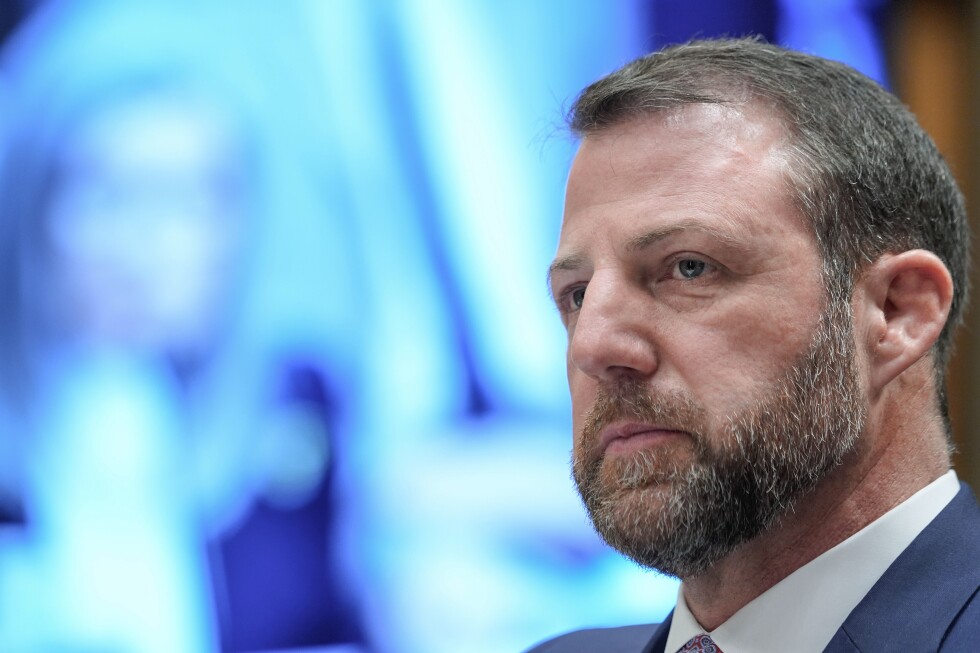
WASHINGTON (AP) — Sen. Markwayne Mullin moved a step closer to becoming President Donald Trump’s next homeland security secretary after a Senate committee Thursday narrowly advanced his nomination.
The 8-7 vote came after a contentious hearing Wednesday and sent the Cabinet nomination to the full Senate, which could act to confirm the Oklahoma Republican next week.
That vote included a “no” from the Republican chairman, Sen. Rand Paul of Kentucky, and a “yes” from a Democrat, Sen. John Fetterman of Pennsylvania. The approval comes as the parties are fighting bitterly over the policies of the Department of Homeland Security, leading to a funding lapse that is now in its 34th day.
During his testimony before the Senate Homeland Security and Government Affairs Committee, Mullin tried to make the case that he would be a steady hand after the tumultuous tenure of Kristi Noem, Trump’s first DHS secretary. Mullin also signaled support for Trump’s immigration priorities, which are central to the funding standoff after the death of at least three American citizens at the hands of federal agents.
Advertisement
AP AUDIO: Mullin’s DHS nomination advances to full Senate despite opposition from Republican Rand Paul
Advertisement
AP Washington correspondent Sagar Meghani reports Markwayne Mullin is edging closer to become Homeland Security secretary.
Mullin’s hearing was unusually combative and came close to going off the rails as he engaged in heated exchanges with some Democrats as well as Paul.
In addition to a lengthy exchange over Mullin’s failure to disclose what he characterized as a “classified” congressional trip while a House member, Paul opened the hearing with a fiery statement challenging Mullin’s fitness to lead DHS.
Paul pointed to comments Mullin made after a funding fight, when he called Paul a “freaking snake” and said he understood why a neighbor had tackled Paul in a lawn care dispute. That incident happened several years ago, and Paul suffered multiple broken ribs and later had surgeries he linked to the attack.
Advertisement
“I just wonder if someone who applauds violence against their political opponents is the right person to lead an agency that has struggled to accept limits to the proper use of force?” Paul said.
Mullin refused to back down.
“For you to say I’m a liar, sir, that’s not accurate,” Mullin said.
Paul later said he would not vote for Mullin’s confirmation.
Advertisement
Fetterman, who has frequently challenged his own party, said his vote was “rooted in a strong committed, constructive working relationship with Senator Mullin for our nation’s security.”
I cannot resist the combination of lamb, sweet dates and nutty tahini. You need plenty of herbs, though, to cut through the sweetness here, so use loads and don’t stint on the feta cheese either. Greek yogurt and shreds of preserved lemon zest would help, too. Serve with couscous, bulgar wheat or little olive oil-roasted potatoes.
Footage from Russian state broadcaster RT has captured the moment a missile lands just a few feet from where its reporter was broadcasting in southern Lebanon.
RT, formerly Russia Today, said Steve Sweeney, its Lebanon bureau chief, and his cameraman had “miraculously survived” and were being treated in hospital.
The BBC has verified the footage.
There have been ongoing Israeli air strikes and ground operations in southern Lebanon.
Airlines have suspended or rerouted services as safety concerns and airspace closures continue to affect global travel, with routes linking Manchester to key Middle Eastern destinations among the hardest hit.
Flights between Manchester and Kuwait and Dubai were cancelled today, including:
Kuwait Airways flight KU114 to Kuwait (12:00 departure)
The disruption has left many passengers in Bolton and surrounding areas facing uncertainty, with some forced to rearrange travel plans at short notice.
Travel experts have warned that the situation is ongoing, with further cancellations and delays likely in the coming days as airlines continue to adjust schedules.
Advertisement
Across the UK, thousands of flights have already been affected since the conflict escalated, with Manchester Airport among the worst impacted regional hubs.
In a statement on its website, Manchester Airport advised passengers seeking refunds to use its official Booking Cancellation/Refund Request Form.
The airport said: “If you have booked parking, FastTrack and/or Lounge through a third-party travel agent, please contact them directly as we are unable to process cancellations or refunds on their behalf.
“If you purchased cancellation protection, you can cancel and receive a full refund via self-service up to one hour before your scheduled departure time.”
Advertisement
Passengers are being urged to check with their airline before travelling to the airport and allow extra time for their journeys.
Smaller and more compact than a treadmill or rowing machine, the right exercise bike can be a great investment.
“Indoor cycling is low impact, but high intensity,” says Alana Murrin, co-founder at Saint Studios Dublin and former head instructor at London’s Psycle studios. “It’s a huge mind booster and mood shifter. Even when I just have small bursts of time, I can put on a 20-minute express workout and get that same sensation I get from an in-person class.”
Cyclists who use stationary bikes for short, high-intensity interval training can significantly improve performance on the road. “Twenty to 30 minutes is the sweet spot for those working out at home,” Murrin says. “If you commit to doing that every other day, you’ll find that consistency is more valuable than intensity.”
Advertisement
On a mission to improve my own fitness, I’ve spent months testing several of the best exercise bikes on the market. Only four made my final cut. Here they are.
The best exercise bikes of 2026: At a glance
How to choose the best exercise bike
There are three main types of exercise bike.
Upright exercise bikes (sometimes called static bikes) have an upright seat position and higher handlebars. They also tend to have a larger and more padded seat.
Spin bikes have lower handlebars and geometry similar to a road bike – they are what you would find in an indoor cycling or spin class.
Recumbent exercise bikes see you sit slightly reclined, with your feet in front of your body. These are useful for those with reduced mobility.
Once you’ve chosen your style of bike, the next thing to consider is its resistance. Most exercise bikes use a flywheel – a metal disc that provides the resistance to your pedalling. Spin instructor Alana Murrin recommends magnetic or electromagnetic resistance, which is quieter and smoother to adjust than direct contact or “friction” resistance. “I’m looking for a fluid sense of resistance,” she says. “If it feels clunky, you’re not going to be able to work up to higher speeds.”
Size is also a key consideration: you need to be able to fit the bike in your home and store it. Then there’s technology. Top-of-the-range models come with monitors to give you real-time feedback, show online cycling classes and simulate outdoor rides, or a tablet holder for using training apps such as Strava and Zwift.
Dean Markson, 27, admitted assaulting the victim to his severe injury and permanent disfigurement at Merryton Tower on May 27 last year.
15:50, 19 Mar 2026Updated 15:53, 19 Mar 2026
A thug has been jailed for 32 months after a Motherwell man was attacked with a bottle and a machete outside his home.
Dean Markson, 27, admitted assaulting the victim to his severe injury and permanent disfigurement at Merryton Tower on May 27 last year.
Hamilton Sheriff Court heard the victim was walking home from the shops about 3.25pm when he was attacked.
Advertisement
Markson ran towards him and struck him on the head with an Eldorado wine bottle, knocking him to the ground.
He continued to inflict blows until the bottle slipped out of his hand and smashed. Another male then struck the victim repeatedly on the head and back with a machete.
The pair left the scene in a car but police officers identified Markson from CCTV images. His DNA was on the broken bottle.
The victim’s partner returned home to find him injured. Worried about the amount of blood he had lost, she called an ambulance.
Advertisement
He had a number of cuts, the most serious of which was a 5cm wound to his back that was closed with stitches.
Markson has previous convictions for assault but defence lawyer Matthew McGovern said there was nothing on his record since 2020 and he had been attempting to “change his lifestyle”.
He has had addiction issues in the past that led to serious health problems and put his involvement in this assault down to “poor decision-making”.
Advertisement
Sheriff John Hamilton KC said it appeared from a criminal justice social work report that Markson had become involved in a “misguided revenge attack” on the victim.
The sheriff told him: “It seems you felt there was some justification for it.
“There seems to have been some planning as you waited for him to walk past as he came back from the shops.
“He suffered a number of significant wounds and it’s fortunate his injuries were not more serious given he was struck by a bottle and a machete.
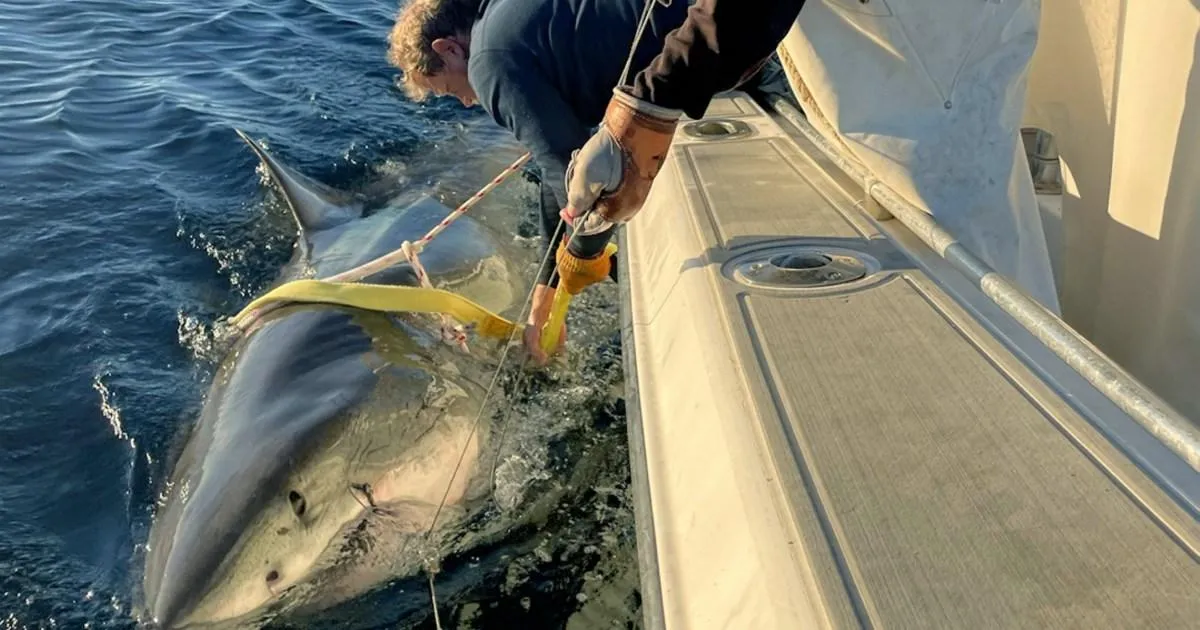
The 14-foot shark has moved close to a popular Florida beach town (Picture: SWNS)
The biggest great white shark ever recorded in the Atlantic is lingering just six miles off the coast of a major tourist destination.
The 14-foot shark, named Contender, most recently ‘pinged’ last week approximately six miles off St. Augustine, Florida.
Weighing 1,700 pounds, the creature vanished north to Canada’s Gulf of St. Lawrence – and is now back in Florida waters after an impressive 1,000+ mile odyssey.
Scientists say the shark could point them to one of science’s biggest mysteries – where great white sharks mate.
Advertisement
His return to shore on March 12 comes at peak breeding season – and researchers are watching his every move.
The move is a dramatic shift from his mid-February location off Cape Fear, North Carolina, where researchers had been monitoring his southward migration.
‘Contender has become a pretty famous shark, in part because he’s the largest mature male that OCEARCH has ever tagged,’ John P. Tyminski, senior data scientist at OCEARCH, said.
OCEARCH researchers originally tagged Contender offshore of the Florida-Georgia border on January 17 of last year, beginning what would become one of the most fascinating tracking stories in the organisation’s history.
Advertisement
‘He’s shown very interesting movements – gone all the way up into the Gulf of St. Lawrence during the summer and has come all the way back down,’ Tyminski said.
The shark’s epic migration covered thousands of miles along the Atlantic coast, demonstrating the incredible range the apex predators can travel.
What makes Contender’s current location particularly significant to researchers is both his proximity to shore and the timing of his return to Florida waters.
Advertisement
Scientists tagged Contender in the Atlantic Ocean (Picture: SWNS)
His recent movements have brought him much closer to the coastline than his previous positions further north.
‘His recent move brings him closer to shore,’ Tyminski said, noting that the shark had previously been tracked in the Carolinas before making his way back to Florida’s Atlantic coast.
Contender represents more than just an impressive specimen – he’s a key to unlocking one of the ocean’s greatest mysteries.
As a sexually mature male, his movement patterns could provide crucial insights into the reproductive biology of great white sharks.
‘We keep a close eye on sharks like Contender because, again, he’s sexually mature,’ Tyminski said. ‘One of the questions that we have is where mating takes place for white sharks?’
Advertisement
The timing of Contender’s return to warmer waters aligns with researchers’ theories about great white shark breeding behaviour.
Scientists believe the late winter and early spring period could be critical for mating activity among these magnificent predators.
‘We hypothesise that mating likely occurs or could occur in the late winter, early spring period,’ Tyminski said. ‘So we’re right in the midst of that.’
This makes tracking mature sharks like Contender invaluable for conservation efforts.
Advertisement
By monitoring the movement patterns of both mature males and females during this crucial time period, researchers hope to identify potential mating grounds and better understand the reproductive cycle of great white sharks.
‘Keeping an eye on white sharks like Contender can give us some indirect clues as to where mating may be occurring,’ Tyminski said.
‘It is definitely one of the questions that we still really want to try to answer to help protect and conserve white sharks.’
Woltemade made an impressive start to his career at Newcastle following his £69 million move from Stuttgart last summer, scoring six goals in his first 11 appearances.
But the 24-year-old has found the net just once in 19 appearances in 2026 and in recent weeks, he has played in a central midfield role with Anthony Gordon playing as a striker.
Woltemade, who has now been called up to Germany’s squad for their upcoming friendlies against Switzerland and Ghana, was also left on the bench for both of Newcastle’s Champions League last-16 games against Barcelona this month.
Advertisement
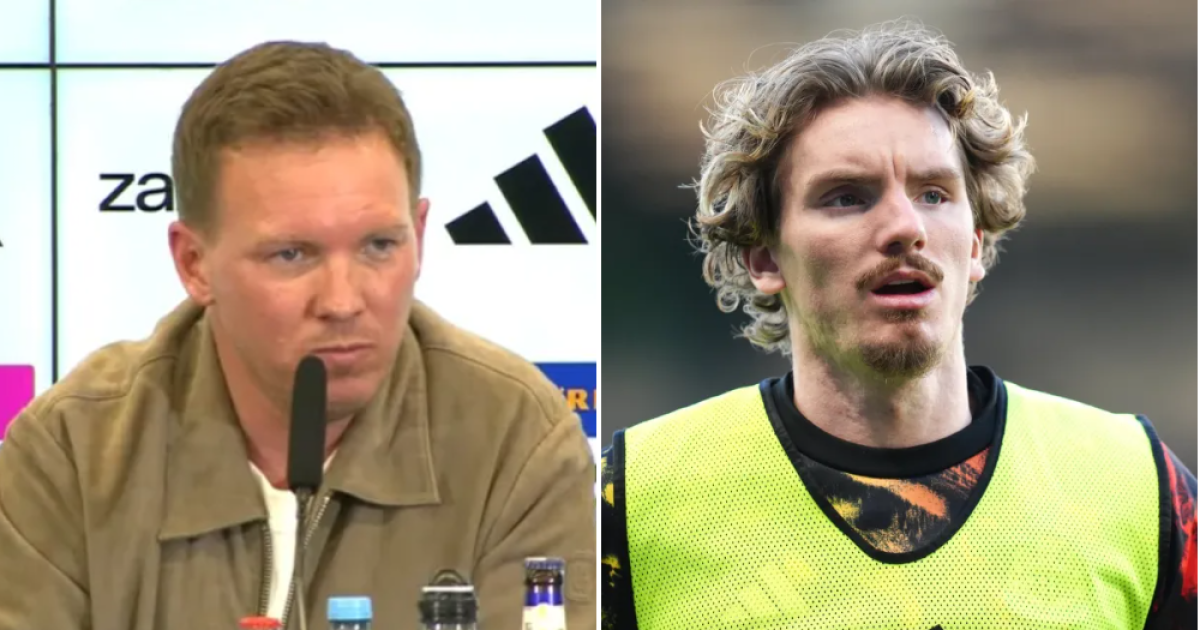
After announcing his Germany squad on Thursday, Nagelsmann took aim at Howe’s decision to play Woltemade as a midfielder and claims the forward is simply too far from goal to make an impact.
‘In a quieter setting he’s a super pleasant guy with a good wit, great sense of humour, I think he’s a really great character who is always in a good mood and always radiates a lot in conversations,’ Nagelsmann said.
‘He’s undoubtedly had a difficult time at Newcastle, no doubt, but that’s normal too.
Your football fix
Metro‘s Head of Sport James Goldman delivers punchy analysis, transfer talk and his take on the week’s biggest stories direct to your inbox every week.
Julian Nagelsmann has named Nick Woltemade in his latest Germany squad (Action Images via Reuters)
‘I also tried to play him in his role. I also think that what I said was interpreted too negatively. He did well for us but in a role that no one would have thought of six months ago, or rather, in the six months before the World Cup qualifiers because many other players were injured.
‘He can play from the start but he can also play a good role as a substitute because he already has an unorthodox playing style with his size and technique, and I think if you look at his record with us he has very good memories with the national team recently and is extremely happy about it. I believe it will help him too.
Advertisement
‘And when assessing Newcastle, I think you simply have to look at the whole issue. Yes, he’s not currently a striker in the squad, so [Anthony] Gordon basically scores everything and he [Woltemade] sits out the last two top games.
‘He’s not a striker who plays consistently there and that takes something away. Eddie Howe has obviously decided, without me knowing any more details, to simple swap his strikers and that’s his right, he should do it as he wants and what he thinks is right. It’s not my problem at all, I’m just trying to evaluate the player within the overall structure and if there were three strikers who always played I would be significantly more worried than Newcastle’s current set-up where the strikers are constantly being rotated.
Julian Nagelsmann says Nick Woltemade is playing too far from goal for Newcastle (Action Images via Reuters)
‘Lately, and this is just my opinion, judging him alone he’s often played very deep and when he’s defending as a double pivot, it’s quite a long way for Nick to cover. If he wants to get towards goal it’s very unlikely he will score because he’s not a class counter-attacking striker who can sprint at 36 km/h to outrun the opponent, that has to be said.
‘And then if he’s 80 metres away from the goal, I think as a British journalist you can’t expect him to score 20 goals there because the distance is simply too far. Yes, it depends a bit on the overall situation. What I can promise is that he is rarely 80 metres away from the goal. I will try to move him closer to 30 metres away from the goal and then he’s already dangerous and will do many things well.
‘I think very highly of him as a person too. He is not someone who puts a lot of thought into it. Nevertheless, the situation is obviously disturbing, I think that it’s normal that he would prefer things to be different but I think that’s normal. New culture, new league, new language, you might have learned that in school but it’s all new, new city.
Advertisement
‘It also took time in Stuttgart, not even registered for the Champions League for the first half of the year [last season] then scored seven goals in the second half. Yes, I have total trust in him and I also give him the necessary patience, everything will be alright.’
Shortly before his death, he attended Niall’s concert in Buenos Aires, with the two also catching up while they were both in South America.
Advertisement
“It was great,” the Slow Hands singer recalled, claiming the two quickly fell “back in like it was 10 years ago” when they met up. “[Liam] seemed in good form and we had a good laugh, good reminisce.”
Liam Payne and Niall Horan with One Direction bandmates Louis Tomlinson, Zayn Malik and Harry Styles in 2014
Niall later got the message that Liam had died, admitting: “I just didn’t think it was real. Someone so young, you’re not expecting to hear that they’ve passed, especially someone that you’ve just seen. I just went back from shock to sadness to anger.”
After he and his former bandmates attended Liam’s funeral, he said that he “went into hiding a little bit” to allow himself time to grieve, and has written a song about the loss on his upcoming album Dinner Party.
Per GQ Hype, on the song End Of An Era, Niall can be heard singing: “We had it, pure magic, remember what it was like, time passes so fast and I couldn’t tell you goodbye.”
Advertisement
In the days after Liam’s death, Niall told his Instagram followers: “Liam had an energy for life and a passion for work that was infectious. He was the brightest in every room and always made everyone feel happy and secure.
“All the laughs we had over the years, sometimes about the simplest of things, keep coming to mind through the sadness. We got to live out our wildest dreams together and I will cherish every moment we had forever. The bond and friendship we had doesn’t happen often in a lifetime.
“I feel so fortunate that I got to see him recently. I sadly didn’t know that after saying goodbye and hugging him that evening, I would be saying goodbye forever. It’s heartbreaking.”




















































You must be logged in to post a comment Login