

Over the last four years, the residents of one small Welsh village have seen varying scales of flooding – but nothing like Storm Claudia
Across Wales, communities faced the brutal force of Storm Claudia: roads washed out, businesses ruined, families evacuated, and entire neighbourhoods left sodden and silent in the storm’s wake. Fields became lakes, rivers burst their banks, and emergency crews worked through the night as wave after wave of destruction tore across the country. But one small Welsh village took the brunt of it.
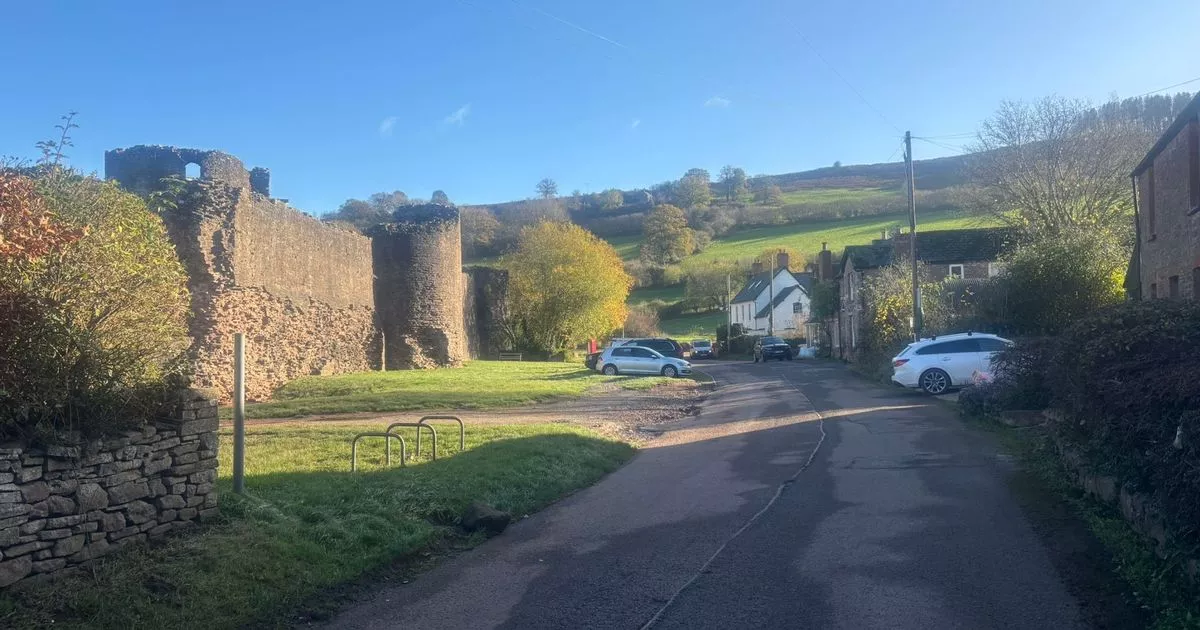
Skenfrith, usually a peaceful Monmouthshire community known for its 13th-century castle and rolling countryside, was overwhelmed as the River Monnow surged through its centre.
Homes filled in minutes, streets vanished beneath churning water, and residents watched helplessly as the village they had known for generations disappeared under the flood. For the biggest stories in Wales first, sign up to our daily newsletter here
Now, several days on, Skenfrith is still clawing its way back – its people exhausted, its homes battle-worn. Mud stains the pavements, ruined belongings lie in sodden piles, and disbelief lingers as villagers face the long, punishing clean-up from a storm that hit them harder than anywhere else.
Trevor, 62, and Katie Bailey-Rudge, 50, were remarkably calm as they cleared out their damaged home and prepared to enter temporary accommodation. As former ambulance service workers, they are no strangers to emergencies – yet both admitted that the scale of this flood was unlike anything they had seen.
“We were feeling calm in the moment. It is what it is, you deal with it,” Katie says. “We were lucky the services were much better prepared this time compared to the floods last November. Now, we’re exhausted.”
Their 1960s bungalow had, until Friday, been one of the few homes that had never fully flooded. “Our place had never flooded until now,” Trevor says. “We’re exhausted. We’re having to move out because it’s a bungalow. Everything’s gone – all the floors. We haven’t even really thought about what comes next. I can’t even see when we are going move back or go entirely back to normal – not till 2026 at least.”
The couple followed the familiar flood protocol that residents along the river know well. “We’d only ever seen the water reach just above our doorstep,” Katie says. “This time it was up to our shoulders. I’ve never seen it so high.”
“The road floods quickly – as soon as the banks burst, it all comes straight down here,” she adds. “It rises so fast. We did everything we could, but no one realised it would get that extreme.”
Trevor and Katie had to be rescued by boat, along with their two dogs and cat. “We were lucky we no longer have our chickens to worry about!” Katie adds with a tired smile.
She credits the rescue teams for their swift response. “After the last flood we felt a bit forgotten, but the rescue services this time were amazing – absolutely brilliant. Even though they didn’t know the area well, having come from North Wales.
“It was a relief when they got here before it got really bad. We’re so isolated. When we lose power, we can’t get help – there’s no mobile signal, and we rely on Wi-Fi. It’s scary. As a village we’re well prepared, but the big issue is people from outside ignoring warnings and road closures. They don’t understand how bad it gets and they put themselves and others at risk.”
One family with young children reportedly became stranded near the village and were rescued by a passing farmer. They were taken in by neighbour Graham Edmunds, 76, who lives slightly further up from the worst-affected road.
Despite living in Skenfrith for 28 years, Graham says the weekend’s flood was the worst he has seen. “It came closer to the house than it’s ever come before. It was deeper than anything we’ve had.”
“It always seems to flood here,” he says. “But this time we couldn’t even get onto the main road. They called in the Coastguard crews from Llandudno and Harlech with a boat to help with rescues. Everyone was as prepared as they could be, but the water still came straight through the flood defences. There was nothing anyone could do – it was so powerful.”
A toppled heating-oil tank has left parts of the village reeking of fuel. The smell still hangs heavy in the air. For the biggest stories in Wales first, sign up to our daily newsletter here
Not far from Trevor and Katie lives Ruth Walker, who has spent 10 years in Skenfrith. When asked how she feels in the wake of the flood, she replies simply: “Stoic.”
“You get used to dealing with it and trying to get back to normal, but it’s a massive inconvenience,” she says. “We’ve been flooded four times in six years, but you can never see it coming.”
Ruth was in Italy when her neighbour called to warn her of the approaching flood. “I had the dogs with me, but I drove back. I got home around 10.30am on Friday. My husband was away, but neighbours helped me move the furniture.”
“Honestly, it’s almost become routine. We had the flood defences up quickly – everyone knows what to do. We had emergency supplies ready, my daughter took the dogs, and I just went upstairs to wait it out. It’s horrendous when the power goes off. Some people have walkie-talkies – that’s the only way we can talk to each other.”
Saturday morning, however, was the worst. “To come downstairs and see water still in the house by ten the next morning… In the past, it would have drained overnight. But this time it was still really high.”
Still, Ruth was determined. “When you’ve been flooded before, you know what to do. By yesterday the place was spotless again. We’re not even touching the garage yet.”
She praises the sense of community: “Everyone helps each other. We’ve got Facebook group chats – someone said they had the boiler man round, and then sent him to other houses to help. It’s a great community.”
That spirit was on full display on Monday as people from surrounding areas travelled down to help. Among them were Charlie Kensington and Stuart Atkinson.
“We’re just up the hill, so we came down to help families here,” Charlie says. “From our point of view, we could see the flood levels rising rapidly online.”
“Last time there was about two feet of water in the houses,” Stuart says. “We’d already put everything up high, expecting it. It helped a bit, but some things still didn’t escape the damage.”
“When things start floating, it’s surreal,” Charlie adds. “Clay and mud everywhere. Kitchen cupboards are the worst. pans and cups full of water…”
“I opened the washing machine just now and a stream of it came out!” Stuart interjects.
Charlie says no one expected the scale of the flooding – especially not in nearby Monmouth. “People in Monmouth didn’t think it would flood. But by 4.30pm it had gone up a metre. In two hours it peaked at about three-and-a-half. We know it floods at five metres- and we knew there were another eight hours of rain coming.”
“The other clue was how fast the rescue services arrived,” Stuart adds. “They got here so early it almost guaranteed it was going to be bad.”
But this time, there was a new and unsettling factor: the overpowering smell of fuel.
“There was an awful smell – fuel everywhere. Even tanks that were bolted down tipped over. We were helping people wading through three feet of water,” Stuart says. “Landlines and internet went down immediately.”
Charlie points out that the flooding has become alarmingly frequent. “Last year it flooded almost on the exact same date -two feet of water. Before that, February 2020: three feet. And four months before that, another flood.”
“People felt more confident last year because the groundwater was low,” he says. “But climate change is making everything worse. It’s not just the council’s fault in not putting in flood defences – intensive farming has changed the landscape. Rivers used to meander; now farmers have clawed back flood plains. It’s all become industrialised.”
The impact of the flood has hit Karen and Darren Rockach hard, as this is the first time water has ever entered their home. “We’ve been here for four years,” Karen says candidly. “Last year the defences saved us. In 2019 and 2020 the barriers were really effective. In November they worked again – but this time it was just too much.”
Despite that, they felt as ready as anyone could be. “We actually felt very prepared,” Darren explains. “We’d had a survey done to boost our flood defences, and the people who came were really impressed. We followed all the instructions, had the pumps set up – we could get everything done in minutes. Everything worked… until the water overwhelmed it.”
The moment the water breached their home, everything unravelled at once. “We lost internet, hot water, electricity – all went first,” Darren says. “I like to think I’m organised, but I never thought to print things out – think about numbers we needed until the internet was not there. There’s always something you forget.”
“And with no mobile signal, you can’t tell your family you’re okay,” Karen added. “That was really difficult.”
Worse still was the loss of irreplaceable belongings. “We’ve lost things passed down from our parents,” she says.
“Some things just washed away – we’ll never see them again,” Darren said emotionally. “Memories that you think you will have forever, just gone – lost.”
Now they have to focus on recovery, but the cost feels astronomical. “We were at a point where we felt that everything was finished in the house. Every knick knack – all was what we wanted,” Darren continued. “But now we basically have to go back to scratch. We will have to rip out the kitchen and put in a new one in.”
“One of the septic tanks burst and sewage came streaming into the house,” Karen said. “The floor will all need to be redone, the smell… there’s just a lot to think about.”
They also faced the same issue plaguing others in the village: heating oil tanks tipping and spilling into the floodwater. “The smell of oil is constant – I was genuinely worried it would kill us in our sleep,” Darren said. “I didn’t sleep all night on Friday, I had been up for thirty-six hours straight.”
The scale of the flood has left them devastated – and the pattern has become impossible to ignore. “Skenfrith seems to get higher every year,” Darren adds grimly. “There will come a point when no one will be able to stand it anymore – then this historic town will become something of a ghost town.”



