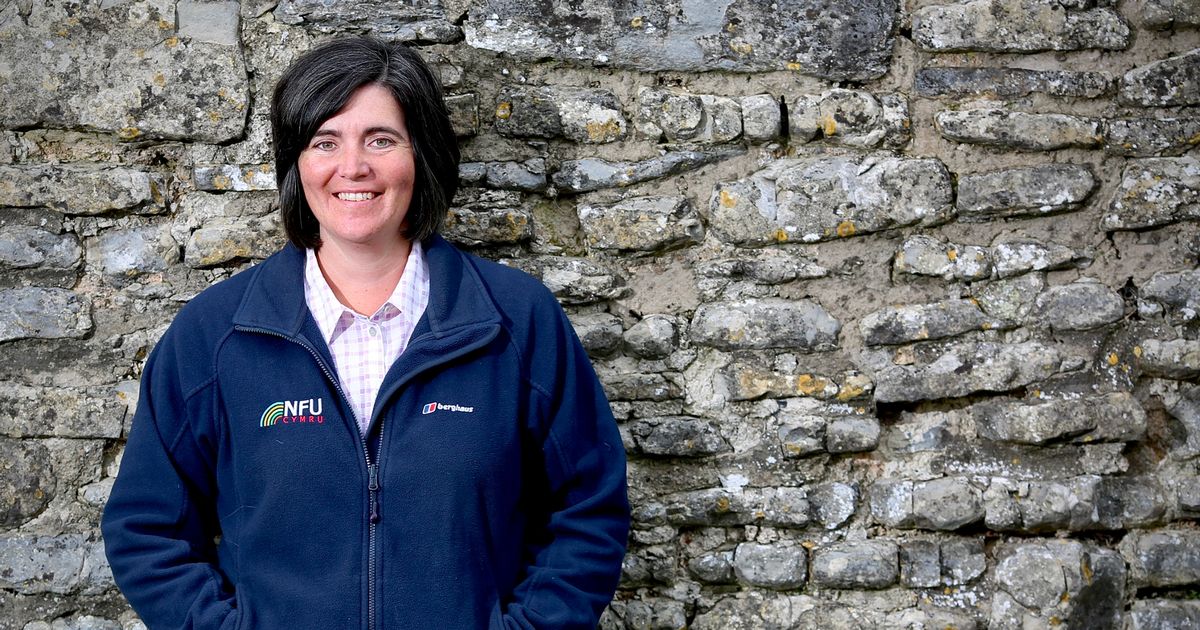
She was one of those who feared she would lose her farm under government inheritance tax changes, now Abi Reader is switching her farm for the corridors of power
Most days, if you want to find Abi Reader you’ll have to set your alarm and get your wellies on. Her alarm goes off, just after 5am and she’s out of the door, her dog at her side and will return home only when the herd is milked and jobs on the farm completed.
There is, she says, nowhere she would rather be.
“It just runs through my veins,” she said. “From the moment that alarm clock goes off at 10 past, quarter past five, four in the morning, and stepping out of that back door with wellies on and with my dog by my side, and then spending the whole day on the yard with cows, it’s the best place in the world to be,” she said.
A third-generation farmer, farming dairy, sheep and arable, at Goldsland Farm in partnership with her parents and uncle in Wenvoe, just outside Cardiff, but from now on, you should expect to see more of her in the corridors of power, rather than the milking shed as the 44-year-old has just been elected as NFU Cymru president, the first woman to hold the role – although she’s keen to point out, the reason she was voted in by members on January 20 is her skills, not her gender.
Farming is inextricably linked to politics, and given the current climate, she knows there is plenty to do.
But, like thousands of farmers, the last 14 or so months have been racked with uncertainty. The Welsh Government was changing the post-Brexit farming subsidy arrangements via the Sustainable Farming Scheme (SFS), and the agricultural community said the Labour-run administration’s approach would have decimated their industry.
The anger was palpable, not least when farmers from all across Wales left their farms to head to the Senedd to protest in their thousands. Abi was one of them.
Since 2012, she has been active in NFU Cymru in 2012, when she joined picketers outside a milk processors to campaign about milk prices.1
“What really stuck with me was that there were hundreds of farmers there, and all sorts of rural businesses, and the media turned up to project that story out to the rest of the world who wanted to know what on earth we were doing, and a lot of the farmers ran away because they were so afraid that they might be caught on camera and their processor might victimise them.
“I realised that we were all in a really difficult situation and I don’t ever want the farming community to feel like it’s afraid to have a voice,” she said.
The unions offer that, but protection too, she said.
That rally in February 2024, was the biggest that have ever been on the Senedd steps. Looking back, I ask her what it taught her.
“It taught me a lot about the agricultural community. Everyone came together to down tools. To leave your farms that day was massive, people do not take that lightly.
“On a farm you can’t just turn the sign from ‘open’ to ‘closed’ on the front door and walk out.
“The farm has to keep going and someone had to stay behind on every single farm to make sure the animals were fed, crops were seen to or wherever it may be.
“For many farming families they’ve got people of all ages so we know that a lot of our young people would have been in school that day and a lot of our elderly wouldn’t have been able to get there.
“What it taught me was how much hurt was out there. and it had got to the final straw.
“It was never just the SFS, it was an accumulation of so many terrible things that farmers have to go through and it still astonishes me that that is where our rural community ended up, that they felt no one was listening to them.
“It dragged them from the mountain tops, from the coastal areas to the front of the Senedd.
“Some of them had never even left their county before but they just wanted somebody to look at them and listen to them.”
After months of negotiations, lobbying and pressure, changes were announced to the scheme.
The announcement was met, she said, with a mix of “relief and anger”. “Relief because so many people would be taken out of the eye of the storm and there had been some terrible thoughts going through farming families, but the anger was ‘why have they put the farming community through that’.
“Some of the damage is irreversible, tragically, and it’s just done so much damage to these farming businesses.
“Some people have had to spend tens of thousands of pounds trying to restructure to save their farms. It will have caused arguments and sleepless nights and stress and all for what?
“Why would you target people who are just trying to feed you?”
At the same time, they were campaigning against the UK Government’s proposed changes to inheritance tax, which, if they’d have gone through, hundreds of farmers said, would mean they would have had to sell their farms and that’s before you look at the impact of Brexit, TB, Covid, the Ukraine war, and falling milk prices.
For the months where inheritance tax changes were being touted, she was one of the key voices from Wales voicing concerns. Not just about the impact members would face, but it was personal.
“I knew that my own farm personally was going to face big problems because of my father’s health.
“He wouldn’t be able to live long enough to pass the farm on, so therefore we would be facing a tax bill of almost half a million pounds.
“The quick maths showed that would take me around about 20 years to pay back if I didn’t take any income or any profit from the business, so it was basically a no-go.
“As well as carrying the weight of members, I started to prepare myself for the fact that, chance was, I would not be farming in four to five years’ time, and how do you do that?
“You could have the situation where your whole world caves in around you, or you can say ‘actually I need to put things in place’.
“I’ve got staff who work for me who I’ve been encouraging into the industry, I’ve got cows, I need think where they’re going to go, I think where I might need to live and get all of those plans in place, and at the same time carry some quite bitter feelings, really, about what the government was doing and how it was doing it.”
She watched the Budget on October 30 when Chancellor Rachel Reeves announced there would be change. Until then she had been considering change, but from that point, the serious planning started.
“Do you let yourself think, game over? No. I never wanted to do that.
“Farmers used to ask me if we’d get concessions, and I could always honestly answer, ‘yes’ because I believe in the power of what we can lobby.
“But at the same time, you’ve got to hope for the best, prepare for the worst,” she said.
Then, on December 23, when the NFU learnt of the concessions planned a test message went round to members. She was on a train with her goddaughter going to see Santa at the time.
“This message came through and it was very difficult to feel happy, there was relief, but there was a lot of anger because they’d done so much damage to my business and other businesses and it’s going to take me a long time to forgive them.”
Can they gain the trust back? “The proof will be in what they do next,” she says.
Agriculture is devolved, so NFU Cymru has to deal with both UK and Welsh governments, and there are differences, she says.
“It’s a bonus in Wales that we have shorter lines of communication, we may not like that communication, but they’re shorter and to be able to get to the top is a lot simpler.
“When you’re reaching from Wales to Westminster, that’s a lot more complicated and a lot of the language that we use, I don’t even just mean the Welsh language, I just mean farm language, rural language.
“It’s very alien in Westminster. So getting our message across, working with the other UK farming unions, so Scotland, Northern Ireland, England.
“It was a long slog,” she said.
“There is a big opportunity, without a doubt, we’re moving from 60 Senedd members to 96. Many of the existing Senedd members are not standing again and others are likely to maybe not be here because of the electoral reform.
“There is a huge opportunity to reset the clock, reshape conversations, and effectively start over and that’s what we want.
“This is a new time, a new era, and we’re going to embrace it,” she said.
The changes to the constituency boundaries from May also mean that the rural/urban divide they believe has been in place goes, because every constituency in Wales will have farming in it.
That lobbying has started already, just this week they invited all MSs to dinner, and started sounding out their policies.
They don’t want to see the progress on the SFS derailed, they say, because of a pledge in a manifesto. “Our opinion that we will be giving to all political parties is that we can’t undo the good work that has been done so far.
“Yes there are problems, but we need evolution, not a complete scrapping and starting over again.”
Abi is a third-generation farmer. When she was born, her mother’s parents were farming in Radyr, and she is working on her father’s farm in Wenvoe.
Growing up, as many children in the community do, she was out on the farm, chipping in, but was it, I ask her, a given that would be her career path or did she have a choice.
“I went to school in the middle of Cardiff where career’s advice at the time was certainly not to advise young girls to think about becoming a farmer.
“The advice really was girls needed to be dentists, solicitors, doctors, secretaries, whatever it was, fantastic careers but there was nothing on land-based work.
“I had no idea what I wanted it to do, certainly there was no help to become a farmer and my parents never wanted to push me into it,” she said.
A chance phone call with someone in the community, suggested going to agricultural college, and at 18, off she went.
“The moment I stepped on those university grounds, I knew that’s what I wanted to be,” she said.
“I call it my Harry Potter moment because instead of doing maths and English and science, I was doing farm livestock, farm mechanisation, grass growth, things like that.”
She spent four-and-a-half years there, completing a degree in agriculture and a postgraduate degree.
She left university and went home and worked with my father, she said.
But, he’s had poor health for around 15 years, so rapidly she had to step up.
“I manage 200 milking cows, I’ve got a small team of staff, one full time and four part time people who come out on the farm, milking twice a day.
“We produce enough milk to feed 4,500 households every single day,” she said.
It is, an honour, she says, to be president but she knows she was elected because of that knowledge as a farmer, not her gender. “Your peers are a great judge and we’re a democratic organisation.
“Members voted me to where I am off the back of the work that I’ve done and my job now is to make sure that I uphold all of those values that I promised them I would and if that inspires other women to come in and do these roles, absolutely brilliant but first and foremost, I’m a farmer. I’m not a lady farmer or a woman farmer.”
Her accolades are plenty, she is a co-founder of the Cows on Tour movement, a former NFU Cymru Wales Woman Farmer of the Year, she was honoured by the Queen with an MBE in 2019 for her services to agriculture.
Her step up to president, after holding numerous roles throughout the years, will inevitably see her time on the farm cut back. The hours will vary, but some weeks will be full-time, so she has put a plan in place for the farm and her team to run it.
But she needs, and wants, to still be there. “That’s still a huge part of who I am and what I do and I need to have that connection,” she said.
Given, I ask her, that the first thing she told me when we met was how much she loves being in her wellies and on the farm, why has she decided to swap to hours in a suit and heels. Why is that a sacrifice worth making?
“Because if we didn’t do the lobbying, I probably wouldn’t be farming.
“If someone didn’t give the rural community a voice, then farms may fall by the wayside and we can’t let that happen.
“Farming is all about the next generation and if we don’t take responsibility to look after our own businesses, they’re not going to be there for the next one,” she said.