Connect with us

NewsBeat

Timeline of a tragedy: Video reveals Border agents leaving near-blind refugee on New York street before he died in the cold

Published

on

Timeline of a tragedy: Video reveals Border agents leaving near-blind refugee on New York street before he died in the cold

One year after he was Tasered, beaten and arrested by police in Buffalo, New York, a 56-year-old refugee from Myanmar was picked up by Border Patrol agents from a local jail and dropped off outside a Tim Horton’s coffee shop before he was found dead on the street one week later.

Video surveillance footage shows a white van dropping Nurul Amin Shah Alam in a shopping center parking lot more than an hour after the shop had already closed. He wasn’t wearing shoes, only the orange booties that were issued by the jail.

Cameras never showed him entering the shop, and he wasn’t seen again until five days later, when a woman called 911 to report his body on the street more than five miles away.

The case of Shah Alam, who was nearly blind and spoke only little English, has shocked Buffalo’s Rohingya community and outraged residents and advocates who have raised alarms for months about the Trump administration’s treatment of vulnerable immigrants, refugees and their families.

Advertisement

A timeline of events before his death on the streets of Buffalo before punishing winter weather are now raising critical questions about local law enforcement’s handling of his case and their cooperation with federal immigration authorities who failed to notify his family that he was no longer in custody.

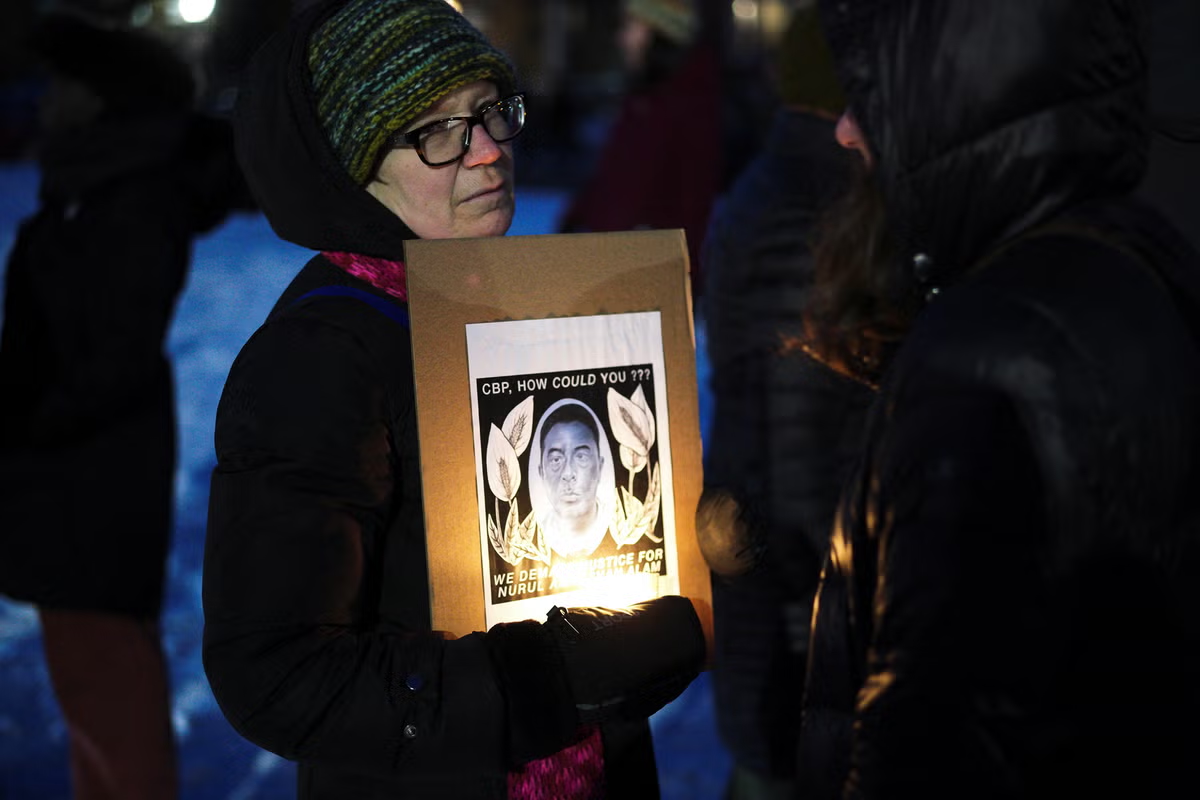
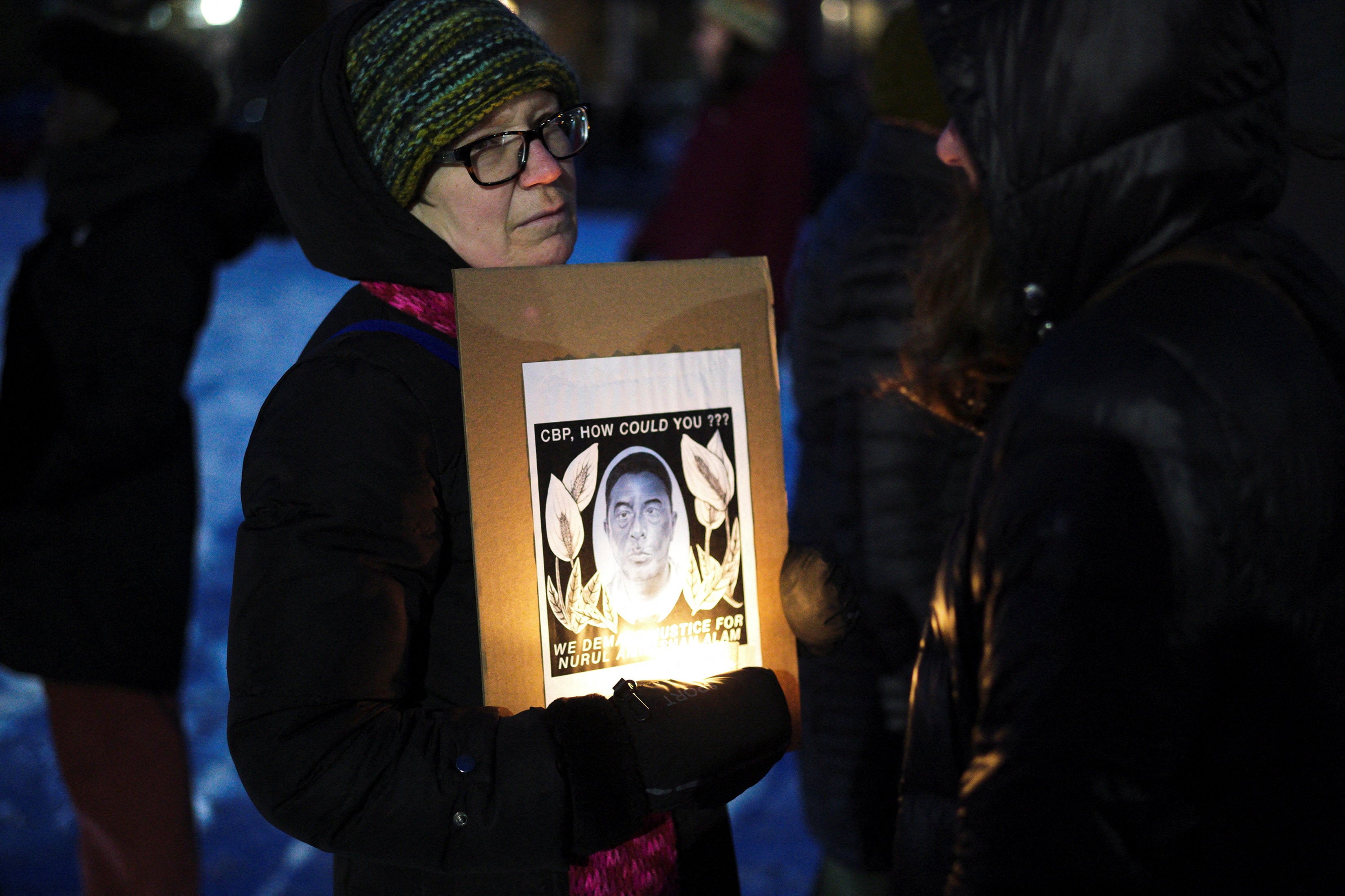
Buffalo residents mourned the death of Nurul Amin Shah Alam, a nearly blind Rohingya refugee who was found dead on the street five days after Border Patrol officers dropped him in a parking lot outside a closed coffee shop

Buffalo residents mourned the death of Nurul Amin Shah Alam, a nearly blind Rohingya refugee who was found dead on the street five days after Border Patrol officers dropped him in a parking lot outside a closed coffee shop (REUTERS)

New York Attorney General Letitia James says her office is reviewing legal options. Members of Congress are also demanding investigations.

February 15, 2025

Advertisement

Shah Alam, a member of Myanmar’s persecuted Rohingya minority, arrived in the United States as a refugee in December 2024 with his wife and two sons.

Two months later, on the morning of February 15, 2025, he had wandered into a person’s backyard in the Riverside neighborhood.

After buying a curtain rod, he mistakenly entered the person’s property, according to the Legal Aid Bureau of Buffalo, which represented Shah Alam.

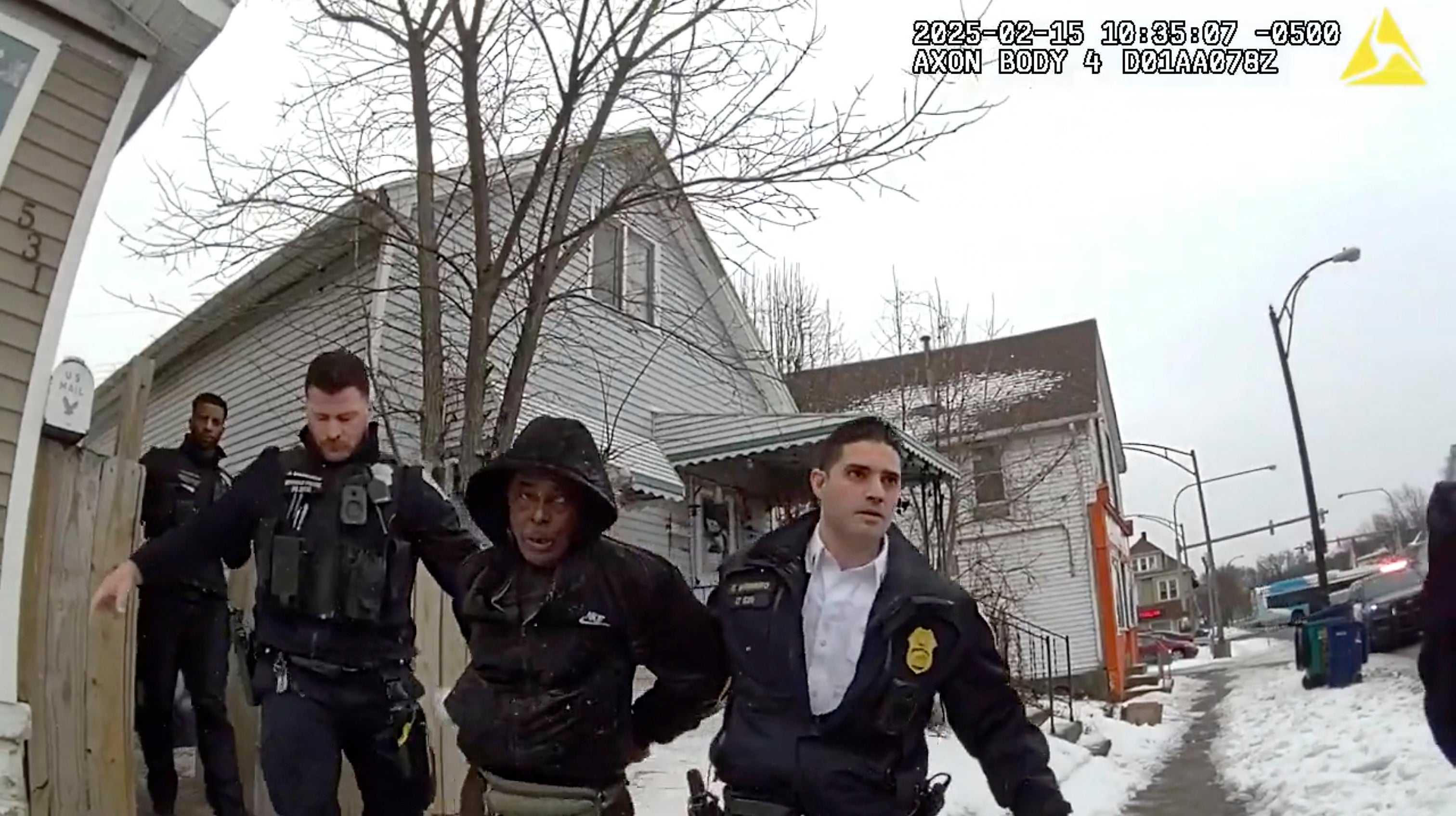
According to body-worn camera footage of the incident, officers can be heard shouting out “what are you doing” and repeatedly ordering him to drop the rod in his hands. “Put it down or you’re going to get Tased,” one officer shouts.

Advertisement
Bodycam footage from Buffalo police show the moment they encountered Shah Alam in a woman’s backyard in February 2025

Bodycam footage from Buffalo police show the moment they encountered Shah Alam in a woman’s backyard in February 2025 (Buffalo Police Department)
Shah Alam was arrested and later indicted for felony assault, burglary and criminal mischief charges. He remained in jail for more than a year

Shah Alam was arrested and later indicted for felony assault, burglary and criminal mischief charges. He remained in jail for more than a year (Buffalo Police Department)

He then sticks the rod into the snow and stands beside it while officers continue to order him to place it on the ground. He then places his hand out in front of the officers while they threaten to fire their Tasers, which they point at him throughout the incident.

Shah Alam, who is speaking Ruáingga throughout the incident, then appears to raise the rod to defend himself, and the officers fire.

Advertisement

Once on the ground, one officer calls Shah Alam a “f****** a******” and punches him in the head.

An officer later says Shah Alam bit the officers..

“He’s gonna be injured. I don’t know how bad,” an officer says. “He got hit by all four [Tasers] and still came at us with the f****** poles. He almost got shot.”

The next day, he was arraigned in Buffalo City Court and held on bail set at $25,000. A federal immigration detainer alerting federal authorities he was in custody was issued after his arrest, according to the Erie County District Attorney’s Office.

Advertisement

May 2025

Shah Alam remained in the local jail, and a grand jury indictment followed four months later.

He was indicted for felony assault, burglary and criminal mischief charges.

Shah Alam was due to be sentenced in March after pleading guilty to reduced charges. For reasons that are still unclear, sheriff’s deputies released him from custody and handed him over to Border Patrol

Advertisement
Shah Alam was due to be sentenced in March after pleading guilty to reduced charges. For reasons that are still unclear, sheriff’s deputies released him from custody and handed him over to Border Patrol (via REUTERS)

His bail was lowered to $5,000, but Shah Alam’s family decided to keep him in the jail where they could visit him, fearing that Immigration and Customs Enforcement would pick him up and send him to a detention center outside of Buffalo, or deport him.

Earlier this month, Shah Alam agreed to plead guilty to reduced charges of criminal possession of a weapon in the fourth degree and one count of criminal trespass in the third degree, according to District Attorney Michael J. Keane.

His sentencing was scheduled for March 24.

“My decision was the result of a comprehensive evaluation of his conduct, criminal history, acceptance of responsibility, medical condition, time served in pre-trial custody, and the proposed resolution,” Keane said in a statement shared with The Independent. “I also considered the significant collateral consequences that would result from a felony conviction — including mandatory deportation.”

Advertisement
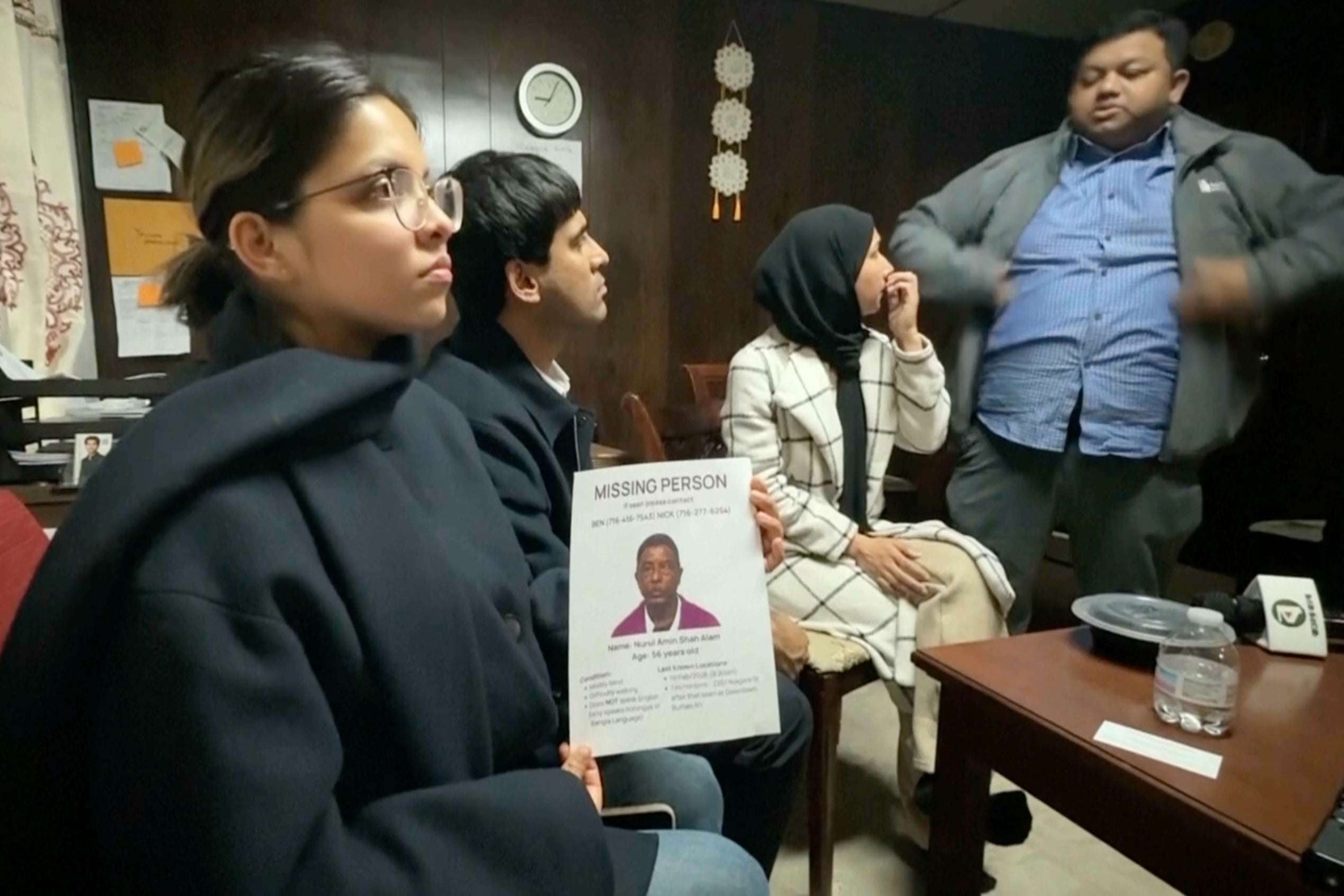
Shah Alam was reported missing after law enforcement failed to notify his family that he was released, and family and friends canvassed Buffalo for several days

Shah Alam was reported missing after law enforcement failed to notify his family that he was released, and family and friends canvassed Buffalo for several days (AP)

February 19

Shah Alam’s guilty plea did not make eligible for ICE detention or removal from the country, according to his attorneys.

At 5:25 p.m. February 19, sheriff’s deputies at the Erie County Holding Center handed him over to Customs and Border Protection officers, according to a timeline from the Buffalo Police Department.

Advertisement

Keane, the district attorney, was not aware of his release into immigration custody until the day he died, he said.

When Border Patrol agents picked him up, they shortly realized he wasn’t supposed to be deported. Officers instead offered him “courtesy ride” to a Tim Horton’s coffee shop, which was “determined to be a warm, safe location near his last known address,” according to a statement from the agency.

On February 19, after determining that Shah Alam was not deportable, Border Patrol officers dropped him off at a closed Tim Horton’s coffee shop on Niagara Street

On February 19, after determining that Shah Alam was not deportable, Border Patrol officers dropped him off at a closed Tim Horton’s coffee shop on Niagara Street (AP)

He showed no signs of distress, mobility issues, or disabilities requiring special assistance, the agency said in a statement.

Advertisement

His family was not contacted.

Video surveillance footage obtained by The Washington Post and Buffalo’s Investigative Post shows Shah Alam exiting a white van in a shopping plaza after 8 p.m., more than an hour after Tim Horton’s had closed for the night.

The van leaves one minute after dropping him off.

He walks slowly past the coffee shop’s drive-through window, which was open, and pulls the black hood of his jacket over his head, according to the video. Footage does not show him trying to enter.

Advertisement

Six minutes after leaving the van, the man walks away through a parking lot then disappears from view. He never made it home.

February 22-24

Shah Alam’s Legal Aid Bureau attorney Benjamin Macaluso filed a missing persons report on Sunday with the Buffalo Police Department, according to police.

Macaluso said he was “unable to confirm his client’s current location despite contacting federal authorities,” police said.

Advertisement

The next day, police launched an investigation and mistakenly determined that Shah Alam was in federal custody — and then closed the case. The detective handling the case corrected the error four hours later.

Buffalo police briefly closed the missing persons case after believing he was in federal custody — three days after Border Patrol officers left him outside Tim Horton’s

Buffalo police briefly closed the missing persons case after believing he was in federal custody — three days after Border Patrol officers left him outside Tim Horton’s (via REUTERS)

On Tuesday, police issued a missing person poster on social media.

That night, police began canvassing the area, including previous known addresses as well as local hospitals and shelters.

Advertisement

Between his arrest and release, Shah Alam’s family had moved across town, roughly five miles away from where he was dropped off.

February 25

According to police, a woman called 911 at 8:29 p.m. Tuesday to report an “unresponsive male wearing a dark parka and khaki pants who appeared not to be breathing, with his hands described as gray in color.”

She said the man was moving three hours earlier but, when she passed by the same area that night, he was still on the ground “and no longer moving, at which time 911 was contacted,” according to police.

Advertisement

Buffalo Fire Department personnel arrived on the scene and initiated chest compressions. Buffalo Police officers also administered Narcan. Emergency responders pronounced him dead.

Shah Alam was more than five miles south of where Borders Patrol officers left him.

Community members and loved ones buried Shah Alam two days after he was found dead roughly five miles from where he was last seen by Border Patrol officers

Community members and loved ones buried Shah Alam two days after he was found dead roughly five miles from where he was last seen by Border Patrol officers (REUTERS)
Advocates and elected officials are demanding answers and investigations to examine the failures that led to Shah Alam’s death

Advertisement
Advocates and elected officials are demanding answers and investigations to examine the failures that led to Shah Alam’s death (REUTERS)

February 26

According to police, Shah Alam’s family was notified of his death by the Erie County Medical Examiner’s Office shortly after 10 a.m. Wednesday.

His death was determined to be “health related in nature,” according to a spokesperson for the city. The medical examiner has not yet determined a cause or manner of death.

Source link

Advertisement
Continue Reading
Click to comment

Leave a Reply

Your email address will not be published. Required fields are marked *

NewsBeat

A virus hiding inside bacteria may help explain colorectal cancer

Published

on

A virus hiding inside bacteria may help explain colorectal cancer

The gut bacterium Bacteroides fragilis has long presented researchers with a paradox. It has been associated with colorectal cancer, yet it also lives quite happily in most healthy people. A new study from a Danish research team offers a possible clue. When they looked beyond the bacterium itself and into its genome, they found a previously unknown virus embedded within it – one that was significantly more common in cancer patients.

Colorectal cancer is the third most common cancer worldwide and is responsible for the second highest number of cancer-related deaths. Up to 80% of colorectal cancer cases are attributed to environmental factors, with one of the most significant being the gut microbiome – the collection of bacteria, fungi and viruses that live in the human gut.

This means that colorectal cancer could – in theory – be partly preventable. But the precise link between the microbiome and colorectal cancer remains poorly understood. It is much easier to associate two things than it is to show a mechanism.

Most studies of the gut microbiome examine which species of bacteria are present and how abundant they are. But species are not homogeneous. Think of how all domestic dogs belong to the same species (Canis familiaris) yet show enormous within-species diversity – a chihuahua is not the same as a great dane. The same is true for bacteria, even if it is harder to visualise.

Advertisement

Just looking at which species are present may not give us the resolution we need to understand what is going on. Perhaps the answer lies not in which bacteria are in the gut, but in the finer genetic differences between strains of the same species.

Bacteroides fragilis is generally considered a harmless member of the gut microbiome and is found in most healthy people. Despite this, it has repeatedly been found to be more abundant in people with colorectal cancer. So could there be specific genetic features that set some strains of B fragilis apart from others, and could these features be linked to colorectal cancer?

Even bacteria get infections

All cellular life can be infected by viruses. Bacteria are no exception. The specific viruses that infect bacteria are called bacteriophages – from the Greek phagos, meaning to eat or devour. They selectively infect bacteria and, importantly, do not infect human cells.

But not all of these viruses kill the bacteria they infect. Some integrate their own genome within the bacterium’s genome, becoming what is known as a prophage – a hitchhiker within the bacterial cell.

Advertisement

Many prophages carry genes that can alter the characteristics of their bacterial host. Diseases such as cholera, botulism and diphtheria are all the result of toxins carried by prophages within otherwise (mostly) harmless bacteria. The conversion of harmless bacteria to harmful ones by prophages is well documented.

A micrograph of B fragilis.
Gado Images/Alamy

To determine whether specific genetic signatures linked B fragilis to colorectal cancer, a Danish team sequenced the genomes of B fragilis from people with and without a colorectal cancer diagnosis.

First, they looked at whether the cancer-associated bacteria came from a distinct evolutionary lineage. They did not. But not all genetic features of bacteria are passed from mother to daughter. Some are acquired sideways, through a process called horizontal gene transfer – such as infection by a prophage.

When the researchers compared the genomes more closely, they found that bacteria from cancer patients carried two previously unknown prophages that were largely absent in bacteria from people without cancer.

Advertisement

These prophages did not carry any obvious genes that would link the bacteria to colorectal cancer – in the way that cholera toxin genes are readily identifiable – but most prophage-carried genes are very poorly understood and we know little about what they do.

A broader test

This initial finding was based on 48 bacteria collected from patients, so the team wanted to test whether the pattern held more broadly. They screened data from faecal samples taken from 877 people across Europe, the US and Asia – 434 with colorectal cancer and 443 without.

Patients with colorectal cancer were more than twice as likely to have detectable levels of the prophages. It is important to stress that this is an association, not proof that these prophages cause or contribute to colorectal cancer. No biological mechanism by which they might do so has been proposed.

It is also possible that the gut environment in cancer patients simply suits these particular strains of B fragilis – meaning the disease could be creating conditions in which the bacteria thrive, rather than the bacteria helping to cause the disease. An alternative explanation is that the gut environment itself predisposes people both to harbour these prophage-containing strains and to develop colorectal cancer.

Advertisement

The study had limitations worth noting. The bacteria originally examined came from patients with bloodstream infections rather than bowel cancer itself, while the broader validation used stool samples – a different source entirely. And some of the “healthy” comparison group had not been formally confirmed to be cancer free.

Despite these limitations, the finding raises an interesting possibility for cancer screening. The most common non-invasive screening method for colorectal cancer is the “faecal immunochemical test”, which checks stool samples for traces of blood. A test that also screened for these viral traces could, in principle, be performed on the same samples.

A preliminary analysis by the researchers found that a panel based on fragments of the prophage genomes detected around 40% of colorectal cancer cases. This is a very early result and would need considerable further work, but it points to the possibility of using viral signatures alongside existing screening methods.

The broader implication of this work is a shift in how we think about the gut microbiome and its relationship to disease. It may not be enough to ask which bacteria are present. We may also need to look at what is inside those bacteria – and what those hidden passengers might be doing.

Advertisement

Source link

Continue Reading

NewsBeat

‘I don’t remember when I became a Christian, but the God that rescued my mam became my God too’ Katie Taylor on her deep faith

Published

on

Belfast Live

She was preaching to a congregation of sorts. Boxing fans, running club members, media and influencers – all hanging on her every word as she fielded questions on everything from her boxing career to a final fight in Dublin and everything in between.

Then a question from the floor, from someone looking for an inspirational message to take back to his church, to share with the congregation there.

He wanted the back-story to Katie Taylor’s journey in Christianity, and how her faith had helped her get through the tough days.

Taylor has never been shy to show her gratitude to God, or throw in a piece of scripture, into an interview.

Advertisement

But what was it that turned the Bray boxer, Olympic champion and world champion to a higher power?

We were at Intersport Elverys in Fonthill for the unveiling of Taylor as Brooks Running’s newest ambassador when mental health advocate Aidan Loughnane posed the question.

There was silence from the floor as she delivered her response.

“My journey in faith has been so connected to how my mam became a Christian,” started Taylor.

Advertisement

“My mam [Bridget], as a young woman, she won’t mind me saying this, she is here today, she was a heavy drinker, a heavy smoker.

“Her life was very, very chaotic, my father’s life was very, very chaotic as well.

“They had four little kids and they were in their early-20s, and it was a bit of a crazy, chaotic home.

“There wasn’t much structure there, there wasn’t any real vision for a good life, just two broken people trying their best to raise four young kids.”

Advertisement

And then she delivered the lines that – like one of her famous uppercuts – KO’d her audience.

“My mam walked into a coffee shop one day after a tragic incident happened,” Taylor explained.

“One of our neighbours, there was this house fire where basically the whole family passed away, it was a family of six and only two people survived.

“And that really deeply affected my mam, that house fire, that made her think there has to be more to life than this.

Advertisement

“The next day she went for a walk, she went into a coffee shop, and a couple were in there that had been very kind to her as a teenager.

“This couple had invited her to Bible studies as a young girl, and they left a deep impression on her, and that the couple just invited her to church.

Advertisement

“She went to church with them and that was the start of the journey for her.

“She started to follow God, she became a Christian, she gave her life to the Lord.

“And honestly it was night and day in the house after that, there was peace in our house for the first time.

“She gave up drinking, she gave up smoking, there was a sense of peace in her as well, there was a sense of life in our house.

Advertisement

“She’d speak of peace and hope and life to us as young kids. She started to tell us that God had a plan for us.

“She started to tell us that with God nothing is impossible, that God could turn humble things into great things.

“This became part of our normal lives. And so from then on my journey as a Christian started.

“I don’t really remember specifically when I became a Christian, it’s just that the God that rescued my mam became my God too.

Advertisement

“I just heard scripture in my house all the way up, I heard my mam praying with such deep conviction as well.

“It became the cornerstone of my life, really.”

Taylor spoke about the hardships, about the 2016 Olympic quarter-final defeat in Rio and the 3 Arena defeat to Chantelle Cameron in May 2023, and how her faith got her through those times.

“I fell in love with the Word of God, and the Word of God has become my cornerstone, I would say,” she said.

Advertisement

“It’s gotten me through so many tough, tough moments in my life as well.

“When things aren’t going well for me I walk through with peace and assurance just because I know that God is walking with me.

“And, yeah, for me living my life with Christ has been the most remarkable journey and I am so grateful for the goodness of God all my life, his faith, he is such a faithful God, he cares about every detail of my life.

“And for me I know, I’m confident that it wasn’t just my hard work or my talent that got me to where I was, but that God literally transformed my family life and he transformed my life.

Advertisement

“And for that I am forever grateful.”

Want to see more of the stories you love from Belfast Live? Making us your preferred source on Google means you’ll get more of our exclusives, top stories and must-read content straight away. To add Belfast Live as a preferred source, simply click here.

Click here to sign up to our sport newsletter, bringing you the latest sports news, headlines and top stories

Source link

Advertisement
Continue Reading

NewsBeat

James Martin of Glawning speaks of Dragon Den tv appearance

Published

on

James Martin of Glawning speaks of Dragon Den tv appearance

James Martin of Ripon-based Glawning posted on social media today (Fri): “What a rollercoaster!”

James recalled: “Peter Jones called the pitch disingenuous then offered up his number.”

“Steven Bartlett said he’s a “big fan” of the company’s driveaway awning.

RECOMMENDED READING:

Advertisement

And Jenna Meek said with the company appearing at so many events it may have “the start of something huge.,”

Glawning founder James Martin appeared on the show seeking £60,000 for 10% of the business. The programme broadcast on Thursday night was recorded in May.

James Martin with his invention (Image: Pic supplied)

James’ pitch was his driveaway awning invention and the vision behind what he calls “the Glawning Revolution.”

James did not get the investment, but he says he came away from the show with something just as powerful.

Advertisement

He explained: “Since the episode aired, we’ve seen a 6000% increase in website traffic, hundreds of comments, and an incredible wave of support from campers, adventurers, and glamping enthusiasts across the UK.

“Yes, the edit was tough in places and standing in front of the Dragons was nerve shredding. But putting our invention on national television and sharing our story with millions? That’s a win we’ll always be proud of.”

James added: “We’re especially grateful for the offer of a direct line to Peter Jones when the patent is through! Not to mention every single one of you who reached out, shared, commented, or placed an order.

“From a brand built from the ground up in North Yorkshire to national TV — this is only the beginning.”

Advertisement

Source link

Continue Reading

NewsBeat

what Hannah Spencer’s speech tells us about her, and the state of British politics

Published

on

what Hannah Spencer’s speech tells us about her, and the state of British politics

Hannah Spencer’s parliamentary story – as the new Green MP for Gorton and Denton – has just begun.

Nevertheless, the life story that she presented in her victory speech was that of a plumber, not a politician. She identified herself – in present tense – by that trade; she had not grown up wanting to be a politician. She also celebrated qualifying as a plasterer during the “chaos” and “pressure” of the election campaign. She described campaigning jovially as “all this”, as if it were just a challenge in the broader adventure, not the adventure itself.

Despite, or perhaps because of, accusations that the Greens used “sectarian politics” to secure victory, the speech was one of solidarity, of aligning herself with the struggles and achievements of “the community that I am from”. Spencer said that she had lived there in one of the hardest times of her life, and presented the strength of the community “at holding things together” as an inspiration.

She aligned herself and her personal characteristics with those of the constituency, stressing that “I am no different to every single person here in this constituency. I work hard. That is what we do.”

Advertisement

Alongside all the talk of “we”, of common interests and lack of difference, Spencer singled out several audiences for her story. One such audience? Her now-plumberless “customers”, to whom she duly apologised: “I’m sorry, but I think I might have to cancel the work that you had booked in, because I’m heading to parliament”.

Spencer also addressed those who voted for her, and those who didn’t. She spoke of “my Muslim friends and neighbours”, who “are just like me: human”. She discussed the “left-behind” (“I see you, and I will fight for you”), and people doing jobs like hers: “We will finally get a seat at the table”. And she addressed “our white working class communities, the background that I have become so glad to be from”.

A personal and political journey

My research focuses on political narratives and storytelling as a means of communication: the stories that parliaments contain and project, the stories we tell about the places we’re in and the stories that politicians use to communicate themselves to voters. Spencer’s speech is an attempt to portray a compelling story to her new constituency.

Advertisement

She spoke about how moving away from the constituency to nearby Trafford made the qualities of Gorton and Denton’s community “even clearer”. Only realising your love for a place and the people in it when you’ve moved away is a familiar narrative device. As Joni Mitchell once sang, “You don’t know what you’ve got ‘til it’s gone”.

In Spencer’s speech, this tactic carried a sharper political edge. This is a constituency that people move away from to get the “nice life” that Spencer described: “good schools, a thriving high street and clean air”.

This part of the story carried a rebuke to an audience that Spencer was addressing, but not by name: the Labour Party, for whom this was a traditionally safe seat. Spencer observed that “working hard used to get you something”.

I would argue that “you”, in this context, is a reference to traditional Labour voters. The implication here is that it is voting Labour that “used to get you something”.

Advertisement

Being a politician now isn’t an aspect of Spencer’s story that she’s keen to claim. She may now sit at Westminster, but she appears to frame this as an extension of who she already is — a worker, a neighbour, a constituent — in a new arena.

In doing so, she attempts to recast political representation itself as continuity of identity. The challenge, of course, will be whether she can sustain that claim. It is easier to say “I am no different” on a victory stage following a byelection win than from the House of Commons. The durability of her narrative – and perhaps her political appeal – will rest on whether she can remain recognisably “from” the constituency while operating within the institution of parliament.

Source link

Advertisement
Continue Reading

NewsBeat

We’d rather have a dumb home than smart tech – here’s why

Published

on

We'd rather have a dumb home than smart tech - here's why

Far from embracing and being dependent upon technology, many people are pushing against it and ditching smart home devices.

They are turning their backs on lights that turn on automatically, robot vacuum cleaners and ovens you can turn on from your office 30 miles away.

They are living in what are being called ‘dumb homes’, where lights are turned on by proper switches, the oven needs to be manually operated with knobs, and the fridge doesn’t send photos to your phone when you’re short of milk.

Advertisement

Our house is and always will be a dumb house. My husband and I each have a smartphone, and we have an internet router, but other than that our house and its contents are bordering Neolithic.

When people arrive at our house they don’t get filmed by a doorbell as they dither about on the doorstep; they simply knock on the door. I know ring doorbells are supposed to be good for security, but society has managed for centuries with a door knock, and that is what we’re sticking with.

We don’t have lights that turn on automatically with the morning alarm or blinds that open themselves.

We don’t have a fridge that sends an alert to us if we accidentally leave the door open. If this happens we just curse a little and take it on the chin. And we wouldn’t dream of getting one of those high-tech fridges fitted with cameras that take pictures – ‘shelfies’ – of their contents and send them to your phone so you know what to stick on your shopping list. Basically, we have a small, no-mod-cons fridge, one step up from an old-fashioned larder.

Advertisement

Our oven isn’t very smart either. In fact, until I started writing this column I didn’t know there was such a thing as a smart oven – one that allows users to monitor and control cooking from their phones. They can include automated cooking programs, recipe suggestions sent directly to the oven, voice control, and built-in cameras to check on food remotely. I couldn’t think of anything worse. I find it hard enough to successfully cook a meal while standing in front of my oven never mind from several miles away. Were I to try remote cooking I’d need the fire service on standby.

This growing shift towards dumb homes – highlighted by estate agents and often referred to in newspaper property supplements – features reliable, no-fuss appliances over automated systems. Many homeowners are opting for simple buttons, switches, and knobs over voice-activated or app-controlled systems.

Our TV isn’t smart, our radio isn’t smart, our vacuum cleaner isn’t robotic and our toilet hasn’t got Bluetooth: don’t you just hate those loos that flush when they feel like it – usually when you’re still on it?

Our home is well and truly dumb, and I’m glad of that.

Advertisement

We also have – brace yourself – a landline, which I have to say I use more than my mobile to make calls. Speaking on it doesn’t make my tinnitus worse, which mobiles tend to do, especially after more than ten minutes.

I recently read about ‘dumb phones’ – basic models offering a digital detox from smartphone distractions. They are gaining popularity for their simplicity, long battery life, and affordability, often featuring physical keypads, small screens, and limited, or no internet connectivity.

I don’t want a fully-integrated smart home. I want a comfortable house that, if anything, harks back to the good old days when people flipped light switches, drew curtains and flushed the toilet themselves. Dependable and reliable, and far better than all this so-called smart nonsense.

Advertisement

Source link

Continue Reading

NewsBeat

Attorney General Pam Bondi announces 30 more indicted in Minnesota church protest

Published

on

Attorney General Pam Bondi announces 30 more indicted in Minnesota church protest

Attorney General Pam Bondi announced federal charges Friday against 30 more people who are accused of civil rights violations in a January protest inside a Minnesota church where a pastor works for Immigration and Customs Enforcement.

Bondi said on social media that 25 people were in custody and more arrests would follow. The new indictment comes a month after independent journalists Don Lemon and Georgia Fort and prominent local activist Nekima Levy Armstrong were charged for their alleged roles in a protest at Cities Church in St. Paul.

Bondi accused the group of attacking a house of worship.

“If you do so, you cannot hide from us — we will find you, arrest you, and prosecute you,” she wrote on social media.

Advertisement

A livestreamed video posted on Facebook shows people interrupting services at Cities Church on Jan. 18 by chanting “ICE out” and “Justice for Renee Good,” a reference to the woman who was fatally shot by an ICE officer in Minneapolis on Jan. 7.

Protesters targeted church over its pastor

Protesters descended on Cities Church after learning that one of the church’s pastors also serves as an ICE official. The protest drew swift condemnation from Trump administration officials and conservative leaders for disrupting a Sunday service.

In total, 39 people now face charges of conspiracy against religious freedom and interfering with the right of religious freedom. The new defendants had initial court appearances and were released.

Lemon and Fort said they were at the church as journalists covering news. Levy Armstrong was the subject of a doctored photo posted by the White House showing her crying during her arrest. The three have pleaded not guilty.

Advertisement

The indictment says the “agitators” entered the church in a “coordinated takeover-style attack” and engaged in acts of intimidation and obstruction.

“Young children were left to wonder, as one child put it, if their parents were going to die,” the indictment says.

Church welcomes more arrests

A lawyer for the church praised the Justice Department for charging more people.

“The First Amendment does not give anyone — regardless of profession, prominence, or politics — license to storm a church and intimidate, threaten, and terrorize families and children worshipping inside,” Doug Wardlow said in a statement.

Advertisement

The revised indictment adds new allegations when compared to the original filed in January.

It says two people “conducted reconnaissance” outside the church a day before the protest and recorded their visit on video, with one saying, “My thoughts are to be able to close up this whole alleyway right here.”

The court filing quotes one protester as chanting in the church, “This ain’t God’s house. This is the house of the devil.”

Trahern Crews, who was charged in January and is lead organizer of Black Lives Matter Minnesota, said the latest arrests were a “waste of time.”

Advertisement

“It’s a shame that the people who have killed Alex Pretti and Renee Good or Keith Porter have not been arrested but peaceful protesters have,” Crews said. Porter was fatally shot in Los Angeles by an off-duty ICE officer.

Minnesota was hotbed for immigration blitz

Levy Armstrong defended the protest shortly after it occurred. She said critics needed to “check their hearts” if they were more concerned about a disruption than the “atrocities that we are experiencing in our community.”

The protest came at a tense time in Minnesota, where the Trump administration sent thousands of federal officers for Operation Metro Surge after a series of public fraud cases where the majority of defendants had Somali roots. Officers frequently deployed tear gas for crowd control in neighborhood clashes with residents, often detaining them along with immigrants.

Good, 37, was shot in Minneapolis. In another fatal shooting a week after the church protest, a federal officer killed Pretti, a 37-year-old nurse, in the same city.

Advertisement

Nationwide demonstrations erupted in response, followed by a change in Operation Metro Surge’s leadership and the eventual wind-down of the immigration enforcement operation. Roughly 400 ICE officers and Homeland Security agents were expected to remain in Minneapolis by early March, down from roughly 3,000 at the peak, according to a court filing.

Since then, the Twin Cities have grappled with the impact to communities and the local economy. Minneapolis said it suffered an impact of $203 million due to the operation, with tens of thousands of residents in need of urgent relief assistance.

Separately, a woman who was at the church service has filed a lawsuit against some people who were charged, alleging emotional trauma and an inability to exercise her religion that day.

___

Advertisement

Associated Press writer Ed White in Detroit contributed to this report.

Source link

Advertisement
Continue Reading

NewsBeat

Score and latest Premier League updates

Published

on

Score and latest Premier League updates

Hello and welcome to coverage from the Premier League of Wolves vs Aston Villa.

The two sides will start the match with very different objectives, one desperately trying to pick up points to avoid the inevitable, while the other attempts to keep the league’s big beasts behind them in the race for Champions League football next season.

Wolves welcome Villa to Molineux – the first of three home games in the space of a week. Liverpool are visitors on Tuesday, and again in the FA Cup next Friday.

Advertisement

And manager Rob Edwards says it is time for his players to lift themselves for the fight. Edwards said: “We’re here to fight and show how good we are. The players have always got something to fight for, these next three games in particular, and they shouldn’t be difficult to get up for at all.

“We understand the scale of the task and we know we’re not going to be favourite in any of the games, but we’ve got to make sure that we bring our best.”

In contrast, Villa boss Unai Emery sounded downbeat, claiming it is going to be “very, very difficult” for Aston Villa to maintain their top-three position in the table after picking up only five points from four league games.

Emery said: “I know it’s going to be very, very difficult to keep our position. Why? Because we have three teams behind us: United, Chelsea and Liverpool. Our position for them is their objective, their priority and their challenge, and they have the power to get us.

Advertisement

“Of course, our challenge is to try to keep the advantage we have now, and try to play looking forward, and tomorrow, three points, no more. We are going to fight, day by day, next week, next month, very exciting moments. Everything can happen, but exciting moments.”

Stand by for lineups and team news…

Source link

Advertisement
Continue Reading

NewsBeat

Vehicle fire sees M2 road closed as drivers urged to find alternative routes

Published

on

Belfast Live

A vehicle fire has led to a major road closure

The M2 has been closed near Ballymena following a vehicle fire.

The affected area has seen the major road closed from the junction of the Raceveiw Rd in the direction of the Larne roundabout.

Authorities have been contacted for more information.

Advertisement

Drivers are advised to avoid the area if possible and should seek an alternative route at this time.

Want to see more of the stories you love from Belfast Live? Making us your preferred source on Google means you’ll get more of our exclusives, top stories and must-read content straight away. To add Belfast Live as a preferred source, simply click here

Source link

Advertisement
Continue Reading

NewsBeat

How Wolves beat Aston Villa to surpass Premier League record low points tally

Published

on

How Wolves beat Aston Villa to surpass Premier League record low points tally

Wolves delivered a significant blow to Aston Villa’s Champions League aspirations with a 2-0 victory at Molineux, a result that also saw them surpass Derby County’s record-low Premier League points tally.

Second-half goals from Joao Gomes and Rodrigo Gomes secured only Wolves’ second win in 29 games, taking their season total to 13 points and moving them beyond the meagre 11 points posted by the Rams in the 2007-08 season, thus avoiding the notoriety of being the worst-ever Premier League team.

The defeat was particularly galling for Unai Emery’s side, coming against local rivals and extending their poor record at Molineux.

Villa’s woeful display saw their top-four hopes take another hit.

Advertisement
Joao Gomes scored Wolves’ opener

Joao Gomes scored Wolves’ opener (Nick Potts/PA Wire)

Having been in the title race as recently as January, their form has dramatically declined, with just one win from their last five games, leaving them now looking over their shoulder at the chasing pack rather than challenging at the top.

Villa had not won at Molineux since 2020, so, despite their respective positions in the table, the visitors knew this was not going to be an easy game.

The weather did not help, with rain lashing down and affecting both sides’ ability to move the ball around.

Advertisement

Still, it was Villa that looked the most likely initially and they fashioned several good chances in the first half.

The first came after six minutes when Morgan Rogers played a brilliant ball for Ollie Watkins to race on to, but the striker took too long to get his shot away and it was blocked by Yerson Mosquera.

From the resulting corner, Pau Torres found himself in yards of space near the penalty spot but could not make a clean connection with his header.

Rodrigo Gomes scored the second eight minutes into second half stoppage time

Advertisement
Rodrigo Gomes scored the second eight minutes into second half stoppage time (Bradley Collyer/PA Wire)

Jose Sa was tested for the first time in the 17th minute as Douglas Luiz produced a rasping volley from Matty Cash’s cross, but it was straight at the goalkeeper.

Villa could not find that early goal and the level of their performance slipped alarmingly as the match went on.

They were punished just after the hour as Wolves scored with their first shot on target.

They won the ball in midfield, Jackson Tchatchoua was given too much space to send in his cross, which Adam Armstrong laid off for Gomes to power the ball into the roof of the net.

Advertisement

It was the only real moment of quality in a poor game.

Villa tried to get something out of it in the final 30 minutes, but the closest they came was when Ian Maatsen thrashed an effort straight at Sa.

Their best chance came in the seventh minute of stoppage time when a loose ball fell to Amadou Onana, but Sa got enough on the ball to allow Mosquera to clear off the line.

Then, with the game in the final throes, Wolves sealed the three points with a breakaway goal, Rodrigo Gomes converting from 12 yards.

Advertisement

This result will not change the outcome of Wolves’ season but there were wild scenes of celebration at the end while Emery stormed down the tunnel in disgust.

Source link

Continue Reading

NewsBeat

Neil Sedaka, legendary ‘(Is This the Way to) Amarillo’ songwriter, dies aged 86

Published

on

Neil Sedaka, legendary ‘(Is This the Way to) Amarillo’ songwriter, dies aged 86

Neil Sedaka, the legendary songwriter behind hits including “(Is This the Way to) Amarillo”, “Breaking Up Is Hard to Do” and “Love Will Keep Us Together,” has died. He was 86.

The New York-born songwriter was reportedly rushed to hospital in Los Angeles this morning.

In a statement to Variety, Sedaka’s relatives said: “Our family is devastated by the sudden passing of our beloved husband, father and grandfather, Neil Sedaka.

“A true rock and roll legend, an inspiration to millions, but most importantly, at least to those of us who were lucky enough to know him, an incredible human being who will be deeply missed.”

Advertisement

More to follow…

Source link

Continue Reading

Trending

Copyright © 2025