Iran’s Foreign Minister Abbas Araghchi said in a video address to the UN meeting in Geneva that the bombing was a “deliberate and intentional” attack by the US. “This atrocity cannot be justified, cannot be concealed, and must not be met with silence and indifference,” he said.
Tracy Carragher is an SNP candidate in May 7 despite defending a disgraced ex-council leader in court.
13:58, 27 Mar 2026Updated 14:08, 27 Mar 2026
A senior SNP figure has urged one of his party’s Holyrood election candidates to “reflect” on their position after they gave evidence for the defence in the trial against Jordan Linden.
Stephen Flynn, Nationalist leader at Westminster, spoke out today following the conviction of ex-council leader Linden yesterday of five sexual assaults against young men.
Two sitting SNP councillors gave evidence for the defence during the seven-day trial at Falkirk Sheriff Court. One of the duo, Tracy Carragher, is a list candidate for the Central region at the election on May 7.
Advertisement
Linden, 30, was previously viewed as a high-flyer in the party and served as leader of North Lanarkshire Council from 2022-2024.
Speaking at a campaign event in Glasgow today, Flynn was asked if it was appropriate for Carragher to remain an SNP candidate.
“I think it’s important for that individual to reflect on the choice they have made,” he told reporters.
It comes as the SNP leadership is under increasing pressure today to “come clean” over its handling of repeated complaints made about Linden’s behaviour.
The former council leader was convicted on Thursday of 10 separate offences after a trial at Falkirk Sheriff Court, including five sexual assaults.
His victims were five young men and boys aged 15 to 22.
During the trial, a councillor who made complaints about Linden said: “Everywhere I went for help in the SNP I was ignored or it was downplayed.”
Advertisement
The man said he contacted the police in 2023 because he “did not feel confident” the reports he had made to the SNP would be dealt with appropriately.
Flynn told reporters today: “I’ve seen the comments of one of the victims in particular in relation to their experience and I’m understandably worried by that.
“I think everyone would be – because that should not be their experience.
“There’s going to be some significant learning for the SNP.”
Advertisement
Flynn added the party would not make a full response to the matter until after Linden’s sentencing heading on May 5.
He continued: “We’ve previously said that we were going to be reviewing things. I hope that that’s happened.
“I would like to think these things were under constant review because we need to make sure that people are safeguarded and that people have the support that they need.”
FRANKFURT, Germany (AP) — Iran appears to be setting itself up as the gatekeeper for the Strait of Hormuz, the world’s most important artery for oil shipments. The move could cement Tehran’s de facto chokehold over the crucial waterway and formalize its ability to keep its own oil flowing to China.
Iranian communications to the United Nations maritime authority and the experience of ships transiting the strait suggest the creation of something akin to a “toll booth.” Ships must enter Iranian waters and be vetted by Iran’s Islamic Revolutionary Guards Corps. At least two vessels have paid for passage.
Traffic through the strait has fallen by 90% since the start of the Iran war, sending global oil prices skyrocketing and inflicting alarming shortages on the Asian nations that get their oil from Persian Gulf countries via the strait.
Only about 150 vessels, including tankers and container ships, have transited since March 1, according to Lloyd’s List Intelligence shipping information firm. That’s a little more than one day’s normal traffic before the war. Iran’s Kharg Island terminal loaded 1.6 million barrels in March — largely unchanged from prewar monthly loading totals, according to data and analytic firm Kpler. Most of the customers are small, private refineries in China that don’t care about U.S. sanctions.
Advertisement
A majority of the ships that have made it through in recent weeks headed east, out of the Gulf; Iran-affiliated ships accounted for 24% of transits, Greece 18%, and China 10% counted by ownership or flag registration. Yet on closer examination, vessels connected to Iran accounted for 60% of transits during the first part of the war and in the last few days, some 90%.
About half of the vessels turn off radio identification systems that show their location before going through, and reappear on the other side in the Gulf of Oman. There’s a reason for their reluctance and caution. At least 18 ships have been hit and at least seven crew members have been killed, according to the U.N.’s International Maritime Organization, which tracks maritime security. It did not specify which nation attacked the vessels.
Lloyd’s List says tolls are paid in yuan, China’s currency
“Iran’s IRGC has imposed a de facto ‘toll booth’ regime in the Strait of Hormuz,” says shipping information firm Lloyd’s List Intelligence.
Normally ships use a two-lane shipping channel in the middle of the strait. But increasingly, vessels are taking a different route, to the north around Larak Island, placing them in Iran’s territorial waters and closer to the Iranian coastline.
Advertisement
Entities that want their vessels to safely pass through must submit their details to what Lloyd’s List Intelligence refers to as “approved intermediaries” of the Revolutionary Guard, including the cargo, owners, destination and a complete crew list. Approved vessels receive a code and are escorted by an IRGC vessel. Oil is prioritized and vessels are subject to “geopolitical vetting,” Lloyd’s said.
“While not all ships are paying a direct toll, at least two vessels have and the payment is settled in yuan,” Lloyd’s List said, referring to the Chinese currency.
Some ships appear to have been allowed through following diplomatic pressure. Two Indian vessels loaded with liquid petroleum gas have been able to pass, according to Lloyd’s.
Iran appears to be setting up a permanent system
On Tuesday, the IMO received a letter from the Iranian government saying it “had implemented a set of precautionary measures aimed at preserving maritime safety and security.” The letter claimed Iran was acting within the principles of international law.
Advertisement
Iran’s parliament appears to be working on a bill to formalize fees for some ships in the Strait of Hormuz, local media reported.
The Fars and Tasnim news agencies, both close to Iran’s Revolutionary Guard, quoted lawmaker Mohammadreza Rezaei Kouchi saying “parliament is pursuing a plan to formally codify Iran’s sovereignty, control and oversight over the Strait of Hormuz, while also creating a source of revenue through the collection of fees.”
The IMO has condemned the attacks on vessels and called for an internationally coordinated approach to secure passage through the strait that respects freedom of navigation.
An Emirati oil executive calls Iran’s chokehold ‘economic terrorism’
The comment by Sultan al-Jaber, who leads the massive state-run Abu Dhabi National Oil Co., signaled the hardening rhetoric of the United Arab Emirates as the war nears its one-month mark.
Advertisement
“Weaponizing the Strait of Hormuz is not an act of aggression against one nation,” al-Jaber said in a speech for an event hosted by the Middle East Institute in Washington.
“It is economic terrorism against every consumer, every family that depends on affordable energy and food. When Iran holds Hormuz hostage, every nation pays the ransom, at the gas pump, at the grocery store and at the pharmacy,” he said. “No country can be allowed to destabilize the global economy in this way.”
Iran’s approach may violate international law
Article 19 of the U.N.’s Law of the Sea Treaty states that countries must allow “innocent passage” of peaceful, law-abiding vessels in their territorial waters.
“There’s no provision in international law anywhere to set up a toll booth and shake down shipping. … This is Iran using the element that they have right now, which is control of the Strait of Hormuz,” said Sal Mercogliano, a maritime historian at Campbell University in North Carolina.
Advertisement
The secretary general of the Gulf Cooperation Council, Jasem Mohamed al-Budaiwi, said Iran’s collection of fees for passage is “an aggression and a violation of the United Nations agreement on the law of the sea.”
Such payments likely run afoul of American and European sanctions on the Guard, a key power center within Iran that controls its ballistic missile arsenal and was key in suppressing nationwide protests in January.
___
Gambrell contributed from Dubai, United Arab Emirates.
Strictly Come Dancing professional Luba Mushtuk is the latest cast member to confirm they’re leaving the show in an apparent mass exodus ahead of the show’s return later this year.
On Friday morning, the Russian-British performer confirmed to her Instagram followers that she would not be returning to the Strictly ballroom after a decade as a pro.
“With a heart full of gratitude, the time has come for me to step away from Strictly Come Dancing,” she wrote. “I am deeply grateful for the past 10 years on this beautiful show!
“Thank you for the amazing opportunity and the unforgettable memories. It has truly meant the world to me. Now it’s time for me to follow my dreams beyond the show, and I’m excited for what the future holds.”
Advertisement
Despite her exit, Luba has announced she will still be taking part in this tour, telling her fans: “I can’t wait to see you all on the Pro Tour and I’m really looking forward to it for one last time.”
Strictly is currently on the hunt for two new presenters for this year’s run, following the much-publicised departures of Claudia Winkleman and Tess Daly towards the end of 2025.
Stockton Council has made a Temporary Traffic Regulation Order for Skyttering Beck Bridge on March 19.
The authority decided access to the footpath over the bridge should be prohibited, because works are being, or are proposed to be, carried out on or near the footpath.
The notice states that the order came into effect on March 19 and temporarily closes the full length of Skyttering Beck Bridge, Yarm.
Advertisement
The closure will apply at such times as traffic management signs are erected on site to notify users that the bridge is shut.
According to the notice, work at the site is expected to continue until about May 31.
For more notices affecting YOUR area, visit our Public Notice Portal – Public Notices from The Northern Echo (publicnoticeportal.uk).
However, the order itself can stay in force for a maximum of six months if required, unless extended further with the approval of the Secretary of State for Transport.
Access for pedestrians and emergency services will not be maintained while the closure is in place.
A diversion route will be signposted on site to direct people around the affected section.
It is believed that the child killer’s ashes will be scattered in secret
Tom Wilkinson, Press Association and Cait Findlay Content Editor
12:08, 27 Mar 2026
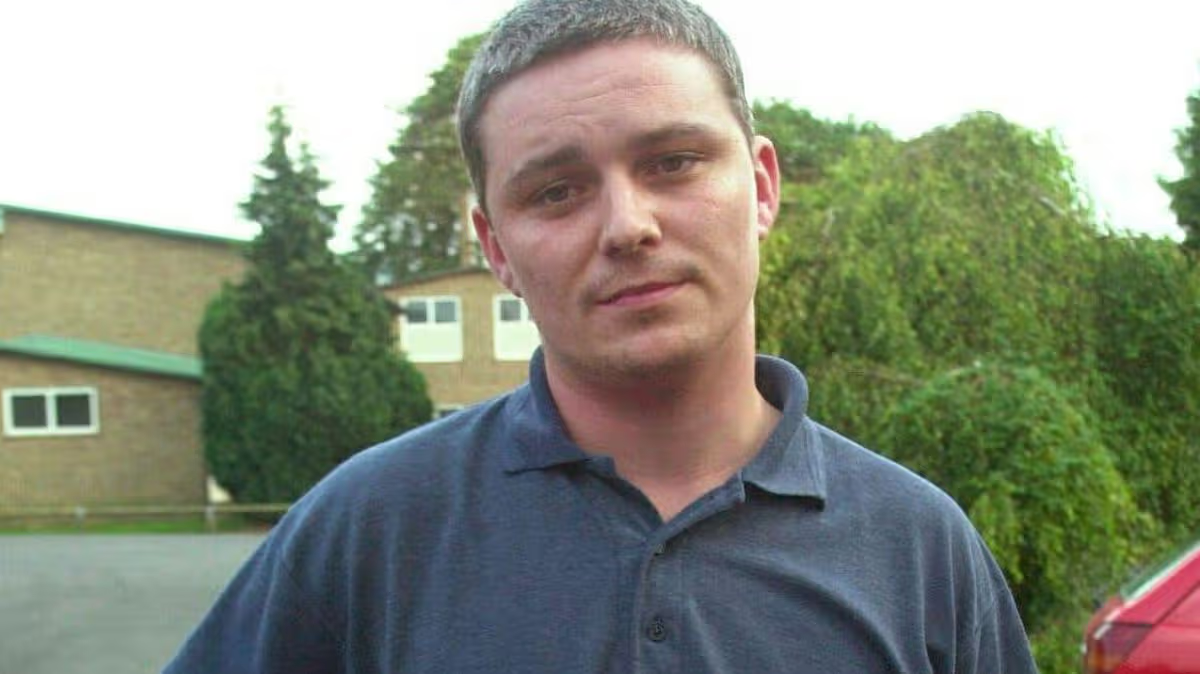
An inquest is scheduled open in April for Soham killer Ian Huntley, who died days after a prison attack. The 52-year-old died in the Royal Victoria Infirmary in Newcastle on March 7 after he was allegedly attacked with a metal bar in a workshop at HMP Frankland in Durham on February 26.
The County Durham and Darlington Coroner has posted details of an inquest opening hearing, due to be held in Crook, County Durham, on April 14. Listed under the name Ian Kevin Huntley, the inquest opening will be heard by senior coroner Jeremy Chipperfield.
It has been reported there will be no funeral service for the child killer. The Sun has said it understood Huntley’s family will scatter his ashes in secret.
Advertisement
Anthony Russell, 43, has been charged with murdering Huntley at the maximum security jail. He will attend Newcastle Crown Court on April 24 for a pre-trial preparation hearing.
Huntley was serving a life sentence for the 2002 murders of 10-year-olds Holly Wells and Jessica Chapman. The ex-school caretaker killed the best friends after they left a family barbecue to buy sweets in Soham on August 4, 2002.
He dumped their bodies in a ditch 10 miles away. They were not found for 13 days, despite a search involving hundreds of police.
At the time, Huntley lived with Maxine Carr, who was a teaching assistant at Holly and Jessica’s primary school. He denied murdering the girls but was convicted after a trial at the Old Bailey in 2003. He was jailed for life with a recommended minimum term of 40 years.
Advertisement
Carr gave Huntley a false alibi and was jailed for 21 months for perverting the course of justice. She is now living under a new identity.
Time for a change? Five ways to navigate a mid-career transition – Positive News
Advertisement
Advertisement
Switching career can be daunting, but hugely rewarding. Here are five steps to make the transition easier
Advertisement
Switching career can be daunting, but hugely rewarding. Here are five steps to make the transition easier
Advertisement
1. Know when to go
“Every career chapter has a natural rhythm. There’s energy and learning at the start, mastery in the peak, and eventually, a gradual sense that something has shifted. That’s the moment we’ve outgrown where we are. Leaving isn’t failure; it’s progress. It’s recognising that you are allowed to want something different. Knowing when to go is an act of courage and the beginning of what comes next.”
Image: Bram Naus
Advertisement
2. Give yourself permission to pause
“We’re conditioned to move quickly but transitions are essential. It’s rarely possible to take time off from earning but if you can, take a moment to reconnect with who you are beyond your CV. What do you value? What energises you? What do you miss? A pause is often the most useful part of the process. It helps you return to your essence, not just your output. It’s the space where clarity grows.”
Advertisement
Image: Inspa Makers
Advertisement
Solutions every Saturday Uplift your inbox with our weekly newsletter. Positive News editors select the week’s top stories of progress, bringing you the essential briefing about what’s going right. Sign up
3. Challenge the narrative that says it’s too late
“So many of the narratives that hold us back are inherited from workplaces, families and culture. ‘People my age don’t change careers.’ ‘If I stop now I’ll lose everything I’ve built.’ These beliefs are protective stories designed to keep us in the familiar. Question them. Ask: ‘Is this true, or just familiar?’ Replace those limiting narratives with more empowering ones: ‘I am allowed to evolve.’
Image: Hannah Olinger
Advertisement
4. Explore with intention
“You don’t need to know the full five-year plan. You just need to be willing to experiment. Start small: read widely, try a short course, have conversations, shadow someone whose work you admire, volunteer in a space that intrigues you. Think of it as research rather than reinvention. By taking tiny, low-stakes steps, you gather information about what feels energising and what doesn’t.”
Image: Christina
Advertisement
5. Curate your support network
“Transitions can feel lonely, especially when the world sees you as ‘the person who used to…’. Surround yourself with people who see your potential, not just your past. Seek out those who listen without judgement and who remind you that you are capable. Let go of the voices that keep you small. Your environment shapes what feels possible. Choose people who help you expand.”
Advertisement
Image: Surface Main image: Windows
Advertisement
Be part of the solution
At Positive News, we’re not chasing clicks or profits for media moguls – we’re here to serve you and have a positive social impact. We can’t do this unless enough people like you choose to support our journalism.
Give once from just £1, or join 1,800+ others who contribute an average of £3 or more per month. Together, we can build a healthier form of media – one that focuses on solutions, progress and possibilities, and empowers people to create positive change.
Once you’ve paid your mortgage or rent, settled your bills, and done your weekly food shop, often there’s little left to squirrel away.
And for many, that’s before being able to spend your hard-earned cash on ‘little treats,’ from dinner and drinks with friends to relaxing holidays.
However, it’s not all doom and gloom in the world of personal finance.
Advertisement
Despite 61% of UK consumers finding it harder to save compared to this time last year — caused by the cost of living crisis, which continues to squeeze finances — there are ways you can save some money if you know how.
Metro spoke with chartered accountant Nicole Zalys, also known as The London Accountant on social media, to get her top saving tips. Plus, to find out how much you could realistically save per year based on your salary.
Nicole Zalys, aka the London Accountant, has shared her money knowledge (Picture: Supplied)
Disclaimer: We’re aware that, even though some people may be on the same salary, outgoings are likely to be different.
When factoring in variables like rent, mortgages, financing cars, and kids, very different amounts will leave people’s bank accounts. Therefore, saving goals might be different.
Nicole’s top saving tips
Drawing on extensive experience of her own and that of her clients, Nicole explains that saving money is something almost everyone says they want to do more of. Yet for many, it remains harder than expected.
Advertisement
According to the FCA’s Financial Lives Survey, the average UK household has just £1,000 in accessible savings. So why do so many people struggle?
Here, Nicole shares three things you can do money-wise that will consistently make a difference:
First, automate it. Nicole reveals that research across 94 studies found that specific ‘if then’ plans can double follow-through rates.
‘A rule such as “when my salary lands, I transfer £X” is far more effective than relying on willpower alone,’ she adds.
Advertisement
Second, Nicole recommends making the future feel tangible. ‘Our brains tend to treat our future selves like strangers, which helps explain why saving is so easy to put off.’
Her advice? Give your goals a name. Make them personal.
Don’t miss our Money tips! Add us as a Preferred Source
At Metro Money, we’re here to bring you all the latest news and advice on personal finance, cost of living, saving and investing. As part of our vibrant community of highly engaged readers, we want to make sure you never miss our articles when searching for stories.
Click the button below and tick Metro.co.uk to ensure you see stories from us first in Google Search.
Our Money experts are here to give you the latest tips and insider guides
Third, if saving feels like deprivation, Nicole advises reframing it as paying your future self.
‘You are not giving something up. You are spending on someone who happens to be you.’
Advertisement
Is it time to re-evaluate your savings strategy? (Picture: Getty Images)
Additionally, while many attempt to follow the popular 50/30/20 rule, which suggests spending 50% of your monthly salary on needs, 30% on wants and 20% on savings, Nicole says it was actually designed with the American middle class in mind.
Therefore, for individuals, couples, or households in expensive cities like London, housing alone can swallow a huge share of income.
So, what is actually realistic?
‘Before looking at the numbers, one point matters most,’ states Nicole. ‘If you are carrying high-interest debt, especially on credit cards, paying that down should come before building savings.’
Clearing a balance charging 20% interest is effectively the same as securing a 20% guaranteed return, something no ISA or savings account is likely to match.
Once that is dealt with, the expert explains that the targets below become far more meaningful.
Advertisement
Even if you don’t hit them every month, it’s important not to be disheartened: Living costs are high, but these figures are a useful benchmark.
Savings vs salary: how much should you save?
Below, Nicole has zoomed in on six salaries. From sharing the average monthly take-home amount to a savings target, hopefully, it helps make your money journey easier.
Again, don’t stress if you don’t relate to these figures — saving in whatever capacity you can is still good practice. No one’s financial experience is the same, so it’s important not to compare yourself to others and their situations.
Everyone is on their own financial journey (Picture: Getty Images)
£20,000 salary
• Take-home: around £1,493 a month
• Target: 3%
Advertisement
At this level, ‘most income will go straight on housing and essentials,’ states Nicole. Even saving £25 a month matters because consistency is what builds the habit.
‘It is also worth making full use of a workplace pension, as the employer contribution is effectively free money.’
£25,000 salary
• Take-home: around £1,793 a month
• Target: 5%
Advertisement
This is still a tight income, particularly in cities. However, ‘consistency matters more than the amount itself.
‘A Lifetime ISA offers a 25% government bonus on up to £4,000 a year, making it one of the strongest guaranteed returns available for first-time buyers or retirement savers.’
£30,000 salary
• Take-home: around £2,090 a month
• Target: 7%
Advertisement
‘Before anything else, this is the point at which aiming for an emergency fund becomes particularly important,’ says Nicole. Covering three months of essentials, roughly £3,000 to £4,500, can make a significant difference.
‘Research suggests people with this kind of buffer tend to make better financial decisions.’
Do you have a comfortable safety buffer? (Picture: Getty Images)
£40,000 salary
• Take-home: around £2,693 a month
• Target: 10%
At this level, Nicole says it’s worth making the most of your Cash ISA allowance, currently £20,000 a year tax-free, while also reviewing whether your pension contributions are working hard enough.
Advertisement
£50,000 salary
• Take-home: around £3,293 a month
• Realistic target: 12%
You are approaching the 40% tax threshold, which means that where you save becomes almost as important as how much you save.
£60,000 salary
• Take-home: around £3,780 a month
Advertisement
• Realistic target: 15%
‘This is the point at which the High Income Child Benefit Charge begins to bite, but pension contributions can reduce or even eliminate it entirely,’ the expert explains.
Maxing out your ISA, reviewing salary sacrifice and speaking to a financial planner may all be worth considering.
It might be time for that pay rise… (Picture: Getty Images)
Bottom line?
‘Sometimes, though, the answer is not saving more but earning more,’ educates Nicole.
In an inflationary environment, there is only so much to be gained from cutting back. Energy, rent and food are structural costs. For many people, the more powerful lever is income.
Advertisement
‘Asking for a pay rise remains one of the highest-return financial moves available, and while many employers do not offer increases proactively, they will often respond when asked.
‘Even a side income of £3,000 to £5,000 a year, if saved in full, can outperform years of budgeting on a lower salary.’
These figures are based on typical observations and should be treated as a guide rather than a rule. Always seek financial advice before making major decisions.
Five teenagers were in a car that crashed into the River Nene on March 17
12:14, 27 Mar 2026Updated 13:00, 27 Mar 2026
Searches for a missing 18-year-old involved in a crash are continuing for a 10th day. Five teenagers were in the blue VW Polo that crashed into the River Nene along North Brink, Wisbech at around 8.20pm on Tuesday, March 17.
Three teenagers, including an 18-year-old boy and two 16-year-old girls, were able to escape and were taken to hospital. However, Eden Bunn, 16, and Declan Berry, 18, were missing.
Sadly, Eden’s body was recovered from the river on March 18. The car was also recovered on Sunday (March 22).
Flowers and tributes were laid at the roadside of where the crash is believed to have happened. Eden’s family also paid tribute to her last week, describing her as the “kindest, most loving girl”.
The force said three people, including a patient and a paramedic, were in the back of the vehicle at the time but none were injured in the incident.
Marshall Leese, 31, of Hanley, Stoke-on-Trent, has been charged with kidnap, theft of a motor vehicle and failing to provide a specimen for analysis.
Advertisement
He has also been charged with driving a motor vehicle dangerously, driving a motor vehicle otherwise than in accordance with a licence and using a motor vehicle without third party insurance.
Leese is due to appear at the North Staffordshire Justice Centre on Friday.
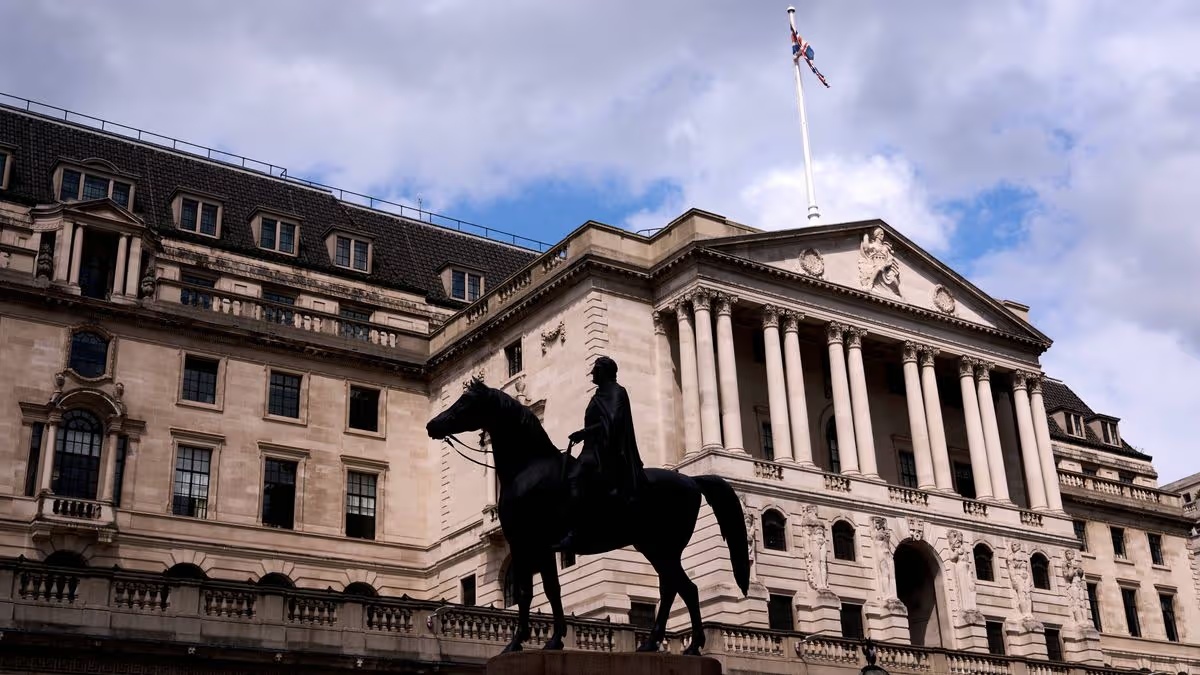
Speaking in New York this week, rate-setter Alan Taylor argued that the central bank must maintain a high bar for increasing borrowing costs despite the significant spike triggered by the conflict in the Middle East.
The Monetary Policy Committee member emphasised that monetary policy is fundamentally ill-suited to address sudden, unpredictable surges in global oil and gas prices that remain entirely outside the control of domestic officials.
Advertisement
Get MEN Premium now for just £1 HERE – or get involved in our WhatsApp group by clicking HERE. And don’t miss out on our brilliant selection of newsletters HERE.
While the Bank’s nine-member committee recently voted unanimously to hold interest rates at 3.75%, the geopolitical landscape has shifted dramatically since the conflict began on February 28.
This has forced a pivot from previous expectations of rate cuts to a market now pricing in multiple hikes by the end of the year.
This change comes as the bank warns that inflation is now projected to climb as high as 3.5% by the third quarter, a figure that significantly overshoots its 2% target.
Advertisement
Despite this inflationary pressure, Mr Taylor suggested that holding policy steady remains the preferable course of action until the full economic impact of the Middle East conflict becomes clearer. He noted that the UK currently faces a relatively low risk of inflation expectations becoming unanchored, pointing to a weakening labour market and slowing wage growth as factors that provide the MPC with some breathing room.
According to Mr Taylor, the primary role of the Bank in this “all hands on deck” moment is to navigate an increasingly acute trade-off between fighting high inflation and supporting weakening economic growth.
However, Mr Taylor’s cautious stance highlights a growing divide within the Bank of England’s leadership regarding how to handle the “growth-inflation trade-off” during wartime. His preference for patience stands in contrast to recent comments from Chief Economist Huw Pill, who signaled a readiness to vote for a rate hike sooner rather than later to curb rising price risks.
Pill has argued that the “fog of uncertainty” surrounding the war should not serve as an excuse for policy inaction, suggesting that the Bank must be proactive to ensure inflation does not become a permanent fixture of the UK economy.
Advertisement
With the next rate decision and a fresh set of economic forecasts scheduled for April 30, the committee remains tasked with applying deep analytical rigor to a crisis that Taylor admits will demand extreme policy flexibility and clear communication to the public.
























































You must be logged in to post a comment Login