

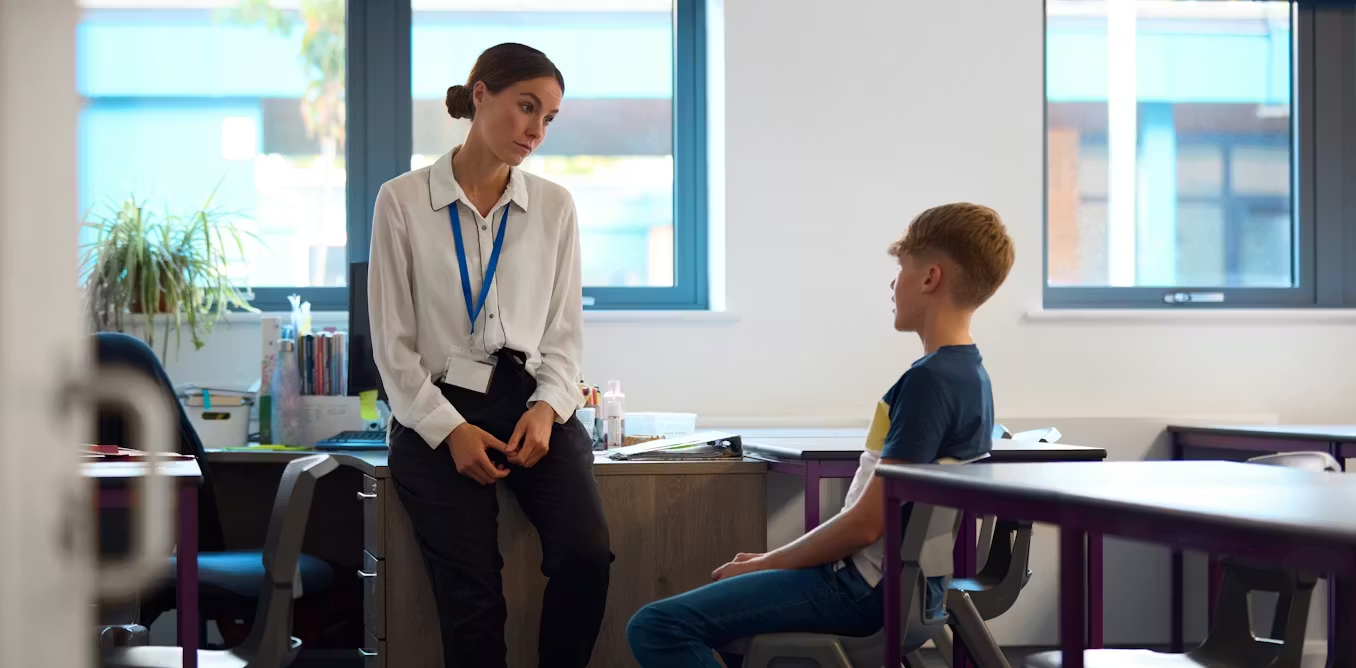
When we think about school bullying, we often focus on victims given the emotional toll they endure, the academic disruption they face and the long-term scars that follow them into adulthood.
Victim-centred research has been critical in shaping strategies to prevent bullying. But there’s a perspective that would help us understand bullying that is too often ignored: that of the aggressors themselves.
There is a growing body of research that explores how students themselves understand and explain bullying, but very few explicitly address the perspectives of the aggressors. Consequently, there’s a risk of misunderstanding the complex social and psychological forces that drive this behaviour.
In a study I carried out in Mexico, I interviewed 13 former secondary students – now adults – who had once been bullies. By delving into their life stories and memories from childhood and adolescence, the study uncovered critical insights into why school violence occurs and how we might interrupt it.
What emerged from these conversations was not a portrait of monsters, but of children navigating harsh environments, social pressure and emotional confusion. The findings challenge some of the myths that revolve around bullies. My research reveals reveal how aggression is often learned, normalised, and even rewarded.
What do bullies say?
Many participants told me that their aggressive behaviour was modelled and reinforced in their homes, schools and communities. Several recounted growing up in households where domestic violence and dysfunctional relationships were common. “We grow up in a violent environment … it becomes normalised … even to survive,” one said.
Others described how violence was institutionalised in several community spaces. This included in sport clubs where abusive coaches “toughened up” players, inadvertently teaching them to equate aggression with strength. Media and social media also played a role. One interviewee admitted to replicating a violent social media trend, highlighting how digital platforms can amplify harmful behaviour.
People in my research described how, rather than being punished, physical dominance and violence was praised and reinforced through the approval of their peers. One explained: “The jerk who made life impossible was the one everyone wanted to hang out with … How are you going to change if everyone celebrates you?”
wavebreakmedia/Shutterstock
Perhaps most revealing was the role of bullying in securing social status and group belonging. Participants described aggression as a way to solidify friendships, join peer groups or avoid becoming victims themselves. The “game” of bullying, as they called it, was often seen as a ritual – one rooted in reciprocal joking, physical roughhousing and group cohesion. One participant explained: “You’d hit someone as a sign of friendship … That’s just how the group got along. If you complained, no one would invite you anymore.”
Importantly, such practices also involve blaming the victim, especially when victims were constructed as “weak” or “deserving” of mistreatment.
Bullying functioned also as a way to police norms, particularly around gender and conformity. Boys who failed to perform dominant masculinity, broadly understood as an idealised manhood shaped by aggression and toughness, were often a target. One recalled: “A guy who doesn’t fight back is labelled ‘pathetic’, ‘coward’, ‘less of a man’.” But girls, too, engaged in bullying to maintain social order, often within friendship circles.
These testimonies challenge simplistic views of bullies as merely “bad kids”. Instead, they reveal a troubling mirror of broader social values: competition, dominance, emotional repression and the normalisation of exclusion.
What this means for schools
School-based programmes must go beyond punitive discipline. Many former aggressors shared that suspensions or expulsions had little impact, and in some cases, even increased their hostility. One participant described expulsion as a “reward” that placed them in a school with other aggressive peers, perpetuating the cycle of violence.
What mattered more were moments of emotional connection. For some, a heartfelt conversation with a parent or a teacher’s genuine concern became a turning point. As one interviewee shared: “I stopped bullying when my mom talked to me … I saw her crying and realised I needed to change.”
Interventions should include restorative practices such as family group boards, reflection circles and community service, which are aimed at building community rather than just punishing. These practices include dialogue sessions, peer mediation, and conflict resolution and reparation mechanisms such as apologies, paying for damages or any other agreement to repay the harm.
Equally, social-emotional learning that helps students to understand and manage their feelings and teacher training focused on recognising subtle forms of aggression, also must be considered. Parents must be engaged not only as disciplinarians but as partners in emotional development. And importantly, students must be invited into honest conversations about empathy, belonging, and responsibility (to themselves and to other peers).
By listening to the voices of those who once caused harm, we can have a better picture of the complex dynamics that underpin school bullying. And in doing so, we open up new pathways for healing, not just for victims, but for those who once harmed.



















































You must be logged in to post a comment Login