
News Beat
US to run Venezuela for now, Trump says after capturing Maduro in extraordinary attack


The United States will run Venezuela until there is a peaceful transition, Donald Trump has said, after US forces captured its president in an extraordinary overnight attack that has sent shockwaves around the world.
The US president said he was “not afraid to put boots on the ground” and warned a second wave of attacks on Venezuela could take place “if we need to do so” after Nicolas Maduro, who has ruled the country for nearly 13 years, was snatched from a military base by the Delta Force.
Explosions were reported across the country and low-flying aircraft were seen in Venezuela’s capital in the early hours of Saturday, as its government said the US had targeted civilian and military sites in multiple states in what it described as an “imperialist attack”, urging citizens to take to the streets.
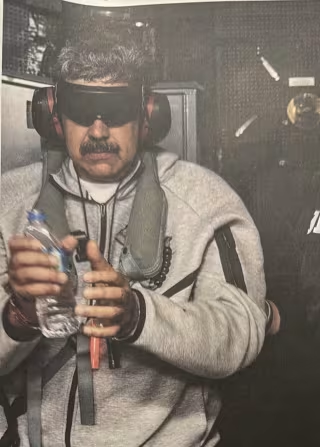
Mr Maduro and his wife, Cilia Flores, were transported on Saturday evening by a US warship to New York, where they are set to face criminal charges. A photo of the 63-year-old in US captivity was shared by President Trump on social media.
The operation – the culmination of months of escalating Trump administration pressure on the oil-rich South American nation – has been condemned by several world leaders, as well as some senior politicians in the US, despite many of them welcoming the end of the Maduro regime.
The legal authority for the attack is not immediately clear and questions have been raised about the immediate future of Venezuela, with President Trump insisting the US would seize control of the country and its oil infrastructure.
“We’re going to run the country until such time as we can do a safe, proper and judicious transition,” Mr Trump said at a Mar-a-Lago news conference where he boasted that this “extremely successful operation should serve as warning to anyone who would threaten American sovereignty or endanger American lives”.
He claimed the American presence was already in place, though there were no immediate signs that the US was running the country.
“We’re going to have our very large United States oil companies, the biggest anywhere in the world, go in, spend billions of dollars, fix the badly broken infrastructure, the oil infrastructure, and start making money for the country,” he added.
The US government does not recognise Mr Maduro, who last appeared on state television on Friday while meeting with a delegation of Chinese officials in Caracas.
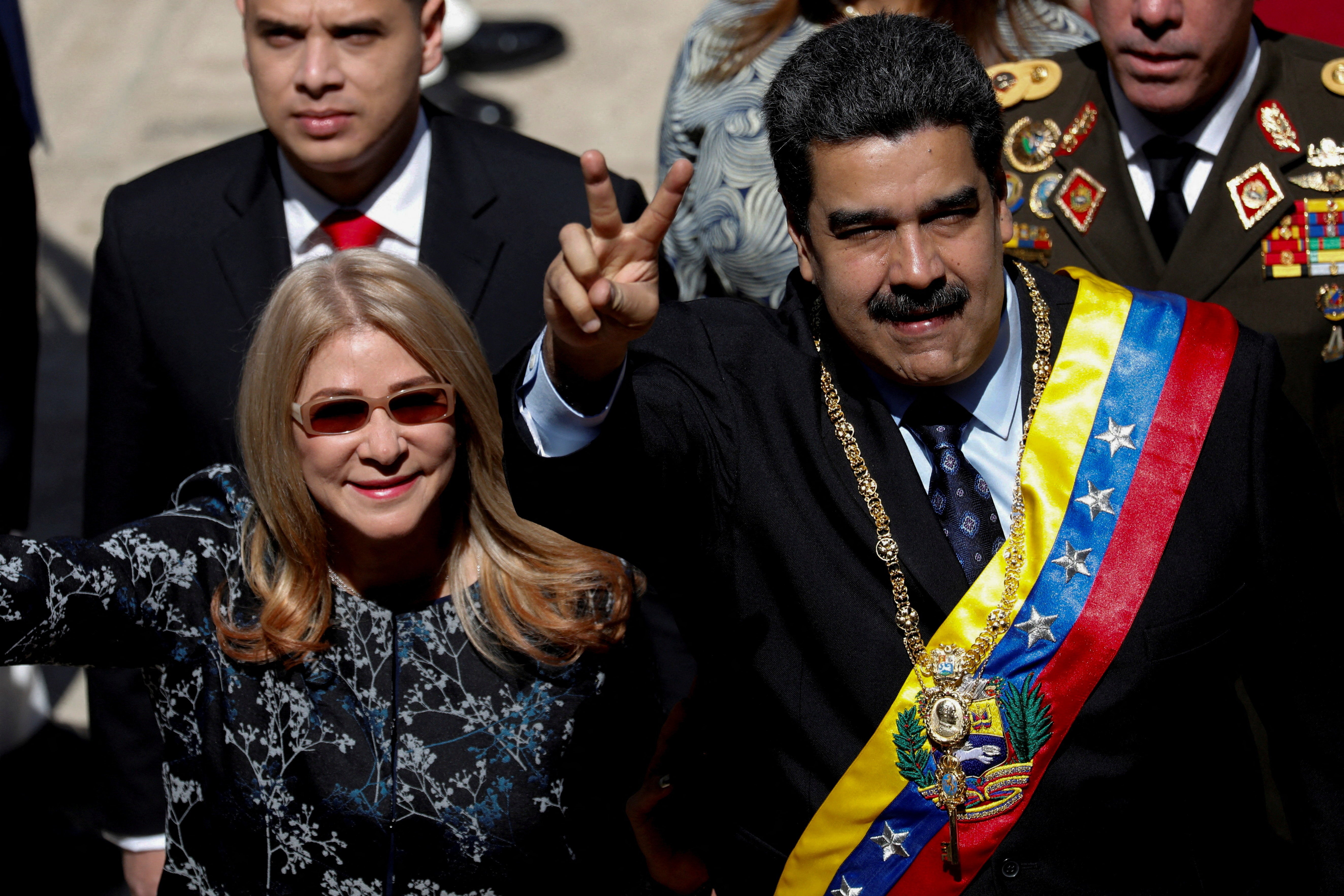
Mr Maduro and other Venezuelan officials were indicted in 2020 on “narco-terrorism” conspiracy charges, but the US justice department released a new indictment on Saturday of Mr Maduro and his wife, Cilia Flores, accusing them of a role in narco-terrorism conspiracy.
US attorney general Pam Bondi vowed in a social media post that the couple would “soon face the full wrath of American justice on American soil in American courts”.
Venezuelans expressed deep concern over Donald Trump’s shock statement that the US was planning to “run the country” and his apparent endorsement of Mr Maduro’s second-in-command, Delcy Rodriguez, as an interim leader of that transition.
“They have not clarified the legal, political or the temporal framework of this leadership – who’s going to lead?” asked Maria Corina Roldan Robles, a Venezuelan political analyst currently based in Chile. She said they were concerned that instead of the US cooperating with opposition figures like Nobel Prize winner Maria Corina Machado or Edmundo Gonzalez Urrutia, who was recognised as winning the 2024 elections, it appeared they were going for “Chavismo under a different leadership”.
In the press conference Mr Trump dismissed Ms Machado as lacking “support or respect” to take over. He did not even mention Mr Gonzalez, despite the fact that the Venezuelan opposition leader was recognised by the Biden administration as the “president-elect” in the wake of the July 2024 vote.
Instead, Mr Trump confirmed that secretary of state Marco Rubio had had a lengthy conversation with Rodriguez, who Robles said was “one of the most central pillars of the regime that governed alongside Maduro”.
Mr Trump said Ms Rodriguez had already been sworn in as interim leader and was “essentially willing to do what we think is necessary to make Venezuela great again”. The concern in Venezuela is that the US had been positioning Ms Rodriguez as a “person that could be considered for a transition” months go, Robles added.
Ana Maria Diez, the head of the Coalition of Venezuela a union of civil society organisations and an advisor on UN mechanism said that while people were celebrating the capture of Maduro, there were growing fears about Trump’s intentions towards Venezuela’s vast oil reserves.
“President Trump has repeatedly referred to ‘our oil’ when speaking of Venezuelan resources. It is important to remind him that these resources belong to the Venezuelan people, who need humanitarian aid and the reconstruction of the country now more than ever, not the rule of outsiders,” she told The Independent.
The military operation has drawn widespread condemnation around the world, but members of Trump’s administration, including vice president JD Vance and Mr Rubio, defended the action and denied questions of illegality.
Venezuela’s allies Russia, Cuba, and Iran swiftly condemned the strikes as a violation of national sovereignty. President Javier Milei of Argentina reacted to the news that Mr Maduro had been captured with a political slogan he often deploys to celebrate right-wing advances: “Long live freedom, dammit!”
Meanwhile Mexico denounced the intervention and Brazil’s president, Luiz Inácio Lula da Silva, said it crossed “an unacceptable line.”
Sir Keir Starmer has said the UK played no role in the military strikes on Venezuela, but added the UK “sheds no tears” about the end of Maduro’s regime.
“I reiterated my support for international law this morning. The UK government will discuss the evolving situation with US counterparts in the days ahead as we seek a safe and peaceful transition to a legitimate government that reflects the will of the Venezuelan people,” he added.
In a demonstration of how polarising a figure Mr Maduro is, people variously took to the streets to deplore his capture and celebrate it.
According to statements from residents of the western areas, armed groups have begun patrolling, acting as an alternative to official state security forces, displaying long and short firearms while on foot and on motorcycles.
“We never imagined this could happen; we weren’t prepared for an attack. We just spent everything on the Christmas holidays. Now we have to see what happens and buy as much as we can in case we can’t go out anymore.”
Similarly, motorcyclists and drivers in gasoline lines stated, “We have to fill our tanks because we don’t know if this will leave us stranded again, and then we won’t have any way to get around.”
The strike followed a months-long Trump administration pressure campaign on the Venezuelan leader, including a major build-up of American forces in the waters off South America and attacks on boats in the eastern Pacific and Caribbean accused of carrying drugs.
Last week, the CIA was behind a drone strike at a docking area believed to have been used by Venezuelan drug cartels – the first known direct operation on Venezuelan soil since the US began strikes in September.
As of Friday, the number of known boat strikes was 35 and the number of people killed at least 115, according to the Trump administration.
Mr Trump said that the US is engaged in an “armed conflict” with drug cartels and has justified the boat strikes as a necessary to stem the flow of drugs into the US.



