


The Grinch is one of the holiday season’s most familiar icons. The grumpy, green, fur-covered misanthrope who plotted to sabotage Christmas in Dr Seuss’s classic 1957 work has now become a quintessential part of the yearly festive ritual he so despised.
But beneath that snarl and green fur, what kind of creature is he, really? Not even Dr Seuss really had an answer.
As an anatomist, I can’t help but wonder what the Grinch would look like on the dissection table – and what his skeleton, muscles and brain can tell us about his unique origins.
The skull
The Grinch’s most recognisable feature is, of course, his face. And underlying these characteristic features would be a unique skull – unlike anything you’d find in Whoville or on Earth.
Structurally, the Grinch’s facial skeleton would blend primate and canine traits: short, broad snout, high cranium and powerful jaws. It’s a face evolved for expression, adeptly capable of sneering, gloating and ultimately smiling with genuine warmth.
His zygomatic arches (cheekbones) are broad and flared to accommodate for the large zygomaticus major muscles needed to lift the corners of his mouth into his exaggerated, mischievous smirk.
Beneath his eyes would be a large bony canal, carrying nerves to his whisker-like facial hairs – granting exquisite tactile sensitivity to changes in air currents. Like a cat’s whiskers, they’d help him sense approaching Whos or dangling baubles – crucial for a creature who thrives on stealth.
His teeth would be similar to a chimp’s, with sharp canines for tearing through Who “roast beast,” sturdy molars for grinding tougher festive fare and incisors adapted for nibbling fruitcake or the occasional candy cane.
The upper jaw, or maxilla, would be robust and slightly vaulted, lending resonance to that infamous laugh echoing through Mount Crumpit.
The face
The Grinch’s yellow eyes, with large, forward-facing eye sockets, suggest a crepuscular lifestyle: most active at dawn and dusk.
Many animals with yellow eyes, such as owls and cats, are adapted to low light. The yellow pigment filters blue light and sharpens contrast, allowing movement to be detected in the half-light. Perfect for a nocturnal gift thief.

Everett Collection Inc/ Alamy
His nasal aperture would be tall and narrow, with a complex set of internal conchae (nasal bones) to warm the cold alpine air of Mount Crumpit. The constant twitching of his nose might indicate a highly attuned sense of smell to detect roast beast from a distance.
The Grinch’s expressiveness would involve a complex set of muscles – many of which would be unusually large so he can convey every scheme, doubt, pang of guilt and emotion he experiences. For example, he would probably have very distinct levator labii superioris alaeque nasi – “Elvis muscles” – so he can lift his upper lip sneeringly.
The spine
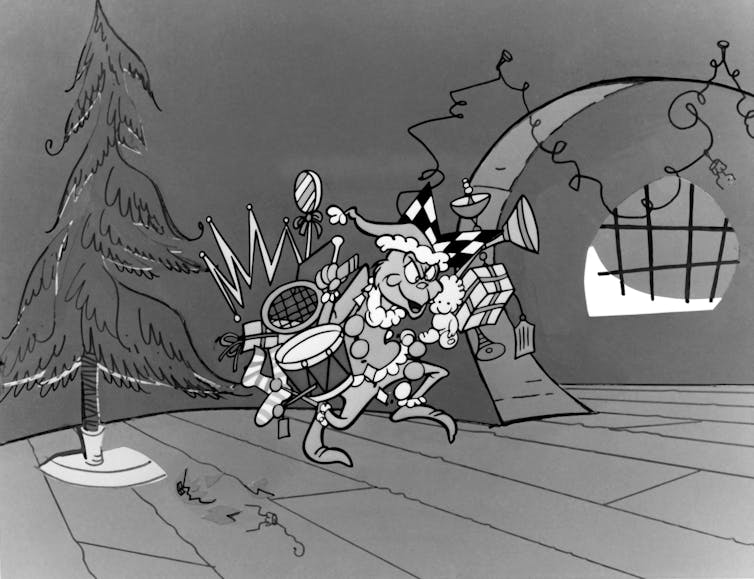
If you watch the Grinch walk, he’s upright but fluid, almost serpentine. His spine would probably resemble a cross between a gibbon and a cat – long, flexible and sinuous.
The lower back would be extended and highly mobile, allowing that characteristic slouch and coiled posture. The thoracic vertebrae (found in the middle and upper back) would produce a gentle outward curve – creating a hunched silhouette suited to skulking. His cervical vertebrae (neck bones) would be elongated, letting him tilt and crane his head with exaggerated expressiveness.
Like a cat, he’d be digitigrade – meaning he walks on the balls of his feet and toes rather than on the soles (as humans do). This stance softens each step – allowing for the quiet, agile motion needed to lurk through Whoville stealing presents on Christmas eve.
Everett Collection Inc/ Alamy
Though his pelvis supports an upright posture, his centre of gravity sits slightly forward and low — a design that sits somewhere between human and primate.
The brain
Anatomy often mirrors personality. Judging by behaviour, the Grinch’s frontal lobes, particularly his prefrontal cortex, would be on the small side – explaining his flat and small forehead.
Given this region governs planning, impulse control and moral reasoning, it would explain why he lacks these faculties at the story’s start. Having a smaller frontal lobe also explains his rash decisions and inability to foresee consequences beyond the next stolen bauble.
His temporal lobes, would be large and active. They process sound and memory – ideal for recognising (and despising) Whoville’s Christmas carols. They also house functional areas that process smells – important for sniffing out hidden cans of Who-Hash.
His occipital and parietal lobes would also be well developed, supporting the sharp vision, coordination and spatial awareness he needed to climb, leap and slide down chimneys.
The Grinch’s amygdala (also involved in experiencing emotions) would probably be hypertrophied – explaining his emotional volatility, paranoia and exaggerated reactions. Combined with his limbic system, part of the brain’s memory and emotion centre, creates a creature ruled by passion and reactivity.
The heart
No anatomical analysis of the Grinch is complete without addressing the moment when “his heart grew three sizes.”
Biologically, such a sudden expansion would be catastrophic. In humans and other mammals, cardiomegaly (an enlarged heart) is a dangerous condition linked to heart failure, arrhythmias and poor pumping efficiency.
A real heart simply cannot enlarge in an instant of emotional revelation. But the brain can change rapidly.
The Grinch’s transformation is probably better understood as a neurological shift – with increased activity and connectivity occurring between the prefrontal cortex (empathy and regulation) and the limbic system (emotion and reward). His “growing heart,” is probably not an anatomical miracle but a metaphor for his brain becoming more socially attuned.
Anatomy of a redemption arc
To anatomists, the Grinch is more than a Christmas curiosity. He’s a case study in form and function. And in his final form, anatomy and morality align.
The muscles that once powered a sneer now lift into a genuine smile. The hands that stole presents now carve roast beast. His limbic system now fires with satisfaction.
So perhaps the real message of the Grinch’s anatomy is this: change is always possible.



