

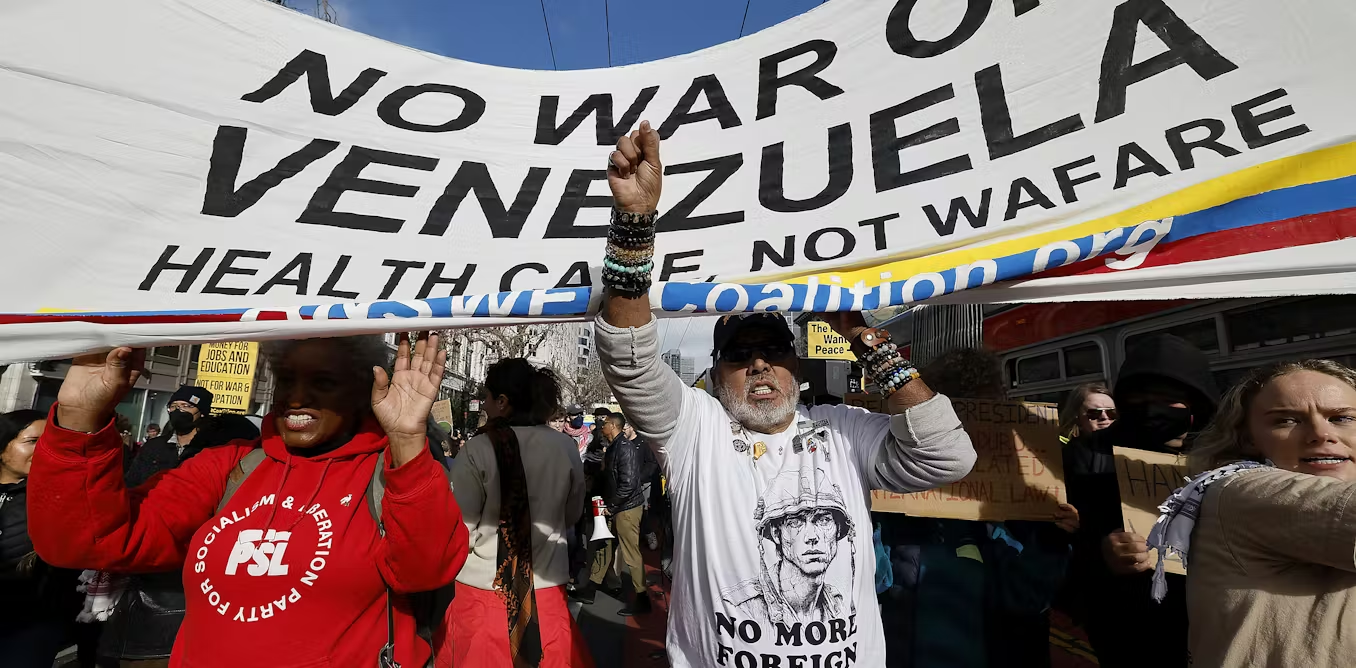
Republican congresswoman Marjorie Taylor Greene, once a close ally of Donald Trump, spelled out in one short sentence why elements of the US president’s core voter base were dismayed at the weekend operation that captured Venezuelan leader Nicolás Maduro: “This is what many in Maga thought they voted to end.”
The sentiment expressed by Greene, who recently broke with Trump over what she alleged was his unwillingness to order the justice department to fully release its files relating to the late convicted sex offender Jeffrey Epstein, was shared by some other elected Republican officials.
This included Kentucky’s Thomas Massie, who also publicly stated his disapproval with Trump’s decision to order the attack. But so far these voices are in the minority. In the days and hours since the operation, a series of prominent Congressional Republicans have united behind the president.
Senator Lindsey Graham of South Carolina, for example, praised Trump’s decision to green light the US mission. He wrote on social media: “We will be more prosperous and safer for it. I am hoping and praying that the Venezuelan people will soon have a fresh start on democracy and freedom.”
American public opinion on the Venezuela attack will be measured in the coming days. But it is useful to reflect on polling leading up to the event. The Trump administration has authorised a number of military strikes on alleged drug boats near Venezuelan territory in recent months, while Trump himself has repeatedly threatened land strikes in the country.
A poll from December 2025 conducted by Quinnipiac University in the US found that 63% of registered American voters opposed military action against Venezuela – a significant figure against this type of intervention. More than half of the 25% of voters that supported military action were Republicans.
Some Republican political operatives are warning that a prolonged American presence in Venezuela will be detrimental to Trump and his party ahead of midterm elections in November. Dave Carney, a Republican strategist, stated on January 3 that “Nobody wants a quagmire. Nobody wants … body bags coming back to Dover of American soldiers who are being sniped at from … a rebellious minority in Venezuela.”
Philip Elliot, senior correspondent at Time magazine, has asserted that Trump’s aversion to foreign interventions was a huge appeal for many who supported him in the 2024 election. Elliot wrote on January 3 that, for these people, Trump’s “incursion into Venezuela, the capture of its first family, and its about-face of campaign promises stung something bitter”.
Trump’s overseas strategy
The military operation in Venezuela modifies Trump’s make America great again (Maga) foreign policy doctrine. In his second inaugural address in January 2025, Trump pledged that: “We will measure our success not only by the battles we win, but also by the wars that we end, and perhaps most importantly, by the wars we never get into.”
But the recent events in Venezuela seem to indicate a shift in Trump’s overseas strategy. The attack sees the president follow similar forays by his Republican predecessors in the western hemisphere. These include Ronald Reagan’s decision to invade Grenada in 1983 and George H.W. Bush’s authorisation of a military operation to oust Panama’s president, Manuel Noriega, in 1989.
This reorientation was to some extent codified by the Trump administration’s new national security strategy, which was published in late 2025. Vanda Felbab-Brown of the Brookings Institution argues that this document pivots “the US toward the western hemisphere … essentially asserting a neo-imperialist presence in the region”. The document may explain the rationale behind the operation in Venezuela.
Nicole Combeau / EPA
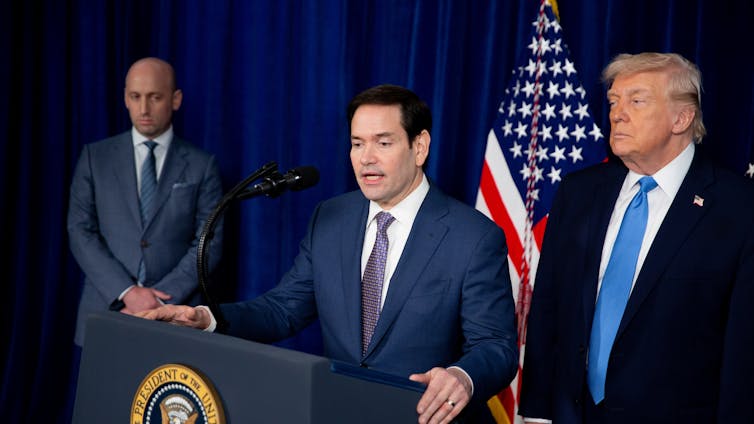
The military action in Venezuela represents a victory for the more hawkish members of the Trump administration. This is perhaps most true for secretary of state Marco Rubio, who has long advocated removing Maduro from power. A possible change in government in Venezuela could lead to other geopolitical events in the western hemisphere that Rubio has spent years pushing for.
In 2019, for instance, he intimated that a diminished Cuban regime would be a welcome “byproduct” of Maduro’s removal. Since the raid in Venezuela, Rubio has asserted that Cuba’s government may be on borrowed time. “If I lived in Havana and I was in the government, I’d be concerned at least a little bit,” he said.
Being focused solely on the foreign policy sphere is also currently a political advantage for Rubio, especially if he is contemplating a run for the presidency in 2028. The crisis in Venezuela ensures he avoids becoming ensnared in other current domestic political controversies, including the high cost of living and continuing controversy over the release of the Epstein files.
The road ahead
In the coming weeks and months, the Trump administration will strive to navigate a path that reduces the risk of the US becoming entangled in a military conflict in South America. It will face continuing criticism from within its own party ranks and the Democratic opposition in Congress. The administration will also face media scrutiny on the legality of the action as well as the future scope of the US mission in Venezuela.
Laurel Rapp from Chatham House, a research institute based in the UK, has stated the Trump team will worry particularly about the potential for some of the leaders within the “Maga movement” who have broken with Trump to “exploit this rift as the midterms heat up”.
There could be some political currency for Maga standard bearers opposed to military operation in Venezuela to trade on. But, in my opinion, it is unlikely to have serious national domestic political ramifications in the immediate term. This is due to the fact the military action was executed successfully and without any American deaths.
So, standby for the more established issues to return to the fore soon – the economy, healthcare costs and the Epstein files.



