


When people encounter racism or discrimination, they don’t all respond in the same way. Some calmly challenge the remark, some file a complaint, others confront the offender aggressively – and many say nothing at all.
A common assumption is that speaking up against discrimination is a matter of personal courage, political ideology or education. But my recent research suggests that people’s cultural values, shaped by their backgrounds and life experiences, strongly influence how they confront discrimination.
Confrontation comes in very different forms. Some choose to confront non-aggressively (such as calmly pointing out prejudice, explaining why it is offensive or sharing how it impacts them emotionally). Others prefer relatively more aggressive confrontation (such as shouting back, threatening or physical retaliation). These responses carry different risks and consequences, both for the person confronting and for wider social relations.
My recent study with colleagues Thomas Kessler and Ayşe K. Uskul looked at how people’s cultural views of honour affected how they might respond to an insult or discrimination.
Honour is often misunderstood as a personal trait or a relic of “traditional” cultures. In psychology, honour is better understood as a cultural system that develops when people cannot rely on institutions – such as courts or police – to protect them from harm or injustice.
Honour cultures, common in Latin America, north Africa, south and west Asia and the southern US, often developed under harsh historical, social and ecological conditions, for example, scarce resources unprotected by central authorities.
In such contexts, reputation matters. Maintaining honour requires projecting a reputation for toughness. It means signalling a readiness to retaliate against perceived threats or insults to protect oneself and one’s family.
Being seen as weak or passive can invite further mistreatment, so individuals and groups learn to defend their dignity themselves. Honour codes travel with people through migration, continuing to shape how they interpret threats, insults and unfair treatment in new social environments.
The role of honour
Our study sought to understand how internalised honour codes shape responses to discrimination. Specifically, we looked at two communities: south and west Asians in the UK and Turkish migrants in Germany.
People in these communities may have grown up in an honour culture, where personal retaliation against insults is expected. Or, they may have learned these codes from parents and grandparents, while living in countries where such codes are not widespread.
Our findings show that honour codes play a central role in how people say they would confront discrimination. We asked participants a series of questions about their views on honour, as well as their experiences of discrimination. We then asked them to rate the different confrontation styles that they might use when someone discriminates against them based on their ethnic or cultural background.
We found that broadly, people who experienced discrimination more frequently said they were more likely to confront it. But the style of confrontation they chose depended strongly on their cultural values.
A key finding concerned collective honour: the belief that you have a responsibility to defend the dignity of your ethnic or cultural group. Participants who strongly endorsed collective honour reported they were more likely to confront prejudice in any form, whether calmly or aggressively. For them, remaining silent felt like allowing an insult to stand.
Martin Suker/Shutterstock
In contrast to those who view honour as a collective quality, there are also those who view honour as more of an individual, internalised quality. This can manifest in how people rate the importance of family reputation, and their readiness for retaliation against insults.
People who emphasised family reputation values – concern with maintaining respectability and avoiding shame – said they were more likely to confront discrimination in non-aggressive ways. They also reported being less likely to respond aggressively. Maintaining dignity, for them, meant self-control.
Those who strongly endorsed retaliation values – belief that failing to respond to insults signals weakness and dishonour – were more likely to confront prejudice aggressively and less likely to use calmer strategies. In other words, honour does not push people uniformly toward violence or to remain silent. Different honour codes lead to very different ways of speaking up.
Interestingly, broader structural factors — such as financial insecurity or distrust in the police and authorities — played a smaller role than expected in how people responded to discrimination. What mattered most was how often people actually experienced discrimination.
Repeated exposure to discrimination increased the likelihood of aggressive confrontation, especially among those who endorsed retaliation norms. This suggests that speaking up is shaped less by abstract perceptions of injustice and more by life experiences.
Why this matters
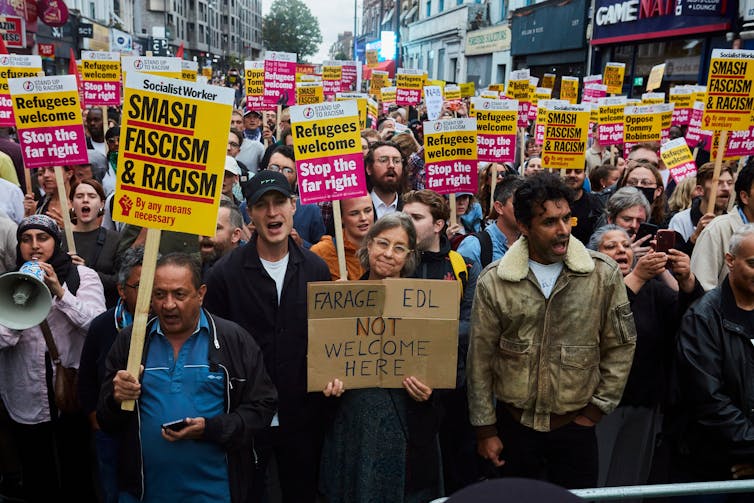
Political rhetoric around immigration has contributed to a broader climate of hostility and suspicion of some communities. This is evident in the waves of anti-immigration protests the UK has seen in recent years, and their effects on communities. According to Home Office data released in late 2025, police recorded 10,097 racially or religiously aggravated offences in August 2024 alone.
Against this backdrop, those who speak up — whether in calm advocacy or in heated confrontation — risk being judged against a narrow standard of “civility” that disregards the personal and cultural experiences that shape their responses.
For some people, walking away preserves dignity. For others, it undermines it. This does not mean all confrontational responses are equally effective or desirable.
But it does mean that judging these responses without understanding their cultural roots risks blaming individuals for navigating systems that were never designed to protect them. If we want more constructive conversations about discrimination and how we speak up against it, our research can offer a place to start.



