

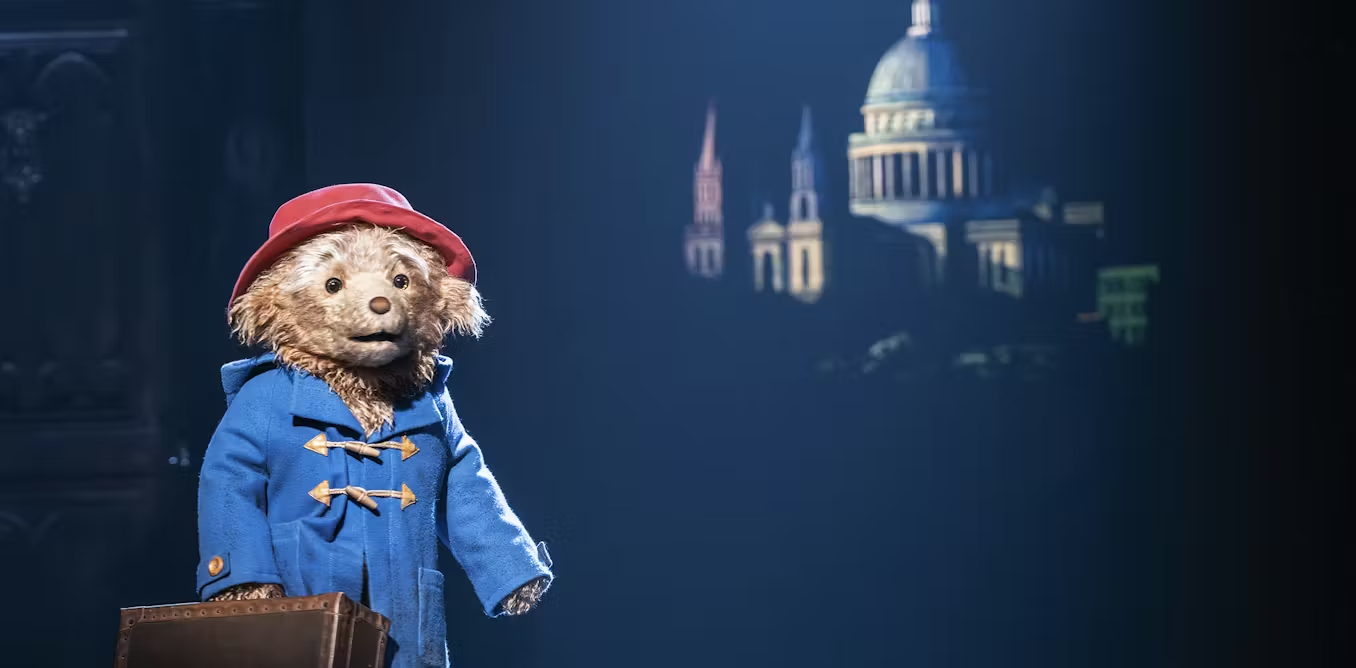
This year, fans of the tiny marmalade-loving bear from Peru can catch him on stage at London’s Savoy Theatre in the West End, in Paddington The Musical.
This is a stage adaptation of the first film in the most recent Paddington franchise, which began in 2014. While it features more than 18 new songs by Tom Fletcher (of the band McFly), it follows the film’s plot quite closely. It also shares its values of home, family and tolerance of difference – particularly relevant to current debates on immigration.
As an expert in ancient Greek culture, what struck me most was how this theatrical re-imagining casts Paddington as a hero in the tradition of Homeric epic.
Although there have been several iterations of the Paddington story since he was first introduced by Michael Bond in A Bear Called Paddington (1958), his journey has always been prompted by the destruction of his Peruvian home by an earthquake. His only surviving relative, Aunt Lucy, is too old to look after him, so he must find a new home. And so Paddington makes his way to London and to his new adopted family, the Browns.
This quest can be compared to Virgil’s epic poem the Aeneid. In this tale Aeneas flees the fall of Troy and wanders the Mediterranean until he eventually settles at the site of the future Rome. Arguably, both stories conform with American writer Joseph Campbell’s theory of the monomyth, or the “hero’s journey”, in which a quest is precipitated by a crisis. In this, the hero must overcome various challenges, often with the help of a mentor and some form of talisman or supernatural aid. In the end, he is victorious and reaches home transformed.
The quest for home and belonging is a popular theme in 21st-century film but it goes right back to Homer’s Odyssey. There the hero Odysseus has to overcome monsters, gods and men before finally achieving his nostos, his return home, with the help of the goddess Athene.
Such divine assistance may not be available to Paddington, but Aunt Lucy serves as his spiritual guide. In the musical, we never see her but her guidance is communicated by letter. As her words are read out, a bear-shaped constellation appears on the wall behind, giving her an almost magical quality.
Adversaries and talismans
Ancient and modern heroes alike must face monsters of one sort or another. Paddington’s adversaries are primarily human.
Opposition is briefly offered in act one by the splendidly bombastic Lady Sloane (Amy Booth-Steel) who is the leader of the Geographers’ Guild.
This institution originally sent the explorer Montgomery Clyde to Peru to collect dead animal specimens, but expelled him when came back empty handed, having instead befriended Paddington’s bear family. Lady Sloane is easily vanquished by Paddington’s superpower – his famous hard stare.
Paddington turns this withering look on people he thinks are behaving badly, making them feel hot under the collar and forcing them to realise the error of their ways. A whole musical number is dedicated to this small but mighty gesture.
In act two, the geographers reappear in pursuit of Paddington. Their song, The Geographer’s Guild, pays musical homage to Gilbert and Sullivan for whose light operas the Savoy Theatre was originally built. Its lyrics joke about the imperialist acquisitiveness of the geographers, who have already “collected” the Elgin marbles and now have their eye on the Statue of Liberty.
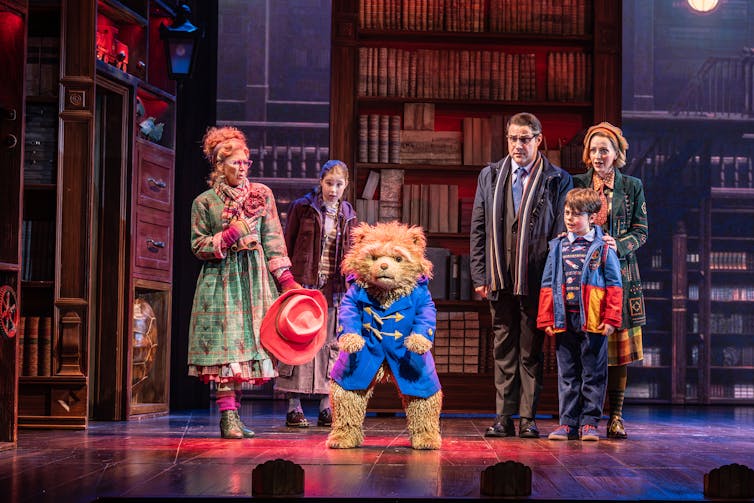
Foremost of his adversaries, however, is Millicent Clyde (Victoria Hamilton-Barritt), evil daughter of the sympathetic explorer Montgomery. She introduces herself with the magnificent number Pretty Little Dead Things in which she lists the animals she has subjected to taxidermy – many of which can be seen as part of the stage set.
Millicent is on a mission to complete what her father could not, and in the climactic scene, Millicent has taken Paddington to be stuffed at the Natural History Museum. These scenes wonderfully feature the distinct hind quarters of Dippy, the dinosaur skeleton-cast that, until recently, stood in the museum’s entrance, Hintze Hall.
Johan Persson
If the hard stare is his superpower, Paddington’s talisman is undoubtedly that orange sticky substance. Act two opens with the ridiculously catchy song Marmalade, an extravagant fantasy in which the Brown’s cantankerous neighbour Mr Curry is won over by the taste of a marmalade sandwich, a fantasy into which the audience are drawn as they join in with the “ma-ma-ma-ma-marmalade” refrain.
While the marmalade sandwich kept in Paddington’s hat is a fundamental part of Michael Bond’s original character, it is pressed into service in the film as the secret weapon with which he escapes the clutches of Millicent Clyde. In the musical, it is likewise used to enlist the aid of Hank the Pigeon (voice/puppeteer Ben Redfern) and his fellow birds.
So Paddington is a hero, in the classical sense of the word. He is on a journey to find home after his was destroyed and is guided from afar by his Aunt Lucy. Along the way he must overcome evil and other obstacles. But with the help of his hard stare as his weapon and his trusty talisman, a marmalade sandwich, he triumphs.
This article features references to books that have been included for editorial reasons, and may contain links to bookshop.org. If you click on one of the links and go on to buy something from bookshop.org The Conversation UK may earn a commission.

Looking for something good? Cut through the noise with a carefully curated selection of the latest releases, live events and exhibitions, straight to your inbox every fortnight, on Fridays. Sign up here.



