
News Beat
why the WHO has gone Goopy for traditional medicine

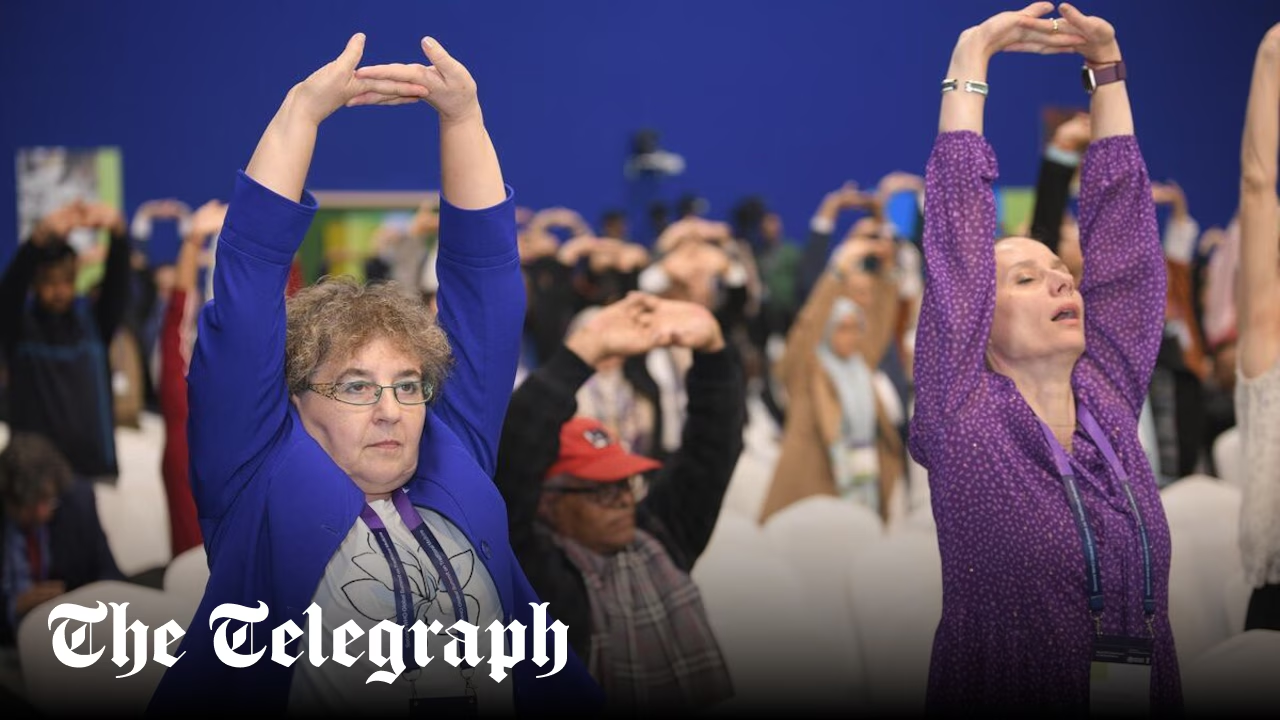

Both China and India have invested heavily in promoting their medical traditions at home and abroad.
India donated $350m to establish a permanent WHO Global Centre for Traditional Medicine in Jamnagar in 2022 and largely funded the Delhi conference.
China, meanwhile, has become the WHO’s single biggest funder now that the US has pulled out, promising investment of $500m over the next five years.
Herbal medicine is a multi-billion-dollar industry in China and is used by at least 75 per cent of the population.
While some elements of traditional Chinese medicine – such as acupuncture for chronic pain – have demonstrated benefit in clinical trials, large parts have also been debunked as pseudoscience.
The use of animal products such as bear bile for pain relief and inflammation and rhino horn for everything from rheumatism and typhoid to “devil possession” do not just put patients at risk but fuel cruel and dangerous illegal wildlife trafficking.
Politics over science?
Even within the WHO, there is tension over what is being platformed at the summit.
One senior official, speaking on condition of anonymity, described homeopathy, a central pillar of Ayurveda, as “complete nonsense”.
“There is not one shred of evidence anywhere, absolutely anywhere, that suggests it works,” the official said, while acknowledging pressure to engage rather than alienate powerful member states.
Dr Ernst, the British-German academic, said: “Many experts are puzzled by this attitude. The most likely explanation is that the WHO is bowing to political will instead of science.”
Homeopathy is based on the principle of “like cures like” and claims to treat illness by administering highly diluted substances that, in undiluted form, would produce symptoms similar to those of the disease.
For example, a homeopathic remedy might involve giving a highly diluted preparation of poison ivy – which can cause a red, itchy rash – to someone experiencing similar skin symptoms.
But even if you accept the principle of homoeopathy – for which there is no robust scientific evidence – the dilution of these “remedies” is so extreme that, more often than not, not a single traceable molecule of the original “healing” substance remains.
Ben Goldacre, the British doctor and professor of evidence based medicine at the University of Oxford, who refers to homoeopathic drugs as “empty little sugar pills”, explained in his best-seller book Bad Science:
“The typical homeopathic dilution is 30C: this means that the original substance has been diluted by one drop in a hundred, thirty times over. The Society of Homeopaths’ website will tell you that ‘30C contains less than one part per million of the original substance.”
“Less than one part per million’ is something of an understatement: a 30C homeopathic preparation is a dilution of one in 10 [to the power of 60], or one followed by sixty zeroes.
“For perspective, there are only around 100,000,000,000,000,000,000,000,000,000 molecules of water in an Olympic-sized swimming pool. Imagine a sphere of water with a diameter of 150 million kilometres (the distance from the earth to the sun) with one molecule of a substance in it: that’s a 30C dilution.”



