
News Beat
Widow calls for frozen tissue law change after husband’s brain tumour death

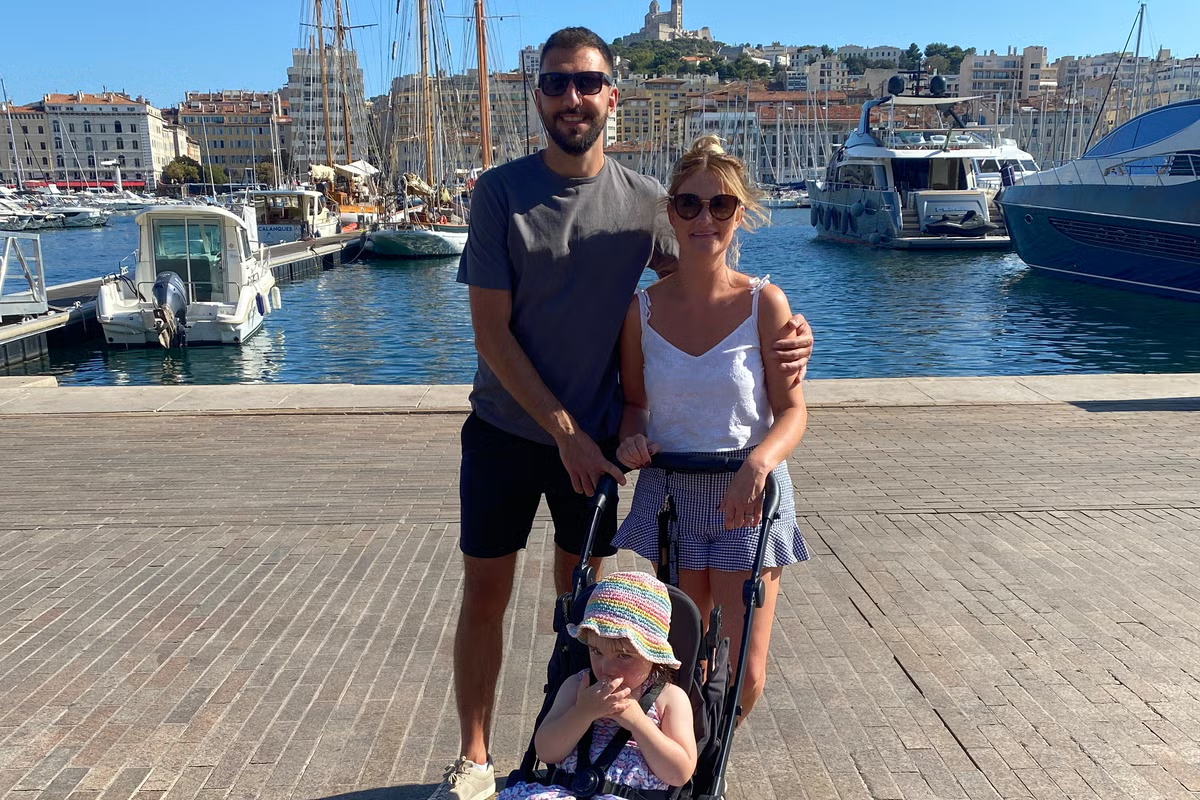
A grieving widow is campaigning to end a “postcode lottery” in brain cancer care, following her husband’s death this year. Ellie James’s husband, Owain, died in 2024 from a glioblastoma, a type of brain tumour.
His access to personalised treatment was hindered because most of his tumour, removed during surgery, was not frozen. Mrs James now leads a campaign for patients to have the legal right to have their tissue frozen and stored post-operation, enabling crucial personalised treatments and genetic tests.
The 36-year-old, from Caerphilly in south Wales, said this is done “inconsistently” across the NHS, creating a postcode lottery of care.
She is calling for a change in the law, dubbed Owain’s Law, which would let patients give consent about what happens to their tissue.
Mrs James said she believes her husband would still be alive had the law been in place when he was receiving treatment.
The issue is to be discussed in a Westminster Hall debate on Wednesday.
Mr James, a father of one, was diagnosed with brain cancer in September 2022.
He had a 14cm tumour, half of which medics were able to safely remove during surgery.
After the operation, the family raised funds to get Mr James a personalised treatment.
Mrs James told the Press Association: “What we didn’t realise at the time was to have that vaccine you needed to have fresh frozen tumour tissue.”
She said that 6cm of the tumour was put in a chemical, which made it unusable for the treatment.
“That meant that we only had a tiny little bit of tissue that could be used to make this vaccine,” she said.
“And the more tissue you’ve got for the vaccine, the more vaccines you can get.
“But because he only had a little bit, he only had three vaccines, where really he should have had around 30.”
After receiving the vaccines – which came after surgery, chemotherapy and radiotherapy – a scan revealed that the tumour had “completely regressed, it was completely gone,” she said.
“It was an absolute miracle.
“He had nine months of clear scans, his quality of life was completely normal.
“And then, unfortunately, nine months later, his tumour did come back and we weren’t able to get any more vaccine, unfortunately, and he sadly passed away in June 2024.
“If we’d had those 30 vaccines at the beginning, I fully believe probably would still be here today.
“And I feel like that choice for us was taken out of our hands by a decision made by a pathologist who had no idea what we were going to do and didn’t think it right to get the relevant consent on what they should do with his tissue.”
She added: “I think patients should have control and informed consent over what happens to their tissue and how it’s stored and whether they want to use it for future treatments or research or through the testing, whatever that might be.
“So for me, Owain’s Law is really about just allowing patients to have options and choice.”
Commenting, Dr Karen Noble, director of research, policy and innovation at Brain Tumour Research, said: “Personalised treatments for brain tumours rely on gathering detailed genetic information about the tumour following surgery.
“The way tissue is stored post-surgery has a critical impact, because there is a real risk that powerful information is lost, closing down pathways to clinical trials and innovative treatments.
“We are calling on Government to ensure that fresh-frozen tissue storage is available in all possible instances around the UK.
“The technology is there – let’s use it to make a difference.”



