

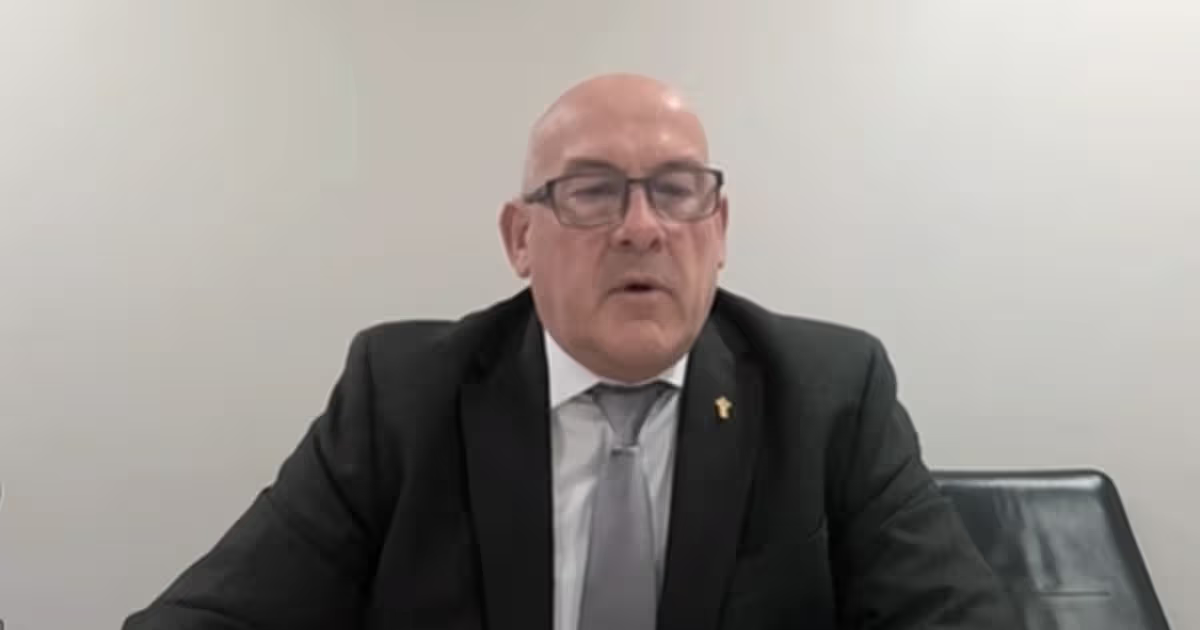
WRU chair Richard Collier-Keywood faced a grilling from the Senedd
Welsh Rugby Union chair Richard Collier-Keywood claims Y11’s deal to buy Cardiff doesn’t necessarily mean the Ospreys will be killed off and insists an EGM ploy to oust him would be a backwards step.
Collier-Keywood was up in front of the Senedd this morning alongside the WRU’s community director Geraint John and independent non-executive director Alison Thorne. The trio were thoroughly questioned on the WRU’s plans for the game in Wales, including the proposed reduction to go from four to three professional teams.
Swansea Council claims if Y11’s deal to buy Cardiff is completed it will result in the Ospreys transitioning from a professional team into a semi-professional Super Rygbi Cymru outfit.
Ensure our latest sport headlines always appear at the top of your Google Search by making us a Preferred Source. Click here to activate or add us as Preferred Source in your Google search settings
As a result they are exploring legal avenues in a bid to save the Ospreys as a pro side.
But Collier-Keywood insists the WRU’s plan wouldn’t automatically result in the Scarlets being granted the west licence, confirming it is possible for Y11 to own two sides in the United Rugby Championship.
“The assumption then was that Ospreys was going to be the club that was killed off,” said Collier-Keywood.
“That is not the case in terms of what will necessarily happen as a result of Y11 owning two clubs.
“There is a totally separate process the WRU are going through of how we decide to award the licences.
“There is one west licence.
“Going forward I expect that we will carry out a fair and transparent process to determine who gets that licence. We have not done that yet.
“We will carry out that process because there may be some conditions we will put into that licence about where rugby needs to be played.
“For example, it could be that rugby has to be played across the west region, for example.
“We will take out some form of process to award the west licence. We have not had enough time to do that yet.
“We made this decision at the very end of October. We are three months into this process and we will carry that out properly.”
Collier-Keywood is also facing a vote of no confidence from member clubs who will vote at an EGM which will be held after the Six Nations concludes.
There are three motions which include a vote of no confidence in Collier-Keywood and Professional Rugby Board chair Malcolm Wall.
The second motion is for the WRU council to hold elections for the four elected WRU council member board positions which is to take place within 14 days of the EGM.
In addition, the third motion is to amend how the WRU district and council members are elected, which will require a 75% majority.
Although, under section 36 of the WRU’s articles of association, that is technically inadmissible by the clubs and only the WRU board has the power to do so at an EGM.
Collier-Keywood believes moves to oust him at an EGM would be a backwards step.
“We entirely respect the EGM process and we will be complying with our obligations in full,” he said.
“Secondly, I was brought in as an independent chair on a mandate of change. Change is never easy, we recognise that and we are in the midst of significant change.
“The first thing would be it really feels like a step backwards when you look at some of the requests in there.
“We are not paying consultants to do our jobs. We are skilled independent directors and administrators.
“We’ve brought back Steve Tandy as a brilliant coach with a culture of collaboration across the teams. We’ve brought back Sean Lynn who was the top PWR coach.
“We are not paying consultants to do our jobs.
“The second message is we have professionalised governance. It would be a totally backwards step if you reversed the changes brought in at the EGM in 2023 and brought in an opaque group of people to do the jobs we are doing.
“The third point is we have genuine concern about the financial system we have now built. Within the last two months we have completed the refinancing which includes HSBC and Goldman Sachs and that has given us £60m over the course of the next three years to invest in Welsh rugby.
“We have made a commitment to go from four to three teams. We need to concentrate resources on fewer professional clubs to make our clubs better and make the system work better.”
Despite significant pushback the WRU maintain they are correct to reduce to three teams.
“The benefits are very significant. Financially we will be able to put enough money into our teams to be competitive,” he said.
“Do you want four teams who have struggled in URC or three teams where at least some of them get to the knockout stages in URC?
“What Steve Tandy and Dave Reddin tells us is they want the best players to play together more closely for longer periods in time. We have to achieve that.
“We are paying for a system with a lot of NWQ players. The Board reached a unanimous decision on three teams.
“They understand what this all means. The board was unanimous in this view.
“Am I inclined to throw that away? Probably not.
“You asked me to bring this change so that Welsh rugby would have a strong, proud and sustainable future.”















































You must be logged in to post a comment Login