
News Beat
York in 1926: changing face of our city a century ago

A CENTURY ago, York was a city embracing change while holding tight to its rich heritage.
The year 1926 marked a period of progress, pride, and a few indulgent pleasures that still echo through the city’s story today.
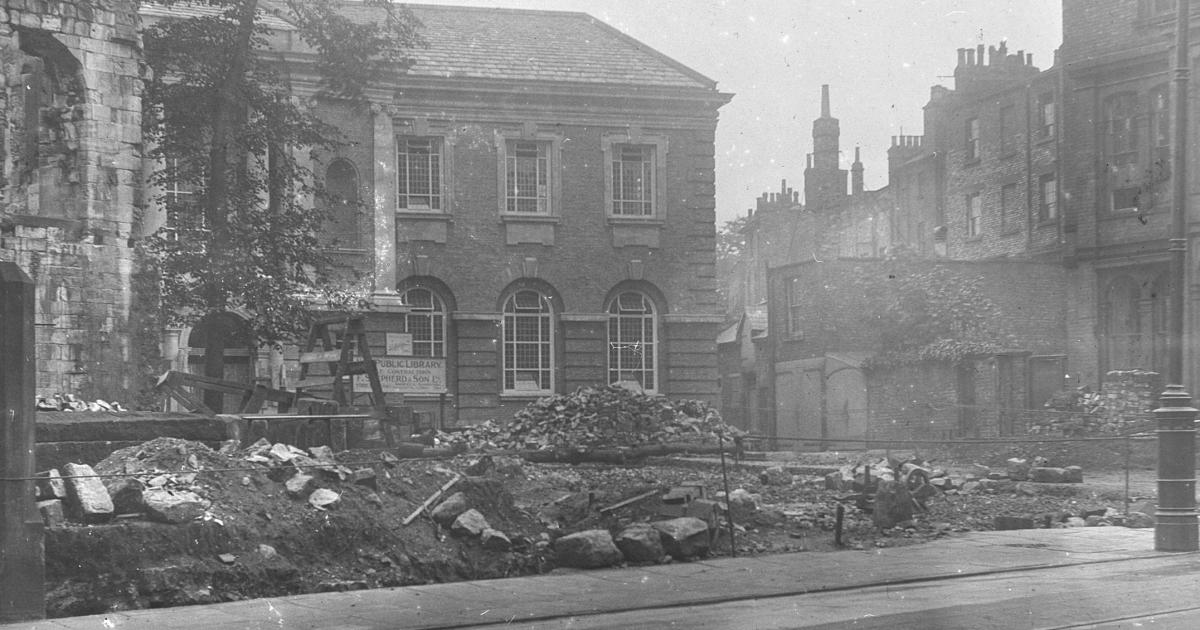
One of the most significant developments was the building of York’s new public library on Museum Street.
Built by local firm F. Shepherd and Son at a cost of £25,600, it was a bold investment in learning and culture.
The land, once home to livery stables, was transformed into a civic landmark, standing proudly beside the ruins of St Leonard’s Hospital. The library opened the following year, in 1927.
For Shepherd and Son, now internationally renowned for complex construction projects, this was likely one of their first major undertakings.
Elsewhere, York’s commercial heart was being refreshed. JH Wilson Drapers’ distinctive building on Pavement underwent restoration in 1926.

From above, the city’s historic core told its own story – and reveals parts of York which are long gone.
An aerial view of the York Castle area captured the Eye of York, Clifford’s Tower, and the imposing men’s prison, all encircled by a formidable wall.
Entertainment and spectacle were also part of life in 1926. A Military Tattoo on the Knavesmire, immortalised on a postcard submitted by Mr Bryan Thornton, drew crowds eager for pageantry. The Knavesmire, better known for horse racing, became a stage this military display – a patriotic flourish in a decade still shadowed by the Great War.

Industry and innovation were thriving too. At Terry’s, a sweet revolution was underway with the launch of the Dessert Chocolate Apple, a treat that tempted chocolate lovers until its discontinuation in 1954. Terry’s Chocolate Orange was launched in 1932 and proved to be more popular – and remains a best-seller today.

Infrastructure improvements were shaping the city’s future. Monk Bridge, a vital link towards Monkgate, was widened between 1924 and 1926. A photograph from the era shows the bridge looking towards the city – a snapshot of York adapting to the demands of modern transport while preserving its character.

Looking back, 1926 was a year of transformation. From libraries and bridges to chocolate and military tattoos, York balanced progress with pride in its past.
A hundred years on, these stories remind us that the city’s enduring charm lies in its ability to evolve without losing sight of its roots.
Great events of 1926
One of the biggest events of 1926 was the General Strike – which lasted nine days, from May 4 to 12. It was called by the General Council of the Trades Union Congress (TUC) in an unsuccessful attempt to force the British government to act to prevent wage reductions and worsening conditions for 1.2 million locked-out coal miners. Here are some other key events of the year:
January 27: John Logie Baird demonstrates a mechanical television system in London.
March 6: The Shakespeare Memorial Theatre in Stratford-upon-Avon is destroyed by fire.
April 21: Princess Elizabeth – later Queen Elizabeth II – is born at 2.40am.
July 24: The first greyhound track in Britain opens in Manchester.
Recommended reading:
How York once looked: 10 old York scenes from yesteryear
A century of sweet tradition: York’s role in the Christmas selection box story
How the York Pageant of 1909 brought the city’s history to life
August 6: American swimmer Gertrude Ederle becomes the first woman to swim the English Channel from France to England.
August 7: The first British Grand Prix is held at the Brooklands circuit near Weybridge.
October 12: British miners agree to end their strike.
October 14: AA Milne’s Winnie-the-Pooh is published.
November 15: Rudolph Valentino’s final film The Son of the Sheik is released.
December 3: Agatha Christie disappears from her home in Surrey and is found in a Harrogate hotel on December 14.



