For nearly forty years, Fergal Keane has reported for the BBC from some of the world’s most brutal conflicts – in Gaza, Iraq, Rwanda, Sudan, Ukraine and beyond – and in that time interviewed scores of children who are the innocent victims of adult wars.
As he came to understand the impacts of trauma on young minds, Keane began too to experience his own mental breakdowns – the result of a troubled childhood and a career spent running towards danger – and was eventually diagnosed with PTSD.
In today’s episode, he reflects on what he has learned from his own experiences and reporting about how childhood traumas can be treated, and the hope for those living through today’s wars.
Advertisement
Producer: Hannah Moore
Executive producer: Bridget Harney
Mix: Travis Evans
Senior news editor: China Collins
Advertisement
Photo: Displaced children play in Gaza, amid a ceasefire between Israel and Hamas. Haitham Imad/ EPA/ Shutterstock.
It is hoped the guidelines will bring ‘meaningful change’
Oliver Pridmore and Katrina Chilver Editor
09:12, 17 Mar 2026
New guidelines are set to bring ‘meaningful change’ to how the police and media work together. The new Policing and Media Charter was officially launched at the Society of Editors’ ‘Future of News’ conference in London today (Tuesday, March 17), and sets out clear guidance to police force communication teams and journalists to help them work more effectively together during major incidents.
The charter has been jointly developed by the National Police Chiefs’ Council (NPCC), College of Policing, Crown Prosecution Service, Crime Reporters Association, Society of Editors and Media Lawyers Association.
Advertisement
It follows the forming of a national working group in 2023 which was prompted by the College of Policing’s review into the missing person investigation of Nicola Bulley. The working group has also produced updated guidance for police forces on the release of information to the public and new guidance on journalists requesting material used in open court.
Chief Constable Gavin Stephens, Chair of the NPCC, said: “Policing needs open and honest communication with the public, and the media has a central role to play in this, especially in fast-moving or sensitive situations.
“This ground-breaking charter represents the willingness of policing and the media to come together to build mutual trust and bring about meaningful change in how we work together.
“It will form the backbone of stronger relationships between police forces and media organisations across the country, and I’d like to thank everyone who contributed to the vital discussions, debate and disagreements that shaped it.”
Advertisement
Dawn Alford, Chief Executive of the Society of Editors, said: “The relationship between journalists and the police is central to ensuring the public receives accurate and timely information about crime and policing. This charter represents a genuine effort from both policing and the media to rebuild trust and improve the way we work together in the public interest.
“When information flows well between policing and professional journalists, the public benefits. This charter is an important step towards strengthening that cooperation.”
Rebecca Camber, Chair of the Crime Reporters Association, added: “This charter has the potential to fundamentally transform the relationship between police and the media, which remains essential to public confidence and policing legitimacy in the UK.
“Two years ago, the Crime Reporters Association made a series of recommendations kickstarting a vital conversation between policing and the media about rebuilding trust.
Advertisement
“I’m delighted that police have listened and together we have produced a groundbreaking charter which I hope will make a real difference to journalists, police and press officers everywhere.”
The Affair was set to make its ITV debut last week but the schedule suffered a last-minute shake-up.
Hayley Anderson Screen Time TV Reporter
09:59, 17 Mar 2026
ITV has rescheduled the “best drama ever” with fans soon able to immerse themselves in the iconic series The Affair.
On Friday, March 13, ITV viewers eagerly anticipated the 2014 drama featuring Ruth Wilson, Dominic West, and Dawson’s Creek star Joshua Jackson making its terrestrial television premiere.
Advertisement
Yet audiences were baffled when the schedule was abruptly altered, with The Affair replaced by an instalment of game show Beat The Chasers in the 9pm time slot.
Whilst the rationale behind the eleventh-hour alteration remains uncertain, ITV has subsequently confirmed to Reach Plc that audiences won’t face a lengthy wait for the drama’s broadcast.
The Affair will launch on ITV this Friday, March 20, at 9pm, with plans to transmit the acclaimed series weekly every Friday evening.
For the latest showbiz, TV, movie and streaming news, go to the new **Everything Gossip** website.
There’s an alternative viewing option available, as the first three seasons have recently become accessible on ITV’s streaming platform ITVX.
Consequently, eager audiences needn’t wait through weekly Friday instalments to discover subsequent events, though series four and five remain unreleased.
The Affair centres on married educator and writer Noah Solloway’s (played by Dominic West) forbidden affair with waitress Alison Lockhart (Ruth Wilson) whilst she grapples with her own devastating loss.
Advertisement
Episodes are usually divided into two segments, presenting the same events from differing viewpoints, which helps establish The Affair as a distinctive programme for many viewers.
Describing it as the “best TV show ever”, one fan wrote on IMDb: “They don’t make TV shows like this. This is drama at its best.
“Superb writing and cast of actors, so much talent in this one show.”
Advertisement
Another viewer concurred: “Love this series, the way the episodes play out showing both sides of the story from two different perspectives is brilliant. The acting is superb!”
“What a brilliant show, gripping from start to finish. Watched all seasons and it certainly wasn’t predictable at all,” commented a third.
Meanwhile, another fan enthused: “I think this is my favorite show of all time!”
“Please keep going, the stories are great, exciting, realistic, fun, mind blowing and so much more!”
Advertisement
The Affair premieres on Friday, March 20, at 9pm on ITV.
Steve Clarke will lead Scotland at their first World Cup since 1998 but is likely to go into this summer’s tournament in North America with only a few months left on his contract
Scotland manager Steve Clarke has revealed that he’s yet to be offered a new contract, despite guiding them to their first World Cup in 28 years. Clarke’s current deal with the Scottish FA will expire after this simmer’s tournament, where his side have been drawn to face Haiti, Morocco and Brazil in Group C.
Advertisement
The 62-year-old has guided Scotland to three major tournaments since taking charge in 2019. But his position came under scrutiny before the World Cup qualifying campaign, having finished bottom of their group at Euro 2024 and suffering relegation in the Nations League.
Ahead of their friendlies against Japan and the Ivory Coast during the upcoming international window, the former Kilmarnock and West Brom boss says that the ball is in the SFA’s court. Quizzed on his future, Clarke said: “Obviously the thing in my head is what do I do next, where do I go next, what’s next for me?
“I’ve qualified for three tournaments out of four. I think that’s a pretty decent record.” The Scot added: “Obviously, I’d like to do a little bit better at the tournament this summer, but that’s something that we can address when we get out there.
“Do the Scottish FA think that I’m the guy that can go forward and progress the squad into the next tournament and hopefully set us up for a further World Cup qualification in four years’ time? That’s what they have to decide.
“At the moment I don’t really have a choice to make because they haven’t put an offer in front of me and none of the club sides have put an offer in front of me either. I’m just sitting here talking to you guys, having a good time.
Should Steve Clarke be offered a new contract? Have your say in the comments section.
“I’ve just got to sit and see if any club approaches me between now and the end of the season, and then I’ll have a decision to make.”
Clarke went on to confirm that he’s had a ‘very brief conversation’ with SFA chief executive Ian Maxwell regarding their future plans. As for the next step, the ex-Chelsea and St Mirren right-back explained: “I think I’m waiting on the Scottish FA now coming to me and saying, ‘look, this is what we see as the future’ and if I’m part of that then we can have that discussion.”
Last month, Clarke was present at the draw for the 2026-27 Nations League. Having been relegated to League B, Scotland will face Switzerland, Slovenia and North Macedonia, but the question of who’ll be in the dugout at Hampden Park when the competition begins in September remains unanswered.
Join our new WhatsApp community and receive your daily dose of Mirror Football content. We also treat our community members to special offers, promotions, and adverts from us – and our partners. If you don’t like our community, you can check out any time you like. If you’re curious, you can read our Privacy Notice.
Networking is so often presented as a kind of performance – confident handshakes and quick conversations in crowded rooms. But for many people, particularly introverts, these situations feel more draining than energising.
Building contacts and generating opportunities in this way may sound like something that extroverts are naturally better at. But this assumption, and the idea that introverts must therefore be at a disadvantage, is misleading.
Networking does not have to mean being the most visible person in the room. It can simply be about building relationships in a way that feels genuine and sustainable. In my research on women entrepreneurs, including interviews for my new book, Permission Granted, I have seen introverts thrive when they lean into their natural strengths rather than trying to put on an outgoing persona.
Of course men can be introverts too, and face the same misconceptions. Whoever you are, and wherever you are on your career ladder, here are my top tips for succeeding at work as an introvert.
Advertisement
1. Understand your introverted strengths
Introversion is not shyness or a lack of confidence. It is about how you process energy and information. Many introverts are deep thinkers, strong listeners and thoughtful communicators; qualities that can help to build meaningful professional relationships.
You do not need to work the room. Focusing on one or two deeper conversations is often more powerful than spreading your energy too thinly. When introverts approach networking with curiosity rather than performance, it often becomes more natural and far more effective.
2. Understand why networking feels harder for introverts
Advertisement
Across my research and developed further in my book, I emphasise that networking is work. It uses cognitive and emotional energy, after all. Busy rooms can be overstimulating and small talk can be draining. And the expectation to perform socially can create pressure long before an event even begins.
3. Redefine what networking is
At its core, networking is about connection. When you think of it as an opportunity to learn from others rather than to impress them, the pressure lifts. A single sincere exchange might be remembered far longer than a flurry of rushed introductions. People respond to warmth, attentiveness and genuine interest.
4. Prepare in ways that suit your temperament
Advertisement
Preparation is one of the great advantages introverts bring to networking. Being clear about why you are attending an event can help shape the experience and reduce the sense of overwhelm. Identifying a couple of people you would like to meet can help you feel more anchored. And having a few conversation-openers ready (perhaps about the topic of the event or shared interests) can create a sense of ease. A simple, one-sentence introduction is often all you need to start a conversation without forcing anything.
Smaller, more structured work events can feel more comfortable for introverts. PeopleImages/Shutterstock
5. Choose environments that work for you
Not every setting suits every temperament. Introverts often thrive in more structured or intimate settings: roundtables, smaller workshops, breakfast events or even one-to-one coffee chats. Large, unstructured rooms can feel overwhelming, and choosing alternatives is not avoidance, it is strategy.
Advertisement
6. Follow up in your own way
Introverts often shine in the quiet, reflective stage of relationship-building: the follow-up. A personalised LinkedIn note or a brief invitation to continue the conversation can go a long way. This deliberate, thoughtful style of nurturing professional relationships is something introverts often do better than they realise.
7. Protect your energy
Networking uses real energy. Feeling drained afterwards is not a flaw; it is biology. Planning downtime before and after events, limiting the number of events per week, and taking breaks during busy sessions helps to maintain balance. Introverts need energy management. Building in recovery time, protecting your quiet and giving yourself permission to rest is essential for maintaining any kind of sustainable networking practice.
Advertisement
8. Depth over volume
Professional culture often celebrates the loudest voice in the room. But long-term relationships grow from listening, curiosity and your presence – all qualities that introverts naturally bring. That is a core theme I return to in my research: you do not need to dominate a room to make meaningful connections. You just need to network in a way that works for you.
Start small. Protect your energy. Trust your quieter strengths. Depth, not volume, is where introverts shine.
National Car Parks manages around 340 car parks across the country, including in major towns and city centres, airports and at hospitals
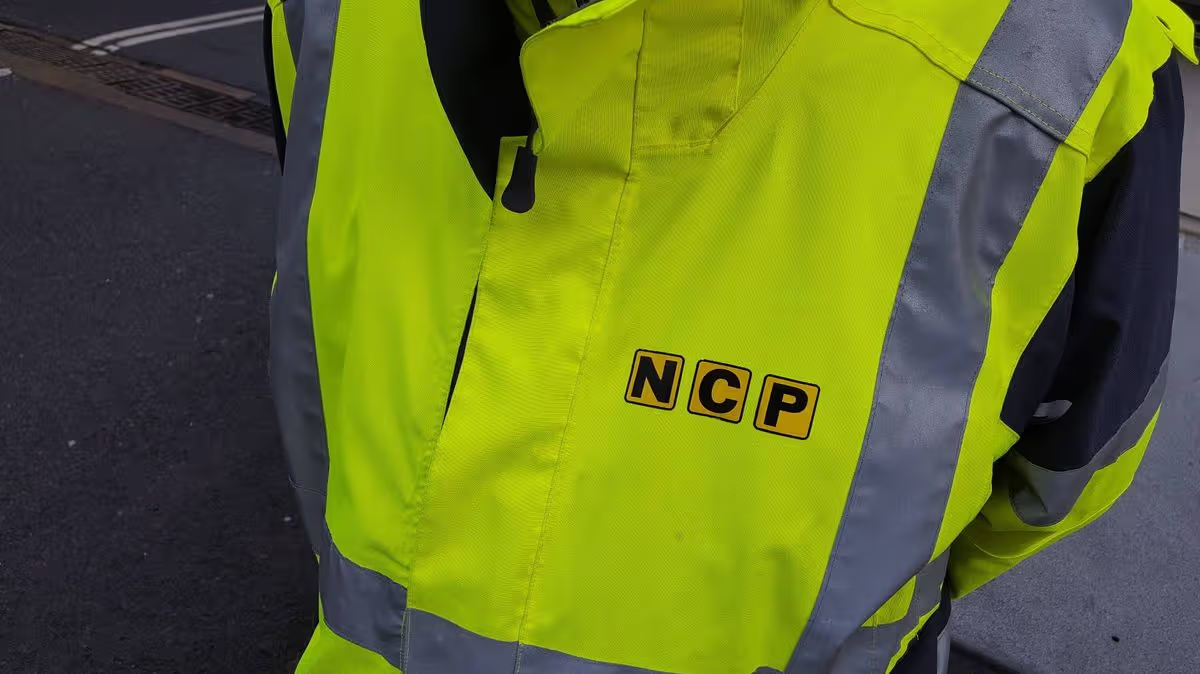
Britain’s largest car park operator has entered administration, sparking concerns over potential site closures. National Car Parks (NCP) has 682 staff and operates approximately 340 car parks nationwide, including locations in major urban centres, airports, and hospitals.
Advertisement
The firm’s financial results have deteriorated in recent years following the Covid pandemic as demand for parking has not returned to pre-pandemic levels, especially in city centre and commuter areas. This, combined with changes to working habits, has left its car parks with excessive vacant spaces.
However, many of its locations are tied to long-term, inflexible leases which has prevented the company from cutting costs or disposing of them, leading to continued trading losses. Administrators say NCP now has “insufficient cash available to meet its financial obligations”.
Zelf Hussain, Rachael Wilkinson, and Toby Banfield of PwC have been appointed as Joint Administrators. Their immediate priority will be to “stabilise the business while assessing options for its future”, reports the Mirror.
During this period, they will be engaging with site owners and stakeholders to evaluate potential cost-reduction measures. A sale of the entire business or parts of it will also be considered.
Advertisement
PwC said they would be examining the viability of each site, but noted that “there may need to be site closures as part of the process”.
Zelf Hussain, Joint Administrator and PwC partner, said: “NCP has faced a challenging trading environment over several years, with changing consumer behaviours impacting volumes, and a high fixed cost-base leading to trading losses. Our priority on appointment is to ensure continuity of service while we undertake a detailed review of the business.
“All sites are open, staff remain in post, and trading continues as normal. We will be engaging with landlords, employees and other stakeholders as we explore all options, including the potential sale of all or part of the business, to secure the best possible outcome for creditors.”
Established in London in 1931, NCP is owned by Japanese company Park24. In confirming the administration, the firm revealed NCP had accumulated nearly £44million in net losses over the previous three years and held net liabilities of £352million.
Advertisement
Explaining the circumstances, the company stated: “Since joining our group in 2017, NCP has been positioned as an important operating subsidiary supporting our group’s long‐term growth. From 2020 onwards, however, NCP experienced a decline in demand due to the impact of the COVID‐19pandemic, and the subsequent recovery in utilization remained subdued.
“In addition, operating costs continued to increase as a result of elevated energy prices following the situation in Ukraine and persistently high inflation in the UK, leading to rising inflation‐linked rent payment obligations.
“To address the slower post‐pandemic recovery in demand, NCP pursued new car park developments to support revenue growth, while also implementing cost‐reduction measures such as workforce restructuring. Notwithstanding these efforts, structural losses continued.
” Furthermore, with significant rent payments falling due at the end of March 2026, its cash‐flow position tightened and it became increasingly difficult to secure the necessary funding. In light of these circumstances, and after considering various financing options including potential asset disposals, NCP determined that no prospect of improvement in its cash‐flow position could be identified.
Advertisement
“Accordingly, with the aim of protecting creditors’ economic interests through the preservation of the value of the business and its assets, NCP’s Board of Directors resolved to place NCP into Administration, an insolvency procedure under the laws of England and Wales. Park24 will continue to cooperate in good faith regarding the orderly conduct of the administration.”
Charlotte Tilbury has slashed 20% off everything on its site including Magic Cream now £63.20, Airbrush Bronzer £37.60, and the foundation stick that left our beauty editor looking ’10 years younger’
Eve Rowlands Senior Shopping Writer and Sarah Tulloch
09:15, 17 Mar 2026Updated 09:17, 17 Mar 2026
This article contains affiliate links, we will receive a commission on any sales we generate from it. Learn more
With spring just around the corner, it’s the perfect time to replenish your beauty essentials that give your skin that summer glow and help achieve a radiant, healthy look. This is especially true as several leading retailers have launched sales to compete with Amazon’s Spring Deal Days, including the Oscar-favoured brand Charlotte Tilbury, which has cut prices by 20% across its entire site.
This rare sale offers discounts on all of the brand’s bestsellers, with Charlotte Tilbury reducing prices on skincare products – such as its newly enhanced Magic Cream, now priced at £63.20 down from £79 for a 50ml jar – bronzing items like its Airbrush Bronzer (now £37.60), and glamorous makeup from the Pillow Talk range to its Unreal skin products.
Advertisement
For instance, the brand’s acclaimed Blush Healthy Glow Stick and Unreal Skin Sheer Glow Tint Hydrating Foundation Stick, praised for making skin ‘look so youthful’ are now available for £25.60 and £29.60 respectively, reports the Mirror.
The Unreal Blush Healthy Glow Stick, typically priced at £32, is available in six sunset-inspired shades and has been described as a ‘summer glow-up in a stick’. Featuring a balm-like consistency and smooth application, its enduring formula contains skincare ingredients, including ‘Colour Light Mapping Mesh Tech’, designed to retexturise, blur and enhance the skin’s appearance.
Like its companion product, the blush incorporates the Skin Barrier Defence Matrix, featuring ‘Collageneer’ and hyaluronic acid for a hydrated, smoother, plumper complexion.
Advertisement
Providing a ‘dream-sheen, luminous pop of colour’, the blush can be applied straight onto the skin and smoothed out using a brush or fingertips – perfect for busy lifestyles as it guarantees a fuss-free ‘mistake-proof’ application. Suitable for use on both cheeks and lips, this versatile product can be conveniently tucked into a handbag for frequent touch-ups and has earned an impressive 4.7 star-rating on Charlotte Tilbury’s website.
One beauty enthusiast praised it as a ‘makeup bag must have’ and commented: “I love these blush sticks. I have 3 different colours. Easy to apply and gives a nice healthy glow. Feels light to wear.”
Another customer stated: “Amazing product. Makes you look instantly healthy and glowing! I love it.”
A third reviewer observed: “Slides on like butter, stays on like a stain blush! A little goes a long way so well worth the money. Lovely packaging and such a gorgeous colour.”
Advertisement
Whilst numerous users praised its relatively impressive staying power, others were less convinced, reporting how it ‘faded quickly on my skin’, requiring frequent reapplication. For those seeking a blush stain offering a natural-looking flush with superior longevity, Benefit’s Benetint Rose Tinted Lip and Cheek Stain consistently garners rave reviews and is currently reduced by 20% at Lookfantastic, bringing the price down to £18.
Another option is the Milk Makeup Cooling Water Jelly Tint, £23, which promises ‘all day colour’ and serves as a buildable blush and lip product delivering a ‘watercolour-like finish’.
As for Charlotte Tilbury’s Unreal Skint Tint, now reduced to £29.60 from £37, this summer essential has earned endorsements from celebrity makeup artists alongside our beauty team for its featherlight texture and effortless application – plus the stunning radiance it provides throughout the year.
Advertisement
The formulation, enriched with ‘light mapping mesh tech’, hyaluronic acid, daikon radish seed oil, antioxidant-packed vitamin E, collageneer and ultra-fine ‘pearlescent filters’, is designed to blur and refine skin whilst supporting the skin barrier’s resilience. With a selection of 20 shades, customers who have purchased this product have lauded its ‘dewy’ finish and ‘natural looking radiance’.
One satisfied customer shared: “I love this makeup. It is ideal for the days when my skin is tired and I just want to brighten up without anything too heavy. Suits fair skin, just gives a natural glow.”
Another user commented: “As someone with extremely sensitive skin, aged 40 and who never wore facial make-up growing up, I have been looking for a light foundation that can give me some coverage mainly on my cheeks and nose, just to cover the natural blemish red I get across my cheeks and having purchased the flawless filter i decided to try this foundation as well and it is by far the best I’ve probably ever tried! It gives a lovely light but buildable cover, the texture is velvety smooth and the colour match is perfect. It doesn’t feel like I’m wearing anything on my skin, which I love, and yet blurs my cheeks to look like I’m juuusst in soft focus.”
Meanwhile, a third customer enthused: “This is honestly the makeup buy of the summer for me. This foundation glided onto my skin making my skin look so youthful and radiant. My husband commented ‘You look radiant.’ Really natural looking. I was thrilled. Highly recommend this product for a ten years younger looking face.”
Advertisement
Whilst numerous customers have praised its ‘glowy’ effect, others discovered it wasn’t quite right for them, with one person commenting: “I have oilier skin, so this being a hydrating/glowy product was a little too much glow for my skin, so I had to set it with a little more powder.” Bear this in mind when considering the product.
For those seeking luminosity without excessive shimmer on oilier skin types, bareMinerals has just introduced its Complexion Rescue Luminious Skin Tint Stick, priced at £33. The product promises a gentle, dewy appearance that conceals blemishes whilst enhancing radiance.
The messaging platform began as a paid app upon its launch in 2009 before becoming free to use in 2016.
Along with Netflix, Disney+, and Spotify, an increasing number of apps are turning to paid subscription services, giving users access to extra content at a cost.
Some of these major apps include TikTok, Snapchat, Strava, Calm, Tinder, and Instagram.
Advertisement
WhatsApp to launch new ‘Premium’ subscription
It appears WhatsApp is now set to join these major apps in launching an optional premium subscription that will offer users extra features in exchange for a monthly fee.
WhatsApp Plus is under development for Android and iOS, according to WABetaInfo.
It appears WhatsApp will remain free to use, with the upcoming Plus tier being an optional subscription offering extra perks.
WhatsApp will remain free to use, with the new Plus subscription completely optional, WABetaInfo explains.
It continues: “This means that users are not required to subscribe in order to continue using WhatsApp.
“Again, all of the app’s essential tools (including sending and receiving messages, making voice and video calls, sharing media, participating in group chats, privacy and security features) will remain fully accessible to everyone at no cost.
“The introduction of the paid tier is designed to offer additional customization and convenience features for users who want them, without restricting or limiting the free experience.”
Advertisement
WhatsApp has not yet confirmed pricing or an official launch date for its new premium subscription.
Features included in WhatsApp Plus
WhatsApp Plus will include a range of exclusive features, which is expected to be added to over time.
Some of the features included in the new subscription, according to WABetaInfo, include:
Several customisation options to change the app theme, app icon, and accent colors, including a selection of 14 new icons and multiple color choices for interface elements.
The ability to pin up to 20 chats (instead of the standard limit of three)
Exclusive ringtones
Will you be buying the new WhatsApp Plus subscription when it comes out? Let us know in the poll above or in the comments below.
Science in the modern era is increasingly reliant on enormous datasets and automated analysis. In astronomy, the Vera C. Rubin Observatory’s Legacy Survey of Space and Time (LSST) – a ten-year survey covering the entire southern sky almost a thousand times over the next decade – will test the limits of this reliance.
The Rubin observatory, located on a mountaintop called Cerro Pachón in Chile, is expected to catalogue the night sky in exquisite detail. The observatory aims to answer a number of questions about the universe by studying different phenomena in the sky, including supernovae (exploding stars), asteroids, dark matter and the properties of our own galaxy.
What it will also answer is a question dominating all areas of science in the 21st century: how is discovery viewed in the age of big data?
Although primarily funded by the US Department of Energy and National Science Foundation (NSF), the Rubin telescope is the product of a collaborative effort by astronomers spanning six continents and over a dozen countries.
Advertisement
Assistance in setting up its data processing systems was provided by the UK, France, Spain, Italy, Japan, Brazil, Australia, South Africa and Canada, among others. These in-kind contributions provide researchers from these countries with data rights for the LSST.
Alerts providing scientific data are forwarded to seven “brokers” scattered around the world. The brokers are websites or software that astronomers use to access the data from LSST.
The alerts provide information on a new astronomical object, such as its likelihood of being real, its type, the galaxy it belongs to and how its brightness has changed over time. With this data, astronomers are able to select the best candidates for follow-up research.
However, even with the efforts of the software teams and brokers, there is still too much transient data for any research team to sift through. The final stage of data processing from the Rubin telescope will involve scientists using machine learning and AI techniques to identify the best data.
Advertisement
These techniques may be for identifying real cosmic objects among the terabytes of false alerts received, or for classifying the ones most interesting to scientists.
The Rubin observatory will generate huge amounts of data, requiring large numbers of personnel to analyse it. NOIRLab/NSF/AURA/T. Slovinský
Astronomy is increasingly code-heavy and focused on in-house development. Given the huge amounts of data generated with every night of telescope observations, it is, unsurprisingly, one of the first sciences to turn to machine learning as a solution.
Astronomy has led the charge in regard to big data, with funding provided by companies such as Amazon and Microsoft for a number of major projects. Indeed, the namesake of the 8.4-metre Simonyi Survey Telescope at the Rubin observatory, Charles Simonyi, is known for software development in the early days of Microsoft, as well as his philanthropic work.
Advertisement
The volume of data produced by the observatory will not only produce opportunities for scientists, software developers and tech workers, but also for volunteers with an interest in astronomy via citizen science projects.
LSST’s partnership with the citizen science platform Zooniverse will ask volunteers to look through data and provide additional context to what they’re shown – identifying interesting objects, discarding garbage data and classifying various types of phenomena.
Future lessons
What does the Rubin observatory tell us about modern astronomy? The 20th century saw a greater push for international collaboration in exploring the skies. The increased sophistication of the resulting observatories means that more and more astronomers are working in the service of enabling science, rather than making discoveries themselves.
The huge amounts of data generated by the survey, and the huge number of personnel required to analyse it, is not novel to Rubin. Other contemporary surveys such as Euclid and the Ligo-Virgo-Kagra collaboration, as well as the next decade’s even larger Square Kilometer Array, each consist of thousands of collaborators worldwide leveraging huge amounts of data.
Advertisement
What is clear is that AI will dominate the scientific discovery space of the Rubin observatory to meet these big data challenges. With more funding from industry to develop AI tools to analyse astronomy data, astronomy is becoming deeply embedded within the tech-sphere that dominates modern life.
Rubin will produce 10 terabytes of data every night, with the aim of a final database size of 15 petabytes at the end of its ten-year survey. With the majority of the 10 million alerts produced each night expected to be false, advanced machine learning and AI tools are required to filter out all but the most promising candidates for follow-up.
By reducing the amount of time spent by astronomers reviewing this data, more time can be spent carrying out new and exciting astrophysics research.
Ownership of both the tools of discovery and the discovery itself is now disseminated among scientists, big tech and the citizens who label data. The unresolved question is whether the cosmos will remain a shared public frontier, or become a domain shaped by the priorities of Silicon Valley.
Around 6pm on Tuesday, 25 February, a property near the B739, between Tarbolton and Monkton, was broken into.
Jewellery and clothes worth approximately £300,000 were stolen during a housebreaking and theft in Ayrshire.
Advertisement
Around 6pm on Tuesday, 25 February, a property near the B739, between Tarbolton and Monkton, was broken into.
Police have since confirmed that jewellery and clothing worth approximately £300,000 were taken.
It is believed two males were involved in the break-in and they would have needed access to a vehicle.
A team of detectives has reviewed CCTV and carried out extensive enquiries in the local area.
Advertisement
Police Scotland Detective Sergeant Davie Gillies, Ayr CID, said: “We are now appealing for the help of the public.
“We believe this house was targeted specifically for its remote location and with the intention of stealing high-value items.
“Our enquiries remain ongoing and I am appealing to anyone who witnessed the incident, who may have seen a car or people acting suspiciously in the area on the day the property was broken into or in the days leading up to it or who may have information which could assist to contact us.
“I would also ask any motorists who were in the area of the B739, between Tarbolton and Monkton, around the time and who may have dash cam footage which could help to get in touch.”
Advertisement
Anyone with any information is asked to contact 101 quoting reference 3693 of 24 February, 2026.


















































You must be logged in to post a comment Login