Politics
CBS News contributor appears in the Epstein files
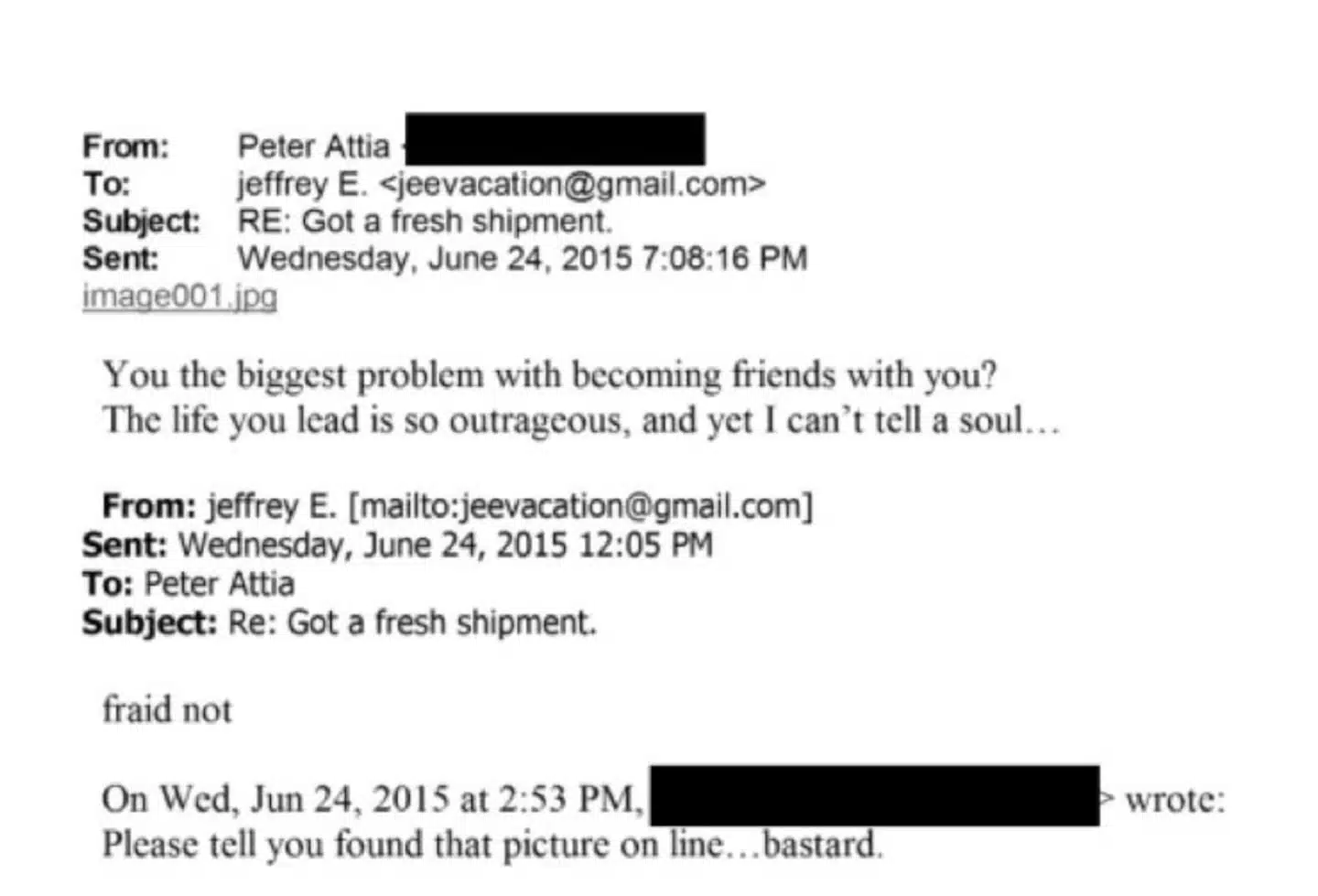
CBS News, since its takeover by the Israel-fanatic Ellison family and the installation of equally Zionist Bari Weiss to run it despite her inexperience, has announced a slew of new contributors. These include Israel-supporting hack Tony Dokoupil, who shamelessly regurgitated Israel’s ‘terrorist’ smears against a colleague it had murdered this month. They also include ‘wellness bro’ Peter Attia. But the CBS contributor’s name also appears in this week’s new Epstein file releases
CBS contributor appears in the Epstein files
He was joking with serial child-rapist Jeffrey Epstein about his “outrageous” life that Attia couldn’t tell anyone about. The email is from 2015, years after Epstein’s first conviction for raping a minor:
In 2016, Attia joked with Epstein that:
“pussy is, indeed, low carb. Still awaiting results on gluten content, though.
Attia does not appear to have commented publicly so far. Nor has his new boss Bari Weiss, despite having read messages sent to her about the matter, according to X:
> seen by all pic.twitter.com/x7TCStpc2V
— Chris Brunet (@chrisbrunet) January 31, 2026
Since her installation by the Ellisons, Weiss has spiked stories on CBS inconvenient to the Trump regime, including one on the torture of prisoners it has deported, and has pushed for positive coverage of the regime. She has visited Israel at least fifteen times, including during its genocide in Gaza.
Epstein was, beyond doubt, an Israeli intelligence operative. The newest release of files from investigations into his crimes has revealed witnesses alleging child rape and violence by Trump and that he was “compromised”, and therefore presumably controlled, by Israel, likely as a result of his closeness to Epstein.
Featured image via the Canary

Politics
Farage would tank the economy for racism
Nigel Farage’s anti-immigration policies are reprehensible racism. And, they’re completely unviable for the economy.
Dr Benjamin Caswell, a senior economist at National Institute of Economic and Social Research (NIESR), has said:
Net zero migration leaves the economy 3.6% smaller by 2040 and this reflects slower employment growth and a smaller workforce.
Farage would tank the economy
The vast majority of people coming to the UK are studying or working, or their dependants. In fact, people born outside the UK but living here are more likely to be employed than UK born residents. Towards the end of 2025, 74.7% of UK-born residents were employed, compared to 81.1% of EU born residents and 74.8% of non-EU and non-UK born residents.
Farage’s anti-immigration policies are not only unprincipled, but economically deficient. His party Reform aims to deport 600,000 people from the UK over the course of a parliament. And that’s before you get to added restrictions on people arriving. As NIESR research shows, this would contract the economy because we are relying on people from other countries to support our workforce.
Caswell continued:
Imagine it as like freezing the population where it is, and then just having a continually ageing population. In the short to medium term, it’s not too detrimental, but over 20 years this gap [in spending and receipts] becomes continually larger and larger.
This is because the UK’s fertility rate is just 1.44. In order for the population to be replaced, it must be 2.1.
The cause of less children: inequality
In 1964, the UK’s fertility rate was 2.9. People could afford houses, had free university, and a much cheaper cost of living due to the nationalisation of essentials. Now no one can afford a home. Many of us don’t have the financial security to have children. Student debt is hanging over us and the cost of living keeps getting worse.
Another issue is the ratio of older people to the workforce. In 1973, there were 21.8 retired people for every 100 people working. Now there are 30.4 retired people for every 100 workers.
As economist Richard Murphy summarises:
We have a system which is, in other words, basically hostile to children; hostile to the actual fact of having children; hostile to the support of children; hostile to the parents who want to support children financially and who can’t because the system makes that nigh on impossible for them to do so. Hostile to the whole idea that we should be able to reproduce in the way that we need to. And now hostile to migrants who might be able to help solve this problem by becoming the teachers and everything else that we need to fill the gaps in the system, or to simply provide the cover to ensure that sufficient nursery care is, for example, available. Everything is hostile to having children.
Automation and technological advancement could solve this. But Farage’s ideological anti-immigrant policies would only make it worse.
Featured image via the Canary

Politics
LIVE: PMQs
LIVE: PMQs
Politics
FURIOUS ROW: Adam Boulton vs. Julia Hartley-Brewer on Mandelson
Honey – get the popcorn…
Politics
Human Rights Watch spike Israel report
Human Rights Watch (HRW) has spiked its own report describing Israel’s treatment of Palestinians as a “crime against humanity”. It’s Israel-Palestine director Omar Shakir resigned in protest at the decision.
The report, which had been legally approved and was ready for publication, addressed Israel’s denial of Palestinians’ legal ‘right of return’ to their homes and lands. Hundreds of thousands were violently expelled by Zionist militias and UK military in 1948. Many more have been dispossessed or killed since and Israel has forcibly expelled Palestinians from refugee camps.
The report analysed field work in refugee camps in Lebanon, Jordan, and Syria. Despite passing successfully through all HRW’s checklist stages, new executive director Philippe Bolopion shelved it. It was due to go public last December, but Shakir was informed that it had been spiked a fortnight before.
Bolopion’s killing of the report came after a senior HRW official objected on the grounds that it would undermine Israel’s apartheid. Or, as the official put it, that it might:
demographically extinguish the Jewishness of the Israeli state.
‘Lost faith’ in Human Rights Watch leadership
Shakir told Drop Site News that he had lost faith in HRW’s leadership after a decade of hard work:
I’ve given every bit of myself to the work for a decade. I’ve defended the work in very, very difficult circumstances. I have lost faith in our senior leadership’s fidelity to the core way that we do our work, to the integrity of our work, at least in the context of Israel, Palestine.
The refugees I interviewed deserve to know why their stories aren’t being told.
Shakir’s Palestinian researcher Milena Ansari also resigned, leaving HRW without an Israel-Palestine team.
In an attempt to justify its decision, HRW said in a statement that the report was “complex“:
The report in question raised complex and consequential issues. In our review process, we concluded that aspects of the research and the factual basis for our legal conclusions needed to be strengthened to meet Human Rights Watch’s high standards. For that reason, the publication of the report was paused pending further analysis and research. This process is ongoing.
Bill Frelick, HRW’s Refugees and Migrant head, claimed he did not object to Palestinians’ legal right of return. He then questioned whether it really applied any more – in part, ironically, because some Palestinians might have obtained citizenship elsewhere:
To be clear, I am not objecting to our position that the Right of Return (RoR) is, indeed, a human right and that denying the right of return is a human rights violation. I do not think, however, that we have strong grounds for asserting that the denial of this right is a Crime Against Humanity (CAH)…
…I also question the strategic value of HRW advocating in 2025 for Palestinian refugees and their descendants to reclaim homes in present-day Israel that were lost in 1948…
… Does the suffering (and claims) of descendants of refugees who lost their homes in 1948 weaken over time? How does HRW assess whether descendants of refugees from 1948 have maintained ties that keep their claims viable? Does having citizenship in another country have impact on those claims? Are these claims unique to the descendants of Palestinian refugees or do they apply to the descendants of all refugees from all places throughout history?
At least ten percent of Israelis hold dual nationality – probably considerably more now. Iran’s effective retaliation to Israel’s aggression in June 2025 saw a flood of Israelis apply for passports in their original states. Frelick also questioned whether Israel was deliberately causing harm by preventing Palestinians returning to their homes:
Per the requirement of “intentionally” causing great suffering, is Israel’s intent in denying return to cause great suffering or it is rather motivated by Israel’s national security concerns, demographic engineering, or other motivations, and, therefore, whatever suffering it causes would be incidental or consequential to these purposes but not their intent?
“Losing the organization”
According to Drop Site, HRW’s senior management refused attempts to find a compromise and told staff the report could only be published if its scope was limited to Palestinians displaced since 2023 and excluded refugees in other countries. Some 200 staff signed a letter of complaint; 300 participated in an online all-staff meeting and voiced their objections. All were ignored. Participants in the meeting said that human rights defenders were “losing” HRW and that the spiking was indefensible:
We are losing the organization we love and are so passionate about…
…no one will be able to defend the organization.
Quite.
While HRW is frequently critical of Israel, it has also been accused of going soft on its crimes when it matters. Academic and author Immanuel Ness wrote that HRW demonstrates:
continuous and reliable support for positions advanced by the USA, Britain, and Western states.
Featured image via the Canary

Politics
Mandelson peddles bizarre lie
As reported by the BBC, Peter Mandelson has made his most brazen claim yet:
Mandelson just told the BBC that when he passed government documents to Jeffrey Epstein he was “acting in the national interest” pic.twitter.com/8NY8YOYeqo
— Nicholas Guyatt (@NicholasGuyatt) February 3, 2026
Sorry, but we’re having a hard time believing that feeding British secrets to an international paedophile was in the “national interest”.
Mandelson and suspected criminal behaviour
As revealed by the latest Epstein Files, Mandelson was feeding the now-dead paedophile confidential government information during the New Labour years:
Peter Mandelson leaked a sensitive UK government document to Jeffrey Epstein while he was business secretary that proposed £20bn of asset sales and revealed Labour’s tax policy plans. https://t.co/vVvoE5TIH9 pic.twitter.com/B31Ba2sKXj
— Financial Times (@FT) February 2, 2026
I’ve been trawling through the Mandelson/Epstein emails and those guys were TIGHT
Here’s Mandelson tipping Epstein off on a major financial announcement while he was Business Secretary and Epstein was on year of probation on house arrest after his conviction and jail sentence pic.twitter.com/nYC32jSg7A— Robbie G D2theI2theD2theF (@Gruntfutuck) January 31, 2026
In the clip at the top, the BBC’s political editor Chris Mason said:
It’s my understanding that he doesn’t believe he has acted in any way criminally; that he was acting in the national interest. It’s his view, I’m told, that in his dealings with Jeffrey Epstein – particularly during the financial crisis – dealing with Epstein, a man who had knowledge and expertise in banking, was worthwhile.
To give you an idea of how Epstein viewed the world, we know from another leak that he told Palantir boss Peter Thiel Brexit was “just the beginning”. When asked “of what”, Epstein answered:
return to tribalism… counter to globalization. amazing new alliances. you and I both agreed zero interest rates were too high, and as I said in your office, finding things on their way to collapse… was much easier than finding the next bargain
Reading this, do you think it would be in your interests for this man to have access to confidential British secrets?
Because to us, it reads like the grandiose monologuing of a man who wants to burn the world down to sell off the ashes.
Speaking of Peter Thiel and Palantir, as we’ve reported, Starmer’s government has handed this company new contracts worth hundreds of millions.
And the dodginess doesn’t end there.
They are, generally speaking, disgusting people entirely unrepresentative of the country in just about every way.
But a combination of our electoral system (which has so far guaranteed two parties), and the media, has completely insulated them from real accountability.
— Aaron Bastani (@AaronBastani) February 2, 2026
An actual conspiracy
At this point, the connections are obvious. And it’s clear that none of this is being done in the name of Britain’s ‘national interests’.
Featured image via FCDO
Politics
6 acquitted of all charges
Six members of the Filton 24 have been acquitted by a jury in a major victory for anti-genocide protesters. After an 8-day deliberation Charlotte Head, Samuel Corner, Ellie (Leona) Kamio, Fatema Zainab Rajwani, Zoe Rogers, and Jordan Devlin were cleared of all charges brought against them by the Starmer regime. The ‘Filton 24’ are a group of political prisoners held for action to inhibit the manufacture of Israeli weapons used against Palestinians.
The verdicts include the most serious charge, that of aggravated burglary. The jury refused to convict all the defendants of that charge, as well as charges of criminal damage. The ‘conscience’ verdict came despite five of the defendants admitting in court that they had destroyed Israeli weapons and equipment belonging to Israel’s biggest weapons firm, Elbit Systems.
Filton 24 vindicated
The trial exposed the Starmer government’s collusion with Israel and the UK state’s lies about the accused’s actions, when video evidence contradicted the claims of police and security guards.
Corner was also acquitted of a charge of ‘grievous bodily harm with intent’. Corner had been accused of striking a police officer.
The political prisoners’ supporters described the result as a “monumental victory” that has “vindicated” the defendants, who had been smeared by government ministers and state-corporate media as “violent criminals”.
Aggravated burglary carries a potential sentence of life in prison. The not guilty verdicts mean that the jury did not accept the prosecution case that the defendants entered the Elbit weapons factory with the intention of using the items they carried as weapons, or threatened/used unlawful violence against Elbit security guards.
‘Prevent violence’
Instead, the jury agreed with the defence argument that the defendants sole intention was to use the items, including sledgehammers, as tools to disarm Israeli weapons to “prevent violence”.
Campaigners say the refusal to convict the defendants even of criminal damage, despite evidence demonstrating damage of Israeli weapons, shows that the jury:
understood that it is not those who destroy Israeli weapons which are guilty, rather the guilty party in the one that it is deploys such weapons to commit genocide in Gaza.
Featured image via the Canary

Politics
What are the pull factors for those seeking asylum in the UK?
Ali Ahmadi, Catherine Barnard and Fiona Costello look at the reasons why asylum seekers come to the UK and to what extent UK asylum policy is a factor in the decision.
The government’s flagship Restoring Order and Control policy is based upon the claim that tougher asylum policy will deter asylum seekers from coming to the UK. The proposals include measures such as temporary refugee status, scrapping family reunion, a longer route to settlement (up to 30 years), and limited access to benefits. These are intended, according to the Home Secretary, to reduce the ‘pull factors’ and/or the ‘generosity’ of the UK’s asylum offer. The logic is that if the UK makes the asylum system less attractive, fewer asylum seekers will come to the UK.
But what does evidence say about why (some) asylum seekers choose the UK as their destination? And to what extent does the UK’s asylum policy influence these decisions?
For asylum seekers heading to Europe and the UK, the strongest pull factor is social networks. Research consistently shows that first-time asylum applicants are more likely to apply in countries where they have family members, friends, and/or established diaspora communities. A 2023 analysis of asylum applications within the European Union (from 2008 to 2020) found that the number of previous asylum seekers and migrants from the same origin country was the biggest influence on where new asylum seekers went. The study also found that restrictive welfare policies and employment bans had only a ‘modest’ impact on the flow of asylum seekers. Similarly, the Home Office’s own research into ‘asylum seeker decision-making’ found that social networks were among the most influential factors in choosing a destination.

Family reunion seems to be a strong determinant of destination for asylum seekers. It is for this reason that the Home Office scrapped the refugee family reunion route last year. Although it is not possible to quantify its deterrent impact, it will likely discourage some asylum seekers from coming to the UK. However, the impact will likely be limited as most asylum seekers do not apply for family reunion. For instance, between 2023 and 2025, there was one arrival via family reunion for every five new grants of refugee status to adult main applicants. It is also possible that scrapping the possibility of family reunion will increase the number of ‘illegal’ arrivals via small boats, as entire family units might attempt crossing the channel rather than waiting for the main applicant to come and then apply for family reunion. Evidence from Europe and Australia shows that when reunion visas are unavailable, some families and children follow unauthorised routes.
The evidence on the effect of granting temporary rather than permanent status to asylum seekers is mixed. The probability of obtaining protection status matters a lot for asylum seekers, but there is not much research comparing temporary and permanent alternatives. When Sweden began granting permanent rather than temporary residency for Syrian refugees in 2013 this led to a ‘clear and fast, yet temporary,’ increase in Syrian asylum applications. This indicates that asylum policies can directly affect asylum flows. Yet other studies found no connection between permanent status rules and the number of asylum applications in European countries. When it comes to migration decisions more broadly, having access to permanent residence appears to be important, but not the length of time it takes to obtain it. Therefore, it is unlikely that the Home Office’s temporary status proposal will have any meaningful effect on arrivals.
Colonial and historical ties also have major influence on migration decisions. Asylum seekers from countries with past British rule, like Sudan or Pakistan, are more likely to come to the UK due to the colonial connection and established communities. This shows that language and educational content are part of making the UK a favourable destination for some asylum seekers. These factors are largely out of the UK government’s control.
It is also plausible that people refused asylum in the EU might see UK as their final chance, because it lacks access to shared asylum databases after Brexit. It is hard/impossible to know the number of arrivals motivated by this factor, but if it is at all significant, making the UK’s asylum policies more restrictive may have only a limited deterrent effect on this group who are desperate and do not have any other option available.
Evidence also suggests that ‘push factors’ from France encourage onward movements. For asylum seekers living in makeshift camps, life is often precarious and inhumane. Reports from Human Rights Watch have documented police brutality and abusive practices, limited access to water and sanitation facilities, and dependence on local associations for food distributions. In general, ‘push factors’ seem to be the main drivers of forced displacement. This is why some studies suggest that deterrence rarely works as it does not address the underlying factors such as conflict.
Ultimately, for all the government’s changes, evidence shows that asylum seekers have limited knowledge of asylum policies in destination countries. Most have vague and/or inaccurate information, particularly concerning their entitlements and requirements. Studies also suggest that the majority of asylum seekers rely on rumours, smugglers, and friends for information about destination countries and ‘very few’ are fully informed. This was also confirmed by the Home Office’s own research:
“They [asylum seekers] are guided more by agents, the presence or absence of family and friends, language, and perceived cultural affinities than by scrutiny of asylum policies or rational evaluation of the welfare benefits on offer.”
The available evidence shows that there is a far more complex relationship between asylum policy and asylum inflow than a simple ‘pull factor’ model would suggest. While the Home Office wants to manage asylum arrivals, their policy levers may be less effective than political rhetoric suggests. A more evidence-based approach might focus on addressing the factors within government control while acknowledging the limitations of policy in shaping destination choice. This would include ensuring fair and efficient decision-making and working with other European countries to address conditions that act as ‘push factors’ from transit countries like France. Simply making conditions harsher in the UK the hope it will deter arrivals appears, based on the evidence, unlikely to achieve the desired effect.
By Catherine Barnard, Senior Fellow, UK in a Changing Europe & Professor of EU Law and Employment Law, University of Cambridge, Fiona Costello, Assistant Professor, University of Birmingham and Ali Ahmadi, Research Associate, University of Cambridge and PhD student at Anglia Ruskin University.
Politics
4 In 10 Cancer Cases ‘Preventable’: 3 Factors Matter Most
New research from the World Health Organisation’s (WHO’s) global analysis has suggested that 37% of cancer cases worldwide are, to some degree, “preventable”.
The study, conducted with the WHO’s International Agency for Research on Cancer (IARC), looked at data from 85 countries concerning 36 cancer types.
“Preventable” cancers were higher in men (45% of cases globally) than in women (30%).
Study author and WHO Team Lead for Cancer Control, Dr André Ilbawi, said: “This is the first global analysis to show how much cancer risk comes from causes we can prevent”.
Which “modifiable factors” might affect our cancer risk?
In this study, researchers looked at the effect of 30 potentially modifiable factors on global cancer risk.
These included alcohol and tobacco use, physical activity levels, air pollution, and UV ray exposure.
Lung, stomach, and cervical cancers accounted for almost half of “preventable” cases; lung cancers were linked to smoking and air pollution, while stomach cancers were associated with Helicobacter pylori infection.
Cervical cancers were “overwhelmingly caused by human papillomavirus (HPV)”.
The study was also the first to look at “infectious causes of cancer alongside behavioural, environmental, and occupational risks,” the study’s senior author and Deputy Head of the IARC Cancer Surveillance Unit, Dr Isabelle Soerjomataram, said.
Of the 18.7 million cancer cases noted in the study (7.1 million of which were deemed possibly preventable), three potentially modifiable factors were deemed “the leading contributors to cancer burden”.
- Smoking tobacco (3.3 million)
- Infections like HPV (2.3 million)
- Alcohol use (700,000).
The WHO urged “context-specific prevention strategies”
“By examining patterns across countries and population groups, we can provide governments and individuals with more specific information to help prevent many cancer cases before they start,” said Dr André Ilbawi.
Following the study’s release, the WHO said that the results underscore the need for “context-specific prevention strategies”.
These include “strong tobacco control measures, alcohol regulation, vaccination against cancer-causing infections such as human papillomavirus (HPV) and hepatitis B, improved air quality, safer workplaces, and healthier food and physical activity environments.”
Politics
Ike Ijeh: How to end Labour’s lurid legacy of towers
Ike Ijeh is Head of Housing, Architecture & Urban Space at Policy Exchange.
Margaret Thatcher once famously intoned that Tony Blair was her “greatest achievement”. With a similar level of ironic counterintuition, one could reasonably argue that British municipal socialism’s greatest urban achievement over the past 25 years has been the luxury residential tower block.
These structures now proliferate across our inner-cities and suburbs and whether they are in Manchester, Birmingham, Croydon or Southwark, in the vast majority of cases, they were brought to you either by a Labour mayor or a Labour council.
In 2002 London had just twelve buildings taller than St. Paul’s Cathedral. After two Labour mayors and a Conservative mayor who promised to stop tall buildings then ended up building significantly more than his Labour predecessor, the capital now has well over 120.
Most of these towers are residential and they are frequently justified on the basis that they will help fix the housing crisis. But this has demonstrably not been the case and there is even an argument to suggest they might have made it worse. As Policy Exchange’s 2024 Tall Buildings paper exclusively revealed, of the new residential units created in the 70+ high-rises taller than St. Paul’s built since the Millennium, only 6 per cent have been affordable and just 0.3 per cent have been social housing.
Equally, despite decades regurgitating tall buildings, London retains the lowest residential density of any European capital save for Rome, Oslo and Dublin. Additionally, it offers only a quarter of the density of low-rise Paris.
This is why Policy Exchange’s latest paper calls for a fresh approach to solving the housing crisis. Instead of a rush to build tall, S.M.A.R.T Density: Building Dense, Building Beautiful, advocates for a smarter and more intelligent approach to density that essentially makes high density more desirable.
Housing density is currently occupying rare political prominence because the latest revision to the NPPF (National Planning Policy Framework) explicitly calls for residential density across England to be increased. This is a wise and natural response to the housing crisis and we saw it percolate through the Government’s policy portfolio last month when, as part of its ongoing planning reforms, it was announced that high density housing around strategic rail hubs will receive default planning permission.
However, high density, especially in the marginal greenbelt constituencies the Government wishes to install it, is frequently an electorally incendiary proposition precisely because local residents often fear it will lead to inappropriate tall buildings, harmful development, bad design, poor infrastructure and fractured communities.
This is scorched earth territory painfully familiar to Conservatives. The landmark Chesham and Amersham by-election was lost in 2021 due to the proposed zonal planning reforms that would have increased density in certain wards. And even the historic Conservative losses of Westminster and Wandsworth councils at the following year’s local elections could be construed, at least in part, as electoral punishment for both councils’ obdurate pursuit of locally contentious and sporadically ridiculed regeneration schemes like Nine Elms, Paddington Basin and the lamentable Marble Arch Mound.
Therefore, Policy Exchange’s S.M.A.R.T. Density paper seeks to publicly and politically rehabilitate high density from an acquired taste to an aspirational target. It does so by recommending that high density schemes adopt many of the characteristics advocated by Policy Exchange’s Building Beautiful programme, such as placemaking excellence, community empowerment and aesthetic quality. But it principally calls for the wholesale reintroduction of two entities once common to English urban planning: mid-rise and mansion blocks.
Mid-rise can be up to 40 per cent cheaper than high-rise to build and because it doesn’t absorb the spatial, structural, economic and energy inefficiencies high-rises eventually accumulate over a certain height, it can produce densities that either match or exceed those generated by tall buildings.
One of the strongest examples of mid-rise housing is the mansion block, the late 19th century London invention that is capable of producing astonishingly high densities within a format that is effectively a traditional, horizontal skyscraper.
Had Nine Elms been covered with mansion blocks rather than skyscrapers, not only could we have created a timeless new neighbourhood far more sympathetic to London’s traditional scale and character, but, in the midst of a housing crisis, we could have built thousands more homes too. Plus, because mid-rise is cheaper to build than high-rise, a mansion block-focused Nine Elms could have provided significantly more affordable and social housing.
Additionally, we have calculated that were our S.M.A.R.T. Density approach used to raise Birmingham’s density to London’s, this would mean another 200,000 homes in the city, a massive boost to one of Britain’s biggest regional economies. Equally, because high density makes transport improvements more viable, it would have been less likely to spark last month’s indefinite postponement of a new tram network for Leeds – already England’s least dense big city and, by no coincidence, Europe’s largest city without rapid rail transit.
But there is another, more politically localised advantage to increasing density. While Labour has deftly pirouetted from backing council estate tower blocks in the 1970s to privately developed luxury skyscrapers in the 2020s, British conservatism has not had a positive regeneration narrative since the transformation of Liverpool and London docklands in the 1980s. It desperately needs one.
It just so happens that the London districts that specialise in mid-rise and mansion blocks, such as Kensington, Chelsea, Maida Vale, Marylebone and Westminster, are not only some of the most dense echelons of the capital but they also happen to be some of the most desirable. If conservatives can use the density approach advocated in our paper to construct a housing crisis solution centred on recreating Marylebone rather than simply reaching targets, then Labour’s lurid legacy of towers could finally give way to a more popular, productive and patriotic sequel.
Politics
THE RENT BOY SHAGGER of No10 Says Mandelson Betrayed The Country And Lied To Him About His Relationship With Epstein. This man Starmer is a Moral Degenerate.

The worst hypocrisy from the mouth of the worst Traitor in parliament this really is the pot calling the kettle black, Starmer is selling out the UK to the EU for which he should be hanged as a Traitor , and the rent boy shagger of No 10 is now hanging his best bum friend out to dry, this man has no morals, no honour, and no balls to say he is a low life scumbag demeans scumbags.
Starmer said he regretted appointing Mandelson as the UK ambassador to the US (Alamy)
3 min read
Keir Starmer has accused Peter Mandelson of betraying the country and lying to Downing Street about his relationship with Jeffrey Epstein, as the Prime Minister comes under pressure over his initial decision to appoint Mandelson as US ambassador.
Speaking in PMQs on Wednesday, Starmer said he regretted appointing Mandelson as the UK ambassador to the US, and announced that he had agreed with the King to remove him from the Privy Council over the growing scandal surrounding his relationship with Epstein.
Starmer admitted to MPs that he was aware of Mandelson’s relationship with the paedophile financier when he appointed him as the UK’s ambassador in Washington, but said that Mandelson “lied” to him about the depth and extent of that relationship.
The PM sacked Mandelson as the UK’s ambassador in the US in September after more details about the nature of his relationship with Epstein emerged.
Starmer said that Mandelson had “completely misrepresented the extent of his relationship with Epstein and lied throughout the process”.
On Tuesday night, the Metropolitan Police confirmed it will investigate the former cabinet minister for misconduct in public office.
Earlier in the day, Mandelson, who was a key figure in the New Labour administrations of Tony Blair and Gordon Brown, and has remained an influential figure in the Labour Party, said he would resign from the House of Lords amid growing outrage over his links to Epstein.
The government is also planning to use legislation to remove Mandelson’s peer title — an action which no UK government has taken since World War One.
It came after millions of court documents relating to Epstein were published by the US Department of Justice, revealing that Mandelson had shared confidential and high-level UK government information with him, including that the euro bailout was coming.
Speaking on Wednesday, Starmer said: “To learn that there was a cabinet minister leaking sensitive information at the height of the response to the 2008 crash is beyond infuriating.
“And I am as angry as the public and any member of this House. Mandelson betrayed our country, our Parliament, and my party.”
“Mr Speaker, he [Mandelson] lied repeatedly to my team when asked about his relationship with Epstein before and during his tenure as ambassador.
“I regret appointing him.
“If I knew then what I know now, he would never have been anywhere near government.”
On Tuesday, PoliticsHome reported that the Prime Minister was coming under growing pressure from Labour MPs to sack his chief of staff, Morgan McSweeney, over his key role in the original appointment of Mandelson as US ambassador.
Questioned by Tory leader Kemi Badenoch, the PM defended McSweeney, who is seen as the driving force of the Starmer project, and said he had confidence in him.
“Morgan McSweeney is an essential part of my team. He helped me change the Labour Party and win an election. Of course, I have confidence in him,” he said.
The Conservatives are calling on Starmer to publish all documents regarding the vetting of Mandelson ahead of his appointment as US ambassador. The PM has said that he intends to publish all relevant documents, apart from those that could undermine national security and international relations. MPs will vote on what should be published later on Wednesday.
The PM also said that the Metropolitan Police had been in touch “to raise issues about anything that would prejudice their investigations”.
“We’re in discussion with them about that, and I hope to be able to update the House,” he added.
-
Crypto World5 days agoSmart energy pays enters the US market, targeting scalable financial infrastructure
-
Crypto World6 days ago
Software stocks enter bear market on AI disruption fear with ServiceNow plunging 10%
-
Politics5 days agoWhy is the NHS registering babies as ‘theybies’?
-
Crypto World5 days agoAdam Back says Liquid BTC is collateralized after dashboard problem
-
Video2 days agoWhen Money Enters #motivation #mindset #selfimprovement
-
Tech6 hours agoWikipedia volunteers spent years cataloging AI tells. Now there’s a plugin to avoid them.
-
NewsBeat5 days agoDonald Trump Criticises Keir Starmer Over China Discussions
-
Politics2 days agoSky News Presenter Criticises Lord Mandelson As Greedy And Duplicitous
-
Crypto World4 days agoU.S. government enters partial shutdown, here’s how it impacts bitcoin and ether
-
Fashion5 days agoWeekend Open Thread – Corporette.com
-
Sports4 days agoSinner battles Australian Open heat to enter last 16, injured Osaka pulls out
-
Crypto World4 days agoBitcoin Drops Below $80K, But New Buyers are Entering the Market
-
Crypto World2 days agoMarket Analysis: GBP/USD Retreats From Highs As EUR/GBP Enters Holding Pattern
-
Crypto World5 days agoKuCoin CEO on MiCA, Europe entering new era of compliance
-
Business5 days ago
Entergy declares quarterly dividend of $0.64 per share
-
Sports2 days agoShannon Birchard enters Canadian curling history with sixth Scotties title
-
NewsBeat1 day agoUS-brokered Russia-Ukraine talks are resuming this week
-
NewsBeat2 days agoGAME to close all standalone stores in the UK after it enters administration
-
Crypto World15 hours agoRussia’s Largest Bitcoin Miner BitRiver Enters Bankruptcy Proceedings: Report
-
Crypto World5 days agoWhy AI Agents Will Replace DeFi Dashboards