
Politics
Ending A Marriage: How A Therapist Helps Couples


“You made a sex tape?!”
Susannah turned to her husband, Ron, mouth agape. He looked down, his cheeks reddening.
“It was right after college. I was experimenting,” he mumbled, twisting in his seat. “No big deal.”
As a couples therapist, I am always looking for how to mend the frayed edges of a relationship, but Susannah and Ron were different: they had come to my office to end their marriage.
I practice what I call breakup therapy — a short-term treatment I developed for couples who want to end their relationships without bitterness.
The premise is counterintuitive: instead of looking forward toward separate futures, we look backward at the relationship itself. It’s structured to look at the beginning, middle and end of their time together with exercises that focus on both their gratitude as well as their resentment.
The work culminates with the couple crafting a shared narrative about their union and literally writing it down – a story of what worked and ultimately what did not. Then, I ask them to sign it. In this way, they resolve the many unanswered, and often unasked, questions that can trap couples in recriminations and keep them from moving on.
The idea was born from my own bitter divorce. After my split, I was plagued by questions that repeated on an endless loop in my brain: “What was I thinking?”; “Why didn’t I see that red flag?”; “What is wrong with me – I’m a therapist and I should have seen what was happening.”
Then, one day, my therapist asked me a different question: who was I when I decided to marry? Suddenly, my internal feedback loop stopped.
“You’re asking me who I was, not why I married him?” I said, skeptically.
“Yes, I am,” she answered. “Marriages can be as much about identity as they are about a union. What were you trying to solve — or avoid — by marrying him?”
The question unlocked something for me. I’d been full of anger at myself, but I hadn’t really taken responsibility for my own actions. With her help, I crafted a story that I could hold onto about what function the marriage had served for me. Truly owning my choices helped me have more compassion for myself and less anger. The most startling realisation? When I had created a story that hung together, the nagging questions ended for good.
I have seen this same process unfold for many couples. But often, in the course of these sessions, new things surface.
“Susannah?” I said, surprised to hear the hurt in her voice. “This feels like a big deal for you. Why is that?”
Ron and Susannah had not been the most willing subjects for breakup therapy. During our first session, Ron blurted out: “You’re like a medical examiner doing autopsies on dead relationships! Your scalpel hurts. I don’t think you know what it feels like to be humiliated.”
“I wouldn’t be so sure,” I answered softly. “I have a teenager.”
“This feels stupid,” he said on another occasion. “She’s done, I accept that. What is there to say? This feels like horseshit.”
“See what I’m working with here?” Susannah said, throwing up her hands and shifting away from Ron on the couch. “I knew he wouldn’t take this seriously.”
“No, he’s right,” I said. “If it’s really true that you fully accept and understand her decision, Ron, then this is horseshit. But is that true?”
His silence was all the answer I needed.
Over the next few sessions, we went over how they’d fallen in love (“It just made sense, we fit”); the birth of their three children (“The unit held us together”); the unraveling of their connection (“We were ships in the night for as long as I can remember, but then one day I woke up and just wanted more from life”).
We mapped the patterns their marriage had fallen into over the course of three houses, two cross-country moves and their children’s exodus from home. It was a saga spanning decades.
Then, in our fourth session, Ron mentioned the sex tape.
“Something about this is landing hard on you,” I said to Susannah, her mouth still ajar. “Why?”
“Yeah, why?” Ron echoed.
Susannah paused and looked out the window.
“It’s that you … you tried something that – I don’t know – was out there … bold and different.”
A tear welled in a corner of her eye.
“It’s not you. You’re not brave! Or, at least you haven’t been with me, not in all these years together.”
Then she began to cry. Ron and I looked at one another.
“Susannah?” Instantly, I regretted breaking the silence.
“All this time, I decided you just couldn’t try new things,” she managed after a while. “I gave up.”
Ron put up his palms. “What is happening?” he said, exasperated.
“But if you can do that …” she continued. “What was it? Did I just not ask? Did I build my life around a lie?” She looked lost. “Was it that you never really loved me enough?”
She turned back to Ron and banged her fist on the couch.
“I did ask! I asked you to look at porn together when we stopped having sex, to take classes with me, to go on that whale-watching tour. … You just ignored me!”
This time, I held my tongue.
“Is that a thing?” she went on, turning to me. “That you can reach the end of a relationship and not even have known what was possible?”
“I made that tape 30 years ago,” Ron blurted out. “She’s upset over something I did when I was a totally different person!”
This was the impasse that I had expected, that arrives in most of my breakup therapy work – the moment when two people realise that as well as they think they know each other, there are things they don’t know or have lost track of. It’s my job to help them hold that bitter realisation. Then it’s my job to help them arrive at forgiveness or some kind of reconciliation – if not with each other, then with what happened to them.
“It was 30 years ago, Ron,” I said. “But you aren’t a different person. You’re the same person, and she’s wondering why you couldn’t have been that with her.”
I turned to Susannah and said, “You have a right to be hurt, but were you truly honest with him? Did you give him the space and the safety and the encouragement to be that person? Do you think you both can forgive each other for what you weren’t?”
It was three weeks before they appeared again in my office, having canceled two sessions in between appointments.
“I was stirred and moved by what happened here last time,” Susannah began. “When we left, I thought: Maybe there’s enough left between us?”
Ron’s eyes were downcast.
“But I realised I can’t,” she said. “I just can’t open up that part of me with him anymore. I want … I need this divorce.”
I nodded. “Ron? How do you feel?”
“I can see where we are … I’m not fighting it.” His voice broke. “I’m just really sad.”
Often it requires some kind of shock to break through the built-up layers of anger, resentment and disappointment in a couple in order to illuminate the cracks in their relationship – something true that has been avoided or left unsaid. In this case, it was the surprise of an ancient transgressive act that lay bare how little they knew each other and how misaligned they’d become.
Susannah moved closer to Ron on the couch and laced her fingers with his.
“You guys seem calmer – closer. Tell me what you are feeling,” I said.
I knew something about that calm after the storm. After my own divorce, we had maintained an uneasy truce for years, until one long car ride after dropping our daughter at camp. As we rode in silence, I suddenly remembered my therapist’s question: Who was I when I decided to get married? For the next two hours, we talked over that question and everything else, and together realised how lonely we had been — two Israelis who, instead of understanding why we had both chosen to leave, had clung to each other and to a shared language. Before long, we were laughing as we had not laughed since the early days of our marriage.
“So, where do we go from here?” Ron asked me in their last session.
“Well, in my experience, when a marriage ends, a different relationship can sometimes be created,” I said. “That’s up to you guys. All endings are sad, but not all endings have to leave you broken. There’s an opportunity here to get to know each other in a different way. And …” I leaned forward to make eye contact with each of them “… to know yourselves better.”
After they left, I sat quietly in my chair for a while. I allowed myself to remember that moment in my therapist’s office when I realised that I had been using my marriage to escape a question I had been avoiding and what a relief it had been to finally face it.
When a sex tape from decades ago unlocks two people’s grief, it’s not so much about the end of the road as it is about the roads never taken – the versions of a marriage they never tried. It is a sad moment, but also a generative one.
They’d come to me to bury their marriage. What they found instead was a way to know each other – maybe for the first time in years – even as they said goodbye.
Note: Names and some details have been changed to protect the identities of the individuals appearing in this essay.
Sarah Gundle, Psy.D., is a psychologist in private practice and an assistant professor at the Icahn School of Medicine, Mount Sinai Medical Center. She is currently writing a book about breakups. You can find her on Instagram @dear_dr_sarah.
Do you have a compelling personal story you’d like to see published on HuffPost? Find out what we’re looking for here and send us a pitch at pitch@huffpost.com.


What happens when you put a half-soaked (allegedly) TV presenter in charge of the military? Well, Trump’s ‘secretary of war’ Pete Hegseth is doing his best to show us.
His latest nugget? Encouraging shipping companies to keep sailing through Iran’s Strait of Hormuz despite its re-closure because the US and Israel won’t stop slaughtering innocents. Because, y’know, Hormuz is safe. The only risk is getting hit by an Iranian missile.
You couldn’t make it up. Tragically for the world, you don’t need to:
Featured image via the Canary
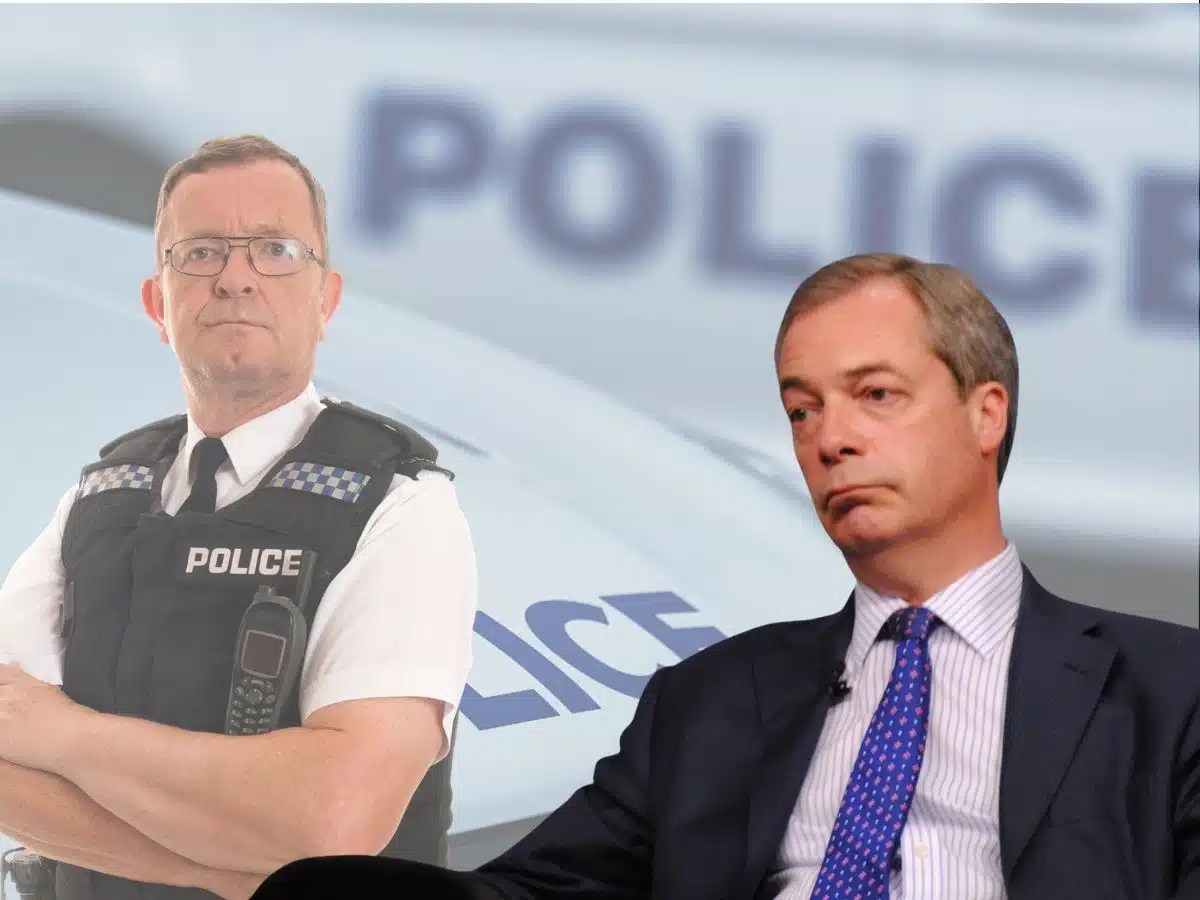
On 9 April, Reform UK announced the winner of their ‘Free Energy Bill’ prize draw. As we noted at the time, it seemed to be an excuse for Reform to make life a little easier for a family who appeared to have it quite easy already:
Giving old wealthy people assistance while the rest of the UK suffers.
Classic Reform. https://t.co/GbbeelYWEb
— Canary (@TheCanaryUK) April 9, 2026
Since then, eagle-eyed investigators have noticed that this particular family have a history with Farage. Oh, and the police are looking into the raffle too. So all in all, things haven’t gone quite as well as they might have done.
Farage loyalists
Firstly, the prize-winning couple do seem to have a documented history of being around Farage. As political commentator Don McGowan noted (with help from the Yorkshire Lass account and Reform Party UK Exposed):
🗼WELL I NEVER🗼
Would you believe that Ray and June, who won the Reform UK energy bills prize, go back all the way to the Brexit Party with Farage?
Here they are with Farage, Widdecombe and Bull [a truly awful supernatural detective thriller].
What a coincidence [increasingly unlikely]
The point McGowan and others are making is that this longstanding history with Farage and his various political vehicles suggests these winners were likely hand picked by the party. In the same post, McGowan showed the following images which picture Ray, June, and Farage at the same event:
🗼WELL I NEVER🗼
Would you believe that Ray and June, who won the Reform UK energy bills prize, go back all the way to the Brexit Party with Farage?
Here they are with Farage, Widdecombe and Bull [a truly awful supernatural detective thriller].
What a coincidence [increasingly… pic.twitter.com/9VgIdB4wjP
— Don McGowan (@donmcgowan) April 10, 2026
McGowan also provided the following timeline:
<-> Ray and June Dibble are photographed at a Brexit Party rally in 2019 with Nigel Farage, Anne Widdecombe and David Bull.
<-> Ray and June nominate local councillor, Lee Moffitt as branch chair for Reform UK, Wigan.
<-> Ray and June win Nigel Farage’s energy bills competition.
<-> Additional info — Farage and Jenrick turn up at Ray and June’s house with a cheque for a VERY SPECIFIC amount of £1,758.
It’s almost as though the entire thing was orchestrated from the beginning.
What a surprise! The staunch Wigan branch members won.
It was pitched as a competition open to the general public in national press.
Reform will FIX it. pic.twitter.com/tXInAVkVes
— Reform Party UK Exposed 🇬🇧 (@reformexposed) April 10, 2026
Look, we’re going to be completely fair here. It seems reasonable to think that the sort of person who enters a Reform giveaway is almost certainly going to be the sort of person who likes and follows Farage. As such, the fact that the couple have been hanging around Nigel for years isn’t a smoking gun, as Reform themselves have argued:
Reform source says many of the party’s 270,000 members entered the competition.
“Is it a shock a member won? No.” https://t.co/ZNOJjihueC
— Kevin Schofield (@KevinASchofield) April 10, 2026
Back to being less nice, Reform have certainly given no reason to believe that they didn’t fix it.
And really, it didn’t take a genius to foresee that the draw would end up looking like a fix, even if they didn’t purposefully orchestrate one.
Of course your members would enter the competition, Nigel.
Of course people would call foul when one of them won.
Of course the inevitable outcry would overshadow any benefits from this little gimmick.
Some called the “competition” a cynical PR stunt.
Others said it was deflection from Farage’s Iran war flip-flop.
A few spotted the data harvesting.
Turns out it was far simpler: just a giveaway to their own Reform party members.
June from Wigan, congrats on ‘winning’!! https://t.co/FKvvpCOqHW pic.twitter.com/XDhCg04Uzl
— Luke Charters MP (@lukejcr) April 10, 2026
And as Mr Ethical noted, the way things have shaken out could in fact be criminal:
Since it would appear that Reform knew the winners of their energy scam, they have almost certainly committed a criminal offence. I don’t suppose anything will happen though. pic.twitter.com/xspFLWXuJj
— Mr Ethical 🚩 (@nw_nicholas) April 10, 2026
This is why political parties don’t usually do giveaways.
That and because they’re not daytime TV game shows.
It’s not surprising that Reform would ape light television, anyway, given that they’ve already stolen Jimmy Saville’s catchphrase.
GMP’s Reform investigation
As reported by the Telegraph, the police are now looking into the raffle. Greater Manchester Police have said:
We have received a report and are currently reviewing the matter.
It’s currently unclear what potential offences the police are looking into. Reform, meanwhile, have said they’re not worried, having previously solicited legal advice.
In all likelihood, nothing will come of the above, because UK electoral law is a joke. Clearly, however, political parties giving out cash prizes is not a sign of functioning democracy.
Featured image via Chatham House (Flickr)

Yet another right-wing, friends-of-Israel paedophile has been convicted — the latest in the seemingly endless production line of Zionist Labour child rapists and abusers. Former Dudley councillor — and “attack dog” for arch-Zionist Luke Akehurst’s ‘Labour First’ pressure group — Adrian Hughes has pleaded guilty to three charges of grooming children for sex.
Hughes, who now lives in Preston, admitted communicating with a 13-year-old girl about meeting her to touch her and “teach her about sex” in May 2025. Also in the same month, he admitted trying to persuade a 13-year-old girl to have sex. Finally, he confessed to sending a picture of himself nude to an even younger girl and asking her to meet and have sex.
During his time as a Dudley councillor, Hughes sat on the council’s Children’s Services Select Committee, the Children and Young Person’s Scrutiny Committee and the Children’s Corporate Parenting Board.
Hughes has locked his X account, but traces of his own support for Israel are still identifiable. In 2023, he described comments from Keir Starmer supporting Israel’s ‘right to defend itself’ by killing Palestinians as “reassuring”.
Broxtowe Alliance councillors and former Labour national executive member Mish Rahman pointed out financial support Hughes received from right-wing, pro-Israel MPs:
Labour Right MPs funded his campaign 👇https://t.co/z1Y8wNuP7A
— Broxtowe Alliance Councillors (@broxtoweindys) April 10, 2026
Spot the Labour First MPs who supported this cretin and used him as an attack dog – I can see three of themhttps://t.co/VCgCVsVaGy
— Mish Rahman (@mish_rahman) April 10, 2026
Two MPs with definite links to Labour First among Hughes’s donors include Gurinder Singh Josan, Akehurst’s right-hand man in Labour First and Russia hawk and “Labour First candidate” Phil Brickell. Also featuring is Josh Newbury, whose Cannock Chase seat is in Labour First’s West Midlands heartland.
The prevalence of paedophiles among the Labour right was not lost on respondents:
this way above the numbers of paedos you’d expect in a random cross section of people
— Diogenes 🇵🇸 (@Northern_cynic2) April 10, 2026
Hughes will be sentenced on 24 April.
Zionist Labour paedos — a long and growing list
Some commenters wondered whether paedophilia is an entry requirement for the pro-Israel Labour right. Not without reason.
Former Hackney councillor and Labour First organiser Thomas Dewey received 150 hours of ‘community service’ for possession of sadistic child rape images. Sam Gould, a former aide to Starmer’s health secretary Wes Streeting, received a suspended sentence for flashing a child and also an adult woman.
Israel fanatic and former Labour councillor Liron Velleman was convicted of sex offences with what he thought was a 13-year-old girl but turned out to be a police officer conducting a paedophile sting. Like many of his child-predator faction, he escaped jail. Some alleged Zionist paedophiles seem to escape consequences altogether. Former government minister Ivor Caplin is no longer even on bail after being caught — on camera — turning up to meet what he thought was a child for sex.
Some are accused but still awaiting trial. Starmeroid MP Dan Norris has been arrested — twice — for sex offences including rape and child-sex offences, including abduction. Former councillor Conor McGrath has been charged with possessing child-rape images after a ten-month police operation.
And the perversion is rife in the genocidal colony they all support, too. Israel is sheltering thousands of paedophiles and refusing extradition requests from their home countries’ police.
Extradition requests
Israeli cyber-spy boss Tom Alexandrovich was allowed to escape to Israel after meetings with US federal agencies. He had been caught in a paedophile sting. Israeli minister Orit Strook, her husband and son were accused by Strook’s daughter Shoshana of repeatedly raping her as a child and filming it. Shoshana Strook was found dead — ‘suicide’ — weeks after warning her followers that if she was found dead it would not be suicide — and days after hiring lawyers. Reports say that Israeli police are not pursuing the case against the family.
Featured image via the Canary
Taking place on Thursday 7 May, the 2026 local elections are fast approaching. If you’re an outsider party looking to do well, this is the moment when you want the maximum momentum. As such, it’s good news for the Green Party that they just hit a brand new milestone:
Victory rally in Margate this evening *and* an announcement!@TheGreenParty now has 225,000 members!
That’s an extra 25,000 since Hannah Spencer won last month and 2000 new members in the last 10 days.
Join the movement!https://t.co/0qbagSvIYp pic.twitter.com/naMXs1NysP
— Zack Polanski (@ZackPolanski) April 10, 2026
Reform, meanwhile, are embroiling themselves in an endless stream of scandals while sliding down the polls.
Mass membership
The Green Party’s membership has skyrocketed since Zack Polanski took over. As James Wright reported for us in October 2025:
Green Party membership has skyrocketed to 115,000 – a jump of 50,000 members since their recent leadership election. Meanwhile, the latest figures show Labour is losing a member around every ten minutes. In other words, they’ve been dropping 152 members a day. With that direction, it’s no wonder Labour is not releasing updated membership figures.
At that point, the party membership had nearly doubled. Since then, it’s almost doubled again. It would be a massive upset if it doubled once more from here, but we can’t rule anything out at this point.
Reform have also built a substantial membership, as the BBC reported in December 2025:
Reform UK claims it is now the largest political party in Britain, following reports Labour has lost more members.
According to the Times newspaper, external, internal figures show Labour’s membership has fallen below 250,000.
Reform said it had more than 268,000 paid-up members, which would mean it has overtaken Labour to become the biggest party by membership in the UK.
Labour refused to comment on the accuracy of the membership figures in the Times, with a spokesperson saying they would be published in the party’s annual report.
If the above figures remain accurate, the Greens could potentially become the largest party in the UK this year. This is especially true if they do well in the local elections, and they subsequently enjoy a post-ballot bounce like what they saw after Hannah Spencer became the MP for Gorton & Denton.
Green Party — On the up
As we reported, the Greens have pulled ahead of Reform in some polls:
‼️BREAKING | Greens surge into LEAD (1st!!)
🟢 Grn: 21.4% (+2.1)
➡️ Ref: 20.9% (-1.4)
🔵 Con: 20.5% (+0.2)
🔴 Lab: 17.0% (-0.4)
🟠 Lib: 9.2% (-1.9)Poll: @LordAPolls, 26-30 Mar (+/- vs 19-23 Feb) pic.twitter.com/oDVw4cDaFC
— Stats for Lefties 🍉🏳️⚧️ (@LeftieStats) April 5, 2026
Lord Ashcroft is far from the most well-respected pollster, but other polls are showing that the Greens have overtaken Labour and the Tories while Reform stagnate:
‼️POLL | Reform lead by 5%
➡️ Ref: 25% (-1)
🟢 Grn: 20% (=)
🔵 Con: 17% (-1)
🔴 Lab: 16% (+1)
🟠 Lib: 11% (+1)— Seats —
➡️ Ref: 331
🟢 Grn: 115
🟠 Lib: 78
🟡 SNP: 48
🔵 Con: 37
🔴 Lab: 11Poll: @findoutnowUK, 8 April (+/- vs 1 April) pic.twitter.com/Ir8NcrnNwM
— Stats for Lefties 🍉🏳️⚧️ (@LeftieStats) April 9, 2026
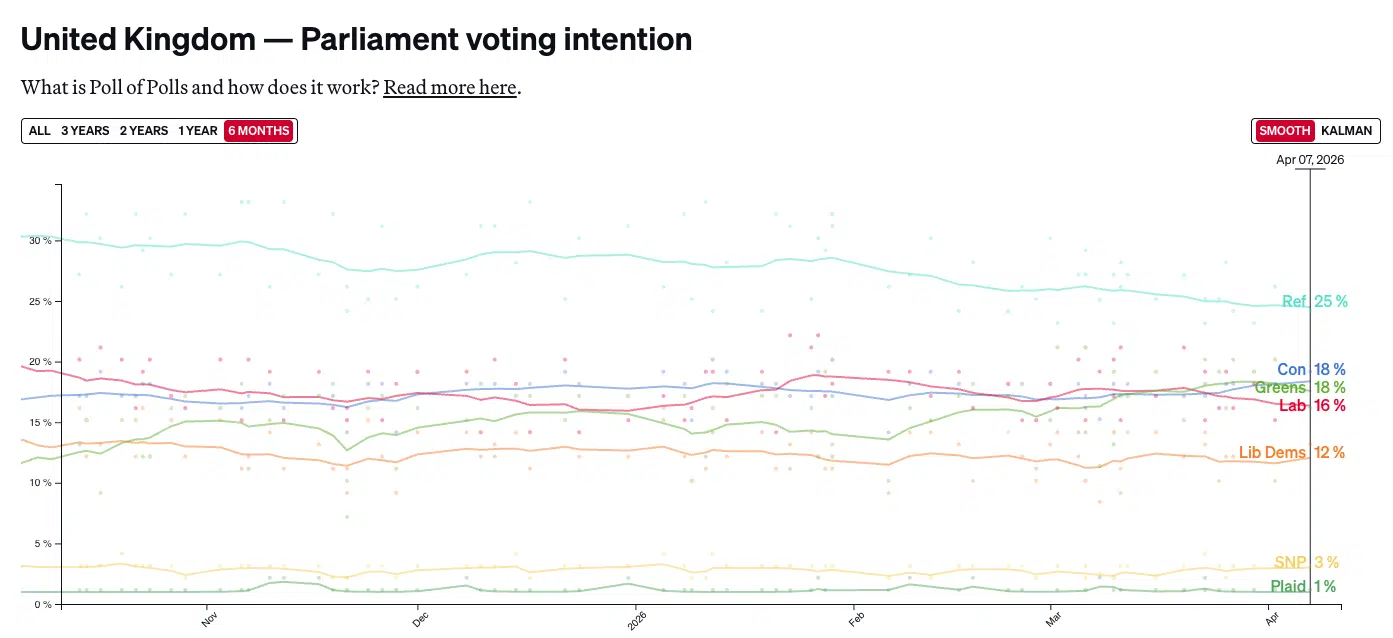
Individual polls might not tell us much, but looking at all the polls over time gives an idea of which way the wind is blowing. On the topic of momentum, Politico’s poll of polls shows that the Greens are on up the up while Reform have squandered their lead (the sort of lead which could have won them a majority):

Results
Regardless of momentum, Reform could still outperform the other parties in the local elections — Green Party included. This is what Elections Etc predicted in March:
‼️NEW | Projected seat change in local elections:
➡️ Ref +2,260
🟢 Grn +450
🟠 Lib +200
🔵 Con -1,010
🔴 Lab -1,900(Source: Stephen Fisher / @ElectionsEtc) pic.twitter.com/pkPixJ3Ont
— Stats for Lefties 🍉🏳️⚧️ (@LeftieStats) March 30, 2026
We do know that polling has often failed to reflect Green support — most notably in the Gorton & Denton by-election, where the party outperformed all expectations (encouraging another 25,000 people to become members).
We could see similar in the local elections, but even if we don’t, the more councils Reform run, the more the endless scandals will increase, because these people are terrible at being in power. This is dreadful for the areas that will suffer, of course, which is why we should all do what we can now to keep Reform out of power.
Featured image via Barold

If you’ve ever left the house only to wonder whether you turned off the stove or unplugged your curling tongs, you’re not alone. However, this uncertainty doesn’t have to be your destiny.
In Japan, railway operators use a simple but powerful technique to avoid mistakes. And this method might be exactly what you need to stay focused on everyday tasks. It’s called “shisa kanko”.
“Shisa kanko essentially means ‘pointing and calling,’ which is used to improve attentiveness and accuracy,” said Joy Gallon, a licensed therapist with Thriveworks. “It was developed as a method of ensuring safety on the Japanese railway system. Operators are trained to focus on and point at an object such as a signal or stopping point and verbally ‘call out’ the name of the object.”
Research by Japan’s Railway Technical Research Institute in 1994 found that the practice of shisa kanko reduced incidents of human error by almost 85%.
“Because the practice uses eyes, hands, mouth and ears, it actively engages the senses,” Gallon said. “Studies have shown that it increases the blood flow to the frontal lobes, which is where our reasoning, logic and ability to see future consequences of current actions lie.”
In other words, it’s a multimodal system for attention and memory.
“The brain has to see something, say something and do something, so we are using our visual system, our motor system and our auditory system,” said therapist Rachael Bloom. “This reduces error because if one ‘system’ fails, there are two backup systems that have the same information.”
This approach is important for high-stakes daily tasks such as operating a train system – as well as smaller, mundane things like using a curling iron.
“Our brains are built for survival, so we spend a lot of time operating based on habit,” said time management coach Anna Dearmon Kornick. “When we take actions based in habit, we expend less cognitive energy, which allows us to preserve energy.”
Daily routine tasks like curling your hair tend to happen in autopilot or default mode, which means you don’t tend to remember them as clearly. That’s why so many people end up with uncertainty around questions like “Did I unplug my curling iron?” or “Did I turn off the stove?”
“Introducing something that is not part of the default mode helps you remember it,” Dearmon Kornick said. “A non-default mode action could be making a weird sound, snapping your fingers, clapping your hands or singing a song, which helps you stay more conscious.”
So while it might feel silly to point and make a sound at once, the shisa kanko method can be incredibly effective by bringing greater awareness to consequential tasks.
“It requires you to make two or more physical ‘checks’ or confirmations of your actions,” said Rashelle Isip, a productivity coach at The Order Expert. “These checks shift your thoughts into the realm of physical action, which requires more effort. This might mean pointing, picking up an item or speaking aloud.”

In addition to improving safety in different industries, shisa kanko can help with personal focus or error prevention.
“I’ve used aspects of this method to help me improve my focus or anchor myself during the day while performing everyday tasks like making phone calls, exercising or getting ready for the day,” Isip said.
It’s another way to engage in mindfulness overall.
“When we are present, or mindful, we notice our surroundings better, are able to see the potential for error and course correct,” Gallon said. “Shisa kanko involves literally pointing at the object and naming it, which essentially grounds us in that moment.”
This method may be especially helpful for people with ADHD
A method like shisa kanko could be particularly helpful for people with ADHD or other forms of neurodivergence that impact focus and memory.
“When the ADHD brain finds stimulation, it also finds regulation,” said Billy Roberts, a therapist at Focused Mind ADHD Counselling. “By engaging multiple senses, the ADHD brain can become more engaged in that behaviour. Think of it as a form of active listening. If a person with ADHD repeats what was just said, the words will be encoded better due to repetition.”
Terry Matlen, a psychotherapist and ADHD consultant, noted that some of her clients with ADHD sing a short verse of a song to help them remember certain things. For example, they might take the tune of “London Bridge Is Falling Down” and sing “Need to turn the oven off, oven off, oven off ….”
“Executive function is impaired to some degree in everyone with ADHD – planning, organising, initiating, memory,” Matlen said. “So simply thinking to yourself, ‘I need to remember to turn off the stove after I finish cooking,’ just might not be enough.”
“I often talk out loud when needing to remember something – i.e., ‘call back Susan, call back Susan,’” she added. ”You can add another modality to saying things out loud, like tapping your wrist while saying it. Or in the case of traditional shisa kanko, pointing and verbalising.”
The experts who spoke to HuffPost agreed that shisa kanko helps people with ADHD by increasing conscious attention. Some noted that dopamine may play a supporting role as well, though more research is needed to fully explore that.
“Vocal stimming – like humming or singing – can increase dopamine and enhance focus for some people with ADHD,” Roberts said. “Humming and singing can be grounding when a person feels overwhelmed or anxious.”
Experts emphasised that it’s not just about making noise but what that action represents or accomplishes – for example, self-soothing.
“Self-stimulatory behaviours, including vocal stims, can release dopamine because they work with the part of the brain that deals with reward – but not simply because someone is ‘making a sound,’” Bloom noted.
In this sense, making a particular vocal expression is more about calming down your nervous system, self-regulating, self-motivating or breaking out of boredom. But a dopamine release related to shisa kanko might also simply be associated with accomplishing a task.
“Every time we knock even something small off our to-do list, we get a hit of dopamine and feel really good,” Dearmon Kornick said. “So if you decide to make a weird noise as you unplug your straightener, you might get the dopamine release of ‘Woo! I did what I said I was going to do.’”
There are many ways to incorporate shisa kanko into everyday life
There are ways to incorporate the method or even the spirit of shisa kanko into your everyday life.
“Try using this technique to reinforce the importance of information or actions in your daily routine,” Isip suggested. “Maybe you don’t want to forget your glasses before you leave for work or you don’t want to ignore an important letter on your desk. That might mean speaking aloud, picking up an object, handwriting a note, snapping your fingers or adding a reminder to a notetaking app.”
You can experiment with different approaches and find which ones work for you.
“Someone with ADHD could apply this to virtually everything they frequently forget to do – taking medication, packing what they need for the day, remembering daily tasks,” Bloom said.
“People with ADHD are most likely to forget or make mistakes on tasks that are repetitive, mundane and non-urgent, so using strategies that disrupt autopilot to ensure accuracy with this type of task makes a lot of sense.”
It can be as simple as pointing at your door handle and saying, “I’ve locked the door,” or at the light switch and saying, “I’ve turned off the lights,” as you leave the house. Or maybe you point at your keys and wallet and say “keys” and “wallet” to remember to bring them with you.
“Another option is to use it whenever you’re feeling overwhelmed, frustrated or stressed,” Isip said. “You probably already use some form of this technique in your daily life to help you refocus your attention and balance your thoughts. That might look like saying aloud, ‘Take a deep breath and relax,’ ‘You’ve got this!,’ ‘Time to get back on track,’ ‘OK, where were we?’ or ‘Let’s take it from the top.’”
Bringing mindfulness to these moments helps you regain a sense of calm, focus and agency.
“Use a meditation involving noticing and naming objects in the environment around you, combined with a reinforcing phrase and/or gesture to help manage negative thoughts and improve concentration,” Gallon said.
She noted that many therapists recommend a grounding strategy that guides you to name five things you can see, four things you can touch, three things you can hear, two things you can smell and one thing you can hear.
“Shisa kanko has been touted as a ‘habit hack’ for fighting bad habits such as doomscrolling, which we know can be very detrimental to a person’s mental health,” Gallon added.
Of course, it takes practice and time to successfully implement any strategy to the fullest. So be patient as you explore this method.
“You can make use of elements of shisa kanko in everyday life by using it to confirm, reinforce or anchor either a habit, information or skill,” Isip said. “Try using it when starting or ending your workday, transitioning between tasks, confirming appointment details, paying for goods and services or even motivating yourself to act.”
She suggested saying phrases aloud along the lines of “Time to get to work,” “The appointment is April 16th at 10 AM” or “Let’s have a good workout session!”
Shisa kanko can be useful for avoidance-ridden behaviours, Matlen noted. People with ADHD in particular tend to struggle to start a task, stay on task and/or finish the task.
“An adult with ADHD who is facing an unpleasant task causing them angst and anxiety – say, de-cluttering their desk at work – might point to one piece of paper falling off a pile of reports and say aloud, ‘I’m going to put that page into that folder in that file cabinet.’ Then continue from there, perhaps setting a timer for 15 minutes,” she explained.
Thus, the system can help alleviate procrastination, avoidance and stress. Make sure to change things up periodically, however.
“If you start singing the same song or doing the same snaps or making the same weird sound every time, eventually that sound is going to become a part of the default experience, and you’re not going to remember if you made the sound because you always do,” Dearmon Kornick warned.
Ultimately, shisa kanko is a dynamic approach. The method might not be right for you, but it doesn’t hurt to try it out.
“Every ADHD brain is different,” Roberts noted. “What works for some might not work for others. It is critical to understand that if a skill works, keep it. But if a skill doesn’t work, then maybe you and that skill aren’t a good fit. It’s fine to leave it be and find another!”

Actor Aubrey Plaza is expecting a baby with her partner, actor Christopher Abbott, according to her representative.
But instead of sharing congratulations, many people on social media are responding with judgment about how soon Plaza should be moving forward as a grieving widow. In 2025, Plaza’s husband, Jeff Baena, died by suicide.
“She should’ve at least waited a few years,” one popular X post reads, while another commenter remarked that having a new partner one year after your previous partner dies “seems a little weird.”
This backlash is all too common. There is still an outdated idea that widows should have a long, formal mourning period, even though there is no single correct or certain timeline about how a grieving person should date or find love again.
“Society thinks you shouldn’t do anything for a year. You’re supposed to mourn a full season of cycles,” grief counsellor Jill Cohen told HuffPost. “What’s important to remember is that we never know what’s behind the story” of why people do or don’t want to have sex and find love again after loss, she said.
Anita Coyle, a widow and co-host of the Widow We Do Now? podcast, said young widows are especially damned if they date, damned if they don’t.
“People want to make it a litmus about the kind of relationship you had with your late partner. If you date too early, then it must mean that you didn’t love them. And then if you don’t date soon enough, then you’re ‘stuck’ in your grief,” Coyle said. “No matter what you do, people who aren’t in your situation are going to judge you.”
Coyle knows this firsthand. Coyle’s husband died in 2019, and she has not dated since. Coyle said she got the opposite reaction from what Plaza is experiencing, such as questions like “Are you stuck? Are you not moving on?”
In response to judgment, “I think a lot of widows probably just want to yell at the people, like, ‘It’s none of your business,’” Coyle said.

Dia Dipasupil via Getty Images
PSA: How Widows Move Forward Is Not Up To Us
How one’s partner dies also adds to the kind of judgment the surviving partner faces going forward.
Plaza and Baena had been separated for four months before Baena died by suicide, according to a report from the Los Angeles County medical examiner.
Elishia Durrett Johnson, a widow and licensed clinical counselor who specializes in grief, said people whose partners die a stigmatized death like suicide face unfair judgment about how they should move forward because their partner’s death is “not considered natural.”
“Anytime during that, I extend grace and I implore others to be quiet,” Durrett Johnson said. “You don’t know what life is going to afford you later. The very thing that you’re complaining or criticizing one person about, you have no idea how you would handle that.”
People policing other people’s grief “is the awfulness” of mourning, she added: “That’s the thing that we should not do.”
Widows also face more stigma than widowers for dating and repartnering after their partner dies. “Men get a little bit more leeway in moving forward quickly,” Coyle said. People give men more grace if they find a new partner soon after their loss because they believe “he needs a wife,” Cohen said.
But the truth is, grief is hard on everyone. “We normalize men moving forward with other women,” Durrett Johnson said. But for both widows and widowers, “it is just as hard as finding your forward.”
That’s why widows say the best answer to hearing about a grieving person falling in love again is to congratulate them. In Plaza’s case, “she’s experienced this horrendous thing in her life, and she deserves to have a next chapter that makes her happy, and whatever that looks like for her and for everybody is up to them to determine,” Coyle said.
Plaza has shared that the “awfulness” of her grief over Baena is “always there.”
“There’s, like, a giant ocean of just awfulness that’s like right there, and I can, like, see it,” she said on former co-star Amy Poehler’s Good Hang podcast last August. “Sometimes, I just want to just dive into it and just, like, be in it. And then sometimes, I just look at it, and then sometimes, I just try to get away from it. But it’s always there.”
Durett Johnson said Plaza’s metaphor of an ocean of awfulness is apt and is why it’s remarkable when grieving widows and widowers find new love.
“If you find someone that is going to help you in that move forward, that understands that awful ocean that you’re dealing with, that’s powerful,” Durrett Johnson said about why she congratulates Plaza on finding a partner again. “That’s just as rare as finding the love of your life.”

Are you hydrating enough?
There are now so many ways to get and track your fluids – from customisable Stanley tumblers to in-home IV services to apps that remind you to chug a few extra ounces every hour – that it’s easy to worry you’re not getting enough.
But is it possible to be too hydrated? And what happens if you are?
That’s what Raj Punjabi and Noah Michelson, hosts of HuffPost’s Am I Doing It Wrong? podcast, asked Colleen Muñoz, director and co-founder of Hydration Health Center at the University of Hartford.
“[Drinking too much water] is a real thing,” Muñoz, who is also an associate professor of health sciences at University of Hartford, said. “[It doesn’t happen] as often as you would think, relative to somebody who is underhydrated – that’s definitely a more common scenario – but it’s something we need to pay attention to.”
The main issue with ingesting too much water or other fluids is that it can dilute the electrolyte content of our blood. Electrolytes (in this case we’re mostly talking about sodium, but also potassium, magnesium, chloride and calcium) must remain “in balance in order to maintain healthy blood, heart rhythm, muscle function and other important functions.”
When these electrolytes “get out of whack,” it can cause nausea, vomiting, headaches, muscle cramps and even death.
“If they get too dilute, we start to have some pretty severe ramifications, largely related to our nervous system … [including] brain swelling, coma, [and then] death … and pretty quick,” Muñoz warned.
This happened to a woman in Los Angeles in 2007.
“It was pretty soon after the first Nintendo Wii came out and one of the radio stations had some competition – I think it was called like ‘Pee for a Wii’ or ‘Wee for a Wii’ – and unfortunately they didn’t consult anybody before they did this,” Muñoz said. “Whoever could drink the most amount of water in one day won the Nintendo Wii and a woman died.”
However, Muñoz noted that overhydration is less common in the general population and typically more worrisome for athletes.
“[It’s happened to some athletes and] it’s scary. It happens quickly and it’s not always easily detectable. So, a lot of times, unfortunately, they keep drinking water thinking that they collapsed due to dehydration,” she said.
It’s also a risk for recreational exercisers, like marathon or triathlon participants.
“[These people] might not actually be working out as intensely as they might suspect, and they haven’t really done a lot of homework into an individualised hydration plan, so they just assume, like, the more water the better,” Muñoz said.
“They’re actually not sweating that much, you know, or they’re not losing as much salt as they think, so they start chugging water and that’s a lot of times when this happens, unfortunately.”
So how much should we be drinking to reach a hydration sweet spot?
Muñoz said that most people need between 2 and 4 litres of water a day depending on body size, activity level, and other personal factors, like how much someone sweats, but checking in with your doctor or a medical professional about your specific needs is always a good idea.
She also noted that it’s possible to achieve proper hydration by drinking fluids other than plain water – including coffee, tea, sports drinks, juice and seltzer – and through the foods we eat.
One good way to tell if you’re properly hydrated is easy and free: take a look at the colour of your urine.
“I’m not saying that that’s a perfect marker, but it’s a very easily accessible one and it actually gives us a lot of good information,” Muñoz said. “We’re normally looking for, like, a light yellow colour – like lemonade or a straw kind of colour.”
Despite what you might think, completely clear urine is not necessarily a good thing because it can mean you’re overhydrated.
“That’s one of those things that I still have a lot of people tell me,” she said. “People who are well educated in biology will tell me, like, ‘My urine was clear today, so that’s good, right?’ I’m like, ‘No, no, no, no, no.’ You know, there is such a thing as drinking too much water.”
For lots more hydration tips and tricks, listen to the full episode here or wherever you get your podcasts.
Have a question or need some help with something you’ve been doing wrong? Email us at AmIDoingItWrong@HuffPost.com, and we might investigate the topic in an upcoming episode.
9 min read
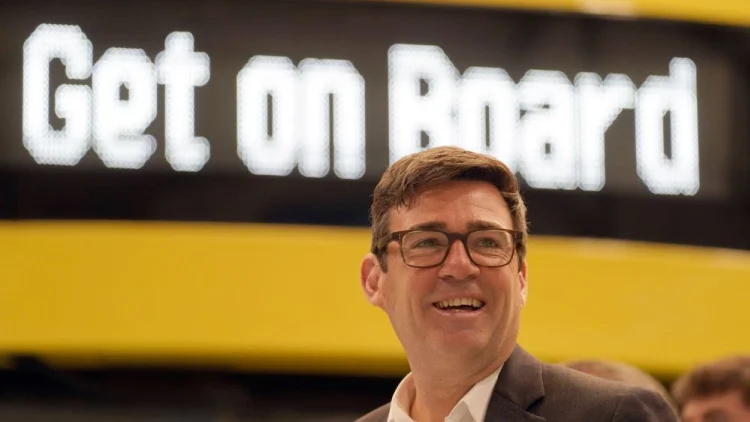
Andy Burnham remains a likely candidate to replace Keir Starmer if the Prime Minister leaves office before the next election. Tom Scotson goes in search of the people, ideas and forces shaping what would be his third leadership campaign
Last October, Andy Burnham was a badly damaged figure. A series of high-profile interventions in the run-up to and during Labour’s conference – widely interpreted as a soft coup – had misfired.
Keir Starmer’s allies mocked the so-called ‘King of the North’ as a presumptuous, vainglorious blowhard, a risk to the UK’s financial credibility and a political dead-end for Labour.
At this low point, an old friend offered some comradely advice to the Greater Manchester mayor. “Remember what Lenin said in 1917 as he waited for a train in Switzerland,” David Blunkett recalls telling Burnham. “Timing is everything in politics.”
The timing – six months on – looks rather different. Labour is braced for heavy losses in elections in Scotland, Wales and England’s local councils. And while the Iran conflict is dampening speculation around Starmer for the moment, it is likely to reignite soon enough.
And while Angela Rayner has ensured she remains part of that conversation in recent weeks, many MPs believe that only one figure can save them. As one ally puts it, “It’s Andy Burnham or bust.”
Supporters believe he continues to hone his strengths (communication), jettison past mistakes (support for the Iraq war), and is building a coherent political philosophy (Manchesterism).
Quitting Westminster for the mayoralty is cited as the best move Burnham made to rebuild his profile. It is now, ironically, a major obstacle between him and the job of prime minister.
Ahead of the Gorton and Denton by-election, Burnham put his hat in the ring to stand as a candidate but was rejected by the party’s National Executive Committee (NEC) officers by eight votes to one, with only deputy leader Lucy Powell on side. The House understands that, despite boldly resolving to apply to stand, Burnham made little to no effort ahead of the vote to lobby any of the NEC officers who declined to back him.
Polling by Britain Elects suggests Burnham would have won the parliamentary seat comfortably.
Insiders working on the campaign say internal figures were even more positive, with one believing he would win with almost 60 per cent of the vote, as voters saw him as the obvious ‘Stop Reform’ candidate.
It is a thesis now safe from contact with reality. But Gorton is unlikely to be the last Labour-held seat to become free this Parliament.
To find out whether the twice-failed leadership hopeful has what it takes to return and topple a sitting Prime Minister, The House spoke to a wide range of Labour sources, Burnham allies and close friends.
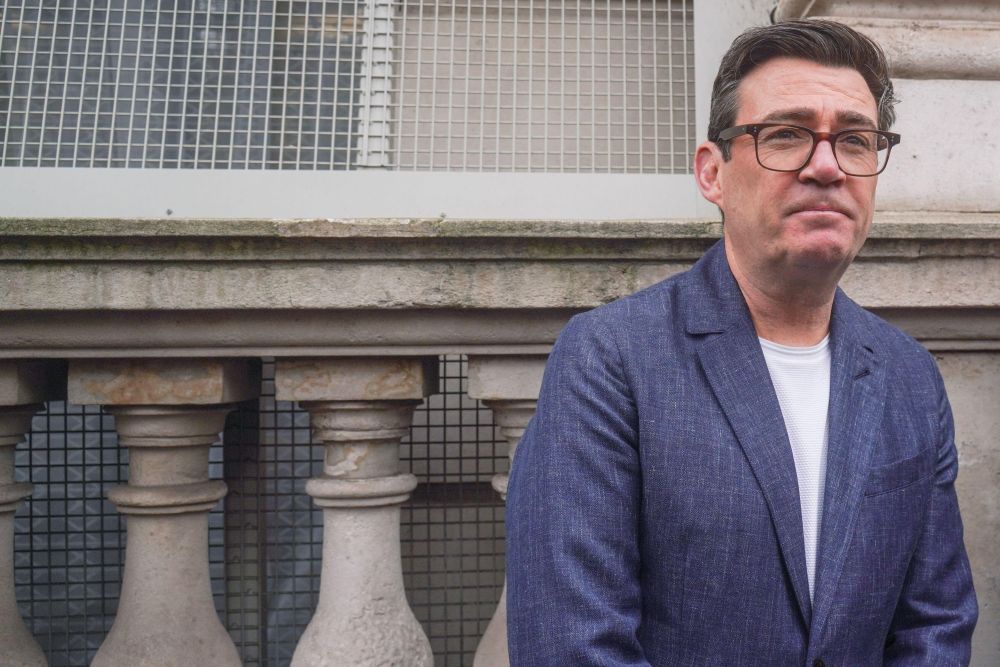 Burnham, a local journalist for a short while, sees policy through the lens of how it will land in the press. “It is all media,” says a senior former aide, who helped run one of his failed leadership campaigns.
They added: “He was always very good at ‘the story’: where can I go, or what can I go and do, so that I get noticed?”
Burnham read English literature at the University of Cambridge after devouring the collective works of Philip Larkin and Shakespeare. Despite this, his friends are unsure if he continues to read for pleasure anymore.
“I can’t see Andy reading Jane Austen,” says a long-standing ally and Labour MP. “It would be interesting to know why he did English. Usually, lads would do history or PPE at Oxford. Maybe it would be the Morrissey type thing, the Oscar Wilde’s, that more romantic side of things.”
A minister adds dryly: “He travels lightly: both intellectually and politically.”
Nonetheless, he has a deep love for romantic poetry and Irish history. Steve Rotheram, Burnham’s best friend in politics, recalls the Manchester mayor chatting away with Michael D Higgins – the former Irish President and poet – about poets and ancient philosophers.
Burnham is a Roman Catholic. His Irish ancestry has been researched by Liverpool Central Library. “He does feel firmly attached,” says Rotheram of his Irish genealogy, “but he’s also one of those people who… is very patriotic as well.
“Andy’s always nailed his colours firmly to the mast. I think he’s a royalist, he loves the country.”
Burnham begins his mornings running regularly while listening to music on a predictably ‘Madchester’ playlist featuring The Stone Roses – his favourite band – as well as Joy Division, Oasis and New Order.
He works on his box over breakfast while preparing for a full day of meetings and events, which stretch into the afternoon and evening. Accompanied by his political aide Kevin Lee, Burnham drives around Greater Manchester in a run-down Volkswagen usually littered with disposable coffee cups.
You won’t find many of these speeches published because most of them are written and delivered from a set of notes that he’s made – they are his thoughts
Working late makes family life more difficult, but friends say he and his Dutch wife Marie-France van Heel remain close. The couple, who first met at university, live with their children and dog Axel in Leigh. Even at home, however, Burnham is said to chase colleagues and advisers over the weekend with questions arising from new academic reports and what he is reading in the papers. This is in contrast to the disengaged attitude the Prime Minister is accused of adopting.
Burnham has long traded on being a lifelong Evertonian. “You’d always see him in animated conversation with the doorkeepers, and then when you eavesdropped, it was always about football,” says an MP. He had a season ticket at Goodison Park in the Gwladys Street end and renewed his ticket when the club moved to the Hill Dickinson stadium at the start of the season.
The mayor of Manchester is also a real ale enthusiast. Another MP friend reports that, although “not a piss artist”, Burnham does enjoy a drink: “You could see him drink eight or 10 pints without appearing to be pissed.”
Outside of his day-to-day schedule, his inner circle, like all metro mayors, remains small. Lee, Burnham’s political secretary, is a Manchester United season ticket holder who has been working for him for 16 years.
Amy Davies now runs his office and his diary. Kate Green, Greater Manchester’s deputy mayor for policing and crime, is also a close associate of Burnham’s, having left Parliament in 2022 to join ‘Team Andy’.
The list of those in Burnham’s orbit but outside the inner circle makes for more interesting reading. It includes around 14 experts working on policy to flesh out his own political offer.
A close confidant of his remains Neal Lawson, director of centre-left pressure group Compass, who continues to introduce the Manchester mayor to more left-wing voices. Lawson and Burnham first met playing for the Labour football team Demon Eyes; the Compass director was goalie, Burnham up front.
Other influential voices close to Team Andy include Mathew Lawrence of Common Wealth, Zoë Billingham from IPPR North and Andrew Carter, CEO of Centre for Cities.
Lawrence has recently been tasked, alongside the Mainstream group, with fleshing out Manchesterism. His phrase “the Privatisation Premium” was used in a recent speech of Burnham’s – which the mayor continues to write himself, often in bullet point form.
“You won’t find many of these speeches published because most of them are written and delivered from a set of notes that he’s made – they are his thoughts,” Lawson says.
Lawrence is in the middle of writing a separate upcoming paper, which will flesh out Manchesterism in more detail. It will attempt to connect the affordability crisis and related pressure on public spending to the structural retreat of investment in energy, housing and water.
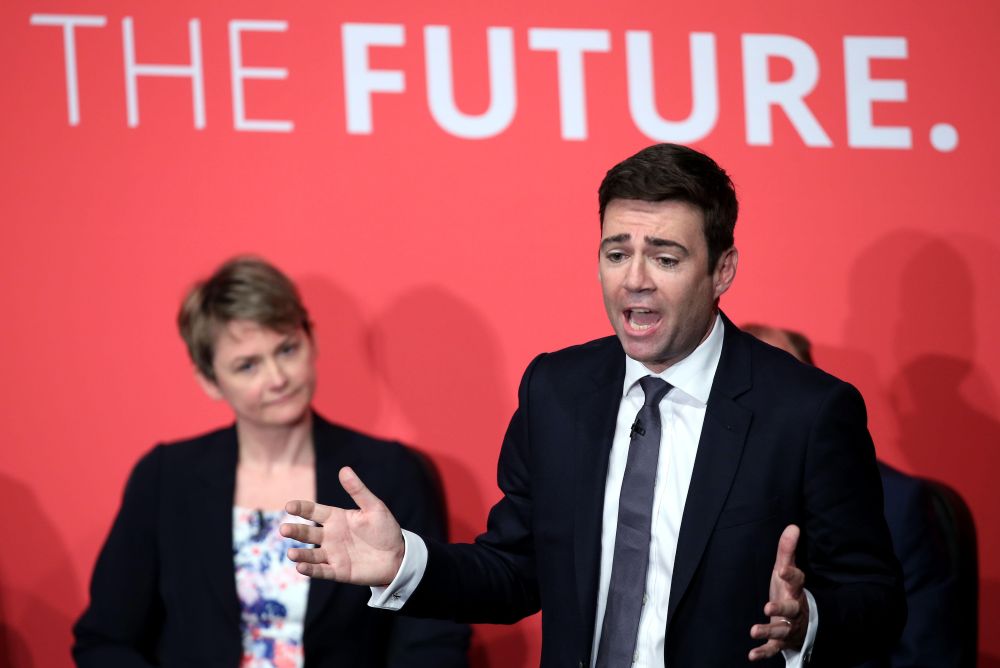
A sympathetic minister tells The House: “What we are building is a movement, so it doesn’t matter about the individual, it’s who can drive it.”
Aides of Burnham say civil servants attend his events and snoop at his press conferences as he critiques Whitehall and lays the foundations of his political position.
Critics of Manchesterism – which, paradoxically, were once associated with free trade and laissez-faire economics – believe it lacks any meaning apart from nationalisation.
His supporters contend that the framework is meaningful while reflecting his pragmatism and keen eye for the most useful political fights. Capping bus fares across Greater Manchester to £2 is a perfect example, they say, as it brings in a visible change to the daily lives of so many.
“‘Transport is number one, transport is key,’ he would say as the gamechanger for Greater Manchester,” another former long-serving aide of Burnham tells The House.
He surrounded himself with a bunch of yes people, which is a challenge in itself
But there are long-running criticisms of Burnham, including from allies. The most notable is his tendency to be indecisive at key moments. Former colleagues point to his failed leadership campaigns as evidence.
During the 2010 leadership race, Burnham’s campaign was split over whether to take money from Unite, then run by Len McCluskey. One person who was working on Burnham’s campaign recalls: “We had a very, very polite but nonetheless heated discussion. He believed the right-wing press during the leadership camp would assert the fact that they’re in the pocket of [Unite]. My contention was I couldn’t give a monkey’s – the membership of the Labour Party [is] what matters.”
In the run-up to the 2015 leadership election, there was still considerable discontent despite being a leading contender.
“He surrounded himself with a bunch of yes people, which is a challenge in itself,” one former aide tells The House. A crucial downfall of the campaign was when he could not decide whether to rebel after the then-acting leader Harriet Harman urged colleagues to abstain on a controversial welfare bill.
Jeremy Corbyn was one of the 48 rebels who voted against the bill, which is commonly thought to be a major factor in his subsequent victory. The former aide says: “Classic Andy, he found a reasoned amendment which didn’t mean anything to anyone, while Corbyn was explicitly against it.”
Allies acknowledge he has made mistakes yet believe he is now more comfortable in his own skin.
“He doesn’t have to think about slicing and dicing for particular audiences in particular ways,” Lawson says. “I don’t think it’s enormously calculated. I think it’s quite authentic and quite genuine.”
Nonetheless, Burnham still faces one problem which could be insurmountable: returning to Westminster.
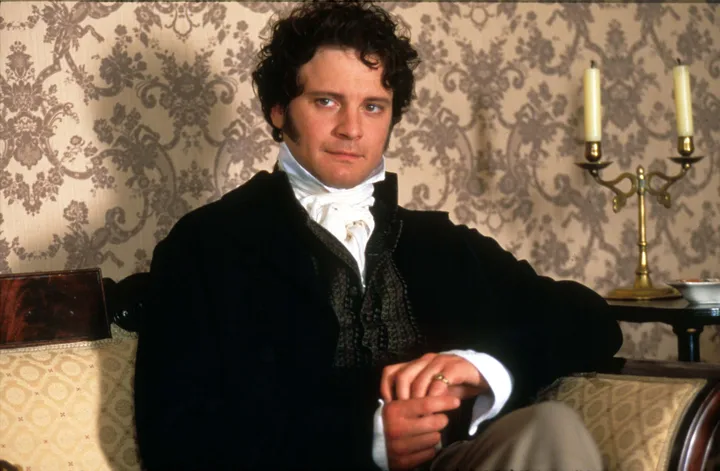
It’s time to dust off your biggest and comfiest pants, cook up some blue soup and warm up your pipes for a Céline Dion sing-a-long because a very special anniversary is just around the corner.
This month marks 25 years since Bridget Jones made her big screen debut, diary in hand, introducing the world to one of 21st century British cinema’s most iconic and beloved characters.
Bridget Jones’s Diary has gone on to become one of the most enduring and game-changing romantic comedies of its time, going on to gross hundreds of millions of dollars at the box office, spawn three sequels and even earn its leading lady Renée Zellweger her first Oscar nominations (she’s since gone on to win two, as it goes).
A quarter-century later, you might think you know Bridget inside and out (and love her “just as she is”), but we bet there’s still plenty about the enduring movie classic that you still don’t know.
To commemorate its 25th anniversary, here are 25 behind-the-scenes facts you probably never knew about how Bridget Jones’s Diary was made…
Alright, we’re starting with a pretty obvious one here, but for those who didn’t know, both the original novel Bridget Jones’s Diary and the movie were inspired by Jane Austen’s Pride And Prejudice
Bridget Jones creator Helen Fielding said back in 2001: “Jane Austen’s plots are very good and have been market researched over a number of centuries so I decided simply to steal one of them.”
“I thought she wouldn’t mind,” Helen quipped. “And anyway, she’s dead.”
Because of the book’s ties to Pride And Prejudice, the Bridget Jones team were always adamant that Mark Darcy should be played by Colin Firth, who previously appeared in the BBC’s much-loved adaptation of the Jane Austen book
“Colin always had to be Mark Darcy,” producer Eric Fellner put it around the film’s release. “As the story unfolds, and the audience comes to understand Mark Darcy, he transforms from a seemingly snobby and cold intellectual into a thoughtful and sensitive man.”

There is another Pride & Prejudice reference hidden in Bridget Jones’s Diary that we’re only clocking now 25 years later
The publishing house where Bridget Jones works is called Pemberley Press, a subtle nod to Mr Darcy’s estate in the Austen classic.
When Bridget walks in on the woman that Daniel Cleaver has been cheating on her with, she’s covering herself with a Pemberley Press portfolio, sporting an image of a stately home not unlike Darcy’s.

When it came to casting the role of Bridget Jones, Renée Zellweger wasn’t actually the first choice
In fact, the role first went to Toni Collette, who turned it down because she was appearing in a Broadway play at the time filming was due to get underway.
She told Watch What Happens Live in 2023: “I have no regrets – life happens as it’s meant to.”
The casting process apparently took around two years before producers found their Bridget in Renée Zellweger.
Of course, the decision to cast an American actor as such an iconic Londoner wasn’t exactly met with unanimous praise, but Renée pulled it out of the bag and won over her detractors in the end.

To help perfect her British twang to play Bridget Jones, Renée Zellweger worked with the famous dialect coach Barbara Berkery
Right before Renée worked with Barbar Berkery, the dialect coach had helped Gwyneth Paltrow on her way to winning an Oscar for Shakespeare In Love.
Before that, she’d also coached Gwynnie while she was playing a Londoner in the 90s classic Sliding Doors.
It’s fair to say that Hugh Grant wasn’t initially convinced by Renée Zellweger’s Bridget Jones accent…
“She came in, doing quite a good British accent, but it was Princess Margaret,” Hugh recalled in the 2020 documentary Becoming Bridget Jones. “That was a little startling.”
After the suggestion that she “loosen it up a bit”, Hugh claimed that Renée’s next attempt was more “Princess Margaret having a stroke – but a week later, it was bang on”.

Alex Bailey/Miramax/Universal/Kobal/Shutterstock
To help retain her accent, Renée Zellweger continued speaking in Bridget Jones’ voice even between takes
Sally Phillips once told Lorraine: “I’d made quite good friends with her during the filming [but] I realised towards the end, when she suddenly lost a stone in the last week, and started talking in a Texan accent at the wrap party, I’d made friends with Bridget, not Renée.”
It’s well-documented that Renée Zellweger intentionally gained weight to help her play Bridget Jones, which she did by increasing her food intake and not exercising
For the second Bridget Jones film, Renée opted for prosthetics rather than gaining the weight back, and by the third and fourth films, it was decided that the actor and her on-screen counterpart should be the same size.
As well as her accent and weight gain, Renée Zellweger also got into the Bridget Jones mindset by working a brief internship at a publishing house

Paul Chedlow/Miramax/Universal/Kobal/Shutterstock
“A young work experience woman came into the office and introduced herself as Bridget and we were all a bit bemused by the fact that Bridget seemed to have really nice clothes (not smart, just a lot better than our outfits) and a transatlantic accent,” Mary Mount – who was working as an editorial assistant at Picador at the time – recalled last year. “I thought she looked vaguely familiar but in that way that you can’t really place.”
One of the future Oscar winner’s tasks was cutting out any press clippings about Picardo at the time.
Unfortunately, the big story surrounding Picador at the time was the fact that a Bridget Jones movie was in the works, meaning “her job was literally to cut out nasty articles about herself”.
“She kept her cool,” said Camilla Elworthy, who oversaw Renée during her work experience. “But [she] did scribble ‘rubbish’ in the margins of one piece.”
As for the rest of the Bridget Jones’s Diary cast, Hugh Grant actually turned down the part of Daniel Cleaver on several occasions

Miramax/Universal/Kobal/Shutterstock
“The only reason for that was because I didn’t feel they had the script quite right for a long time,” he admitted in the lead-up to its release. “And I kept saying, it’s not working. Just get Richard Curtis to come in and help rewrite it.”
Hugh had already worked with Richard Curtis on Four Weddings And A Funeral and Notting Hill, with the two later reuniting on Love Actually and the second Bridget Jones movie.
“As soon as Richard came on board, I signed on the dotted line,” the Bafta winner added. “So, that’s all it was.”
Bridget Jones’s Diary was filmmaker Sharon Maguire’s feature-length directing debut, although she did already have a connection to the source material
Sharon was close friends with Helen Fielding, and was heavily rumoured to be have been the inspiration for “Shazzer”, the character played on screen by Sally Phillips.
“I’m delighted to be in the book, especially as Shazzer is so much wittier than me,” Sharon once told The Telegraph. “The only thing is that you go to parties and you worry that people will expect you to be funnier than you really are.”
“Helen was just writing about our lives – hilariously,” she later told the LA Times in 2016, adding: “Thirtysomethings had come out of long relationships in their 20s and realised they hadn’t ended up married or with children. We were in our 30s, behaving like we were 17-year-olds and having a great time but still floundering around asking questions about relationships, careers, biological clocks.”

Miramax/Universal/Kobal/Shutterstock
Salman Rushdie’s Bridget Jones’s Diary cameo came about he, too, was a friend of Helen Fielding
“For me, it was very simple,” he told Texas Monthly in 2001. “Helen Fielding, the author of the book, is an old pal of mine, and she asked if I’d come along and make a fool of myself, and I said, ‘Why not?’.”
As for sharing the screen with the movie’s leading lady, the author added: “Renée was wonderful, I thought, and at the premiere we had a little joke. I told her that my performance is what held the film together – and she agreed. She thought it was a pivotal role.”
The exterior of Bridget Jones’ flat was a pub just off Borough market
The Globe Tavern, to be exact, which was already notable as it’s rumoured to be the location where the Great Train Robbery of 1963 was planned.
All those wintery scenes at Bridget Jones’ parents’ home were actually shot at the height of summer
Because of this, several locations in Snowshill, Worcestershire had to be covered in fake snow to make the setting more believable.

Miramax/Universal/Kobal/Shutterstock
As a result – Colin Firth didn’t exactly have the best time filming in his infamous Bridget Jones reindeer jumper…
Colin told Entertainment Weekly in 2020: “The set was lit at about 140 degrees Fahrenheit; it melted candles and desiccated the turkey curry. I almost tore the jumper to pieces pulling it off between takes – I probably lost about 15 pounds. I had little love for it by the end.”
…not that it actually is a reindeer, mind you
“We sent out the knitting challenge to approximately 20 or 30 knitters,” Sharon Morgan also told Entertainment Weekly for the same piece. “At first, none of the designs worked. They were lovely, but they just weren’t funny. So eventually we decided it had to be a moose, not a reindeer.”
“I never noticed it was a moose,” Colin added.

Daniel Cleaver and Mark Darcy’s fight sequence is one of Bridget Jones’s Diary’s stand-out scenes – but it could have looked very different
“There had been an earlier idea to make the fight look sexy,” Colin told the LA Times. “We were going to be buff and our shirts were going to be ripped off.
“I looked at myself and said, ‘You’re certainly never going to get that type with me’.”
Colin Firth and Hugh Grant decided between them to keep their Bridget Jones fight a little more… well… British

Alex Bailey/Miramax/Universal/Kobal/Shutterstock
“We both realised that the last time we fought was when we were 10. A playground fight,” Colin quipped. “So, we made a decision largely based on logic and common sense to make it more playful.”
He pointed out the characters are “two very ineffectual, frightened, angry yuppies going at each other – pulling hair and wanting to run away at the same time”, which needed to come across on screen.
During a video interview with Vanity Fair, Hugh later claimed: “The big fight was to stop stuntmen getting involved. They always want to come in and choreograph the whole thing and say, ‘mate, it’d be great if you swing a right hook and his head’ll go back’.
“I just thought, ‘yeah, in action films, cowboy films, whatever, that’s great, but these are two middle-class Englishmen, and they don’t fight like that’. I’ve seen them fight, and it’s shit.
“So, we managed to ban the stuntman. I think the last thing he contributed was probably the dustbin lid, and after that, it’s just me and Colin messing about.”
Stuntmen were used for one crucial part of the fight, though
That’d be the bit where Mark and Daniel fly through the front window of a Greek restaurant, which they thought they’d better leave to the pros.
By contrast, Bridget Jones’ infamous fireman’s pole scene was meticulously planned to ensure Renée Zellweger’s safety

“Renée did it on wires – it was her backside that came down,” stunt performer Dani Biernet told Time Out in 2017. “But I did all the lining up and the wide shots without a wire.”
Another of Bridget Jones’ more surprising physical moments required a stunt double, too
Dani also had to step in to play Bridget during the moment when she drunkenly tumbles out of a black cab.
“When I first did it they were all like, ‘Bloody hell, did that hurt?’. But as a stunt person, you learn how to fall,” she said.
“I remember doing it about six times and, to be fair, by take five you’re a bit bruised. But that’s part of the job.”
No, Renée Zellweger didn’t really have to smoke all those cigarettes on the set of Bridget Jones’s Diary
While it was once commented that Bridget “smokes like a chimney, drinks like a fish and dresses like her mother”, fortunately Renée didn’t quite need to copy her character’s habits.
Instead, the cigarettes she was supplied to play Bridget were herbal, rather than tobacco-based.
You might not realise it but Bridget Jones’s Diary has a different ending depending on where in the world you’re watching

Alex Bailey/Miramax/Universal/Kobal/Shutterstock
Here in the UK, after Bridget and Mark’s big kiss, the credits roll and we’re treated to scenes of different characters being interviewed about their love story, while Robbie Williams’ rendition of Have You Met Miss Jones? plays.
Across the pond, though, the credits are interspersed with “home video footage” of Bridget and Mark as kids, recreating the paddling pool scene we hear so much about over the course of the film.
As for the fate of Bridget Jones’ iconic ‘big pants’…
“I heard some rumour that Hugh Grant kept the pants – the big pants,” Renée Zellweger told British Vogue while promoting the fourth Bridget Jones movie in 2024.
“But I don’t know if that’s true,” she quickly clarified. “We’ll have to ask him.”
Bridget Jones’s Diary is currently available to stream on Now.
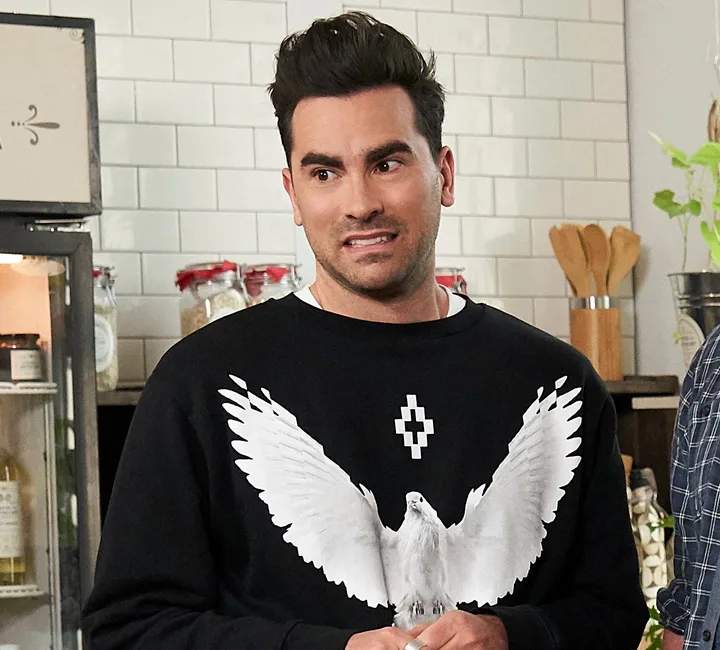
Six years after the much-loved Schitt’s Creek finale, Dan Levy is returning to the TV world with his new Netflix series.
The Emmy winner has teamed up with Bottoms and I Love LA writer Rachel Sennott to create Big Mistakes, an exciting eight-part series that’s part comedy, part heist, part caper and part gritty crime drama.
As well as co-creating Big Mistakes and writing select episodes, Dan also takes the lead as a priest who lands both himself and his sister in hot water when some petty thievery grabs the attention of a criminal organisation.
He’s joined by an impressive cast of recognisable faces in Big Mistakes, many of whom you’re sure to recognise from their TV, movie and stage careers.
For those who’ve already been enjoying the new show, here’s your quick guide to where you’ve seen the cast before…
Dan Levy

CBC/ITV/Kobal/Shutterstock
As mentioned above, Dan Levy was a co-creator and star of the beloved sitcom Schitt’s Creek, in which he starred as David Rose alongside his famous dad, Eugene Levy.
The Canadian star initially got his start in TV presenting rather than acting, working on the likes of MTV Live, The Hills’ “after show”, the Canadian version of Great British Bake Off and the cooking show Dismantled.
Since Schitt’s Creek, his acting work has included Modern Family, Sex Education, The Idol and Curb Your Enthusiasm.
He’s also acted in films like Disney’s Haunted Mansion, the Christmas comedy Happiest Season and the dark comedy Good Grief, the first offering to come from Dan’s deal with Netflix.
Taylor Ortega

Dan’s on-screen sister in Big Mistakes is played by Taylor Ortega, who Succession fans might remember for her one-episode stint as Greta, before she was cast in the US remake of the British comedy Ghosts.
You could have also seen her in Love Life, Welcome To Flatch or Netflix’s The Four Seasons, as well as films like Another Simple Favour or Wine Club.
Meanwhile, if you were a Kim Possible fan back in the day, you might be interested to hear that she played Shego in Disney’s 2019 live-action movie based on the classic cartoon.
Laurie Metcalf

Universal Pictures/Kobal/Shutterstock
Laurie Metcalf won three Emmys for her work in the sitcom Roseanne, but you might also recognise her for her Oscar-nominated performance as the mum character in Lady Bird.
Over the years, she’s also made memorable appearances as a murderous supermarket shopper in the iconic Desperate Housewives episode Bang, Sheldon’s mother in The Big Bang Theory, Augusta Gein in Monster and exhausted tour manager Weed in Hacks (for which she won her fourth Emmy).
Her film work includes everything from Uncle Buck, Toy Story and Leaving Las Vegas to Scream 2 and Runaway Bride.
We’d be remiss not to mention her stage career, too, as Laurie is a six-time Tony nominee (and two-time winner), treading the boards as everyone from Misery’s Annie Wilkes (opposite Bruce Willis’ Paul Sheldon), A Doll House’s Nora Helmer and Hillary Clinton.
Elizabeth Perkins

Monty Brinton/Showtime/Kobal/Shutterstock
With a screen career spanning 40 years, it’s tough to know exactly where to start with Elizabeth Perkins.
Over the decades, she’s appeared in films like The Flintstones, Miracle On 34th Street, Finding Nemo and, more recently, Spider-Man: Across The Spider-Verse and The Housemaid.
She’s perhaps best known for her TV work, though, which includes playing Celia in Weeds, Janet Malone in This Is Us, Birdie in Glow and Jackie O’Neill in Sharp Objects, which earned her a Critics’ Choice Award nomination.
Abby Quinn

Horror fans might be familiar with Abby’s performances in the likes of Knock At The Cabin, I’m Thinking Of Ending Things or Hell Of A Summer.
Abby has also had minor roles in Greta Gerwig’s Little Women adaptation, the sinister Black Mirror episode Arkangel, the Breaking Bad spin-off Better Call Saul and the 21st century revival of the sitcom Mad About You.
Mark Ivanir

Between 2015 and 2018, Mark Ivanir had a recurring role in the thriller Homeland, playing Ivan Krupin, an SVR agent.
His other notable TV roles have included the Netflix political drama Zero Day, the dark comedy Barry and Amazon Prime’s original series Transparent.
As for his film work, he has appeared in Schindler’s List, The Terminal and the critically-panned musical Emilia Perez.
Jack Innanen

A comedian as well as an actor, Jack Innanen rose to prominence in the early 2020s thanks to his viral TikTok videos, landing him roles in the Canadian series The Dessert and The Office Movers.
Since then, he’s appeared in the main cast of the sitcom Adults, and recently hinted at a possible role in the next season of Heated Rivalry.
Boran Kuzum

Originally hailing from Turkey, Boran Kuzum’s work primarily consists of shows and films in his home country including Wounded Love, Bihter: A Forbidden Passion and Magnificent Century: Kösem.
Before being cast in Big Mistakes, he also played a pivotal role in another Netflix series, Kimler Geldi, Kimler Geçti (known in English-speaking territories as Thank You, Next).
Joe Barbara

Joe Barbara’s career began in the late 1990s, with roles in US soaps like Another World (which he appeared in over a four-year period) and All My Children.
More recently, he’s acted in FBI, Blue Bloods and lent his voice to the Grand Theft Auto games series, playing crime boss Ray Boccino.
Josh Fadem

Comedian, writer and actor Josh Fadem’s stand-out work has included playing Phil Busby in the 2017 revival of Twin Peaks, Pat Stanley in On Becoming A God In Central Florida, Simon Barrons in 30 Rock and Joey Dixon in Better Call Saul.
He also repeatedly portrayed Sean Penn in the sketch comedy series The Midnight Show and Adolf Hitler in The Crossroads Of History, in addition to roles in Reservation Dogs, Tulsa King, Minx and Adventure Time.
Jacob Gutierrez

Playing Tareq in Big Mistakes is definitely Jacob Guttierez’s biggest TV role to date, but he has appeared in the TV series A Crime To Remember, Bull and Dear Edward in recent years.
He’s also acted in short films, including A Night Off and It’s Not You, It’s Her.
Big Mistakes is now streaming on Netflix.

High-Yield REITs I Would Trust For Retirement Income

Iran’s Hormuz Toll Could be In Stablecoins, Not Bitcoin

Sharks eager to snap skid in home finale vs. Canucks

Why Israel is blocking foreign journalists from entering

Bitcoin: We’re Entering The Most Dangerous Phase

Alan Cumming Brands Baftas Ceremony A ‘Triggering S**tshow’

Btc prediction | Bitcoin price prediction in Hindi #india #btc #crypto #bitcoin

Dale makes money by selling bee stings.#foryou #comedy #shortvideo #shorts #shortvideos

BITCOIN, CRYPTO: PREPARATI A UNA SETTIMANA DI CAOS (-72 ORE…)
-

 Business5 days ago
Three Gulf funds agree to back Paramount’s $81 billion takeover of Warner, WSJ reports
-

 Sports7 days ago
India men’s 4x400m and mixed 4x100m relay teams register big progress | Other Sports News
-

 Politics17 hours ago
US brings back mandatory military draft registration
-

 Fashion18 hours ago
Weekend Open Thread: Veronica Beard
-

 Tech4 days ago
How Long Can You Drive With Expired Registration? What Florida Law Says
-

 Business6 days ago
No Jackpot Winner, Prize to Climb to $231 Million
-

 Fashion5 days ago
Massimo Dutti Offers Inspiration for Your Summer Mood Board
-
 Sports18 hours ago
Man United discover Nico Schlotterbeck transfer fee as defender reaches Dortmund agreement
-

 Fashion4 days ago
Let’s Discuss: DEI in 2026
-

 Crypto World3 days ago
Bitcoin recovers as US and Iran Agree a Ceasefire Deal
-

 Crypto World2 days ago
Canary Capital Files SEC Registration for PEPE ETF
-

 Business15 hours ago
Tesla Model Y Tops China Auto Sales in March 2026 With 39,827 Registrations, Beating Cheaper EVs and Gas Cars
-

 Business7 days ago
Akebia Therapeutics, Inc. (AKBA) Discusses Pipeline Progress and Strategic Focus on Kidney Disease Treatments at R&D Day – Slideshow
-

 Business23 hours ago
OpenAI Halts Stargate UK Data Centre Project Over Energy Costs and Copyright Row
-

 Tech5 days ago
Gamer Restores the Original PlayStation Portal From Two Decades Ago
-

 Tech5 days ago
Haier is betting big that your next TV purchase will be one of these
-

 Tech5 days ago
The Xiaomi 17 Ultra has some impressive add-ons that make snapping photos really fun
-

 Tech5 days ago
Samsung just gave up on its own Messages app
-

 Tech5 days ago
Save $130 on the Samsung Galaxy Watch 8 Classic: rotating bezel, sleep coaching, and running coach for $369
-

 Tech5 days ago
Italian court says Netflix must refund customers up to $576 over price hikes
You must be logged in to post a comment Login