




Connect with us
DAPA Banner

Politics

Malcom Gooderham: The resistible rise of Green fascism must not be ignored

Published

on

Malcom Gooderham: The resistible rise of Green fascism must not be ignored

Malcolm Gooderham is the founder of Elgin Advisory, and a former Conservative Party adviser.

The media profile and some polling suggest the Green Party is on the rise.

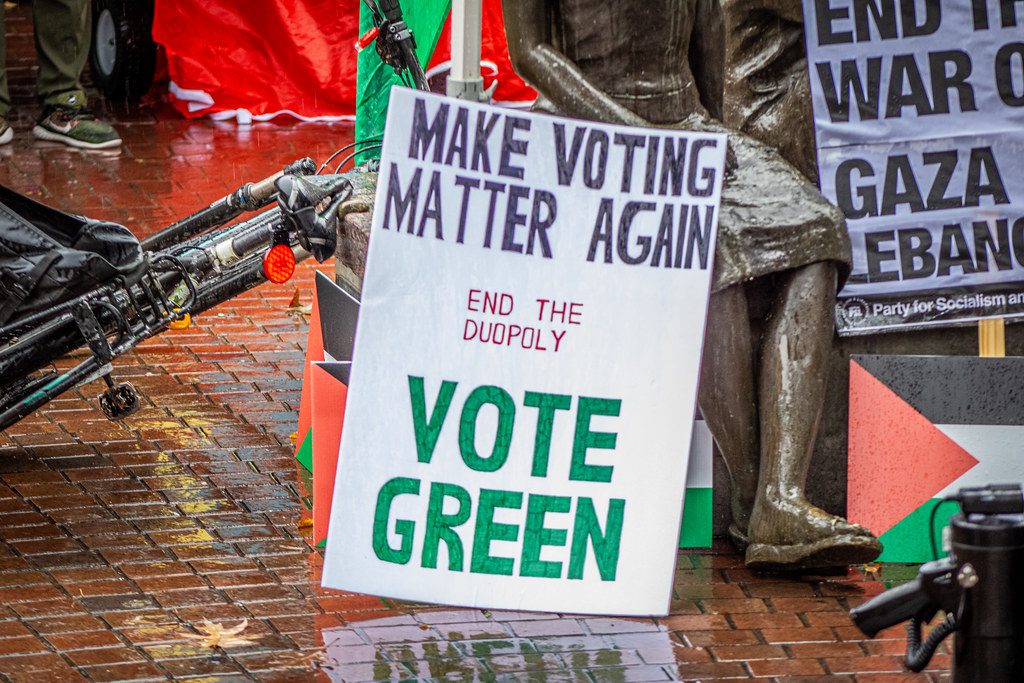
We have been here before, but this crop of Green Leaders has a more pernicious and divisive politics. Their focus is not on mainstreaming support for environmental causes, but on delegitimising the state of Israel. In doing so, they reveal their bigotry and raise broader questions about the Left’s political activism, the treatment of the Jewish community and the role of the State broadcaster.

The Green Party, like the far Left in general, has a long-standing and unhealthy obsession with Jews and the state of Israel.  While the Left indulges all sorts of gesture politics and flirts with all sorts of boycotts, they reserve their passion and ‘progressive outrage’ for Israelis. This is currently driving Green Party campaigns to pressure shopkeepers and residents not to stock or buy goods imported from Israel. The tactics and discrimination has yet to attract the opprobrium they warrant. Note we have not seen Sir Keir Starmer rush out a demand for an apology or retraction unlike his decision to single-out  Sir Jim Ratcliffe.

Advertisement

The Green political energy tilts towards foreign affairs and is Israel-centric or more accurately phobic. There is little ‘green space’ for campaigns to boycott goods from nations other than Israel. For instance, the CCP and China ignore prior commitments to freedom of speech in Hong Kong. Not to mention the rights of religious minorities.  Or protests about Iran where the regime constantly kills demonstrators, denies women and girls equality and violates human rights. Or African countries where Muslim militias violently persecute Christians. Or, on our own Continent where they could raise awareness about Russia’s abduction of thousands of children from Ukraine. Or much closer to home, they could focus their energies on delivering accountability for the grooming and gang-raping of teenagers across northern towns and cities. Their relative silence is woeful.

Sadly the new Green Leader Zack Polanski has been swept up in the Green tide of opposition to Israel. As a man who is not shy about his Jewish ancestry he has been on a journey, from challenging the Green Party’s unhealthy pre-occupation with Israel – which he once bemoaned as “obsessive” – to now championing their anti-Zionist causes. His politics are morphing with those of Jeremy Crobyn and a political alliance with the former Labour Leader seems inevitable.

The Green wave of anti-Israeli activity is a salutary reminder of an uncomfortable political truth, those on the far Left do not see Jews as a minority worthy of their support. Instead they prefer to isolate and even intimidate them. While claiming to be inclusive they repeatedly single out one country and people for their caustic campaigns.

For the far Left opposition to Israel is a touchstone issue. Politicians that do not sign-up to an anti-Zionist agenda fall foul of a perverse purity test and are not welcome in certain movements. It is seemingly a driving force and even organising principle of politics for Leftists, like the Corbyn/ Zultana zealots or the Green brigade.

Advertisement

Leaving aside the BBC’s coverage of Hamas’ behaviour before, during and after the ceasefire, it is deeply disturbing that Britain’s state broadcaster is unmoved by anti-Zionism. At the chaotic launch of the breakaway Labour movement, ‘Your Party’, Zultana’s speech received its biggest cheers to her cries of anti-Zionism. The BBC team clipped and replayed this, of course, but not as an example of extremism and or even a radical agenda.

It is alarming that politicians on the far Left feel they enjoy social permission to openly say they are  “anti-Zionist”. In doing so they display bigotry, but it often goes unchecked and unremarked upon. Their fellow travellers, not least in the media, either share their agenda or fail to see it as a corrosive ideology.

In fact, anti-Zionist propagandists are probably the modern day ‘UI’, or ‘Useful Idiots’. The term the Kremlin reserved for western ciphers for their propaganda during the Cold War. The new cadre are also making fools of themselves by giving air cover to another enemy of freedom and liberty, Islamic fundamentalists, who not only want to oppress and deny Jews a homeland but want to eradicate them and Judeo-Christian people and values.

While the Left and Polanski himself may be reticent to talk about it, Jews living in Britain, like Jews the world over, are deeply worried about the march of militant Islam and its ideology of hate. This is too often buried by default or by design by politicians in Europe. It is a grim irony that Militant Islam poses a real and present danger to the very democratic values that Left-wing political classes espouse.

Advertisement

Yet their own extremism blinds them to the potential outcomes of their witless attacks on the state of Israel and the Jewish people.

Source link

Advertisement
Continue Reading
Click to comment

You must be logged in to post a comment Login

Leave a Reply

Politics

Claudia Winkleman Accidentally Drops F-Bomb During Child Interview

Published

on

Claudia Winkleman Accidentally Drops F-Bomb During Child Interview

Claudia Winkleman had an unfortunate slip of the tongue during a recent appearance on the Heart Radio breakfast show.

On Friday, the Traitors host joined Amanda Holden and Jamie Theakston in the Heart radio show, where she spoke via video-link with Finley, a young fan who conducted a brief interview with her in his school uniform.

After the conversation was over, Claudia gave him a rapturous round of applause, while Jamie told listeners: “We’ll have more from our special guest Claudia Winkleman right after this.”

“Oh no,’ the former Strictly Come Dancing presenter joked in response to Jamie’s outro. “Fuck’s sake.”

Advertisement

Unfortunately, what she didn’t realise was that young Finley was still on the call, prompting her to issue a hasty apology.

“Finley, do not be me,” she instructed him, after the realisation began to sink in. “Ever! I’m so sorry, Finley!”

Claudia is currently on the promo trail for her new BBC talk show, which returns for its second episode on Friday night.

The first instalment aired last week, with Hollywood legend Jeff Goldblum, three-time Emmy nominee Vanessa Williams and comedy fave Jennifer Saunders among Claudia’s inaugural guests.

Advertisement

For her second episode, she will be joined by guests including pop singer Niall Horan, musical theatre icon Rachel Zegler, actor Guz Khan and comedian Joanne McNally.

The first season will come to an end next month after a run of seven episodes, after which the BBC will decide whether to renew The Claudia Winkleman Show for more instalments.

Source link

Continue Reading

Politics

Greg James Moved To Tears As He Completes Comic Relief Challenge

Published

on

Greg James Moved To Tears As He Completes Comic Relief Challenge

Greg James was overcome with emotion after completing his latest mammoth physical challenge in aid of Comic Relief.

For the last eight days, the Radio 1 host had been pedalling 1,000km from Weymouth to Edinburgh in a fundraising effort in honour of Red Nose Day.

Over the course of the journey, there were tearful moments and star-studded surprises, and on Friday morning, the course came to an end at Murrayfield Stadium in the Scottish capital.

Radio 1 presenters Vick Hope and Jack Saunders noted that an “elated” Greg had crossed the finish line while “punching the air”, “waving at the crowd” and “soaking it all in” with tears “flooding down his face”.

Advertisement

“It’s overwhelming, I’m sorry,” Greg told the pair as they approached him at the finish line. “It’s too much! We did it!!”

Greg added: “I just keep bursting into tears. I actually can’t believe it. What a beautiful day! This is unbelievable. Weymouth to Edinburgh! What a stupid idea!”

He later beamed: “It feels amazing to complete that. It feels amazing to have done that adventure. It feels amazing to have pushed through it all. It feels amazing to be part of an amazing team. It feels amazing to have raised so much money. And it feels amazing to be finished.

“It’s been such a struggle at times – but everyone has got me through all of it, and the Radio 1 lot got me through it, and every smiling face.

Advertisement

“Aside from all the pain, and all the legs that are barely working – by the way that last 10km was so difficult – the thing I will remember the most is the joy of seeing everyone, and I just tried to push through the pain to get to that joy.”

At the time of writing, Greg’s efforts have helped raise more than £4 million for this year’s Comic Relief telethon.

His challenge was made all the more emotional by the fact his father suffered a stroke just days before it was due to begin.

Greg subsequently told his supporters he’d be going ahead with the cycling challenge, as it was something his father “really wanted me to do”.

Advertisement

Source link

Continue Reading

Politics

HIIT: Benefits, Risks, And Who It Helps Most, Explained

Published

on

HIIT: Benefits, Risks, And Who It Helps Most, Explained

Medical comment provided by Dr Giuseppe Aragona, GP and medical adviser for Prescription Doctor.

When I first began working out about 10 years ago, high-intensity interval training, or HIIT, was everywhere.

Is that deserved? We looked at the research into HIIT to see what science says, and asked GP and medical adviser Dr Giuseppe Aragona for his thoughts, too.

Advertisement

What is HIIT?

HIIT, which involves short bursts of incredibly high-intensity exercise interspersed with rest periods, makes you reach about 80-100% of your maximum heart rate.

We’re talking burpees. We’re talking squat jumps. Rowing counts, too (HIIT is considered a form of cardio).

“High-intensity interval training, or HIIT, can be a very effective and time-efficient form of exercise, but like most things in medicine, the benefits and risks depend heavily on the individual, their baseline fitness, and how the training is implemented, rather than the concept itself being inherently good or bad,” Dr Aragona told us.

Advertisement

Does HIIT damage your joints?

Some argue that HIIT can be hard on your body, especially if your form isn’t perfect (and given that some very fast-paced HIIT workouts demand multiple complex moves, like jumping lunges, in short intervals, it might be hard to perform all of them to the ideal standard).

But a 2026 study from University Hospital Rigshospitalet and the University of Copenhagen found that HIIT workouts were well-tolerated by (meaning they didn’t cause harm to) people with mild to moderate knee osteoarthritis over a 12-week period. Training sessions happened three times a week.

“From a musculoskeletal point of view, poor technique, insufficient warm-up, or pre-existing joint issues can increase the risk of strain or injury,” Dr Aragona said.

Advertisement

If structured well, though, HIIT can sometimes be tolerated by those with e.g. sore knees, “as the intermittent nature of the exercise reduces sustained load through the joint compared with continuous activity”.

Does HIIT damage your mitochondria?

Some research says excessive HIIT may harm our mitochondria, which help to generate energy from cells, and possibly lower our glucose tolerance.

But per the GP, “the idea that HIIT ‘damages mitochondria’ is somewhat overstated in the mainstream discussion, as in reality moderate amounts of high-intensity exercise tend to stimulate mitochondrial biogenesis and improve metabolic health”.

Advertisement

“Excessive volumes without recovery may contribute to oxidative stress and fatigue, which is where the perception likely comes from, so the issue is less about HIIT itself and more about overtraining,” he said.

Does HIIT disrupt your sleep?

Some research suggests that doing HIIT too close to bed can ruin your sleep, and that it might be a lot worse than lower-intensity activity for helping older people with existing poor sleep.

But others say it can improve sleep efficiency and perceived sleep quality.

Advertisement

Dr Argaona agreed that negative changes to sleep are only expected if you do HIIT “late in the evening or on consecutive days”: otherwise, you’re likely in the clear.

Does HIIT build muscle and strengthen bones?

A common critique of HIIT is that it doesn’t build muscle, as it’s a predominantly cardiovascular exercise. But one paper found 12 weeks of HIIT increased lean leg muscle in participants.

“It is generally less effective than structured strength training for building significant muscle mass or bone density, where progressive overload and mechanical loading are more important,” Dr Aragona said ― in other words, it’s true that HIIT won’t build as much lean muscle as strength training.

Advertisement

However, “weight-bearing HIIT can still play a supportive role in maintaining bone health, especially when combined with resistance exercise,” he added.

Are there any other benefits to HIIT?

“HIIT is very effective at improving aerobic capacity and VO2 max because it repeatedly pushes the cardiovascular system close to its upper limits,” Dr Aragona told us. That can help us to use oxygen more efficiently when we work out.

“It is also worth noting that high-intensity training has broader systemic benefits, including improvements in insulin sensitivity and vascular function,” said the GP.

Advertisement

That can even have benefirs for those with erectile dysfunction (ED) “by enhancing cardiovascular health, boosting testosterone, and increasing blood flow… regular, intense, short-duration workouts performed perhaps twice per week can strengthen the pelvic floor and improve vascular function”.

How much HIIT should I do a week?

It depends on your fitness levels, said the doctor.

He explained: “I generally suggest that for most people two to three HIIT sessions per week is sufficient to gain cardiovascular benefits, particularly improvements in VO2 max, which is one of the strongest predictors of long-term health and mortality… beyond that point the incremental benefit diminishes while the risk of overuse injury and burnout increases.”

Advertisement

If you already do cardio and strength training, “it should be viewed as a supplement rather than a replacement, perhaps used once or twice a week to improve cardiovascular fitness and add variety”.

How can I tell if I’m doing too much HIIT?

Many of the harms linked to HIIT come about when it’s overdone. Dr Aragona said that some of the signs you’ve been going too hard include:

  • persistent tiredness
  • declining performance
  • irritability
  • sleep disturbance.

Who should avoid HIIT?

There are “clear groups in whom caution is warranted, including individuals with uncontrolled hypertension, significant cardiovascular disease, advanced joint problems, or those who are completely unaccustomed to exercise,” said the doctor.

Advertisement

Consider speaking to your doctor and starting slowly, if deemed appropriate, if you’re considering HIIT.

If you’re new to working out, “suddenly introducing very intense activity can increase the risk of cardiac events or musculoskeletal injury, and in these patients a gradual build-up with lower intensity work is far safer and more sustainable”.

Source link

Advertisement
Continue Reading

Politics

Neil Shastri-Hurst: Build more homes, but build them beautifully

Published

on

Neil Shastri-Hurst: Build more homes, but build them beautifully

Dr Neil Shastri-Hurst MP is the Conservative Member of Parliament for Solihull West & Shirley, elected in 2024. He previously served as a British Army Medical Officer and barrister, and sits on the House of Commons Justice Committee.

Britain faces a housing challenge that cannot be ignored. Too many young people are locked out of home ownership. Too many families are living in accommodation that is overcrowded or insecure. Too many communities lack the homes necessary to sustain local economies and public services. The argument for building more is clear and compelling.

However, in our understandable urgency to increase supply, we risk overlooking something fundamental; the quality of what we build. A nation is not simply strengthened by the number of houses it produces. It is shaped by the character of the places those houses create.

Britain’s towns and cities are among the most recognisable in the world because earlier generations built with confidence and care. The elegant terraces of the Regency period, with their measured proportions and coherent streets, remain among the most admired urban environments anywhere. The Victorian era, too, produced civic buildings, railway stations and town halls that combined engineering ingenuity with architectural ambition. Those structures were built not merely for utility, but for permanence.

Advertisement

Even where the buildings themselves were modest, they were conceived as part of a wider whole. Streets were designed with rhythm and harmony. Materials were chosen with durability in mind. Public spaces were integrated rather than incidental. The result was an environment that felt deliberate and settled.

By contrast, much contemporary development appears detached from place. Estates are laid out with little regard for the character of surrounding neighbourhoods. Materials are selected primarily for speed and cost. Streets are often treated as functional corridors rather than civic spaces. The outcome may satisfy housing targets, but it rarely inspires affection.

Such lack of attachment has consequences.

Beautiful architecture does more than please the eye; it shapes behaviour. When people live in places that are attractive, coherent, and well cared for, they are more likely to feel pride in their surroundings. That pride expresses itself in practical ways. Streets are kept cleaner. Public spaces are respected. Communities become more invested in maintaining the quality of their environment.

Advertisement

The reverse is also true. Where developments appear temporary, anonymous, or poorly designed, residents can struggle to form a sense of ownership. The built environment begins to feel disposable. Over time, that detachment can erode civic responsibility.

This is why design quality matters so profoundly. The homes we construct today will form the landscape of Britain for generations. They will shape how children grow up, how neighbours interact and how communities perceive themselves. Building well is therefore not an aesthetic indulgence; it is an act of civic stewardship.

None of this is an argument against building. Britain must increase housing supply if we are to provide opportunity for the next generation. But the choice is not between quantity and quality. We can do both. Indeed, we must.

That means making better use of brownfield land and regenerating underused urban spaces. Many of our towns contain disused industrial sites, vacant plots and neglected high streets that could be transformed into thriving neighbourhoods. Development in such locations brings new life to existing communities while reducing pressure on open countryside.

Advertisement

It also means recognising the continuing value of the green belt. The principle behind it remains sound; to prevent uncontrolled urban sprawl, protect the character of the countryside, and encourage renewal within our towns and cities. The green belt should not be treated as a convenient reservoir for poorly conceived expansion. Once open land is lost, it is rarely recovered.

Equally important is the role of design standards. Clear design codes, shaped locally and applied consistently, can provide certainty for developers whilst ensuring that new housing respects the scale, materials, and character of existing places. They should not be seen as bureaucratic obstacles but as instruments of good planning.

Where design is taken seriously from the outset, the results can be striking. Streets become places where people want to walk rather than merely drive through. Squares and parks encourage interaction and recreation. Homes feel connected to their surroundings rather than isolated from them. In such environments, residents develop a stronger sense of belonging.

There is also a broader cultural dimension. Britain’s built environment forms part of our national identity. Visitors from around the world admire our historic towns precisely because they possess coherence and character. We should not assume that such qualities are relics of the past. They can, and should, be carried forward.

Advertisement

Innovation in architecture is entirely compatible with respect for tradition. The best new buildings learn from what came before them whilst adapting to modern needs. They employ contemporary methods and technologies but remain attentive to proportion, materials, and context.

This approach reflects a deeper understanding of the nation as an inheritance. We receive landscapes shaped by previous generations and pass them on, altered in turn, to those who follow. That continuity imposes a responsibility to build in ways that enhance rather than
diminish the places we inhabit.

Britain must therefore pursue a housing strategy that is both ambitious and thoughtful. Ambitious in its determination to meet demand, and thoughtful in its commitment to beauty, coherence, and environmental stewardship.

If we succeed, the rewards will extend far beyond the provision of homes. We will create neighbourhoods that foster pride, encourage care for public spaces, and strengthen the bonds between citizens and their communities.

Advertisement

Britain has built beautifully before. With the right ambition and discipline, it can do so again.

Source link

Advertisement
Continue Reading

Politics

Wings Over Scotland | Irony you can’t buy

Published

on

Posted without comment.

Except this: good riddance to the worst traitor in Scotland’s history.

Source link

Advertisement
Continue Reading

Politics

Reform UK Election Candidate Suspended Day After Unveiling

Published

on

Reform UK Election Candidate Suspended Day After Unveiling

Reform UK has suspended one of its election candidates less than 24 hours after he was unveiled.

Party chiefs have launched an investigation into claims Stuart Niven diverted thousands of pounds from a taxpayer-backed Covid loan into his personal account.

He is also disqualified as a company director until 2033.

Niven was only announced as one of Reform’s candidate at the upcoming Scottish Parliament elections on Thursday.

Advertisement

Nigel Farage joined Lord Offord, the party’s leader in Scotland, at the event, which also saw the launch of Reform’s election manifesto.

A spokesperson from Reform UK Scotland said: “We take allegations like this very seriously, and a full investigation is underway.”

It has also been reported that a Reform candidate in Fife said former SNP first minister Humza Yousaf was “not British”.

And the party’s candidate in Galloway and West Dumfries, Senga Beresford, has previously given her support to far-right agitator Tommy Robinson.

Advertisement

Scottish Labour leader Anas Sarwar said: “Reform Scotland’s campaign has immediately been exposed as the farce that it is.

“From the dodgy dealings of a Covid scammer to the divisive tweets of obsessive racists, these scandals show Reform are just taking whoever they can get.

“Reform is treating Scots with contempt by asking them to vote for this hopeless gaggle of Tory rejects and odd balls, and I have no doubt Scotland will send them packing.

“The spineless Lord Offord has only suspended one candidate and effectively given the green light to the fringe views of the rest of these candidates.”

Advertisement

Source link

Continue Reading

Politics

UK 10-Year Gilts On Track for 2008 Financial Crisis Levels

Published

on

UK 10-Year Gilts On Track for 2008 Financial Crisis Levels

Markets turning, gilts spiking. Good job Reeves has “the right economic plan”, apparently…

Source link

Continue Reading

Politics

Viral Magazine Cover Delivers Blistering Takedown Of Trump’s Iran War

Published

on

Viral Magazine Cover Delivers Blistering Takedown Of Trump’s Iran War

The Economist has delivered a damning verdict on Donald Trump’s Iran war with its latest cover.

“Operation Blind Fury,” blared the headline, a scathing twist on Trump’s own “Operation Epic Fury” name for the U.S.-Israeli military action.

The artwork depicted the president wearing a camouflage military helmet, complete with bullets tucked into the strap, pulled down over his eyes — a stark suggestion he’s got no clear sense of where he’s going with the conflict, which is now in its third week.

Sharing the cover on X, the magazine warned: “The reckless campaign against Iran will weaken America’s president. That will make him angry. Be warned: he makes a very bad loser.”

Advertisement

The post has gone viral, with more than 2.2 million views.

Commenters on the Elon Musk-owned platform praised the front page as brutally accurate, with one saying it “summed it up perfectly.”

Source link

Advertisement
Continue Reading

Politics

I Tried The ‘Bee Hum’ Method For Better Sleep

Published

on

I Tried The 'Bee Hum' Method For Better Sleep

This year, I’ll be trying sleeping tricks to see whether they actually improve my insomnia. Check back in on this series, Rest Assured, to see how I get on.

So far this year, I’ve taken vitamin D, read in bed, sipped on passionflower tea, and eaten kiwis in hopes of managing my sleep maintenance insomnia.

The condition means that while I fall asleep just fine, I struggle to stay asleep once I’ve nodded off: 3am wakeups are all too common.

At this point, I’ll try anything to prevent my morning grogginess. And apparently, that includes humming like a bee, a method suggested to me by Ailsa Frank, a sleep expert working with Post Office Life Insurance.

Advertisement

Why would humming like a bee help you sleep?

I was sceptical when I first heard the advice. But some research has shown that “bumblebee breathing,” a yoga technique also known as bhramari pranayama, really can help you nod off.

A 2025 paper said it improved sleep initiation, continuity (the part I’m worried about), and depth (hey, that doesn’t hurt either). It may also reduce the impact of sleep disturbances.

“It’s a gentle humming exhale that soothes the parasympathetic nervous system by easing tension and, in turn, improves sleep quality,” Frank shared.

Advertisement

At this point, I reasoned, why not?

How can I “bee hum” to help my sleep?

  • Cover your ears with your thumbs,
  • Close your eyes with your first three fingers,
  • Breathe in deeply through your nose,
  • Make a bee-like “humming” sound as you exhale, keeping your lips pursed,
  • Repeat up to 10 times.

How did it go?

As I’ve said, I was a little sceptical at first. But the facts are the facts: I had one fewer 3am wakeup than is usual for me in the work week I tried the method, and my sleep quality was generally pretty great.

Also, I was amazed by how comforting I found the technique.

Advertisement

Experts have long recommended breathing techniques, like the “finger breathing” and “4-7-8″ method, to lower our heartbeats and relax our nervous systems.

This seemed to be no different. And, as the authors of the paper about the “bumblebee breath” method said, it’s non-invasive and completely free.

Source link

Advertisement
Continue Reading

Politics

Alex Clarkson: Why village post offices matter

Published

on

Alex Clarkson: Why village post offices matter

Alex Clarkson is Councillor for Borehamwood Hillside on Hertsmere Borough Council and is also Deputy Chairman of Hertsmere Conservative Association. He stood in Stevenage at the last General Election. He is a Founder Member of Conservatives Together and is the Vice-Chairman (Outreach) of LGBT+ Conservatives.  

I don’t know what it is, but I have always had a soft spot for village post offices. Maybe it was going down to my local one, before it was shut by the Blair government, to pick up my First Day Cover. Yes, philately anorak alert.

Maybe it is the fact that as an actor I voiced several male characters in Postman Pat: Special Delivery Service, still shown on CBBC most weekday mornings, with our hero Pat souped up for the 21st century now armed with a lorry, motorbike and helicopter.

Or maybe it is because village post offices are exactly what they appear to be. They are a quintessential part of British rural life. They are community hubs where villagers and passers-by do not just post letters or parcels, but natter in the queue and connect with one another, perhaps picking up some stationery or a Mother’s Day card just in time.

Advertisement

Now from experience voicing so many episodes, I can tell you that the goings-on in Mrs Goggins’ post office in the fictitious Cumbrian village of Greendale make an Eastenders Christmas special pale into insignificance. Unlike our much loved animation though, the realities of this Starmer government, with its 18 U-turns, higher taxes, higher borrowing and general chaos, means we are in a Greendale-like emergency, but with no Postman Pat to sort it out!

Labour’s threat to rural post offices

Ironically, one of the more monstrous proposals appeared in a Green Paper published last summer. It suggested abolishing the minimum number of 11,500 post offices nationwide introduced in 2010 by David Cameron, scrapping the Three Mile Rule that ensures 99 per cent of the population lives within three miles of a post office, and phasing out part time, mobile, or outreach branches that typically serve rural communities.

For our villages and small towns this would have been devastating. Post offices are often the last remaining public service in Hertfordshire’s rural communities.

Advertisement

The campaign in North East Hertfordshire

Credit to CCHQ and the Campaign Toolkit team. They were ahead of the curve from the outset, with leaflet and survey templates appearing in their own sub-section of the website within weeks of the Green Paper announcement.

Some Conservative members in our patch initially told us the issue was exaggerated and might generate complaints. It is right to be cautious yes, but once we showed them proof of the Green Paper announcement (which had of course been buried deep under other news announcements at the time), they got behind us. Meanwhile local Liberal Democrats went ballistic on the inevitable Facebook groups. Apparently, they believe they are the only party allowed to campaign on local issues!

But off we went last August, campaigning to save four village post offices in a corner of North East Hertfordshire. These are Greendale-style villages connected by winding country lanes and narrow rural roads, with cottages, village greens and small high streets where the post office still sits at the heart of the community.

Advertisement

These branches could easily have closed, forcing pensioners and residents to travel into Stevenage by bus simply to access basic services.

Listening on the doorstep

Using the ‘Knock, Drop & Collect’ system, dropping off an easy-to-use survey and returning in 20 minutes to collect it, we heard repeatedly how vital these post offices were. Residents told us they had helped keep villages connected during the pandemic. They explained how they allowed pensioners to manage their bank accounts after local bank branches closed. Two of them even offered to do social media videos for us illustrating these points, which of course we gladly accepted.

The key point is that we heard this directly, and residents felt heard.

Advertisement

We did not simply write a few bullet points on a leaflet and push it through doors, or post a graphic on Facebook. Using the knock, drop and collect model, we spoke to people directly.

The result was that we learned the issues first hand and, more importantly, voters saw us listening rather than simply asking for their vote. We received hundreds of voter intentions, and using the 0-10 system too rather than the old-fashioned (and largely useless) canvass letter code.

Bearing in mind this was territory that had not been canvassed for a while. With its council elections ‘all out’ rather than up ‘in thirds’, elections come once every four years with not much else happening in-between. These were villages that had been blue since time immemorial but were now either fair game for Reform or were already ensnared by the ‘Japanese knotweed’ that is the Liberal Democrats.

Now there is bang on up to date canvass data – these villages are campaign ready for a future local or General Election.

Advertisement

Unexpected campaigning bonuses

Two unexpected things happened.

First, a huge number of residents who were not home when we knocked, used the QR code to complete the survey online, or even sent the form back to our Association Office using their own stamp. Postman Pat would have been proud, and busy!

Second, we harvested what campaigners love most. Bonus prizes. Nearly two dozen residents requested information about Party membership, including one person interested in becoming a Conservative councillor and another keen to return as a branch chairman. We also recruited over a dozen new leaflet deliverers, the same number of social media supporters, and even gained several requests for postal votes.

Advertisement

What activists can learn

The lessons are clear.

– Knock, drop and collect works, but always include a QR code and return address for those not in

– Always include tick box options for membership, volunteering, or helping online.

Advertisement

– A strong local issue like ‘Save the Post Office’ dramatically increases engagement as it is relevant and emotive

– Check Campaign Toolkit for ready to use campaign materials

– Do not neglect areas you once assumed were ’true blue’ – in fact concentrate on them during ‘peacetime campaigning’ to shore up the core vote, lay the foundations and stop any bleed to rival parties

– Do not listen to local Fib Dems who will start whining, moaning and calling you liars the moment you start campaigning

Advertisement

A quiet but significant victory

Nationally, 180,000 people signed the Party’s petition to protect our post offices. In our corner of North East Hertfordshire we played our part.

On 22nd February Labour quietly performed another U turn. It barely made page eight of the Daily Mail, but for Dane End, Walkern, Watton-at-Stone and Weston it was big news.

The newspapers attributed the reversal to ‘public pressure’. In truth, it was Conservative pressure. A policy U turn, voter data gathered, new members recruited, and new volunteers signed up. Job done. For a moment the North East Herts team almost felt disappointed when the news arrived that the post offices were safe, because we were already preparing to campaign in a fifth village.

Advertisement

Not for long though. We are out saving the local pubs now!

And if Mrs Goggins had been watching from behind the counter of Greendale Post Office, I suspect she would have approved. Even Postman Pat would struggle to deliver that many campaign surveys!

Source link

Advertisement
Continue Reading

Trending

Copyright © 2025