
Politics
So you’re not rich, but you argue against increasing taxes on the rich?! Here’s how you’ve been totally brainwashed (by the rich).

If Britain really has “run out of money” – as both Labour and the Conservatives keep childishly claiming – why are neither party actually proposing any ways to raise more money?
Stay in touch!
Sign up to be updated with Evolve’s latest stories, and for opportunities to get involved.
It seems a little strange, doesn’t it!
I mean, both are essentially saying “let’s continue doing exactly the same things that got us into this mess in the first place and hope everything somehow gets better on its own“!
It’s literally the definition of insanity.
However, there’s one surefire way of raising a bit more money that neither politicians or the media talking about: increasing taxes.
But we’re not talking about raising taxes on ordinary people (in fact, I think we should lower taxes on ordinary people considerably).
No. We’re talking about something the billionaire-controlled media, and the entire political class, fiercely avoids mentioning: raising taxes on the very richest (and making damn sure they can’t just avoid them)!
However, it’s not just the media and politicans who consistently reject the idea. Many ordinary people – even though they’re definitely not rich themselves – constantly argue against raising taxes on the rich as well.
“If we raise taxes on the rich, they’ll simply just leave the country or they’ll just find some way to avoid paying it – and anyway, rich people work hard and create jobs, so they deserve low taxes anyway” they claim.
However, every single one of these arguments is complete and utter horse shit, concocted by some Billionaire-backed thinktank, Trust Fund baby “journalist”, or private-schooled posho politician, purely so them and their wealthy chums can simply continue to hoard increasingly massive stacks of cash and assets without paying a penny more in tax.
And yet, for the last half decade, ordinary people have been constantly falling for these completely bogus arguments – totally against their own interests.
So here’s how the hell it happened – and here’s how we can actually start to improve our country again.
50 Years of Tax Cuts for The Rich and Tax Rises for The Poor
First, a little bit of history.
Many people aren’t aware of it, but for the last 50 years or so, successive governments have constantly lowered taxes purely for the very richest people in our society.
And, whilst doing so, numerous progressive wealth taxes have also been scrapped and replaced by regressive taxes which hit ordinary people far harder than those at the top.
And then there are the mountains of tax loopholes that have been intentionally baked into the system, which only the very richest with their fancy pants accountants and high price lawyers can afford to take advantage of.
And, if you don’t believe me, here are the facts:
- In 1972, the Purchase Tax – a progressive tax on luxury goods which stood at 33% – was abolished. It was replaced by VAT, a regressive tax levied on almost all goods which hits the poorest the hardest. VAT has gradually been raised from 10% on its introduction, to 20% presently.
- In 1975, Estate Duty was abolished. It taxed the transfer of estates worth over £5.5m (adjusted for inflation) at 85%. Thatcher replaced Estate Duty with Inheritance Tax, which currently taxes estates worth over £325,000 at a flat rate of 40%. However, there are numerous huge loopholes built into the tax; loopholes which Margaret Thatcher’s children used to avoid paying around £1m in Inheritance Tax on the estate she left to them because the property was registered in an offshore trust. In addition, research shows that the super-rich pay an average rate of just 10% in Inheritance Tax – saving them countless billions each year – whilst ordinary families inheriting average sized estates pay far more.
- In 1979, the top rate of income tax was 83%. By 1988, Margeret Thatcher had more than halved it to 40%. It currently stands at 45%
- In 1979, Corporation Tax was 52%. It has been systematically reduced over the last 40 years, and now stands at just 25%
- In 1984, Thatcher abolished the Surtax – an extra tax levied at 15% for unearned income such as interest from investments, dividends from shareholdings, or rent from investment properties
- In 1990, Thatcher introduced the widely-hated Poll Tax – a regressive flat rate charge on every adult in the country regardless of income. This was replaced by Council Tax in 1993 – a system which is almost as regressive as the Poll Tax, and which still hits lower earners far harder than the rich
(This is by no means a definitive list – and if you have any more examples, please leave them in the comments!)
These tax changes were purposefully designed to shift a large proportion of the tax burden from the very richest onto the rest of us instead – and it worked.
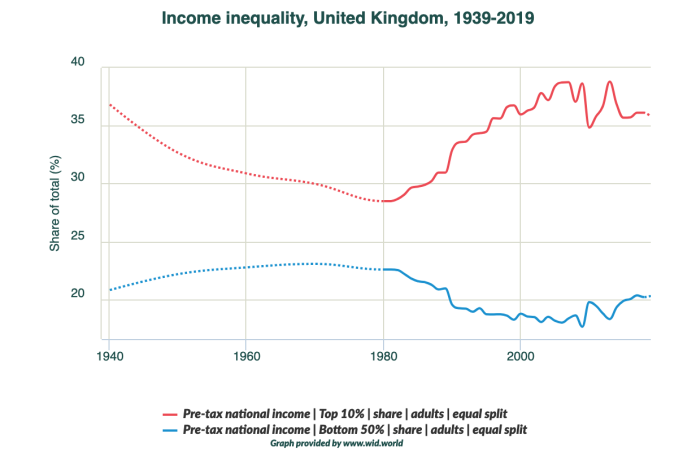
Indeed, from the late 1970s until the present day, the richest 10% of Brits have steadily increased their share of the UK’s wealth, whilst the wealth of the bottom 50% has fallen.
After WWII, high taxes specifically on the super-rich helped to fund the creation of the the NHS, the Welfare State and other progressive public policies, helping to dramatically improve ordinary people’s incomes, reduce inequality, and significantly improve the state of the country (which is why this period is widely know as the ‘post-war boom’).
However, as demonstrated by the graph below, since the late 1970s and the introduction of so-called Trickle Down Economics (or Neoliberalism), the rich have slowly been clawing this lost wealth back, and income equality has become just as bad as it was prior to WWII again.

Tax (The Rich) Avoidance
So, as I’m sure you’ll now agree, the facts are crystal clear: cutting taxes for the rich only benefits the rich.
Yet, despite the state of the UK declining horrendously over the last decade or so, barely anybody is talking about reversing the trend which is quite clearly causing it – especially not the mainstream media.
So why is nobody talking about taxing the rich again?
Well it’s quite simple. The vast majority of our political institutions – including the mainstream media and both main political parties – have been captured by the super-rich and their outriders.
These institutions are simply used as vehicles to further their own interests – and these interests quite obviously include, among other things, keeping their own taxes as low as possible!
Who controls the UK media?
Who controls the UK’s main political parties?
The Conservative Party has been the political vehicle of the rich and powerful since it was formed – as I have previously written about extensively here.
Its donors include a who’s who of billionaires, oligarchs, hedge fund managers, property developers and other extremely wealthy individuals and organisations.
It’s obviously not a coincedence that Tory policies just happene to benefit these people, and that they also often benefit from crony contracts and lifetime peerages – just a few of the numerous examples of legalised corruption that plague our political system.
However, when it comes to the Labour Party – which was created as the political vehicle of the working class, and whose funding comes from a mixture of Trade Unions and private donors – things are a little more complicated.
As you’ve probably heard before, the Labour Party has always been a so-called “broad church” o left-wingers. However, since the 1990s, the party has become increasingly dominated by a right-wing faction funded by vested interests and closely aligned with the interests of the Establishment.
When a Labour leader is elected who doesn’t adequately serve the interests of the Estalishment, they are systematically attacked both internally by careerist MPs who align with the rich and powerful, and externally by the billionaire-controlled media and their outriders – something we saw with both Ed Miliband from 2010-15 and, to a far greater extent, Jeremy Corbyn from 2015-19.
Indeed, the only Labour Prime Minister to be directly elected in the last four decades, Tony Blair, is now a close personal friend of Rupert Murdoch – having made a secret pact with the billionaire media mogul before the 1997 election. And, during his time as PM, rather than reversing any of Thatcher’s tax cuts and privatisation, Blair overwhelmingly served the interests of the Establishment by simply continuing where she left off – something he himself admitted to in 2013.
And now, the current Labour leader Keir Starmer is following this exact playbook: steadfastly refusing to do literally anything which could in any way contradict the interests of the Establishment, and completely reversing on his previous redistributive pledges in an attempt to reassure the rich and powerful that he is not a threat.
Class Interest
With control of virtually the entire media and the two main political parties, the Establishment has untold power to dominate the political narrative and shape public talking points to suit themselves – allowing fierce debate, but only within a tight ‘acceptable’ political spectrum.
Any talk of taxing the rich, reversing privatisation, or tackling inequality, is highly frowned upon – and anyone with any kind of platform who attempts to bring up these subjects is immediately and unrelentingly attacked with the full force of the political and media Establishment.
This hyper-domination of the narrative, added to the demonisation of anyone who strays from it, trickles down into the public conciousness and leads to a rote-learning of arguments and the creation of a false reality where it seems as if there is simply is no alternative.
It’s essentially a case of “So many popular people are saying the same thing that it simply must be true.”
This learned helplessness is routinely displayed by people on social media who clearly aren’t rich, but who routinely mock the idea that taxing the rich could actually work – even though it clearly does!
Hare are some of the more commonly-used arguments, and exactly why they’re complete rubbish:
Argument 1: “If we increased taxes on the rich they’d just find some way of avoiding it anyway!”
Solution 1: Britain controls a huge proportion of the world’s tax havens – and we’re literally the world’s biggest enabler of global tax abuse. We have the power to shut these Tax Havens down any time we want. According to research, Tax Havens based in UK Crown Dependencies and Overseas Territories help the rich avoid a staggering £152 billion in tax every single year – with Jersey and Guernsey adding a further £6.9bn to this total!
Also, regarding our domestic tax laws, we could also just close all the tax loopholes which are intentionally written into our current laws, or just write new laws instead!
Argument 2: “But if we closed all the loopholes, the rich would just move to another country with lower taxes!”
Solution 2: Most rich people who live in the UK have their wealth tied up in fixed assets like land, properties and businesses that they can’t take with them! Even if we raised taxes, they’d still be able to make profits here – but they’d just make slightly less profit. The very worst that could happen is they sell all their fixed assets, uproot their family, and start again somewhere else – but if they did this they’d just leave a gap in the market for someone else to fill and get rich from anyway!
Argument 3: “Taxes are already at their highest levels since WWII!”
Solution 3: Yes, they are. However, ordinary people are now contributing a far higher proportion of the tax burden than they used to due of 40 years worth of tax cuts for the super rich, loopholes that have been built into the system to allow them to avoid tax, and regressive stealth taxes which have been implemented on the rest of us.
In addition, in comparison to other similar countries, the UK actually has a relatively low tax burden – lower than both the EU and G7 average, as shown in the graphs below – meaning there is significant scope to increase taxes on the wealthy.


Argument 4: If we raise taxes on the rich, I might be affected!
Solution 4: But you’re not rich are you?
Argument 4a: No, of course not. But I read the news and they keep warning me that I might be affected. Also, I might actually get rich someday and I wouldn’t want to pay higher taxes even though I’d have more than enough to live comfortably anyway.
Solution 4a: Stop reading the billionaire-owned media, for fuck sake.
How should we tax the rich?
There’s been huge amounts of research conducted into wealth taxes by various charities and progressive think tanks over the past decade or so, looking at as how much money they could raise and the potential positive and negatives effects, but almost all of the research has – surprise surprise – been almost ignored by the mainstream media and polticians.
For instance, a tiny one off 1% wealth tax on millionaire couples could raise a staggering £260bn over five years.
Whilst properly cracking down on tax avoidance and evasion, and closing existing loopholes within legislation, could raise around £30bn a year.
And just a simple policy such as raising Capital Gains Tax – a tax on unearned income from the sale of assets or investment profits which the rich often benefit from – to the same level as income tax, could raise an extra £12.5bn a year.
Then there’s the idea of equalising the tax system so that people who do absolutely nothing for their income are taxed at the same rate as people who actially work for a living. Because, believe it or not, our tax system currently rewards landowners and landlords far better than nurses and teachers.
For instance, we could implement a Land Value Tax – a radical left-wing policy championed by noneother than the world-famous Socialist, err… Winston Churchill.
“Roads are made, streets are made, services are improved, electric light turns night into day, water is brought from reservoirs a hundred miles off in the mountains – and all the while the landlord sits still. Every one of those improvements is effected by the labour and cost of other people and the taxpayers. To not one of those improvements does the land monopolist, as a land monopolist, contribute, and yet by every one of them the value of his land is enhanced. He renders no service to the community, he contributes nothing to the general welfare, he contributes nothing to the process from which his own enrichment is derived.” argued the then Conservative MP in the House of Commons in a rousing speech in favour of a Land Value Tax in 1909.
The fact is that Britain is not broke at all. There’s more than enough wealth to go around. It’s just that tax system has been rigged by the rich in favour of themselves, meaning that wealth is increasingly being siphoned off and stashed away in Tax Havens, laundered through the purchase of economically unproductive assets that gain value over time, or pumped into property in order to generate passive income.
There are countless opportunities to raise money from additional taxes on those who can actually afford to pay them – and absolutely none of the arguments spouted by the billionaire-controlled media against increasing taxes on them and their wealthy chums have any merit whatsoever.
But, for as long as ordinary people continue to be brainwashed against their own interests, the rich and powerful will simply continue to become richer and richer – all at our expense.


After the farce of the Starmer government’s fake and short-lived ‘ban’ on arms sales to Israel, illegal weapons destined for Israel have fallen foul of an NGO’s efforts. A disguised cargo of weapons and military spare parts en route from the UK has been seized at Liège airport in Belgium. An operation by an NGO identified the shipment after concerns were raised about the accuracy of its cargo manifest, which did not disclose the real contents.
The consignment was scheduled to fly on Challenge Airlines, a firm that regularly flies to the genocidal colony.
In total, 33 crates of undeclared military equipment were opened and seized. The contents included laser sights, fire control systems and spare parts for fighter jets involved in the bombing of civilians in Gaza, Lebanon and Iran. The items would have needed specific declaration, followed by authorisation from the Belgian government, to transit legally — an unlikely outcome given decisions in 2025 in Belgium’s top courts and the policies of federal and regional government.
Belgian authorities have opened an investigation to identify those responsible for the attempted smuggling.
Featured image via the Canary

From time to time, people question why a person would put their neck on the line for Donald Trump. The answer to that is obvious (at least when he’s the president); it’s because he can literally pardon people of their crimes:
BREAKING WSJ:
Trump has repeatedly promised his top administration officials pardons before he leaves office, according to people who have heard his comments.
“I’ll pardon everyone who has come within 200 feet of the Oval,” Trump said in a recent meeting.…
— Kyle Griffin (@kylegriffin1) April 10, 2026
Trump’s criminal enterprise
According to the Wall Street Journal (WSJ), Trump is promising to pardon anyone who’s had anything to do with his second administration:
“I’ll pardon everyone who has come within 200 feet of the Oval,” Trump said in a recent meeting to laughs, according to people with knowledge of the comments. That radius appears to be expanding as the president repeats the line. Another person who met with Trump earlier this year said the president quipped about pardoning anyone who had come within 10 feet.
In one conversation with advisers in the dining room next to the Oval Office last year, Trump said he would host a news conference and announce mass pardons before he left office, some of the people said. The people said they weren’t aware of specific pardons being offered to specific people for specific acts.
As we all know, Trump is prone to just saying things – many of which never come to pass. At the same, Trump is also prone to pardoning people.
In December 2024, the BBC reported that the US President had granted “237 acts of clemency” in his first term (143 pardons and 94 commutations). In that same article, they noted that Trump was kicking off his second term by pardoning/commuting 1,600 individuals who were linked to the botched insurrection of 2021. Trump has continued to grant clemency since then, and there’s little reason to suspect he’ll stop.
Oh, and talking of the botched insurrectionists who got pardoned; it’s notable that several have been re-arrested since. As CREW reported in December 2025:
At least 33 January 6th insurrectionists pardoned by President Trump have been rearrested, charged or sentenced for other crimes since January 6, 2021, according to new analysis by CREW. Four pardoned insurrectionists have allegedly reoffended since receiving their pardons. Several have argued that the pardon should cover unrelated criminal convictions, and in one case last month, Trump explicitly re-pardoned one insurrectionist for his unrelated weapons charges.
Six of the pardoned January 6th insurrectionists are charged with committing child sex crimes, ranging from sexual assault to possession of child pornography. At least five were charged with illegal possession of weapons, including at least two who had a previous domestic violence conviction. Five were arrested or charged with driving while impaired or under the influence. In two of these cases, the defendant’s reckless driving resulted in a fatality. Two were charged with rape.
Absolute power
This is how Trump’s press secretary Karoline Leavitt responded to the WSJ story:
The Wall Street Journal should learn to take a joke, however, the President’s pardon power is absolute
It’s almost like the Yanks didn’t think this pardon power thing through, isn’t it?
That or successive politicians simply pushed things more and more in their own favour to the point where we now have an American king (what you’d call a ‘burger king’ if not for potential trademark infringement).
Featured image the Canary

Brain ageing is a complicated process, unlikely to have a single cause. But scientists think they may have found a key piece in the puzzle: protein FTL1.
A study published in Nature Ageing looked at how the brains of mice changed as they aged. They wanted to see what might drive the processes that can slow down our mental activity and impair our memory over the years.
They found that the protein seemed to be the only consistent difference between younger and older mice minds – and they think they know how to counter it.
What does FLT1 do?
In older mice, FLT1 levels were higher. They had fewer connections in a part of the brain called the hippocampus (which is responsible for learning and memory), and their cognitive abilities weren’t as high as those of the younger mice.
To investigate whether the protein itself was causing that change, the scientists gave younger mice more of the protein than their bodies naturally made. When they did that, the younger mice had “synaptic changes and cognitive impairments indicative of hippocampal ageing”.
In other words, their brain and behaviours began to mimic those of older mice.
But when they did the inverse – reduced the amount of FLT1 in the brains of older mice – the opposite happened.
They had more connections between nerve cells and performed better on cognitive tests: they seemed, in short, “younger”.
FLT1 slowed metabolism in the hippocampus of older mice. But by giving them a treatment to speed their metabolism up, the scientists were able to prevent that from happening.
They’re hopeful that this might lead to ways to block the effects of the protein in the brain.
What might this mean?
In mice, changing FTL1 levels made a bigger difference than just managing the effects of ageing.
Speaking to the University of California, San Francisco, the paper’s senior author, Dr Saul Villeda, said: “It is truly a reversal of impairments. It’s much more than merely delaying or preventing symptoms.”
Though more research is needed to get even close to something like this for humans, Dr Villeda added, “We’re seeing more opportunities to alleviate the worst consequences of old age. It’s a hopeful time to be working on the biology of ageing.”
Labour keeps telling voters some variation of the following:
Only we can beat Reform!
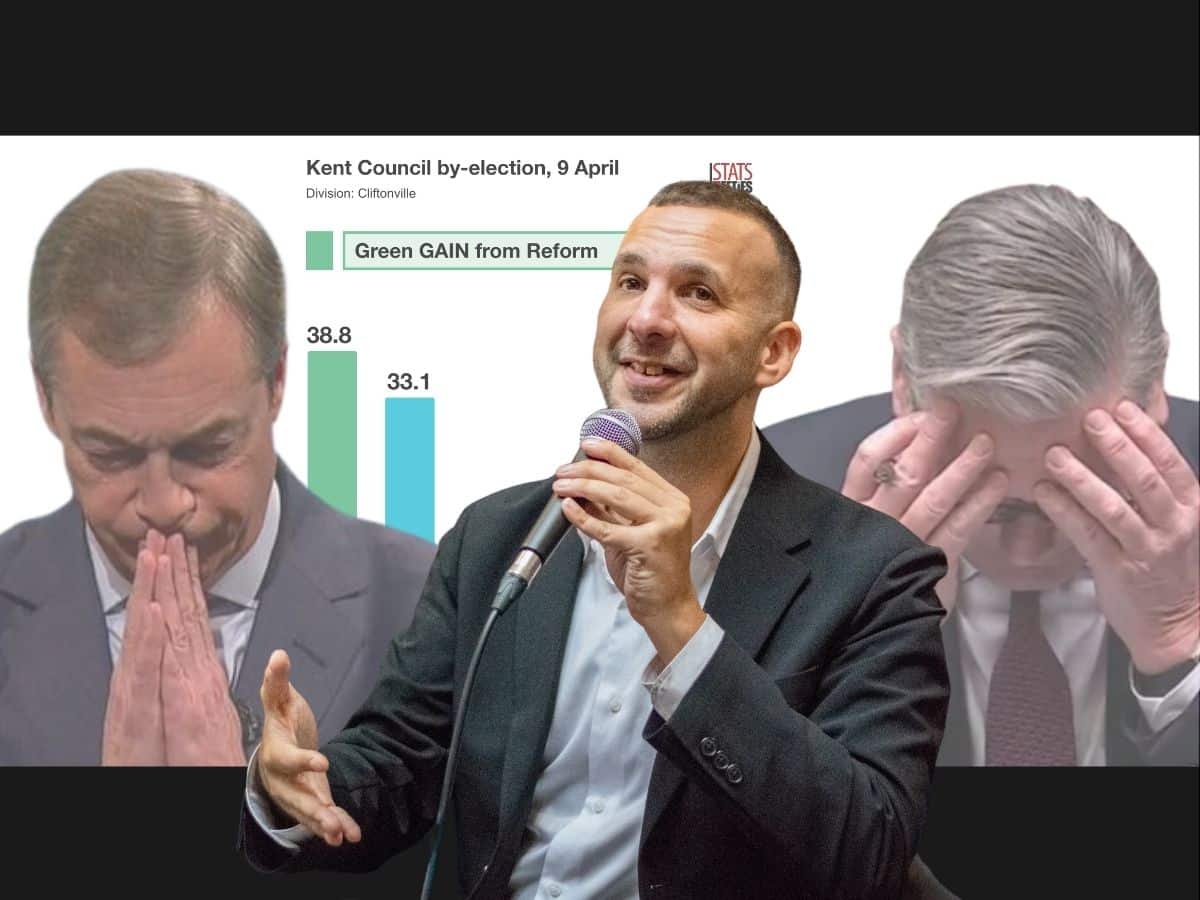
The problem is they keep proving themselves wrong — most recently in a Kent County Council by-election:
These people are genuinely addicted to lying.
Labour have deployed this “only Labour can beat Reform” line in 3 legislative by-elections, and…
➡️ Reform won Runcorn + Helsby
🏴 Plaid Cymru won Caerphilly
🟢 Greens won Gorton + DentonIt does not work! Why keep saying it?? pic.twitter.com/az7IKNun54
— Stats for Lefties 🍉🏳️⚧️ (@LeftieStats) April 10, 2026
Greens keep winning
The Greens secured an impressive victory over Reform in Kent — an area which had come to be seen as a Reform stronghold:
‼️Greens GAIN Kent council seat from Reform
🟢 Grn: 39% (+27)
➡️ Ref: 33% (-7)
🔵 Con: 15% (-4)
🔴 Lab: 10% (-12)
⚪️ Ind: 1% (-2)
🟠 Lib: 1% (-2)Ward: Cliftonville (+/- vs 2025 election) pic.twitter.com/JyzM7Gg3AB
— Stats for Lefties 🍉🏳️⚧️ (@LeftieStats) April 10, 2026
As it’s only been in Reform hands since May 2025, we guess it’s less of a ‘stronghold’ and more of a ‘limp-grip’ given that they’re already vacating their seats for the Greens.
In March this year, Labour List published the following:
Dame Emily Thornberry said the lesson from last time was that only Labour was in with a chance of beating Reform in Cliftonville.
She said:
“I’ve campaigned against Reform UK councils across the country, but this one in Kent is among the worst I’ve seen. They are hiking council tax when they said they wouldn’t, slashing vital services in Thanet, and the council leader was even caught screaming and swearing at her own colleagues.
“Labour came second here last time, so Cliftonville voters have a real chance to send Reform a message that Thanet won’t tolerate their public service cuts and shameless lies.”
In the end, Labour won fewer than half the votes that the Greens did. And if you look at how much vote share the Greens gained compared to how much everyone else lost, it looks like Zack Polanski’s party may be picking up votes from all of the other parties at this point.
In other words, if anyone should be arguing ‘only we can beat Reform‘, it’s the Greens. Except they shouldn’t say that; they should say ‘only the Greens are beating Reform‘, because that’s the reality we’re living in.
As Stats for Lefties added:
The problem with claiming “only Labour can beat Reform” over and over and over is voters have eyes. And whenever Labour goes up against Reform, they watch Labour eat shit. All they do is prove that they CAN’T beat Reform.
So voters think – maybe someone else can.
— Stats for Lefties 🍉🏳️⚧️ (@LeftieStats) April 10, 2026
People reacted to the victory as follows:
The Greens have won a Kent County Council by-election, called after Reform councillor Daniel Taylor was given a 12-month prison sentence after admitting to controlling or coercive behaviour towards his wife.
Green candidate Rob Yates won with nearly 39% of the vote.
— Mukhtar (@I_amMukhtar) April 10, 2026
Managed to say which party won but curiously left out which party the jailed councillor was from. https://t.co/rNdst2AlAf
— cez (@cezthesocialist) April 10, 2026
Reform’s disgrace
The Kent by-election occurred because an ex-Reform councillor was jailed for abusing his wife:
#Reform Councillor David Taylor JAILED.
“nasty and violent”.
“told his wife he would hunt her like prey and kill her, and that he would “put her in the boot and set fire to the car”.And STILL he was ‘vetted’ & ‘approved’ by #Reform as a candidate while this was all going on. pic.twitter.com/WhMox3ope4
— John O’Connell (@jdpoc) February 20, 2026
Kent is one of Reform’s key councils; it’s also the party’s most chaotic.
Infamously, Kent had to suspend four Reform councillors after a “chaotic meeting was leaked”. As Joe Glenton wrote for the Canary:
A spokesperson for the far-right party said they’d brought Reform UK into disrepute.
Which is quite a gallant argument given Reform UK didn’t have much repute to start with. Anyway, here’s a group of dysregulated middle-aged toddlers having an incredibly puerile row:
Kent Council also drew criticism for telling a local parish they couldn’t put Christmas lights up because they had Union Jacks on them (flags which went up as part of the flag mania which sweeped the UK in 2025).
Labour — Changes
Gone are the days when only Labour and the Tories were viewed as serious political entities. Now, voters don’t want to hear ‘only we can win‘; they want to know why a political party winning will benefit them.
Labour have no good answers on that front, which is why they can now only come third (at best!).
Featured image via Barold

Many people’s vitamin D levels do not fall within a healthy range, which can cause muscle weakness, fatigue, depression, bone pain and lower immune function. In fact, an estimated 60% of the world is vitamin D deficient and needs a supplement, Dr. Michael Holick, a professor of medicine, pharmacology, physiology & biophysics and molecular medicine at Boston University Chobanian & Avedisian School of Medicine, previously told HuffPost.
But if that alone isn’t enough to convince you to prioritise getting vitamin D, which you can do through foods like salmon, tuna, and milk, new research published in the journal Neurology this month may do the trick. The study suggests that people with high vitamin D levels in their 30s and 40s have lower dementia risk factors later in life.
The study investigates the potential impact of vitamin D levels in early midlife by examining the prevalence of tau protein and amyloid protein in the brain, “which are key hallmarks of Alzheimer’s disease,” Dr. Thomas M. Holland, physician-scientist and assistant professor at the Rush Institute for Healthy Aging at Rush University Medical Center in Chicago, told HuffPost via email. Holland is not affiliated with the study.
Researchers followed 793 people in their 30s and 40s with an average age of 39 over 16 years. Vitamin D levels were tested at the beginning of the study; those with levels below 30 nanograms per milliliter (ng/mL) were categorised as having low vitamin D; anything above was considered high.
After a follow-up at the end of the study, it was determined that participants in the high-vitamin D group were more likely to have lower tau levels in their brains.
“Researchers looked at two different types of scans of the brain called PET scans,” said Dr. David Gill, chief of the division of cognitive and behavioural neurology at the University of Rochester in New York. Gill is not affiliated with the study. “One looks at the amyloid protein [prevalence], and one looked at the tau protein [prevalence].”
Even though tau protein levels were lower in participants with high vitamin D, researchers found that those elevated levels did not impact levels of amyloid in the brain. This indicates someone with high vitamin D could still have elevated levels of amyloid protein, which, as mentioned above, is a characteristic of Alzheimer’s disease.
This study does have a “major limitation,” Dr. Jagan Pillai, a Cleveland Clinic neurologist and director of the Cleveland Alzheimer’s Disease Research Center, told HuffPost via email. Vitamin D levels were measured once at the beginning of the study “and after that PET scans were completed 15 or more years later,” said Pillai, who was not associated with the study..
“So, we don’t have any information in between,” Pillai added. It’s unknown if participants took supplements or followed a healthy lifestyle that helped them maintain healthy vitamin D levels, he noted. Because vitamin D levels were only measured once, it’s also unclear if someone shifted from having healthy levels to unhealthy levels (or the opposite) during the study’s time period.
While this study has solid data, it does not prove that vitamin D levels directly affect dementia risk, according to Gill. There are many studies on this topic, and they’re conflicting.
“Specifically, there’s been some studies to show that giving vitamin D might help improve memory a little bit, but those are also conflicting. There’s been all of this information out there without a firm understanding of whether there’s a real connection between low vitamin D and Alzheimer’s disease,” Gill said. “I don’t know this [study] answers that question, but it helps move us forward.”
So, does this mean having healthy vitamin D levels in your 30s and 40s will protect you from dementia? Not necessarily. But having healthy vitamin D levels can bolster many systems in your body, including the brain. And as research emerges about vitamin D and dementia risk, there are other changes you can make to take care of your cognition.

Anastasiia Voloshko via Getty Images
To lower your risk of dementia, there are certain rules you should follow in midlife and throughout your life.
Holland said the amyloid and tau brain proteins associated with dementia begin accumulating “15 to 20 years before the clinical symptoms of dementia or cognitive decline are detected.”
Anything we can do in midlife to support cognitive function and reduce the risk of dementia will “benefit us later in life,” Holland added. “We know that low vitamin D levels and other nutrient deficiencies are associated with neuroinflammation and potentially oxidative stress.” All of that can take a toll on your brain.
Throughout your life, you should work with your doctor to correct any vitamin deficiencies, whether that’s vitamin D, vitamin B12 or something else, according to Pillai.
Eating a nutrient-dense diet is also protective for the brain.
″For vitamin D specifically, adding in healthy protein sources, particularly fatty fish such as tuna, salmon, sardines and mackerel, can be beneficial,” Holland said.
“For overall brain health, incorporating foods such as dark leafy greens (i.e., kale, romaine lettuce, and spinach), berries (such as blueberries, strawberries, and blackberries), whole grains (like oatmeal, brown rice, and quinoa) and extra virgin olive oil is helpful, as these foods provide beneficial fatty acids and a wide range of supportive nutrients,” Holland continued.
Additionally, “we should be as physically active as possible,” Gill said.
This doesn’t mean signing up for a marathon, but can instead mean going for frequent walks in your neighbourhood.
“We should be doing things that challenge us mentally to keep ourselves mentally active,” Gill added.
For older folks, staying challenged can be tough — working is one of the easiest ways to stay mentally active, Gill said. For those who no longer work, taking a class, playing cards with friends, volunteering or joining a book club are all good options.
“Really, anything that you enjoy that engages your brain can be a good thing,” Gill said.
Socialising is also important.
“Being social is important for a number of reasons. We know the opposite, being lonely, is bad for our memory over time. And so being social is good for us because it keeps our brain active, but also avoids loneliness,” Gill said.
Finally, you should address any issues you have that could lead to dementia down the line.
“We should treat the medical problems that can increase the risk of Alzheimer’s disease,” said Gill, noting that “the things that increase the risk of heart disease tend to increase the risk of Alzheimer’s disease.” Diabetes, high blood pressure, smoking and high cholesterol are all issues that you should work with your doctor to treat, Gill said.

What happens when you put a half-soaked (allegedly) TV presenter in charge of the military? Well, Trump’s ‘secretary of war’ Pete Hegseth is doing his best to show us.
His latest nugget? Encouraging shipping companies to keep sailing through Iran’s Strait of Hormuz despite its re-closure because the US and Israel won’t stop slaughtering innocents. Because, y’know, Hormuz is safe. The only risk is getting hit by an Iranian missile.
You couldn’t make it up. Tragically for the world, you don’t need to:
Featured image via the Canary

On 9 April, Reform UK announced the winner of their ‘Free Energy Bill’ prize draw. As we noted at the time, it seemed to be an excuse for Reform to make life a little easier for a family who appeared to have it quite easy already:
Giving old wealthy people assistance while the rest of the UK suffers.
Classic Reform. https://t.co/GbbeelYWEb
— Canary (@TheCanaryUK) April 9, 2026
Since then, eagle-eyed investigators have noticed that this particular family have a history with Farage. Oh, and the police are looking into the raffle too. So all in all, things haven’t gone quite as well as they might have done.
Farage loyalists
Firstly, the prize-winning couple do seem to have a documented history of being around Farage. As political commentator Don McGowan noted (with help from the Yorkshire Lass account and Reform Party UK Exposed):
🗼WELL I NEVER🗼
Would you believe that Ray and June, who won the Reform UK energy bills prize, go back all the way to the Brexit Party with Farage?
Here they are with Farage, Widdecombe and Bull [a truly awful supernatural detective thriller].
What a coincidence [increasingly unlikely]
The point McGowan and others are making is that this longstanding history with Farage and his various political vehicles suggests these winners were likely hand picked by the party. In the same post, McGowan showed the following images which picture Ray, June, and Farage at the same event:
🗼WELL I NEVER🗼
Would you believe that Ray and June, who won the Reform UK energy bills prize, go back all the way to the Brexit Party with Farage?
Here they are with Farage, Widdecombe and Bull [a truly awful supernatural detective thriller].
What a coincidence [increasingly… pic.twitter.com/9VgIdB4wjP
— Don McGowan (@donmcgowan) April 10, 2026
McGowan also provided the following timeline:
<-> Ray and June Dibble are photographed at a Brexit Party rally in 2019 with Nigel Farage, Anne Widdecombe and David Bull.
<-> Ray and June nominate local councillor, Lee Moffitt as branch chair for Reform UK, Wigan.
<-> Ray and June win Nigel Farage’s energy bills competition.
<-> Additional info — Farage and Jenrick turn up at Ray and June’s house with a cheque for a VERY SPECIFIC amount of £1,758.
It’s almost as though the entire thing was orchestrated from the beginning.
What a surprise! The staunch Wigan branch members won.
It was pitched as a competition open to the general public in national press.
Reform will FIX it. pic.twitter.com/tXInAVkVes
— Reform Party UK Exposed 🇬🇧 (@reformexposed) April 10, 2026
Look, we’re going to be completely fair here. It seems reasonable to think that the sort of person who enters a Reform giveaway is almost certainly going to be the sort of person who likes and follows Farage. As such, the fact that the couple have been hanging around Nigel for years isn’t a smoking gun, as Reform themselves have argued:
Reform source says many of the party’s 270,000 members entered the competition.
“Is it a shock a member won? No.” https://t.co/ZNOJjihueC
— Kevin Schofield (@KevinASchofield) April 10, 2026
Back to being less nice, Reform have certainly given no reason to believe that they didn’t fix it.
And really, it didn’t take a genius to foresee that the draw would end up looking like a fix, even if they didn’t purposefully orchestrate one.
Of course your members would enter the competition, Nigel.
Of course people would call foul when one of them won.
Of course the inevitable outcry would overshadow any benefits from this little gimmick.
Some called the “competition” a cynical PR stunt.
Others said it was deflection from Farage’s Iran war flip-flop.
A few spotted the data harvesting.
Turns out it was far simpler: just a giveaway to their own Reform party members.
June from Wigan, congrats on ‘winning’!! https://t.co/FKvvpCOqHW pic.twitter.com/XDhCg04Uzl
— Luke Charters MP (@lukejcr) April 10, 2026
And as Mr Ethical noted, the way things have shaken out could in fact be criminal:
Since it would appear that Reform knew the winners of their energy scam, they have almost certainly committed a criminal offence. I don’t suppose anything will happen though. pic.twitter.com/xspFLWXuJj
— Mr Ethical 🚩 (@nw_nicholas) April 10, 2026
This is why political parties don’t usually do giveaways.
That and because they’re not daytime TV game shows.
It’s not surprising that Reform would ape light television, anyway, given that they’ve already stolen Jimmy Saville’s catchphrase.
GMP’s Reform investigation
As reported by the Telegraph, the police are now looking into the raffle. Greater Manchester Police have said:
We have received a report and are currently reviewing the matter.
It’s currently unclear what potential offences the police are looking into. Reform, meanwhile, have said they’re not worried, having previously solicited legal advice.
In all likelihood, nothing will come of the above, because UK electoral law is a joke. Clearly, however, political parties giving out cash prizes is not a sign of functioning democracy.
Featured image via Chatham House (Flickr)

Yet another right-wing, friends-of-Israel paedophile has been convicted — the latest in the seemingly endless production line of Zionist Labour child rapists and abusers. Former Dudley councillor — and “attack dog” for arch-Zionist Luke Akehurst’s ‘Labour First’ pressure group — Adrian Hughes has pleaded guilty to three charges of grooming children for sex.
Hughes, who now lives in Preston, admitted communicating with a 13-year-old girl about meeting her to touch her and “teach her about sex” in May 2025. Also in the same month, he admitted trying to persuade a 13-year-old girl to have sex. Finally, he confessed to sending a picture of himself nude to an even younger girl and asking her to meet and have sex.
During his time as a Dudley councillor, Hughes sat on the council’s Children’s Services Select Committee, the Children and Young Person’s Scrutiny Committee and the Children’s Corporate Parenting Board.
Hughes has locked his X account, but traces of his own support for Israel are still identifiable. In 2023, he described comments from Keir Starmer supporting Israel’s ‘right to defend itself’ by killing Palestinians as “reassuring”.
Broxtowe Alliance councillors and former Labour national executive member Mish Rahman pointed out financial support Hughes received from right-wing, pro-Israel MPs:
Labour Right MPs funded his campaign 👇https://t.co/z1Y8wNuP7A
— Broxtowe Alliance Councillors (@broxtoweindys) April 10, 2026
Spot the Labour First MPs who supported this cretin and used him as an attack dog – I can see three of themhttps://t.co/VCgCVsVaGy
— Mish Rahman (@mish_rahman) April 10, 2026
Two MPs with definite links to Labour First among Hughes’s donors include Gurinder Singh Josan, Akehurst’s right-hand man in Labour First and Russia hawk and “Labour First candidate” Phil Brickell. Also featuring is Josh Newbury, whose Cannock Chase seat is in Labour First’s West Midlands heartland.
The prevalence of paedophiles among the Labour right was not lost on respondents:
this way above the numbers of paedos you’d expect in a random cross section of people
— Diogenes 🇵🇸 (@Northern_cynic2) April 10, 2026
Hughes will be sentenced on 24 April.
Zionist Labour paedos — a long and growing list
Some commenters wondered whether paedophilia is an entry requirement for the pro-Israel Labour right. Not without reason.
Former Hackney councillor and Labour First organiser Thomas Dewey received 150 hours of ‘community service’ for possession of sadistic child rape images. Sam Gould, a former aide to Starmer’s health secretary Wes Streeting, received a suspended sentence for flashing a child and also an adult woman.
Israel fanatic and former Labour councillor Liron Velleman was convicted of sex offences with what he thought was a 13-year-old girl but turned out to be a police officer conducting a paedophile sting. Like many of his child-predator faction, he escaped jail. Some alleged Zionist paedophiles seem to escape consequences altogether. Former government minister Ivor Caplin is no longer even on bail after being caught — on camera — turning up to meet what he thought was a child for sex.
Some are accused but still awaiting trial. Starmeroid MP Dan Norris has been arrested — twice — for sex offences including rape and child-sex offences, including abduction. Former councillor Conor McGrath has been charged with possessing child-rape images after a ten-month police operation.
And the perversion is rife in the genocidal colony they all support, too. Israel is sheltering thousands of paedophiles and refusing extradition requests from their home countries’ police.
Extradition requests
Israeli cyber-spy boss Tom Alexandrovich was allowed to escape to Israel after meetings with US federal agencies. He had been caught in a paedophile sting. Israeli minister Orit Strook, her husband and son were accused by Strook’s daughter Shoshana of repeatedly raping her as a child and filming it. Shoshana Strook was found dead — ‘suicide’ — weeks after warning her followers that if she was found dead it would not be suicide — and days after hiring lawyers. Reports say that Israeli police are not pursuing the case against the family.
Featured image via the Canary
Taking place on Thursday 7 May, the 2026 local elections are fast approaching. If you’re an outsider party looking to do well, this is the moment when you want the maximum momentum. As such, it’s good news for the Green Party that they just hit a brand new milestone:
Victory rally in Margate this evening *and* an announcement!@TheGreenParty now has 225,000 members!
That’s an extra 25,000 since Hannah Spencer won last month and 2000 new members in the last 10 days.
Join the movement!https://t.co/0qbagSvIYp pic.twitter.com/naMXs1NysP
— Zack Polanski (@ZackPolanski) April 10, 2026
Reform, meanwhile, are embroiling themselves in an endless stream of scandals while sliding down the polls.
Mass membership
The Green Party’s membership has skyrocketed since Zack Polanski took over. As James Wright reported for us in October 2025:
Green Party membership has skyrocketed to 115,000 – a jump of 50,000 members since their recent leadership election. Meanwhile, the latest figures show Labour is losing a member around every ten minutes. In other words, they’ve been dropping 152 members a day. With that direction, it’s no wonder Labour is not releasing updated membership figures.
At that point, the party membership had nearly doubled. Since then, it’s almost doubled again. It would be a massive upset if it doubled once more from here, but we can’t rule anything out at this point.
Reform have also built a substantial membership, as the BBC reported in December 2025:
Reform UK claims it is now the largest political party in Britain, following reports Labour has lost more members.
According to the Times newspaper, external, internal figures show Labour’s membership has fallen below 250,000.
Reform said it had more than 268,000 paid-up members, which would mean it has overtaken Labour to become the biggest party by membership in the UK.
Labour refused to comment on the accuracy of the membership figures in the Times, with a spokesperson saying they would be published in the party’s annual report.
If the above figures remain accurate, the Greens could potentially become the largest party in the UK this year. This is especially true if they do well in the local elections, and they subsequently enjoy a post-ballot bounce like what they saw after Hannah Spencer became the MP for Gorton & Denton.
Green Party — On the up
As we reported, the Greens have pulled ahead of Reform in some polls:
‼️BREAKING | Greens surge into LEAD (1st!!)
🟢 Grn: 21.4% (+2.1)
➡️ Ref: 20.9% (-1.4)
🔵 Con: 20.5% (+0.2)
🔴 Lab: 17.0% (-0.4)
🟠 Lib: 9.2% (-1.9)Poll: @LordAPolls, 26-30 Mar (+/- vs 19-23 Feb) pic.twitter.com/oDVw4cDaFC
— Stats for Lefties 🍉🏳️⚧️ (@LeftieStats) April 5, 2026
Lord Ashcroft is far from the most well-respected pollster, but other polls are showing that the Greens have overtaken Labour and the Tories while Reform stagnate:
‼️POLL | Reform lead by 5%
➡️ Ref: 25% (-1)
🟢 Grn: 20% (=)
🔵 Con: 17% (-1)
🔴 Lab: 16% (+1)
🟠 Lib: 11% (+1)— Seats —
➡️ Ref: 331
🟢 Grn: 115
🟠 Lib: 78
🟡 SNP: 48
🔵 Con: 37
🔴 Lab: 11Poll: @findoutnowUK, 8 April (+/- vs 1 April) pic.twitter.com/Ir8NcrnNwM
— Stats for Lefties 🍉🏳️⚧️ (@LeftieStats) April 9, 2026
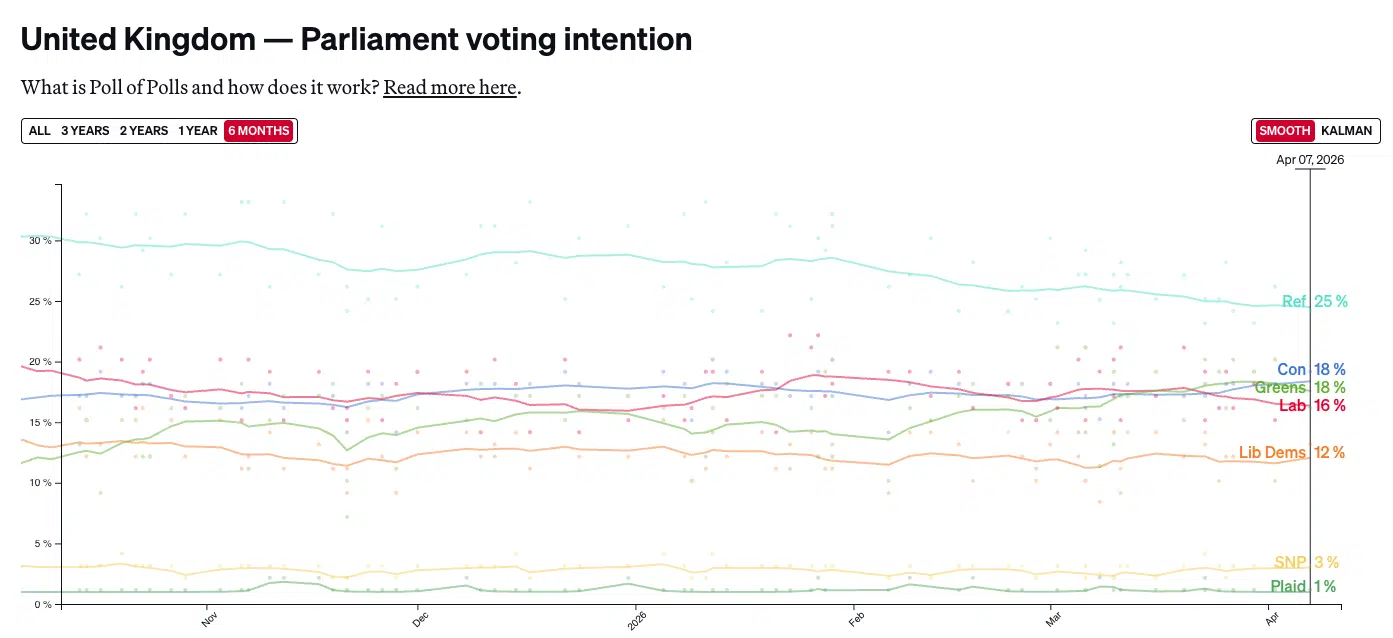
Individual polls might not tell us much, but looking at all the polls over time gives an idea of which way the wind is blowing. On the topic of momentum, Politico’s poll of polls shows that the Greens are on up the up while Reform have squandered their lead (the sort of lead which could have won them a majority):

Results
Regardless of momentum, Reform could still outperform the other parties in the local elections — Green Party included. This is what Elections Etc predicted in March:
‼️NEW | Projected seat change in local elections:
➡️ Ref +2,260
🟢 Grn +450
🟠 Lib +200
🔵 Con -1,010
🔴 Lab -1,900(Source: Stephen Fisher / @ElectionsEtc) pic.twitter.com/pkPixJ3Ont
— Stats for Lefties 🍉🏳️⚧️ (@LeftieStats) March 30, 2026
We do know that polling has often failed to reflect Green support — most notably in the Gorton & Denton by-election, where the party outperformed all expectations (encouraging another 25,000 people to become members).
We could see similar in the local elections, but even if we don’t, the more councils Reform run, the more the endless scandals will increase, because these people are terrible at being in power. This is dreadful for the areas that will suffer, of course, which is why we should all do what we can now to keep Reform out of power.
Featured image via Barold

If you’ve ever left the house only to wonder whether you turned off the stove or unplugged your curling tongs, you’re not alone. However, this uncertainty doesn’t have to be your destiny.
In Japan, railway operators use a simple but powerful technique to avoid mistakes. And this method might be exactly what you need to stay focused on everyday tasks. It’s called “shisa kanko”.
“Shisa kanko essentially means ‘pointing and calling,’ which is used to improve attentiveness and accuracy,” said Joy Gallon, a licensed therapist with Thriveworks. “It was developed as a method of ensuring safety on the Japanese railway system. Operators are trained to focus on and point at an object such as a signal or stopping point and verbally ‘call out’ the name of the object.”
Research by Japan’s Railway Technical Research Institute in 1994 found that the practice of shisa kanko reduced incidents of human error by almost 85%.
“Because the practice uses eyes, hands, mouth and ears, it actively engages the senses,” Gallon said. “Studies have shown that it increases the blood flow to the frontal lobes, which is where our reasoning, logic and ability to see future consequences of current actions lie.”
In other words, it’s a multimodal system for attention and memory.
“The brain has to see something, say something and do something, so we are using our visual system, our motor system and our auditory system,” said therapist Rachael Bloom. “This reduces error because if one ‘system’ fails, there are two backup systems that have the same information.”
This approach is important for high-stakes daily tasks such as operating a train system – as well as smaller, mundane things like using a curling iron.
“Our brains are built for survival, so we spend a lot of time operating based on habit,” said time management coach Anna Dearmon Kornick. “When we take actions based in habit, we expend less cognitive energy, which allows us to preserve energy.”
Daily routine tasks like curling your hair tend to happen in autopilot or default mode, which means you don’t tend to remember them as clearly. That’s why so many people end up with uncertainty around questions like “Did I unplug my curling iron?” or “Did I turn off the stove?”
“Introducing something that is not part of the default mode helps you remember it,” Dearmon Kornick said. “A non-default mode action could be making a weird sound, snapping your fingers, clapping your hands or singing a song, which helps you stay more conscious.”
So while it might feel silly to point and make a sound at once, the shisa kanko method can be incredibly effective by bringing greater awareness to consequential tasks.
“It requires you to make two or more physical ‘checks’ or confirmations of your actions,” said Rashelle Isip, a productivity coach at The Order Expert. “These checks shift your thoughts into the realm of physical action, which requires more effort. This might mean pointing, picking up an item or speaking aloud.”

In addition to improving safety in different industries, shisa kanko can help with personal focus or error prevention.
“I’ve used aspects of this method to help me improve my focus or anchor myself during the day while performing everyday tasks like making phone calls, exercising or getting ready for the day,” Isip said.
It’s another way to engage in mindfulness overall.
“When we are present, or mindful, we notice our surroundings better, are able to see the potential for error and course correct,” Gallon said. “Shisa kanko involves literally pointing at the object and naming it, which essentially grounds us in that moment.”
This method may be especially helpful for people with ADHD
A method like shisa kanko could be particularly helpful for people with ADHD or other forms of neurodivergence that impact focus and memory.
“When the ADHD brain finds stimulation, it also finds regulation,” said Billy Roberts, a therapist at Focused Mind ADHD Counselling. “By engaging multiple senses, the ADHD brain can become more engaged in that behaviour. Think of it as a form of active listening. If a person with ADHD repeats what was just said, the words will be encoded better due to repetition.”
Terry Matlen, a psychotherapist and ADHD consultant, noted that some of her clients with ADHD sing a short verse of a song to help them remember certain things. For example, they might take the tune of “London Bridge Is Falling Down” and sing “Need to turn the oven off, oven off, oven off ….”
“Executive function is impaired to some degree in everyone with ADHD – planning, organising, initiating, memory,” Matlen said. “So simply thinking to yourself, ‘I need to remember to turn off the stove after I finish cooking,’ just might not be enough.”
“I often talk out loud when needing to remember something – i.e., ‘call back Susan, call back Susan,’” she added. ”You can add another modality to saying things out loud, like tapping your wrist while saying it. Or in the case of traditional shisa kanko, pointing and verbalising.”
The experts who spoke to HuffPost agreed that shisa kanko helps people with ADHD by increasing conscious attention. Some noted that dopamine may play a supporting role as well, though more research is needed to fully explore that.
“Vocal stimming – like humming or singing – can increase dopamine and enhance focus for some people with ADHD,” Roberts said. “Humming and singing can be grounding when a person feels overwhelmed or anxious.”
Experts emphasised that it’s not just about making noise but what that action represents or accomplishes – for example, self-soothing.
“Self-stimulatory behaviours, including vocal stims, can release dopamine because they work with the part of the brain that deals with reward – but not simply because someone is ‘making a sound,’” Bloom noted.
In this sense, making a particular vocal expression is more about calming down your nervous system, self-regulating, self-motivating or breaking out of boredom. But a dopamine release related to shisa kanko might also simply be associated with accomplishing a task.
“Every time we knock even something small off our to-do list, we get a hit of dopamine and feel really good,” Dearmon Kornick said. “So if you decide to make a weird noise as you unplug your straightener, you might get the dopamine release of ‘Woo! I did what I said I was going to do.’”
There are many ways to incorporate shisa kanko into everyday life
There are ways to incorporate the method or even the spirit of shisa kanko into your everyday life.
“Try using this technique to reinforce the importance of information or actions in your daily routine,” Isip suggested. “Maybe you don’t want to forget your glasses before you leave for work or you don’t want to ignore an important letter on your desk. That might mean speaking aloud, picking up an object, handwriting a note, snapping your fingers or adding a reminder to a notetaking app.”
You can experiment with different approaches and find which ones work for you.
“Someone with ADHD could apply this to virtually everything they frequently forget to do – taking medication, packing what they need for the day, remembering daily tasks,” Bloom said.
“People with ADHD are most likely to forget or make mistakes on tasks that are repetitive, mundane and non-urgent, so using strategies that disrupt autopilot to ensure accuracy with this type of task makes a lot of sense.”
It can be as simple as pointing at your door handle and saying, “I’ve locked the door,” or at the light switch and saying, “I’ve turned off the lights,” as you leave the house. Or maybe you point at your keys and wallet and say “keys” and “wallet” to remember to bring them with you.
“Another option is to use it whenever you’re feeling overwhelmed, frustrated or stressed,” Isip said. “You probably already use some form of this technique in your daily life to help you refocus your attention and balance your thoughts. That might look like saying aloud, ‘Take a deep breath and relax,’ ‘You’ve got this!,’ ‘Time to get back on track,’ ‘OK, where were we?’ or ‘Let’s take it from the top.’”
Bringing mindfulness to these moments helps you regain a sense of calm, focus and agency.
“Use a meditation involving noticing and naming objects in the environment around you, combined with a reinforcing phrase and/or gesture to help manage negative thoughts and improve concentration,” Gallon said.
She noted that many therapists recommend a grounding strategy that guides you to name five things you can see, four things you can touch, three things you can hear, two things you can smell and one thing you can hear.
“Shisa kanko has been touted as a ‘habit hack’ for fighting bad habits such as doomscrolling, which we know can be very detrimental to a person’s mental health,” Gallon added.
Of course, it takes practice and time to successfully implement any strategy to the fullest. So be patient as you explore this method.
“You can make use of elements of shisa kanko in everyday life by using it to confirm, reinforce or anchor either a habit, information or skill,” Isip said. “Try using it when starting or ending your workday, transitioning between tasks, confirming appointment details, paying for goods and services or even motivating yourself to act.”
She suggested saying phrases aloud along the lines of “Time to get to work,” “The appointment is April 16th at 10 AM” or “Let’s have a good workout session!”
Shisa kanko can be useful for avoidance-ridden behaviours, Matlen noted. People with ADHD in particular tend to struggle to start a task, stay on task and/or finish the task.
“An adult with ADHD who is facing an unpleasant task causing them angst and anxiety – say, de-cluttering their desk at work – might point to one piece of paper falling off a pile of reports and say aloud, ‘I’m going to put that page into that folder in that file cabinet.’ Then continue from there, perhaps setting a timer for 15 minutes,” she explained.
Thus, the system can help alleviate procrastination, avoidance and stress. Make sure to change things up periodically, however.
“If you start singing the same song or doing the same snaps or making the same weird sound every time, eventually that sound is going to become a part of the default experience, and you’re not going to remember if you made the sound because you always do,” Dearmon Kornick warned.
Ultimately, shisa kanko is a dynamic approach. The method might not be right for you, but it doesn’t hurt to try it out.
“Every ADHD brain is different,” Roberts noted. “What works for some might not work for others. It is critical to understand that if a skill works, keep it. But if a skill doesn’t work, then maybe you and that skill aren’t a good fit. It’s fine to leave it be and find another!”

Is Louisville basketball big Vangelis Zougris in NCAA transfer portal?

How Quiet Failures Are Redefining AI Reliability

Escaping the Rat Race: What School Failed to Teach You About Money.


-

 Business6 days ago
Three Gulf funds agree to back Paramount’s $81 billion takeover of Warner, WSJ reports
-

 Sports7 days ago
India men’s 4x400m and mixed 4x100m relay teams register big progress | Other Sports News
-

 Politics21 hours ago
US brings back mandatory military draft registration
-

 Fashion21 hours ago
Weekend Open Thread: Veronica Beard
-

 Tech4 days ago
How Long Can You Drive With Expired Registration? What Florida Law Says
-

 Business6 days ago
No Jackpot Winner, Prize to Climb to $231 Million
-

 Fashion5 days ago
Massimo Dutti Offers Inspiration for Your Summer Mood Board
-
 Sports22 hours ago
Man United discover Nico Schlotterbeck transfer fee as defender reaches Dortmund agreement
-

 Fashion4 days ago
Let’s Discuss: DEI in 2026
-

 Crypto World3 days ago
Bitcoin recovers as US and Iran Agree a Ceasefire Deal
-

 Crypto World2 days ago
Canary Capital Files SEC Registration for PEPE ETF
-

 Business18 hours ago
Tesla Model Y Tops China Auto Sales in March 2026 With 39,827 Registrations, Beating Cheaper EVs and Gas Cars
-

 Business7 days ago
Akebia Therapeutics, Inc. (AKBA) Discusses Pipeline Progress and Strategic Focus on Kidney Disease Treatments at R&D Day – Slideshow
-

 Business1 day ago
OpenAI Halts Stargate UK Data Centre Project Over Energy Costs and Copyright Row
-

 Tech5 days ago
Gamer Restores the Original PlayStation Portal From Two Decades Ago
-

 Tech5 days ago
Haier is betting big that your next TV purchase will be one of these
-

 Politics1 day ago
Malcolm In The Middle OG Turned Down ‘Buckets Of Money’ To Appear In Reboot
-

 Tech5 days ago
The Xiaomi 17 Ultra has some impressive add-ons that make snapping photos really fun
-

 Tech5 days ago
Samsung just gave up on its own Messages app
-

 Tech5 days ago
Save $130 on the Samsung Galaxy Watch 8 Classic: rotating bezel, sleep coaching, and running coach for $369
You must be logged in to post a comment Login