
Sports
Fiorentina Banned Away Shirt Became Football’s Most Controversial Kit

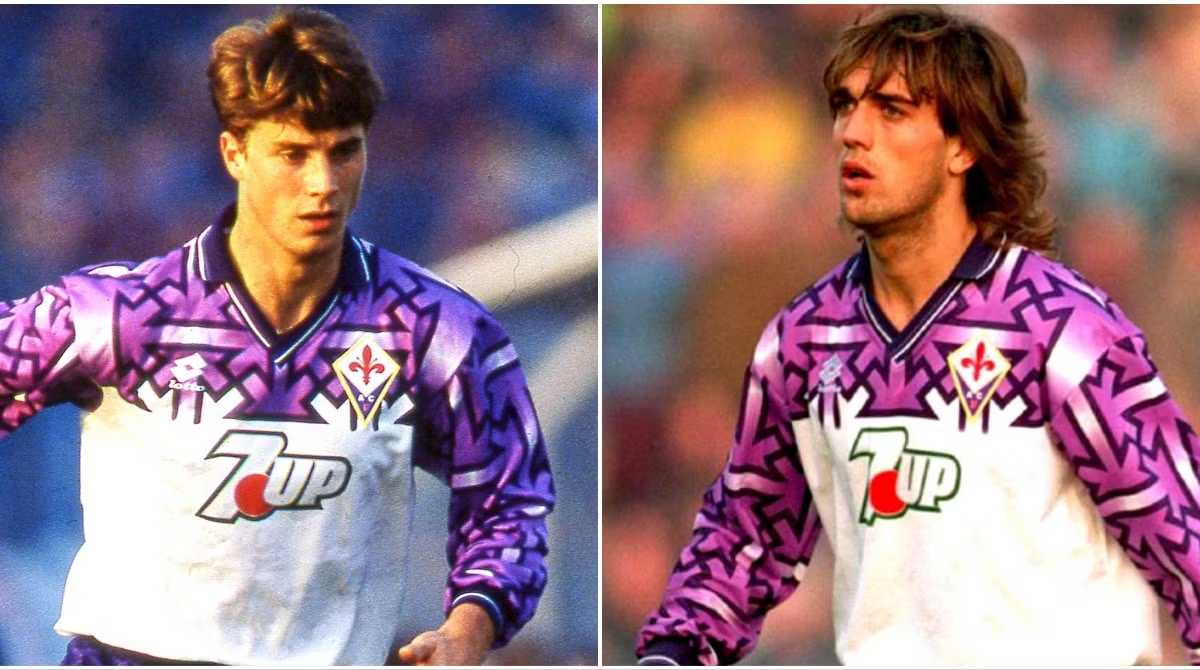
With football clubs releasing brand new kits every single year, it can be hard to always churn out great new shirts that manage to satisfy everyone. It is even harder, though, to release a shirt so controversial that it ends up being banned just months after it was released – but that’s what Fiorentina managed to do in 1992.
There have been numerous football shirts throughout history that really missed the mark. Some cracking examples of that include Manchester United’s grey shirt from 1996 that they removed halfway through their contest with Southampton, and Barnsley’s home kit from a couple years ago that more closely resembled a rugby shirt than it did a football one. While Getafe’s 2009-10 home strip, which had a wild Burger King print inside of the shirt, will be forever recalled as a shocking moment in sport fashion.
These kinds of shirts are remembered for all the wrong reasons but manage to live on in infamy, and the Fiorentina away kit from 1992 is no different. In fact, La Viola’s disastrous shirt may be one of the most controversial of all time.
What Fiorentina’s 1992/93 Away Shirt Looked Like
It featured an eye-catching pattern
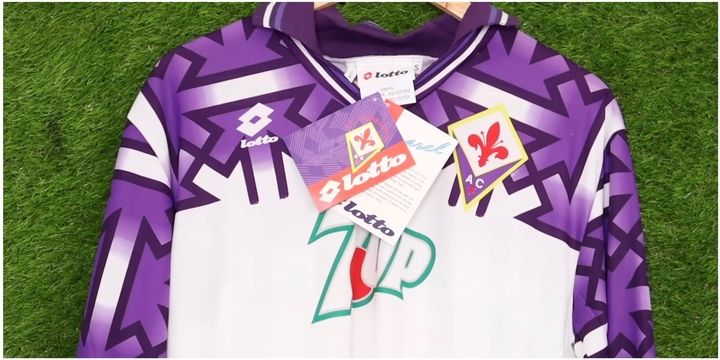
At first glance, there doesn’t appear to be too much wrong with the Fiorentina shirt. With the majority of the body just plain white, the club’s then-logo 7 Up was plastered in the middle and the shirt’s top third and shoulders were covered in purple with a peculiar-looking pattern spread across it.
Nobody saw much wrong with the shirt immediately, but after a few months and several appearances from Serie A side in the kit, fans noticed something rather sinister about the pattern scatted across the top third of it.
While it may have been accidental, the pattern used on the shirt looked awfully similar to the swastika, the infamous sign of the Nazi Party, and it quickly outraged many in football. Fiorentina claimed the design was a mere accident, and there was no intention for the design to look so similar to such a controversial symbol, but it was something that couldn’t continue being shown.
Fans were incensed by the similarities and the club had to act quickly to appease their supporters and prevent upsetting anyone else in the football world.
Shirt Was Banned Due to Controversial-looking Symbols
It was banned by the Italian Federation for its eyebrow-raising pattern
While it’s fair to assume that Fiorentina and Lotto, the team behind the design, didn’t intend for the patterns on the shirt to resemble the swastika, it did, and the players were quickly banned from playing in the kit once the situation was brought up.
Surprisingly, according to The Guardian, fans didn’t actually notice how closely the shirt’s pattern suspiciously looked like swastikas for several months, with the first complaints only really coming in December 1992. It didn’t take long for the club to release an official statement, addressing the controversy, where they denied any intention to showcase swastikas on their kit, claiming the incident was a mere coincidence. A spokesperson said:
“Fiorentina and the manufacturers, Lotto, would like to underline that the optical [swastika] effect is purely a matter of chance.”
The club played the remainder of the season in a completely different kit, and it was taken off sale quickly. There are still a number of shirts out in circulation, though, with the controversial strip now treated as a collector’s item for fans who like to collect shirts.
Away Shirt Not the Only Wild Thing About Fiorentina’s 1992-93 Season
La Viola were eventually relegated in the same season
Revealing a shirt as controversial as their away one in 1992 should have been a good indicator for the wild year that Fiorentina were about to embark on, but no one could have seen the disastrous season that was on the horizon.
After starting the season fairly well, with just three losses in their first 13 league games, the season capitulated shortly after the club banned their controversial away shirt, and they lost nine of their next 21 games as the season unravelled.
La Viola went on to be relegated to Serie B at the end of the season, but it wasn’t quite that straightforward. The club tried everything in their power to avoid the drop, and four different managers took charge of the team that year, with Luigi Radice, Aldo Agroppi, Luciano Chiarugi and Giancarlo Antognoni all step into the dugout at some point during the season.
None of them could work their magic, though, and Fiorentina finished 16th and were relegated on goal difference. Bizarrely, only four teams in the entire Serie A scored more goals than the club’s 53 that season, with firepower clearly not proving to be an issue. It was their defence that let the club down, with only two sides conceding more than their 56 goals that year.
The season was filled with ups and downs, with some monumental wins such as their 7-1 victory over Ancona early in the season and their 6-2 win against Foggia on the final day of the season the highlights, but they were also on the receiving end of some brutal results, losing 7-3 to AC Milan just two games after they put seven past Ancona themselves.
They would also suffer a 4-0 loss to Udinese, while beating Sampdoria 4-0 themselves. It was a real mixed bag of a year, with some incredible displays, far outweighed by the disappointing turnouts. It was a season very few could have predicted, but after they got off to the most controversial of starts with that disastrous away kit, it’s quite fitting that the season played out the way it did.



