The German national team’s sporting director, Rudi Völler, stressed in a weekly sports talk show recently, that while no gag order would be imposed on anyone, “it cannot be that it’s being talked about, practically on a matchday like with this disaster in Qatar.”
Germany were met with a lot of criticism for their gesture in Qatar, but Jürgen Mittag, a professor of sports politics at the German Sport University Cologne, believes had they made the quarterfinals things might have been different.
“But as it was, they were met with a great deal of ridicule because they were symbolically strong but sportingly weak,” Mittag told DW.
Advertisement
Germany’s protest ahead of the Japan game in Qatar was met with a lot of criticismImage: Alexander Hassenstein/Getty Images
EU weakens Germany’s stance
The hope is that in the United States of America, Canada and Mexico Germany will perform better on the field, but what does that mean for their stance off it?
Michael Mutz, a professor of social sciences in sports at the Justus-Liebig University Giessen, doubts that any political statement will be made.
“I can’t imagine that the DFB (German Football Association) will actively pursue a political agenda against the host country again after the negative experiences in Qatar,” Mutz told DW.
“The DFB is exposing itself to accusations of double standards because it criticized the situation in Qatar so harshly and will now presumably remain silent about the US, but the association will have to accept that.”
Advertisement
Mittag believes Germany’s postion is weakened by the current state of the European Union. The bloc is now further challenged by Donald Trump’s new round of tariffs on six member states as well as the UK and Norway who sent troops or officials to Greenland — which Trump is intent on acquiring — for security purposes.
“European democracy is also suffering a little… it is becoming increasingly fragmented and is therefore somewhat less capable of acting in foreign policy. This applies to the big picture as a whole, as well as to the internal sphere of football and other sports-related matters,” Mittag explained before the tariffs, set to start on February 1, were announced.
“Germany has been very proactive in sports diplomacy in recent years, but has also found that although it plays a prominent role, it doesn’t receive much support,” Mittag added.
Mittag cites the example of Germany’s stance on Russia and Belarus’s return to the Olympics. Germany petitioned hard against this and tried to forge a strong alliance, but only received minimal support. Mittag believes this defeat has hurt them, and forced them to reconsider their approach.
Advertisement
“That’s when Germany realized that it needs to pursue a different strategy. It doesn’t want to give up its position, but placing too much emphasis on moral, value-based issue is strategically clumsy. So, in the end, it does not lead to success and then you even have to put up with scorn or schadenfreude when you perform poorly in sporting terms,” Mittag explained.
Andreas Rettig (right) meets with DFB President Bernd Neuendorf (left) and Germany’s former Economic Affairs and Climate Action minister Robert HabeckImage: Dominik Butzmann/BMWK/picture alliance/dpa
Political shift in sports diplomacy
Andreas Rettig, an outspoken sports executive who used to work at St. Pauli, was appointed as the new DFB’s CEO in 2023 and may be the perfect person to forge new alliances and better position Germany in committees. Even he has come up against challenges though. Rettig’s attempt to initiate a dialogue on critical issues ahead of the 2024 Euros was not met with much enthusiasm by regional associations.
Others in Germany have been loud, though. St. Pauli President and DFB Vice President Oke Göttlich recently told Sportschau: “Personally, I would advise against traveling given the current situation in the country.”
After Bayern Munich’s Champions League win over Union Saint-Gilloise, Bayern and Germany captain Joshua Kimmich said he would “no longer be taking part in the political discussion.”
The DFB have yet to comment.
Advertisement
“There has been a realpolitik shift in sports diplomacy, it’s somewhat less value-based, somewhat more realistic and acting pragmatically in order to perhaps achieve more success than in the past,” Mittag added.
Jürgen Mittag believes that Germany can have a more effective strategy by winning over associations and committeesImage: BEAUTIFUL SPORTS/Wunderl/picture alliance
Viewership might drop
The January protests against the Trump administration’s clampdown on illegal immigration – including a decision by the US justice department not to launch a criminal civil rights investigation into the fatal shooting of Renee Good by an Immigration and Customs Enforcement (ICE) officer in Minneapolis on January 7 – have increased tensions in many places.
Given that Germany’s viewership dipped for the World Cup in Qatar, it wouldn’t be a surprise to see another drop this summer, particularly given the difficult kickoff times for European viewers.
“I believe that we will not see the same viewing figures as in previous World Cups,” Mittag said.
“I would actually assume that broadcasting and media behavior will also reflect the fact that a lot of people in the summer of 2026 will say, ‘I’m aware of this World Cup, but I’m not going to watch it all. I’m not as enthusiastic as in previous years, and in a small way, I’m expressing my criticism.’”
Advertisement
What is clear is that the moment Germany touch down in the United States, players and staff will have to answer questions about playing a tournament in the current political and social climate. The strength of their answers will depend on many factors, but perhaps most of all on how well they play on the field.
“The decisive factor for identification with the national team is not so much the political situation as the fact that the DFB team is perceived as a likeable, approachable, and successful team,” Mutz explained.
“Certainly, there is also a growing awareness in society that we are living in times of crisis and that political opinions are highly polarized. Especially in these times, the national football team could be an important anchor point for identification and the experience of belonging and community—across all social groups and political camps. However, football’s ability to bring different people together is weakened when the national team is perceived as too political.”
Edited by: Chuck Penfold
Advertisement
This article was updated on January 26, 2026 to include the statement from the St. Pauli President.
After a season of turmoil, at last some light at the end of the tunnel for West Ham.
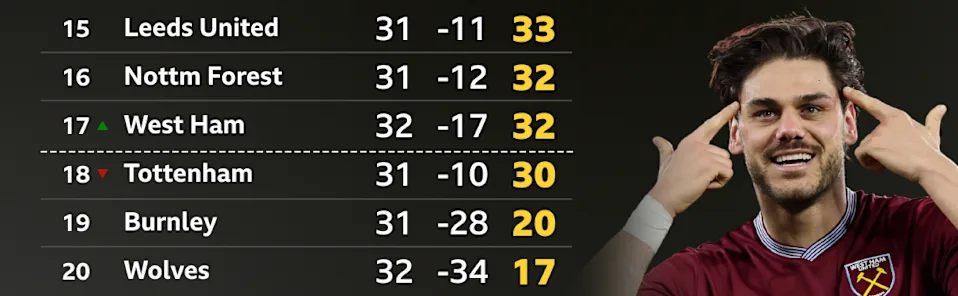
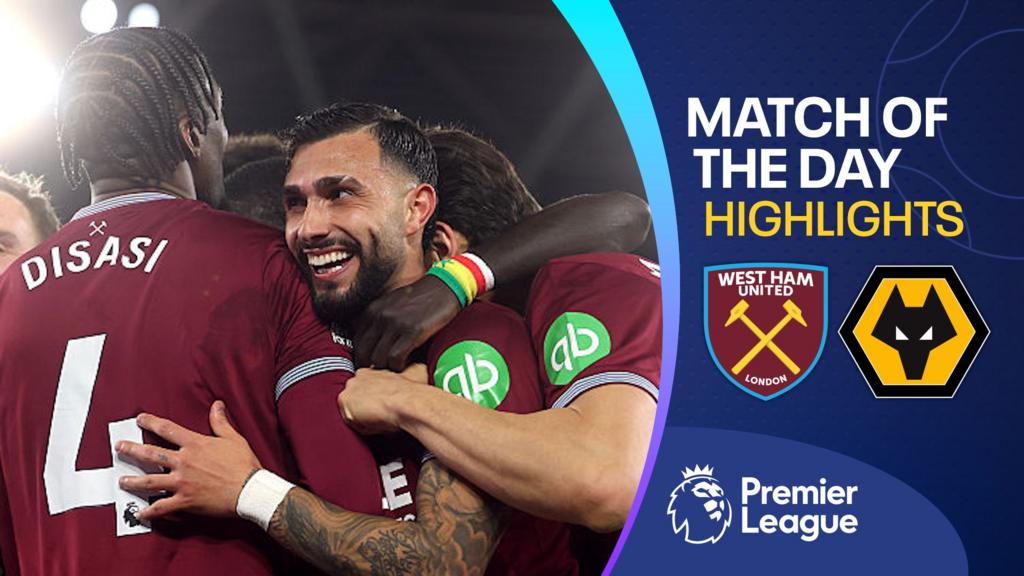
Friday’s thumping 4-0 win over Wolves – their biggest of the season so far – lifted West Ham out of the Premier League relegation zone, and plunged London rivals Tottenham into it.
Advertisement
Just three points now separate four teams in the battle to avoid the third relegation spot, with Wolves and Burnley both cut further adrift.
Advertisement
West Ham manager Nuno Espirito Santo insisted there was still “a lot of work to do” – but enjoyed a “big step” towards safety after Taty Castellanos and Konstantinos Mavropanos both scored twice at London Stadium.
“We are happy, extremely happy,” he told Sky Sports. “All of us deserve this kind of evening, especially our fans.
“The London Stadium today was amazing, bouncing with energy and helping us in the hard parts.”
Advertisement
Advertisement
But while West Ham fans were bouncing, Tottenham supporters watching at home were likely slumping further into their armchairs as each goal went in.
Spurs, who face Sunderland on Sunday in new boss Roberto de Zerbi’s first game in charge, are now in completely uncharted territory.
So what next?
A place Spurs have never been before
While Spurs have flirted with the bottom three for the past two seasons – even during their spectacular run to Europa League glory only 11 months ago – this is the first time they have actually occupied the relegation zone since 2015.
On that occasion, the league season was only one game old and Tottenham – then managed by Mauricio Pochettino – had lost their opener against Manchester United, but recovered to finish the campaign in third place.
Advertisement
Advertisement
To find the last time Spurs were in the relegation zone past the midway point of a campaign, you have to go back to February 1998 – when they sat 18th after 24 games.
But after 31 matches? That has never happened in the Premier League era. This is another new low.
What will worry Spurs fans even more is that across 31 Premier League seasons, a team occupying 18th place after 31 matches has been relegated on 21 occasions.
Advertisement
[BBC]
“When I look at the Tottenham team… where’s your match-winner? Who’s going to win you the game?” said ex-Spurs midfielder Jamie Redknapp on Sky Sports.
“When I look at Jarrod Bowen and Crysencio Summerville, they have moments – that’s the important thing.
Advertisement
“And that’s now put almighty pressure on Tottenham Hotspur, who have to go and beat Sunderland in their next game. That’s not an easy fixture.
Advertisement
“Anything can happen. There will still be twists and turns. West Ham have only got to lose their next game at Crystal Palace next week and they’re right back in it.
“It’s very difficult to predict. But you need calm heads and what West Ham did today – look a threat from set-pieces, a real threat from your best players – you give yourself a real chance.”
After their trip to the Stadium of Light, four of Tottenham’s six remaining games are against teams in the top half of the table. They still have to go to Aston Villa and Chelsea, both chasing Champions League football.
Advertisement
Advertisement
But while the stats suggest 18th position is not the place to be after 31 games, not all the data is doom and gloom for Spurs.
Of the 17 times a team has been on 30 points after 31 games (Tottenham’s current tally), only six were relegated. It is something to cling on to.
Which other teams are battling for survival?
There are sure to be plenty more twists and turns in the final weeks of the season.
But, after their hard-fought and well-deserved win against Wolves, West Ham’s players can at least breathe a sigh of relief as attention turns to their relegation rivals – Leeds United, Nottingham Forest and Spurs – for the rest of the weekend.
Advertisement
Advertisement
Up first are Forest, who host Champions League-chasing Aston Villa at 14:00 BST on Sunday, after a gruelling Europa League quarter-final first leg against Porto on Thursday.
Later in the day, Spurs, as mentioned, will have to inflict just a fourth home defeat of the season on an impressive Sunderland side if they are to move out of the relegation zone at the first time of asking.
Leeds – one point and two places above West Ham – round off the weekend’s fixtures on Monday when they travel to Manchester United.
Advertisement
But it will not be easy against one of their fiercest rivals – Daniel Farke’s men have not won at Old Trafford in the league since 1981.
Advertisement
A favourable weekend of fixtures for the Hammers then?
It is little wonder West Ham captain Jarrod Bowen admitted he would be keeping a close eye on the television over the weekend.
Advertisement
“I’ve got three kids to entertain but I will keep an eye on the games,” added Bowen. “We have a bit of time before the game against Palace then go again.
“The spirit, the togetherness is so important in this situation. You can always have quality, but you need grit and desire and a will to win through the whole squad.
“The only thing we know as a club is to keep fighting and doing what we’re doing and take it into the next six games.”
Opta’s supercomputer still predicts that West Ham are more likely to finish in 18th than Tottenham [BBC]
Edwards sticking to ‘same message’ – but was this it for Wolves?
While those above them continue to battle it out for Premier League survival, it looks almost certain that Wolves’ race is run.
Advertisement
Advertisement
Fifteen points from safety with just 18 points left to play for, their relegation could be confirmed as early as next Saturday if results go against them.
They have been made to pay for a dreadful first half of the season, failing to win any of their opening 19 games and picking up just three points in the process.
Defender Ladislav Krejci apologised to the fans after their defeat at London Stadium – “not just for this game but the situation in the table”.
Advertisement
But manager Rob Edwards would not be drawn on whether it was a result that killed any remaining hope.
“For us it is the same message,” he told Sky Sports. We have to try to finish strong, respect every game and go for it.
Advertisement
“We are all under the microscope and we have to make sure we perform.”
Galatasaray look to take a step closer to a fourth consecutive league title when they host a weaker Kocaelispor at the Rams Park Stadyumu on Sunday in the 29th round of the 2025-26 Super Lig campaign. The Lions have remained atop the league table for almost the entirety of the league season and now need a couple more wins to finish the job.
Galatasaray suffered a disappointing loss to third-placed Trabzonspor last weekend, but returned to winning ways on Wednesday with a comfortable 3-1 win over Goztepe, retaining their four-point cushion above Fenerbahce and Karadeniz Fırtınası.
Thanks for the submission!
Advertisement
Okan Buruk’s side have clearly missed the presence of star striker Victor Osimhen, who is out injured with a broken arm, but will hope to continue their charge to match their own record for consecutive league titles (4).
Advertisement
Kocaelispor, on the other hand, would have begun the season with the aim of securing survival in their first campaign back in the Turkish top flight since 2008-09, but have exceeded expectations, currently sitting in eighth place as they chase a top-half finish.
The visitors have only one win from their last six games following a goalless draw with Istanbul Basaksehir on Monday and will need to make major improvements when they visit a much better side.
Galatasaray vs Kocaelispor Head-to-Head and Key Numbers
The sides have met on 44 previous occasions going into the weekend. Galatasaray have won 27 of those games, and nine have ended in draws while Kocaelispor have won the remaining eight.
November’s meeting between the two teams marked the first edition of this fixture since the 2008-09 season and ended in a shock 1-0 win to Kocaelispor.
The hosts boast the best offensive and defensive records in the league this season, having scored 66 goals and conceded only 21 across 28 games played.
Kocaelispor hold the second-worst offensive record in the Turkish top flight this season, with only 23 goals scored after 28 games played.
The injured Victor Osimhen has contributed directly to 16 of Galatasaray’s 66 league goals this season in just 19 games.
Galatasaray vs Kocaelispor Prediction
With the odds strongly in favor of the Lions, Okan Buruk will be keen to see his side get revenge on the visitors after losing the reverse fixture and, hopefully, gain more ground in their title charge.
Körfez, meanwhile, can only hope to avoid a heavy defeat against a side with just two home league losses in the last four seasons.
Prediction: Galatasaray 3-1 Kocaelispor
Advertisement
Galatasaray vs Kocaelispor Betting Tips
Tip 1 – Result: Galatasaray to win
Tip 2 – Goals- Over/under 2.5 – Over 2.5 goals (Four of the hosts’ last five games have produced more than 2.5 goals)
Campbelltown Sports Stadium will play host to Sunday’s
Round 6 NRL game between Wests Tigers and
Newcastle Knights. The game kicks off at 4:05 pm with Wests Tigers heading into the game as favourites with the bookmakers. Continue reading for our in-depth preview of the Wests Tigers vs.
Newcastle Knights
game and give you our free tips and bets.
Newcastle has emerged as one of the early-season surprise packets, climbing into the top three through disciplined performances built on defence. The Knights have consistently restricted opponents, though they now face a Tigers side showing signs of attacking growth. Wests has improved with the ball in hand and will test Newcastle’s defensive resolve. With key players sidelined, the Knights’ ability to maintain structure will again be crucial. If the Tigers can lift their intensity, this shapes as a far more competitive contest than the ladder suggests.
Operations at the canteen inside the Sports Authority of India headquarters in Delhi have come to a partial halt. The cooking activities have been suspended amid what is being described as an LPG supply issue
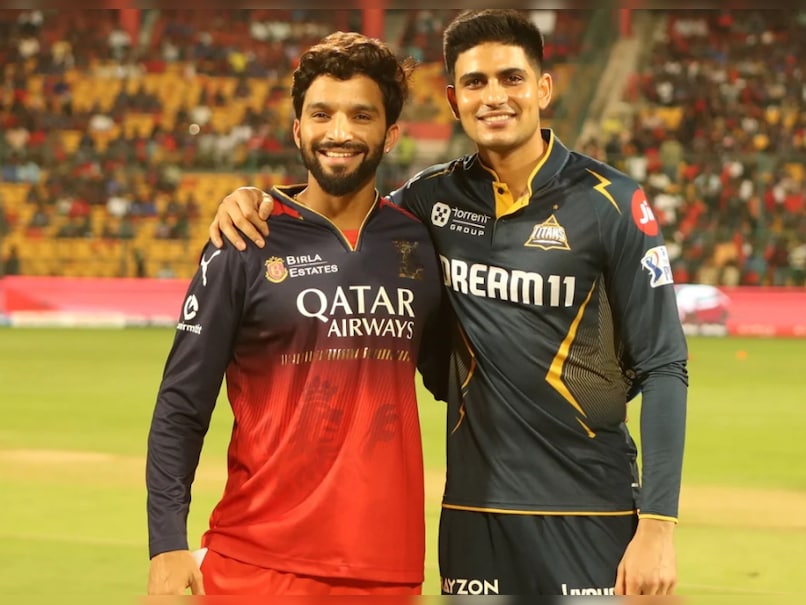
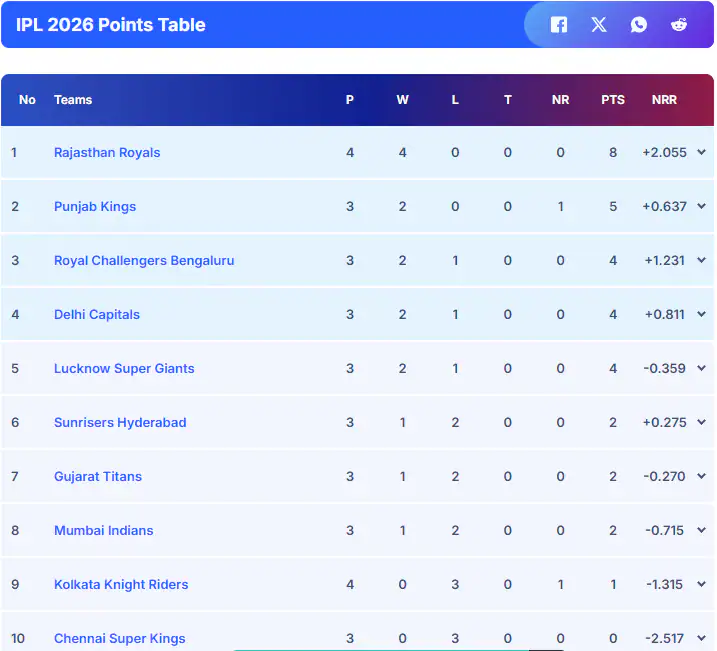
Rajasthan Royals are unstoppable. Vaibhav Sooryavanshi proved one can better the best by playing another astonishing innings — a 26-ball 78 with seven sixes — to set up an easy six-wicket victory for Rajasthan Royals against defending champions Royal Challengers Bengaluru in the IPL on Friday. While most 15-year-olds across the country were sweating over their 10th board exams results, this teenager from Bihar’s Samastipur spent the evening hitting a 15-ball fifty as a victory target of 202 was achieved by Royals in just 18 overs. With the win RR consolidated their top spot in the IPL points table.
Dhruv Jurel (81 not out off 43 balls), enjoying his best IPL season with the willow, played a number of graceful shots but when Sooryavanshi is on song, everyone else is compelled to become a bridesmaid or a bystander, getting a first-hand dosage of what brilliance looks like.
Advertisement
Sooryavanshi continued to put the reputation of world famous international bowlers at stake with his amazing bat speed and timing. The chubby cheeked teenager had toyed with Jasprit Bumrah‘s ego in an earlier game and Friday was comeback man Jos Hazlewood’s turn to get butchered.
Hazlewood, a red ball doyen, bowled a perfect delivery close to his body cramping Sooryavanshi for room. To his horror, he found the young boy just heavily chopping the delivery for a boundary.
The next two deliveries were boundaries over mid-on and then he fetched the Aussie’s pace off delivery from outside the off-stump to dispatch into the square leg stands.
The best shot however was a snap hit — where he just whipped a yorker length delivery from seamer Abhinandan Singh into the gallery — just a bit wide of long-on.
Advertisement
Every shot that he hit left the crowd yearning for more. Who could have possibly imagined that he took only 15 balls to score 74 of his 78 runs in fours (8) and sixes (7).
A wily bowler like Bhuvneshwar Kumar was treated with utter disdain as he added a staggering 108 runs for the second wicket in just 6.1 overs with Jurel. Even Jurel feasted on below-par Abhinandan, who had gone for 24 in one of his overs.
Critics are always sceptical about “second season blues” when it comes to newcomers but Sooryavanshi, just like his cricketing philosophy, is out there to change the popular perceptions.
His first season as a 14-year-old was an exceptional one. His second season, so far, has been magnificent.
Advertisement
Just when people were saying that a strike rate of 200 was the industry norm, Sooryavanshi upped the bar and took it to 300. He is not just on a mission to rewrite the record books, but to change perceptions and throw conventional wisdom out of the stadium — along with his orbit-touching sixes.
He is not just knocking on the national T20 team door, he is in a mood to break it down.
Earlier, RCB skipper Rajat Patidar‘s 40-ball-63 and a cameo from Impact Sub Venkatesh Iyer took RCB to 201 for 8, even though they were 25 runs short of what should have been a par score.
But once Sooryavanshi started hitting, it seemed like the total was 50 below par score
Advertisement
Featured Video Of The Day
IPL 2026 | Delhi Capitals Wins By 6 Wickets Against Mumbai Indians: Redemption For Sameer Rizvi
The New Hampshire Fisher Cats, the Toronto Blue Jays’ Double-A affiliate, achieved a rare feat not seen in the post-expansion era.
Portland’s pitchers — New Hampshire’s opponent for a six-game series — combined for walks, wild pitches and hit batters, paving the way for the Fisher Cats to pull off the feat.
The Fisher Cats fell behind 2-0 early in Tuesday’s game against the Sea Dogs, the Eastern League affiliate of the Boston Red Sox.
Advertisement
But New Hampshire scored its first eight runs in the second inning without recording a single base hit.
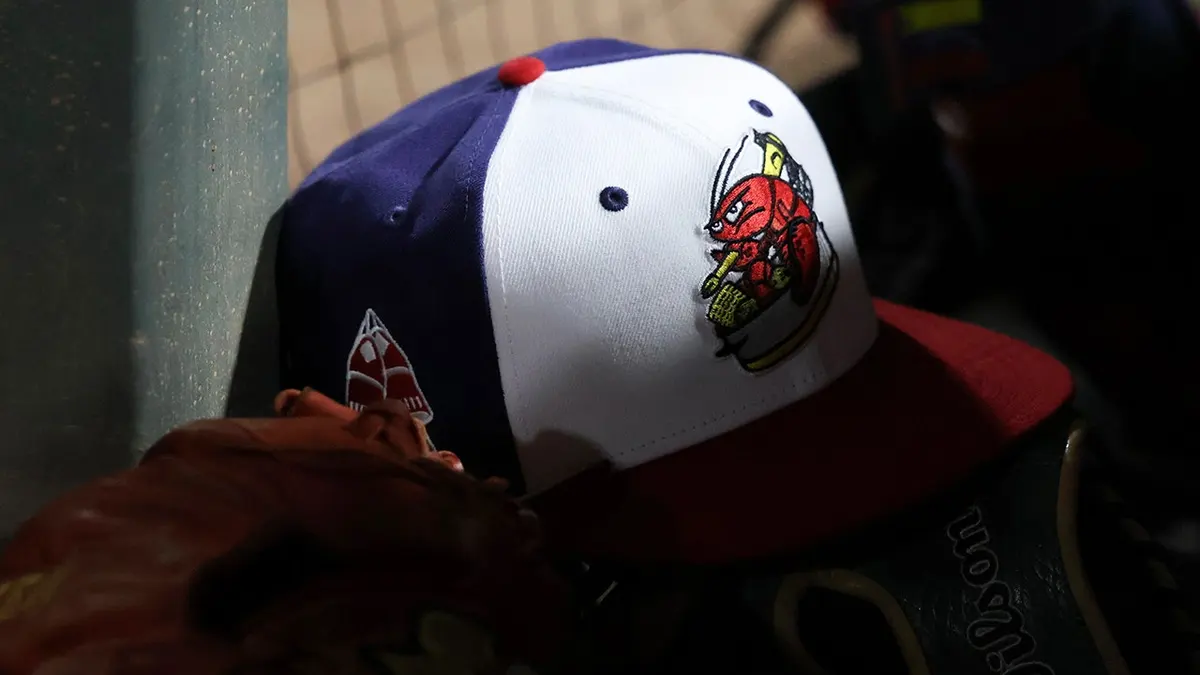
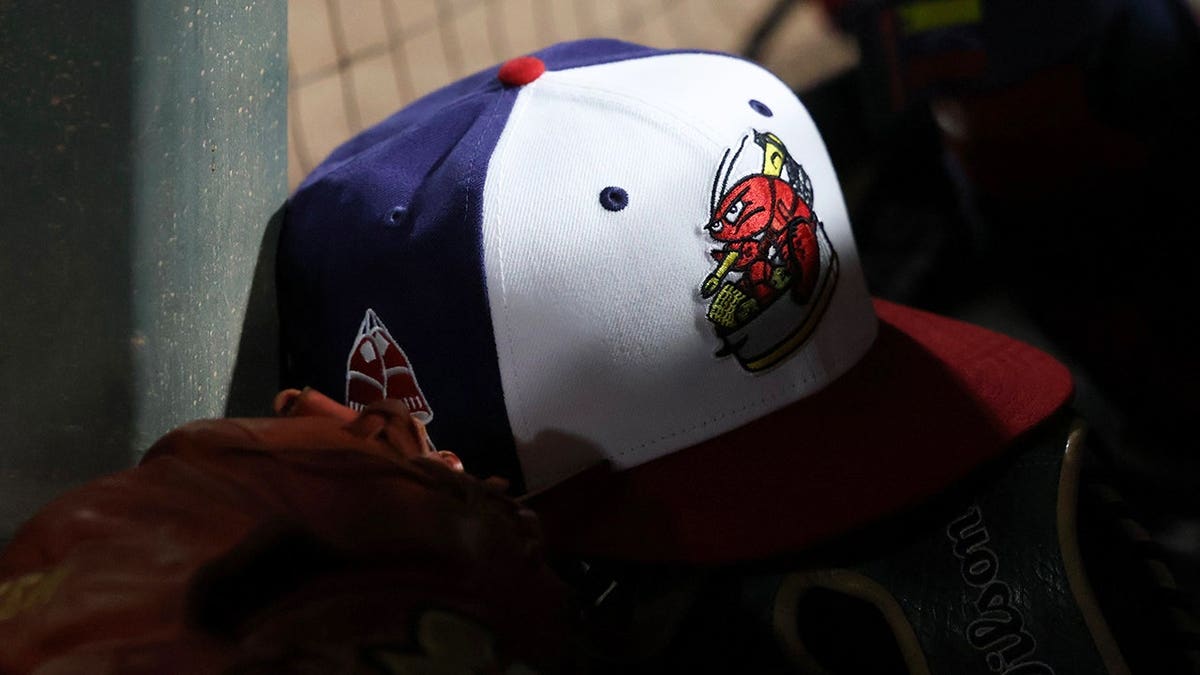
A Portland Sea Dogs cap during a game between the Erie SeaWolves and the Portland Sea Dogs at Hadlock Field in Portland, Maine, Sept. 5, 2025.(Ella Hannaford/Minor League Baseball)
The Fisher Cats exploded for 10 runs in the inning — nine with two outs — on just one hit and no errors, the final box score in New Hampshire’s 12-7 win showed. The feat was fueled by Portland pitchers issuing eight walks and hitting two batters. Sea Dogs pitchers also uncorked four wild pitches and allowed a sacrifice fly and the inning’s lone hit.
Sea Dogs president Geoff Iacuessa couldn’t believe what unfolded.
“I don’t ever remember seeing that here or any other game I’ve ever seen,” Iacuessa told Portland’s WGME Channel 13. “It was crazy. I thought maybe something was going on with the scoreboard, and then I checked the GameChanger, and it was correct.”
The rare moment happened amid frigid conditions that prompted the stadium’s ground crew to clear the playing grass and infield after heavy snow fell earlier in the day. Temperatures were just a few degrees above freezing at first pitch.
The inning unraveled quickly after a quiet start, when Portland starter Hayden Mullins issued two walks and uncorked a wild pitch despite striking out the side in the first. New Hampshire then broke through with a sacrifice fly.
Advertisement
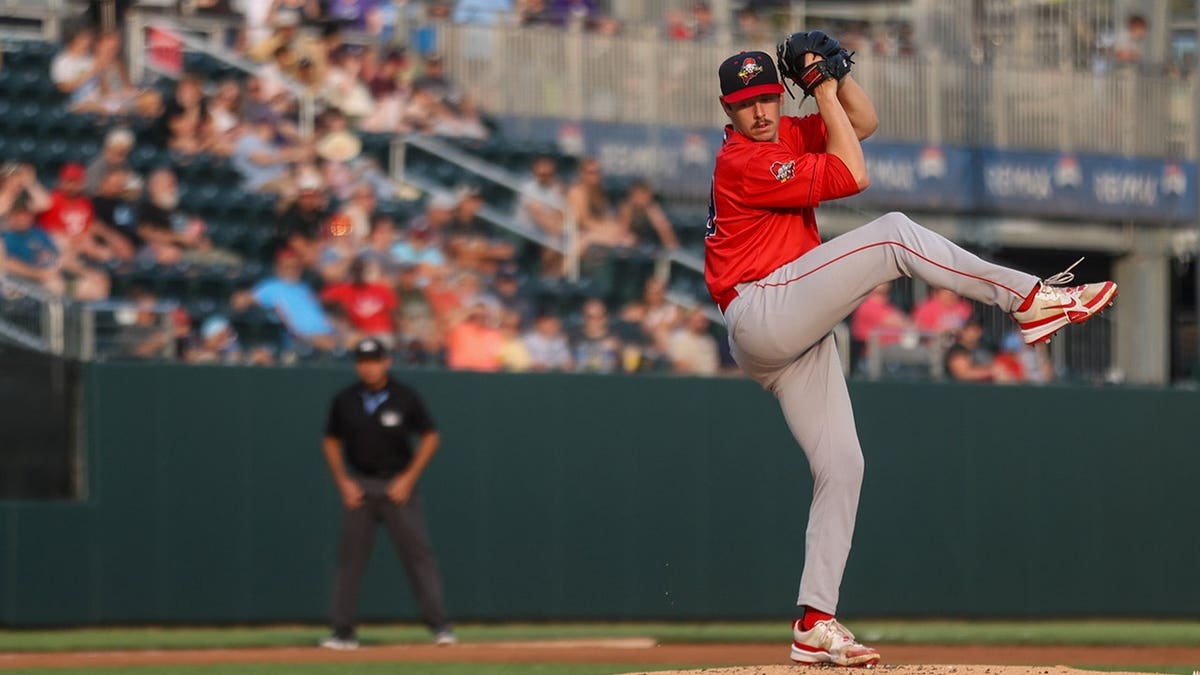
Hayden Mullins pitches for the Portland Sea Dogs during a game against the Harrisburg Senators at FNB Field in Harrisburg, Pa., Aug. 5, 2025.(Kyle Mace/Minor League Baseball)
Mullins eventually managed to record two outs, but then lost control, walking three straight to tie the game. Jorge Juan came on in relief but hit the first batter he faced with the bases loaded.
A wild pitch made it a 4-2 score, and a walk loaded the bases again for the Fisher Cats. Juan then hit a batter, making it 5-2, before firing another wild pitch to push the Sea Dogs deficit to four runs. Juan walked two more to push it to 7-2 before leaving the mound with a runner at each base again.
Cade Feeney took the hill next and finally stopped the leaking, but not before a wild pitch made it 8-2 and New Hampshire outfielder Ismael Munguia’s two-run single pushed the lead to 10-2.
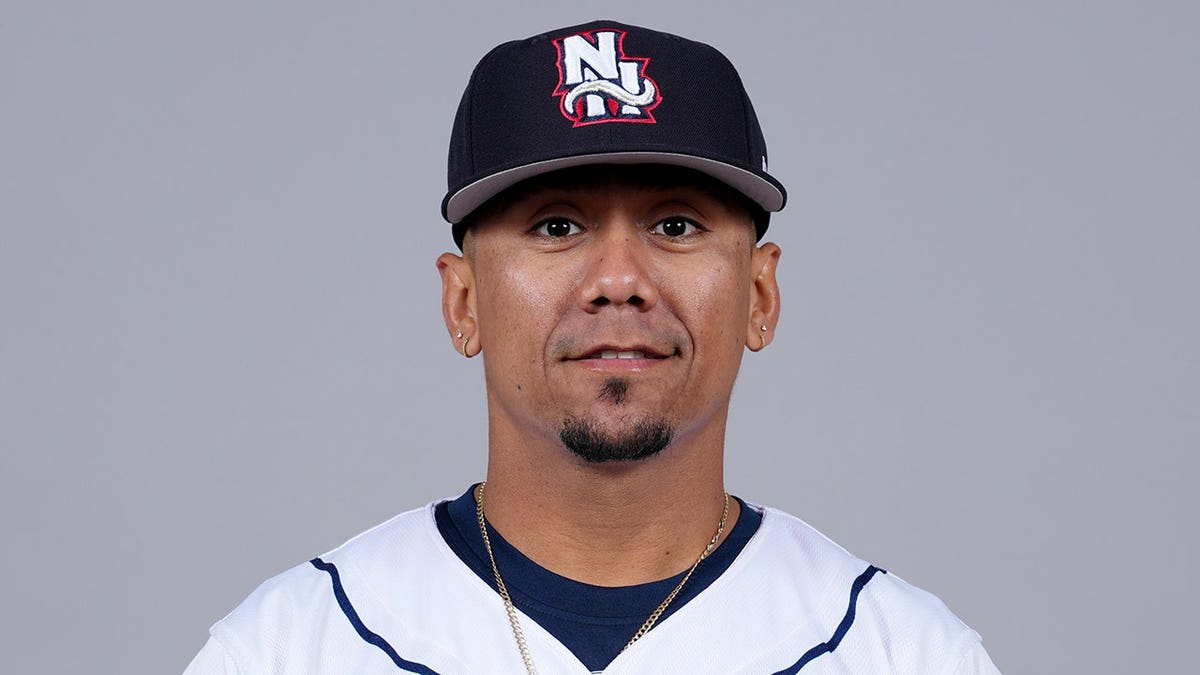
Ismael Munguia of the New Hampshire Fisher Cats poses for a photo during the team’s photo day at Delta Dental Stadium in Manchester, N.H., March 30, 2026.(Michael Owens/MLB Photos)
Munguia represented his native Nicaragua in last month’s World Baseball Classic, appearing in four games.
Not even a team at the major league level has scored more than four runs in an inning without recording its first hit, according to the Elias Sports Bureau.
MLB.com reports it has happened just 16 times in American League and National League history that a pitcher allowed five runs without surrendering a hit in 1⅔ innings or fewer.
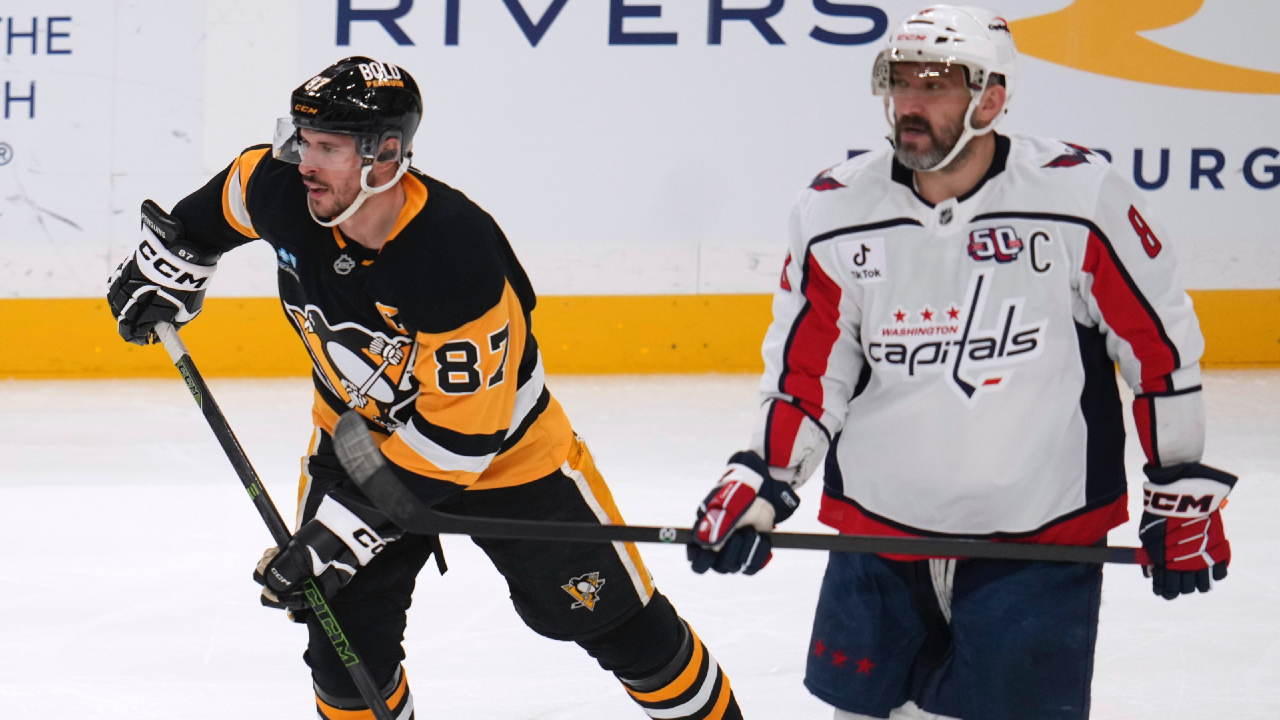
The duo have matched up 99 times in their career, but they may only have two meetings left.
This will make 101 games against each other, the most among duelling No. 1 picks in league history. Without knowing if there will be a 102nd matchup, Ovechkin will enjoy these next two games.
“It’s history what we have, 20 years playing against each other,” Ovechkin said Friday. “We came into the league at the same time, and we’re still battling and we still have a good match.”
In 74 regular-season games between the two, Crosby holds the edge with a 43-27-4 record. It’s the same in the playoffs, as the Penguins have beaten the Capitals in three out of four series between the two stars.
Advertisement
Playing against one another seems to bring out the best in each other. Ovechkin has 70 points (38 goals, 32 assists) in regular-season contests and 33 points (15 goals, 18 assists) in the postseason, while Crosby has 97 (35 goals, 62 assists) and 30 (13 goals, 17 assists).
“I think the whole situation around Ovi and Sid was kind of a big time,” Ovechkin said, “and even more, not pressure, but even more (you) think about it and get ready for it.
“It’s still the same since the first game when we played against each other. The fans are in, and you guys (the media) are in, and we take that energy and put it on the ice.”
Despite the constant comparisons, battles and headlines surrounding Ovechkin and Crosby over the year, the two have been able to separate their hockey battles from their personal relationship.
Advertisement
“We became friends,” Ovechkin said. “I think we understand the battle is out there, but off the ice we can talk to each other, congratulate each other on that moment. So, it’s pretty good.”
This weekend’s games will also mean a lot to Ovechkin and the Capitals because they most likely need to win both in order to stay in the playoff chase. Washington sits five points behind the Ottawa Senators for the East’s final Wild Card spot.
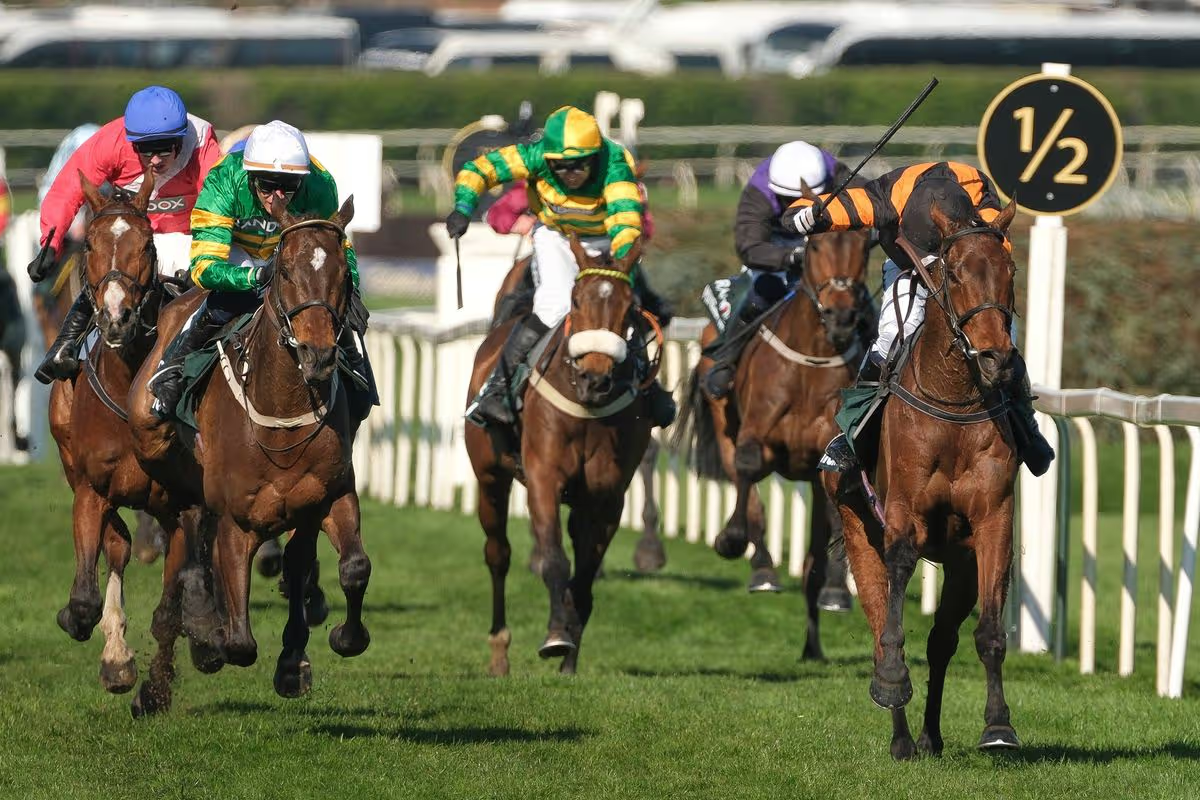
A leading tipster has backed Patrick Mullins to complete back-to-back Grand National victories, though this time on a different mount.
Mullins, son of legendary trainer Willie, rode 33-1 outsider Nick Rockett to victory in 2025. The top amateur jockey had been expected to ride Nick Rockett again this year before switching to Grangeclare West earlier this week.
Nick Rockett has since been pulled out of the Aintree showpiece. Paddock expert Ken Pitterson, a regular contributor to ITV’s racing coverage, predicted Nick Rockett’s shock win 12 months ago.
Now he is tipping another Willie Mullins-trained horse, Grangeclare West, who is among the favourites for the race at 10-1. Pitterson said: “This year, I like the chances of Grangeclare West. He ran third in the race last year and again the way he’s been trained by Willie Mullins. It looks like he’s been gradually building him up.
Advertisement
“I like the way he won the Bobbyjo Chase, which Nick Rockett won last year on the way to Aintree. The way he’s trained him, he’s getting him to peak at the right time.
“He’s got the same sort of profile as Nick Rockett and if you look back at his previous form, he’s a classy performer.
“He won a Grade 1 as a seven-year-old, so you know he’s got a bit of back class as well. He fits the criteria of a horse I’m looking for going into the National.”
Advertisement
Regarding his second and third picks, Pitterson, who works for William Hill Racing Radio, is anticipating another of the favourites, Panic Attack, along with outsider Gerri Colombe, to put in strong performances.
He said: “I think Panic Attack is an interesting runner. She’s a mare in form and mares at this time of year can be dangerous.
“I love the way she performed when she won the two big races in November – the Paddy Power Gold Cup and the Coral Gold Cup. She’s done something which no other horse has done.
“She’s had a great campaign and the fact she’s a mare on form could be dangerous. You know what [trainer] Dan Skelton can do. The other one I’m interested in is a horse called Gerri Colombe. I saw him as a youngster and he’s just got that build.
“The way he jumps and travels he could be a Grand National horse. He’s not the quickest but he did win a Grade 1 as a younger horse.
“He’s had a few problems last year, he’s come back and again he’s won his last race at Down Royal and he comes in relatively fresh. He has the look of a horse to me who could figure in a Grand National.”
Last-minute Grand National 2026 tickets
Advertisement
This article contains affiliate links, we will receive a commission on any sales we generate from it. Learn more















































You must be logged in to post a comment Login