Connect with us
DAPA Banner

Tech

Belfast’s SciLeads announces plans to create 60 new remote jobs

Published

on

The organisation intends to create roles in software engineering, product, sales, customer success and marketing.

SciLeads, a market-intelligence solutions provider for the global life sciences sector, intends to create 60 new fully remote jobs over the course of the next three years. The company explained that a strong 2025 has set SciLeads up for “major growth as it approaches its 10-year anniversary”.

To meet increasing demand, SciLeads said, it has already expanded its workforce this year and will be welcoming new hires across multiple departments. Jobs are to be created for professionals in areas such as software engineering, product, sales, customer success and marketing.

Established in 2016 by friends Daniel McRitchie, Laura Haldane and James Campbell, SciLeads is headquartered in Belfast, Northern Ireland. The company aims to make lead generation and market research simpler and more streamlined.

Advertisement

“2025 was a transformational year for SciLeads,” said McRitchie, the company’s CEO. “We’re continuing to invest in our platform and data so we can deliver even greater value to our customers, and we’re looking forward to welcoming new talent, both here in the UK and across the Atlantic, as we scale globally in 2026.”

Haldane, a co-founder, added: “As a remote company, we’ve an excellent advantage in that we can recruit top talent from anywhere, so it means we not only have the best team but also the flexibility of working on our own terms.” 

There have been a number of key announcements from Northern Irish businesses since the beginning of 2026. 

In late January, Belfast health-tech start-up Eolas Medical announced it had raised $12m in Series A funding to further scale its existing AI functionality within the UK’s National Health Service and continue its plans for international expansion.

Advertisement

Also in January, TeamFeePay, a sports technology start-up based out of Belfast, closed a £9m equity funding round to help expand into new markets and fuel a recruitment drive.

The round was led by YFM Equity Partners, which invested £4.5m, and Investment Fund for Northern Ireland, which contributed £3m, with more funding of £800,000 from Techstart and £700,000 from private investors.

Don’t miss out on the knowledge you need to succeed. Sign up for the Daily Brief, Silicon Republic’s digest of need-to-know sci-tech news.

Advertisement

Source link

Continue Reading
Click to comment

You must be logged in to post a comment Login

Leave a Reply

Tech

Starling launches an AI banking assistant that actually does things

Published

on

The UK challenger bank is rolling out Starling Assistant to personal account holders today, billing it as the UK’s first agentic AI financial assistant. It can set up savings goals, organise bill payments, and even quiz you on your own spending, all from a voice or text prompt.


Starling Bank has been building methodically towards this moment for the better part of a year. In June 2025 it became the first UK bank to put a natural language AI interface over customer spending data, with Spending Intelligence.

In October it launched Scam Intelligence, which lets customers upload images of marketplace listings or suspicious messages and receive a fraud-risk assessment. Both ran on Google Gemini on Google Cloud. Both were billed as UK firsts. On Friday, the bank announced the next step: Starling Assistant, which it is calling the UK’s first agentic AI financial assistant.

The distinction matters, at least in principle. Spending Intelligence and Scam Intelligence are read-and-respond tools: they analyse data and surface outputs.

Advertisement

Starling Assistant is designed to act, to take a voice or natural language prompt, and execute banking tasks directly on the customer’s behalf. It is also the umbrella under which those earlier tools now sit, creating a single conversational interface for what was previously a set of separate features.

Advertisement

The range of what it can do is more specific than most agentic banking announcements tend to offer. A customer planning a holiday can say they need to save £500 for a trip to Paris in July and ask the assistant to calculate a monthly savings schedule and set up automatic transfers to a dedicated Space.

Someone wanting to restructure their finances on payday can instruct it to create Spaces for groceries, bills, travel, and eating out, and specify how much to route to each. The press release also lists the ability to answer questions about direct debits and outstanding bills, analyse transaction history with specific payees, and, a detail that stands out, generate a quiz in which the assistant asks the customer to guess their top merchant for the last month or the category where they spend the most.

One caveat worth flagging: voice prompts are enabled by the user’s mobile keyboard rather than by native voice recognition built into the assistant itself. The distinction is small in practice but matters for anyone expecting a fully hands-free experience.

The assistant also has an explicit welfare dimension. Customers with vulnerability or accessibility needs can ask for specialist support without speaking to a human agent: it can help hard-of-hearing customers set up Starling’s sign language service, guide customers through setting up gambling blocks, and point those in financial distress to specialist resources.

Advertisement

Harriet Rees, Starling’s group chief information officer, described the launch as the culmination of eight years of AI development at the bank. Raman Bhatia, the group chief executive, called agentic AI “the next step in banking.”

Starling Assistant is live for personal current account customers from today, with business and joint accounts to follow. It is opt-in, and Starling says all data remains within its Google Cloud environment and is not used to train the underlying models. Graham Drury, director of FSI at Google Cloud UK and Ireland, described the shift as moving from navigating complex app menus toward simply having a conversation about your money.

The context around this launch is not entirely uncomplicated. The bank was fined £29 million by the Financial Conduct Authority in October 2024 for anti-money laundering and sanctions screening failures covering the period from 2017 to 2023, a fine reduced from £41 million after Starling cooperated with the investigation.

Building a reputation as the UK’s most ambitious AI-driven bank requires that the underlying compliance infrastructure is demonstrably sound. The welfare features built into Starling Assistant, the opt-in model, and the explicit commitment not to use customer data for model training are all consistent with a bank that has spent the past year investing heavily in rebuilding regulatory credibility alongside its product roadmap.

Advertisement

In the neobank sector more broadly, the race to agentic AI is accelerating. Revolut has signalled it is exploring AI agents but has not yet launched a comparable product in the UK. Bunq launched an AI assistant in 2024. Klarna has deployed AI extensively across customer service. For the moment, Starling is making the argument that the field in UK retail banking remains its to define.

Source link

Advertisement
Continue Reading

Tech

Hackaday Podcast Episode 362: Compression Molding, IPv4x, And Wired Headphones

Published

on

As the sun goes down on a glorious spring evening on the western edge of Europe, Elliot Williams is joined by Jenny List for a look at the week in all things Hackaday.

First up: Hackaday Europe tickets are on sale! Bad luck folks, the early bird tickets disappeared in an instant, but regular ones are still available for now. We’re really looking forward to making our way to Lecco for a weekend of hacks, and it would be great to see you there too.

Then we have a new feature for the podcast, the Hackaday Mailbag. This week’s contribution comes from [Kenny], a longtime friend of Hackaday and probably our most regular conference attendee.

Advertisement

To the hacks, and we have some good ones. An air hockey robot might not seem like a challenge, but the engineering which went into [BasementBuilds’] one proves it’s not a job for the faint hearted. Then we look at compression molding of recycled plastic using 3D-printed molds, something that seems surprisingly accessible and we’d like to try, too. We’ve got a new DOS, a 3D-printed zipper repair, the IPv4 replacement we didn’t get, and the mind-bending logic of ternary computing. It’s one of those weeks where the quick hacks could all deserve their own in-depth look, but perhaps the stand-outs are and Arduino style compiler that includes the source code compressed within the binary, and a beautifully-done revival of a 1980s brick cellphone as a modern 5G unit.

Finally in the longer reads we’ve got an examination of wired versus Bluetooth headphones — we’re both in the wired camp — and a look back at the age of free dialup. As is so often the case, the experience there differed between Brits and Americans. Anyway, enjoy the episode, and we have another week to look forward to.

Download your own personal copy of the Podcast in glorious 192 kB MP3.

Advertisement

News:

What’s that Sound?

  • Congrats to [Captain Click-Clack] who got it wrong, but just as right as anyone else.
  • NASA’s Sounds From Beyond

Interesting Hacks of the Week:

Quick Hacks:

  • Elliot’s Picks:
  • Jenny’s Picks:

Can’t-Miss Articles:

Source link

Continue Reading

Tech

Kalshi Has Been Temporarily Banned in Nevada

Published

on

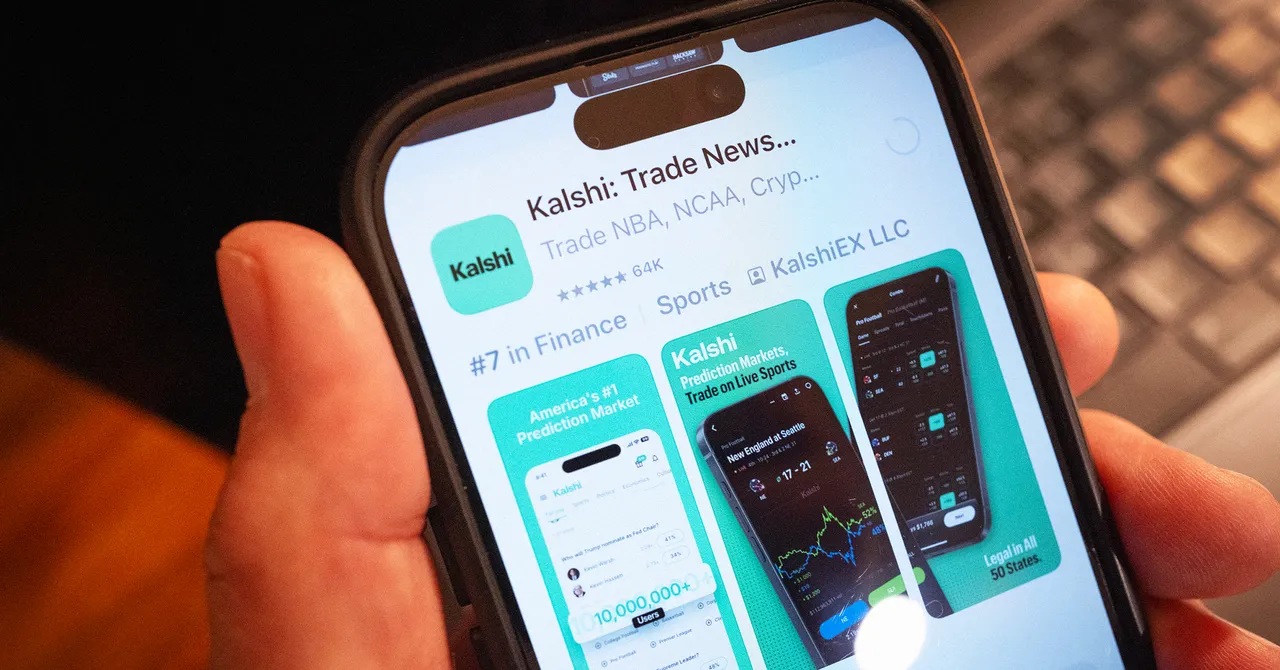
Kalshi has been temporarily banned in Nevada, marking the latest escalation in the widening regulatory war over prediction markets. The First Judicial District Court of Nevada has issued a 14 day restraining order, effective immediately, barring the company from “offering a derivatives exchange and prediction market which offers event-based contracts relating to sports, election, and entertainment related events” without first obtaining gaming licenses.

This is the first time a US state has forced the company to cease operations. Kalshi declined to comment.

This particular legal battle began just over a year ago, when Nevada regulators sent Kalshi a cease-and-desist letter demanding that it stop offering sports-related events contracts. That initiated a messy tug-of-war between plaintiffs and defendants as the case moved between state and federal court. Until now, Kalshi could keep operating in the state as its lawyers sparred with authorities in what the company has described as a “jurisdictional quagmire.”

After the 14 days, the court will then assess whether to extend the ban for the duration of the court case. “The expectation here is that the judge will convert the 14 day TRO to a case-long preliminary injunction,” says gaming lawyer Daniel Wallach.

Advertisement

The ruling comes after a particularly turbulent few weeks for Kalshi. On Tuesday, the Arizona attorney general brought criminal charges against the company, accusing it of running an illegal gambling operation. Just days earlier, Kalshi filed a lawsuit against Arizona state regulators pre-emptively challenging any effort to make it follow state gambling laws.

Dozens of similar legal battles are underway across the country over whether prediction markets should be forced to abide by state gambling laws, including in Ohio, Tennessee, and Massachusetts.

A number of prominent prediction market platforms, including Kalshi, offer sports-related contracts to people over 18 across the United States, even where state gambling laws prohibit sports betting. The result is that a 19-year-old in Utah can put money on the outcome of a soccer game through prediction markets, but not through sports betting, since the state outlaws it altogether. It also means that a 19-year-old in Indiana can make a similar prediction market wager, even though state gambling law prohibits people under 21 from placing bets. This has made a growing group of bipartisan lawmakers furious.

Kalshi argues that its sports-related event contracts—where, for example, someone can wager on which teams would win the Super Bowl or a particular March Madness basketball game—are not a form of betting. Instead, the company says they should be viewed as financial instruments known as “swaps.” So far, the federal government agrees. The Commodity Futures Trading Commission (CFTC), the US agency that oversees swaps and other derivatives markets, maintains that it has exclusive jurisdiction over prediction markets. The agency’s head, Michael Selig, has forcefully rejected claims that the industry should be subject to state gambling laws, telling critics that he will see them “in court.”

Advertisement

The federal government’s stance hasn’t deterred various state attorneys and gaming commissions from continuing their legal fights—and they’ve recently notched some notable victories. In January, Nevada blocked Polymarket from operating within the state; the temporary restraining order is in place through April. It was a victory for the prediction markets-are-gambling side, albeit a limited one:While Polymarket does have a modest official US presence, the bulk of its trading volume takes place on its global exchange, which is technically blocked in the US but accessible to traders willing to use virtual private networks (VPNs) to get around the ban.

Last week, a judge in Ohio rebuffed Kalshi after the prediction market company filed for a preliminary injunction to prevent state regulators from pursuing it for violating state gambling laws. In her order denying Kalshi’s motion, United States District Court for the Southern District of Ohio Judge Sarah D. Morrison wrote that the court had an obligation to “avoid absurdity.”

Source link

Advertisement
Continue Reading

Tech

CISA orders feds to patch max-severity Cisco flaw by Sunday

Published

on

CISA orders feds to patch max severity Cisco flaw by Sunday

The Cybersecurity and Infrastructure Security Agency (CISA) has ordered federal agencies to patch a maximum-severity vulnerability, CVE-2026-20131, in Cisco Secure Firewall Management Center (FMC) by Sunday, March 22.

Cisco published a security bulletin about the flaw on March 4, urging system administrators to apply the security updates as soon as possible and warning that no workarounds are available.

The Cisco Secure Firewall Management Center (FMC) is a centralized administration system for critical Cisco network security appliances, such as firewalls, application control, intrusion prevention, URL filtering, and malware protection.

“A vulnerability in the web-based management interface of Cisco Secure Firewall Management Center (FMC) Software could allow an unauthenticated, remote attacker to execute arbitrary Java code as root on an affected device,” Cisco says in the advisory.

Advertisement

The issue is caused by insecure deserialization of a user-supplied Java byte stream and is exploitable by sending a specially crafted serialized Java object to the web-based management interface of an affected device.

On March 18, the vendor updated its bulletin to warn of active exploitation of CVE-2026-20131 in the wild. Amazon threat intelligence researchers confirmed that threat actors are leveraging the vulnerability in attacks, noting that the Interlock ransomware gang had been exploiting it as a zero-day since the end of January.

Amazon stated that the ransomware threat actor exploited CVE-2026-20131 more than a month before the vendor published the patch.

Interlock ransomware has claimed several high-profile victims since its launch in late 2024, including DaVita, Kettering Health, the Texas Tech University System, and the city of Saint Paul, Minnesota.

Advertisement

The threat actor is also using the ClickFix technique for initial access, as well as custom remote access trojans and malware strains like NodeSnake and Slopoly.

CISA has added CVE-2026-20131 to its Known Exploited Vulnerabilities (KEV) catalog, marking it as “known to be used in ransomware campaigns.”

Given the severity of CVE-2026-20131 and its active exploitation status since late January 2026, CISA gave Federal Civilian Executive Branch (FCEB) agencies only until this Sunday to apply the security updates or stop using the product.

CISA’s deadline is relevant to all entities subject to the Binding Operational Directive (BOD) 22-01, but private firms, state/local governments, and all non-FCEB organizations are still recommended to consider it and act accordingly.

Advertisement

Malware is getting smarter. The Red Report 2026 reveals how new threats use math to detect sandboxes and hide in plain sight.

Download our analysis of 1.1 million malicious samples to uncover the top 10 techniques and see if your security stack is blinded.

Source link

Continue Reading

Tech

Apple just broke launch-week records for new Mac users

Published

on

Tim Cook says Apple just had a record-breaking week for brand-new Mac users. While he won’t give details, it’s surely the low-cost MacBook Neo that’s leading the way.

Stack of four closed Apple MacBook laptops in green, blue, silver, and black, aligned neatly on a gray surface with a blurred indoor background
Apple’s latest MacBook Pro, MacBook Air and especially MacBook Neo are breaking recordds

Apple CEO Tim Cook is currently travelling the world as the company celebrates its anniversary, and so far seemingly hasn’t had enough time to post his usual photos on social media. But he has now taken to X to celebrate how well Apple’s recent Mac launches have gone.

Continue Reading on AppleInsider | Discuss on our Forums

Source link

Advertisement
Continue Reading

Tech

Brendan Carr Crafting ‘Patriotic’ Call Center Onshoring Plan To Provide Cover For Mass Looming Telecom Layoffs

Published

on

from the corruption-is-patriotic dept

When he’s not busy trampling free speech, crushing the First Amendment, and destroying media consolidation and consumer protection standards, Brendan Carr has other hobbies. Like helping the telecom industry patriotically sell a brutal coming wave of new layoffs caused by the kind of industry consolidation he regularly rubber stamps.

Carr recently began circulating plans for something he claims will restrict U.S. telecom companies’ ‌use of foreign call centers and require foreign-based customer service workers to be proficient in American Standard English. The plan is vague, but Reuters unskeptically frames it as a good faith effort to protect U.S. consumer privacy, improve customer service, and protect Americans from the scourge of foreign accents:

“Carr noted that nearly 70% of U.S. businesses outsource at least one ‌department, ⁠including customer service and call center operations, to overseas locations.

“As a result, too many Americans have struggled to resolve an issue with a representative due to cultural and language barriers,” Carr said, adding foreign customer ​service centers “also raise ​concerns about ⁠protecting consumers’ personal information.”

What is Carr really up to here? I suspect he’s working closely with U.S. telecoms to craft pseudo-patriotic/nationalistic cover for another brutal round of layoffs. Some of which will be caused by AI, but a huge amount of which will have been caused by Carr’s love of rubber stamping harmful telecom industry consolidation.

Advertisement

For one, there’s no real evidence that overseas customer service centers create serious cybersecurity issues. As he did with his recent effort to remove phone unlocking rules, Carr likes to use cybersecurity as a bogeyman when convenient to something unpopular he’s trying to help industry sell.

Then, with his other hand, Carr is busy making U.S. consumers less safe and secure by gutting functional oversight of giant telecoms (despite the recent massive Salt Typhoon hack by China).

It’s also not really clear the FCC even has this authority. Especially in the Trump era, which has involved the Trump courts taking an absolutely brutal hatchet to regulatory independence. This sudden micromanagement of telcom support runs contrary to Carr’s “light regulatory touch” rhetoric. It’s also worth noting that a lot of telecoms, like Charter, already have mostly U.S. support agents.

But here’s the more important thing. I’ve covered Brendan Carr probably longer and more extensively than pretty much anybody alive. And I can tell you, with 100% certainty, that Carr doesn’t do anything that’s just inherently in the public interest. That’s simply not who he is.

Advertisement

He’s always working an angle for industry or large companies, usually media and telecom giants. There’s just no evidence that he’s a good faith operator in any of the arenas Reuters gives him unearned credibility for, and his ethics and principles, as we’ve seen repeatedly, are not consistent.

So I really doubt this has anything to actually do with improving customer service, or holding telecoms accountable for shoddy overseas support. I suspect he’s cooking up a stage play.

We’ve long noted how these consolidated regional telecom monopolies have some of the worst customer service ratings of any industry in America (which is truly saying something). Maybe AI will improve some aspects of that, but as we’ve seen in other arenas where AI is layered on top of very broken sectors (journalism, health insurance) by unethical executives, the end result isn’t particularly great.

If you don’t fix the underlying monopolization, you can’t fix the symptoms of monopolization, which generally are high prices, spotty service, slow speeds, and abysmal customer service. Layer AI on top of a broken industry, and you usually get a badly automated broken industry.

Advertisement

It will be worth keeping an eye on Carr’s final proposed plan. But I suspect it mostly involves him working closely with telecom giants to put a nationalistic, racist veneer on looming plans to dramatically accelerate layoffs in a telecom sector that’s already seen massive workforce reductions, largely due to the mindless consolidation Carr regularly rubber stamps.

Filed Under: brendan carr, call centers, customer service, fcc, offshoring, onshoring, telecom, wireless

Source link

Advertisement
Continue Reading

Tech

Jeff Bezos’ Blue Origin enters the space data center game

Published

on

Blue Origin, the space conglomerate founded by Amazon chair Jeff Bezos, has asked the U.S. government for permission to launch a network of more than 50,000 satellites that will act as a data center in orbit.

In a March 19 document filed with the Federal Communications Commission, Blue Origin’s attorneys described “Project Sunrise” as a network of spacecraft that will perform advanced computation in orbit to “ease mounting pressure on U.S. communities and natural resources by shifting energy – and water-intensive compute away from terrestrial data centers.”

Blue Origin’s filing did not describe its plans for the satellites in detail, so it’s hard to know how much computing power the company is aiming to generate in space. It does note that Blue Origin plans to use another satellite constellation it is seeking to build, called Terawave, as a high-throughput communications backbone for the data satellites.

Shifting massive compute to space is attractive because solar energy is free to harvest and, once in orbit, there are fewer regulations restricting corporate activities. Entrepreneurs behind these projects envision a future where AI tools are widespread and imagine that much of the inference work behind them will be outsourced to orbit.

Advertisement

Several companies are already pursuing the idea. SpaceX has filed for permission to launch a million satellites to be used as a distributed data center, while the startup Starcloud has proposed a network of 60,000 spacecraft to the FCC. Google is also developing a concept for a space data center called Project Suncatcher, which will see its partner Planet Labs launch two demo spacecraft next year.

While excitement about space data centers is high in the tech world, the economics of these projects remain challenging. Technology for cooling processors and communicating between spacecraft with powerful lasers will need to be developed and manufactured as cheaply as possible, while scientists are still determining how well advanced chips work on different tasks while exposed to the high radiation environment in space.

A critical area is the cost to launch these computers into orbit, and most are betting that the price of reaching orbit will fall due to SpaceX’s Starship rocket, which is still under development and may see its first 2026 launch next month.

Techcrunch event

Advertisement

San Francisco, CA
|
October 13-15, 2026

This is an area where Blue Origin, long an also-ran in the rocket business, may have an advantage. Its New Glenn rocket, which first flew last year, is one of the most powerful operational launch vehicles on Earth. If the company can start flying and reusing them at a regular pace, Blue Origin could see the same kind of benefits from vertical integration that allowed SpaceX to dominate space telecommunications with its Starlink network.

Advertisement

Beyond economic and technological challenges, the space environment itself may prove an obstacle. Space in key orbits close to the Earth is getting ever more congested, and adding tens or hundreds of thousands of new satellites will increase concerns about orbital collisions. Meanwhile, burning up thousands of satellites in orbit after they become obsolete, as is standard practice in the industry today, is likely to affect the chemistry of the upper atmosphere, with researchers fretting about harms to the ozone layer.

The filing also lacked details about timing, but experts tell TechCrunch that such projects are unlikely to come to fruition until the 2030s.

Source link

Advertisement
Continue Reading

Tech

Quantum cryptography pioneers win Turing Award for unhackable encryption breakthrough

Published

on


The pair will share the $1 million prize for their pioneering work in quantum cryptography and the broader field of quantum information science. Their 1984 paper introducing the BB84 protocol – an encryption method based on the fragile nature of photons – reimagined how information could be kept secret. At…
Read Entire Article
Source link

Continue Reading

Tech

‘Toons, Tunes and Blonde Buffoons: A Blu-ray Roundup

Published

on

Adding to a home entertainment library is largely about the intentionality of the deep dive. While the digital landscape offers a wide, often fleeting pool of content, physical media remains the gold standard for those who value archival quality, creative and historical context, and the quiet joy of a well-curated shelf. We’re celebrating that spirit of discovery with a mix of recent titles, from high-energy animation to meticulously restored musical treasures to a couple of complete sets of television series that might have flown under your radar. Whether you’re looking for a Technicolor escape or a laugh at the expense of a lovable oaf, these releases offer the permanence and performance that only Blu-ray can provide.

Looney Tunes Collector’s Vault Volume 2 Blu-ray (Warner Archive)

Looney Tunes Volume 2 Blu-ray Disc Warner Archive

Given the whims of HBO Max and other purveyors of Looney Tunes over the decades, nothing beats having them on physical media in some of their finest quality ever. Disc One proudly presents 26 shorts* that have never before been released on DVD or Blu-ray in remastered form, while Disc Two packs 25 more, remastered in HD for the first time as part of a WB cartoon collection. There are ample helpings of Bugs (every one a gem), Daffy, Porky and the Road Runner, a couple with favorites Ralph & Sam and some fascinating one-offs, too. The list of creators is a who’s-who of animation: Chuck Jones, Friz Freleng, Robert McKimson, one each from Tex Avery and Bob Clampett, among other legends, totaling some six solid hours. Keep in mind, these are unrated, uncensored cartoons for the adult collector, with a handful of previously recorded/released audio commentaries from animation historians.

*It would have been a nice round 25, but an extra ‘toon is included here to make up for an oversight on last year’s Volume 1.

Where to buy: $27.33 at Amazon


Scott Pilgrim Takes Off The Complete Limited Series Blu-ray (Universal Pictures Home Entertainment)

Scott Pilgrim Takes Off Blu-ray Disc

The 2010 cult favorite Scott Pilgrim vs. the World was apparently so much fun to make, the ensemble cast remained friends ever since. That might have been the only way to gather a lineup of this magnitude which includes Michael Cera, Mary Elizabeth Winstead, Kieran Culkin, Chris Evans, Anna Kendrick, Brie Larson, Alison Pill, Aubrey Plaza, Brandon Routh, Jason Schwartzman, and Mae Whitman for an anime on Netflix. Scott Pilgrim Takes Off is neither a remake nor a direct adaptation of a specific volume from Bryan Lee O’Malley’s manga. Instead, it functions as a “remix” of the original film, unfolding in an alternate timeline that reimagines the story.

Scott (Cera) once again battles the seven evil exes of girlfriend Ramona (Winstead), but he disappears after losing a fight, and she investigates. Across its 3.5-hour runtime, the story spends more time exploring the exes, while the Asian-inspired source material naturally complements the over-the-top anime style of this wild saga. The high-energy soundtrack by Anamanaguchi and Joseph Trapanese sounds fantastic in DTS-HD Master Audio 5.1, and Bryan Lee O’Malley and series co-creator BenDavid Grabinski provide audio commentaries for all eight episodes.

Advertisement

Where to buy: $27.99 at Amazon


Broadway on the Big Screen Collection Blu-ray (Warner Archive)

Broadway on the Big Screen Collection Blu-ray Disc

These high-value (and slim, shelf-friendly!) repackagings make it easy to catch up on some all-time great toe-tappers you might have missed the first time around, boasting the lovely restorations for which the Warner Archive is so well-known. “Broadway” assembles an eclectic half-dozen adaptations spanning almost two decades in what might have been the heyday of the Hollywood musical:

  • Brigadoon (1954) – Romance transcends time for Gene Kelly and Cyd Charisse in this dance-filled fantasy, with a surreal “Metrocolor” palette and wide 2.55:1 frame, both meticulously preserved.
  • Guys and Dolls (1955) – Frank Sinatra and Marlon Brando shine, but for me it’s Frank Loesser’s magnificent lyrics that make G&D such a treasure.
  • The Pajama Game (1957) – Doris Day stars and Bob Fosse choreographs, and everything we need to know about him is right there in the “Steam Heat” number.
  • Damn Yankees (1958) – Fosse stages once again, this time providing his only onscreen appearance with future wife, Gwen Verdon, starring as the temptress Lola.
  • Gypsy (1962) – Rosalind Russell and Natalie Wood attack their roles as a mother-and-daughter stage family, with timeless Stephen Sondheim/Jule Styne songs and grand Technirama cinematography.
  • The Boy Friend (1971) – The stage musical that catapulted young Julie Andrews to stardom, boldly reimagined as only Ken Russell could do it, restored to its full length and in 5.1 to recreate the 70mm six-track experience from the British premiere.

Across the six discs we’re given a range of bonus content, from basic trailers to modern and vintage featurettes to quite a few deleted musical numbers.

Where to buy: $59.99 at Amazon


Fred Astaire Collection Blu-ray (Warner Archive)

Fred Astaire Collection Blu-ray (both Warner Archive) Blu-ray Disc

The Fred Astaire set meanwhile hones in on the legendary hoofer, specifically the years following his iconic partnership with Ginger Rogers, all of these in glorious Technicolor:

Advertisement. Scroll to continue reading.
  • Easter Parade (1948) – This one-and-done pairing of Mr. Astaire and Judy Garland is joyful from beginning to end, with irresistible dance numbers highlighted by the slow-mo/full-speed wonder “Steppin’ Out with My Baby.”
  • The Band Wagon (1953) – Widely regarded as one of the finest movie musicals ever, with must-rewatch numbers including “Girl Hunt Ballet,” “A Shine on Your Shoes” and the mesmerizing “Dancing in the Dark.”
  • Silk Stockings (1957) – This remake of Ninotchka is considered Astaire’s last full-on musical role, showcasing both his versatility and still-got-it legwork alongside Cyd Charisse.
  • Finian’s Rainbow (1968) – Directed by a pre-Godfather Francis Ford Coppola (assisted by George Lucas), it’s a bit more whimsical and psychedelic than Astaire’s earlier films, trippy and a total hoot, presented here in its full roadshow A/V splendor.

The bonus content in this four-disc set is particularly generous, with multiple documentaries, classic cartoons and short subjects, audio rarities, as well as commentaries for three of the titles: Fred’s daughter Ava Astaire McKenzie on Easter Parade, director Vincente Minelli’s daughter Liza on The Band Wagon, and Coppola himself on Finian’s Rainbow.

Where to buy: $41.04 at Amazon

Advertisement

Cobra Kai The Complete Series Blu-ray (Sony)

Cobra Kai The Complete Series Blu-ray Disc Set

The show I didn’t know I needed in my life, this unabashedly comedic return to the world of The Karate Kid centers largely on erstwhile bad boy Johnny Lawrence (William Zabka, a revelation), who peaked in high school and is still living in the ’80s. He’s a strangely endearing loser with a dark side that ebbs and flows across six seasons, alternately allied and at odds with his perceived nemesis, Daniel-san (Ralph Macchio). Throw in a whole bunch of deep-cut guest stars, new characters and a modern generation of teen drama, and Cobra Kai turns out so much better than it could have in lesser hands. Thank superfans Josh Heald, Jon Hurwitz, and Hayden Schlossberg, who created the show out of an obvious love for the franchise.

Cobra Kai began its run in 2018 as the flagship scripted series on YouTube Red (now YouTube Premium), ironically to compete with Netflix, which is where it completed its tenure with huge viewership, higher production values and a globetrotting scope. Sony’s six-season boxed set is the only way to get any of them on Blu-ray, porting the extras from the legacy DVDs (deleted scenes, bloopers, featurettes), in addition to brand-new creator commentaries on both the pilot and the finale.

Where to buy: $116.21 at Amazon


Resident Alien The Complete Series Blu-ray (Universal Pictures Home Entertainment)

Resident Alien Blu-ray Disc

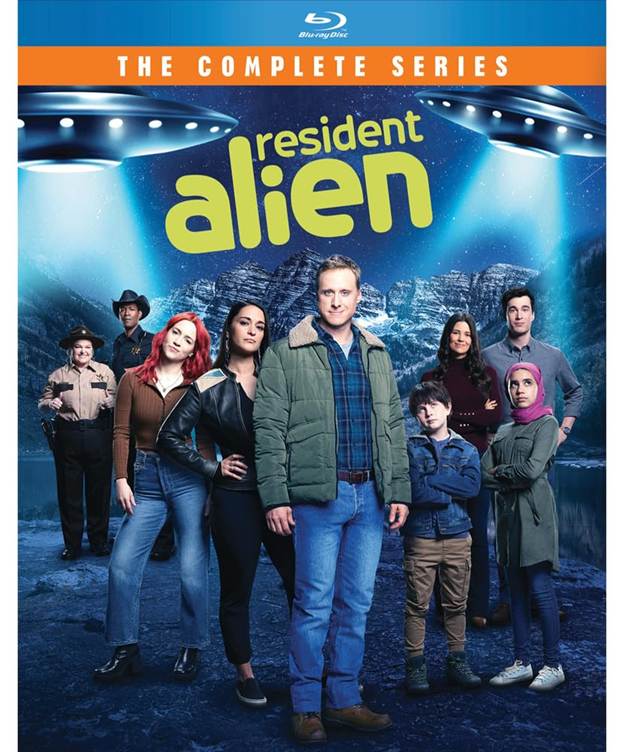
Harry Vanderspeigle is an extraterrestrial visitor on a mission to destroy humanity when he crash-lands in the quiet mountain town of Patience, Colorado. As the title character, he’s a fish out of water whose growing connection to the locals complicates his objective, all while he displays a slapstick awkwardness in his social ineptitude and more than a little heart. It takes one hell of an actor to pull off Harry for four Syfy/USA seasons, and fortunately they cast Alan Tudyk, the Juilliard-trained performer who makes the role endlessly watchable with his what-will-he-do-next comedic brilliance. Tudyk is also widely known as the voice of K-2SO in the film Rogue One: A Star Wars Story and its prequel series Andor, and has voiced a wide range of characters over the years, including Optimus Prime and The Joker.

We see him evolve from reluctant invader into a loyal protector, bonding with his new neighbors to defend Earth against other out-of-this-world threats, all while balancing some engaging subplots backed by a strong supporting cast. The ten discs arrive slipcased, in individual season cases, supplemented with featurettes and an assortment of deleted scenes, including several from the 2025 series finale.

Where to buy: $66.99 at Amazon

Advertisement

Source link

Continue Reading

Tech

Amazon has slashed the Fire TV Stick 4K Select to its lowest price ever thanks to an easy-to-miss coupon

Published

on

The Amazon Fire TV Stick 4K Select is a sweet deal at its full price of $39.99, let alone now that it’s been discounted by an unreal $25. That means you can bag yourself the Amazon Fire TV Stick 4K Select for just $14.99 (was $39.99).

To get this record-low price, you’ll need to enter the code FTV4K at checkout or tap the “Redeem” button underneath the price information. Amazon will then take care of the rest.

best streaming sticks, you know you’ll be getting feature-rich devices at affordable prices.

That is exactly the case for the Fire TV Stick 4K Select. Despite not having reviewed this particular model, we were big fans of both the Fire TV Stick 4K (now the Fire TV Stick 4K Plus) and the Fire TV Stick 4K Max, each scoring 4.5 out of 5 stars.

The Fire TV Stick 4K Select delivers essential 4K streaming with High Dynamic Range 10+ (HDR10+). It also opens up a whole world of content with curated recommendations. And, of course, Alexa is built into the heart of the interface, so you can ask the well-known assistant to search and launch TV programmes across your apps.

Advertisement

With so many options available, it can be difficult to know which device to go for. We’d recommend checking out our Amazon Fire TV Stick 4K Select vs Amazon Fire TV 4K Stick comparison to help with understanding the pros and cons of these two options.


Source link

Continue Reading

Trending

Copyright © 2025