
Tech
Bluesky’s Newest Product: an AI Tool That Gives You Custom Feeds


“What happens when you can describe the social experience you want and have it built for you…?” asks Bluesky? “We’ve just started experimenting, but we’re sharing it now because we want you to build alongside us.”
Called “Attie” — because it’s built with Bluesky’s decentralized publishing framework, AT Protocol (which is open source) — the new assistant turns natural language prompts into social feeds, without users having to know how to code. (It’s part of Bluesky’s mission to “develop and drive large-scale adoption of technologies for open and decentralized public conversation.”)
On the Attie website, examples include prompts like, “Show me electronic music and experimental sound from people in my network” or “Builders working on agent infrastructure and open protocol design.”
“It feels more like having a conversation than configuring software,” [writes Bluesky’s former CEO/current chief innovation officer, Jay Graber, in a blog post]. “You describe the sort of posts you want to see, and the coding agent builds the feed you described.”
Graber added that Attie is a separate app from Bluesky and users don’t have to use the new AI assistant if they don’t want to. However, since Attie and Bluesky were built on the same framework, it could mean there will be some cross-app implementation between the two or any other app built on the AT Protocol.
“Attie is open for beta signups today, and we’ll be sharing what we learn along the way,” Graber writes in the blog post. “To learn more about Attie, visit: Attie.AI. Come help us find out what this can be.”
The blog post warns that “Right now, AI is undermining human agency at the same time it’s enhancing it,” since “The proliferation of low-quality AI-generated content is making public social networks noisier and less trustworthy…” And in a world where “signal is getting harder to find… The major platforms aren’t trying to fix this problem.”
They’re using AI to increase the time users spend on-platform, to harvest training data, and to shape what users see and believe through systems they can’t inspect and didn’t choose. We think AI should serve people, not platforms…
An open protocol puts this power directly in users’ hands. You can use it to build your own feeds, create software that works the way you want it to, and find signal in the noise. We built the AT Protocol so anyone could build any app they imagine on top of it, but until recently “anyone” really meant “anyone who can code.” Agentic coding tools change that. For the first time, an open protocol can be genuinely open to everyone…
The Atmosphere [Bluesky’s interoperable ecosystem] is an open data layer with a clearly defined schema for applications, which makes it uniquely well-suited for coding agents to build on… Bluesky will continue to evolve as a social app millions of people rely on. Attie will be where we experiment with agentic social.
AI is an accelerant on whatever it’s applied to. I want it to accelerate decentralizing social and putting power back in users’ hands. But I don’t think the most interesting things built on AT Protocol will come from us. They’re going to come from everyone who picks up these tools and starts building.

For decades, video games have been largely associated with home consoles or dropping quarters into arcade machines. However, as gaming has evolved, games have become more demanding. In response, some gamers have ditched consoles in favor of computers. While any PC can play at least some video games, desktop gaming PCs are purpose-built for high performance, giving you the sharpest graphics and fastest processing.
Costco members need look no further than their next shopping trip for an advanced gaming setup. The warehouse retailer offers a wide variety of products in addition to bulk groceries at wholesale prices and decent savings at the Costco gas pump. There’s the famous rotisserie chicken, baked goods, tires, hearing aids, entire vacations, and more. You can even buy a gaming PC.
You’ll find a range of gaming PCs in Costco’s electronics department, some of which are relatively affordable, with prices comparable to a typical desktop computer, while others are a bit pricier. Here are the six gaming desktops available from Costco in spring 2026, ranked in descending order of cost.
OMEN MAX 45L Gaming Desktop
As of March 2026, the most expensive gaming PC on Costco’s digital shelves is the OMEN MAX 45L Gaming Desktop. It features plenty of bells and whistles and carries a hefty $2,999 price tag to match.
The tower measures 8.03 inches by 18.5 inches by 21.85 inches, weighs about 50 pounds, and features tool-free access for swapping out or maintaining parts. Inside, there’s plenty to fiddle with. There’s an AMD Ryzen 9 9950X3D processor and graphics are powered by an NVIDIA GeForce RTX 5070 Ti. OMEN Light Studio gives you access to customize and control lighting effects and OMEN AI adjusts your PC’s hardware and settings to improve performance in real time. For connectivity, you’ve got built-in Wi-Fi 7 and Bluetooth 5.4 and there are plenty of ports for connecting peripherals. There’s a combination audio port for a microphone or headphones, one 10Gbps USB-C, two 5Gbps USB-A, four rear-mounted USB-A 2.0, two rear-mounted 5Gbps USB-A, two rear-mounted 10Gbps USB-C, a separate 3.5mm audio jack, an HDMI 2.1b port, and three DisplayPort 2.1a.
It runs on Windows 11 Home and has 64GB of RAM courtesy of two 32GB Kingston Fury DDR5-6000 MT/s. If that’s not enough, you can expand your RAM to 128GB with two available 32GB DIMMs, and all of your game data can be stored on a 2TB PCIe Gen4 NVMe M.2 solid state drive.
MSI Aegis R2 AI Gaming Desktop
Next in Costco’s collection of gaming PC’s we have the MSI Aegis R2 AI Gaming Desktop, with a retail price of $2,499.99. The tower measures 9.1 inches by 19 inches by 19.4 inches and houses an Intel Core Ultra 9 processor and NVIDIA GeForce RTX 5070 Ti 16GB. The exterior features four millimeters of tempered glass, giving visibility into your system’s guts.
Those guts include a 2TB M.2 NVMe solid state drive, 32GB of RAM, and an RGB CPU fan to help keep everything cool. If you’re looking for liquid cooling, you’ll have to look elsewhere. Internal expansion slots include four PCI-E x16 slots (used for connecting graphics cards, network cards, and more), three M.2, four SATA 6G, and four DDR5, with a maximum memory capacity of 256GB.
On the front of the tower you’ll find one 5Gps USB-C, one 5Gbps USB-A, and a combination headphone and microphone port. There are even more connectivity ports in the back with four USB-A 2.0 ports, two 5Gbps USB-A 3.2 ports, two 10Gbps USB-A 3.2 ports, three DisplayPorts, and one HDMI port. You can also connect peripherals using built-in Wi-Fi 7 and Bluetooth 5.3. Keyboard and mouse are included.
MSI Aegis ZS2 Gaming Desktop
An AMD Ryzen 9 9900X (12-core) processor and an NVIDIA GeForce RTX 5070 12GB graphics card set the foundation for the MSI Aegis ZS2 gaming desktop, available from Costco for $2,099.99.
There’s no monitor included but it does come with an MSI gaming keyboard and mouse included. There’s also a Wi-Fi 6E, Bluetooth 5.3, a 2TB M.2 NVMe solid state drive with 32GB of RAM and the temperature of the system is managed by 360mm liquid cooling. You can update or customize your system with four PCI-E x16 slots, three M.2, and four SATA 6G. If 32GB of RAM isn’t enough for your purposes, you can also expand up to 96GB courtesy of two DDR5 slots.
External connecting ports include one 5Gbps USB-C 3.2, one 5Gbps USB-A 3.2, and a combination headphone and microphone port, all in the front. In the back, there are four USB-A 2.0 ports, two 5Gbps USB-A 3.2 ports, two 10Gbps USB-A 3.2 ports, three DisplayPorts, and one HDMI port. And the whole thing comes in a 27-pound package measuring 19.4 inches by 9.1 inches by 19 inches.
CyberpowerPC Gamer Supreme Liquid Cooled gaming PC
Costco’s first offering under the $2,000 mark is the CyberpowerPC Gamer Supreme Liquid Cooled gaming PC, with a price tag of $1,899.99. It runs on Windows 11 Home (which is standard across the current slate of gaming PCs), is liquid cooled, and features an AMD Ryzen 7 9700X 3.8GHz (Max 5.5GHz) processor and an AMD Radeon RX 9060 XT 16GB.
It’s got a different vibe than your typical PC with a white-colored tower weighing about 40 pounds and measuring 18.9 inches by 9.4 inches by 18.9 inches. Memory and storage are provided by a 2TB PCIe 4.0 NVMe solid state drive and 32GB of RAM. In terms of expansion slots, it comes with internal 3.5-inch and 2.5-inch, PCI Express x16, M.2, and more.
External ports include two USB-A 3.2, four USB-A 3.2, two USB-A 2.0, one RJ45 LAN, audio ports for speakers, microphone, and line in, one HDMI port, and two DisplayPort. It also comes standard with a USB RGB gaming keyboard and mouse, no monitor is included.
MSI Codex R2 Gaming Desktop
If you’re looking for something that balances functionality with cost, the MSI Codex R2 Gaming Desktop might be up your alley. It features an Intel Core Ultra 7 processor, an NVIDIA GeForce RTX 5060 Ti 8GB GDDR7 graphics card, and a price tag of $1,499.99.
The Codex R2 has 2TB of storage thanks to an M.2 nVMe solid state drive, and 32GB of built-in RAM. The system doesn’t advertise any expansion ports, so what you see is what you get, but there are plenty of external ports for connecting peripherals. There are a total of 10 USB-A ports and one USB-C. In the front you’ll find a combination microphone in and headphone out jack, one USB-C 3.2, and two USB-A 3.2. In the rear you’ll find four USB-A 2.0, two 5Gbps USB-A 3.2, two 10Gbps USB-A 3.2, one HDMI-out, and three DisplayPorts. You can also connect wirelessly using built-in Wi-Fi 6E and Bluetooth 5.3.
The system runs Windows 11 Home and is cooled by an RGB CPU cooling fan. The tower measures 8.36 inches by 16 inches by 19 inches and it comes standard with an MSI gaming keyboard and mouse. No monitor included.
Skytech Crystal Gaming Desktop
In early 2026, the Skytech Crystal Gaming Desktop is Costco’s most affordable gaming PC, with a price tag of just $1,099.99, roughly a third of the cost of some of its peers.
It measures 21 inches by 13 inches by 22 inches and weighs 30 pounds. Inside, you’ll find an Intel Core Ultra 5 225F processor, an Intel Arc B580 12GB GDDR6 graphics and video card, a 1TB PCIe NVMe Gen 4 solid state drive, and 32GB of DDR5 6000MHz RAM. In terms of expansion, there is a single M.2 expansion slot.
The system gets cooling from three RGB RING fans and runs on Windows 11 Home. External ports include a total of twelve USB-A (six USB-A 3.2 and six USB-A 2.0), two USB-C, one DisplayPort, and two HDMI ports. You can connect to the system wirelessly using built-in Wi-Fi 6E and Bluetooth 5.2. You’ll have to provide your own monitor but Skytech Gaming RGB keyboard and mouse are included.
Finding the right gaming PC for you depends on a number of important considerations including (but not limited to) your gaming needs, space availability, and budget. Based on the range of prices and performance on Costco’s digital shelves, there’s a good chance you can find something that will get you back in the game.

Apple unveiled new device-level age restrictions in the UK on Wednesday. “After downloading a new update, users will now have to confirm that they are 18 or older to access unrestricted features,” reports Gizmodo.
“Users will be able to confirm their age with a credit card or by scanning an ID.”
For those underage or who have not confirmed their age, Apple will turn on Web Content Filter and Communication Safety, which will not only restrict access to certain apps or websites, but will also monitor messages, shared photo albums, AirDrop, and FaceTime calls for nudity. Apple didn’t specify exactly which services and features are banned for under-18 users, but it will likely be in compliance with UK legislation…
The British government does not require Apple and other OS providers to institute device-level age checks, but it does restrict minor access to online pornography under the Online Safety Act, which passed in 2023. So far, that restriction has only been implemented at the website level, but UK officials have been worried about easy loopholes to evade the age restrictions, like VPNs.
The broader tech industry has been campaigning for some time to use device-level age checks instead in response to the rising tide of under-16 social media and internet bans around the world. Last month, in a landmark social media trial in California, Meta CEO Mark Zuckerberg also supported this idea, saying that conducting age verification “at the level of the phone is just a lot clearer than having every single app out there have to do this separately.” Pornhub-operator Aylo had advocated for device-level restrictions in the UK as well, and even sent out letters to Apple, Google, and Microsoft in November asking for OS-level age verification…
The most obvious question: Could this be brought stateside?

Utility-scale solar construction… by robots! It’s “one of the largest real-world demonstrations,” notes Electrek, with 100 MW of capacity installed by the “Maximo” robots from AES, one of the world’s top power companies.
Maximo uses AI “to automate the heavy lifting of solar panels and accelerate solar installation,” according to their web page, which shows a video of Maximo at work installing a vast field of solar panels in Kern County, California. With assistance from Nvidia, the Maximo team could “develop, test and refine robotic capabilities through physics-based simulation and AI driven modeling before deploying updates in the field,”
reports Electrek, and they’re aiming for a full GW of solar generating capacity:
After completing the first half of the Bellefield complex last summer, Maximo engineers went into a higher gear, with the latest version 3.0 robots consistently surpassing an installation rate of one module per minute, with construction crews installing as many as 24 solar panel modules per hour, per person. If that sounds fast, that’s because it is. At full tilt, the latest Maximo robot-equipped crews have nearly doubled the output of traditional installation methods at similar solar locations throughout Southern California.
“Reaching 100 MW is an important milestone for Maximo and for the role robotics can play in solar construction,” explains Chris Shelton, president of Maximo. “It demonstrates that field robotics can move beyond experimentation and deliver consistent results at utility scale. As solar deployment continues to accelerate globally, technologies that improve installation speed, quality and reliability will become increasingly important….”
Like just about every other business that demands a high degree of physical labor, the construction industry is facing huge labor shortages, making machines like Maximo that provide real efficiency gains welcome additions to the job site.
“The combination of AI, vision, robotics and simulation driven engineering reduced development and validation timelines,” the Maximo team said in a statement, “and increased confidence in field performance as the robotic fleet scaled.”

It’s a sad day for the dozens of players still grinding The Elder Scrolls: Blades. Bethesda announced that it’s permanently shutting down the servers for its free-to-play mobile spinoff on June 30. First spotted on Reddit, The Elder Scrolls: Blades has already been delisted from the App Store and Google Play store, and is currently unavailable on the Nintendo Store.
In the meantime, players will receive a free bundle of Gems and Sigils, while all items in the in-game store are available for just one Gem or Sigil each. With a server shutdown imminent, The Elder Scrolls: Blades‘ will at least cross its six-year mark since its official release was in 2020 for Android, iOS and Nintendo Switch. The dungeon-crawling spinoff did see early success when more than one million iOS users downloaded the game during the first week of its early access period, but it never amounted to the commercial success of Bethesda’s mainline titles.
In the end, The Elder Scrolls: Blades ended up with a “Generally Unfavorable” score on Metacritic, with critics calling it “repetitive” and filled with microtransactions. The shutdown doesn’t come as a total surprise, since Bethesda also killed off its other spinoff, The Elder Scrolls: Legends, by halting development in 2019 and ultimately taking the game’s servers offline in January 2025. For anyone who still wants to play a mobile spinoff of Bethesda’s fantasy world, there’s still The Elder Scrolls: Castles.

The further Apple dives into medical technology, the more it will have to deal with regulators. Now, the App Store will label apps that meet select criteria for medical devices in the US, EU, and UK.

App Store will show if an app is a designated medical device
Developers that offer apps with medical uses or connect to medical devices have to be registered with the FDA in the US. Similar regulations exist in the UK and EU, and now there’s a way for developers to label their apps as a regulated medical device in the App Store.
According to Apple’s developer documentation, an app must meet three criteria to get the label. First, the app must be available in the EU, UK, or US and may or may not require registration or authorization from regulatory bodies.
Continue Reading on AppleInsider | Discuss on our Forums

BGIS Grand Finals just wrapped up, and we’ve had a nail-biting competition that went down to the wire. In the end, there were just two rivals, Soul and Genesis. Soul had a horrible last match, which meant all hopes rested on Genesis, and, as you may have guessed from the title, they messed up. Soul ended the day by being crowned BGMIS Grand Finals champions, with Genesis and OG completing the podium. Here’s what the standings look like after day three of BGIS Grand Finals.
BGIS Grand Finals Standings After Day 3
| Team Name | Matches | Wins (WWCD) | Pos. Pts | Fin. Pts | Tot. Pts |
|---|---|---|---|---|---|
| iQOO Soul | 18 | 2 | 54 | 119 | 173 |
| Genesis Esports | 18 | 2 | 49 | 120 | 169 |
| iQOO Orangutan | 18 | 2 | 40 | 92 | 132 |
| Victores Sumus | 18 | 2 | 49 | 79 | 128 |
| Hero Xtreme GodLike | 18 | 2 | 28 | 90 | 118 |
| K9 Esports | 18 | 2 | 41 | 76 | 117 |
| iQOO Revenant Xspark | 18 | 0 | 30 | 84 | 114 |
| Wyld Fangs | 18 | 2 | 48 | 64 | 112 |
| Vasista Esports | 18 | 1 | 35 | 68 | 103 |
| Nebula Esports | 18 | 1 | 40 | 60 | 100 |
| Learn From Past | 18 | 0 | 38 | 59 | 97 |
| Meta Ninza | 18 | 1 | 31 | 64 | 95 |
| Myth Official | 18 | 0 | 27 | 63 | 90 |
| iQOO Reckoning Esports | 18 | 1 | 32 | 57 | 89 |
| iQOO Team Tamilas | 18 | 0 | 20 | 61 | 81 |
| Welt Esports | 18 | 0 | 14 | 48 | 62 |
The action, the thrill, and the fun were all just amazing in the day of action. Lots of tournaments await us in the next couple of months, but Soul does look like the team to beat if anyone else wants to clinch the title. If you missed the games, check out our highlights for both the first and second day.
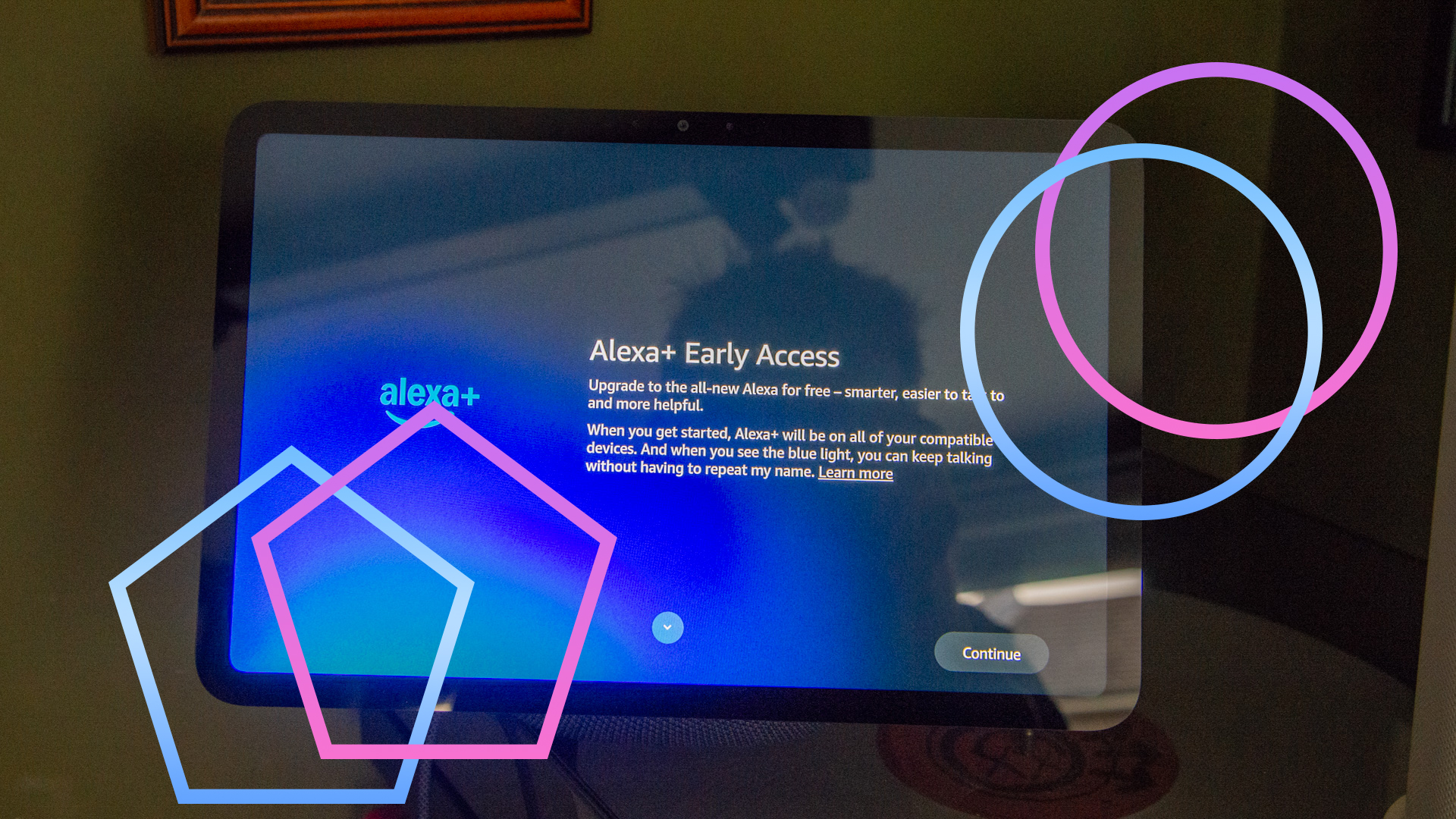
I’ve had access to Alexa+ for a few days now, so not enough for a full review, but enough time to start getting a sense of what the new smart assistant is capable of. While I sort out the final review, here’s what I’ve learned so far.
Gone is Alexa Speak, replaced by the ability to phrase questions and requests more naturally, putting words in the order I see fit.
Alexa+ generally picks up the right context and remembers enough that it’s easy to add follow-up questions. If Alexa+ doesn’t understand, I can just rephrase the question or add a bit more information to try to get the result I want.
It’s a big improvement over the old Alexa+, which felt a lot more transactional, able only to deal with specific requests.
Smart home control is better, with the odd caveat
Go beyond the basic of asking Alexa+ to turn on a light, and the system is surprisingly powerful. Take the little cold spell that we’ve just had. Rather than asking Alexa+ what the temperature currently is in the office, and then asking to set the heating to some level above that, I could just say, “Alexa, it’s cold in here.”
My heating turned on, above the target temperature and my office was given a little boost.
I can also make a command temporary, asking Alexa+ to turn a device off after a specific period. I did find that this required a bit of specific wording: “Alexa, turn the heating off after 10 minutes” didn’t work, but, “Alexa, turn the heating off in ten minutes’ time”, did.
Alexa+ then created a temporary Routine that did what I wanted. It’s possible even to string together something more complicated: “Alexa, turn the heating on. Set the temperature to 21°C and turn the heating off in 30 minutes’ time.”.
Impressively, that mostly worked, although Alexa did decide to set the Bathroom thermostat to 21°C, which was a bit odd. Small issues aside, it’s actually very easy to achieve something quite complex without going anywhere near the app.
The local business search is sub-par
“Alexa, what’s the nearest French restaurant?” I asked. The answer was Le Marmiton, Wanstead. Not only is that restaurant an eight-minute walk from my house, but, the main issue is that Le Marmiton shut down in 2023.
Amazon has said that it’s looking to improve the real-time information, and it needs to do this urgently. This is just one example, but being almost three years out of date isn’t great.
Booking restaurants is good, even if it’s a bit limited
If a restaurant is on OpenTable, then you can get Alexa+ to book the table for you. It’s a neat way of interacting and getting Alexa+ to do the hard work of finding when there’s space free on the date and time you want.
There are some limitations, outside of only supporting OpenTable, with the main one that Alexa+ can’t currently reserve a table at a restaurant that requires a credit card for the booking. It’s a known issue, and Amazon is looking to fix this.
Alexa+ is great at disseminating data
One thing that AI is good at is making sense of data, and that applies with Alexa+, which can scan photos, documents and emails, and can then summarise the information and look for to-do items and calendar dates.
The information can be emailed to Amazon ([email protected]), provided you’re sending from a linked email address. At least, in my experience, that’s in theory. Despite my personal email address being linked, I’ve not had any success when emailing data over.
I can use the app, and that’s impressive. Adding a document for my daughter’s upcoming dance competition, Alexa+ added some checklist items for things that need to be done (costume, etc), and then found the date of the competition and added it to my calendar.
I also took a photo of the school’s term dates page (a hideous, messy table), and Alexa+ found all of the term dates and the inset dates, letting me add them to my calendar.
There’s no support for work calendars
If you’ve got a work Gmail or Exchange account, then you can’t link this to Alexa+. Amazon is working on it, but for now it’s a bit frustrating. I pay for email hosting for my personal account, but I can’t add this to Alexa+. Instead, I’ve had to find a third-party tool that synchronises a free Gmail calendar with my paid-for Exchange one. Amazon needs to fix this one fast.
Alexa+ is the best voice assistant
It’s early days, but my initial impressions are that Alexa+ is the best voice assistant: it understands more, is easier to talk to, and can do more complicated things than its rivals.
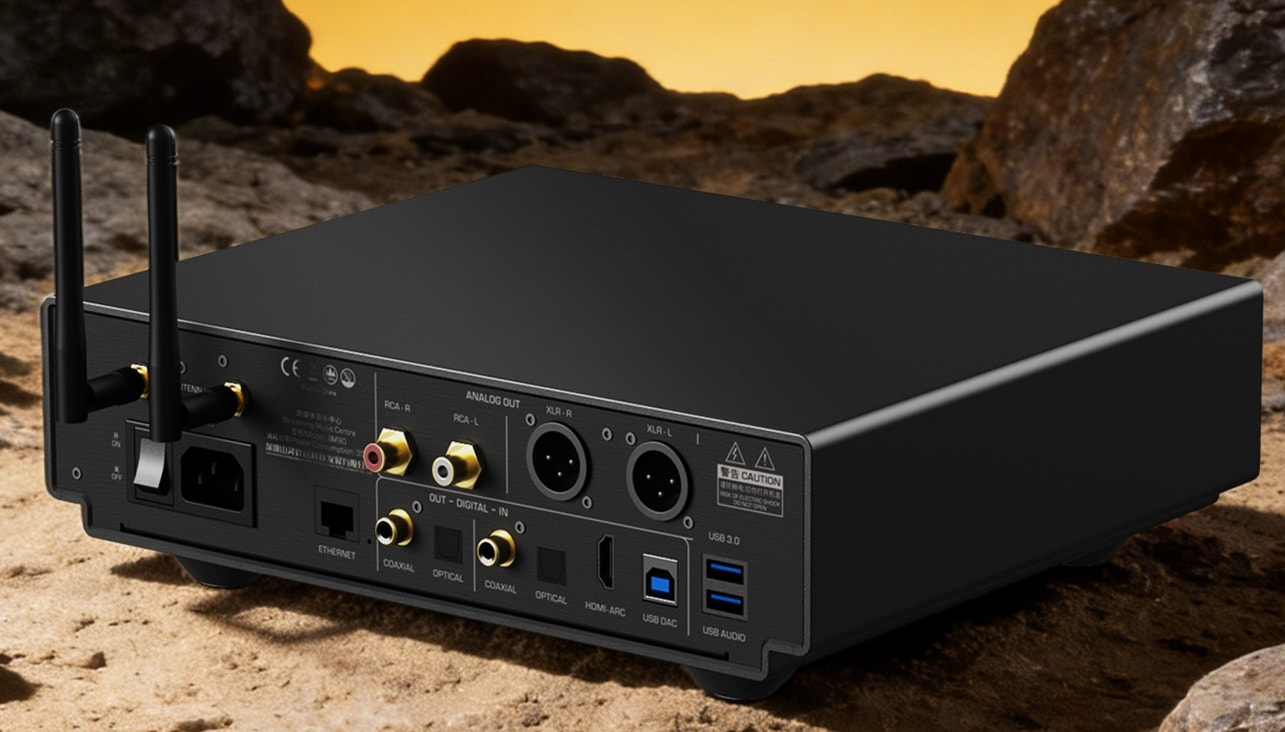
Shanling has officially unveiled the SM90, a compact network player that does more than just stream music. Priced just under $1,000, the SM90 integrates HDMI ARC, dual AKM DACs, and a modern Android-based platform into a single chassis designed to anchor both hi-fi and TV audio systems. That HDMI ARC input is the headline feature and not just for spec sheet bragging rights. It signals a shift in how companies like Shanling are positioning streamers in 2026: not as standalone music devices, but as central hubs for everything from Qobuz playlists to Netflix dialogue.
Although Shanling isn’t the first to build a capable streamer, the SM90 is among the first in its class to take HDMI ARC seriously. That single connection allows users to route TV audio directly into a two-channel system without needing an AVR or soundbar. It’s a practical move. More listeners are consolidating their systems, and the idea of separate music and TV setups feels increasingly outdated. The SM90 leans into that reality, even if purists might roll their eyes.
Familiar Hardware, More Focused Execution
Under the hood, Shanling sticks with a familiar and proven formula. Dual AKM AK4493S DACs handle conversion duties, paired with a closed Android 12 system running on a platform with 4GB of RAM and 64GB of internal storage. A 4.96-inch 1080p touchscreen anchors the user experience. Nothing here reinvents the category, but that seems intentional. Shanling appears more focused on stability and refinement than chasing novelty this time around.
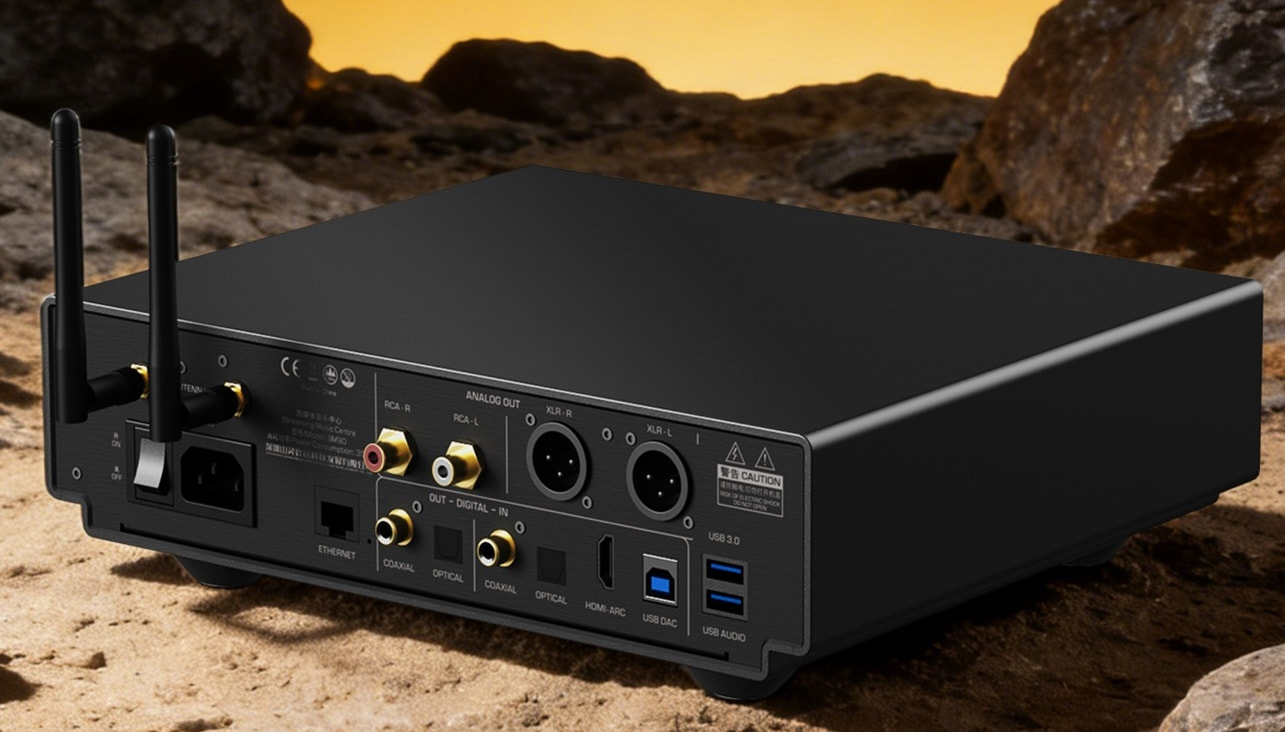
Streaming support covers most of what buyers expect at this level. Qobuz Connect, TIDAL Connect, AirPlay 2, DLNA, and access to major streaming apps are all included, alongside Wi-Fi 6, Ethernet, and Bluetooth 5.2 with LDAC. Roon Ready status is still pending, which may give some buyers pause. In this segment, that box usually needs to be checked on day one.
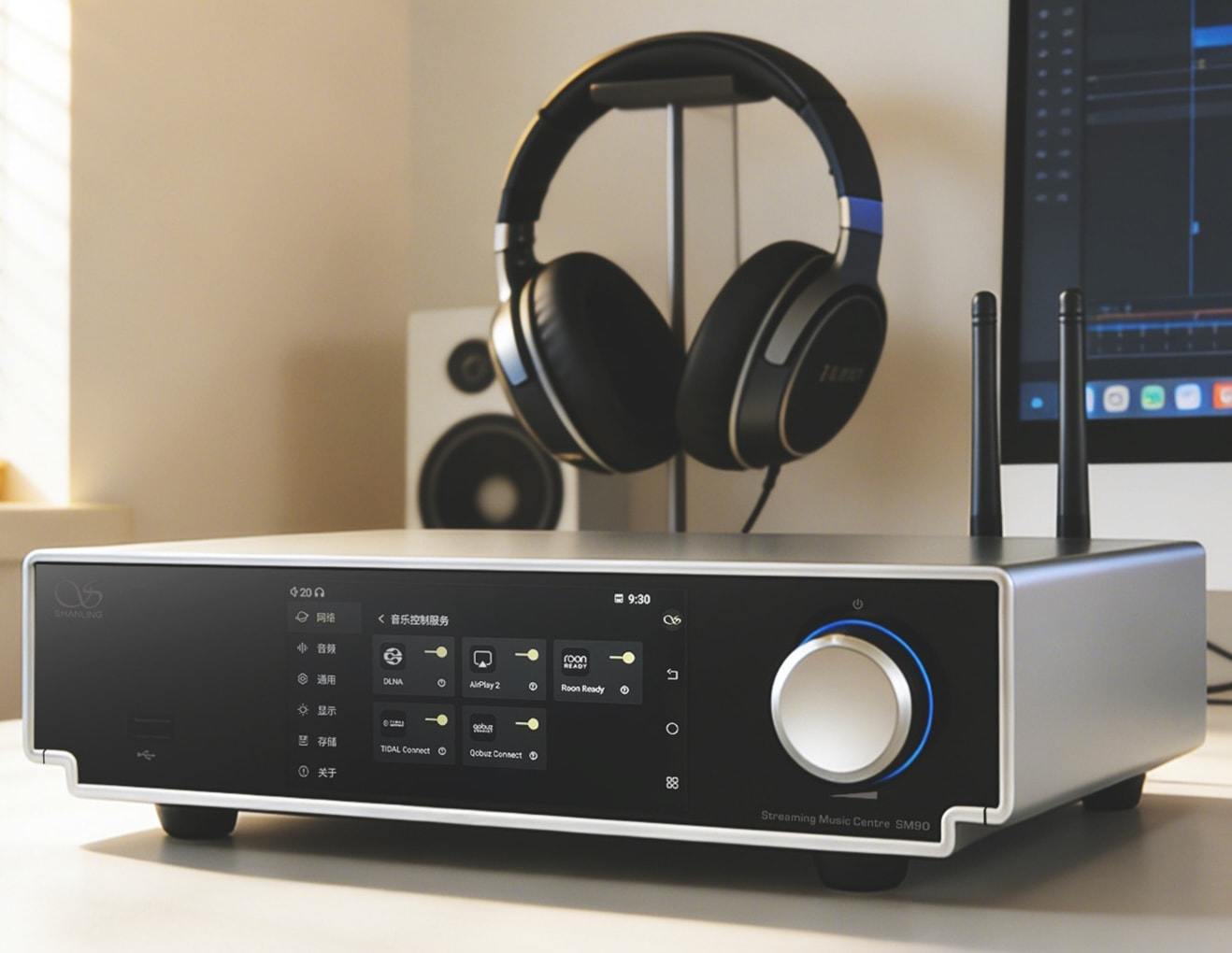
Connectivity is where the SM90 starts to separate itself from a crowded field. In addition to HDMI ARC, it offers USB DAC functionality, optical and coaxial inputs and outputs, balanced XLR and single-ended RCA outputs, and support for internal storage via SSD. That’s a broader and more flexible I/O set than many competitors, reinforcing the idea that Shanling wants this to be the center of a system rather than just another endpoint.
The timing, however, is not exactly forgiving. The sub-$1,000 streamer category is now one of the most competitive in hi-fi, with strong options from WiiM, Eversolo, Cambridge Audio, and HiFi Rose already entrenched. Shanling’s approach leans more traditional, but with a modern twist in the form of HDMI ARC. Whether that combination is enough will come down to execution, particularly on the software side, where stability and responsiveness matter more than another feature checkbox.
The SM90 is less about breaking new ground and more about acknowledging where the category is headed. By adding HDMI ARC and expanding connectivity, it positions itself as a true system hub rather than just another streamer. What remains uncertain is how well it all works in the real world.
There are no meaningful third-party reviews yet, Roon certification is still pending, and Shanling’s software track record is not spotless. But if those pieces fall into place, the SM90 could land exactly where a lot of systems are heading—right between your speakers and your TV, whether audiophiles like it or not.
Features
- Compact dimensions at 28 x 23 x 8.5 cm
- Reduced weight at just 3.3kg
- Dual AKM AK4493s DAC Section
- OPA1612 Analog Output
- 4.96-Inch 1080p Touch Screen
- Closed Android 12 platform, Rockchip CPU
- Qobuz Connect, Tidal Connect, Roon Ready (in process)
- Built-in Streaming Apps
- (Apple, Apple Classical, Amazon, Spotify, KKBox, Presto, Radio Paradise)
- NAS, DLNA, AirPlay 2 Playback
- Internal SSD Slot & USB Drive Playback
- Bluetooth 5.2 Input support LDAC, AAC, SBC
- Digital Inputs: Coaxial / Optical / USB DAC / HDMI ARC
- Digital Outputs: Coaxial / Optical / USB
- Analog Outputs: RCA & XLR
The Bottom Line
The Shanling SM90 is less about breaking new ground and more about acknowledging where the category is headed. By adding HDMI ARC and expanding connectivity, it positions itself as a true system hub rather than just another streamer, one clearly designed to sit between your TV and a modern two channel system without forcing you into an AVR or soundbar ecosystem.
What’s still missing is clarity where it matters. U.S. pricing appears to land somewhere around $900 to $1,000, but nothing feels fully locked, and that matters in a segment where even a modest price shift can change the conversation. There’s also no real world performance data yet, Roon certification remains pending, and Shanling’s software track record, while improving, has not been flawless. Past issues with app stability and gapless playback are still fresh enough to raise concern, and those are the kinds of problems that undermine an otherwise strong product.
It is also worth noting what is not here. There is no indication of built in room correction or system optimization tools, which feels like a missed opportunity in 2026, especially for buyers pairing a streamer with active speakers and expecting a more complete and flexible setup. At the same time, the competition is well established. WiiM, Cambridge Audio, Bluesound, Eversolo, and others already offer mature platforms, stable apps, and in some cases deeper ecosystem integration.
Shanling has been on a solid run lately with its higher end CD and SACD players and a steady stream of well received portable gear, so the SM90 is not arriving from a position of weakness. But this category does not reward potential, it rewards execution. If Shanling delivers stable software and consistent performance, the SM90 could be a serious contender. If not, it risks becoming just another well specified box in a segment that already has plenty of proven alternatives.
Where to buy: $969 (available April 2026)
Related Reading:

Unlike traditional casino sites, where you can wager real money, social casinos operate on virtual currencies or offer games for free. That’s why these special casinos saw remarkable growth across Southeast Asia recently, and Malaysia is one of the first countries in the region to embrace this type of entertainment.
Strict Malaysian regulations have allowed players to enjoy casino-style games purely for entertainment, as most forms of gambling remain prohibited. The Betting Act 1953 and Shariah Law apply to the Muslim-majority population of Malaysia, and social casinos have established themselves as a culturally acceptable alternative for those seeking gaming entertainment. In 2026, the social casino industry in Malaysia is thriving, driven by smartphone adoption, rapid mobile internet penetration, innovative game features, and a digitally savvy population.
The Definition of a Social Casino
A social casino is a gaming platform, be it a website or a mobile app, that perfectly replicates the gambling atmosphere with casino games. At an online casino, you can claim a welcome bonus, for example, after you explore the sign-up bonuses on Plainenglish.io as a first-time player, then play for real money, and cash out actual winnings. In contrast, Malaysian social casinos do not involve real-money stakes and payouts, hence the name, as their effect remains purely social.
Players use virtual coins, chips, or tokens that can be earned through gameplay, daily rewards, or purchased through microtransactions. Sign-up bonuses and other rewards might also be available, and they often come with very simple redemption conditions. This makes social casinos accessible to a broader Malaysian audience, including players who may avoid traditional gambling for religious, cultural, and legal reasons.
Popular Social Casino Trends in Malaysia
If you want to know the top social casino trends in Malaysia for 2026, take a look at the list below:
- Booming mobile gaming: due to high nationwide mobile penetration with rates exceeding 96% in 2025, mobile internet usage averages over four hours daily. This is the main reason why social casino apps are thriving, and they offer games designed primarily for mobile devices. In short, these games are instantly accessible to millions of Malaysians.
- Reducing cultural barriers: although slightly controversial with the gambling law, social casinos remove the ethical and legal concerns associated with real-money gambling. Players can enjoy online slots, roulette, and other classic casino games without financial risk, making them acceptable across diverse cultural and religious backgrounds – something that was a real barrier only a few decades ago.
- Social network interaction: this trend is also known as “online social connectivity”, and it is a very new phenomenon. Malaysians are highly active on social media, using platforms like Facebook, Instagram, and TikTok. Social casinos boost this factor by offering multiplayer features, friend invitations, leaderboards, and social sharing. This trend turns solitary gameplay into a communal interaction that can be easily integrated into daily lifestyle.
- New gameplay modes: social casinos use the free-to-play model, where the barrier to entry is literally zero. Live multiplayer tournaments are another innovative and increasingly popular model where players compete against friends or strangers. Online platforms now host daily and weekly poker and slot tournaments with leaderboard rankings and virtual prize pools.
- Virtual gifting schemes: players can send virtual gifts, coins, or boosters to friends. This feature helps improve community bonds and encourages continued play for newcomers. Some platforms have even integrated live chat and emoji reactions during gameplay to mirror the social energy of a physical casino.
- Personalized avatars and profiles: customization is a major trend in Malaysia. Players create detailed avatars, unlock exclusive outfits and accessories through achievements, and showcase their profiles on public leaderboards, social media, and other channels. This gamification trend transforms a social casino into something much more important than just a website to play free games.
- Cross-platform synchronization: players expect seamless experiences across devices. Leading social casinos now synchronize progress between smartphones, tablets, and desktops. This allows virtual coins, achievements, tournament standings, and many other features to carry over regardless of how you access the social casino platform.
- Popularization of story-driven slot games: modern social slots go beyond simple spinning reels. The top software providers now release slots with narrative-driven progression, where players unlock chapters, complete missions, and explore themed worlds. Although free to play, this storytelling approach matches particularly well the needs of Malaysian players who enjoy RPG-style mobile games.
- Seasonal events and challenges: the best Malaysian social casino platforms regularly launch events tied to cultural celebrations, such as Hari Raya, Chinese New Year, Deepavali, and Malaysia Day. These events are accompanied by exclusive games, themed rewards, and time-limited challenges during festive periods.
- Monetization: while social casinos are free to play, they generate revenue through in-app purchases. Players can buy virtual coin packages, premium boosters, or exclusive content. In Malaysia, spending on social casino microtransactions grew by an estimated 18% year-on-year in 2024. In addition, responsible spending features are becoming standard. Most reputable platforms now include purchase limits, spending trackers, and parental controls as a way to prevent excessive microtransaction spending.
The Verdict
Two things make social casinos important: they are modern and trend-driven, and they can be monetized. This combination is more than enough to show that there is a rise in social casinos in Malaysia. Looking into the future, their popularity is set to keep growing as technology advances and developers create increasingly immersive gaming opportunities for everyone.
Because no real money is won or lost, social casinos fall outside the legal definition of gambling in most jurisdictions, including Malaysia. This is essential for the appeal of online gaming sites in countries where ethical and cultural barriers are still in place.

The fighting game community is going to have their hands full this summer between the release of Marvel Tōkon: Fighting Souls and Avatar Legends: The Fighting Game. The studio behind the 2D fighting game based in the Avatar universe announced that a July 2 release date with a trailer that shows off new gameplay and a base price of $29.99.
The game will launch with 12 characters, encompassing both the heroes and villains from Avatar: The Last Airbender and The Legend of Korra. The game’s developer, Gameplay Group International, said that there are more than 900 hand-drawn frames for each character, which makes the game look like it came directly out of the beloved TV series. Avatar Legends: The Fighting Game will feature both casual and ranked matches, using a rollback netcode to ensure smooth frame-by-frame action between players, along with crossplay across PS5, Xbox Series X and S, Nintendo Switch 2 and PC.
For those more interested in the lore, there will be a single-player story mode and a gallery mode with “never before seen art.” Avatar Legends: The Fighting Game is currently available for pre-order, starting at $29.99, but there’s a $59.99 deluxe edition that includes a digital art book, music soundtrack, unique HUDs and a Year 1 Pass, which adds five additional characters that will be released in the future. Those who pre-order will also get a Samurai skin for Appa, exclusive character colors and voting privilege for the Year 1 Pass characters.

Blue Jays hit three HRs to finish three-game sweep of A’s

Rice will have way more flavour if you add one ingredient to pot

10 Greatest Black-and-White Action Movies, Ranked

Smart energy pays enters the US market, targeting scalable financial infrastructure

Why Israel is blocking foreign journalists from entering

Bitcoin: We’re Entering The Most Dangerous Phase

Old Mutual report reveals mixed signals in Kenya’s financial well-being

Aaron Judge & Paul Skenes Struggle on Opening Day #mlb #baseball #yankees #pirates #oneilcruz #skit

Nisila & Yashmi | Five Million Money Drop S4 | Episode 19 | Sirasa TV
-
 NewsBeat5 days ago
Manchester United reach agreement with Casemiro over contract clause amid transfer speculation
-

 News Videos4 days ago
Parliament publishes latest register of MPs’ financial interests
-

 Sports6 days ago
Gary Kirsten Accuses Pakistan Cricket Board Of ‘Interference’, Mohsin Naqvi Responds
-

 Sports6 days ago
Remo Stars and Kano Pillars Strengthen Survival Hopes in NPFL
-

 Tech7 days ago
AI enters the chat: New Seattle dating app relies on tech to facilitate meaningful human connections
-

 Business3 days ago
Instagram, YouTube Found Responsible for Teen’s Mental Health Struggle in Historic Ruling
-

 News Videos6 days ago
Ch 9 Financial Management Part 1 | Detailed One Shot | Class 12 Business Studies Boards 2026
-

 NewsBeat2 days ago
The Story hosts event on Durham’s historic registers
-
 NewsBeat4 days ago
Tesco is selling new Cadbury Dairy Milk bar and people can’t wait to try it
-

 Tech6 days ago
Samsung will soon let you control smart home devices from your car’s dashboard
-

 Sports7 days ago
2026 Kentucky Derby horses, odds, futures, preview, date: Expert who hit 12 Derby-Oaks Doubles enters picks
-
 Entertainment23 hours ago
Lana Del Rey Celebrates Her Husband’s 51st Birthday In New Post
-
 Entertainment6 days ago
Cynthia Bailey Dishes on ‘RHOA’ Season 17, Discusses Kandi
-
 NewsBeat6 days ago
Colombian military plane with 110 soldiers onboard crashes following takeoff
-

 Fashion5 days ago
Does It Matter What You Wear When You’re Laid Off and Looking?
-

 Business5 days ago
More women enter wealth management, but few in advisory roles: study
-

 Business5 days ago
Late-paying firms face multimillion-pound fines under new crackdown
-

 Sports5 days ago
Fantasy Baseball Week 1 Preview: Top sleeper hitters for both five- and 12-day period led by Munetaka Murakami
-

 Fashion6 days ago
Fringe Bags for the Season
-

 Politics6 days ago
How Media Platforms Balance Performance and Accessibility in Image Delivery
You must be logged in to post a comment Login