







Connect with us
DAPA Banner

Tech

FiiO Confirms Price Increases Starting April 1, 2026, Citing Chip Costs, Tariffs, and Market Pressure

Published

on

FiiO has announced a round of price increases across several of its most popular portable audio products, effective April 1, 2026, and while the official explanation points to rising semiconductor and memory chip costs, that’s only part of the story.

According to the company, ongoing supply chain instability and sharply higher component pricing, particularly for memory, have pushed costs beyond what it can absorb. The result: higher retail pricing for models like the DISC, JM21, M21, and M33. But let’s not pretend this exists in a vacuum. Tariffs continue to cast a long shadow over Chinese audio brands selling into the U.S., and the broader personal audio market is starting to feel…crowded. Very crowded. CanJam NYC was absolutely mobbed with consumers and the FiiO table was one of the busiest at the weekend event, but the shotgun approach may not be the best course of action right now.

fiio-price-adjustment-notice

FiiO, for its part, hasn’t exactly been sitting still. If anything, the brand has been flooding the zone. It’s rolling out new DACs, DAPs, dongles, and IEMs at a pace that feels less like product strategy and more like a high-speed chase. That kind of release cadence keeps the brand top of mind, but it also creates internal pressure: inventory, positioning, and the very real risk of cannibalizing your own lineup.

Layer in intensifying competition from equally aggressive Chinese rivals and increasingly capable budget gear and you start to see the bigger picture. This isn’t just about chip prices going up. It’s about a brand navigating tariffs, margin pressure, and a market that may finally be hitting the brakes after years of runaway growth.

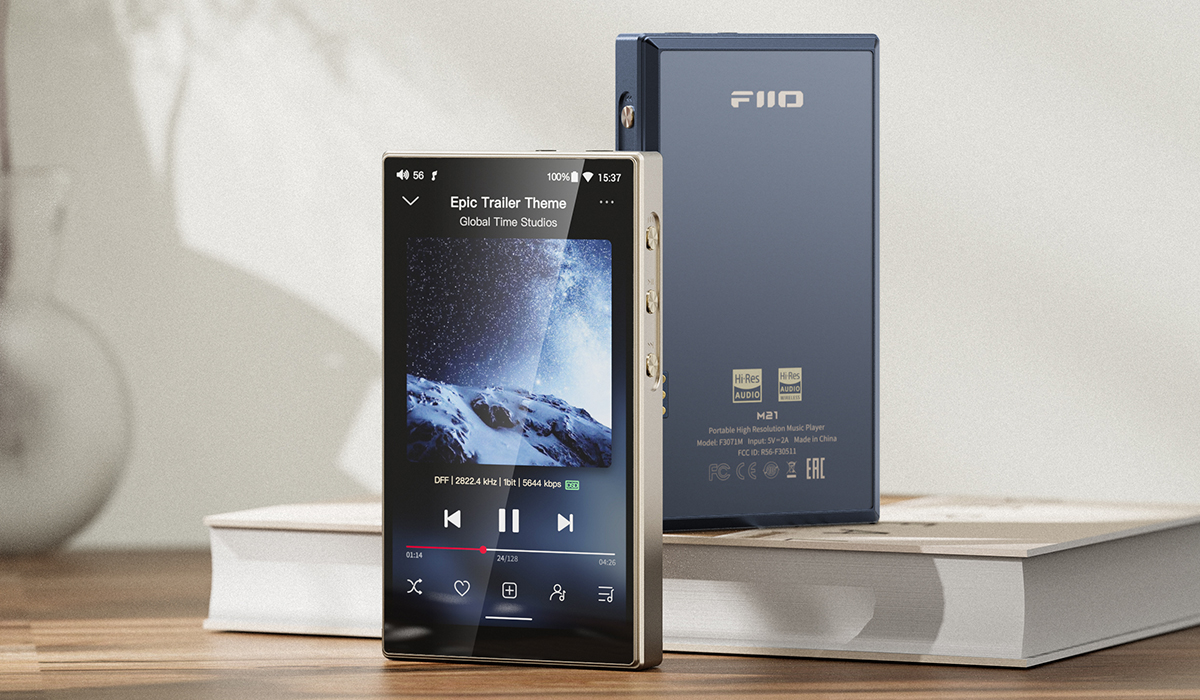
fiio-m21
FiiO M21
FiiO M33 DAP
FiiO M33 DAP

Which FiiO Models Are Getting More Expensive and By How Much?

FiiO has confirmed price increases across four products, covering both its entry and mid tier lineup. Effective April 1, 2026, the DISC will retail for $89.99, the JM21 for $259.99, the M21 for $369.99, and the M33 for $699.99. The changes are not extreme on an individual level, but they are consistent across multiple categories and price points.

The M21 moves up from its original $329 launch price to $369, a noticeable but measured increase for a mid tier digital audio player. The JM21 is a more meaningful shift. Previously positioned closer to the $200 range depending on market and configuration, it now sits just under $260, which places it in a more competitive segment with fewer clear advantages. The M33 approaches $700, moving further into territory where buyers may start comparing it more directly with higher end alternatives. Even the DISC increases from roughly $79 to $89.99, indicating that lower cost products are not exempt from these adjustments.

Advertisement

Taken together, these changes reflect more than a simple update tied to component costs. They suggest a broader shift in pricing across FiiO’s lineup at a time when competition is increasing and buyers have more options at nearly every level.

FiiO JM21 DAP
FiiO JM21 DAP

The Bottom Line

FiiO is being transparent about why prices are going up, and that counts for something. Rising component costs and ongoing tariff pressure are real issues that every manufacturer in this category is dealing with, not just one brand. The lineup itself remains competitive from a feature and performance standpoint, and FiiO still offers a wide range of options that cover everything from entry level to more advanced portable systems.

The downside is timing and positioning. Several of these products were defined by their value, and those margins are now tighter. As prices climb, buyers are more likely to compare across brands, and that is where the pressure builds. HiBy, Shanling, Astell and Kern, and iBasso are all delivering strong alternatives at similar price points, often with distinct strengths in software, design, or tuning.

These increases will likely impact first time buyers and value focused users the most, while existing FiiO customers may be more willing to absorb the changes. The bigger question is whether the market will continue to accept higher pricing as competition intensifies and product cycles continue to accelerate.

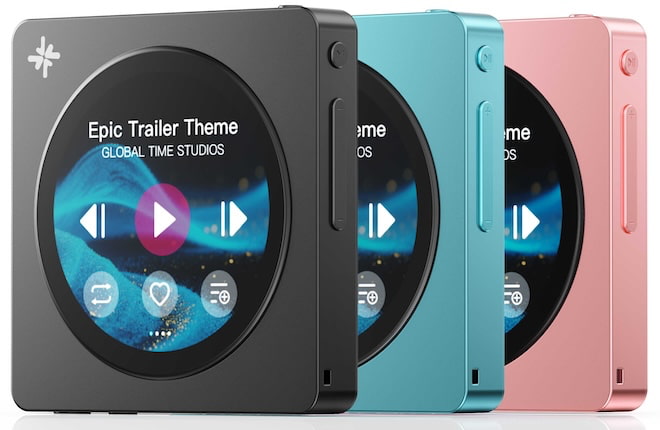
fiio-disc-angle-colors
FiiO DISC

Where to buy:

Advertisement. Scroll to continue reading.
Advertisement

Source link

Continue Reading
Click to comment

You must be logged in to post a comment Login

Leave a Reply

Tech

FBI confirms hack of Director Patel’s personal email inbox

Published

on

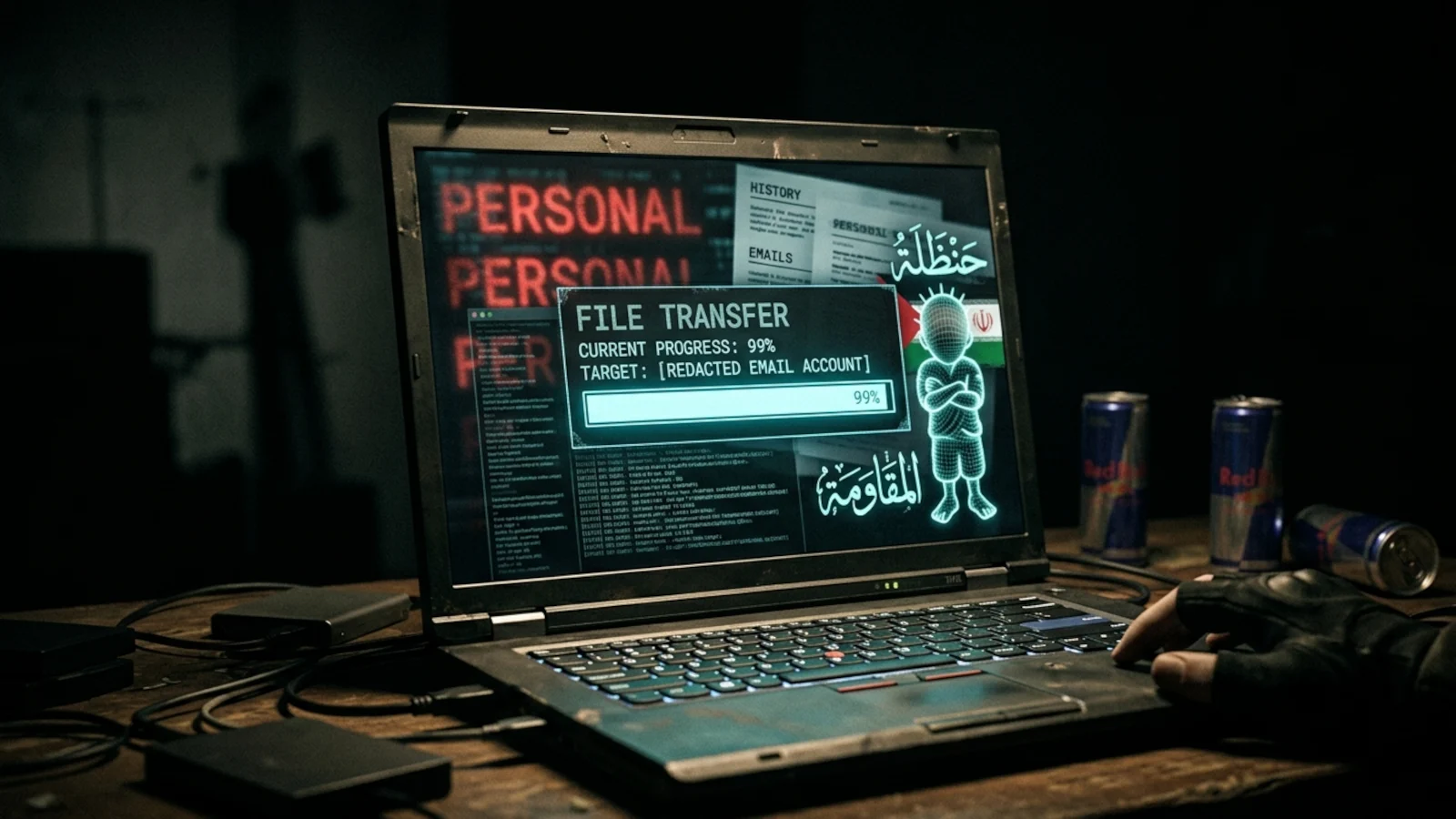
The Handala hackers associated with Iran have breached the personal email account of FBI Director Kash Patel and published photos and documents.

The FBI has confirmed the compromise, saying that the stolen data was not recent and did not include any government data.

​On Friday, the Handala threat actor announced on one of their websites that Patel has been added to the list of their victims, alleging that they compromised “the so-called ‘impenetrable’ systems of the FBI” in just a few hours.

The hackers said that their action was in response to the FBI seizing Handala domains and the U.S. government offering a reward of up to $10 million for information on the threat group’s members.

Advertisement

However, the hackers had breached the FBI Director’s personal Gmail inbox.

“All personal and confidential information of Kash Patel, including emails, conversations, documents, and even classified files, is now available for public download,” the Handala hackers said before publishing proof of the breach.

Handala hackers announcing FBI Director Patel's inbox hack
Handala hackers announcing FBI Director Patel’s inbox hack
source: BleepingComputer

Shortly after the announcement, the threat actor published a set of watermarked personal photos and documents extracted from Patel’s inbox, along with email correspondence from before becoming FBI director.

​In a statement for BleepingComputer, the FBI said that it was aware of hackers “targeting Director Patel’s personal email information.”

The agency further notes that it has taken every necessary precaution to reduce any negative impact that may result from this activity.

Advertisement

​“The FBI is aware of malicious actors targeting Director Patel’s personal email information, and we have taken all necessary steps to mitigate potential risks associated with this activity. The information in question is historical in nature and involves no government information,” – the Federal Bureau of Investigation

​The Handala hacktivist group has previously breached the Microsoft environment of medical technology giant Stryker and wiped nearly 80,000 devices.

​Also known as Handala Hack, Hatef, and Hamsa, the actor emerged in December 2023 and is a hacktivist persona carrying out cyber activities for Iran’s Ministry of Intelligence and Security (MOIS).

​In the statement on the compromise of Director Patel’s personal email account, the FBI reiterated the $10 million reward from the Department of State’s Rewards for Justice “for information leading to the identification of the Handala Hack Team out of Iran.”

Advertisement

Automated pentesting proves the path exists. BAS proves whether your controls stop it. Most teams run one without the other.

This whitepaper maps six validation surfaces, shows where coverage ends, and provides practitioners with three diagnostic questions for any tool evaluation.

Source link

Continue Reading

Tech

‘Project Hail Mary’: Real Space Science, Real Astrophotography

Published

on

Project Hail Mary has now grossed $300.8 million globally after earning another $54.1 million this weekend from 86 markets, reports Variety, noting that after just nine days it’s now Amazon MGM’s highest-grossing film ever.

And last weekend it had the best opening for a “non-franchise” movie in three years, adds the Associated Press — the best since 2023’s Oppenheimer:


Project Hail Mary, which cost nearly $200 million to produce… is on an enviable trajectory. Its second weekend hold was even better than that of Oppenheimer, which collected $46.7 million in its follow-up frame.

But the movie is based on a book by The Martian author Andy Weir, described by one news outlet as “a former software engineer and self-proclaimed ‘lifelong space nerd’… known for his realistic and clear-eyed approach to scientifically technical stories.”


Project Hail Mary has plenty of real science in it, whether it be space mathematics, physics, or astrobiology… The film’s namesake project is even comprised of the space programs of other nations, such as Roscosmos from Russia, the Chinese space program, and the European Space Agency…

Advertisement

The story relies on work NASA has done regarding exoplanets, or planets outside our solar system… [This includes a nearby star named Tau Ceti approximately 12 light years from Earth which is orbited by four planets — two once thought to be in “the habitable zone” where liquid water can exist.] Tau Ceti has long been the setting used by sci-fi authors and storytellers. Isaac Asimov used it for his Robot series. Arthur C. Clarke’s “Rama” spacecraft came across a mysterious tetrahedron in the Tau Ceti system. Authors Ursula K. Le Guin and Kim Stanley Robinson also set stories in Tau Ceti, and it also serves as the extrasolar setting of the 1968 Jane Fonda film Barbarella. Most recently, the Bungie video game Marathon is set in the far-off system, serving as part of the background story for the extraction shooter, about a large-scale plan to colonize the Tau Ceti system.
The movie also mentions 40 Eridani A, according to the article, a real star about 16 light-years away that was said to be orbited by the fictional planet Vulcan, home to Star Trek‘s Mr. Spock, and mentioned in Frank Herbert’s Dune as the planet of at least one alien rase.

And in a video on IMAX’s YouTube channel, the film’s directors explain how for a crucial scene they used non-visible-light photography, which is also an important part of modern astronomy. “Even the credits incorporate real astrophotography into the final moments,” the article points out, using the work of award-winning Australian astrophotographer Rod Prazeres. “The only difference between his work of capturing space data in images and what ended up on the big screen was that he gave them ‘starless versions’ of his photographs to make it easier to place credit text over them.”

Prazeres wrote on his web site that he was touched the producers “wanted the real thing… In a world where CGI and AI are everywhere, it meant a lot…”

Advertisement

Source link

Continue Reading

Tech

Employees are doing more tasks faster thanks to AI, yet disengagement and underutilization are creeping higher

Published

on


  • Weekend work has risen over 40% as schedules start earlier, but productivity gains remain uneven
  • AI adoption has integrated deeply, increasing time spent across all tasks
  • Collaboration and multitasking have surged, while uninterrupted focus reaches a three-year low

The rapid adoption of Artificial Intelligence created the impression that humans would complete tasks faster and reduce workplace burdens.

But new data from the ActivTrak Productivity Lab’s 2026 State of the Workplace analysis claims workplace activity is not shrinking in the way many expected.

Advertisement

Source link

Continue Reading

Tech

When product managers ship code: AI just broke the software org chart

Published

on

Last week, one of our product managers (PMs) built and shipped a feature. Not spec’d it. Not filed a ticket for it. Built it, tested it, and shipped it to production. In a day.

A few days earlier, our designer noticed that the visual appearance of our IDE plugins had drifted from the design system. In the old world, that meant screenshots, a JIRA ticket, a conversation to explain the intent, and a sprint slot. Instead, he opened an agent, adjusted the layout himself, experimented, iterated, and tuned in real time, then pushed the fix. The person with the strongest design intuition fixed the design directly. No translation layer required.

None of this is new in theory. Vibe coding opened the gates of software creation to millions. That was aspiration. When I shared the data on how our engineers doubled throughput, shifted from coding to validation, brought design upfront for rapid experimentation, it was still an engineering story. What changed is that the theory became practice. Here’s how it actually played out.

The bottleneck moved

When we went AI-first in 2025, implementation cost collapsed. Agents took over scaffolding, tests, and the repetitive glue code that used to eat half the sprint. Cycle times dropped from weeks to days, from days to hours. Engineers started thinking less in files and functions and more in architecture, constraints, and execution plans.

Advertisement

But once engineering capacity stopped being the bottleneck, we noticed something: Decision velocity was. All the coordination mechanisms we’d built to protect engineering time (specs, tickets, handoffs, backlog grooming) were now the slowest part of the system. We were optimizing for a constraint that no longer existed.

What happens when building is cheaper than coordination

We started asking a different question: What would it look like if the people closest to the intent could ship the software directly?

PMs already think in specifications. Designers already define structure, layout, and behavior. They don’t think in syntax. They think in outcomes. When the cost of turning intent into working software dropped far enough, these roles didn’t need to “learn to code.” The cost of implementation simply fell to their level.

I asked one of our PMs, Dmitry, to describe what changed from his perspective. He told me: “While agents are generating tasks in Zenflow, there’s a few minutes of idle time. Just dead air. I wanted to build a small game, something to interact with while you wait.”

Advertisement

If you’ve ever run a product team, you know this kind of idea. It doesn’t move a KPI. It’s impossible to justify in a prioritization meeting. It gets deferred forever. But it adds personality. It makes the product feel like someone cared about the small details. These are exactly the things that get optimized out of every backlog grooming session, and exactly the things users remember.

He built it in a day.

In the past, that idea would have died in a prioritization spreadsheet. Not because it was bad, but because the cost of implementation made it irrational to pursue. When that cost drops to near zero, the calculus changes completely.

Shipping became cheaper than explaining

As more people started building directly, entire layers of process quietly vanished. Fewer tickets. Fewer handoffs. Fewer “can you explain what you mean by…” conversations. Fewer lost-in-translation moments.

Advertisement

For a meaningful class of tasks, it became faster to just build the thing than to describe what you wanted and wait for someone else to build it. Think about that for a second. Every modern software organization is structured around the assumption that implementation is the expensive part. When that assumption breaks, the org has to change with it.

Our designer fixing the plugin UI is a perfect example. The old workflow (screenshot the problem, file a ticket, explain the gap between intent and implementation, wait for a sprint slot, review the result, request adjustments) existed entirely to protect engineering bandwidth. When the person with the design intuition can act on it directly, that whole stack disappears. Not because we eliminated process for its own sake, but because the process was solving a problem that no longer existed.

The compounding effect

Here’s what surprised me most: It compounds.

When PMs build their own ideas, their specifications get sharper, because they now understand what the agent needs to execute well. Sharper specs produce better agent output. Better output means fewer iteration cycles. We’re seeing velocity compound week over week, not just because the models improved, but because the people using them got closer to the work.

Advertisement

Dmitry put it well: The feedback loop between intent and outcome went from weeks to minutes. When you can see the result of your specification immediately, you learn what precision the system needs, and you start providing it instinctively.

There’s a second-order effect that’s harder to measure but impossible to miss: Ownership. People stop waiting. They stop filing tickets for things they could just fix. “Builder” stopped being a job title. It became the default behavior.

What this means for the industry

A lot of the “everyone can code” narrative last year was theoretical, or focused on solo founders and tiny teams. What we experienced is different. We have ~50 engineers working in a complex brownfield codebase: Multiple surfaces and programming languages, enterprise integrations, the full weight of a real production system. 

I don’t think we’re unique. I think we’re early. And with each new generation of models, the gap between who can build and who can’t is closing faster than most organizations realize. Every software company is about to discover that their PMs and designers are sitting on unrealized building capacity, blocked not by skill, but by the cost of implementation. As that cost continues to fall, the organizational implications are profound.

Advertisement

We started with an intent to accelerate software engineering. What we’re becoming is something different: A company where everyone ships.

Andrew Filev is founder and CEO of Zencoder.

Welcome to the VentureBeat community!

Our guest posting program is where technical experts share insights and provide neutral, non-vested deep dives on AI, data infrastructure, cybersecurity and other cutting-edge technologies shaping the future of enterprise.

Advertisement

Read more from our guest post program — and check out our guidelines if you’re interested in contributing an article of your own!

Source link

Continue Reading

Tech

Amazon slashes up to $200 off new M5 Pro & M5 Max MacBook Pros

Published

on

Both 14-inch and 16-inch MacBook Pro models are eligible for Big Spring Sale savings to the tune of up to $200 off, delivering the lowest prices on record.

Open Space Black MacBook Pro laptop with abstract dark screen pattern, overlaid large white text reading NEW M5 PRO & M5 MAX DEALS, on a colorful purple, blue, and orange gradient background
Save up to $200 on Apple’s brand-new M5 Pro and M5 Max MacBook Pro – Image credit: Apple

Apple’s 2026 MacBook Pro is on sale at Amazon today, with 14-inch and 16-inch retail configurations eligible for triple-digit savings.
Prices start at $2,049, with a breakdown of the deals below and in our MacBook Pro Price Guide.
Continue Reading on AppleInsider | Discuss on our Forums

Source link

Continue Reading

Tech

Bluesky’s next product is an AI assistant that helps build custom social media feeds

Published

on

Bluesky is the latest social media platform to throw its hat into the AI chatbot ring. Bluesky, but specifically its chief innovation officer Jay Graber and her new Exploration team, built a new AI assistant called Attie that’s designed to help users create custom feeds. Graber called Attie an “agentic social app” that’s built on its its open-source framework called the AT Protocol.

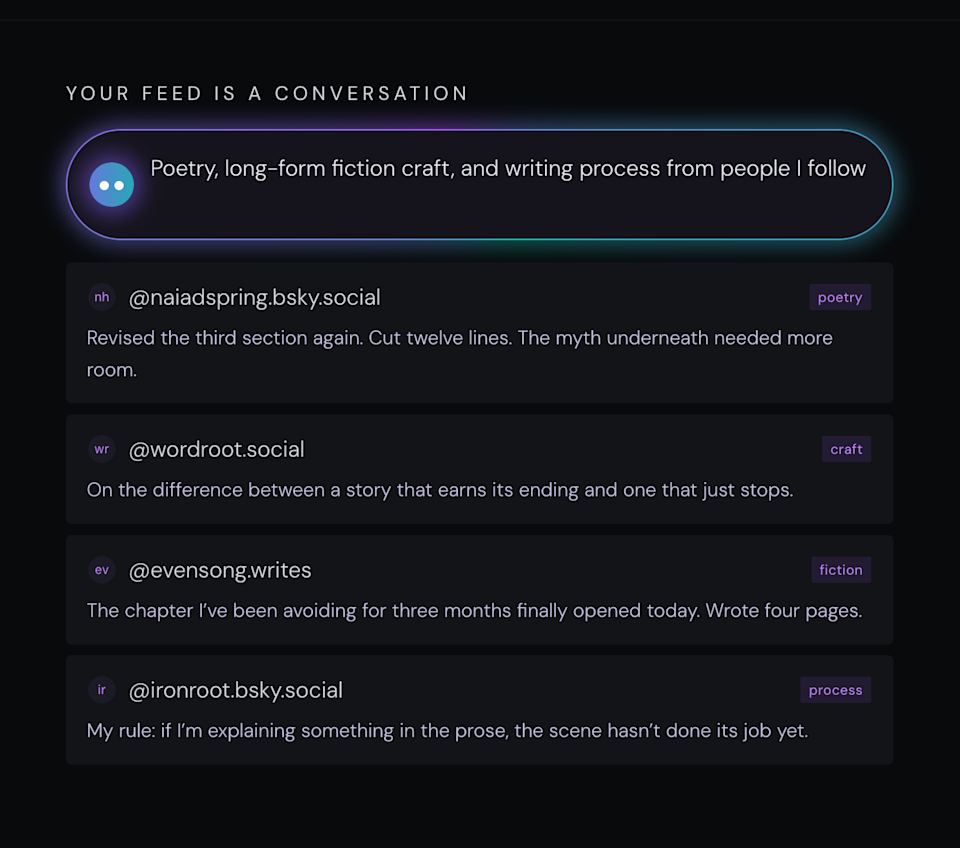
To use Attie, users can punch in prompts in natural language to generate social feeds without having to know how to code. On the Attie website, examples include prompts like, “Show me electronic music and experimental sound from people in my network” or “Builders working on agent infrastructure and open protocol design.”

An example of a user's prompt for Attie and the feed that's generated from it.

Attie

“It feels more like having a conversation than configuring software,” Graber described Attie in a blog post. “You describe the sort of posts you want to see, and the coding agent builds the feed you described.”

Graber added that Attie is a separate app from Bluesky and users don’t have to use the new AI assistant if they don’t want to. However, since Attie and Bluesky were built on the same framework, it could mean there will be some cross-app implementation between the two or any other app built on the AT Protocol. Attie is currently available on an invite-only closed beta, but anyone interested can sign up for the waitlist on its website in the meantime.

Advertisement

Source link

Continue Reading

Tech

Every Gaming PC You Can Buy At Costco Ranked By Price

Published

on


For decades, video games have been largely associated with home consoles or dropping quarters into arcade machines. However, as gaming has evolved, games have become more demanding. In response, some gamers have ditched consoles in favor of computers. While any PC can play at least some video games, desktop gaming PCs are purpose-built for high performance, giving you the sharpest graphics and fastest processing.

Costco members need look no further than their next shopping trip for an advanced gaming setup. The warehouse retailer offers a wide variety of products in addition to bulk groceries at wholesale prices and decent savings at the Costco gas pump. There’s the famous rotisserie chicken, baked goods, tires, hearing aids, entire vacations, and more. You can even buy a gaming PC.

You’ll find a range of gaming PCs in Costco’s electronics department, some of which are relatively affordable, with prices comparable to a typical desktop computer, while others are a bit pricier. Here are the six gaming desktops available from Costco in spring 2026, ranked in descending order of cost.

Advertisement

OMEN MAX 45L Gaming Desktop

As of March 2026, the most expensive gaming PC on Costco’s digital shelves is the OMEN MAX 45L Gaming Desktop. It features plenty of bells and whistles and carries a hefty $2,999 price tag to match.

Advertisement

The tower measures 8.03 inches by 18.5 inches by 21.85 inches, weighs about 50 pounds, and features tool-free access for swapping out or maintaining parts. Inside, there’s plenty to fiddle with. There’s an AMD Ryzen 9 9950X3D processor and graphics are powered by an NVIDIA GeForce RTX 5070 Ti. OMEN Light Studio gives you access to customize and control lighting effects and OMEN AI adjusts your PC’s hardware and settings to improve performance in real time. For connectivity, you’ve got built-in Wi-Fi 7 and Bluetooth 5.4 and there are plenty of ports for connecting peripherals. There’s a combination audio port for a microphone or headphones, one 10Gbps USB-C, two 5Gbps USB-A, four rear-mounted USB-A 2.0, two rear-mounted 5Gbps USB-A, two rear-mounted 10Gbps USB-C, a separate 3.5mm audio jack, an HDMI 2.1b port, and three DisplayPort 2.1a.

It runs on Windows 11 Home and has 64GB of RAM courtesy of two 32GB Kingston Fury DDR5-6000 MT/s. If that’s not enough, you can expand your RAM to 128GB with two available 32GB DIMMs, and all of your game data can be stored on a 2TB PCIe Gen4 NVMe M.2 solid state drive.

Advertisement

MSI Aegis R2 AI Gaming Desktop

Next in Costco’s collection of gaming PC’s we have the MSI Aegis R2 AI Gaming Desktop, with a retail price of $2,499.99. The tower measures 9.1 inches by 19 inches by 19.4 inches and houses an Intel Core Ultra 9 processor and NVIDIA GeForce RTX 5070 Ti 16GB. The exterior features four millimeters of tempered glass, giving visibility into your system’s guts.

Those guts include a 2TB M.2 NVMe solid state drive, 32GB of RAM, and an RGB CPU fan to help keep everything cool. If you’re looking for liquid cooling, you’ll have to look elsewhere. Internal expansion slots include four PCI-E x16 slots (used for connecting graphics cards, network cards, and more), three M.2, four SATA 6G, and four DDR5, with a maximum memory capacity of 256GB.

On the front of the tower you’ll find one 5Gps USB-C, one 5Gbps USB-A, and a combination headphone and microphone port. There are even more connectivity ports in the back with four USB-A 2.0 ports, two 5Gbps USB-A 3.2 ports, two 10Gbps USB-A 3.2 ports, three DisplayPorts, and one HDMI port. You can also connect peripherals using built-in Wi-Fi 7 and Bluetooth 5.3. Keyboard and mouse are included.

Advertisement

MSI Aegis ZS2 Gaming Desktop

An AMD Ryzen 9 9900X (12-core) processor and an NVIDIA GeForce RTX 5070 12GB graphics card set the foundation for the MSI Aegis ZS2 gaming desktop, available from Costco for $2,099.99.

Advertisement

There’s no monitor included but it does come with an MSI gaming keyboard and mouse included. There’s also a Wi-Fi 6E, Bluetooth 5.3, a 2TB M.2 NVMe solid state drive with 32GB of RAM and the temperature of the system is managed by 360mm liquid cooling. You can update or customize your system with four PCI-E x16 slots, three M.2, and four SATA 6G. If 32GB of RAM isn’t enough for your purposes, you can also expand up to 96GB courtesy of two DDR5 slots.

External connecting ports include one 5Gbps USB-C 3.2, one 5Gbps USB-A 3.2, and a combination headphone and microphone port, all in the front. In the back, there are four USB-A 2.0 ports, two 5Gbps USB-A 3.2 ports, two 10Gbps USB-A 3.2 ports, three DisplayPorts, and one HDMI port. And the whole thing comes in a 27-pound package measuring 19.4 inches by 9.1 inches by 19 inches.

Advertisement

CyberpowerPC Gamer Supreme Liquid Cooled gaming PC

Costco’s first offering under the $2,000 mark is the CyberpowerPC Gamer Supreme Liquid Cooled gaming PC, with a price tag of $1,899.99. It runs on Windows 11 Home (which is standard across the current slate of gaming PCs), is liquid cooled, and features an AMD Ryzen 7 9700X 3.8GHz (Max 5.5GHz) processor and an AMD Radeon RX 9060 XT 16GB.

It’s got a different vibe than your typical PC with a white-colored tower weighing about 40 pounds and measuring 18.9 inches by 9.4 inches by 18.9 inches. Memory and storage are provided by a 2TB PCIe 4.0 NVMe solid state drive and 32GB of RAM. In terms of expansion slots, it comes with internal 3.5-inch and 2.5-inch, PCI Express x16, M.2, and more.

External ports include two USB-A 3.2, four USB-A 3.2, two USB-A 2.0, one RJ45 LAN, audio ports for speakers, microphone, and line in, one HDMI port, and two DisplayPort. It also comes standard with a USB RGB gaming keyboard and mouse, no monitor is included.

Advertisement

MSI Codex R2 Gaming Desktop

If you’re looking for something that balances functionality with cost, the MSI Codex R2 Gaming Desktop might be up your alley. It features an Intel Core Ultra 7 processor, an NVIDIA GeForce RTX 5060 Ti 8GB GDDR7 graphics card, and a price tag of $1,499.99.

Advertisement

The Codex R2 has 2TB of storage thanks to an M.2 nVMe solid state drive, and 32GB of built-in RAM. The system doesn’t advertise any expansion ports, so what you see is what you get, but there are plenty of external ports for connecting peripherals. There are a total of 10 USB-A ports and one USB-C. In the front you’ll find a combination microphone in and headphone out jack, one USB-C 3.2, and two USB-A 3.2. In the rear you’ll find four USB-A 2.0, two 5Gbps USB-A 3.2, two 10Gbps USB-A 3.2, one HDMI-out, and three DisplayPorts. You can also connect wirelessly using built-in Wi-Fi 6E and Bluetooth 5.3.

The system runs Windows 11 Home and is cooled by an RGB CPU cooling fan. The tower measures 8.36 inches by 16 inches by 19 inches and it comes standard with an MSI gaming keyboard and mouse. No monitor included.

Advertisement

Skytech Crystal Gaming Desktop

In early 2026, the Skytech Crystal Gaming Desktop is Costco’s most affordable gaming PC, with a price tag of just $1,099.99, roughly a third of the cost of some of its peers.

It measures 21 inches by 13 inches by 22 inches and weighs 30 pounds. Inside, you’ll find an Intel Core Ultra 5 225F processor, an Intel Arc B580 12GB GDDR6 graphics and video card, a 1TB PCIe NVMe Gen 4 solid state drive, and 32GB of DDR5 6000MHz RAM. In terms of expansion, there is a single M.2 expansion slot.

The system gets cooling from three RGB RING fans and runs on Windows 11 Home. External ports include a total of twelve USB-A (six USB-A 3.2 and six USB-A 2.0), two USB-C, one DisplayPort, and two HDMI ports. You can connect to the system wirelessly using built-in Wi-Fi 6E and Bluetooth 5.2. You’ll have to provide your own monitor but Skytech Gaming RGB keyboard and mouse are included.

Advertisement

Finding the right gaming PC for you depends on a number of important considerations including (but not limited to) your gaming needs, space availability, and budget. Based on the range of prices and performance on Costco’s digital shelves, there’s a good chance you can find something that will get you back in the game.


Advertisement

Source link

Continue Reading

Tech

Apple Now Requires Device-Level Age Verification in the UK. Could the US Be Next?

Published

on

Apple unveiled new device-level age restrictions in the UK on Wednesday. “After downloading a new update, users will now have to confirm that they are 18 or older to access unrestricted features,” reports Gizmodo.

“Users will be able to confirm their age with a credit card or by scanning an ID.”

For those underage or who have not confirmed their age, Apple will turn on Web Content Filter and Communication Safety, which will not only restrict access to certain apps or websites, but will also monitor messages, shared photo albums, AirDrop, and FaceTime calls for nudity. Apple didn’t specify exactly which services and features are banned for under-18 users, but it will likely be in compliance with UK legislation…

The British government does not require Apple and other OS providers to institute device-level age checks, but it does restrict minor access to online pornography under the Online Safety Act, which passed in 2023. So far, that restriction has only been implemented at the website level, but UK officials have been worried about easy loopholes to evade the age restrictions, like VPNs.

Advertisement

The broader tech industry has been campaigning for some time to use device-level age checks instead in response to the rising tide of under-16 social media and internet bans around the world. Last month, in a landmark social media trial in California, Meta CEO Mark Zuckerberg also supported this idea, saying that conducting age verification “at the level of the phone is just a lot clearer than having every single app out there have to do this separately.” Pornhub-operator Aylo had advocated for device-level restrictions in the UK as well, and even sent out letters to Apple, Google, and Microsoft in November asking for OS-level age verification…

The most obvious question: Could this be brought stateside?

Source link

Advertisement
Continue Reading

Tech

This Friendly Robot Just Installed 100 MW of Solar Power

Published

on

Utility-scale solar construction… by robots! It’s “one of the largest real-world demonstrations,” notes Electrek, with 100 MW of capacity installed by the “Maximo” robots from AES, one of the world’s top power companies.

Maximo uses AI “to automate the heavy lifting of solar panels and accelerate solar installation,” according to their web page, which shows a video of Maximo at work installing a vast field of solar panels in Kern County, California. With assistance from Nvidia, the Maximo team could “develop, test and refine robotic capabilities through physics-based simulation and AI driven modeling before deploying updates in the field,”
reports Electrek, and they’re aiming for a full GW of solar generating capacity:

After completing the first half of the Bellefield complex last summer, Maximo engineers went into a higher gear, with the latest version 3.0 robots consistently surpassing an installation rate of one module per minute, with construction crews installing as many as 24 solar panel modules per hour, per person. If that sounds fast, that’s because it is. At full tilt, the latest Maximo robot-equipped crews have nearly doubled the output of traditional installation methods at similar solar locations throughout Southern California.

“Reaching 100 MW is an important milestone for Maximo and for the role robotics can play in solar construction,” explains Chris Shelton, president of Maximo. “It demonstrates that field robotics can move beyond experimentation and deliver consistent results at utility scale. As solar deployment continues to accelerate globally, technologies that improve installation speed, quality and reliability will become increasingly important….”

Advertisement

Like just about every other business that demands a high degree of physical labor, the construction industry is facing huge labor shortages, making machines like Maximo that provide real efficiency gains welcome additions to the job site.
“The combination of AI, vision, robotics and simulation driven engineering reduced development and validation timelines,” the Maximo team said in a statement, “and increased confidence in field performance as the robotic fleet scaled.”

Source link

Continue Reading

Tech

Bethesda is shutting down The Elder Scrolls: Blades on June 30

Published

on

It’s a sad day for the dozens of players still grinding The Elder Scrolls: Blades. Bethesda announced that it’s permanently shutting down the servers for its free-to-play mobile spinoff on June 30. First spotted on Reddit, The Elder Scrolls: Blades has already been delisted from the App Store and Google Play store, and is currently unavailable on the Nintendo Store.

In the meantime, players will receive a free bundle of Gems and Sigils, while all items in the in-game store are available for just one Gem or Sigil each. With a server shutdown imminent, The Elder Scrolls: Blades‘ will at least cross its six-year mark since its official release was in 2020 for Android, iOS and Nintendo Switch. The dungeon-crawling spinoff did see early success when more than one million iOS users downloaded the game during the first week of its early access period, but it never amounted to the commercial success of Bethesda’s mainline titles.

In the end, The Elder Scrolls: Blades ended up with a “Generally Unfavorable” score on Metacritic, with critics calling it “repetitive” and filled with microtransactions. The shutdown doesn’t come as a total surprise, since Bethesda also killed off its other spinoff, The Elder Scrolls: Legends, by halting development in 2019 and ultimately taking the game’s servers offline in January 2025. For anyone who still wants to play a mobile spinoff of Bethesda’s fantasy world, there’s still The Elder Scrolls: Castles.

Source link

Advertisement
Continue Reading

Trending

Copyright © 2025