



The internet is an archive of so many different versions of ourselves. If you’re Gen Z or a millennial, there’s a good chance you preserved almost every stage of your life online: old fandoms, old friends, old opinions. And with that comes an inevitable cringe.
Tech
How To Record Phone Calls on a Samsung Galaxy Phone?
Call recording can be very helpful if you have to recall important information, such as instructions, addresses, or office conversations. Samsung Galaxy smartphones have a built-in call recording feature that lets you record phone calls without downloading any additional apps. Before you begin recording calls, be aware that this feature is only available in countries where call recording is permitted, so it may not be available on all phones. For instance, call recording is permitted without consent in India, but in most of Europe and the US, consent is required from all parties involved in the call. Moreover, it also doesn’t work for Wi-Fi calls.
1. Record a Call on a Samsung Galaxy Phone
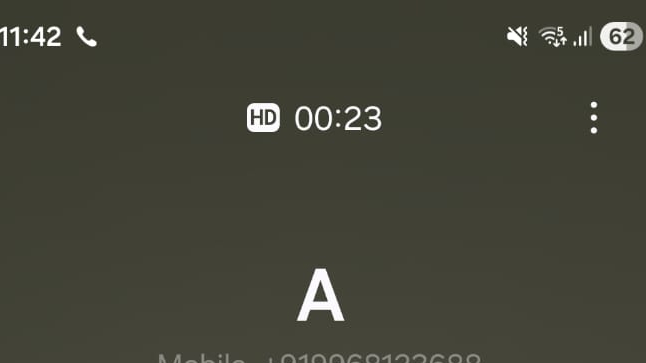
You can record a call on your Samsung Galaxy phone only after the call has been initiated. Follow these simple steps to record a call on your Samsung Galaxy phone:
- Make a phone call using the Phone app on your Samsung Galaxy phone.
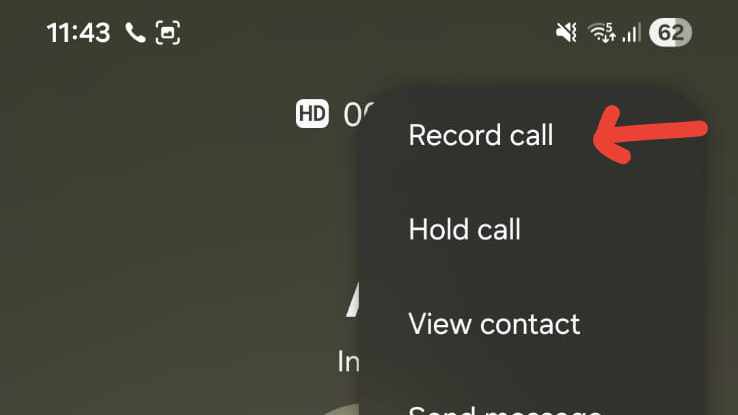
- During the active call, check the call screen for the Record call button.
- If you don’t see it, tap the three-dot menu to find the recording option.

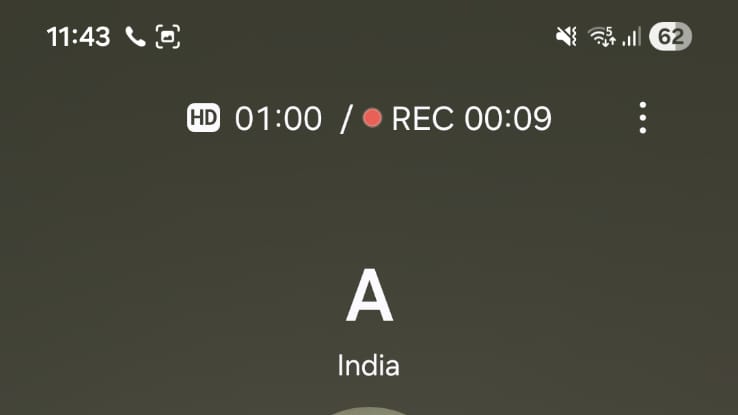
- Tap Record call to start recording the conversation.

- The phone displays a red dot and a timer to show that it is recording the call.

- To end the recording, tap Record call again or end the call.
2. Automatically Record Calls on a Galaxy Phone
This function records calls without having to press the record button each time. Follow these easy steps:
- Open the Phone app on your Samsung Galaxy phone.
- Go to the Keypad section.

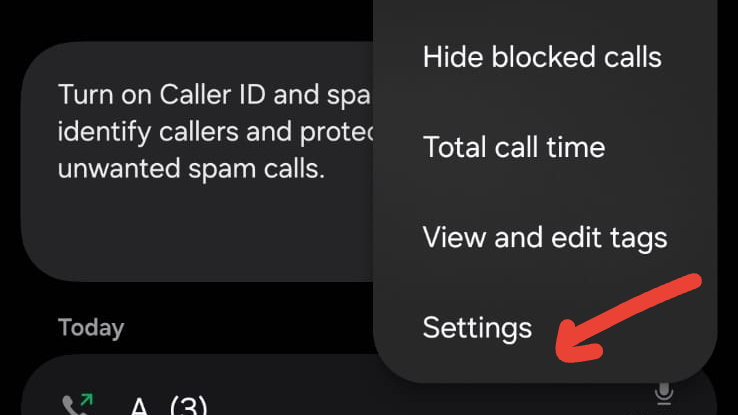
- Tap the three-dot menu at the top and select Settings.

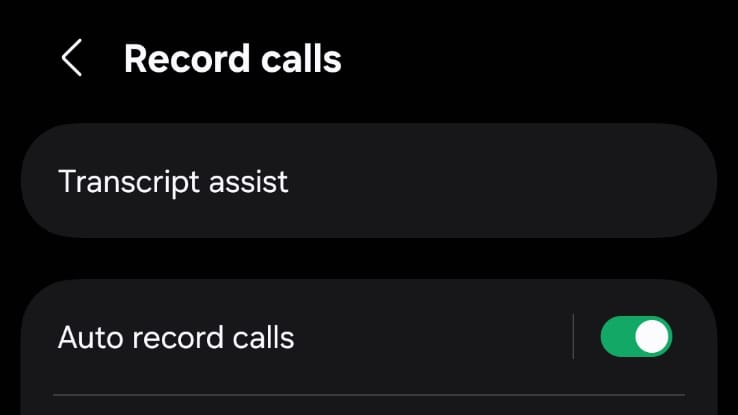
- Tap Record calls.

- Turn on the Auto record calls option.

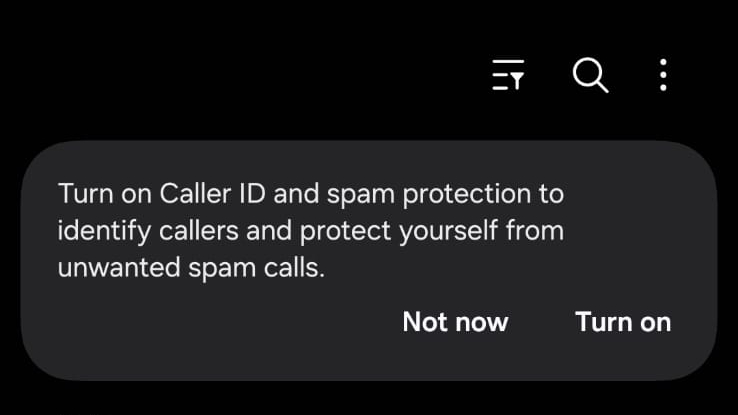
When auto call recording is enabled, Samsung automatically records all calls, including calls from unknown numbers. But you can adjust this preference if you do not want all calls to be recorded automatically. Samsung gives you the flexibility to choose whether to record all calls, unsaved numbers only, or calls from selected contacts. To record calls from selected contacts, you only need to include their numbers in your contact list under the auto-record options.
3. Record Calls Using Google Voice on Samsung
If call recording isn’t available on your Samsung device, you can use Google Voice to record calls made from your Google Voice number. Google Voice announces to all parties that the call is being recorded. The Google Voice app saves the recorded call in the Voicemail tab.
- Open the Google Voice app on your Samsung phone.
- Open the menu and go to Settings.
- Turn on Incoming call options.
- When you receive a call on your Google Voice number, answer the call and open the keypad.
- Tap 4 to start recording the call.
- Tap 4 again to stop recording.
How to Find, Listen to, and Share Recorded Calls?
Samsung saves all call recordings in one place, so you can easily find and manage them later. Here’s how to access recorded calls:
- Open Phone settings.
- Tap Record calls.

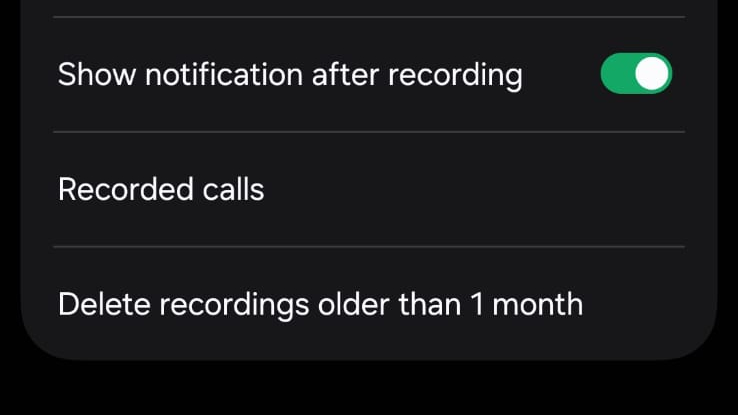
- Select Recorded calls.

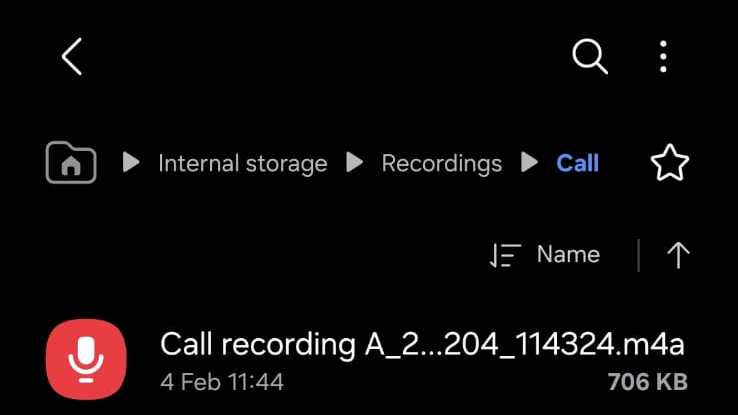
In the call recordings section, you will see all the recordings you have saved, typically in alphabetical order. You can change the list view to date, file size, or call recording. When you long-press a recording, you can rename it, move or copy it to another folder, delete it, or share it via messaging or email clients.
Is It Safe to Use Third-Party Call Recording Apps?
Most third-party call recording apps use accessibility services to record calls, and sometimes do so without informing the other party. Many regions prohibit this practice or consider it illegal, and it can violate local privacy policies. Due to these concerns, Samsung advises against using third-party call recording apps and instead recommends using the call recording feature if available.
Tech
Measles Has Now Begun To Infect Immigrant Detention Camps
from the cascading-failure dept
It’s darkly funny, in a way, to recall a racist trope that gets trotted out about immigration all the time: immigrants bring disease into the country. That in itself isn’t funny, obviously. The funny part is that it seems like we’re proving the opposite to be true under the Trump administration. As the measles outbreak in America continues to rage, immigration detention camps are starting to feel the effects.
Earlier this week reports indicated the Dilley detention center in Texas was going on a sort of soft lockdown due to confirmed cases of measles among those detained.
“ICE Health Services Corps immediately took steps to quarantine and control further spread and infection, ceasing all movement within the facility and quarantining all individuals suspected of making contact with the infected,” McLaughlin said.
McLaughlin said medical officials were monitoring detainees and taking “appropriate and active steps to prevent further infection.”
“All detainees are being provided with proper medical care,” she added.
We are definitely in “prove it” territory when it comes to this administration and immigration questions. That’s all the more so if the government, as they’ve done via other excuses in the past, limits or restrains entry to these facilities from other lawmakers who want to check DHS’ homework and uses the measles outbreak as the reason for it.
Neha Desai, a lawyer for the California-based National Center of Youth Law, which represents children in U.S. immigration custody, said she hopes the measles infections at Dilley are not used to “unnecessarily” prevent lawmakers and attorneys from inspecting the detention center in the near future, citing broader concerns about the facility.
“In the meantime, we are deeply concerned for the physical and the mental health of every family detained at Dilley,” Desai said. “It is important to remember that no family needs to be detained — this is a choice that the administration is making.”
It’s also worth remembering that the spread of disease is a recurring feature in the concentration camp industry. Deaths from disease as well. And, unlike the trope mentioned above, these are infections immigrants are getting from America, not bringing to her soil.
And it’s not just one detention camp, either. The Florence Detention Center in Arizona is also dealing with measles infections.
The U.S. Department of Homeland Security reports one ICE detainee in the Florence Detention Center in Pinal County tested positive for measles on Jan. 21.
Two more measles cases have recently been confirmed among people who are also in federal custody in the county, according to a spokesperson for the Pinal County Public Health Services District. But the spokesperson did not provide details about which facility the other two infected individuals are in, or whether any of the three cases in the county are linked.
As Desai said in the quote above, this is a choice. Or, rather, a series of choices. It’s a choice made by Trump and his minions to carry out this inhumane, disorganized, haphazard campaign of brutality on illegal immigrants. This could have gone many ways, but Trump chose cruelty on purpose. It’s a choice to put RFK Jr. in charge of America’s health and then watch idly, leaning back with folded arms, as the country experiences the worst measles outbreak in decades over the past 13 months. It’s a choice to not pivot on any of the above.
And it’s a choice to leave South Carolina swinging in the wind as the measles outbreak there will no doubt continue to spread to the rest of the country.
State health officials are reporting 29 new cases of measles in the state since Friday, bringing the total number of cases in South Carolina related to the Upstate outbreak to 876. The South Carolina Department of Public Health (DPH) said there are currently 354 people in quarantine and 22 in isolation. The latest end of quarantine for these cases is Feb. 24.
Those numbers will continue to rise, but they are already breathtaking. 2025 saw a measles infection count nationwide of 2,267. South Carolina has generated nearly 40% of that total in one month in one state. 18 states have already had measles infections within their borders this year. The 2026 totals are going to make 2025 look like peanuts.
And it could potentially be hardest on the human beings who are shoved like sardines into these immigrant detention camps. Diseases like the measles will spread incredibly fast there. And, despite DHS’ claims to the contrary, I just can’t find it in me to believe that this administration is going to put a priority on detainee’s health.
Filed Under: arizona, concentration camp, dilley detention center, donald trump, florence detention center, ice, immigration, kristi noem, measles, rfk jr., south carolina
Tech
What to do when you regret a social media post, explained
So what do you do when you see something embarrassing you posted years ago? You may be tempted to go scorched earth, but journalist and Wall Street Journal contributor Alexandra Samuel says that’s not necessarily the best course of action. “I think that you need to think about deleting things you’ve posted as curation,” she told Vox.
“The Internet Archive keeps snapshots of all kinds of things on the internet, so you need to be aware that when you delete something, it might be deleted for you,” Samuel said. “That doesn’t mean it’s deleted from the internet. I think when you delete things, it’s always a good idea to back them up before you delete them.”
What other options do you have when you look back on an old post and cringe? And how should we be thinking about our life’s digital archive? We answer these questions on Explain It to Me, Vox’s weekly call-in podcast.
Below is an excerpt of my conversation with Samuel, edited for length and clarity. You can listen to the full episode on Apple Podcasts, Spotify, or wherever you get podcasts. If you’d like to submit a question, send an email to askvox@vox.com or call 1-800-618-8545.
Was there a moment when online regret and shame first grabbed your attention?
Absolutely. In June 2011, Vancouver lost the Stanley Cup to Boston, and people went nuts. There was this riot in the streets, and what made that riot notable is that for the first time, it was captured in real time on social media. It was the heyday of Twitter. People were tweeting photos. People were making videos and posting them on YouTube. There was initially a lot of excitement about the idea that like, “We’re going to be able to catch the people who are flipping cars and breaking into store windows.”

I saw this unfolding literally that evening, online. And I thought, “This is not a good plan.” History teaches us that when we start narcing on our fellow citizens and stepping into that quasi-surveillance role, it tends to go very, very badly. I wrote a piece that evening for the Harvard Business Review about why this phenomenon of citizen surveillance through social media was so problematic. And I got a lot of pushback.
It’s interesting that so many people’s gut reactions were like, “Okay, but what if I snitched?”
I think there’s something really delightful about outrage as a subjective experience. We live in a really complicated world. There’s a lot of gray. There’s a lot of nuance. It’s really hard to feel like a morally upright person if you shop on Amazon and put gas in your car. And these moments where we’re shaming people online give us a little moment of moral superiority.

What’s the argument for not deleting old posts?
Imagine a scenario where you’ve posted something on Instagram or TikTok. You realize afterwards that you were kind of an idiot, and you wish you hadn’t said what you said. Maybe you even had a back-and-forth in the comment thread where someone pointed out why what you said was insensitive and you showed some capacity for learning. If you delete it without archiving it [and] it comes back to haunt you, you don’t have that evidence of you learning. It’s much better to take the screenshots, archive the thread, and back up all that context so that if it does still come back to haunt you or even if you just want to reflect on it, [you can].
I don’t know if you’ve ever gone back and read old journals, but I have. And every time I think, “What old me thought is none of my business.”
It’s funny you said that. I’ve literally had that exact experience of rereading old journals. We just all need to realize that by definition, anything that is a snapshot is a two-dimensional image of something that we experienced. Whether you’re looking at your own history of something that you did, or if you’re looking at something someone else said, I just wish we could have a little more tenderness and empathy and focus on what people learn and how we grow rather than judging everyone by their most awful moment.
Do you have any advice for best practices when it comes to having a social media presence you won’t be ashamed of in 10 or 20 years?
Trying to have a social media presence where you never regret anything is a recipe for having a completely meaningless and stupid social media presence. Conversely, I think it’s important to resist the lure of the hot take. What you need to do is try and chart that middle ground where you don’t court controversy for its own sake. When you’re deliberately pushing people’s buttons, that’s when you end up saying things that don’t reflect what you truly believe. But if your goal is to have a social media presence where you never regret anything, then truly don’t be online. I actually think it’s a really, really good option now. If I were not a journalist for whom part of the job is showing up online, I do not know if I would use social media anymore.
It sounds like if you’re going to share anything online, that feeling of regret may be inevitable. How do you survive it?
The first thing to do is take yourself out of it, depersonalize it, and think, “If this were happening to a friend, what would I think here?” Don’t hesitate to admit if you think you were wrong, but don’t rush to respond either. You need to close the computer, put the phone down, walk away. Talk to somebody with good judgment and ask what they think. The internet moves quickly, but unless you are a celebrity and you’re getting a hundred thousand responses an hour, there’s actually no reason that three crappy comments can’t wait to be addressed the next day.
And then you absolutely can say you’re wrong. I actually think one of the most powerful things that we can do as humans, as professionals, and as internet users: Show that you can be wrong and you can even be wrong on the internet, and it doesn’t kill you. It doesn’t destroy your value as a human.
Tech
Amazon rolls out Alexa+ to all U.S. customers, making its AI assistant free for Prime members

Amazon is betting that an AI assistant best known for turning on lights and answering trivia questions can become a sought-after benefit of its Prime membership, in the same league as free shipping and streaming video.
The company is making Alexa+, the generative AI-powered upgrade to its voice assistant, available free starting today to all U.S. Prime members, nearly a year after it was unveiled.
Tens of millions of customers used Alexa+ through an early access program, the company says. Today’s rollout opens it up to Amazon’s full U.S. Prime membership base, which is estimated at more than 200 million individual members by Consumer Intelligence Research Partners.
Alexa+ offers more natural, free-flowing conversations than its predecessor, along with agentic capabilities such as ordering takeout, and booking dinner reservations and rides, in addition to core features such as coordinating across family calendars and checking smart-home cameras.
But the broad rollout comes more than three years into the generative AI era, with AI habits already ingrained for many users around ChatGPT, Claude, Gemini, and others.
Given its late start, Amazon is hoping that unlimited access to Alexa+ via Prime (including a browser-based chat experience at Alexa.com) will help close the gap against those rivals.
In that way, the option to subscribe to Alexa+ for $19.99/month outside of Prime feels less like a play for standalone subscribers and more like a way to reinforce the market value of what Prime members will be getting for free.
Amazon is also offering a free but limited version of the Alexa+ chat experience at Alexa.com and in the Alexa app for non-Prime users.
ChatGPT’s free tier limits users to a handful of messages before downgrading to a less-capable model. Google plans to replace its Google Assistant with the AI-powered Gemini across Android devices, making Amazon’s timing all the more urgent.
Daniel Rausch, Amazon’s vice president of Alexa and Echo, said in an interview that the Prime benefit is aimed at customers who use AI tools but can’t or don’t want to pay for a standalone subscription.
Rausch cited the example of students and others who “bounce around between different chat assistants” when they hit usage limits on free tiers. He said offering unlimited access to what amounts to a paid AI service, without those usage caps, is “a really big deal for Prime customers.”
Whether consumers see it as a true replacement for other AI chatbots remains to be seen. Working on this story, for example, I tried uploading the interview transcript, past coverage, and Amazon’s blog post to Alexa.com for reference and analysis. The site was only able to accept one document at a time, unlike other chatbots that can handle multiple uploads simultaneously.
It’s a small but telling limitation for anyone accustomed to the competition.
But that’s a business use case that may not represent consumer patterns. Amazon’s larger pitch isn’t that Alexa+ is a better ChatGPT, it’s that it can do things other AI assistants can’t.
For example, having uploaded those materials individually, I can now ask Alexa+ on my Echo devices to reference them in its responses — something I’ve been doing already in the Alexa+ early access program with emails from our kid’s school and other family documents.
Rausch said 76% of what customers do with Alexa+ is unavailable in any other AI, according to Amazon’s own internal data. He cited functionality such as smart home controls, family calendar management, music discovery, booking reservations, and the thousands of device and service integrations that Amazon has built up over a decade.
Based on the early access period, customers are conversing with Alexa+ two to three times more than they did with the original version, according to Amazon, and engagement continues to grow week over week rather than tapering off after an initial honeymoon period.
Tech
ElevenLabs hits $11bn valuation with $500m series D funding round
Once somewhat of an outcast in Hollywood, today ElevenLabs counts some big stars on its roster, and it has just raised a $500m series D round.
ElevenLabs has raised $500m in a Series D funding round led by Sequoia Capital with partner Andrew Reed joining the board. Existing investors Andreessen Horowitz and Iconiq participated, with new investors coming on board including Lightspeed Venture Partners, Evantic Capital and Bond.
The new round gives ElevenLabs an $11bn valuation, more than tripling its valuation in the space of a year. ElevenLabs started out in 2022, developing a human-like AI text to speech model that got it into hot water in the early days with various Hollywood stars like Emma Watson. Voice actors took them to court at the time and ElevenLabs subsequently settled the lawsuit.
These days some of Hollywood’s elite are fully on board. In November 2025 it launched its Iconic Marketplace, adding actors Michael Caine and Matthew McConaughey to its roster. Having been burnt early on, the company today describes Iconic Marketplace as solving “a key ethical challenge in AI-driven media creation by enabling the ethical sourcing and licensing of some of the world’s most recognisable voices”.
“We started by building a voice that could sound human – and we did,” said said Piotr Dabkowski, co-founder of ElevenLabs. “Today we are building foundational models across the full audio stack – text to speech, transcription, music, dubbing and conversational models with a world-leading research team.”
“This funding helps us go beyond voice alone to transform how we interact with technology altogether. We plan to expand our Creative offering – helping creators combine our best-in-class audio with video and Agents.”
ElevenLabs says the funding will help it to continue its international expansion across London, New York, San Francisco, Warsaw, Dublin, Tokyo, Seoul, Singapore, Bengaluru, Sydney, São Paulo, Berlin, Paris and Mexico City, where they plan to have “go-to-market teams” to support enterprise adoption.
Don’t miss out on the knowledge you need to succeed. Sign up for the Daily Brief, Silicon Republic’s digest of need-to-know sci-tech news.
Tech
Interlune digs into the development of an excavator for helium-3 and construction projects on the moon

Interlune is leveraging a $150,000 NASA contract to develop develop lunar trenching and excavation technology — and although the primary goal is to extract valuable helium-3 from moon dirt, the project also signals the company’s broader play for lunar infrastructure.
Interlune’s work on the Small Business Technology Transfer Phase 1 contract, done in partnership with the Colorado School of Mines, demonstrates that the Seattle-based startup’s business model isn’t limited to helium-3. In the years ahead, the technologies pioneered by Interlune for resource extraction can also be used for building roads, base camps and other construction projects on the moon.
For example, the excavator that’s the focus of the NASA funding — known as the Scalable Implement for Lunar Trenching, or SILT — will support Interlune’ plan to sift through tons of lunar soil. But it will also support NASA’s Artemis program, which aims to establish a sustainable lunar presence in the 2030s.
“We’re looking at some other tools that would move regolith around, or prepare a site for making a road or building a radiation berm, burying a certain piece of infrastructure like a nuclear reactor,” Interlune CEO Rob Meyerson told GeekWire. “So, we’re very interested in participating in the Artemis program in broader ways, and we think the technology we’re developing for helium-3 extraction can support that.”
Lunar helium-3 extraction leads the list of Interlune’s priorities because Meyerson and the company’s other founders believe that could be a lucrative line of business.
Helium-3 can be used in quantum computers, medical imaging systems, nuclear weapon detectors and even future fusion reactors — but it’s so rare on Earth that it sells for up to $20 million per kilogram. Interlune is betting that it can make a profit by extracting helium-3 that’s deposited on the moon by solar wind.
“In the U.S., we produce one kilogram of helium-3 per year from tritium decay, give or take,” Meyerson said. “On the moon, we intend to extract 10 kilograms of helium-3 per year from our first helium-3 harvesting operation in the 2030s. And if we had helium-3 fusion, we would need 100 kilograms of helium-3 to power a city the size of Seattle for one year.”
The excavator development project builds on work that Interlune has conducted in partnership with Vermeer Corp., an Iowa-based industrial equipment manufacturer. Last year, the two companies unveiled a full-scale prototype for an excavator that would be capable of ingesting 100 metric tons of moon dirt in an hour.
Under the terms of the NASA contract, Interlune and the Colorado School of Mines will focus on optimizing the excavator’s design for the lunar environment and minimizing its power consumption. Work on the current phase of the project is due to wrap up by mid-2026, and if the results are sufficiently positive, Interlune could get the go-ahead for follow-up funding.
Meyerson cited other areas where Interlune’s work on the core technologies for its lunar harvesting system is attracting government support:
- The Texas Space Commission provided a grant of up to $4.8 million to support a facility in Houston that focuses on creating better substitutes for moon rocks and soil. “The first one will be a regolith simulant that has implanted solar wind in it. … And we’re working on a device that will actually implant helium and/or hydrogen into the regolith,” Meyerson said.
- The Department of the Air Force’s AFWERX program granted Interlune a $1.25 million contract to work on a new method to separate helium-3 from domestic helium for use in cooling quantum computers. “We’re working very closely with the Air Force Research Lab, and we’re also working with an industrial gas partner that we haven’t announced yet,” Meyerson said. “We would plug into their helium plant and extract helium-3, and so that’s a very important project for us.”
- NASA’s TechFlights program awarded $348,000 to support reduced-gravity testing of Interlune’s regolith-processing system.
- Interlune won a $246,000 grant from the National Science Foundation to work on its soil-sorting technology.
Interlune was founded in 2020 by Meyerson, a former president of Jeff Bezos’ Blue Origin space venture, and other aerospace veterans including Apollo 17 moonwalker Harrison Schmitt. The team has since grown to about 25 employees in Seattle, Houston and Washington, D.C.
So far the company has brought in $18 million in seed funding, and it recently reported raising more funds through a Simple Agreement for Future Equity, or SAFE. “We elected to do this because we wanted to raise some additional money in anticipation of some of these contract awards, like the one we’re talking about today. And we’ve got some more announcements coming,” Meyerson said.
A multispectral camera built by Interlune in partnership with NASA’s Ames Research Center could begin surveying lunar terrain for helium-3 as early as this summer. Interlune says it already has more than half a billion dollars’ worth of purchase orders and government contracts for helium-3.
Meyerson said helium-3 will be a “great first product” for Interlune.
“But once we get established on the moon, and we have all this infrastructure on the moon — excavating and sorting and extracting and separating — we can then start to evolve and add capability to produce water and split that into liquid oxygen and liquid hydrogen,” he said. “We can extract metals, rare earths and silicon, and help with construction and excavation, like we’re doing under this NASA contract. Those are all important adjacent services that will help to build the in-space economy. And we think that is going to be huge.”
Tech
Revealing the Top EdSurge K-12 Stories of 2025
EdSurge readers are well-rounded students of education news.
In 2025, the K-12 articles that proved most popular with our audience reflected the breadth of the big trends gaining momentum in school districts and classrooms.
Even though U.S. education is largely governed by state policy, last year a significant source of change came from the White House. Two of our top 10 stories explored the nuances of executive orders signed by President Trump.
Of course, news about artificial intelligence topped the list, too. About a third of the most-read stories took readers past the hype to explore how educators and students are actually using AI tools.
A full half of the top EdSurge stories from 2025 reflected the diversity of today’s educators and students. Two examined the youth culture and learning preferences of Gen Alpha and Gen Z. Three others highlighted religion, neurodivergence and multilingual learners, respectively.
Finally, four of the top pieces came straight from the perspectives of practicing classroom instructors, demonstrating the resonance and power of educator voices.
Thanks for reading EdSurge in 2025, and cheers to a new year of education news.
1. Religion Is a Taboo Topic. I Discuss It in My Classroom Anyway.
By Hind Haddad

A Voices of Change fellow initially avoided discussing faith in her classroom. But she realized that her students – who mostly come from immigrant families who practice Islam – could benefit by connecting their daily learning with their personal and cultural identities.
2. Trump’s Executive Order on School Discipline Clashes With What Research Says Works
By Nadia Tamez-Robledo

Previously, national education policy aimed to remediate the fact that children who are racial minorities endure disproportionately high rates of punishment in public schools. The Trump administration aims to reverse course, arguing that older policies made schools less safe by incentivizing them to sweep student misconduct under the rug.
3. I’ve Taught Gen Z for Almost a Decade. I’m Split on the So-Called Gen Z ‘Split’
By Jeff LeBlanc

Are today’s youth divided, with half demonstrating high levels of motivation and the other half shrinking from school and career ambition? In this essay, an educator draws on his personal experience in the classroom to dismantle the notion, noting that students today seem to have high levels of intellectual curiosity.
4. Can ‘Math Therapists’ Make a Dent In America’s Declining Math Performance?
By Daniel Mollenkamp

Anxiety about math can pass from teacher to student. Instructional coaches are trying to break that cycle by instilling teachers with more confidence in their computational skills.
5. Why ‘Brain Rot’ Can Hurt Learning — and How One District Is Kicking It Out of School
By Nadia Tamez-Robledo

Educators have talked for years about students’ shortening attention spans and how kids struggle to follow the most basic of instructions. Even children know that their energy for learning is being drained by too much time spent scrolling social media and watching AI videos. What can be done about it?
6. Trump Executive Order Calls for Artificial Intelligence to Be Taught in Schools
By Rebecca Koenig

From the White House came a directive to promote “appropriate integration of AI into education” to “ensure the United States remains a global leader in this technological revolution,” through teaching students and training teachers to use AI in order to improve education outcomes. Education leaders offered mixed first impressions about the order.
7. How I Navigate the Classroom as a Neurodivergent Teacher
By Fatema Elbakoury

How to offer students presence while struggling with anxiety and imposter syndrome? A Voices of Change fellow explains how extensive lesson preparation and organization help her succeed at the head of the classroom with her neurodivergence.
8. Art Saved My Life When I Was a Student. Now, It’s Helping My Multilingual Learners.
By Edgar Miguel Grajeda

The visual arts have the power to transcend language barriers and help all students, especially multilingual learners, thrive in school. A Voices of Change fellow explains how.
9. Teachers Believe That AI Is Here to Stay in Education. How It Should Be Taught Is Debatable.
By Nadia Tamez-Robledo

The life cycle of teachers’ feelings about AI started at confusion, then fear about it threatening their jobs, followed by worries about students cheating but also a desire to see how the technology can be useful with lesson planning and other administrative tasks.
10. An AI Wish List From Teachers: What They Actually Want It to Do
By Ellen Ullman

While edtech vendors race to integrate AI into every aspect of teaching and learning, educators are drawing clearer boundaries: AI should save them time, not replace their judgment. They want support for differentiation, not decision-making. Most of all, they want tools that align with the values and realities of teaching.
Tech
This big Pixel 10 Pro price drop makes it a contender for the best phone
The Google Pixel 10 Pro is an excellent phone, and it’s even more tempting at this new price.
With an RRP of $999, you can now bring the six-month-old Pixel 10 Pro home for a much more wallet-friendly price of $799. That’s 20% off the 128GB, in any of the three colour choices.
That saving isn’t too far away from the Black Friday $749 price, so you didn’t miss out too much on not grabbing it back then.
Amazon bringing back its big Pixel 10 Pro 20% price drop is very welcome this early in the month.

Amazon has brought back its big Pixel 10 Pro price drop, but not for long
One of the key features Google is emphasising with the Pixel 10 series is Gemini. This AI is able to learn how you prefer to frame your photos and offer real-time suggestions, ensuring that every picture you take looks flawless.
Pairing this incredible AI with a solid triple rear camera system (50MP wide, 48MP ultrawide, and 48MP telephoto), the Pixel 10 Pro can churn out scintillating shots that can compete with all of the best camera phones out there right now.
To see the best picture results possible, the 10 Pro pairs Gemini AI with Super Actua tech, which gives the display an extra oomph of brightness.
The battery can last for 24+ hours at a time if you make use of its Extreme Battery saver mode, and thanks to fast charging support, you won’t have to wait long for a top-up should your battery start to run low.
Take this opportunity to pick up one of the best smartphones out there right now, at a price that won’t break the bank.
SQUIRREL_PLAYLIST_10148964
Tech
The Chinese Navy’s Carrier Fleet Is About To Grow Fast
As anyone familiar with aircraft carriers likely knows, the United States Navy is the most powerful carrier-equipped blue-water navy in the world. As of writing, the U.S. maintains a fleet of 11 active aircraft carriers, which doesn’t include its nine amphibious assault ships, which are different from aircraft carriers. The People’s Republic of China is in hot pursuit of matching the U.S.’ naval might, leading the People’s Liberation Army Navy (PLAN) to quickly construct its own fleet of supercarriers.
The PLAN has three carriers, one of which is a converted former Soviet heavy aircraft-carrying cruiser. The other two are newer designs in line with China’s goal to field a total of nine aircraft carriers by 2035. That’s according to a report from the Defense Department detailing China’s interests in an effort to build up its forces to make it a near-peer rival of the United States. While China operates three amphibious assault carriers, its aim is to deploy nine aircraft carriers, which won’t match the U.S.’ naval numeric might, but it will get it close.
Additionally, most of the U.S.’ carrier fleet is composed of older Nimitz-class aircraft carriers. These are being replaced by the newly developed Gerald R. Ford-class carriers, which are the most advanced in the world. While the U.S.’ carriers have a 50-year service life, they are completely refitted and modernized at the 25-year mark. Still, anything newly developed by China has the potential to hit the water with more advanced tech, a larger supply of hypersonic missiles, and more, which is why the DoD is taking notice of China’s efforts.
The PLAN’s aircraft carriers now and in the near future
While China is notoriously fast at constructing everything from buildings to bombers, its goal of fielding an additional six aircraft carriers by 2035 is going to be a challenge. Modern nuclear carriers, whether they’re American or Chinese, take a long time to construct, test, and place into operation. The USS John F. Kennedy (CVN-79) has finally entered its sea trials in January 2026, and it’s expected to be officially commissioned in 2027. It began construction in 2015, so that’s a full 12 years from laying down its keel to commissioning.
The Chinese aircraft carrier Type 003 “Fujian” is the most advanced of China’s carriers, and it was first laid down in 2017. While it was commissioned in 2025, gaining two years on the U.S.’ latest carrier, it doesn’t seem likely that China will be able to complete six more by 2035. That said, the more China builds its carriers, the faster it’s likely to produce them, as it developed the Type 003 and forthcoming Type 004 after decades of research and experimentation.
The DoD’s annual report to Congress doesn’t detail how China might go about building its remaining desired carriers. The Type 004 carrier will likely take to the sea sometime in the late 2020s, and it’s unclear if China is developing any additional carriers at this time. According to the DoD’s report, the PLAN is interested in building a total of six Type 004 carriers, which will be larger than the USS Gerald R. Ford, and could push the PLAN into new heights as a global naval superpower.
Tech
CISA warns of five-year-old GitLab flaw exploited in attacks
The U.S. Cybersecurity and Infrastructure Security Agency (CISA) ordered government agencies to patch their systems against a five-year-old GitLab vulnerability that is actively being exploited in attacks.
GitLab patched this server-side request forgery (SSRF) flaw (tracked as CVE-2021-39935) in December 2021, saying it could allow unauthenticated attackers with no privileges to access the CI Lint API, which is used to simulate pipelines and validate CI/CD configurations.
“When user registration is limited, external users that aren’t developers shouldn’t have access to the CI Lint API,” the company said at the time.
“An issue has been discovered in GitLab CE/EE affecting all versions starting from 10.5 before 14.3.6, all versions starting from 14.4 before 14.4.4, all versions starting from 14.5 before 14.5.2. Unauthorized external users could perform Server Side Requests via the CI Lint API.”
On Tuesday, CISA added the flaw to its list of vulnerabilities exploited in the wild and ordered Federal Civilian Executive Branch (FCEB) agencies to patch their systems within three weeks, by February 24, 2026, as mandated by Binding Operational Directive (BOD) 22-01.
While BOD 22-01 targets only federal agencies, CISA has urged all organizations, including those in the private sector, to prioritize securing their devices against ongoing CVE-2021-39935 attacks.
“These types of vulnerabilities are frequent attack vectors for malicious cyber actors and pose significant risks to the federal enterprise,” CISA warned. “Apply mitigations per vendor instructions, follow applicable BOD 22-01 guidance for cloud services, or discontinue use of the product if mitigations are unavailable.”
Shodan is currently tracking over 49,000 devices with a GitLab fingerprint exposed online, the vast majority of which are from China, and nearly 27,000 are using the default port 443.
GitLab says its DevSecOps platform has more than 30 million registered users and is used by over 50% of Fortune 100 organizations, including high-profile companies such as Nvidia, Airbus, Goldman Sachs, T-Mobile, and Lockheed Martin.
Yesterday, CISA also flagged a critical SolarWinds Web Help Desk vulnerability as actively exploited and ordered government agencies to patch systems within three days.
Tech
The Apple Watch Series 11 is back down to its best price
For anyone who’s been tempted to make the move to Apple’s smartwatch but has yet to pull the trigger, this Series 11 deal we’ve spotted may just force your hand.
At full price, the Apple Watch Series 11 isn’t a cheap smartwatch, but this five-month-old wearable is now cheaper than what you’d expect to pay.
That’s because the 42mm GPS version, in either Jet Black, Rose Gold, Silver, or Grey, is down to $299 from $399.
They were around the same price around Christmas, so it’s nice to see the discount is back.


Apple’s Watch Series 11 is back at its best price, the other side of payday
The Apple Watch Series 11 dropping back to its best price, with 25% is a nice treat for the start of February.
Regardless of which Apple Watch you decide to pick up, you’ll be making a great addition to your iPhone, as it has a robust set of apps and it has great health and fitness tracking.
These deals all come with the sports band, where you’re getting one of Apple’s most alluring bands bundled with a case colour that’ll go with pretty much anything you wear.
Its always-on retina display makes it easy to take an update at a glance without having to raise your wrist each time.
It connects to your smartphone seamlessly over Bluetooth, plus the Apple Music and Podcast apps pre-installed on the device even allow you to save the battery of your phone by leaving it at home when you go out for a run, as you can sync audio files directly to the Apple Watch.
If you’re ready to take the plunge and experience everything that comes with Apple’s fantastic brand of smartwatches, then this Apple Watch Series 11 deal could be just what you need to get started.
SQUIRREL_PLAYLIST_10148964
-
Crypto World6 days agoSmart energy pays enters the US market, targeting scalable financial infrastructure
-
Crypto World7 days ago
Software stocks enter bear market on AI disruption fear with ServiceNow plunging 10%
-
Politics6 days agoWhy is the NHS registering babies as ‘theybies’?
-
Crypto World6 days agoAdam Back says Liquid BTC is collateralized after dashboard problem
-
Video2 days agoWhen Money Enters #motivation #mindset #selfimprovement
-
Fashion6 days agoWeekend Open Thread – Corporette.com
-
Tech1 day agoWikipedia volunteers spent years cataloging AI tells. Now there’s a plugin to avoid them.
-
NewsBeat6 days agoDonald Trump Criticises Keir Starmer Over China Discussions
-
Politics3 days agoSky News Presenter Criticises Lord Mandelson As Greedy And Duplicitous
-
Crypto World5 days agoU.S. government enters partial shutdown, here’s how it impacts bitcoin and ether
-
Sports5 days agoSinner battles Australian Open heat to enter last 16, injured Osaka pulls out
-
Crypto World5 days agoBitcoin Drops Below $80K, But New Buyers are Entering the Market
-
Crypto World3 days agoMarket Analysis: GBP/USD Retreats From Highs As EUR/GBP Enters Holding Pattern
-
Crypto World6 days agoKuCoin CEO on MiCA, Europe entering new era of compliance
-
Business6 days ago
Entergy declares quarterly dividend of $0.64 per share
-
Sports3 days agoShannon Birchard enters Canadian curling history with sixth Scotties title
-
NewsBeat2 days agoUS-brokered Russia-Ukraine talks are resuming this week
-
NewsBeat3 days agoGAME to close all standalone stores in the UK after it enters administration
-
Crypto World1 day agoRussia’s Largest Bitcoin Miner BitRiver Enters Bankruptcy Proceedings: Report
-
Crypto World6 days agoWhy AI Agents Will Replace DeFi Dashboards