

As a kid in the 1970s, I watched the Apollomoon missions on TV, drawn like a curious moth to the cathode-ray tube’s glow. The English band Pink Floyd blared through the speakers of my mom’s Oldsmobile Cutlass Supreme, beckoning us to the dark side of the moon.
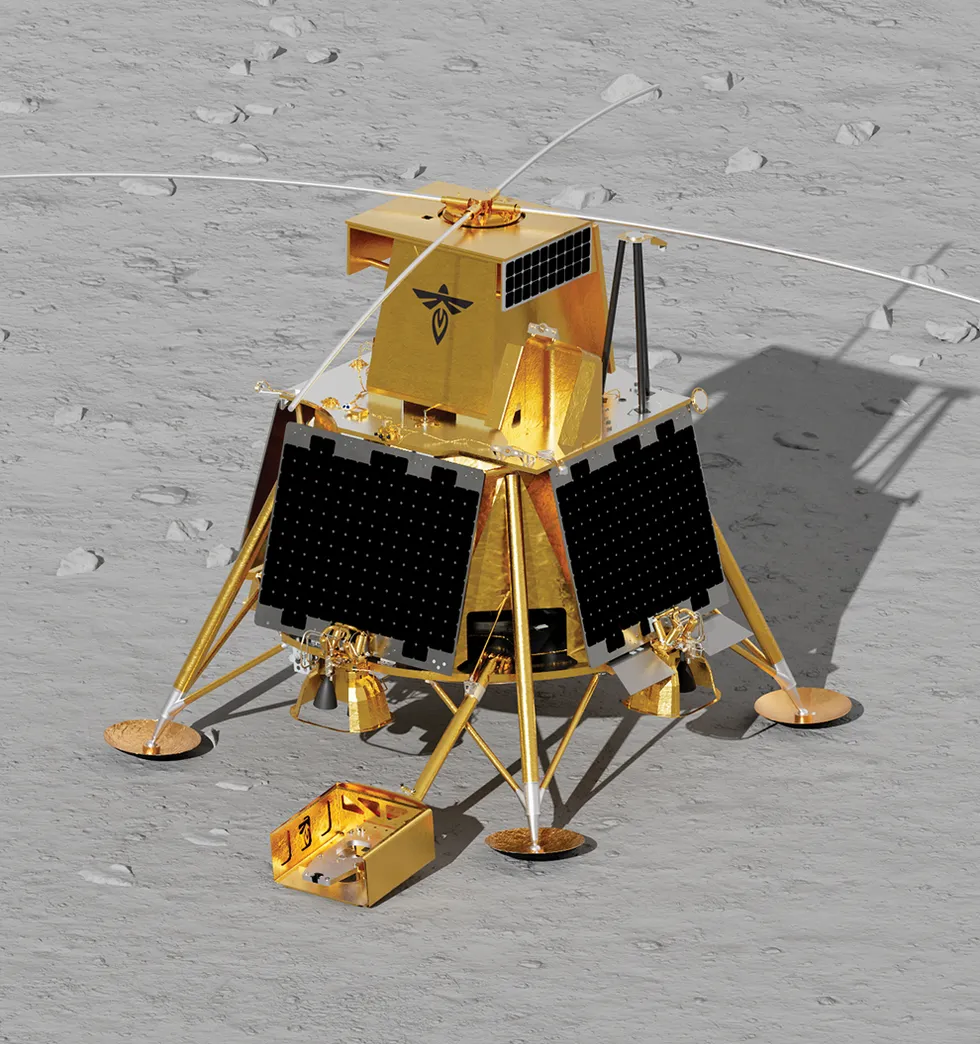
The far side of the moon, the term most scientists prefer, is indeed dark (half the time), cold, and inhospitable. There’s regolith and a couple of Chinese landers—Chang’e 4 in January 2019 and Chang’e 6 in June 2024—and not much else. That could change in about a year, as Contributing Editor Ned Potter reports in “The Quest to Build a Telescope That Can Hear the Cosmic Dark Ages.” Firefly Aerospace’s Blue Ghost Mission 2 with the LuSEE-Night radio telescope aboard will attempt to become the third successful mission to land there.
The moon’s far side is the perfect place for such a telescope. The same RF waves that carried images of Neil Armstrong setting foot on the lunar surface, Roger Waters’s voice, and hundreds of Ned Potter’s space and science segments for the U.S. broadcast networks CBS and ABC interfere with terrestrial radio telescopes. If your goal is to detect the extremely faint and heavily redshifted signals of neutral hydrogen from the cosmic Dark Ages, you just can’t do it from Earth. This epoch is so-called because we Earthlings have yet to sense anything from this time period, which started about 380,000 years after the big bang and lasted 200 million to 400 million years. The far side of the moon may be a terrible place to live, but it’s shielded from all the noise of Earth, making it the ideal spot to place a radio telescope.
As Potter emphasized to me recently, LuSEE-Night won’t listen for a signal from Dark Ages hydrogen directly. “Will the hydrogen from the Dark Ages send a signal? No,” says Potter. “But all that hydrogen out there may absorb a little bit of energy from the cosmic microwave background, interfering with that even more distant remnant of the big bang.”
Advertisement
The far side may not stay quiet for much longer. Several countries, including China, India, Japan, Russia, South Korea, the United Arab Emirates, and the United States, are making slow but steady progress toward establishing a lunar presence. As they do so, they’ll place more relay satellites into orbit around the moon to support exploratory activities as well as moon bases planned for the next decade and beyond. That means the window on a noise-free far side is closing. LuSEE-Night, a project 40 years in the making, might just get there in the nick of time.
Potter is tracking emerging protocols that could preserve the far side’s electromagnetic silence even as such efforts advance. Radio astronomers he’s talked to have shared ideas about how to prevent this emerging problem from turning into a crisis. “There are no bad guys in this story, at least not yet,” says Potter. “But there are a lot of well-meaning people who could complicate the picture a great deal if they don’t know that there’s a picture to complicate.”
It’s a busy time for moon missions. In addition to Blue Ghost Mission 2, the Chinese are sending Chang’e 7 to the moon’s south pole, while NASA’s Artemis II is scheduled to enter the first of three launch windows this month. Artemis II will be the first mission to put humans into lunar orbit since the last Apollo mission in 1972. And IEEESpectrum readers will enjoy a front row seat, thanks to the enterprising reporting of a true legend in the business, our own Ned Potter.
This article appears in the February 2026 print issue as “See You on the Far Side of the Moon.”
Apple’s long-rumored foldable iPhone hasn’t been announced yet, but after years of speculation, it seems like this device could finally be coming out soon(ish). Multiple sources claim that Apple could be targeting a late-2026 launch for its first foldable phone, and new rumors suggest the company is even already thinking about its second model, which could be a clamshell-style foldable iPhone.
But of course, nothing is official yet. Plans can change, features can be dropped and timelines can slip. Still, recent reports paint the clearest picture yet of how Apple might approach a foldable iPhone and how it plans to differentiate itself from rivals like Samsung and Google.
Here, we’ve rounded up the most credible iPhone Fold rumors so far, covering its possible release timing, design, display technology, cameras and price. We’ll continue to update this post as more rumors and details become available.
When could the iPhone Fold launch?
Rumors of a foldable iPhone date back as far as 2017, but more recent reporting suggests Apple has finally locked onto a realistic window. Most sources now point to fall 2026, likely alongside the iPhone 18 lineup.
Some reports still claim the project could slip into 2027 if Apple runs into manufacturing or durability issues, particularly around the hinge or display. Given Apple’s history of delaying products that it feels aren’t ready, that remains a real possibility.
What will the iPhone Fold look like?
Current consensus suggests Apple has settled on a book-style foldable design, similar to Samsung’s Galaxy Z Fold series, rather than a clamshell flip phone.
When unfolded, the iPhone Fold is expected to resemble a small tablet like the iPad mini (8.3 inches). Based on the rumor mill, though, the iPhone Fold may be a touch smaller, with an internal display measuring around 7.7 to 7.8 inches. When closed, it should function like a conventional smartphone, with an outer display in the 5.5-inch range.
Advertisement
CAD leaks and alleged case-maker molds suggest the device may be shorter and wider than a standard iPhone when folded, creating a squarer footprint that better matches the aspect ratio of the inner display. Several reports have also pointed to the iPhone Air as a potential preview of Apple’s foldable design work, with its unusually thin chassis widely interpreted as a look at what one half of a future foldable iPhone could resemble.
If that theory holds, it could help explain the Fold’s rumored dimensions. Thickness is expected to land between roughly 4.5 and 5.6mm when unfolded, putting it in a similar range to the iPhone Air, and just over 9 to 11mm when folded, depending on the final hinge design and internal layering.
iPhone 17 Pro, iPhone Air (Engadget)
Display and the crease question
The display is arguably the biggest challenge for any foldable phone, and it’s an area where Apple appears to have invested years of development.
According to these reports, the panel combines a flexible OLED with a laser-drilled metal support plate that disperses stress when folding. The goal is a display with a nearly invisible crease, something Apple reportedly considers essential before entering the foldable market.
If Apple does use this panel, it would mark a notable improvement over current foldables, which still show visible creasing under certain lighting conditions.
Cameras and biometrics
Camera rumors suggest Apple is planning a four-camera setup. That may include:
Two rear cameras (main and ultra-wide, both rumored at 48MP)
One punch-hole camera on the outer display
One under-display camera on the inner screen
Several sources claim Apple will avoid Face ID entirely on the iPhone Fold. Instead, it’s expected to rely on Touch ID built into the power button, similar to recent iPad models. This would allow Apple to keep both displays free of notches or Dynamic Island cutouts.
Advertisement
Under-display camera technology has historically produced lower image quality, but a rumored 24MP sensor would be a significant step up compared to existing foldables, which typically use much lower-resolution sensors.
iPhone Fold’s hinge and materials
The hinge is another area where Apple may diverge from competitors. Multiple reports claim Apple will use Liquidmetal, which is a long-standing trade name for a metallic glass alloy the company has previously used in smaller components. While often referred to as “liquid metal” or “Liquid Metal” in reports, Liquidmetal is the branding Apple has historically associated with the material.
Liquidmetal is said to be stronger and more resistant to deformation than titanium, while remaining relatively lightweight. If accurate, this could help improve long-term durability and reduce wear on the foldable display.
Leaks from Jon Prosser also reference a metal plate beneath the display that works in tandem with the hinge to minimize creasing — a claim that aligns with reporting from Korean and Chinese supply-chain sources.
Advertisement
Battery and other components
Battery life is another potential differentiator. According to Ming-Chi Kuo and multiple Asian supply-chain reports, Apple is testing high-density battery cells in the 5,000 to 5,800mAh range.
That would make it the largest battery ever used in an iPhone, and competitive with (or larger than) batteries in current Android foldables. The device is also expected to use a future A-series chip and Apple’s in-house modem.
Estimates currently place the price between $2,000 and $2,500 in the US. Bloomberg has said the price will be “at least $2,000,” while other analysts have narrowed the likely range to around $2,100 and $2,300. That positions the iPhone Fold well above the iPhone Pro Max and closer to Apple’s high-end Macs and iPads.
Advertisement
Despite years of rumors, there’s still plenty that remains unclear. Apple hasn’t confirmed the name “iPhone Fold,” final dimensions, software features or how iOS would adapt to a folding form factor. Durability, repairability and long-term reliability are also open questions. For now, the safest assumption is that Apple is taking its time and that many of these details could still change before launch.
Voice AI company ElevenLabs said today it raised $500 million in a new funding round led by Sequoia Capital, which was an investor in the startup’s last secondary round through a tender. Sequoia partner Andrew Reed is joining the company’s board.
The startup is now valued at $11 billion, more than three times its valuation in its last round in January 2025. Earlier in the year, the Financial Times reported that the startup was looking to raise at that valuation.
The company said that existing investor a16z quadrupled its investment amount, and Iconiq, which led the last round, tripled it. Some prior investors, like BroadLight, NFDG, Valor Capital, AMP Coalition, and Smash Capital, also joined the round. New investors for the funding included Lightspeed Venture Partners, Evantic Capital, and Bond.
ElevenLabs said that it will disclose some investors later in February, which might be strategic partners. The company has raised over $781 million to date. It said that it will use the funding for research and product development, along with expansion in international markets like India, Japan, Singapore, Brazil, and Mexico.
“The intersection of models and products is critical – and our team has proven, time and again, how to translate research into real-world experiences. This funding helps us go beyond voice alone to transform how we interact with technology altogether. We plan to expand our Creative offering – helping creators combine our best-in-class audio with video and Agents – enabling businesses to build agents that can talk, type, and take action,” he said in a statement.
The company has seen good growth momentum as it closed the year at $330 million ARR. In an interview with Bloomberg earlier this year, Staniszewski said that it took ElevenLabs five months to reach $200 million to $300 million in ARR.
After Warner Brothers balked at Larry’s competing bid and a hostile takeover attempt, Larry tried to sue Warner Brothers. With that not going anywhere, Larry and MAGA have since joined forces to try and attack the Netflix merger across right wing media, falsely claiming that “woke” Netflix is attempting a “cultural takeover” that must be stopped for the good of humanity.
With hearings on the Netflix merger looming, MAGA has ramped up those attacks with the help of some usual allies. That includes the right wing think tank the Heritage Foundation, which has apparently been circulating a bogus study around DC claiming that Netflix and Warner Brothers are “engineering millions of Americans into a predisposition to accept preferred leftwing ideological dogma”:
“Without ever saying Warner Bros or bid rival Paramount by name, the Oversight Project’s analysis, titled Fedflix: Netflix, The Federal Government, and the New Propaganda State, insists that “relevant federal agencies must scrutinize with extreme intensity any potential Netflix acquisitions of other media and entertainment companies to take into account the full ramifications of the impacts on American society and the health of the Constitutional Republic.”
Again, the goal here is to ensure that Larry Ellison can buy Netflix (and HBO and CNN). Larry, as we’ve seen vividly with his acquisitions of CBS and TikTok, is buying up new and old media to create a propaganda safe space for America’s increasingly unhinged and anti-democratic extraction class. Like Elon Musk’s acquisition of Twitter, the goal is propaganda and information control.
And like any good propagandists, MAGA has tried to invert reality, and is increasingly trying to claim it’s Netflix that covertly wants to create a left-wing propaganda empire that spreads gayness and woke:
Advertisement
“With its subtitle of “The Weaponization of Entertainment for Partisan Propaganda,” the report is tailored for the MAGA base. Full of talking points and and mentions of Stranger Things, the Lena Dunham-produced Orgasm Inc: The Story of OneTaste, the controversial Cuties docu from 2020, and the Obamas-produced American Factory, the 47-page report takes repeated swipes at any expansion of the streamer and its library of “leftwing and progressive” content.”
Of course that’s nonsense. Netflix has demonstrated that they’re primarily an opportunist, and will show whatever grabs eyeballs and makes them money (from gay military dramas that upset the pentagon to washed up anti-trans comedian hacks). And they’re certain to debase themselves further to please the Trump administration in order to gain approval of their merger.
That’s not to say that the Netflix Warner Brothers merger will be good for anybody. Most media consolidation is generally terrible for labor and consumers as we’ve seen with the AT&T–>Warner Brothers–>Discovery mergers. They almost always result in massive debt loads, tons of layoffs, higher prices, and lower quality product.
Enter an old MAGA playbook: try to convince a bunch of useful idiots that the authoritarian corporatist MAGA coalition somehow really loves antitrust reform and is looking out for the little guy, despite a long track record of coddling corporate power and monopoly control.
That’s again the game plan here by Heritage and administration mouthpieces like Brendan Carr; pretend you’re obstructing the Netflix deal for ethical and antitrust reasons, when you’re really just trying to help Larry Ellison engage in the exact sort of competitive and ideological domination you’re whining about.
Advertisement
Among the folks helping this project along is former Trump DOJ “antitrust enforcer” Makan Delrahim, who is now Paramount’s Chief Legal Officer. Delrahim played a starring role during the first Trump term in rubber stamping the hugely problematic Sprint T-Mobile merger, and attempting to block the AT&T Time Warner deal (to the benefit of Rupert Murdoch, who opposed the tie up).
And now here we are again, with many of the same folks joining forces to try and scuttle Netflix’s latest merger, simply to ensure their preferred, anti-democratic billionaire wins the prize.
Ideally, again, you’d block all media consolidation.
Since that’s clearly not happening under the corporation-coddling Trump administration, activists — and the two or three Democratic lawmakers who actually care about media reform — are probably better served by aligning themselves with Netflix. It’s most definitely a lesser of two evils scenario, with, as the chaos at CBS shows, greater Larry Ellison control of media being the worst possible outcome.
Advertisement
In any case, expect right wing propagandists and right wing media to start really lighting into Netflix in the weeks and months to come. You know, because they just really love truth and freedom and hate consolidated corporate power.
Much has been made of the excessive power demands of AI, but solutions are sparse. This has led engineers to consider completely new paradigms in computing: optical, thermodynamic, reversible—the list goes on. Many of these approaches require a change in the materials used for computation, which would demand an overhaul in the CMOS fabrication techniques used today.
Over the past decade, Hector De Los Santos has been working on yet another new approach. The technique would require the same exact materials used in CMOS, preserving the costly equipment, yet still allow computations to be performed in a radically different way. Instead of the motion of individual electrons—current—computations can be done with the collective, wavelike propagations in a sea of electrons, known as plasmons.
De Los Santos, an IEEE Fellow, first proposed the idea of computing with plasmons back in 2010. More recently, in 2024, De Los Santos and collaborators from University of South Carolina, Ohio State University, and the Georgia Institute of Technologycreated a device that demonstrated the main component of plasmon-based logic: the ability to control one plasmon with another. We caught up with De Los Santos to understand the details of this novel technological proposal.
How Plasmon Computing Works
IEEE Spectrum: How did you first come up with the idea for plasmon computing?
Advertisement
De Los Santos: I got the idea of plasmon computing around 2009, upon observing the direction in which the field of CMOS logic was going. In particular, they were following the downscaling paradigm in which, by reducing the size of transistors, you would cram more and more transistors in a certain area, and that would increase the performance. However, if you follow that paradigm to its conclusion, as the device sizes are reduced, quantum mechanical effects come into play, as well as leakage. When the devices are very small, a number of effects called short channel effects come into play, which manifest themselves as increased power dissipation.
So I began to think, “How can we solve this problem of improving the performance of logic devices while using the same fabrication techniques employed for CMOS—that is, while exploiting the current infrastructure?” I came across an old logic paradigm called fluidic logic, which uses fluids. For example, jets of air whose direction was impacted by other jets of air could implement logic functions. So I had the idea, why don’t we implement a paradigm analogous to that one, but instead of using air as a fluid, we use localized electron charge density waves—plasmons. Not electrons, but electron disturbances.
And now the timing is very appropriate because, as most people know, AI is very power intensive. People are coming against a brick wall on how to go about solving the power consumption issue, and the current technology is not going to solve that problem.
What is a plasmon, exactly?
Advertisement
De Los Santos: Plasmons are basically the disturbance of the electron density. If you have what is called an electron sea, you can imagine a pond of water. When you disturb the surface, you create waves. And these waves, the undulations on the surface of this water, propagate through the water. That is an almost perfect analogy to plasmons. In the case of plasmons, you have a sea of electrons. And instead of using a pebble or a piece of wood tapping on the surface of the water to create a wave that propagates, you tap this sea of electrons with an electromagnetic wave.
How do plasmons promise to overcome the scaling issues of traditional CMOS logic?
De Los Santos: Going back to the analogy of the throwing the pebble on the pond: It takes very, very low energy to create this kind of disturbance. The energy to excite a plasmon is on the order of attojoules or less. And the disturbance that you generate propagates very fast. A disturbance propagates faster than a particle. Plasmons propagate in unison with the electromagnetic wave that generates them, which is the speed of light in the medium. So just intrinsically, the way of operation is extremely fast and extremely low power compared to current technology.
In addition to that, current CMOS technology dissipates power even if it’s not used. Here, that’s not the case. If there is no wave propagating, then there is no power dissipation.
Advertisement
How do you do logic operations with plasmons?
De Los Santos: You pattern long, thin wires in a configuration in the shape of the letter Y. At the base of the Y you launch a plasmon. Call this the bias plasmon, this is the bit. If you don’t do anything, when this plasmon gets to the junction it will split in two, so at the output of the Y, you will detect two equal electric field strengths.
Now, imagine that at the Y junction you apply another wire at an angle to the incoming wire. Along that new wire, you send another plasmon, called a control plasmon. You can use the control plasmon to redirect the original bias plasmon into one leg of the Y.
Plasmons are charge disturbances, and two plasmons have the same nature: They either are both positive or both negative. So, they repel each other if you force them to converge into a junction. And by controlling the angle of the control plasmon impinging on the junction, you can control the angle of the plasmon coming out of the junction. And that way you can steer one plasmon with another one. The control plasmon simply joins the incoming plasmon, so you end up with double the voltage on one leg.
Advertisement
You can do this from both sides, add a wire and a control plasmon on either side of the junction so you can redirect the plasmon into either leg of the Y, giving you a zero or a one.
Building a Plasmon-Based Logic Device
You’ve built this Y-junction device and demonstrated steering a plasmon to one side in 2024. Can you describe the device and its operation?
De Los Santos: The Y-junction device is about 5 square [micrometers]. The Y is made up of the following: a metal on top of an oxide, on top of a semiconducting wafer, on top of a ground plane. Now, between the oxide and the wafer, you have to generate a charge density—this is the sea of electrons. To do that, you apply a DC voltage between the metal of the Y and the ground plane, and that generates your static sea of electrons. Then you impinge upon that with an incoming electromagnetic wave, again between the metal and ground plane. When the electromagnetic wave reaches the static charge density, the sea of electrons that was there generates a localized electron charge density disturbance: a plasmon.
Now, if you launch a plasmon by itself, it will quickly dissipate. It will not propagate very far.In my setup, the reason why the plasmon survives is because it is being regenerated. As the electromagnetic field propagates, you keep regenerating the plasmons, creating new plasmons at its front end.
Advertisement
What is left to be done before you can implement full computer logic?
De Los Santos: I demonstrated the partial device, that is just the interaction of two plasmons. The next step would be to demonstrate and fabricate the full device, which would have the two controls. And after that gets done, the next step is concatenating them to create a full adder, because that is the fundamental computing logic component.
What do you think are going to be the main challenges going forward?
De Los Santos: I think the main challenge is that the technology doesn’t follow from today’s paradigm of logic devices based on current flows. This is based on wave flows. People are accustomed to other things, and it may be difficult to understand the device. The different concepts that are brought together in this device are not normally employed by the dominant technology, and it is really interdisciplinary in nature. You have to know about metal-oxide-semiconductor physics, then you have to know about electromagnetic waves, then you have to know about quantum field theory. The knowledge base to understand the device rarely exists in a single head. Maybe another next step is to try to make it more accessible. Getting people to sponsor the work and to understand it is a challenge, not really the implementation. There’s not really a fabrication limitation.
Advertisement
But in my opinion, the usual approaches are just doomed, for two reasons. First, they are not reversible, meaning information is lost in the computation, which results in energy loss. Second, as the devices shrink energy dissipation increases, posing an insurmountable barrier. In contrast, plasmon computation is inherently reversible, and there is no fundamental reason it should dissipate any energy during switching.
It’s hard to tell the difference between Apple’s second-generation AirTag and the almost-five-year-old original just by looking at them. In fact, the only way to tell is the many scratches on my old tracker, picked up from all those years attached to my keyring, living in my pocket.
While the price is still $29, Apple’s latest tracker packs some core upgrades. The new AirTag has a second-generation ultra-wideband (UWB) chip that extends its Precise Finding range up to 50 percent, though it requires an iPhone 15 or newer to do so. It’s also apparently 50 percent louder and has a new, higher-pitched chime. Still no keyring hole, though.
Apple/Engadget
Apple has improved its Bluetooth tracker in practically every way, making it louder and extending its detection range.
Advertisement
Pros
Precise Finding is far more useful
Louder and easier to hear
Same price as the original AirTag
Cons
Still lacks a keyring hole
Apple’s AirTag accessories are too expensive
The new AirTag looks… the same. It’s arguably the most understated hardware design Apple has ever made, with no buttons or ports, just a company logo on one side. It’s made from a combination of a stainless steel plate and a (now 85-percent recycled) plastic enclosure. It’s like a thick coin, a little bigger than a quarter, and slips into any small pocket or wallet. The battery can be replaced by rotating the backing off, but it’s still solid enough that I never felt there was a risk of coming off accidentally.
Apple’s accessories to attach the AirTag to your keys are still more expensive than the tracker itself. However, compared to when the original tracker launched, there’s now a rich collection of third-party options from the likes of Mophie, Belkin and more, many of which are more reasonably priced at around $15. A $35 keyring for a $29 tracker is a very tough sell, Apple.
Apple’s new AirTag promises increased range and a louder ring chime. (Mat Smith for Engadget)
Setting up a new AirTag is just as effortless as its predecessor. Pull out the plastic tag, connecting the battery, and a notification will pop up on your nearby iPhone. You can then name it, assign it to an item and it’ll join your list of findable Apple hardware.
I’ve been testing the range of the new AirTag, and if anything, the 50 percent increase in Precision Finding range is a conservative estimate. Naturally, tracking can be affected by building structure, walls, a lack of nearby Find My network devices and other interference, but the next-generation AirTag’s “getting closer” screen consistently appeared on my phone when I was around 80 feet away. The older tracker, however, needed me to be around 30-40 feet away to do the same. The benefit of Precision Finding was limited on the debut AirTag, because its range was so tiny — especially in busy environments. The hardware upgrades now make it truly useful. The new AirTag is also faster to connect and more responsive to my movements and sudden turns, thanks, I expect, to the new ultra-wideband chip.
Advertisement
You can now also use newer Apple Watches (Series 9, Ultra 2 and up) with precision location detection. After updating her Apple Watch Series 11 to the latest software, my colleague Cherlynn Low reported that locating the new AirTag was pretty much the same as on an iPhone. She did find it slightly counterintuitive to have to first add the Find My shortcut to the Control Center on the watch instead of going to the Find My Items app to do so, but ultimately, once she did that, it mirrored the existing setup for Precision Finding on iPhones.
Apple’s new AirTag promises increased range and a louder ring chime. (Mat Smith for Engadget)
Apple also redesigned the AirTag’s speaker assembly, which it says makes sounds 50 percent louder. Possibly the most effective audio upgrade is a higher-pitched chime that’s easier to hear over ambient noise and in busy public spaces. I could hear it ringing out from the other side of my gym’s locker room, while inside a locker, over music playing in the background. My old AirTag was inaudible until I was a few feet away from my locker. I always thought the sound on the original AirTag was a little too low-key for something you were urgently trying to find. (I’d love to be able to customize the chime, though.)
It’s the Find My network that makes the AirTag shine. Apple’s massive footprint of over a billion devices, from iPhones to Macs, continues to offer a tracking range and finer precision than GPS and Bluetooth alone. If anything, this network is even more built out since the launch of the first Apple tracker.
Since we tested the first AirTag, Apple has added multiple new features, usually through iOS updates, that expanded the utility and versatility of its trackers. In iOS 17, you could share an AirTag through Family Sharing. In iOS 18.2, Share Item Location allowed you to share your tracking information with third parties (such as airlines or train companies), improving the chances of finding the AirTag.
Advertisement
There have also been subsequent safety upgrades, including expanding unknown tracker alerts to Android devices without needing to install an app. Apple also reduced the time an AirTag takes to emit a sound when separated from its owner, shifting the interval to a random range between 8 and 24 hours. At launch, this was a three-day span.
Wrap-up
Apple’s second-gen AirTag is still $29. (Mat Smith for Engadget)
Do you need the new AirTag? While improved in every way, it’s pretty much the same device. However, the AirTag’s simplicity and ease of use are second to none when it comes to Bluetooth trackers. If you already own a single AirTag for your keys or wallet, upgrading to the second-gen iteration and repurposing the old one to track, say, your luggage, makes a lot of sense. You get the more precise location tracking and sensing for your smaller item, while you can reduce your bag anxiety if your suitcase doesn’t make it to your destination.
There’s no doubt the second-gen AirTags are improved, and thankfully, upgrading to the new capabilities doesn’t come at too steep a cost.
Hackers are abusing a legitimate but long-revoked EnCase kernel driver in an EDR killer that can detect 59 security tools in attempts to deactivate them.
An EDR killer is a malicious tool created specifically to bypass or disable endpoint detection and response (EDR) tools, along with other security solutions. They typically use vulnerable drivers to unhook the protections on the system.
Usually, attackers rely on the ‘Bring Your Own Vulnerable Driver’ (BYOVD) technique, where they introduce a legitimate but vulnerable driver and use it to gain kernel-level access and terminate security software processes.
The technique is well-documented and very popular, but despite Microsoft introducing various defenses over the years, Windows systems are still vulnerable to effective bypasses.
Encase is a digital investigation tool used in law enforcement forensic operations that enables extracting and analyzing data from computers, mobile devices, or cloud storage.
Advertisement
Huntress researchers responding to a cybersecurity incident earlier this month noticed the deployment of a custom EDR killer that was disguised as a legitimate firmware update utility and used an old kernel driver.
The attackers breached the network using compromised SonicWall SSL VPN credentials and exploiting the lack of multi-factor authentication (MFA) for the VPN account.
After logging in, the attackers performed aggressive internal reconnaissance, including ICMP ping sweeps, NetBIOS name probes, and SMB-related activity, SYN flooding exceeding 370 SYNs/sec.
The EDR killer used in this case is a 64-bit executable that abuses ‘EnPortv.sys,’ an old EnCase kernel driver, to disable security tools running on the host system.
Advertisement
The driver’s certificate was issued in 2006, expired in 2010, and was subsequently revoked; however, because the Driver Signature Enforcement system on Windows works by validating cryptographic verification results and timestamps, rather than checking Certificate Revocation Lists (CRLs), the operating system still accepts the old certificate.
Although Microsoft added a requirement in Windows 10 version 1607 that kernel drivers must be signed via the Hardware Dev Center, an exception was made for certificates issued before July 29, 2015, which applies in this case.
The kernel driver is installed and registered as a fake OEM hardware service, establishing reboot-resistant persistence.
Establishing persistence on the host Source: Huntress
The malware uses the driver’s kernel-mode IOCTL interface to terminate service processes, bypassing existing Windows protections such as Protected Process Light (PPL).
There are 59 targeted processes related to various EDR and antivirus tools. The kill loop executes every second, immediately terminating any processes that are restarted.
Advertisement
KillProc implementation Source: Huntress
Huntress believes that the intrusion was related to ransomware activity, although the attack was stopped before the final payload was deployed.
Key defense recommendations include enabling MFA on all remote access services, monitoring VPN logs for suspicious activity, and enabling HVCI/Memory Integrity to enforce Microsoft’s vulnerable driver blocklist.
Additionally, Huntress recommends monitoring for kernel services masquerading as OEM or hardware components and deploying WDAC and ASR rules to block vulnerable signed drivers.
Modern IT infrastructure moves faster than manual workflows can handle.
In this new Tines guide, learn how your team can reduce hidden manual delays, improve reliability through automated response, and build and scale intelligent workflows on top of tools you already use.
Segway designed the Cube 1000 power station, priced at $330 (was $500), around a 1024Wh LiFePO4 battery, which can last for over 4,000 charge cycles without significantly losing capacity, equating to around a decade of regular operation. The starting capacity is 1 kWh, but customers can connect up to four additional 1 kWh expansion packs wirelessly, with no wires required, for a total of 5 kWh as needed.
The power station can deliver 2200 watts consistently from the AC side, with a unique R-Drive mode capable of handling brief 4400 watt power surges. That is more than enough to cover most common household appliances, including refrigerators, microwaves, power tools, and even medical equipment such as CPAP machines. There are three AC outlets to go with a decent array of DC options: plenty of USB-A and USB-C ports (one of which is a 100 W fast charge connector for laptops), a 12v car-style plug, and some other DC outputs for flexibility.
High-Power Performance: The Segway Cube 1000 from the Cube Series boasts an impressive 2200W AC power, expandable to 4400W with R-drive function,…
Robust Build: With an IP56-rated design and a LiFePO4 battery capable of lasting over 4000 cycles, the Cube 1000 guarantees durability and reliability…
Rapid Recharging: Enjoy quick recharging with 1kWh in just 1.2 hours, supporting 1250W AC and 800W Solar Charging with an exceptional 97% efficiency…
Filling it up is also simple, as it can be fully charged in around an hour and a half to two hours using a 1250w AC input, or you can just connect it to some solar panels to get up to 800w at 97% efficiency. Car charging is also accessible, albeit at a slower rate. One useful feature is that the unit can accept both AC and solar input in many circumstances, allowing you to charge more quickly during the day.
Advertisement
It’s also a nice-looking product, with an IP56 rating on the battery pack (the entire unit is IPX3), which means it can survive dust and strong water jets, making it ideal for use outside or in the garage. Durable construction combines with a simple, cube design that keeps everything stable even when piled together.
The Segway-Ninebot app allows you to check battery levels, alter settings, and manage power flow remotely. The item has a clear display that allows you to see the important information at a glance. Standard safety features include overload, short circuit, and temperature extremes protection; it can even withstand temperatures of up to 113 degrees Fahrenheit.
You get a total of 12 outputs to power all of your devices, from phones to laptops to lights to tiny fridges, without having to continually juggle cords. In practical terms, that 1024Wh base can recharge your phone about 80 to 90 times, power a small fridge for many hours, or power a laptop and some lights for the evening.
Coinbase contractor improperly accessed data of ~30 customers without authorization
Insider was fired; victims notified and offered identity theft protection services
Incident echoes 2025 case where cybercriminals bribed support agents to steal customer data worth $400 million
Coinbase has confirmed it experienced an insider breach when a contractor accessed data on roughly 30 customers, without proper authorization.
“Last year our security team detected that a single Coinbase contractor improperly accessed customer information, impacting a very small number of users (approximately 30),” a Coinbase spokesperson told BleepingComputer.
The company explained the contractor was fired, and the affected individuals were notified and offered free identity theft protection services, as well as reporting the incident to the regulators.
Bribing contractors
Very little extra is currently known about this incident, but BleepingComputer links it to screenshots that ransomware operators Scattered Lapsus Hunters (SLH) posted on their Telegram channel recently.
The screenshots, which were deleted soon after posting, allegedly showed the internal Coinbase support interface, containing sensitive information such as names, email addresses, dates of birth, phone numbers, KYC information, cryptocurrency wallet balances, and transactions.
It was also said that the screenshots could have been created by any other threat actor, so it is highly unlikely that the fired contractor is a member of the infamous hacking collective. Instead, they might have been bribed into sharing the data, as was the case last year.
Advertisement
In mid-May 2025, Coinbase said that cybercriminals bribed overseas support agents to steal customer data in an incident that ended up costing the firm $400 million. The hackers demanded Coinbase pay $20 million in ransom, in exchange for the data, but that never happened. Instead, Coinbase placed a $20 million bounty on any information leading to the arrest of the cybercriminals.
Sign up to the TechRadar Pro newsletter to get all the top news, opinion, features and guidance your business needs to succeed!
“Cyber criminals bribed and recruited a group of rogue overseas support agents to steal Coinbase customer data to facilitate social engineering attacks,” the company said in a blog post.
“These insiders abused their access to customer support systems to steal the account data for a small subset of customers. No passwords, private keys, or funds were exposed and Coinbase Prime accounts are untouched. We will reimburse customers who were tricked into sending funds to the attacker.”
If you’ve been waiting for the global memory shortage to ease anytime this year and hardware prices to drop, Intel CEO Lip-Bu Tan has some bad news. Speaking at a recent Cisco Systems conference, Tan said the crunch will likely last at least two more years.
According to Bloomberg, Tan cited information from two key players in the memory space who reportedly told him, “There’s no relief until 2028.” The timeline aligns with recent comments from Micron’s Christopher Moore, VP of Marketing for its Mobile and Client Business Unit, who said tight supply conditions are likely to linger for the foreseeable future.
The prolonged shortage is being driven largely by the explosive growth of AI infrastructure, which is soaking up memory at an unprecedented scale. With memory manufacturers increasingly focused on serving data centers and AI workloads, supply for consumer devices is being squeezed. For buyers, that could mean paying more for laptops, phones, PC components, and even TVs.
AI demand could keep your next hardware upgrade expensive
Nvidia’s next wave of AI hardware could make the situation even worse. According to Tan, the company’s latest Rubin platform will drive demand even higher. AI is going to “suck up a lot of memory,” Tan said, which could further tighten supply for consumer electronics.
Advertisement
For consumers, this means the pressure on hardware pricing is unlikely to ease anytime soon. Devices may continue to ship with higher price tags or more modest memory configurations unless memory supply expands significantly or demand from AI infrastructure slows. Until then, buyers may need to plan upgrades carefully or hold onto existing hardware longer than usual.

My inbox is filled with friends and colleagues looking to discuss life after Big Tech. It’s no surprise that older workers seem to be disproportionately affected by recent layoffs in Seattle as tech companies (Amazon, Meta, Expedia, etc.) are rolling out layoffs driven by over-hiring in the pandemic, the shift to AI and performance-related house cleaning.
Most 50-somethings who just got laid off from Amazon are in full frenzy mode. They are hit by the shock of a broken promise. They worked their butts off to get into Big Tech. They have been paid handsomely for 10, 20, or 30 years. And now they find themselves on a list and a Zoom meeting with an HR admin doing mass layoffs. Kids are in college or headed there at $60-100k per year. Health care costs are running $2-3k per month for the family. You stretched to buy that Seattle or Bellevue home with the $5-6k monthly payment. Aging parents need support. Your spouse is asking how he or she can help.

Panic. The instinct is to move fast, fill the calendar, make something happen. Send out resumes. Call back that recruiter from six months ago. Network like crazy. Hit LinkedIn. The adrenaline rush to figure it out right now.
My advice: Stop. Take a breath.
At 50+, this isn’t just another job transition. This may be your last chapter. You’ve got one more career opportunity and maybe 25-to-30 healthy years left, if you’re lucky.
Advertisement
Time is the most precious resource. Why would you spend any of them doing something that doesn’t light you up?
People come out of big tech companies — Amazon, Microsoft, Google — with incredible skills and experience. They can do almost anything. And that becomes the problem. When you can do anything, how do you choose?
Find the horizon with the Four Elements
Every business needs a strategy. You are now a “business of one.” It’s important to do the hard work to figure out where you want to go before you hit the road and start driving. There are many ways to determine your goals and priorities in life. I am a big fan of Career Coach Tim Butler from Harvard Business School and his latest book called “The Four Elements.”
Advertisement
The framework is simple but powerful:
Step 1: Find your flow Think about three times in your career when you were completely engaged. Lost track of time. Felt like you were doing exactly what you were meant to do. Write down what made those moments special. Synthesize the commonalities into one sentence.
Step 2: Identify your signature skills What were you particularly effective at? Not what your job description said you should be good at – what actually energized you and created impact? Think of three times when you were maximally effective. What patterns do you see?
Step 3: Define your ideal environment Come up with five adjectives that describe where you feel at home at work. Then write the opposites. For me? Playful vs. Serious. Team vs. Individualistic. Mission Driven vs. Bureaucratic. Those polarities tell you a lot.
Advertisement
Step 4: Map your constraints (Horizons) Who needs you right now? Spouse/kids/parents/siblings. What are your financial obligations? Mortgage/college/parents/children. What matters most in this next phase of life? Money? Giving back? Spirituality? Friendships? Travel?
Step 5: Brainstorm with AI Take the data from Steps 1-4 and have a conversation with your favorite LLM. Mine is Claude, but this exercise works with ChatGPT, Gemini, or Copilot. I also uploaded the swaths of personality tests and work output that I have been most proud of in my career (strategies, business plans, presentations, execution reports). My personal project on Claude now knows me, my strengths and weaknesses better than anyone on the planet (save my wife ☺).
When I did this exercise and looked at my answers, a pattern emerged. I thrive in rapid-growth, high risk environments with strong teams, focused on customer value, with lots of freedom to experiment and execute. I need work that feels mission-critical. And at this stage, I want to work on things I’m curious about, with people I like, with a strong social purpose.
Nikesh Parekh. (LinkedIn Photo)
Career Sprints: Test before you commit
After you’ve done the soul searching, here’s the next part most people skip: run experiments.
Advertisement
I call them “career sprints.” Come up with a thesis – two or three directions you might want to go. Then figure out low-cost ways to test them before you commit to another five years.
Want to buy a home services business? Find someone who runs one and offer to work for free for three months. See if it actually gives you energy or if it just seemed like a good idea.
Thinking about working in retail? Same thing. Use your severance to do full-time work either free or paid and go deep enough to know if you’d want to spend the next five years doing it.
I did this in 2015. I got tired of selling ads and software in online real estate. I wanted to find my purpose. I thought maybe I wanted to work at a nonprofit, so I spent three months at a large homeless shelter. Loved the mission and the people. But the work? Too slow and not enough strategic execution. I felt like was just turning the crank and I wasn’t excited enough about the day-to-day work. Then I tried venture capital for six months (my third time in VC). VC involves lots of meetings, lots of ego, and lots of social events. Personally, I really like building new businesses and working with a team to charge the hill. I like being on the field and not on the sideline or in the owner’s box. So investing wasn’t a fit for me.
Advertisement
Those experiments saved me from making expensive and time-consuming mistakes. (Or at least making those mistakes as I have made plenty others).
At 50+, with kids launching and maybe 5-to-15 good working years left, you can’t afford to waste time on something that doesn’t energize you. You could probably slot back into a product management role without thinking too hard. You could go make bombs or drones. There’s demand for all of it.
But is that how you want to write your last chapter?
If you’re laid off at 50+, here’s what I’d do:
Advertisement
1. Take 30 days minimum (90 is better) to clear your brain Don’t take meetings. Don’t send resumes. Don’t start networking. Don’t take that recruiter call. Just let yourself breathe. Give yourself the grace of not having it all figured out immediately.
2. Do the Four Elements exercise Get the book or use the free exercises online. Upload your answers into Claude or ChatGPT and have a conversation about it. AI isn’t going to tell you what to do, but it’ll help you see patterns you might miss.
3. Come up with a thesis Based on what you learned, what are 2-to-3 directions that actually excite you? Not what makes logical sense. What makes you want to wake up in the morning?
4. Run career sprints to test your thesis Before you commit, find ways to experiment. Work for someone in that space for free. Shadow people. Get your hands dirty. See if it gives you energy or drains you.
Advertisement
5. Set the strategy, then get tactical Once you know the direction, then you can update the resume and start networking with purpose.
When you’re 50+ and laid off, people treat it like a crisis.
You’ve been given a gift — the chance to reset, to choose differently, to not just optimize for salary and title but for meaning and energy and the kind of life you actually want to live. Take the time. Do the work. Figure out what chapter you want to write before you start writing it.
And if you found this helpful, consider reaching out to and helping a friend who has been laid off recently or is going through a hard transition.