
Tech
Microsoft is using NPUs to automatically capture Xbox game highlights



Sources recently informed Windows Central that Xbox Insiders who own Asus ROG Xbox Ally handheld gaming PCs can test a feature that uses the system’s embedded NPU to capture notable gaming moments. The functionality works without interrupting gameplay.
Read Entire Article
Source link



Threat actors using a previously undocumented phishing-as-a-service (PhaaS) platform called “VENOM” are targeting credentials of C-suite executives across multiple industries.
The operation has been active since at least last November and appears to target specific individuals who serve as CEOs, CFOs, or VPs at their companies.
VENOM also seems to be closed access, as it has not been promoted on public channels and underground forums, thus reducing its exposure to researchers.

The VENOM attack chain
The phishing emails, observed by researchers at cybersecurity company Abnormal, impersonated Microsoft SharePoint document-sharing notifications as part of internal communication.
The messages are highly personalized and include random HTML noise such as fake CSS classes and comments. The attacker also injects fake email threads tailored to the target, increasing credibility.
A QR code rendered in Unicode is provided for the victim to scan for access. The trick is designed to bypass scanning tools and shift the attack to mobile devices.
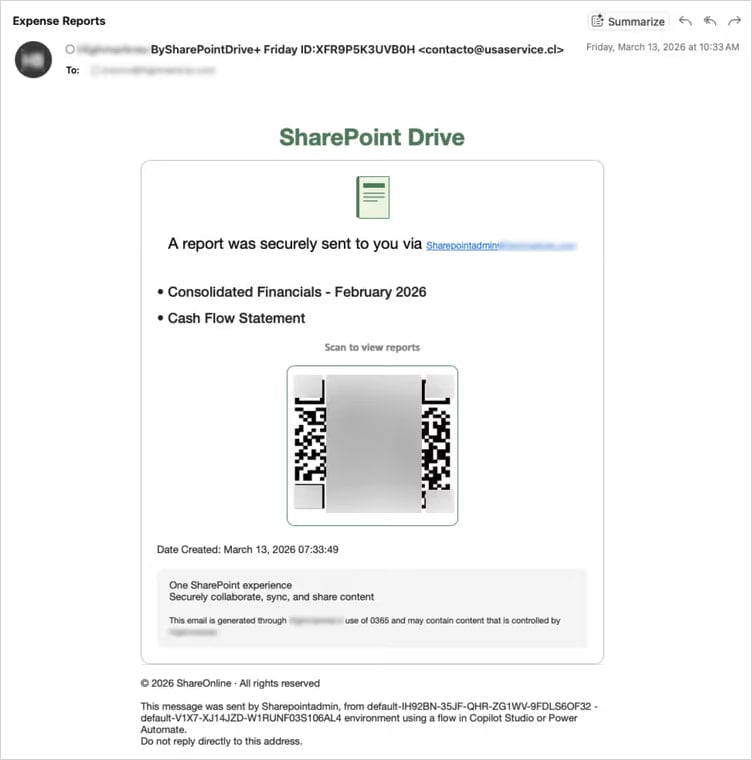
Source: Abnormal
“The target’s email address is double Base64-encoded in the URL fragment—the portion after the # character,” Abnormal researchers explain.
“Fragments are never transmitted in HTTP requests, making the target’s email invisible to server-side logs and URL reputation feeds.”
When the victim scans the QR code, they are taken to a landing page that serves as a filter for security researchers and sandboxed environments, ensuring that only real targets are redirected to the phishing platform. Users outside the threat actor’s interest are redirected to legitimate websites to reduce suspicion.
Those who pass the tests are taken to a credential-harvesting page that proxies a Microsoft login flow in real time, relaying credentials and multi-factor authentication (MFA) codes to Microsoft APIs and capturing the session token.
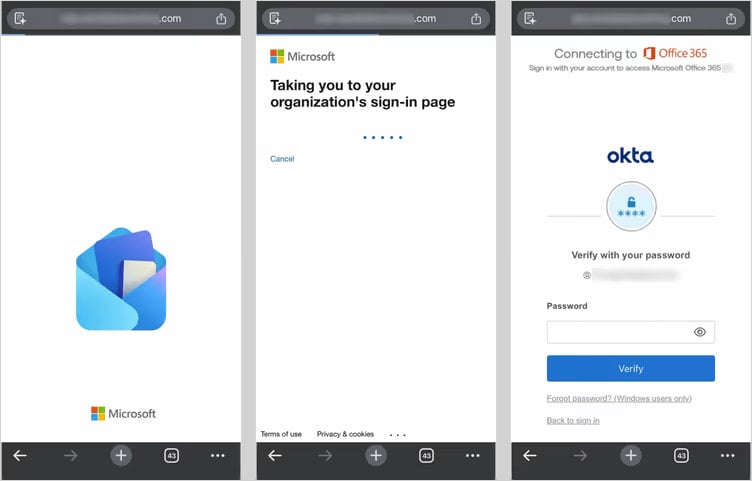
Source: Abnormal
Apart from the adversary-in-the-middle (AiTM) method, Abnormal has also observed a device-code phishing tactic in which the victim is tricked into approving access to their Microsoft account for a rogue device.

Source: Abnormal
This method has become very popular over the past year due to its effectiveness and resistance to password resets, with at least 11 phishing kits currently offering it as an option.
In both methods, VENOM quickly establishes persistent access during the authentication process. In the AiTM flow, it registers a new device on the victim’s account. In the device code flow, it obtains a token that also provides access to the account.
The researchers note that MFA is no longer sufficient as a defense. C-suite executives should use FIDO2 authentication, disable the device code flow when not needed, and block token abuse by implementing stricter conditional access policies.

Automated pentesting proves the path exists. BAS proves whether your controls stop it. Most teams run one without the other.
This whitepaper maps six validation surfaces, shows where coverage ends, and provides practitioners with three diagnostic questions for any tool evaluation.

Gerard “Gus” Gaynor, a long-serving IEEE volunteer and former engineering director at 3M, died on 9 March. The IEEE Life Fellow was 104.
Readers of The Institute might remember Gus from his 2022 profile: “From Fixing Farm Equipment to Becoming a Director at 3M.” Just last year, he and I coauthored twoarticles. One discusses how to leverage relationships to boost your career growth. The other weighs the pros and cons of pursuing a technical or managerial career path. He was 103 years old then. How many IEEE members can claim a centenarian coauthor?
I first met Gus in 2009 at the IEEE Technical Activities Board (TAB) meeting in San Juan, Puerto Rico. We sat together in the airplane on our way back to Minneapolis, our hometown. At home I told many of my friends about the remarkable person—who was 87 years young at the time—with whom I chatted during our six-hour flight.
A decade later, he and I met for lunch in Minneapolis. He drove himself to the restaurant, just asking for a hand to navigate the snowy sidewalk.
A dedicated IEEE volunteer
Gus’s involvement with IEEE predates the organization. He joined the Institute of Radio Engineers, a predecessor society, as a student member in 1942. Twenty years later he became an active IEEE volunteer.
He served on the TAB’s finance committee and the Publications Services and Products Board. He was president of the IEEE Engineering Management Society (now the Technology and Engineering Management Society ), and he was the Technology Management Council’s first president. He was the founding editor of IEEE-USA’s online magazine Today’s Engineer, which reported on government legislation and issues affecting U.S. members’ careers. The magazine is now available as the e-newsletter IEEE-USA InSight.
He authored several books on technology management, published by IEEE-USA.
 IEEE Life Fellow Gerard “Gus” Gaynor died on 9 March.The Gaynor Family
Most recently, after the formation of TEMS in 2015, he became an active member of its executive committee. He served two terms as vice president of publications.
At 100 years old, he led the launch of a new publication, TEMS Leadership Briefs, a novel short-format open-access publication aimed at technology leaders.
Gus, who is a former member of The Institute’s editorial advisory board, also worked with Kathy Pretz, The Institute’s editor in chief, to start an ongoing series of TEMS-sponsored career-interest articles. He coauthored several of them.
Throughout his 64 years as an IEEE volunteer, he received several honors. They include IEEE EMS’s Engineering Manager of the Year Award, the IEEE TEMS Career Achievement Award, and the IEEE-USA McClure Citation of Honor. In 2014 he was inducted into the IEEE Technical Activities Board Hall of Honor.
A 25-year career at 3M
Gus received a degree in electrical engineering in 1950 from the University of Michigan in Ann Arbor. He worked for several companies including Automatic Electric (now part of Nokia) and Johnson Farebox (now part of Genfare), before joining 3M in 1962.
During his successful 25-year career at 3M, he served as chief engineer for a division in Italy, established the innovation department, and led the design and installation of the company’s first computerized manufacturing facilities. He retired as director of engineering in 1987.
Last year, IEEE Life Fellow Michael Condry, a former TEMS president, organized a Zoom call with Gus and other leaders of the society to celebrate Gus’s 104th birthday. Gus looked well and was his usual upbeat self, telling everyone: “I’m good. Everything’s well. I can’t complain.”
Gus was married to Shirley Margaret Karrels Gaynor, who passed away in 2018. He lives on in the hearts and minds of his seven children, seven grandchildren, two great-grandchildren, and innumerable friends and IEEE colleagues.
From Your Site Articles
Related Articles Around the Web


Federal agencies, including the FBI, CISA, NSA, the Department of Energy, US Cyber Command, and the Environmental Protection Agency, issued an urgent joint advisory Tuesday, warning that an advanced persistent threat group linked to Iran has been exploiting vulnerabilities in programmable logic controllers since at least March 2026.
Read Entire Article
Source link


A new Lua-based malware, called LucidRook, is being used in spear-phishing campaigns targeting non-governmental organizations and universities in Taiwan.
Cisco Talos researchers attribute the malware to a threat group tracked internally as UAT-10362, who they describe as a capable adversary “with mature operational tradecraft.”
LucidRook was observed in attacks in October 2025 that relied on phishing emails carrying password-protected archives.
The researchers identified two infection chains, one using an LNK shortcut file that ultimately delivered a malware dropper called LucidPawn, and an EXE-based chain that leveraged a fake antivirus executable impersonating Trend Micro Worry-Free Business Security Services.
The LNK-based attack employs decoy documents, such as government letters crafted to appear as if they originate from the Taiwanese government, to divert the user’s attention.
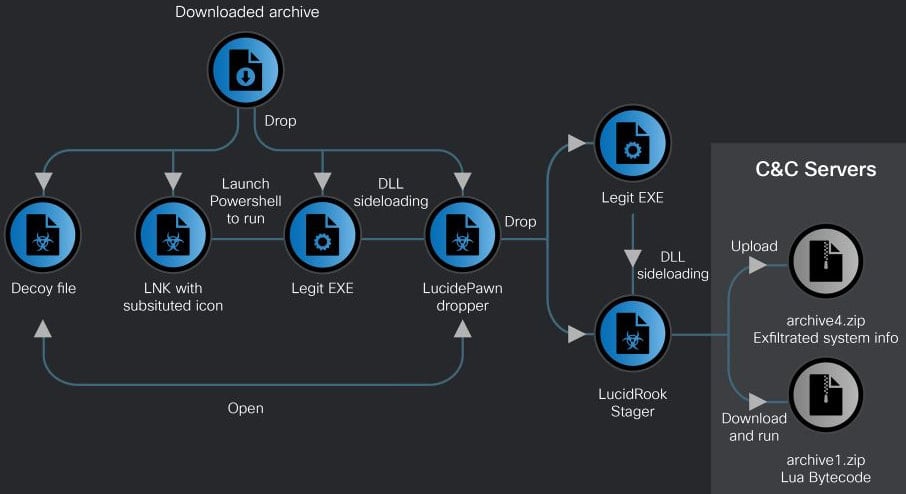
Source: Cisco Talos
Cisco Talos observed that LucidPawn decrypts and deploys a legitimate executable renamed to mimic Microsoft Edge, along with a malicious DLL (DismCore.dll) for sideloading LucidRook.
LucidRook is notable for its modular design and built-in Lua execution environment, which allows it to retrieve and execute second-stage payloads as Lua bytecode.
This approach enables operators to update functionality without modifying the core malware, while also limiting forensic visibility. This stealth is further increased by extensive obfuscation of the code.
“Embedding the Lua interpreter effectively turns the native DLL into a stable execution platform while allowing the threat actor to update or tailor behavior for each target or campaigns by updating the Lua bytecode payload with a lighter and more flexible development process,” Cisco Talos explains.
“This approach also improves operational security, since the Lua stage can be hosted only briefly and removed from C2 after delivery, and it can hinder post-incident reconstruction when defenders recover only the loader without the externally delivered Lua payload.”
Talos also notes that the binary is heavily obfuscated across embedded strings, file extensions, internal identifiers, and C2 addresses, complicating any reverse-engineering efforts.
During its execution, LucidRook performs system reconnaissance, collecting information such as user and computer names, installed applications, and running processes.
The data is encrypted using RSA, stored in password-protected archives, and exfiltrated to attacker-controlled infrastructure via FTP.
While examining LucidRook, Talos researchers identified a related tool named “LucidKnight,” which is likely used for reconnaissance.
One notable characteristic of LucidKnight is its abuse of Gmail GMTP to exfiltrate collected data, suggesting that UAT-10362 maintains a flexible toolkit to meet varying operational needs.
Cisco Talos concludes with medium confidence that the LucidRook attacks are part of a targeted intrusion campaign. However, they were unable to capture a decryptable Lua bytecode fetched by LucidRook, so the specific actions taken post-infection aren’t known.
Automated pentesting proves the path exists. BAS proves whether your controls stop it. Most teams run one without the other.
This whitepaper maps six validation surfaces, shows where coverage ends, and provides practitioners with three diagnostic questions for any tool evaluation.


Gas prices have skyrocketed across the United States in 2026, with prices the highest they’ve been since 2022. As of early April, the average price for a gallon is $4, a rise primarily fueled by the Iran war. As a result, gas prices have changed daily — and sometimes multiple times a day — and drivers are starting to seethe while at the pump. But gas stations haven’t actually benefited from these ballooning gas prices.
According to Patrick De Haan, Head of Petroleum Analysis at GasBuddy, gas stations don’t make more money when prices rise — in fact, it’s the opposite. Speaking to AP News, De Haan said that “The margins shrink when prices go up because it’s harder for [gas stations] to pass along the increases as quickly as they themselves get them.” The profits, then, are going to the companies that extract and refine crude oil, not the retailers you buy your gas from.
Why do gas stations all have different prices if they don’t benefit?

If gas stations aren’t profiting from the increased gas prices, why do gas stations have different prices? There are actually a lot of factors that go into setting the price of a gallon, largely based on location and taxes.
The biggest factor is geography. For one, gas prices can change from state to state due to taxes. For example, California’s gas taxes and fees totaled about 71 cents per gallon last year — for the gas stations to make a profit, they have to raise the prices to offset these taxes. On the other side of the coin, some states have (or are close to) oil refineries, which makes for shorter delivery distances and lower prices.
Prices can also vary within states. The brand, as well as the volume of gas sold, will factor into the pricing. Some gas stations may be in very convenient locations off the highway, allowing them to get away with higher prices. And if there are two gas stations near one another, one may lower its prices, hoping to draw customers away from its rival. Thus, if you want to save some money as gas continues to rise, use a gas-finding app to locate the gas station with the lowest prices wherever you are.

Hitting potholes while driving is never fun. They can cause headaches, car accidents and damage to your vehicle, culminating in a frustrating commute. Waymo, the robotaxi company, and Waze, the free, community-driven GPS navigation app, have come together to do something about potholes.
On Thursday, the two companies announced a joint venture to target potholes that need patching. The new data-sharing pilot program will collect information on troublesome road conditions and communicate the necessary fixes to the city.
Waymo operates in 11 cities, and the pilot program will begin in five major markets: Austin, Texas; Atlanta; Los Angeles; Phoenix and the San Francisco Bay Area, with plans to expand to more cities in the future. So far, Waymo says it has tracked 500 potholes in the Bay Area alone.
“As Waymo’s autonomous fleet travels across San Jose, we appreciate the collaboration with Waymo and Waze as we explore how technology can help identify issues like potholes faster so we can respond more efficiently,” San Jose Mayor Matt Mahan said in an emailed statement.
Departments of Transportation for each city and state will be able to access this pothole information through the Waze for Cities app. Waymo stated in its blog post that the initial idea for this program was inspired by city officials who expressed the need for a better way to ensure safe road conditions.
Most cities still learn about road issues from residents — through either dialing 311 or using the my311 app — or via manual road inspections. This method has resulted in inadequate fixes and an incomplete understanding of a neighborhood’s road health and the resources needed to maintain it.
Waymo’s robotaxis use autonomous driving technology, including an array of high-end cameras, lidar, radar and other tracking sensors, making them the perfect platform for collecting road data.
Waze customers in cities where Waymo operates will also be able to view this data directly in the app, which is noteworthy given that Waze operates on a user-based reporting system to identify troublesome road conditions. You can already receive pothole data and locations in the app, but adding Waymo’s tracking data will help verify the data and improve the app’s accuracy.
“For years, drivers on Waze have helped each other by reporting potholes for a smoother, safer ride,” Andrew Stober, Waze strategic partner manager, said in the blog post. “This pilot program with Waymo adds another source of data to that effort, giving cities a clearer picture of road conditions through our Waze for Cities platform.”
A Waymo representative didn’t immediately respond to a request for further comment.
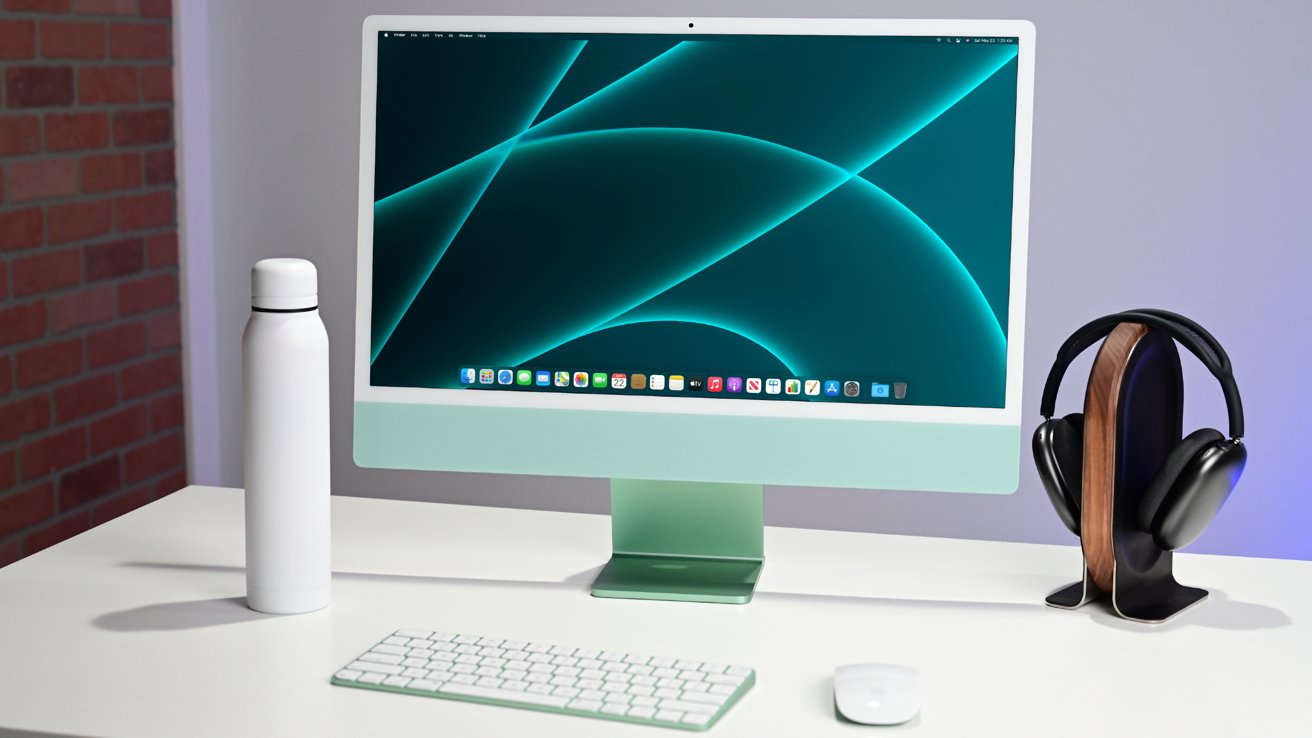
On April 9, Apple released macOS 26.4.1 to the public, alongside vague release notes that just discuss that the update contains bug fixes.
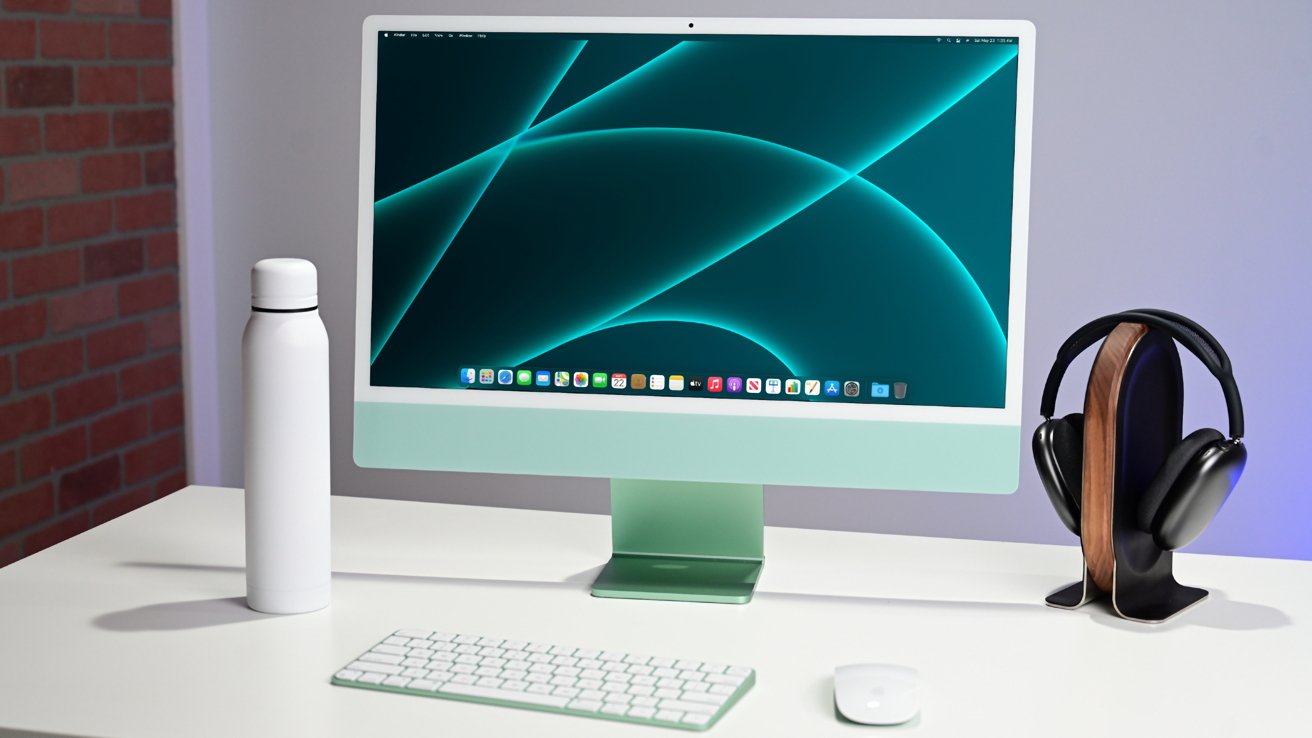
The new macOS 26.4.1 update is now available for download
While Apple hasn’t detailed exactly which bugs this new update addresses, there may be clues from other recent releases. The update comes just 24 hours after Apple also released iOS 26.4.1 and iPadOS 26.4.1.
Both updates applied a fix for one bug in particular. That bug caused some iCloud data not to sync correctly and affected both Apple and third-party apps, including Passwords.
Continue Reading on AppleInsider | Discuss on our Forums


Did Microsoft really retire Windows 10 in October 2025? The company is now offering additional options to further extend the lifespan of an operating system first released in 2015. Redmond’s updated plans include several more years of security patches for Windows 10 Enterprise LTSB 2016 through the same Extended Security…
Read Entire Article
Source link

This is a follow-up to my recent piece “AI Coach or AI Ghostwriter? The Choice Is Yours,” which argued that AI can either sharpen your thinking or replace it. That piece was about writing. This one is about the other side of the coin: reading. The practical question is: how do you use AI to become a more productive reader rather than a lazier one?
Back in 2006, my UW students and I coined the term “machine reading” to describe the autonomous understanding of text by computers (Etzioni, Banko, & Cafarella, AAAI 2006). Two decades later, large language models (LLMs) can digest, summarize, and answer questions about text with startling competence. The irony is that the biggest consumers of this capability are people, using AI to do our reading for us.
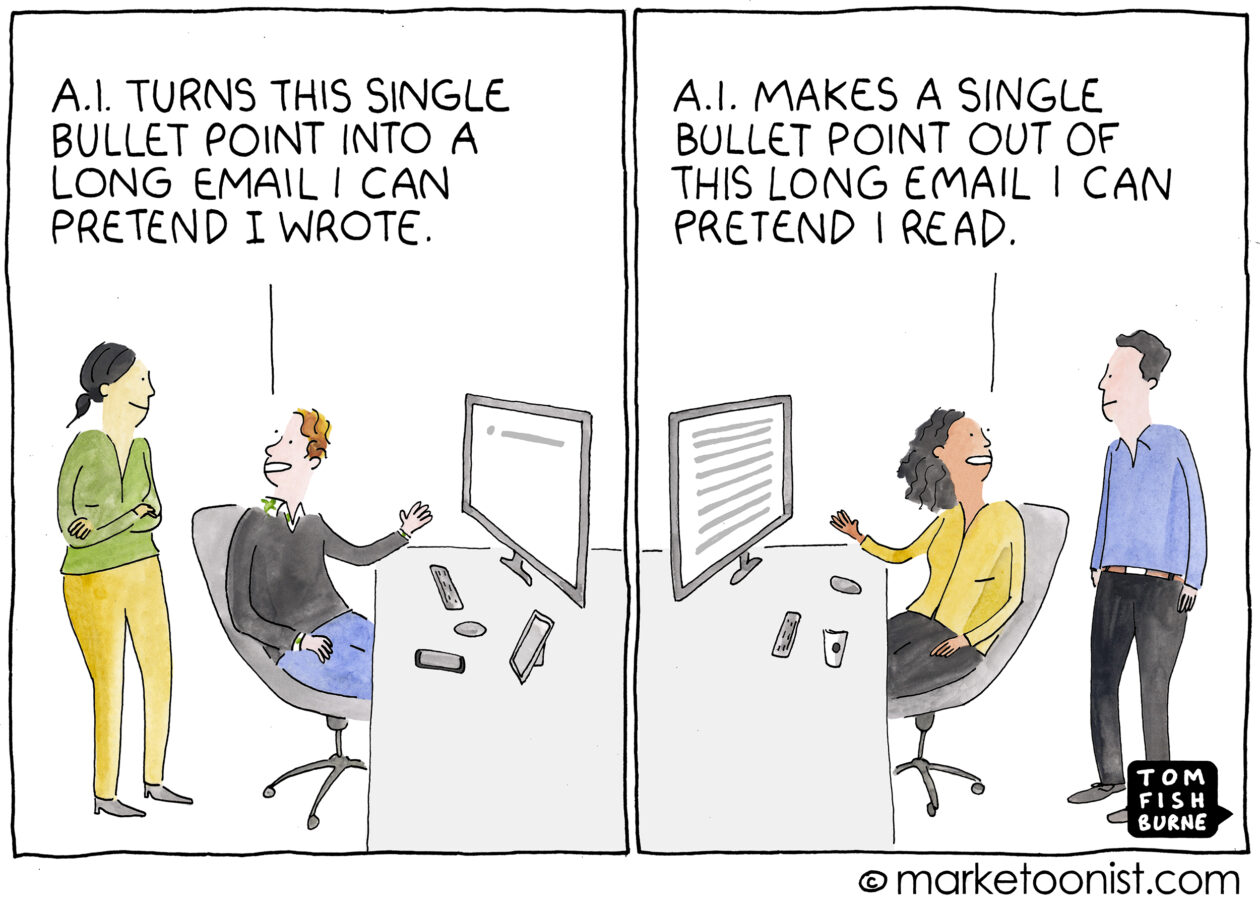
AI-assisted reading has become so pervasive that we are approaching the absurdity captured in Tom Fishburne’s famous Marketoonist cartoon: “AI Written, AI Read.” One AI writes the memo, another AI summarizes it, with minimal human involvement.
The simplest use of AI for reading is summarization, and it certainly has its merits. Drop a 50-page PDF into your favorite LLM, ask for a summary, and you’ll get one in seconds.
But that summary is merely a skeleton. It strips away the voice, the best lines, the telling details, and the nuances that can make or break your understanding. If you are reading a legal contract, the details are the whole point. If you are reading a competitor’s product announcement, the spin they put on the numbers matters more than the numbers themselves. A skeleton doesn’t have a pulse!
AI-assisted reading punishes passivity. A recent Wharton study of over 10,000 participants found that people who relied on AI-generated summaries showed shallower knowledge and offered fewer concrete facts afterward compared to those who engaged with original sources. Advice written after AI use was shorter, less factual, and more homogeneous across users. In other words, AI summaries do not just compress text. They flatten it.
Speed reading via AI can be a bit like speed dating: you cover a lot of ground, but you do not actually know anyone when you leave.
The fundamental question here is not productivity. It is about the impact of AI reading on you as the reader: What happens to your retention, your understanding, your ability to synthesize across sources? Are you winning by doing this, or are you atrophying the cognitive muscle that makes you good at your job? Outsourcing your thinking to AI is not productivity gain; it’s a competence leak.
My practical advice is: treat the summary as a triage tool, not a destination. Use it to decide whether a document deserves your time. That is genuinely valuable. The world produces more text than any human can process, and AI can help you sort the wheat from the chaff in minutes instead of hours. But once you decide that something matters, put down the summary and engage with the source.
The real power of AI reading lies not in one-shot summarization but in dialog. Think of it as an interrogation of the document, focused on what interests you. Upload the contract, the research paper, or the earnings call transcript, and then start asking questions. What are the three riskiest clauses? How does this methodology compare to the Chen et al. paper from last year? Where does the CFO’s commentary contradict the numbers in Table 4?
This is not a command you fire off and forget. It is a back-and-forth conversation between you and the AI about the text, one that surfaces specific quotes, draws connections to related materials, and drills into exactly what you need. The quality of the conversation depends entirely on the quality of your questions. AI-assisted reading rewards curiosity.
A word of caution that I can’t repeat often enough: always verify anything important yourself. AI models hallucinate. They fabricate quotes, invent statistics, and present fiction with the serene confidence of a tenured professor. The verification step is essential. If you skip it, you are not reading with AI. You are gambling with AI.
You also want to adopt different reading strategies for different tasks, just as you would without AI. Summarization is fine for getting the gist of a piece, for sorting your inbox, for deciding what to read next. It will not serve you well if you need to retain the content, defend it in a meeting, or build on it in your own work. For those tasks, you need the interrogation approach, and you need to supplement it with old-fashioned human reading of the passages the AI points you to.
Used well, AI can make you a better, faster, more thorough reader by helping you navigate more material, ask sharper questions, and spot connections you would have missed. Used badly, it turns you into a consumer of predigested pablum, the intellectual equivalent of living on protein shakes when there is a farmers’ market across the street.
The machines are happy to read for you, but they won’t understand for you. The choice, as always, is yours.
Editor’s note: GeekWire publishes guest opinions to foster informed discussion and highlight a diversity of perspectives on issues shaping the tech and startup community. If you’re interested in submitting a guest column, email us at tips@geekwire.com. Submissions are reviewed by our editorial team for relevance and editorial standards.

Lenovo packed some seriously powerful gaming specs into a sleek, 8.8-inch design with its Legion Tab Gen 3. Outfitted with a Qualcomm Snapdragon 8 Gen 3 processor and a 6,550-mAh battery, this gaming tablet provides solid gaming performance and respectable battery life.
The Legion Tab has a fairly standard slab design that won’t turn any heads, but its 2,560×1,600-pixel resolution LCD screen with a 165Hz refresh rate will make your games look great. One of the best quality of life features on this gaming tablet is the fact that it actually has two USB-C ports integrated into its chassis: A USB 2.0 port on the left side of the device supports 65-watt chargers, and a USB 3.0 port at the bottom lets you plug into an external display. It’s a real boon to have such a portable device with the capability to connect to a larger monitor when you sit down to play at home, and the feature differentiates the Legion Tab Gen 3 from its competitors.
The base configuration is priced at $550, which is a solid price point for a dedicated gaming tablet, especially if you can’t find the RedMagic Astra and don’t want to wait for the upcoming release of the Legion Tab Gen 5. The Legion Tab offers a bigger display than the iPad Mini at an even lower price, with slightly outdated but still high-performance processing capabilities to boot. The Legion Tab Gen 3 won’t be going toe-to-toe with the RedMagic Astra when it comes to performance or battery life, but it’s a close race. And while the Legion Tab Gen 3 is nowhere near as small as the iPad Mini, it’s certainly more portable than the 9.1-inch RedMagic Astra.
If you’re looking for a dedicated gaming tablet, the Lenovo Legion Tab Gen 3 might be the most accessible option right now. But if you can hold on a little longer, the Legion Tab Gen 5 will be a technological leap forward for Lenovo’s gaming tablet.
Why we like it: The Legion Tab Gen 3 is a great “middle of the road” gaming tablet. It’s older than other gaming tablets we’ve reviewed, but the processing power and performance still hold up for some of the best games to take on the go.
Who it’s best for: If you’re a hardcore gamer, there are a couple of reasons you might skip out on the RedMagic Astra. Maybe it’s currently unavailable in your market. Maybe you’re turned off by the RedMagic’s lack of commitment to OS security updates. Either way, the Legion Tab Gen 3 is the next best thing in the dedicated gaming tablet space, with outdated hardware that’s still respectably powerful. It’s also an extremely portable device, to boot.
Who shouldn’t buy it: If you’re looking for the best-performing gaming tablet on the market, you could stand to do better than the Legion Tab Gen 3. This is a high-performance budget option, but it’s outclassed by other gaming tablets that we’ve reviewed.
Form 13G Liberty Global Ltd. For: 9 April

Crypto regulation: Coinbase rejects CLARITY Act

‘Malcolm In the Middle’ Revival Series Scores Solid Reviews


-

 Fashion6 days ago
Weekend Open Thread: Spanx – Corporette.com
-

 Business4 days ago
Three Gulf funds agree to back Paramount’s $81 billion takeover of Warner, WSJ reports
-

 Sports5 days ago
India men’s 4x400m and mixed 4x100m relay teams register big progress | Other Sports News
-

 Business6 days ago
Expert Picks for Every Need
-

 Tech2 days ago
How Long Can You Drive With Expired Registration? What Florida Law Says
-

 Business5 days ago
No Jackpot Winner, Prize to Climb to $231 Million
-

 Fashion4 days ago
Massimo Dutti Offers Inspiration for Your Summer Mood Board
-
Politics7 days ago
Wings Over Scotland | The quality of mercy
-

 Fashion2 days ago
Let’s Discuss: DEI in 2026
-

 Business5 days ago
Akebia Therapeutics, Inc. (AKBA) Discusses Pipeline Progress and Strategic Focus on Kidney Disease Treatments at R&D Day – Slideshow
-

 Crypto World1 day ago
Bitcoin recovers as US and Iran Agree a Ceasefire Deal
-

 Politics7 days ago
East Jerusalem Palestinian families eviction orders
-

 Politics7 days ago
Why so many children are now classified as ‘disabled’
-

 Crypto World12 hours ago
Canary Capital Files SEC Registration for PEPE ETF
-

 Politics6 days ago
The UK should not pay a penny in slavery reparations
-

 Politics7 days ago
Nuclear rockets, moon bases and NASA’s Mars plan
-
 Tech7 days ago
The Threadless Ball Screw Never Took Off, But Don’t Write It Off
-
 Business7 days ago
HPS FY 2025 slides: SaaS inflection drives 22% revenue growth
-

 Fashion7 days ago
Tory Burch’s Spring 2026 Campaign Goes on a Getaway
-

 Fashion6 days ago
Frugal Friday’s Workwear Report: Hammered Metallic Button Sweater Vest
You must be logged in to post a comment Login