
Tech
Not the sci-fi voice translator of your dreams

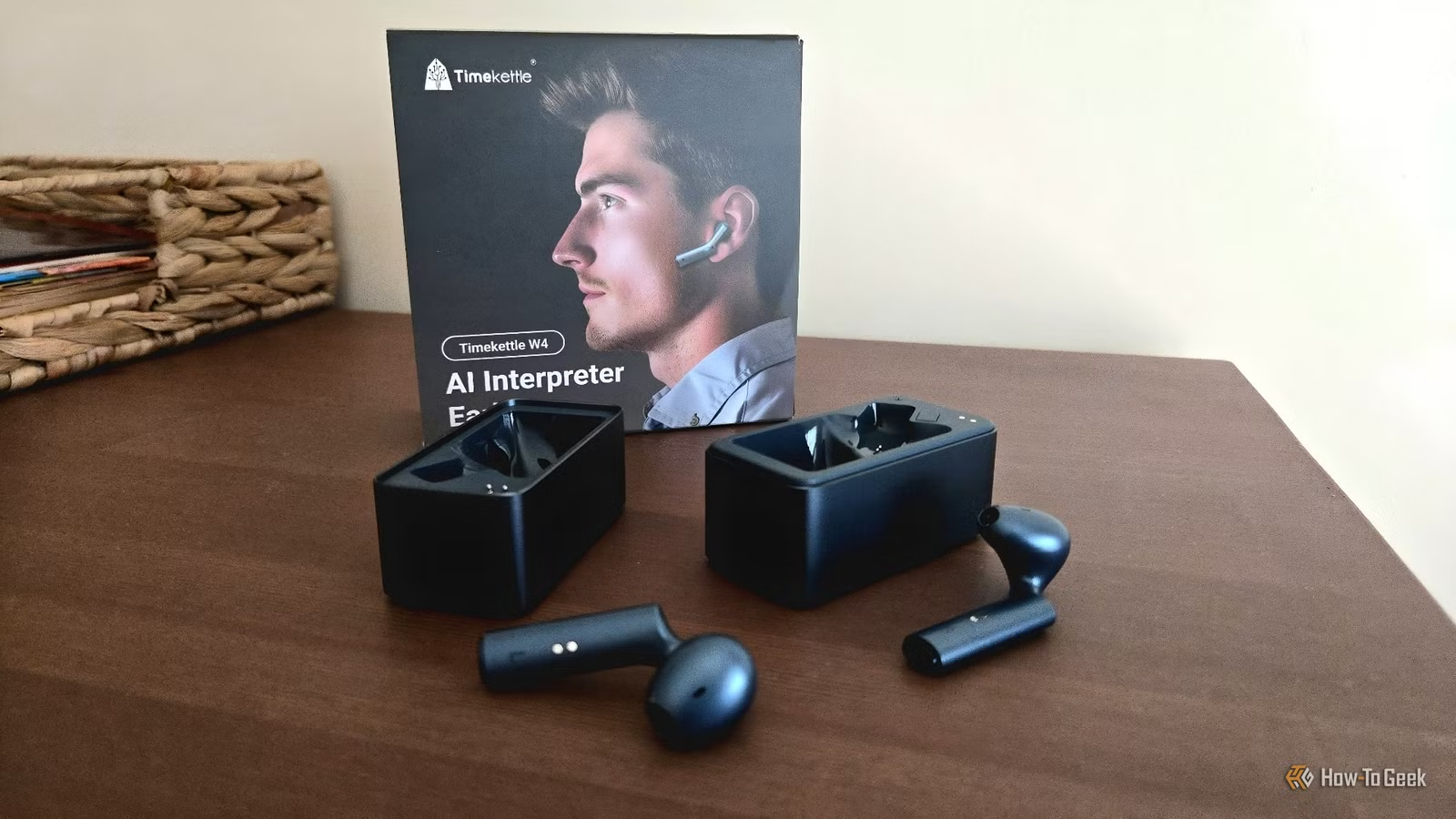
The Timekettle W4 semi-in-ear bone conduction earbuds are designed to translate face-to-face conversations in over 40 languages—and it can definitely help with that, but don’t expect magic.


5/10
- Battery Life
-
4h translation/6h music (without case) / 10h translation/18h music (with case)
- Brand
-
Timekettle
- Bluetooth
-
Yes
- Colors
-
Midnight blue, Sandy gold
The Timekettle W4 is a pair of semi-in-ear bone conduction earbuds designed to translate face-to-face conversations in over 40 languages. The buds come with 100db noise cancellation for use in noisy environments like trade shows, and the app can supply an AI- generated summary of conversions.
- Doubles as a pair of Bluetooth earbuds
- Battery life is adequate
- Better than fumbling through a dictionary
- Functions as a voice recorder
- Don’t expect an accurate translation of the conversation
- Earbuds may fall out quite easily
- Case is on the bulky end

How We Test and Review Products at How-To Geek
We go hands-on with every product to ensure it’s worth your time and money.
Price and availability
The Timekettle W4 serves as Timekettle’s entry-level pair of translation earbuds and is priced at $350—$100 less than the Timekettle W4 Pro. These earbuds come in two colors: Midnight Blue and Sandy Gold. You can purchase them directly from Timekettle or get them on Amazon.
- Battery Life
-
4h translation/6h music (without case) / 10h translation/18h music (with case)
- Brand
-
Timekettle
- Bluetooth
-
Yes
- Colors
-
Midnight blue, Sandy gold
- Charging Port
-
USB-C
- Compatibility
-
Android, iOS
An enticing but impractical design
Most earbuds come in a predictable package. Whether I hand you buds from JLab, JBL, or Samsung, the case opens in the same way. The Timekettle W4 looks like regular buds, but the case is anything but conventional. It’s square instead of round, and rather than pop open a lid, you pull two halves of the case apart. These halves stick to each other via magnets, and inside each one you can find an earbud.
The earbuds are bone conduction and sport a semi-in-ear design. This means you pop them in like any other buds, but they lack ear tips. A stem extends down each bud that is longer than most in order to bring the microphones as close as possible to your mouth. A major downside of this design is that the reduced grip combined with a lengthy stem means these buds can fall out of your ear rather easily. They definitely slip out of mine, requiring me to adjust them every few minutes.

Timekettle is aware of this, so the box comes with ear hooks that can provide each earbud with extra support, making it look like you’re wearing an old-school Bluetooth headset.
Since the earbuds are longer than most, the case is also larger than you might expect. It fits okay when it is in my pocket alone, but it’s a bit too bulky for me to comfortably keep in the same pocket as my wallet or phone. My pockets are rather fitted, however, so those with loose pants may have a better experience. I would rather keep the W4 in a bag, but I don’t always have one, which reduces the likelihood that I would use these as my everyday buds that also happen to be on hand when I might have a conversation with someone in another language. My wife’s side of the family emigrated from India, so that isn’t a farfetched scenario for me.
A rather well-designed app
When you set up the Timekettle app for the first time, it asks what use cases you intend to use the device under. Examples include international business, study abroad, and international friends. I selected multilingual family. You also select which language the app should listen for and which language you want to hear it translated into. In my case, I want Telugu translated into English.
You have a few options that determine the quality of the translation you’re able to get. The use of a large language model is optional, for example. You can also download some languages for offline use, which can reduce the processing power available to the device, increasing how long translations may take. This is still better than nothing when traveling in areas that don’t have signal or where you have neither a travel plan nor Wi-Fi.
There are two methods of holding conversations available to you. You can have someone else speak into the phone while you listen to the translation in your earbuds, or you can offer one earbud to the other person so that you’re both able to hear a translation of the other.
Is your language supported?
Translation software of any kind is only useful if it covers the languages you need. The situation has gradually changed since my wife and I met nearly two decades ago, back when Hindi was the only Indian language I could take for granted. My wife doesn’t speak Hindi. Their family speaks Telugu, which is the second most common language spoken in India. The language I encounter second most often among the Indians and Indian Americans living in my area? Tamil. Hindi doesn’t actually come up all that much in my life unless we’re watching a Bollywood movie.
I’m pleased to say that all three of these languages are among the 43 languages and 96 accents that Timekettle advertises support for.
A conversation dictated by AI
When my wife and I sat down to have a conversation in Telugu, for a moment it felt like magic. My wife spoke out into the air, with my phone picking up her voice and the English translation going into my ear via the earbud. I was actually able to follow along with the conversation!
That magic feeling quickly started to wear off within that first conversation. The W4’s accuracy is enough to have an idea what the other person is talking about, but it’s not accurate enough to fill me with confidence that I know exactly what they are saying.
There were words that were misheard and then mistranslated. Then there were phrases that were simply awkwardly phrased. Sometimes it was easy to pick up what the mistake was. Other times, the translation just seems to go completely off the rails. My wife also giggled as soon as the conversation began, saying the Telugu being spoken back to her sounded overly formal, like talking to the automated voice at the airport.
Then we tried to have a conversion by placing one earbud in my ear and one in hers. I spoke very, very basic Japanese in my earbud, and my wife spoke English into hers. I’m not fluent enough to understand the Japanese spoken back to me, but I could read the English translation of both my speech and what was being spoken back to me. My words seemed to be translated correctly, but whether this was the result of the W4 doing a better job with Japanese than Telugu, or the fact that I was speaking the most basic of phrases, I cannot say.
Fortunately, whether the AI translations are accurate or not, the product also functions as a voice recorder. You can play back the original conversation later for someone or something else to take another crack at translation. Here is a brief sample of our first conversation, with me asking her about a dance performance the day before.
One difference between the W4 and the W4 Pro is that the latter is designed to translate multimedia, such as TV shows and podcasts. I can’t speak to the W4 Pro, but I can confirm that the W4 is not up to the task. I put on the buds while watching Dan Da Dan on Netflix, and the provided translation was too dissimilar to the subtitles to be a mere case of slightly different interpretation. The delay was also way too slow to keep up with the fast pace of a TV. One-to-one conversations allow for speakers to pause and wait, as they both know there’s a device serving as the intermediary.
Should you buy the Timekettle W4?

As a product that costs over $300, the Timekettle W4 is more affordable for a traveling business executive than a student studying abroad, but I feel it’d probably be as useful (if not more) for the latter. The reliability isn’t enough for you to have a heart-to-heart with another person across languages, but you can probably get by asking strangers where the bathroom is or telling a server what you want at a restaurant. I’d still want another person on hand though if I’m closing a large business contract.
In the end, I’d say having the W4 is better than nothing. The product functions as an okay pair of earbuds, so that’s one less thing to pack. The battery life is fine enough, and the app is quite intuitive. Just don’t expect the product to make you feel like you’re fluent—you won’t. If you’re purchasing this thinking you can finally buy a voice translator you’ve seen in science fiction, just know you’re purchasing the janky model that’s there for comic relief.
5/10
- Battery Life
-
4h translation/6h music (without case) / 10h translation/18h music (with case)
- Brand
-
Timekettle
- Bluetooth
-
Yes
- Colors
-
Midnight blue, Sandy gold
The Timekettle W4 is a pair of semi-in-ear bone conduction earbuds designed to translate face-to-face conversations in over 40 languages. The buds come with 100db noise cancellation for use in noisy environments like trade shows, and the app can supply an AI- generated summary of conversions.



