Ask anyone what Nvidia makes, and they’re likely to first say “GPUs.” For decades, the chipmaker has been defined by advanced parallel computing, and the emergence of generative AI and the resulting surge in demand for GPUs has been a boon for the company.
But Nvidia’s recent moves signal that it’s looking to lock in more customers at the less compute-intensive end of the AI market—customers who don’t necessarily need the beefiest, most powerful GPUs to train AI models, but instead are looking for the most efficient ways to run agentic AI software. Nvidia recently spent billions to license technology from a chip startup focused on low-latency AI computing, and it also started selling stand-alone CPUs as part of its latest superchip system.
Yesterday, Nvidia and Meta announced that the social media giant had agreed to buy billions of dollars’ worth of Nvidia chips to provide computing power for its massive infrastructure projects—with Nvidia’s CPUs as part of the deal.
The multiyear deal is an expansion of a cozy ongoing partnership between the two companies. Meta previously estimated that by the end of 2024, it would have purchased 350,000 H100 chips from Nvidia, and that by the end of 2025 the company would have access to 1.3 million GPUs in total (though it wasn’t clear whether those would all be Nvidia chips).
Advertisement
As part of the latest announcement, Nvidia said that Meta would “build hyperscale data centers optimized for both training and inference in support of the company’s long-term AI infrastructure roadmap.” This includes a “large-scale deployment” of Nvidia’s CPUs and “millions of Nvidia Blackwell and Rubin GPUs.”
Notably, Meta is the first tech giant to announce it was making a large-scale purchase of Nvidia’s Grace CPU as a stand-alone chip, something Nvidia said would be an option when it revealed the full specs of its new Vera Rubin superchip in January. Nvidia has also been emphasizing that it offers technology that connects various chips, as part of its “soup-to-nuts approach” to compute power, as one analyst puts it.
Ben Bajarin, CEO and principal analyst at the tech market research firm Creative Strategies, says the move signaled that Nvidia recognizes that a growing range of AI software now needs to run on CPUs, much in the same way that conventional cloud applications do. “The reason why the industry is so bullish on CPUs within data centers right now is agentic AI, which puts new demands on general-purpose CPU architectures,” he says.
A recent report from the chip newsletter Semianalysis underscored this point. Analysts noted that CPU usage is accelerating to support AI training and inference, citing one of Microsoft’s data centers for OpenAI as an example, where “tens of thousands of CPUs are now needed to process and manage the petabytes of data generated by the GPUs, a use case that wouldn’t have otherwise been required without AI.”
Advertisement
Bajarin notes, though, that CPUs are still just one component of the most advanced AI hardware systems. The number of GPUs Meta is purchasing from Nvidia still outnumbers the CPUs.
“If you’re one of the hyperscalers, you’re not going to be running all of your inference computing on CPUs,” Bajarin says. “You just need whatever software you’re running to be fast enough on the CPU to interact with the GPU architecture that’s actually the driving force of that computing. Otherwise, the CPU becomes a bottleneck.”
Meta declined to comment on its expanded deal with Nvidia. During a recent earnings call, the social media giant said that it planned to dramatically increase its spending on AI infrastructure this year to between $115 billion and $135 billion, up from $72.2 billion last year.
IBM and Arm are teaming up to let Arm-based software run on IBM Z mainframes. Network World reports: The two companies plan to work on three things: building virtualization tools so Arm software can run on IBM platforms; making sure Arm applications meet the security and data residency rules that regulated industries must follow; and creating common technology layers so enterprises have more software options across both platforms, IBM said in a statement.
IBM has not said whether the virtualization work will happen at the hypervisor level, through its existing PR/SM partitioning technology, or via containers — a question enterprise architects will need answered before they can assess the collaboration’s practical value. IBM described the effort as serving enterprises that run regulated workloads and cannot simply move them to the cloud, the statement said. IBM mainframe customers have largely missed out on the efficiency and price-performance gains Arm has already delivered in the cloud. “Arm says close to half of all compute shipped to top hyperscalers in 2025 runs on Arm chips, with AWS, Google, and Microsoft deploying their own Arm silicon through Graviton, Axion, and Cobalt, respectively,” reports Network World.
That gap is precisely what IBM and Arm’s collaboration intends to address. “This is a mainframe adjacency play,” says Rachita Rao, senior analyst at Everest Group. “The intent is to extend IBM Z and LinuxONE environments by enabling Arm-compatible workloads to run closer to systems of record. While hyperscalers use Arm to lower their own internal power costs and pass savings to cloud-native tenants, IBM is targeting the sovereign and air-gapped market.”
HP EliteBook 6 G2q delivers up to 85 TOPS for local AI tasks
Always-connected 5G experiences require specific hardware and preinstalled eSIM modules
Service works only on compatible commercial PCs running Windows 11
HP has unveiled the EliteBook 6 G2q, an ultraslim AI PC that relies on Snapdragon X2 Elite or X2 Plus processors to deliver up to 85 TOPS of NPU performance for local AI tasks.
This lightweight laptop, up to 15% thinner than its predecessor, claims to offer always-connected experiences through HP Go 5G service.
This service is advertised as offering unlimited 5G data by automatically switching between carriers for optimal coverage.
Article continues below
Advertisement
Connectivity through HP Go 5G
However, reading through the fine print, some major restrictions and throttles undermine the promise of truly unlimited, seamless 5G broadband.
One key limitation is that HP Go 5G requires specific hardware, including an embedded WWAN 5G module and a preinstalled eSIM.
Advertisement
Unfortunately, it only works on compatible commercial PCs running Windows 11 and is activated through zero-touch deployment via HP’s management console.
Another restriction is that access is limited to the United States, which prevents users from relying on the device for continuous connectivity while traveling internationally.
Sign up to the TechRadar Pro newsletter to get all the top news, opinion, features and guidance your business needs to succeed!
For this reason, international users must return to the United States at least once every 90 days to maintain roaming eligibility.
Advertisement
The service itself is structured around tiered plans, with Lite offering domestic unlimited data, Premier adding 1GB for international use monthly, and Premier Plus promising unlimited global access.
All of these plans are prepaid and non-refundable, requiring 3-, 6-, or 12-month commitments purchased directly through HP sales representatives, which reduces flexibility for many users.
A further limitation appears in the data speeds, which throttle progressively after 5GB per month, eventually slowing to 100Kbps after 100GB.
Advertisement
Tethering and hotspot usage are also explicitly prohibited under all plans, restricting users from sharing the connection with additional devices or coworkers.
Taken together, these conditions reveal that the so-called WiFi-killing broadband carries notable constraints that can complicate practical usage.
HP embeds Wolf Pro Security Next Gen Antivirus directly into the EliteBook 6 G2q to protect against modern threats.
The device also includes HP TPM Guard, which defends BitLocker-encrypted data from physical attacks and unauthorized access.
Advertisement
Additional protections come from the Wolf Connect cellular card, improving asset tracking and data management across multiple endpoints.
These security measures extend across HP’s commercial portfolio, offering consistent defense for AI workloads deployed at the edge.
The HP EliteBook 6 G2q will be available starting in July 2026 on HP.com, with pricing announced closer to launch.
An anonymous reader quotes a report from Bloomberg: Amazon will start charging sellers who use its shipping services a 3.5% “fuel and logistics” surcharge later this month, joining the ranks of shipping companies raising prices as the war in Iran pushes oil prices higher. The fees take effect on April 17 for customers of the company’s Fulfillment by Amazon service — which is used by many of the independent sellers who list their products on Amazon’s retail sites — in the US and Canada. Items shipped by Amazon on behalf of merchants who sell on their own sites or at other retailers will carry the surcharge beginning May 2. “Elevated costs in fuel and logistics have increased the cost of operating across the industry,” Ashley Vanicek, an Amazon spokesperson, said on Thursday. “We have absorbed these increases so far, but similar to other major carriers, when costs remain elevated we implement temporary surcharges to partially recover these costs.”
Vanicek notes that the fee will apply to the sum Amazon charges to ship an item, not the product’s sale price.
Soma Energy’s co-founders, from left: CEO Ath Caramanolis, Chief Technology Officer Mario Souto and Chief AI Scientist Henrique Hoeltgebaum. (Soma Energy Photos)
Soma Energy, a startup founded by former Amazon energy managers, emerged from stealth Thursday with $7 million in funding.
The Vancouver, B.C.-based company has built an AI platform serving power producers and data centers, helping both optimize their energy assets in real time to save money and extend their available power. The technology coordinates resources including wind, solar and batteries and the management of energy demands such as data center workloads.
CEO Ath Caramanolis said you can visualize an electrical system as a complex network of roads and highways on which electrons — instead of cars and trucks — are traveling.
“Our software is sort of a control plane that helps provide the self-driving for electrons on these highway systems,” Caramanolis said in a GeekWire interview.
More efficient routing of electron traffic can bring more power to bear for the grid’s competing needs.
Advertisement
“There is low hanging fruit everywhere, and the opportunities for large energy users like data centers to better utilize the grid exist all across North America,” Caramanolis said.
Industries, utilities and elected officials worldwide are racing to expand energy supply as data centers and electrification of transportation, heating and other sectors drive surging demand. Data centers alone are expected to more than double their power draw — from 82 gigawatts in 2025 to 219 by 2029 — with most of that growth fueled by AI, according to McKinsey.
Amazon hired Caramanolis in 2018 to create the energy optimization team at AWS, which managed about 10 gigawatts of renewable energy across its global network of data centers. Seattle City Light, by comparison, has a generation capacity of about 2 gigawatts.
Caramanolis then recruited Mario Souto, Soma Energy’s co-founder and chief technology officer, to build the machine learning platform AWS used to optimize its renewable portfolio. The startup’s third co-founder, Chief AI Scientist Henrique Hoeltgebaum, is an expert in AI-driven forecasting and anomaly detection for energy systems.
Advertisement
Soma Energy launched in February 2024 and has 18 employees. The startup has deployed 2 gigawatts of assets in the U.S. with customers including several independent power producers and five data center companies — among them H5 Data Centers, whose sites include a large facility in downtown Seattle.
“By coordinating existing resources, we were able to access capacity significantly sooner than expected, accelerating our time to power and removing a critical constraint on expansion,” said Josh Simms, CEO of H5 Data Centers, in a statement.
The seed round was led by Category Ventures, with participation from Haystack, Panache Ventures, RRE Ventures, TO.VC, Uncork Capital and Walter Kortschak. The investment will allow the team to hire new employees in engineering and commercial roles and expand its reach across North America.
“Having managed hyperscale power systems firsthand, the founders built Soma Energy as if they were the customer themselves,” said Villi Iltchev, partner at Category Ventures.
Supercapacitors turn charging time from hours into mere seconds
Fast charging exposes the real limits of lithium-ion battery chemistry
Supercapacitor technology lacks sufficient energy capacity for practical electric vehicles
Dell has introduced a keyboard and mouse combo that charges in five seconds and delivers a full day of use.
The new Dell Pro 7 Rechargeable Compact Keyboard and Mouse relies on supercapacitor technology rather than traditional lithium-ion batteries.
This system delivers unprecedented charging speeds, with a full recharge in under 5 minutes, powering the keyboard for up to 3 months and the mouse for 1.5 months.
Article continues below
Advertisement
How supercapacitors change the charging equation
Supercapacitors differ fundamentally from conventional batteries in how they store and release energy.
Unlike lithium-ion cells that rely on chemical reactions to store power, a process that inherently limits charging speed, supercapacitors store energy electrostatically.
Advertisement
By combining high-speed charging with moderate energy storage, Dell enables a system where devices are ready to use almost immediately.
Dell’s implementation of this technology in the Pro 7 peripherals eliminates the need to leave devices plugged in overnight or carry spare batteries for critical moments.
Sign up to the TechRadar Pro newsletter to get all the top news, opinion, features and guidance your business needs to succeed!
The company also claims the mouse is the world’s lightest rechargeable pointing device that does not use a lithium-ion battery.
Advertisement
The compact design makes the devices ideal for mobile professionals, consultants, or anyone moving between hot desks, conference rooms, or home offices.
The keyboard offers quiet keys for minimal disruption, while the mouse delivers precise tracking without requiring heavy batteries.
This technology could reshape the electric vehicle (EV) industry within the next few years.
Advertisement
EVs rely almost entirely on lithium-ion battery packs that store energy through chemical reactions, and in a typical EV, full charging takes about 30 minutes on fast chargers or several hours using home setups.
That process typically delivers a driving range between 300 and 500 km, depending on the vehicle, but the limitation involves not only charger speed but also the underlying battery chemistry that governs energy storage.
Pushing energy too quickly into lithium-ion cells generates heat, accelerates degradation, and reduces long-term performance reliability.
In theory, an EV powered by supercapacitors could recharge in a few minutes rather than hours under current systems.
Advertisement
Such systems can also handle rapid bursts of energy more efficiently, improving acceleration and regenerative braking performance.
However, there is a trade-off because supercapacitors currently store far less energy than lithium-ion batteries.
This limitation means vehicles would experience reduced driving range if supercapacitors were used on their own.
Supercapacitors also tend to discharge stored energy more quickly over time, especially when the vehicle remains idle.
Advertisement
A more practical solution involves combining lithium-ion batteries with supercapacitors in a hybrid energy storage system.
This approach could improve charging speed, extend battery lifespan, and enhance performance without sacrificing overall driving range.
The same principle seen in Dell’s accessories suggests future EV systems may better balance charging speed and endurance.
If you’re an American and you use the Internet at home, it seems probable that routers are going to be in short supply. The US government recently mandated all such devices be home grown for security reasons, which would be fine were it not that the US has next-to-no consumer-grade router manufacturing industry.
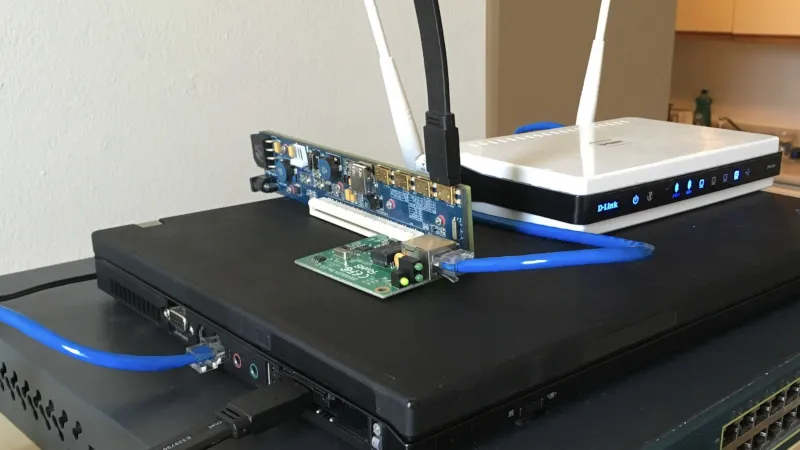
The piece is really a guide to setting up a Linux router, which he does on a small form factor PC and a hacked-together assembly of old laptop, PCI-express extender, and scrap network kit. In its most basic form a router doesn’t need the latest and greatest hardware, so there exists we’re guessing almost two decades of old PCs just waiting to be pressed into service. Perhaps it won’t help the non-technical Man In The Street much, but maybe it’ll inspire a few people to save themselves a hefty bill when they need to connect.
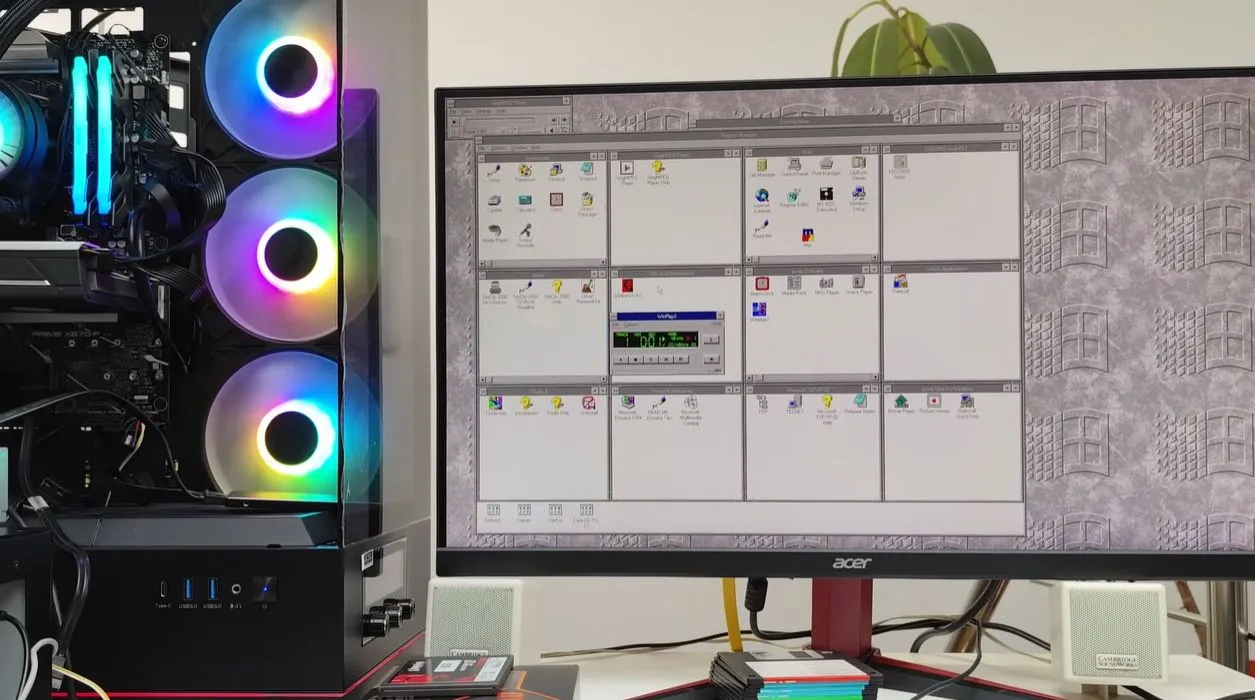
Although Windows 95 stole the show, Windows 3.0 was arguably the first version of Windows that more or less nailed the basic Windows UI concept, with the major 3.1 update being quite recognizable to a modern-day audience. Even better is that you can still install Win3.1 on a modern x86-compatible PC and get some massive improvements along the way, as [Omores] demonstrates in a recent video.
The only real gotcha here is that the AMD AM5 system with Asus Prime X670-P mainboard is one of those boards whose UEFI BIOS still has the ‘classic BIOS’ Compatibility Support Module (CSM) option. With that enabled, Win 3.1 installs without further fuss via a USB floppy drive from a stack of ‘backup’ floppies that someone made in the early 90s. [Omores] also tried it with CSMWrap, but with this USB to PS/2 emulation didn’t work.
Windows 3.1 supports ‘enhanced mode’ by default, which adds virtual memory and multi-tasking if you have an 80386 CPU or better. To fix crashing on boot and having to use ‘standard mode’ instead, the ahcifix.386 fix for the responsible SATA issue by [PluMGMK] should help, or a separate SATA expansion card.
Advertisement
For the video driver the vbesvga.drv by [PluMGMK] was used, to support all VESA BIOS Extensions modes. This driver has improved massively since we last covered it and works great with an RTX 5060 Ti GPU. There’s now even DCI support to enable direct GPU VRAM access for e.g. video playback, with audio also working great with only a few driver-related gotchas.
Back in October, Meta announced that its new Instagram Teen Accounts would feature content moderation “guided by the PG-13 rating.” On its face, this made a certain kind of sense as a communication strategy: parents know what PG-13 means (or at least think they do), and Meta was clearly trying to borrow that cultural familiarity to signal that it was taking teen safety seriously.
The Motion Picture Association, however, was not amused. Within hours of the announcement, MPA Chairman Charles Rivkin fired off a statement. Then came a cease-and-desist letter. Then a Washington Post op-ed whining about the threat to its precious brand. The MPA was very protective of its trademark, and very unhappy that Meta was freeloading off the supposed credibility of its widely mocked rating system.
And now, this week, the two sides have announced a formal resolution in which Meta has agreed to “substantially reduce” its references to PG-13 and include a rather remarkable disclaimer:
“There are lots of differences between social media and movies. We didn’t work with the MPA when updating our content settings, and they’re not rating any content on Instagram, and they’re not endorsing or approving our content settings in any way. Rather, we drew inspiration from the MPA’s public guidelines, which are already familiar to parents. Our content moderation systems are not the same as a movie ratings board, so the experience may not be exactly the same.”
In Meta’s official response, you can practically hear the PR team gritting their teeth:
Advertisement
“We’re pleased to have reached an agreement with the MPA. By taking inspiration from a framework families know, our goal was to help parents better understand our teen content policies. We rigorously reviewed those policies against 13+ movie ratings criteria and parent feedback, updated them, and applied them to Teen Accounts by default. While that’s not changing, we’ve taken the MPA’s feedback on how we talk about that work. We’ll keep working to support parents and provide age-appropriate experiences for teens,” said a Meta spokesperson.
Translation: we’re still doing the same thing, we’re just no longer allowed to call it what we were calling it.
There are several layers of nonsense worth unpacking here. First, there’s the MPA getting all high and mighty about its rating system. Let’s remember how the MPA’s film rating system came into existence in the first place: it was a voluntary self-regulation scheme created in the late 1960s specifically to head off government regulation after the government started making noises about the harm Hollywood was doing to children with the content it platformed. Sound familiar? The studios decided that if they rated their own content, maybe Congress would leave them alone. As the MPA explains in their own boilerplate:
For nearly 60 years, the MPA’s Classification and Rating Administration’s (CARA) voluntary film rating system has helped American parents make informed decisions about what movies their children can watch… CARA does not rate user-generated content. CARA-rated films are professionally produced and reviewed under a human-centered system, while user-generated posts on platforms like Instagram are not subject to the same rating process.
Sure, there’s a trademark issue here, but let’s be real: no one thought Instagram was letting a panel of Hollywood parents rate the latest influencer videos.
Next, the PG-13 analogy never actually made much sense for social media. As we discussed on Ctrl-Alt-Speech back when this whole thing started, the context and scale are just completely different. At the time, I pointed out that a system designed to rate a 90-minute professionally produced film — reviewed in its entirety by a panel of parents — is a wholly different beast than moderating hundreds of millions of short-form posts generated by individuals (and AI) every single day.
Advertisement
So, yes, calling the system “PG-13” was a marketing gimmick, meant to trade on a familiar brand while obscuring how differently social media actually works — but the idea that this somehow dilutes the MPA’s marks is still pretty silly.
Then there’s the rating system’s well-documented arbitrariness. The MPA’s ratings have been criticized for decades for their seemingly incoherent standards. On that same podcast, I noted that the rating system is famous for its selective prudishness — nudity gets you an R rating, but two hours of violence can skate by with a PG-13.
There was a whole documentary about this — This Film Is Not Yet Rated — that exposed just how subjective and inconsistent the whole process was. Meta was effectively borrowing credibility from a system that was itself created as a regulatory dodge, is famously inconsistent, and was designed for an entirely different medium. And the MPA’s response was essentially: “Hey, that’s our famously inconsistent regulatory dodge, and you can’t have it.”
The whole thing was silly. And now it’s been formally resolved with Meta agreeing to stop doing the thing it had already mostly stopped doing back in December. So even the resolution is anticlimactic.
Advertisement
But there’s a more substantive point buried under all this trademark squabbling: the whole approach reflects a flawed assumption that one company can set a universal standard for every teen on the planet.
As I argued on the podcast, the deeper issue is that the whole framework is wrong for the medium. The MPA’s rating system was built to evaluate a single 90-minute film, reviewed in its entirety by a panel of parents. Applying that logic to hundreds of millions of short-form posts generated by people across wildly different cultural contexts — a kid in rural Kansas, a teenager in Berlin, a twelve-year-old in Lagos — was never going to produce anything coherent. Different kids, different families, different communities have different standards, and no single company should be setting a universal threshold for all of them. The smarter approach is giving parents and users real controls with customizable defaults, rather than having Zuckerberg (or a Hollywood trade association) decide what counts as age-appropriate for every teenager on the planet.
This whole dispute was silly from start to finish.
The Drift Protocol lost at least $280 million after a threat actor took control of its Security Council administrative powers in a planned, sophisticated operation.
The attacker leveraged durable nonce accounts and pre-signed transactions to delay execution and strike with accuracy at a chosen time, the platform explained.
Drift underlines that the hacker did not exploit any flaws in its programs or smart contracts, and no seed phrases have been compromised.
Drift Protocol is a DeFi trading platform built on the Solana blockchain that serves as a non-custodial exchange, giving users full control of their funds as they interact with on-chain markets.
Advertisement
As of late 2024, the platform claimed to have 200,000 traders, supporting total trading volumes of more than $55 billion and a daily peak of $13 million.
According to Drift’s report, the heist was prepared between March 23 and 30, with the attacker setting up durable nonce accounts and obtaining 2/5 multisig approvals from Security Council members to meet the required threshold.
This enabled them to pre-sign malicious transactions that weren’t executed immediately.
On April 1st, the attacker performed a legitimate transaction and immediately executed the pre-signed malicious transactions, transferring admin control to themselves within minutes.
Advertisement
Having gained admin control, they introduced a malicious asset, removed withdrawal limits, and eventually drained funds.
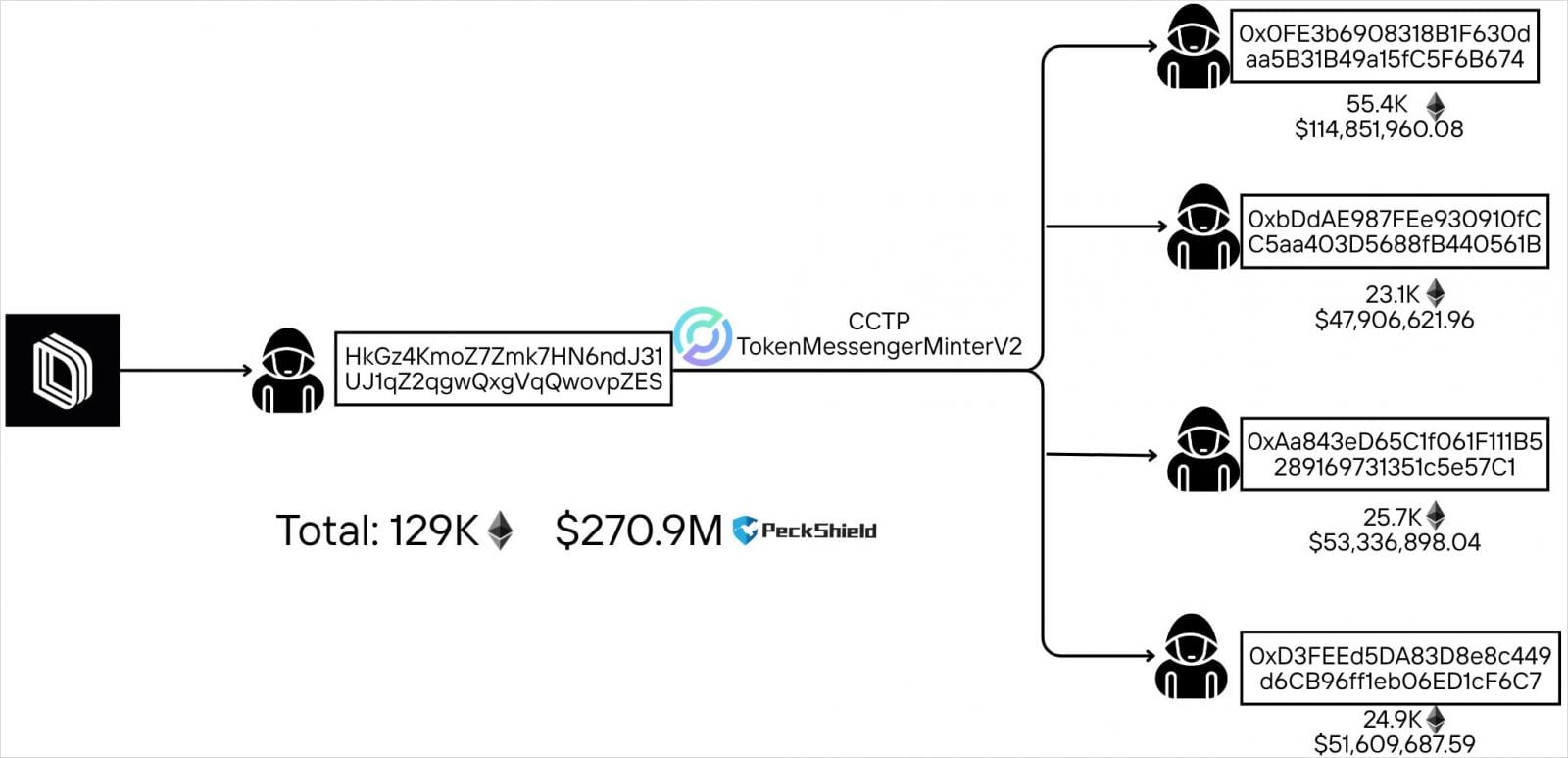
Source: PeckShield
Drift Protocol estimates the losses at about $280 million, while blockchain tracking account PeckShieldAlert has calculated them at $285 million.
When unusual activity on the protocol was detected, Drift issued a public warning to users, stating that started an investigation and urging them not to deposit any funds until further notice.
As a result of the attack, borrow/lend deposits, vault deposits, and trading funds have been affected, and all protocol functions are now essentially frozen. Drift said DSOL is unaffected, and insurance fund assets are secured.
The platform is now working with security firms, cryptocurrency exchanges, and law enforcement authorities to trace and freeze the stolen funds.
Advertisement
Drift promised to publish a detailed post-mortem report in the coming days.
Automated pentesting proves the path exists. BAS proves whether your controls stop it. Most teams run one without the other.
This whitepaper maps six validation surfaces, shows where coverage ends, and provides practitioners with three diagnostic questions for any tool evaluation.
Fortis Solutions, an enterprise technology partner with decades of experience across infrastructure, cybersecurity, and data systems, approaches artificial intelligence as a force that is redefining how work is performed while preserving the importance of human contribution. Its perspective reflects a future where human judgment and machine precision operate in tandem, introducing new ways to elevate performance, strengthen decision-making, and expand what teams can accomplish together.
This perspective emerges within a rapidly evolving landscape where AI continues to influence how organizations operate, decide, and govern. Leadership conversations have shifted from verifying processes to explaining how AI-driven decisions occur, how fairness is maintained, and how control is exercised. This signals a broader transition from traditional compliance models toward governance frameworks that prioritize accountability, transparency, and oversight.
Within this environment, Fortis Solutions emphasizes a foundational principle: AI benefits from human governance. Myron Duckens, President and CEO, says, “Technology becomes meaningful when it reflects human intention. Governance is where intention is translated into action, ensuring that innovation continues with clarity and purpose.” He adds that systems often require clearly defined rules, structured frameworks, and ethical guardrails established by people who understand both operational realities and broader societal expectations.
Fortis Solutions acknowledges that even with strong governance, human limitations remain part of the equation. Fatigue, cognitive overload, and the complexity of modern infrastructure introduce variables that may influence outcomes in subtle ways. In high-stakes environments such as healthcare systems or large-scale venues, even minor inconsistencies can carry significant implications. CTO Jeremy Roach says, “This reality has shaped how we approach the integration of AI. We view it as a complementary force that enhances human capability while maintaining oversight at every critical juncture.”
Advertisement
Credit: CTO, Jeremy Roach
At the same time, the current AI landscape presents challenges that require careful consideration. Generative AI systems can produce outputs that appear credible yet lack factual grounding, often referred to as hallucinations. These outcomes frequently stem from gaps in data quality, incomplete context, or overly generalized training models. Tony Gonzalez, CIO, offers a practical perspective on this dynamic. He says, “Data determines direction. When inputs are precise and validated, outcomes become more dependable. That relationship sits at the center of every AI system.”
Credit: CIO Tony Gonzalez
Concerns around data integrity extend further when considering the widespread use of open and crowdsourced AI models. Industry insights highlight how data provenance, security, and governance remain central concerns for organizations scaling AI initiatives, with a significant percentage of leaders prioritizing risk management and cybersecurity investments. These concerns reflect a broader awareness that while AI introduces new capabilities, it also introduces new considerations around accountability and control.
Another dimension of the current landscape is the pace at which AI innovation is advancing. Roach notes that technological capabilities continue to expand quickly, while governance frameworks, regulatory structures, and organizational policies evolve more gradually. “This creates a gap where systems may operate faster than the mechanisms designed to oversee them,” he explains. The result can include exposure to misinformation, vulnerabilities within infrastructure, and unintended data movement across systems.
Advertisement
Fortis Solutions aims to address this gap through a focus on controlled AI environments. Its approach centers on privatized large language models designed to operate within defined boundaries, using verified internal data rather than external, unfiltered sources. Roach states, “Control creates clarity. When systems learn within a defined environment, they become more aligned with the objectives they are designed to support.” This controlled model is designed to support consistency, help reduce the likelihood of unpredictable outputs, and reinforce confidence in the system’s performance.
Integral to this approach are platforms such as Source of Truth and NetRaven, which function together as interconnected layers within the infrastructure. Source of Truth operates as a centralized decision layer, maintaining a dynamic, real-time understanding of infrastructure components and their relationships. NetRaven complements this by translating system activity into accessible insights through continuous monitoring and visualization.
Together, they form what the team describes as a SMART operational foundation, an acronym which stands for Seeing everything across the infrastructure, Monitoring activity continuously, Assessing what is happening as conditions evolve, Remediating issues automatically to optimize and troubleshoot, and Translating vendor‑agnostic CLI data into a unified operational language. The goal is to create an environment where accuracy and responsiveness are closely aligned.
According to Roach, this alignment becomes particularly meaningful when considering the role of human error in complex systems. Extended work hours, high-pressure scenarios, and large-scale operations may introduce challenges that affect even the most experienced professionals.
Advertisement
“AI systems can help reduce operational inconsistencies, enhance monitoring capabilities, and provide additional layers of validation,” he says. “In healthcare environments, this may support more consistent system performance, while in business contexts, it may contribute to more reliable operational continuity.”
Despite these advancements, perceptions around AI continue to evolve. Fortis Solutions points to concerns related to job displacement and data security that often accompany discussions about adoption. The company notes that these sentiments mirror earlier reactions to cloud computing, where initial hesitation transitioned into widespread acceptance as trust and familiarity developed. “Every transformative technology begins with questions. Over time, understanding replaces uncertainty, and organizations begin to see how these tools can extend their capabilities,” Roach remarks.
A key theme within Fortis Solutions’ approach is the importance of collaboration. AI systems can benefit from diverse perspectives, continuous feedback, and the ability to adapt as organizational needs and societal expectations evolve. Input from both technical and non-technical stakeholders contributes to more well-rounded systems, helping ensure that technology reflects a broader range of insights and experiences.
Advertisement
This collaborative dynamic reinforces the idea that AI functions most effectively as a partner. Humans establish the direction, define the parameters, and interpret outcomes, while AI contributes speed, scalability, and analytical depth. Together, they create a model that aims to enhance efficiency while supporting thoughtful decision-making.
As technology and societal expectations continue to evolve, adaptability remains essential. Fortis Solutions argues that systems built with flexibility, strong governance, and secure infrastructure are best positioned to grow with these shifts, ensuring long-term relevance. In this view, AI becomes a broader opportunity to strengthen organizational decision-making and operational resilience. By emphasizing human oversight and collaborative design, Fortis Solutions frames AI as a means to enhance reliability, maintain continuity, and elevate the overall quality of outcomes.














.png)









































You must be logged in to post a comment Login