

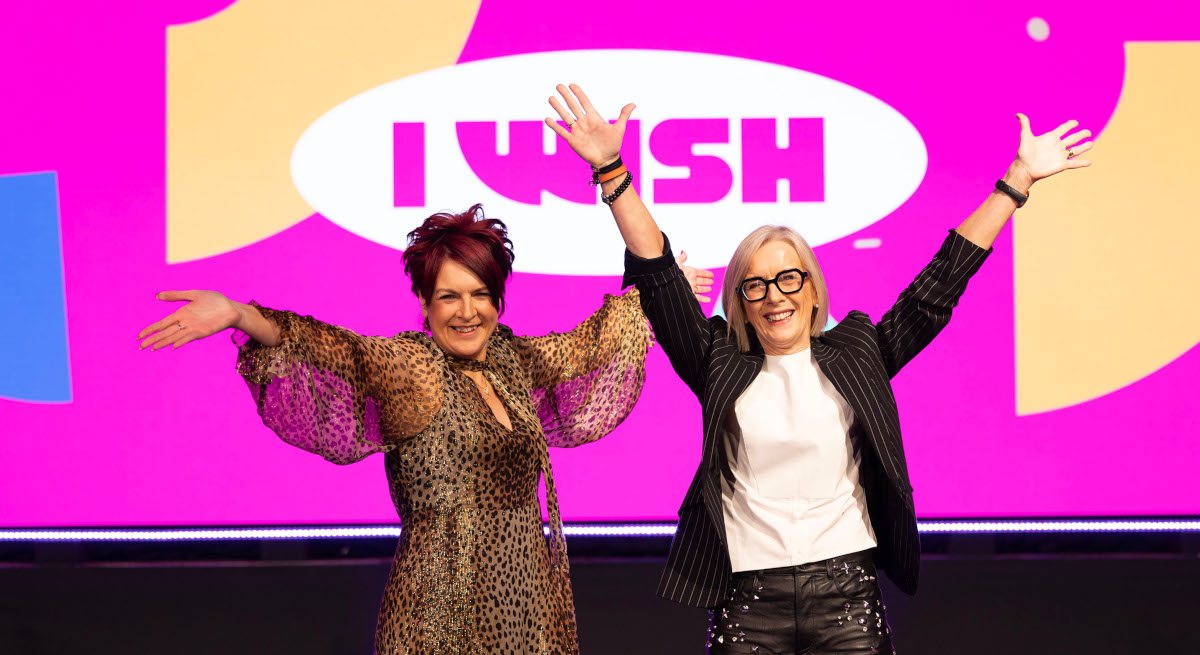

Gillian Keating and Caroline O’Driscoll explore the opportunities for women and girls in STEM – as well as the many challenges.
Caroline O’Driscoll and Gillian Keating are the co-founders of I Wish, a national initiative promoting gender equity in STEM that aims to inspire, inform and empower teenage girls. A major event on the organisation’s annual calendar is the I Wish Festival, which this month welcomed nearly 4,000 girls to Dublin’s RDS.
There, they had the opportunity to engage with industry leaders and role models, hear about real career journeys, and see STEM careers as visible, achievable, and relevant. According to O’Driscoll, the festival directly impacts gaps in STEM education for young women by connecting them with positive role models and providing guidance.
“Over the past 12 years, I Wish has built a sustainable, inclusive and gender-equitable STEM ecosystem in Ireland, supporting girls from primary school through higher education,” O’Driscoll tells SiliconRepublic.com.
“Many alumni return as volunteers, mentors and speakers, highlighting the lasting impact of the programme in creating confident, skilled young women who believe they belong in STEM.”
The marginalisation that impacts girls and women often starts early and accumulates over time, notes Keating, who explains that a lack of visible role models in leadership positions is key, especially as confidence gaps shaped by social conditioning and structural barriers prevent access to STEM subjects.
“This marginalisation is rarely about talent – it’s about access, encouragement and belonging,” she says.
This is why, for both O’Driscoll and Keating, progress in STEM equality doesn’t come from a single event or initiative but from consistent commitment, collaboration and belief in potential.
Keating says: “This is on all of us. The I Wish Festival matters because it doesn’t just ask girls to adapt to STEM, it asks STEM to adapt to girls. That shift in thinking is where real, lasting change begins.”
Ireland’s future
Recent research from the Economic and Social Research Institute found that Ireland currently has Europe’s largest gender gap in advanced digital skills usage in the workplace. It found that 44pc of men in Ireland use advanced digital skills in their jobs, compared to just 18pc of women, a 26pc difference that is close to double the European average.
Prof Joyce O’Connor, the co-founder and chair of Block W and a research contributor, made note of the fact that in an economy like Ireland’s, which is close to full employment, “failing to fully utilise the advanced digital capability of women already in the labour market is inefficient and unsustainable”.
This point is echoed by O’Driscoll, who says: “Ireland’s future economy depends heavily on STEM skills, innovation and problem-solving. Excluding or under-supporting half the population is not just inequitable, it’s unsustainable.
“By enabling girls and women to fully contribute their skills and expertise, Ireland benefits from a larger, more diverse talent pool, stronger innovation and creativity, better decision-making and problem-solving, and a workforce that reflects the society it serves. Gender inclusion in STEM is both a social imperative and an economic necessity.”
First impressions
While the present is always a good place to start, when attempting to undo bias or break down barriers, often the work begins from birth and never stops. O’Driscoll explains how educational and workplace institutions often bridge the gap for girls and women in STEM.
She says: “At primary level, gender inclusive STEM education is key. At secondary level, they need to expose the girls to initiatives like I Wish to connect learning to real world careers.
“At third level, they need to provide mentorship and targeted support. At industry level, they need to support flexible pathways that account for different life stages and responsibilities.”
But to truly advance the system, for all women, Keating emphasises the importance of offering continuous support and – when you have made it – showing others how it can be done.
Speakers at the I Wish Festival included Olympic paracyclist Richael Timothy, International Rose of Tralee Katelyn Cummins and Olympians Louise Shanahan and Gráinne Walsh, all of whom shared their authentic career journeys, highlighting both the challenges and the successes they have experienced.
“Our goal is simple but powerful,” says Keating. “If even one girl in our audience leaves I Wish feeling that she truly belongs in this space and is inspired to pursue her ambitions, then we consider it a real win. Through these stories, we hope to spark belief, courage and a sense of possibility in every participant.”
O’Driscoll confirms the importance of a strong role model, noting that when young girls are looking to their futures and the careers they may want, seeing women succeed in STEM can help them visualise themselves in similar roles, breaking down stereotypes about who belongs in these fields.
She adds: “Our I Wish surveys repeatedly show that girls want more information about STEM and say that access to female role models positively influences their choices. One of the central aims of I Wish is to connect girls with inspiring women in STEM, not just to inform them, but to support them.
“By inviting women to share their stories and engage directly with students, I Wish creates a network of support that helps girls feel they belong and that their pathways are real and possible.”
Don’t miss out on the knowledge you need to succeed. Sign up for the Daily Brief, Silicon Republic’s digest of need-to-know sci-tech news.

















































You must be logged in to post a comment Login