Sometimes a visually compelling metaphor is all you need to get an otherwise complicated idea across. In the summer of 2001, a Tulane physics professor named John P. Perdew came up with a banger. He wanted to convey the hierarchy of computational complexity inherent in the behavior of electrons in materials. He called it “Jacob’s Ladder.” He was appropriating an idea from the Book of Genesis, in which Jacob dreamed of a ladder “set up on the earth, and the top of it reached to heaven. And behold the angels of God ascending and descending on it.”
Jacob’s Ladder represented a gradient and so too did Perdew’s ladder, not of spirit but of computation. At the lowest rung, the math was the simplest and least computationally draining, with materials represented as a smoothed-over, cartoon version of the atomic realm. As you climbed the ladder, using increasingly more intensive mathematics and compute power, descriptions of atomic reality became more precise. And at the very top, nature was perfectly described via impossibly intensive computation—something like what God might see.
With this metaphor in mind, we propose to extend Jacob’s Ladder beyond Perdew’s version, to encompass all computational approaches to simulating the behavior of electrons. And instead of climbing rung by rung toward an unreachable summit, we have an idea to bend the ladder so that even the very top lies within our grasp. Specifically, we at Microsoft envision a hybrid approach. It starts with using quantum computers to generate exquisitely accurate data about the behavior of electrons—data that would be prohibitively expensive to compute classically. This quantum-generated data will then train AI models running on classical machines, which can predict the properties of materials with remarkable speed. By combining quantum accuracy with AI-driven speed, we can ascend Jacob’s Ladder faster, designing new materials with novel properties and at a fraction of the cost.
At the base of Jacob’s Ladder are classical models that treat atoms as simple balls connected by springs—fast enough to handle millions of atoms over long times but with the lowest precision. Moving up along the black line, semiempirical methods add some quantum mechanical calculations. Next are approximations based on Hartree-Fock (HF) and density functional theory (DFT), which include full quantum behavior of individual electrons but model their interactions in an averaged way. The greater accuracy requires significant computing power, which limits them to simulating molecules with no more than a few hundred atoms. At the top are coupled-cluster and full configuration interaction (FCI) methods—exquisitely accurate but, at the moment, restricted to tiny molecules or subsets of electrons due to the large computational costs involved. Quantum computing can bend the accuracy-versus-cost curve at the top of Jacob’s Ladder [orange line], making highly accurate calculations feasible for large systems. AI, trained on this quantum-accurate data, can flatten this curve [purple line], enabling rapid predictions for similar systems at a fraction of the cost of classical computing.Source: Microsoft Quantum
In our approach, the base of Jacob’s Ladder still starts with classical models that treat atoms as simple balls connected by springs—models that are fast enough to handle millions of atoms over long times, but with the lowest precision. As we ascend the ladder, some quantum mechanical calculations are added to semiempirical methods. Eventually, we’ll get to the full quantum behavior of individual electrons but with their interactions modeled in an averaged way; this greater accuracy requires significant compute power, which means you can only simulate molecules of no more than a few hundred atoms. At the top will be the most computationally intensive methods—prohibitively expensive on classical computers but tractable on quantum computers.
Advertisement
In the coming years, quantum computing and AI will become critical tools in the pursuit of new materials science and chemistry. When combined, their forces will multiply. We believe that by using quantum computers to train AI on quantum data, the result will be hyperaccurate AI models that can reach ever higher rungs of computational complexity without the prohibitive computational costs.
This powerful combination of quantum computing and AI could unlock unprecedented advances in chemical discovery, materials design, and our understanding of complex reaction mechanisms. Chemical and materials innovations already play a vital—if often invisible—role in our daily lives. These discoveries shape the modern world: new drugs to help treat disease more effectively, improving health and extending life expectancy; everyday products like toothpaste, sunscreen, and cleaning supplies that are safe and effective; cleaner fuels and longer-lasting batteries; improved fertilizers and pesticides to boost global food production; and biodegradable plastics and recyclable materials to shrink our environmental footprint. In short, chemical discovery is a behind-the-scenes force that greatly enhances our everyday lives.
The potential is vast. Anywhere AI is already in use, this new quantum-enhanced AI could drastically improve results. These models could, for instance, scan for previously unknown catalysts that could fix atmospheric carbon and so mitigate climate change. They could discover novel chemical reactions to turn waste plastics into useful raw materials and remove toxic “forever chemicals” from the environment. They could uncover new battery chemistries for safer, more compact energy storage. They could supercharge drug discovery for personalized medicine.
And that would just be the beginning. We believe quantum-enhanced AI will open up new frontiers in materials science and reshape our ability to understand and manipulate matter at its most fundamental level. Here’s how.
Advertisement
How Quantum Computing Will Revolutionize Chemistry
To understand how quantum computing and AI could help bend Jacob’s Ladder, it’s useful to look at the classical approximation techniques that are currently used in chemistry. In atoms and molecules, electrons interact with one another in complex ways called electron correlations. These correlations are crucial for accurately describing chemical systems. Many computational methods, such as density functional theory (DFT) or the Hartree-Fock method, simplify these interactions by replacing the intricate correlations with averaged ones, assuming that each electron moves within an average field created by all other electrons. Such approximations work in many cases, but they can’t provide a full description of the system.
A joint project between Microsoft and Pacific Northwest National Laboratory used AI and high-performance computing to identify potential materials for battery electrolytes. The most promising were synthesized [top and middle] and tested [bottom] at PNNL. Dan DeLong/Microsoft
Electron correlation is particularly important in systems where the electrons are strongly interacting—as in materials with unusual electronic properties, like high-temperature superconductors—or when there are many possible arrangements of electrons with similar energies—such as compounds containing certain metal atoms that are crucial for catalytic processes.
In these cases, the simplified approach of DFT or Hartree-Fock breaks down, and more sophisticated methods are needed. As the number of possible electron configurations increases, we quickly reach an “exponential wall” in computational complexity, beyond which classical methods become infeasible.
Enter the quantum computer. Unlike classical bits, which are either on or off, qubits can exist in superpositions—effectively coexisting in multiple states simultaneously. This should allow them to represent many electron configurations at once, mirroring the complex quantum behavior of correlated electrons. Because quantum computers operate on the same principles as the electron systems they will simulate, they will be able to accurately simulate even strongly correlated systems—where electrons are so interdependent that their behavior must be calculated collectively.
Advertisement
AI’s Role in Advancing Computational Chemistry
At present, even the computationally cheap methods at the bottom of Jacob’s Ladder are slow, and the ones higher up the ladder are slower still. AI models have emerged as powerful accelerators to such calculations because they can serve as emulators that predict simulation outcomes without running the full calculations. The models can speed up the time it takes to solve problems up and down the ladder by orders of magnitude.
This acceleration opens up entirely new scales of scientific exploration. In 2023 and 2024, we collaborated with researchers at Pacific Northwest National Laboratory (PNNL) on using advanced AI models to evaluate over 32 million potential battery materials, looking for safer, cheaper, and more environmentally friendly options. This enormous pool of candidates would have taken about 20 years to explore using traditional methods. And yet, within less than a week, that list was narrowed to 500,000 stable materials and then to 800 highly promising candidates. Throughout the evaluation, the AI models replaced expensive and time-consuming quantum chemistry calculations, in some cases delivering insights half a million times as fast as would otherwise have been the case.
We then used high-performance computing (HPC) to validate the most promising materials with DFT and AI-accelerated molecular dynamics simulations. The PNNL team then spent about nine months synthesizing and testing one of the candidates—a solid-state electrolyte that uses sodium, which is cheap and abundant, and some other materials, with 70 percent less lithium than conventional lithium-ion designs. The team then built a prototype solid-state battery that they tested over a range of temperatures.
This potential battery breakthrough isn’t unique. AI models have also dramatically accelerated research in climate science, fluid dynamics, astrophysics, protein design, and chemical and biological discovery. By replacing traditional simulations that can take days or weeks to run, AI is reshaping the pace and scope of scientific research across disciplines.
Advertisement
However, these AI models are only as good as the quality and diversity of their training data. Whether sourced from high-fidelity simulations or carefully curated experimental results, these data must accurately represent the underlying physical phenomena to ensure reliable predictions. Poor or biased data can lead to misleading outcomes. By contrast, high-quality, diverse datasets—such as those full-accuracy quantum simulations—enable models to generalize across systems and uncover new scientific insights. This is the promise of using quantum computing for training AI models.
How to Accelerate Chemical Discovery
The real breakthrough will come from strategically combining quantum computing’s and AI’s unique strengths. AI already excels at learning patterns and making rapid predictions. Quantum computers, which are still being scaled up to be practically useful, will excel at capturing electron correlations that classical computers can only approximate. So if you train classical models on quantum-generated data, you’ll get the best of both worlds: the accuracy of quantum delivered at the speed of AI.
As we learned from the Microsoft-PNNL collaboration on electrolytes, AI models alone can greatly speed up chemical discovery. In the future, quantum-accurate AI models will tackle even bigger challenges. Consider the basic discovery process, which we can think of as a funnel. Scientists begin with a vast pool of candidate molecules or materials at the wide-mouthed top, narrowing them down using filters based on desired properties—such as boiling point, conductivity, viscosity, or reactivity. Crucially, the effectiveness of this screening process depends heavily on the accuracy of the models used to predict these properties. Inaccurate predictions can create a “leaky” funnel, where promising candidates are mistakenly discarded or poor ones are mistakenly advanced.
Quantum-accurate AI models will dramatically improve the precision of chemical-property predictions. They’ll be able to help identify “first-time right” candidates, sending only the most promising molecules to the lab for synthesis and testing—which will save both time and cost.
Advertisement
Another key aspect of the discovery process is understanding the chemical reactions that govern how new substances are formed and behave. Think of these reactions as a network of roads winding through a mountainous landscape, where each road represents a possible reaction step, from starting materials to final products. The outcome of a reaction depends on how quickly it travels down each path, which in turn is determined by the energy barriers along the way—like mountain passes that must be crossed. To find the most efficient route, we need accurate calculations of these barrier heights, so that we can identify the lowest passes and chart the fastest path through the reaction landscape.
Even small errors in estimating these barriers can lead to incorrect predictions about which products will form. Case in point: A slight miscalculation in the energy barrier of an environmental reaction could mean the difference between labeling a compound a “forever chemical” or one that safely degrades over time.
Accurate modeling of reaction rates is also essential for designing catalysts—substances that speed up and steer reactions in desired directions. Catalysts are crucial in industrial chemical production, carbon capture, and biological processes, among many other things. Here, too, quantum-accurate AI models can play a transformative role by providing the high-fidelity data needed to predict reaction outcomes and design better catalysts.
Advertisement
Once trained, these AI models, powered by quantum-accurate data, will revolutionize computational chemistry by delivering quantum-level precision. And once the AI models, which run on classical computers, are trained with quantum computing data, researchers will be able to run high-accuracy simulations on laptops or desktop computers, rather than relying on massive supercomputers or future quantum hardware. By making advanced chemical modeling more accessible, these tools will democratize discovery and empower a broader community of scientists to tackle some of the most pressing challenges in health, energy, and sustainability.
Remaining Challenges for AI and Quantum Computing
By now, you’re probably wondering: When will this transformative future arrive? It’s true thatquantum computers still struggle with error rates and limited lifetimes of usable qubits. And they still need to scale to the size required for meaningful chemistry simulations. Meaningful chemistry simulations beyond the reach of classical computation will require hundreds to thousands of high-quality qubits with error rates of around 10-15, or one error in a quadrillion operations. Achieving this level of reliability will require fault tolerance through redundant encoding of quantum information in logical qubits, each consisting of hundreds of physical qubits, thus requiring a total of about a million physical qubits. Current AI models for chemical-property predictions may not have to be fully redesigned. We expect that it will be sufficient to start with models pretrained on classical data and then fine-tune them with a few results from quantum computers.
Despite some open questions, the potential rewards in terms of scientific understanding and technological breakthroughs make our proposal a compelling direction for the field. The quantum computing industry has begun to move beyond the early noisy prototypes, and high-fidelity quantum computers with low error rates could be possible within a decade.
Realizing the full potential of quantum-enhanced AI for chemical discovery will require focused collaboration between chemists and materials scientists who understand the target problems, experts in quantum computing who are building the hardware, and AI researchers who are developing the algorithms. Done right, quantum-enhanced AI could start to tackle the world’s toughest challenges—from climate change to disease—years ahead of anyone’s expectations.
The Federal Communications Commission has banned new consumer internet routers manufactured outside the US, citing national security concerns. The ban doesn’t affect any routers already in American homes or currently on sale in the US, but all new routers aimed at the consumer market will need to be approved.
While the headline is that foreign-made consumer routers are banned, manufacturers can apply for exemptions. There’s no need to throw out your router, and you’ll still find plenty of mesh systems on the store shelves. But what does this mean for you?
Why Are Foreign-Made Routers Banned?
“Malicious actors have exploited security gaps in foreign-made routers to attack American households, disrupt networks, enable espionage, and facilitate intellectual property theft,” the FCC wrote. “Foreign-made routers were also involved in the Volt, Flax, and Salt Typhoon cyberattacks targeting vital US infrastructure.”
Foreign-made consumer routers were added to the Covered List, which details equipment and services “deemed to pose an unacceptable risk to the national security of the United States.”
Advertisement
Bogdan Botezatu, director of Threat Research at cybersecurity firm Bitdefender, says this ban is a step to harden the cybersecurity readiness of US households, given ongoing geopolitical tensions.
“Consumer routers sit at the edge of every home network, which makes them an attractive target and a strategic risk if compromised at scale,” he says. Asked whether he thinks the risk is real, Botezatu says the risk is real, though there’s no easy way to prove intent. “[Internet of Things] devices, including routers, are a weak point across the internet.”
Which Routers Are Banned?
The ban only affects the sale of new Wi-Fi routers aimed at consumer households. The ban does not apply to existing FCC-approved routers on sale in the US. Previously purchased routers already in use in homes across the country are also fine and are not part of the ban, according to the FCC’s FAQ. These routers can continue to be sold, used, and updated with new firmware.
Any new router manufactured outside the US now requires FCC approval before it can be imported, marketed, or sold in the US. This includes routers from US companies that are manufactured overseas, which is the vast majority of the market right now.
Advertisement
What Does Foreign-Made Mean?
This is decidedly murky. The ban is concerned with “consumer-grade” routers and could include any that are designed or manufactured outside the US or manufactured by companies that are not completely US-owned and operated. All the major players in the market, including Netgear, TP-Link, Asus, Amazon’s Eero, Google’s Nest, Synology, Linksys, and Ubiquiti, fall under the definition. As do most, if not all, of the routers supplied by internet service providers in the US.
Just like the recent federal drone ban, the router only applies only to new routers, but manufacturers can apply for Conditional Approval from the Department of Defense and the Department of Homeland Security. Applications must include details about ownership, board membership, and country of origin for components, IP ownership, design, assembly, and firmware, among other things. The final section requests details of the applicant’s US manufacturing and onshoring plan, so there’s a clear push to persuade companies to commit to making their routers in the US.
“No routers or manufacturers have been granted a Conditional Approval so far, but as the process gets underway, we expect approvals to be granted in a timely manner,” an FCC spokesperson tells WIRED.
What About Foreign-Made Components?
Well, the FCC provides some clarification in its FAQ (“covered” here means banned):
Advertisement
“Non-‘covered’ devices do not become ‘covered’ simply because they contain a ‘covered’ component part, unless the ‘covered’ component part is a modular transmitter under the FCC’s rules,” it says. “Therefore, a router produced in the United States is not considered ‘covered’ equipment solely because it contains one or more foreign-made components.”
Manufacturers importing components from China but assembling them in the US will presumably be OK, though it’s far from clear. “Applicants will need to be able to have sufficient evidence that the routers were not produced in a foreign country to make this certification, but there is no specific documentation or evidence required,” according to the FCC.
Let’s look at the big three US router brands and see how they’re affected.
Will TP-Link Be Banned?
Advertisement
Since all of its routers are made overseas, TP-Link will have to apply for Conditional Approval or spin up manufacturing in the US to sell any new routers. Estimates vary, but TP-Link’s US consumer router market share is somewhere around 35 percent, with Netgear and Asus accounting for another 25 percent or so.
The US Commerce, Defense, and Justice departments have reportedly been investigating and considering a ban on TP-Link routers for more than a year over concerns about the company’s links to China. No ban has been enacted until now, but Texas attorney general Ken Paxton sued TP-Link in February, claiming the company allows the Chinese Communist Party to access American consumers’ devices. Detractors have also criticized perceived predatory pricing, claiming TP-Link flooded the US market with a wide range of affordable routers to establish dominance.
TP-Link has repeatedly denied any wrongdoing and claims it has divested from its Chinese roots and is now headquartered in the US with the bulk of manufacturing in Vietnam. TP-Link’s cofounder and CEO, Jeffrey Chao, recently applied for permanent US residency through President Trump’s Gold Card program, according to the Times of India.
“Virtually all routers are made outside the United States, including those produced by US-based companies like TP-Link, which manufactures its products in Vietnam,” a spokesperson from TP-Link tells WIRED. “It appears that the entire router industry will be impacted by the FCC’s announcement concerning new devices not previously authorized by the FCC.”
Advertisement
TP-Link is a privately owned company and not publicly listed on any stock exchange. Chao and his wife, Hillary, are listed as the company’s sole owners.
Will Netgear Be Banned?
While it is a US-founded and headquartered company, Netgear’s routers are manufactured abroad, mostly in Vietnam, Thailand, Indonesia, and Taiwan, so it will have to apply for Conditional Approval. The company has moved away from China in recent years. Netgear has been lobbying the government on “cybersecurity and strategic competition with China.”
“We commend the administration and the FCC for their action toward a safer digital future for Americans,” a Netgear spokesperson tells WIRED. “Home routers and mesh systems are critical to national security and consumer protection, and today’s decision is a step forward.”
Advertisement
Netgear is a publicly traded company on the Nasdaq, mostly owned by institutional investors, including BlackRock and Vanguard. The company’s stock rose on news of the ban, suggesting that many investors believe it won’t be hit too hard.
Will Asus Be Banned?
Asus primarily makes its routers in Taiwan, though it has production facilities in China and works with several third-party manufacturers. Recent tariff pressures led the company to branch out to Thailand, Vietnam, Indonesia, Mexico, and the Czech Republic, but the bulk of its routers still come from Taiwan or China. Asus will have to apply for Conditional Approval to sell new routers. The company did not respond to WIRED’s request for comment.
The company is listed on the Taiwanese Stock Exchange and is mostly owned by public shareholders. The ban doesn’t appear to have impacted its stock price.
Advertisement
Are Any Routers Manufactured in the US?
The only routers I know of that are manufactured in the US are some Starlink Wi-Fi routers, which are primarily made in Texas. Starlink is part of Elon Musk’s SpaceX company, but many of the components in these routers come from East Asia.
Botezatu says what matters more than geography is the security model behind the product. Companies that invest in “long-term firmware support, vulnerabilitgy management, and built-in protection layers” offer stronger security.
How Will the Router Ban Impact Ordinary Folks?
It’s not entirely clear, but it probably won’t have a huge immediate impact. There is already a wide range of Wi-Fi 7 routers and mesh systems on the market that will continue to be sold—they enable speeds well in excess of what most people need at home. Whether companies spin up manufacturing in the US or find other ways to satisfy government agencies that their wares are not a security risk, the result is likely to be higher prices for consumers.
“This ruling has the potential to significantly disrupt the US consumer router market,” Brandon Butler, a research manager of Network Infrastructure and Services at IDC tells WIRED. “In the near term, much will depend on how quickly conditional waivers are processed. Most vendors are likely to pursue them, but any delays could constrain supply and create upward pressure on pricing.”
Advertisement
If you haven’t upgraded to the latest Wi-Fi 7 standard, now might be a good time to do it. But it’s worth keeping in mind what you’re buying. Botezatu says consumers should “stick with reputable manufacturers that have a track record of issuing updates and maintaining their devices. Check that your router is still supported and runing the latest firmware.”
Unanswered Questions
The ban does leave several unanswered questions. Why is it being applied only to consumer routers? Which routers or manufacturers will be granted a Conditional Approval? Why are the foreign-made routers currently on sale and in our homes deemed safe? The FCC did not address these questions.
As Boston Dynamics demonstrated years ago, “bullying” technology designed to mimic intelligent behaviors is nothing new. Memvid is now offering $800 to someone interested in putting modern AI models to the test – a “professional” yeller tasked with spending an entire day stressing popular chatbots. Read Entire Article Source link
“It looks like an attempt to cripple Anthropic,” Lin said of the Pentagon designating the company a supply-chain risk. “It looks like [the department] is punishing Anthropic for trying to bring public scrutiny to this contract dispute, which of course would be a violation of the First Amendment.”
Anthropic has filed two federal lawsuits alleging that the Trump administration’s decision to designate the company a security risk amounted to illegal retaliation. The government slapped the label on Anthropic after it pushed for limitations on how its AI could be used by the military. Tuesday’s hearing came in a case filed in San Francisco.
Anthropic is seeking a temporary order to pause the designation. The relief, Anthropic hopes, would help convince some of the company’s skittish customers to stick with it just a bit longer. Lin can issue a pause only if she determines that Anthropic is likely to win the overall case. Her ruling on the injunction is expected in the next few days.
Advertisement
The dispute has sparked a broader public conversation about how artificial intelligence is increasingly being used by the armed forces, and whether Silicon Valley companies should give deference to the government in determining how the technology they develop is deployed.
The Department of Defense, which now calls itself the Department of War (DoW), has argued that it followed procedures and appropriately determined that Anthropic’s AI tools could no longer be relied upon to operate as expected during critical moments. It has asked Lin not to second-guess its assessment about the threat it claims Anthropic poses to national security.
“The worry is that Anthropic, instead of merely raising concerns and pushing back, will say we have a problem with what DoW is doing and will manipulate the software … so it doesn’t operate in the way DoW expects and wants it to,” Trump administration attorney Eric Hamilton said during Tuesday’s hearing.
Lin said that it was Defense Secretary Pete Hegseth’s role—not hers—to decide whether Anthropic is an appropriate vendor for the department. But Lin said it’s up to her to determine whether Hegseth violated the law by taking steps beyond simply canceling Anthropic’s government contracts. Lin said it was “troubling” to her that the security designation and directives more broadly limiting use of Anthropic’s AI tool Claude by government contractors “don’t seem to be tailored to stated national security concerns.”
Advertisement
As Anthropic’s spat with the government escalated last month, Hegseth posted on X that “effective immediately, no contractor, supplier, or partner that does business with the United States military may conduct any commercial activity with Anthropic.”
But on Tuesday, Hamilton acknowledged that Hegseth has no legal authority to bar military contractors from using Anthropic for work unrelated to the Department of Defense. When asked by Lin why Hegseth would have posted that, Hamilton said, “I don’t know.”
Lin further questioned Hamilton about whether the Pentagon had considered taking less punitive measures to move the department away from using Anthropic’s tools. She described the supply-chain-risk designation as a powerful authority typically reserved for foreign adversaries, terrorists, and other hostile actors.
Michael Mongan, a WilmerHale attorney representing Anthropic, said it was extraordinary for the government to go after a “stubborn” negotiating partner with the designation.
Advertisement
The Pentagon has said it is working to replace Anthropic technologies over the coming months with alternatives from Google, OpenAI, and xAI. It also said it has put measures in place to prevent Anthropic from engaging in any tampering during the transition. Hamilton said he didn’t know if it was even possible for Anthropic to update its AI models without permission from the Pentagon; the company says it is not.
A ruling in the other case, at the federal appeals court in Washington, DC, is expected to come soon without a hearing.
Fujifilm has recently unveiled the latest addition to its instant camera range, with the aptly named Instax Mini 13.
As the Fujifilm Instax Mini 12 has a spot on our best instant cameras list, are there enough improvements with the Mini 13 to warrant an upgrade? Or, is the Mini 12 still a great choice for many.
We’ve compared the specs of the Fujifilm Instax Mini 13 to the Mini 12 and noted all the noteworthy differences between the instant cameras below. Keep reading to see what’s new with the Mini 13 and to decide whether or not you should upgrade.
For more of an overview, we’ve also rounded up a list of the best cameras we’ve reviewed recently.
Advertisement
Price and Availability
At the time of writing, Fujifilm is yet to provide an exact launch date for the Instax Mini 13, and instead has promised the instant camera will be available “in or around late June 2026”. Its current MSRP is £79/€89.99/$93.95.
Advertisement
In comparison, the Fujifilm Instax Mini 12 is readily available to purchase now and has an RRP of around £79.99/$94. Having said that, it is possible to nab the instant camera with a decent price drop.
Instax Mini 13 includes a self-timer
One of the main new additions to the Instax Mini 13 is the inclusion of a self-timer. The timer is fitted with an LED lever that allows you to switch between either a two-second or ten-second countdown. The shorter two-second timer is designed for capturing hands-free selfies with reduced blur, while the ten-second alternative enables easier group shots and different angles.
Advertisement
Self timer on Instax Mini 13. Image Credit (Fujifilm)
As mentioned, this is a brand new addition to the Mini 13 so the Mini 12 unfortunately lacks this tool. Even so, it’s still worth noting that we found the Mini 12 to be easy to use, thanks to the few buttons or features on offer.
Both feature a selfie mirror and close-up mode
If you’re coming from an older Instax Mini, then you’ll be pleased to know that both the Mini 13 and Mini 12 are fitted with built-in selfie mirrors at their respective fronts. It’s a great addition that allows you to check whether everyone is in the frame before potentially wasting a precious print.
Not only that, but both cameras also benefit from Close-Up Mode which is enabled by twisting the lens twice. Essentially, Close-Up Mode could also be classed as “selfie” mode, and ensures the main subject is captured right in the centre.
Advertisement
Instax Mini 12. Image Credit (Trusted Reviews)
Speaking of similarities, it’s also worth noting that both the Mini 13 and Mini 12 have automatic lighting adjustment and promise to print a photo in just five seconds and have it develop within 90.
Instax Mini 13 has new film
Alongside the launch of the Instax Mini 13, Fujifilm has also revealed a couple of new additions and updates to its existing line-up. Firstly, the Instax Up! Smartphone apps will now integrate AI to increase image scanning precision, which is thanks to an update to its “overall learning capability”. This, according to Fujifilm, is promised to recognise images over backgrounds for “more precise scans” overall.
Advertisement
In addition, Fujifilm is also introducing a new Pastel Galaxy-themed film roll which includes sparkly, gloss embellishments and more colours too. This will be available by “late June 2026” with an MSRP of €9.99.
Although both of these new additions are introduced with the Instax Mini 13, the film and smartphone app updates will be supported by the Instax Mini 12.
Instax Mini 12 photos. Image Credit (Trusted Reviews)
Advertisement
Instax Mini 13 includes a camera angle adjustment accessory
Designed to work with the self-timer, the Instax Mini 13 comes equipped with a camera angle adjustment tool. Made up as part of the wrist strap, the tool can be used to position the camera with a slight upward tilt – negating the need for a tripod or any additional equipment.
Instax Mini 13 has more of a square design
Although at first glance you’d be forgiven for not noticing a huge design difference between the two, there are a few things to consider. Firstly, although both are undoubtedly portable, it’s fair to say that neither are quite pocket-friendly cameras to whip out in a flash. If that’s something you’d prefer, then we’d recommend the Instax Mini Evo instead.
Instax Mini 13. Image Credit (Fujifilm)
Otherwise, alongside the addition of the timer lever at its side, the Mini 13 also has more of a uniform rounded shape compared to the Mini 12. Either way, both cameras are compact and come in a choice of five pastel colours too.
Advertisement
Advertisement
Early Verdict
With the addition of a self-timer, a rounder and more uniform design and the inclusion of the camera angle adjustment accessory on its wrist strap, the Instax Mini 13 looks set to be a brilliant instant camera – especially if you’re coming from an older model.
However, whether you really need to upgrade from the Instax Mini 12 is still up for debate as, although the Mini 12 may lack the self-timer, it still sports Close-Up Mode, automatic light and flash control and speedy photo printing too. We’ll be sure to update this versus once we do review the Instax Mini 13.
Sweeney also pointed to industry-wide changes including slower growth, weaker spending on games and consoles, tougher cost economics, and new forms of entertainment competing for gamers’ attention as additional factors hurting their business. Read Entire Article Source link
Kyndryl’s Ismail Amla discusses the company’s new policy as code process, and how it can help address AI issues such as agentic drift.
When it comes to AI adoption in enterprise, compliance concerns are becoming ever more important.
According to Kyndryl’s most recent Readiness Report, 31pc of enterprise customers cite regulatory or compliance concerns as a primary barrier limiting their organisation’s ability to scale recent technology investments.
2026 marks an important point on the AI compliance timeline in particular, with the EU’s AI Act transparency rules coming into effect in August.
Advertisement
Last month, Kyndryl announced its new ‘policy as code capability’ – a new process designed for creating policy-governed agentic AI workflows for enterprises.
“Policy as code is the process of translating an organisation’s rules, policies and compliance requirements into machine-readable code, so AI systems are restricted to only operating within pre-defined guardrails,” explains Ismail Amla, senior vice-president at Kyndryl Consult. “Human experts continue to oversee all activities related to these processes.”
Compliant design
“Many organisations, especially those in complex, highly regulated environments, want to scale agentic AI, but are held back by concerns around security, compliance and control”, says Amla.
Speaking to SiliconRepublic.com, he says policy as code can help organisations support “consistent policy interpretations” and define clear operational boundaries, subsequently ensuring agent actions are explainable, reviewable and “aligned with organisational standards”.
Advertisement
Amla also says the framework can help reduce costs, accelerate decision-making, eliminate errors and “power AI-native workflows within defined policy guardrails”.
“By embedding policy and regulatory requirements directly into AI agent operations, policy as code can help organisations execute AI workflows that are governed, transparent, explainable and aligned to business requirements.”
But what about the long-term applications of policy as code?
Amla says the main benefit of the process is “trust through stronger governance, better transparency, lower operational risk and more reliable AI at scale”.
Advertisement
“Managing agentic workflow execution in this way supports controlled and responsible deployment of policy-constrained AI agents in sectors such as financial operations, public services, supply chains and other mission-critical domains, where reliability and predictability are essential,” he explains.
Catch the drift
Over the past year, according to Amla, the biggest change he’s noticed in AI adoption is that organisations are moving beyond proofs of concept and “focusing more seriously on what it takes to make AI work in production and at scale”.
“That means more attention on infrastructure, governance, data quality and organisational readiness,” he says. “Organisations are moving from experimentation to making more strategic decisions with the experience they have gained to drive higher value outcomes and performance for their organisation, and receive a return on their investment.”
But with increased focus on serious AI integrations comes risk, particularly if an organisation is not fully prepared.
Advertisement
Amla warns of something called ‘agentic drift’, which refers to when an AI agent can appear reliable while working toward unwanted outcomes due to a gradual separation from the agent operator’s original intention or goal.
“Agentic drift creates pressing challenges for all organisations, but it is especially acute in the public sector and highly regulated sectors, such as banking and healthcare,” says Amla.
“In these industries, organisations cannot move from pilots to production if issues around control, trust and compliance remain unresolved. It’s clear enterprises urgently need a way to constrain what agents can do at runtime and close governance gaps long before drift leads to financial or compliance failures.”
Amla believes that policy as code can help address this issue, due to its ability to allow businesses to translate their rules and policy into machine-readable instructions that “govern how AI agents reason, adapt and act”.
Advertisement
“This greatly reduces the risk of agentic drift,” he says. “It also alleviates the trust and compliance concerns standing between large enterprises and a return on their AI investments.”
Don’t miss out on the knowledge you need to succeed. Sign up for the Daily Brief, Silicon Republic’s digest of need-to-know sci-tech news.
Sony is shutting down Dark Outlaw Games, a first-party game studio led by former Call of Duty producer Jason Blundell, Bloomberg‘s Jason Schreier reports. Before leading Dark Outlaw Games, Blundell was the head of Deviation Games, which was an independent studio, but also happened to be developing a PlayStation game before it shut down, Schreier says.
Dark Outlaw Games had yet to announce what it was working on, but considering Blundell’s experience with the Call of Duty franchise, it seems likely the studio was developing a multiplayer project for PlayStation. Blundell was a programmer and producer at Activision before making the jump to Treyarch to work on Call of Duty 3, and he contributed to multiple Call of Duty: Black Ops games after that, including serving as the director for the campaign and Zombies mode of Call of Duty: Black Ops III and the career and Zombies modes of Call of Duty: Black Ops 4.
Engadget has contacted Sony for more information about the fate of Dark Outlaw Games. We’ll update this article if we hear back.
The studio’s shutdown is being paired with cuts to staff at PlayStation focused on mobile development, according to Schreier. Sony has made a habit of laying off staff and shutting down studios in the last year, seemingly as a way to retreat from an earlier investment in online, live-service multiplayer games. The company shut down Bluepoint Games in February following attempts to get a live-service God of War game off the ground. Sony also closed Firewalk Studios after the spectacular failure of multiplayer shooter Concord in October 2024. And a year before that, Naughty Dog officially abandoned work on a standalone multiplayer version of The Last of Us in December 2023.
Advertisement
That leaves Sony with at least two Horizon Zero Dawn spin-offs, a co-op game from original developer Guerilla Games and a MMO from developer NCSoft; Fairgame$, which is still in active development despite the departure of Haven Studios head Jade Raymond; Arrowhead Game Studios’ Helldivers 2; Bungie’s Destiny 2 and Marathon; and if you really want to stretch, Gran Turismo 7. Sony clearly hasn’t given up on producing online multiplayer games, but it’s not hard to characterize its attempt to expand into the space as a disaster.
For developers using AI, “vibe coding” right now comes down to babysitting every action or risking letting the model run unchecked. Anthropic says its latest update to Claude aims to eliminate that choice by letting the AI decide which actions are safe to take on its own — with some limits.
The move reflects a broader shift across the industry, as AI tools are increasingly designed to act without waiting for human approval. The challenge is balancing speed with control: too many guardrails slows things down, while too few can make systems risky and unpredictable. Anthropic’s new “auto mode,” now in research preview — meaning it’s available for testing but not yet a finished product — is its latest attempt to thread that needle.
Auto mode uses AI safeguards to review each action before it runs, checking for risky behavior the user didn’t request and for signs of prompt injection — a type of attack where malicious instructions are hidden in content that the AI is processing, causing it to take unintended actions. Any safe actions will proceed automatically, while the risky ones get blocked.
It’s essentially an extension of Claude Code’s existing “dangerously-skip-permissions” command, which hands all decision-making to the AI, but with a safety layer added on top.
Advertisement
The feature builds on a wave of autonomous coding tools from companies like GitHub and OpenAI, which can execute tasks on a developer’s behalf. But it takes it a step further by shifting the decision of when to ask for permission from the user to the AI itself.
Anthropic hasn’t detailed the specific criteria its safety layer uses to distinguish safe actions from risky ones — something developers will likely want to understand better before adopting the feature widely. (TechCrunch has reached out to the company for more information on this front.)
Auto mode comes off the back of Anthropic’s launch of Claude Code Review, its automatic code reviewer designed to catch bugs before they hit the codebase, and Dispatch for Cowork, which allows users to send tasks to AI agents to handle work on their behalf.
Techcrunch event
Advertisement
San Francisco, CA | October 13-15, 2026
Auto mode will roll out to Enterprise and API users in the coming days. The company says it currently only works with Claude Sonnet 4.6 and Opus 4.6, and recommends using the new feature in “isolated environments” — sandboxed setups that are kept separate from production systems, limiting the potential damage if something goes wrong.
OpenAI is shutting down Sora, its generative-AI video creation platform it launched in December 2024. “The move is one of a number of steps OpenAI is taking to refocus on business and coding functions ahead of a potential initial public offering as soon as the fourth quarter of this year,” reports the Wall Street Journal.
CEO Sam Altman announced the changes to staff on Tuesday. “We’re saying goodbye to Sora,” the Sora Team said in a post on X. “To everyone who created with Sora, shared it, and built community around it: thank you. What you made with Sora mattered, and we know this news is disappointing. We’ll share more soon, including timelines for the app and API and details on preserving your work.”
Last week, OpenAI announced plans to combine its Atlas web browser, ChatGPT app, and Codex coding app into a singular desktop “superapp.” “We realized we were spreading our efforts across too many apps and stacks, and that we need to simplify our efforts,” said CEO of Applications, Fidji Simo. “That fragmentation has been slowing us down and making it harder to hit the quality bar we want.” This could behind the decision to kill Sora as the company redirects its resources and top talent towards productivity tools that benefit both enterprises and individual users.
A few months after its initial launch, Amazon has recently unveiled the Kindle Scribe Colorsoft in a brand new fetching Fig shade that’s proved especially popular.
In fact, the Fig-colour Kindle Scribe Colorsoft is so popular that it’s becoming increasingly difficult to get our hands on the e-reader, with shipping delays stretching well beyond the typical delivery windows we’d expect from Amazon.
At the time of writing, new orders for the Fig iteration in the US are expected to arrive anywhere between mid-April to mid-May. However, you can get your hands on the standard Graphite finish which is currently still in stock within the US. This suggests that the issue really only affects the newer colour option, rather than the entire product line.
Such differences in availability often point to supply constraints or production adjustments, particularly when a new finish launches after the initial release and demand shifts toward the latest variant.
Advertisement
Kindle Scribe Colorsoft in Fig. Image Credit (Amazon)
Advertisement
It’s worth noting that at the time of writing, neither the Fig nor Graphite Kindle Scribe Colorsoft has officially launched in the UK. In addition, neither iterations are even available to pre-order, as the product page just states the e-reader is “coming soon”. Instead, you can opt into receiving an email to get notified on when the product will be available to buy.
Delays highlight uneven availability
The Kindle Scribe Colorsoft was initially only available in a Graphite option until Amazon recently introduced the new Fig finish, which seemingly appears to have drawn a considerably higher demand than anticipated. Either that, or the Fig shade has encountered production challenges soon after release.
However, delays tied to a specific colour variant are not uncommon, as sometimes manufacturing complexity or material sourcing can affect certain finishes differently than standard models.
In addition, the extended wait times also suggest that supply has not yet caught up with demand, especially as colour e-paper devices remain a relatively new category with more limited production scale compared to traditional e-readers.
Advertisement
Essentially, customers are left choosing between faster delivery by opting for the Graphite version, or waiting considerably longer to nab the Fig iteration instead.
Advertisement
This situation leaves buyers choosing between faster delivery with the Graphite version or waiting longer to secure the Fig model.
Same hardware, different buying experience
Following on from the above, it’s worth noting that both versions of the Kindle Scribe Colorsoft share the same core hardware, including an 11-inch colour e-paper display based on Kaleido 3 technology, which combines standard black-and-white clarity with lower-resolution colour output.
The device also integrates a redesigned front-light system and a textured display surface that improves writing feel, placing it closer to digital notebooks than traditional e-readers focused only on reading.
Advertisement
Storage options and connectivity remain consistent across variants, with support for Wi-Fi, Bluetooth audio, and bundled stylus input, which reinforces that the delay relates to availability rather than product capability.
Amazon has not provided a detailed explanation for the extended shipping times on the Fig model, but current delivery estimates suggest that availability may stabilise later in the Spring.
Advertisement
If you are exploring other options, our Best Kindle 2026 roundup highlights the top-performing e-readers available today.


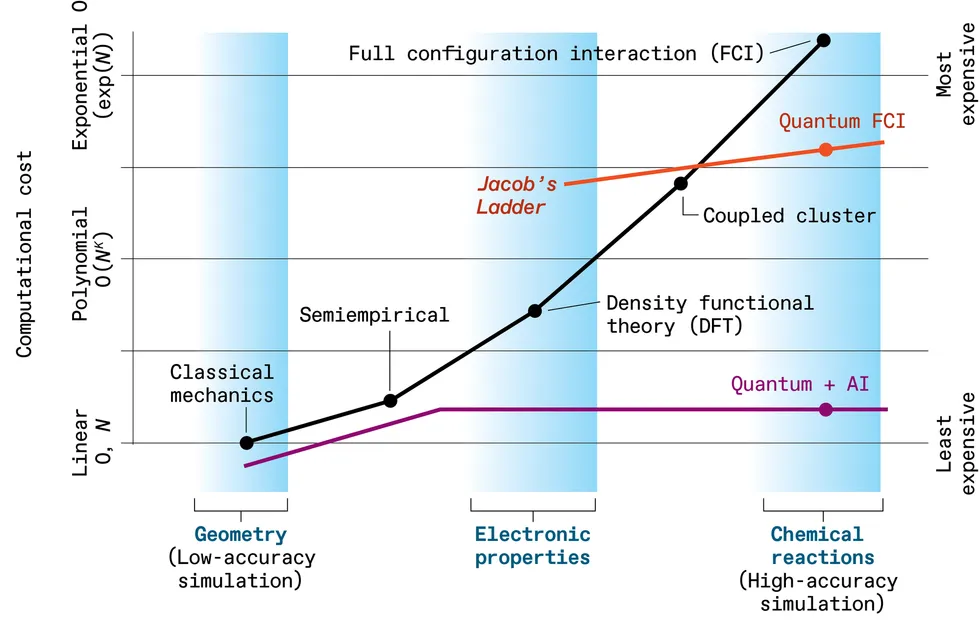
 At the base of Jacob’s Ladder are classical models that treat atoms as simple balls connected by springs—fast enough to handle millions of atoms over long times but with the lowest precision. Moving up along the black line, semiempirical methods add some quantum mechanical calculations. Next are approximations based on Hartree-Fock (HF) and density functional theory (DFT), which include full quantum behavior of individual electrons but model their interactions in an averaged way. The greater accuracy requires significant computing power, which limits them to simulating molecules with no more than a few hundred atoms. At the top are coupled-cluster and full configuration interaction (FCI) methods—exquisitely accurate but, at the moment, restricted to tiny molecules or subsets of electrons due to the large computational costs involved. Quantum computing can bend the accuracy-versus-cost curve at the top of Jacob’s Ladder [orange line], making highly accurate calculations feasible for large systems. AI, trained on this quantum-accurate data, can flatten this curve [purple line], enabling rapid predictions for similar systems at a fraction of the cost of classical computing.Source: Microsoft Quantum


 A joint project between Microsoft and Pacific Northwest National Laboratory used AI and high-performance computing to identify potential materials for battery electrolytes. The most promising were synthesized [top and middle] and tested [bottom] at PNNL. Dan DeLong/Microsoft
























































You must be logged in to post a comment Login